31
Simulation Of Wireless Networked Control System
Using TRUETIME And MATLAB
Nyan Phyo Aung, Zaw Min Naing, Mo Mo Myint Wai, Hla Myo Tun
Abstract: Wireless networked control systems (WNCS) are attracting an increasing research interests in the past decade. Wireless networked control system (WNCS) is composed of a group of distributed sensors and actuators that communicate through wireless link which achieves distributed sensing and executing tasks. This is particularly relevant for the areas of communication, control and computing where successful design of WNCS brings about new challenges to the researchers. The primary motivation of this survey paper is to examine the design issues, and to provide directions for successful simulation and implementation of WNCS. The paper also as well reviews some simulation tools for such systems.
Index Term: Network Control System, Stability Analysis, Industrial Electronics, MATLAB, Time Delay
————————————————————
Introduction
Wireless sensor networks (WSNs) are the
promisingtechnology in the future, which is suitable for a lot
ofapplications, such as battle surveillance,
environmentalmonitoring, health care, target tracking, industry, and automation and so on. The primary benefit of wireless technology isessentially the reduced installation cost, both financially andin labor, as a considerable investment is made in the wiringof factories. The use of wireless technology is not onlyare placement of cables, the benefits go beyond that. Withwireless devices, increased flexibility is gained, as sensors canbe placed more freely in a plug-and-play fashion, even onrotating machines. Cable failures are eliminated and wirelesscommunication is robust, as it can be done over several pathsin a mesh-net
work. Finally, there are the opportunities for
newapplications that are enabled by wireless control. An important class of networked control systems (NCS)are now being implemented over wireless networks becauseof the need for node mobility in many applications. Thesesystems are known as wireless networked control systems(WNCS). The simplest WNCS includes a plant and a controllerwith point to point wireless communication between them. Sensor and actuator in wireless networked
controlsystem are composed of a group of
distributedsensors and actuators that communicate through wirelesslink which achieves distributed sensing and executingtasks. Simulation plays an important role at several stages ofsystem design. In order to support the application at hand,co-simulation should simultaneously simulate thecomputations that take place within the controller nodes,the wireless communication between the nodes, the sensorsand actuator dynamics and the dynamics of the controlledplant. The objective of this paper is a real-time simulation model which provides timely reactions to the environment upon detection of sensing data and to establish guidelines for successful implementation of WNCS. The paper also touches on the communication network and co-simulation and focuses on the interactions between the network and the control system.
Related WORK
Two simuslation case studies: a simple communication scenarioand a mobile robot soccer game and truetime are described in [1].Ngai described about tackle twoproblems, i.e., minimizing the transmission delay fromsensors to actuators and improving the coordination amongthe
actuators for fast reaction and designed areal-time communication framework to support eventdetection, reporting, and actuator coordination andproposed two self-organized and distributed algorithms forevent reporting and actuator coordination[2].The sampling period scheduling of networkedcontrol system with multiple control loops by TrueTime under Matlab is expressed in [3].A wireless networked control system isconstructed on TrueTime simulation platform andperformances of control system are compared underconventional PID and predictive PI algorithms in [4]. Thebeacon-enabled mode of IEEE 802.15.4/ZigBee is added toTrueTime in order to study the effect of the GTSmechanism on wireless networked control systems in because TrueTime does not implement this mode. By usingthe TrueTime toolbox, Havet et al. [5] present the modelingand simulation method based on Matlab/Simulink.Apart from the above, the gas turbine distributed net controlsemi-physical simulation platform which includedmulti-smart devices is established through TrueTime,and TrueTime can be used in wireless industrialmonitoring and control [6],wildfire hazard predictionsystem modeling and target tracking.
III COMMUNICATION NETWORK
The following topics are discussed for the design issues from the area of communication network.
A. Wireless communication standards
1) IEEE 802.11
Most WNCS researches are based on mainly IEEE 802.11 standards and support data rates 1, 2, 11, 54 Mbps. IEEE 802.11 uses Carrier Sense Multiple Access with Collision Avoidance (CSMA/CA) as Medium Access Control (MAC) protocol. However, contention based protocols, e.g., CSMA/CA, are not appropriate for real time communication as they require handshaking among the nodes and do not guarantee bounded packet delay.
2) IEEE 802.15.4/ZigBee
32
offers low cost and low power consumption in ad hoc mode but low data rate andrelaxed performance requirements. Supported datarates are 250, 40 and 20 Kbps.
3) IEEE 802.15.1/Bluetooth
Bluetooth offers low cost and low power requirementwith a high degree of versatility. It has been used insome industrial applications such as sensor devicesfor monitoring, driver hands-free calling etc.
B. Packet delay
Network packet delay can degrade the NCS
performancesignificantly and even destabilize the entire system.The total closed loop delay τ is given in (1)
where τ issensor-to-controller, τ is controller computation
and τ iscontroller-to-actuator delay, respectively.
τ = τ + τ + τ (1)
For simplicity, the controller delay τ is ignored or treatedas a part of the controller-to-actuator delay since it is negligibleand almost constant compared to the delays τ andτ . Therefore the total delay can be obtained by (2):
τ ≈= τ + τ (2)
Control mechanisms based on constant time delay arenot suitable for NCS, since network delay is usually timevarying. When τis less than the sampling period Ts,the stability condition of the NCS can be found by computingthe upper bound of delay between any two successive sensormessages. On the other hand, whenτis larger thanthe sampling period, some delay compensation technique mustbe employed. Various delay compensation techniques can befound in [34]. Networks with constant and independent delayshave been developed and controller design with constant andrandom time delay have been discussed in [7]–[10].
C. Packet drop/loss
Wireless networks can suffer from packet drop/loss thatcan cause instability of the NCS. Re-transmission will generateobsolete packets and it will simply produce more traffic in thenetwork. As NCS carries real-time traffic; it might be beneficialto drop a packet that cannot be transmitted immediately.The tolerable packet drop rate must be analyzed to maintainguaranteed desired system stability. NCS with packet dropcan be modeled as two-state switch, where θ ∈ *0,1+ iscalled receiving sequence that indicates reception (θ = 1)orloss (θ = 0). If the current state of the plant is missing becauseof the packet drop, the previous state buffered at the controlleris used. Therefore, the dynamical model can be expressed by(3). Modern NCS can tolerate packet drop up to some extentand can still maintain stability [10].Modelling NCS with random communication delays, wherethe sensor is clock driven and the controller and the actuatorare event driven. The discrete-time linear time-invariant plantmodel is as follows:
x (k + 1) = Ax + Bω , y (k) = Cx (k),
z (k) = Gx (k) (3)
Wherex (k) ∈ ℜ is the plant’s state vector and ω (k) ∈
ℜ , z (k) ∈ ℜ and y (k) ∈ ℜ are the plant’s
disturbanceinput, and output vectors, respectively. A, B, and C are known as real matrices with appropriate dimensions with C being offull row rank. A more general case that the measurement witha randomly varying communication delay is described by
yc(k)={yp(k-τkm), δ(k)=1
yp(k), δ(k)=0 (4)
Whereτkmstands for measurement delay, the occurrence
ofwhich satisfies the Bernoulli distribution, and δ(k) is Bernoullidistributed white sequence. An approach for a remote PIDcontroller design for multivariable NCSs has been addressedin [11].
D. End to end connection type
Communication over wireless network can be
performedusing either Transmission Control Protocol (TCP) or UserDatagram Protocol (UDP). TCP/IP is not suitable for MANETas it uses connection oriented packet transfer. On theother hand, UDP offers low overheads as it does not maintainconnections and discards obsolete or lost packets. Therefore,it is preferable for networked control applications.
E. Delay jitter
In general, jitter is defined as deviation of an instantin the signal from its actual position in time or standarddeviation of the measured delays of network packet. Thisproblem can be caused by some or all of the following: clockdrift of a transmitter-receiver, congestion, routing algorithmin communication systems, scheduling of real time tasks incomputer systems, number of hops on the path. It can beexpressed by
Ej=Vj-Uj (5)
Where Uj is the time between j-th and (j+1)-th packet arrivaland Vj is the time between j-th and (j+1)-th packet departure.In this case, negative jitter represent clustering of packets thatcan cause buffer overflow and positive jitter correspond todispersion of packets that can cause excessive delay.
F. Network design
In order to achieve a wider acceptance of wireless
technologyin industrial control,various networking
challenges areto be addressed. One main network design issue in WCSsis the medium access (MAC) protocol, as it
determines thecommunication opportunities. The
distribution and length ofconsecutive packet drops are significant from the controlsystem point of view, because of the real-time requirementsof control.MAC protocols can be categorized into deterministic andrandom access. In random access MACs, no guarantees toacquire access to the medium in a given time can, in general, begiven. In
deterministic MACs, a communication slot (either
33
assignment has theadvantage that the access to the medium can be guaranteed ina predetermined time. Deterministic MAC protocols are thusmore desired in WCS, where real-time operation is required.A network using a random access MAC protocol is obviouslynon-deterministic, but actually even a deterministic MAC protocolis somewhat stochastic due to interference or fading. Inthe case of packet loss, retransmission is needed, which resultsin variable response times, to avoid information loss. The useof frequency hopping and spread spectrum techniques makesthe wireless network less vulnerable to these threats.
G. Control design
The controller design in WNCSs introduces the requirement of robustness against packet loss and delay jitter, which the network inherently induces. Single control loop systems can be analyzed analytically and existing stability proofs take the network delay jitter into account. The case becomes difficult in large control systems with many control loops, or when specific network protocols are considered. In these cases, simulations are needed to investigate the effect of the network and the various protocols on the control system. There are three main control system design architectures in NCS, depicted in Figs.1–3. All architectures consider only wireless measurements, as the controller can in most cases be placed at the actuator, removing an unnecessary communication link between the controller and actuator. These cases can naturally be extended also to the case of wireless communication between the controller and actuator, but in those cases the design becomes more difficult.
yt Control Output
Reference
Network yin
u
z y +
-yout u
State feedback Process State estimator
Figure 1.Optimal state feedback architecture for WNCS
yt Control Output
Reference
Network yin +
-yout u
Conventional PID Controller
Process
State estimator PID
u
z y
y
Figure 2.State estimator and regular PID controller for
WNCS
yt Control Output
Reference
Network yin +
-yout u Networked PID
Process PID
y
Figure 3.Jitter margin tuned PID controller for WNCS
H. Co-design of wireless control systems
With random access MAC there is a trade-off betweenthe network quality of service (QoS) and control performanceas a function of network traffic,that is, sampling time ofthe control system. If the available network bandwidth is toolow, this can be compensated by load balancing, changingthe
network topology, or adding a high-speed back
bonenetwork, quantization or increase in sampling interval of thecontrollers. In the case of packet drop, the physical layer needsto be improved or acknowledgment and retransmissions canbe utilized. On the control side a state-estimator or a networkdelay jitter aware controller can be used. If packet drops aredue to collisions or if communication delay jitter occurs due toretransmission, a deterministic MAC protocol is the solution,or the previously mentioned control side techniques can alsobe used to compensate for the packet drop.
IV Implementation of WNCS
TrueTime Simulator
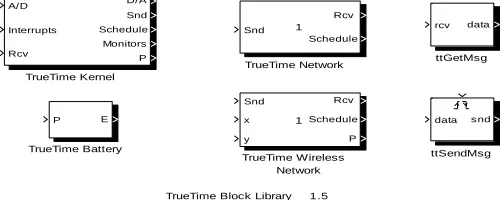
TrueTime is the Matlab/Simulink-based simulator which facilitates co-simulation of controller task execution in real-time kernels, network transmissions, and continuous plant dynamics, and the latest version is 2.0 beta 7. It consists of kernel(computer) and network blocks as shownin Figure 4. The TrueTime blocks are connected with ordinary Simulink blocks to form a real-time control system. The important feature of TrueTime is the possibility of co-simulation of the interaction between the real-world continuous dynamics and the computer architecture in the form of task execution and network communication [12]. It is available at http://www.control. lth.se/truetime. TRUETIME network block simulates Medium Access and Packet Transmission in a Local Area Network (LAN) environment. A node uses ttSendMsg primitive function to transmit a message over network. This causes a triggering signal to the network block on the corresponding channel of node on the network. Version 1.5 of TRUETIME supports simple models of networks including: CSMA/CD (e.g., Ethernet), CSMA/AMP (e.g., CAN), Round Robin (e.g., Token Bus), FDMA, TDMA (e.g., TTP), and Switched Ethernet. The models ignore propagation delay since it is very small in LAN. Models support packet level simulation. Network parameters the can be configured according to experiment include number of nodes connected to network, data rate in bits/s (i.e., speed of network), minimum frame size (bits), and loss probability from 0-1 (i.e., probability that message loss during transmission).
Figure 4.TrueTime Block Library
TrueTime Block Library 1.5
Copyright (c) 2007
Martin Ohlin , Dan Henriksson and Anton Cervin
Department of Automatic Control , Lund University , Sweden
Please direct questions and bug reports to : truetime @control .lth .se
ttSendMsg
data s nd
ttGetMsg
rcv data
TrueTime Wireless Network Snd
x
y
Rcv
Schedule
P 1 TrueTime Network Snd
Rcv
Schedule 1
TrueTime Kernel A/D
Interrupts
Rcv
D/A
Snd
Schedule Monitors
P
TrueTime Battery
34 Proposed Block Diagrm of WNCS
The proposed block diagram of WNCS is shown in Figure 5. Thecontroller gets the output of the system through
wirelesscommunication such as IEEE 802.11b or
IEEE802.15.4(ZigBee) from the sensor(s). Then the controllersends the control output to the actuator by wireless linkwhich is different from the traditional wired control system.
Plant
Actuator Sensor
Network (Wireless)
Controller Reference
Figure 5.The proposed block diagram of WNCS
The figure 5 shows the simulation model of WNCS.In this model,it has two nodes and communication network which is construced by TRUETIME wireless network block. The three nodes are the controller node,the node 2 is the sensor/actuator node.Each node is represented by TrueTimekernel block. A time-driven sensor/actuator node samplesthe process periodically and sends the samples over thewireless network to the controller node. The control task inthis node calculates the control signal and sends the
resultback to the sensor/actuator node which is
subsequentlyactuated. The calculation of the mathematical model of servo motor is used in simulation in[13].The transfer function of servo motor which is used as plant in NCS are
Gp(s) =
1000 1
s s (6)
A. Calculation of PD Gain
PD Controller is used as control algorithm for controller node in this simulation. So controller parameter is required to calculate. The transfer function of controller is
Gc=Kp+Kds. (6)
In this paper, servo motor acts as plant in the Simulink model. The transfer function of motor is shown in (5). First, P controller’s gain Kp is first considered by:
G(s)=
1000 1
s s K (7)
The equation is changed into characteristic equation and solved by root criteria. So the value of gain kp for the
controller p must be greater than zero (kp>0). And next calculation is PD controller gain by
G(s)=
1000
1 Kp Kds
s s
. (8)
By using Routh-Hurwitz, the value of Kd must be greater than 0.001. So The values of gain of KP and KD are 1 and 0.035[13]. The reference input signal is generated by the pulse generator.
The table 1 shows the simulation parameter for wireless
network block.
Parameter Values
Network type 802.11b(WLAN)
Data rate 80kps
Minimum frame size 272 bits
Transmit power 20 dbm
Receiver signal threshold -48 dbm Path loss exponent 3.5
Retry limit 5
Figure 6.Simulink Model of Wireless Networked Control
System
Simulation Results ofWireless NCS
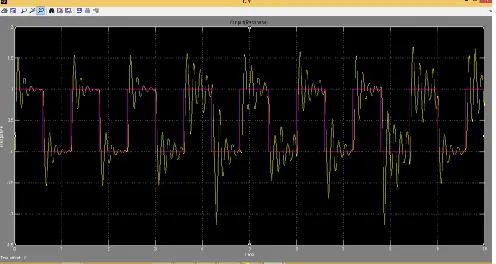
The simulation is carried out using PD controller in WNCS. As discussed above PD controller consists of two tuning parameters Kp and Kd. Figs. 7 show the normal simulation result with sampling period is 10msec. As increase the sampling period to 20ms, the simulation results of model is more overshoot than the earlier result. From these results, sampling rate can degrade the system performance.
Figure7.the simulation results of WNCS with 10ms
sampling rate
u
y
r
Wireless Networked Control System
u
reference
r, y
Wireless Network snd1
snd2 rcv 1 rcv 2 P1 P2
Node 2 (Controller )
A/D Rcv P
Snd Node 1 (Sensor/Actuator )
Rcv A/D P
D/A Snd
y
r
P 2 snd1
snd2
P 1 rcv2 rcv1 y
snd1
r P1
snd2 rcv2
rcv1
P 2 Display Clock
35
Figure 8. The simulation results of WNCS with 20 ms
sampling rate
Conclusion
Wireless sensor networks introduced into the control systemas communication media thereby initiating an interestingclass of control systems termed wireless networked controlsystem (WNCS).This paper presents a
wireless sensor and actuatornetworked control
system(WNCS) based on TrueTimeand Matlab. Then control effects over thePD control algorithm algorithm is applied. The simulation results indicatethat for WNCS architecture, the influences of sampling time.This paper provides asimulation model of WNCS which is cost-effective,easily deployable.
Reference
[1] M. Andersson, D. Henriksson, A. Cervin, and K. Arzen,
―Simulation of Wireless Networked Control
Systems,‖Proceedings of the 44th IEEE Conference on Decision and Control, Spain, Dec. 2005, pp. 476-481.
[2] E. Ngai, M. Lyu,J. Liu,―A Real-Time Communication Framework for Wireless Sensor-Actuator Networks,‖ 2006 IEEE Aerospace Conference, Montana, March 2006,pp. 1-9.
[3] C.Peng, D. Yue, Z. Gu, F. Xia, ―Sampling period scheduling of networked control systems with multiple-control loops,‖Mathematics and Computers in Simulation, vol.79,pp.1502-1511,2009.
[4] J.Fu, C. Xu, B.Kan, and H.Wang, ―Design and
Simulation of Control Algorithms for WINCS,‖ 2009 Wireless Communications, Networking and Mobile Computing, Beijing, Sept. 2009, pp. 1-4.
[5] L. Havet, A. Guenard, F. Lion, ―Samovar: An
evaluation framework for real time applications deployment over WSANs,‖ 2010 IEEE Conference on Emerging Technologies and Factory Automation, Bilbao, Nov. 2010, pp. 1-8.
[6] S. Manfredi, ―A reliable cooperative and distributed management for wireless industrial monitoring and control,‖ Int. J. Robust Nonlinear Control, vol. 20, pp. 123–139, 2010.
[7] M. S. Mahmoud and M. M. Hassan Hamid, ‖Self-tuning control for MIMO network systems‖, Int. J. Signal and Information Processing, vol. 3, no. 2, pp. 154–160, May 2012.
[8] Bo Liu, Yuanqing Xia and M. S. Mahmoud and Harris
Wu, ‖New predictive control scheme for networked control systems‖, J. Circuits, Systems and Signal Processing, vol. 31, no. 2, pp. 945–960, May 2012.
[9] M. S. Mahmoud,‖Improved networked-control systems
approach with communication constraint‖, IMA J. Mathematical Control and Information, vol. 29, no. 2, pp. 215–233, June 2012.
[10] M. S. Mahmoud, S. Z. Selim, P. Shi and M. H. Baig, ‖New results on networked control systems with nonstationary packet dropouts‖,IET Control Theory and Applications, vol. 6, no. 15, pp. 2442– 2452,October 2012.
[11] H. Zhang, Y. Shi and A. S. Mehr, Robust H1 PID control for multivariablenetworked control systems with disturbance/noise attenuation,J. Robust and Nonlinear Control, vol. 22, no. 2, 2012, pp.183-204.
[12] Anton Cervin, Dan Henriksson, Martin Ohlin.TrueTime 2.0 beta-Reference Manual[G/OL]. http://www.control. lth.se/truetime/.2010.
[13] Nyan Phyo Aung, Zaw Min Naing,Hla Myo