Published online9 May 2002
Attentional processes link perception and action
Stephen J. Anderson
1*, Noriko Yamagishi
2and Vivian Karavia
31Neurosciences Research Institute, School of Life and Health Sciences, Aston University, Birmingham B4 7ET, UK
2ATR Human Information Science Laboratories, 2-2-2 Hikaridai, Seika-cho, Soraku-gun, Kyoto 619-0288, Japan
3Department of Psychology, Royal Holloway, University of London, Egham TW20 0EX, UK
Behavioural studies on normal and brain-damaged individuals provide convincing evidence that the per-ception of objects results in the generation of both visual and motor signals in the brain, irrespective of whether or not there is an intention to act upon the object. In this paper we sought to determine the basis of the motor signals generated by visual objects. By examining how the properties of an object affect an observer’s reaction time for judging its orientation, we provide evidence to indicate that directed visual attention is responsible for the automatic generation of motor signals associated with the spatial character-istics of perceived objects.
Keywords:vision; attention; action; movement; affordance
1. INTRODUCTION
More than any other sense, vision allows us to navigate our environment and act upon it. The remarkable ef ciency with which we are able to do this can be attri-buted to the fact that some of our actions, such as reaching for an object, are based, in part, on a repertoire of poten-tial movements derived directly from vision (Gibson 1979; Lhermite 1983; Hommel 1995; Hariet al.1998; Rumiati & Humphreys 1998; Craigheroet al.1999; Grezes & Decety 2002). There is convincing evidence that shifts of atten-tion to the locaatten-tion of visual objects automatically generate some motor response codes (Simon 1969; Nicoletti & Umilta 1989, 1994; Stoffer 1991; Tipper et al. 1992, 1998; Proctor & Lu 1994; Rizzolatti et al.1994; Rubichi et al.1997; Sheligaet al.1997), mimicking the way oculo-motor systems are recruited (Fischer & Breitmeyer 1987; Goldberg & Segraves 1987; Rizzolatti et al. 1987; Schneider & Deubel 1995; Corbetta & Shulman 1998). Separate motor response codes are believed to be gener-ated by the object itself, although their basis remains unclear. There is a long-standing view that perceived objects automatically generate motor codes based on the actions most highly associated with them (Craft & Simon 1970; Wallace 1971; Gibson 1979; Michaels 1988; Tucker & Ellis 1998).
It is axiomatic that the selection of movement plans from an existing repertoire of signals is advantageous in terms of both execution time and ef ciency. These are crucial factors in making postural adjustments essential for survival; for example, moving your arm to de ect an approaching missile, or regulating your gait while in motion to avoid an obstacle. While the advantage of gen-erating motor response codes with respect to the location of objects is clear, it is not clear why motor codes would be generated automatically by everyday objects on the basis of the actions they afford: speed is not essential when grasping a mug of coffee. With such actions we have the luxury of evaluating the sensory information at hand,
*Author for correspondence ([email protected]).
Proc. R. Soc. Lond.B (2002)269, 1225–1232 1225 Ó 2002 The Royal Society
allowing the formulation of motor plans on the basis of need. To determine whether the action-related properties of an object (or its elements) are responsible for the gener-ation of motor codes we used, as stimuli, computer-gener-ated images of everyday objects that either afforded a grasping action or not. Our measure was the reaction time for judging the orientation of each stimulus. The rationale for this experimental approach is well documented (Proctor & Reeve 1990; Tucker & Ellis 1998). In brief, if the action-relevant properties of an object are represented automatically during visual perception, then one would expect preferential activation of the hand most suited to perform the action which should, in turn, facilitate speeded responses by that hand. To determine the role of directed visual attention in the generation of motor codes, we used the same experimental paradigm in conjunction with object and non-object patterns that were either sym-metrical or asymsym-metrical about the vertical axis.
2. MATERIAL AND METHODS (a) Stimuli
White-on-grey images of object and non-object stimuli were generated using a VSG2/3 graphics board (from Cambridge Research Systems, Rochester, Kent, UK) and displayed on an Eizo T662 monitor. Examples of the stimuli are shown in gure 1. The stimuli were viewed binocularly at either 50 cm or 4 m in dim light, using either central or peripheral vision (centred 7.5°
along the horizontal meridian in the left visual eld). A xation target was only employed for eccentric viewing. At 50 cm view-ing distance, the object stimuli occupied approximately the same size (10–14°) as they would in life.
(b) Procedure
12
3
6 9
12
3
6 9
12
3 6 9
symmetrical patterns asymmetrical patterns
(a) (b) (c)
(d) (e) (f)
( l) (k)
(j)
(g) (h) (i)
Figure 1. Examples of the stimuli used, as they appeared on the display monitor. Stimuli were either asymmetrical (a–i) or symmetrical (j–l) about the vertical axis. All stimuli were approximately the same size (10–14°at 50 cm viewing distance). The panels to the left of the dashed line depict the stimuli in their ‘normal’ orientation, while those to the right of the line depict how the stimuli would have appeared on the monitor when clockwise-oriented (by 18°). The analogue clock and non-object patterns were deemed not to afford an action whereas both the scissors and wine glass were. The non-non-object stimuli were termed ‘symmetrical’ (1k, side patches of equal size), ‘left-asymmetrical’ (1g, left-side patch larger than right) or ‘right-asymmetrical’ (1h, right-side patch larger than left).
gure 1). Response buttons were xed to a table in front of the observer, symmetrically displaced about their midline and separ-ated by 30 cm. Observers were instructed to press the right but-ton with their right hand if the stimulus was clockwise-oriented and the left button with their left hand if it was anticlockwise-oriented. Either the reaction time (ms) for a correct response or a response error was recorded. The next trial followed automati-cally after a delay of 2 s. Two of the authors (S.J.A. and V.K.) plus a total of 33 naive persons acted as observers: all had nor-mal or corrected-to-nornor-mal visual acuity and all were right-handed.
Object stimuli included scissors with handles to the left or right, an analogue clock set at 8.45 or at 3.15 and a wine glass. Each was presented either clockwise- or anticlockwise-oriented by 18°, resulting in a total of 10 different object stimuli. For observers S.J.A. and V.K., ve blocks of 100 trials were com-pleted within each experiment, yielding approximately 50 trials per object (minus any response errors made). Reaction time data
for the naive observers are reported as group means, each observer having completed one block of 100 trials (approximately 10 trials per object per observer). The error rate data for the naive observers are reported as group totals.
. .
- -
-. - - .
-0 100 200
–100
–200
0 100 200
–100
–200
20
15
10
5
0
20
15
10
5
0
(a) (b)
(c) (d)
scissors clock glass scissors clock glass left hand fastest
right hand fastest
-ri
gh
t–
le
ft
R
T
(
m
s)
nu
m
be
r
of
e
rr
or
s
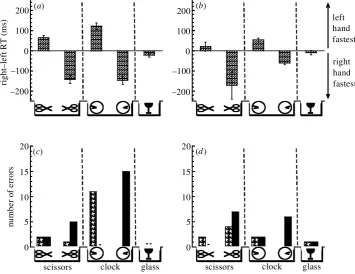
Figure 2. Reaction time (a,b) and error rate data (c,d) for judging the orientation of object stimuli when viewed centrally at a distance of 50 cm, for two experienced observers (S.J.A. (a,c) and V.K. (b,d)). Left-hand reaction times (RT) were subtracted from right-hand reaction times and plotted along the ordinate for each stimulus type (the small icons depict scissors with handles to the left or right of xation, a clock with hands to the left or right of xation, and a symmetrical wine glass). Positive values indicate that the left hand was fastest and negative values, that the right hand was fastest. The error bars show
±one standard error. The total number of response errors is plotted for each stimulus type. Note that for some object patterns, no error was recorded (indicated by a small horizontal dash near the abscissa). Black bars in (c,d) indicate right-hand errors; cross-hatched bars indicate left-hand errors.
patterns the diameter of the large central patch was 10°, match-ing that of the clock face ( gure 1a). For S.J.A. and V.K., three blocks of 120 trials were completed within each experiment, yielding approximately 60 trials per non-object stimulus (minus any response errors made). Reaction time data for the naive observers are reported as group means, each observer having completed one block of 60 trials (approximately 10 trials per stimulus per observer). The error rate data for the naive observers are reported as group totals. Note that different sets of naive observers were employed in the experiments with object and non-object stimuli.
3. RESULTS AND DISCUSSION (a) Object stimuli
(i) Experiment 1
The results for two experienced observers (S.J.A and V.K., the authors) are shown in gure 2 for object patterns viewed centrally at a distance of 50 cm. Observers reported that the hands of the clock, the handles of the scissors and the bowl of the wine glass were salient object features, and that these features were used to judge object orientation on each presentation. The pattern of results for both the clock and scissors was near identical: left-hand responses were fastest when the salient features of the object were to the left of xation andvice versa( gure 2a,b). Response errors usually coincided with the asym-metry of the object. For example, false right-hand responses were most frequent when the object’s salient features were to the right of xation ( gure 2c,d). A small
hand-response difference was also evident with the sym-metrical wine glass ( gure 2): each individual responded fastest with their right hand ( gure 2). We assume this re ects hand dominance, as each individual was right-handed.
Discussion
The reaction time and error rate data for the scissors are in agreement with the hypothesis that perceived objects automatically potentiate components of the actions they afford. This is so because they were within the reaching space of the observer (50 cm), and because it is reasonable to suppose that any grasping action afforded by the scis-sors would be directed towards the handles and not the open, pointed ends. However, this model cannot explain the results for the clock. Although one could grasp the clock when positioned at 50 cm, it does not afford any left or right bias for so doing. Our results for the clock show that any advantage one hand had over the other in making a response was dependent on the time depicted ( gure 2). We further observed that the pattern of results for both the scissors and clock was unaffected by viewing distance (50 cm versus 4 m). This also runs contrary to the afford-ance hypothesis that states that visual objects should elicit automatic motor codes only if the objects are within reach-ing distance (Tucker & Ellis 1998).
(ii) Experiment 2
200
100
0
–100
–200
80
60
40
20
0 (a)
(b)
scissors clock glass left hand fastest
right hand fastest
ri
gh
t–
le
ft
R
T
(
m
s)
nu
m
be
r
of
e
rr
or
s
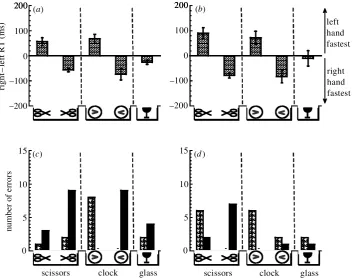
Figure 3. Reported salient feature: handle of scissors. Reaction time (a) and error rate data (b) for judging the orientation of object stimuli when viewed centrally at a distance of 50 cm, for naive observers who reported that the location of the handles of the scissors was used to judge orientation. Reaction time data are reported as group means, and the error rate data are reported as group totals. Data are plotted using the same format as in gure 2. Bar shading as in gure 2.
and/or familiarity with the stimuli affected the authors’ results. Following completion of the experiment, each naive observer reported that the hands of the clock, and the bowl of the wine glass, were conspicuous on each pres-entation, in agreement with the authors. However, only 10 naive observers agreed with the authors that the handles of the scissors were their most salient feature. Ten other observers reported that the open, pointed ends of the scis-sors attracted their attention on each presentation and were used to judge orientation, while one observer reported that the ‘long axis of the scissors’ was used to judge orientation. The pooled data for the naive observers showed clear hand-response differences for the clock, in agreement with the authors, but no hand-response differ-ences for the scissors. However, dividing the entire dataset according to which feature of the scissors the observers reported as most conspicuous revealed differences for both the clock and scissors. Figure 3 shows the dataset for those naive observers who reported that the handles of the scis-sors were used to judge orientation; gure 4 shows the results for those who reported that the pointed ends of the scissors were used to judge orientation. (The data for the naive observer who based their judgement on ‘the long axis of the scissors’ were necessarily excluded from this
-200
100
0
–100
–200
80
60
40
20
0
scissors clock glass
ri
gh
t–
le
ft
R
T
(
m
s)
nu
m
be
r
of
e
rr
or
s
left hand fastest
right hand fastest (a)
(b)
Figure 4. Reported salient feature: points of scissors. Reaction time (a) and error rate data (b) for judging the orientation of object stimuli when viewed centrally at a distance of 50 cm, for naive observers who reported that the location of the pointed ends of the scissors was used to judge orientation. Reaction time data are reported as group means, and the error rate data are reported as group totals. Data are plotted using the same format as in gure 2. Bar shading as in gure 2.
analysis.) The pattern of responses for both the clock and wine glass was similar for each dataset (compare gures 3 and 4), and in general agreement with the authors’ data ( gure 2). However, the two datasets for the scissors were virtually a mirror image of one another. For example, the number of response errors was greatest for the right hand when either the handles of the scissors were conspicuous and to the right of xation ( gure 3b), or when the pointed ends were conspicuous and to the right of xation ( gure 4b).
Discussion
Given these results, it appears unlikely that the hand-response differences for the scissors were based on behav-iourally relevant actions afforded by them. The critical fac-tor was the location of the scissors’ conspicuous feature, as reported by each observer, which we assume induced a degree of attentional bias within the object.
(iii) Experiment 3
- - - -200
ri
gh
t–
le
ft
R
T
(
m
s) 100
0 200
–100 200
–200
200
100
0 200
–100 200
–200
15
10
5
0
15
10
5
0
nu
m
be
r
of
e
rr
or
s
scissors clock glass scissors clock glass
(a) (b)
(c) (d)
left hand fastest
right hand fastest
Figure 5. Reaction time (a,b) and error rate data (c,d) for judging the orientation of object stimuli when viewed eccentrically (centred 7.5°along the horizontal meridian in the left visual eld), for two experienced observers (S.J.A. (a,c) and V.K. (b,d)). The viewing distance was 50 cm. Data are plotted using the same format as in gure 2. Bar shading as in gure 2.
observers S.J.A and V.K. As with central viewing, both observers reported that the hands of the clock, the handles of the scissors and the bowl of the wine glass were used to judge object orientation on each presentation. Note that the pattern of results was near identical to that for central viewing (compare gures 2 and 5). For example, despite the object being located entirely within the left visual eld, right-hand responses remained faster and more error prone than left-hand responses when the object’s salient features were to the right.
Discussion
The results of this experiment support the assumption that it was attentional bias within the object and not hemi- eld bias that was responsible for between-hand motor response differences.
(b) Non-object stimuli
(i) Experiment 1
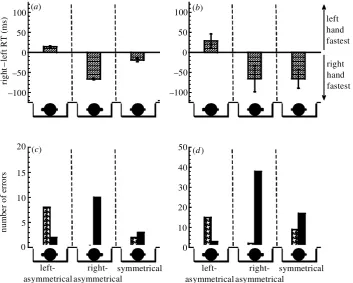
Each stimulus consisted of a large centrally viewed patch and two small side patches. The side patches were either the same size (symmetrical pattern, gure 1k) or not (asymmetrical pattern, gure 1g,h), and were dis-placed from the horizontal meridian such that the stimulus appeared clockwise- ( gure 1i) or anticlockwise-oriented. Reaction time for judging orientation was measured using the same protocol employed with object stimuli. The results are shown in gure 6 for one experienced observer (S.J.A) and a group of 12 naive observers. For observer S.J.A ( gure 6a,c), left-hand responses were fastest (and more error prone) with left-asymmetrical patterns, and right-hand responses were fastest (and more error prone) with right-asymmetrical patterns. With symmetrical pat-terns, the error rate was similar for each hand but reaction
time was fastest for the right hand. The same pattern of results was evident for the group of naive observers ( gure 6b,d). These results are in general agreement with those obtained using object patterns (compare gures 2 and 6).
Discussion
The degree of asymmetry in the ‘left-asymmetrical’ and ‘right-asymmetrical’ patterns was subtle, one side patch being only marginally larger than the other (see gure 1g,h). The task of judging stimulus orientation could have been completed by locating the position of either side patch. Nonetheless, a clear hand-response difference was evident, the hand yielding the fastest and most error prone response coinciding with the position (left or right) of the largest side patch. These results are consistent with verbal reports by observers that the largest side patch was used to judge the orientation of asymmetrical patterns.
Because of the abstract nature of the non-object pat-terns, it is unlikely that the hand-response differences shown in gure 6 could be explained by the affordance hypothesis. The pattern of results leads us to assume that the observer’s attention was biased towards the position of the largest side patch in the asymmetrical patterns. Accepting this to be the case, we propose that a motor response advantage for one hand or the other is a conse-quence of there being a correspondence between the direction of the attentional shift and the hand needed to produce a correct response.
(ii) Experiment 2
rightasym -100
50
0
–50
–100
100
50
–50
–100 0
20
15
10
5
0
50
40
30
20
0
left-asymmetrical
right-asymmetrical
symmetrical left-asymmetrical
right-asymmetrical
symmetrical
(a) (b)
(c) (d)
left hand fastest
right hand fastest
10
nu
m
be
r
of
e
rr
or
s
ri
gh
t–
le
ft
R
T
(
m
s)
Figure 6. Reaction time (a,b) and error rate data (c,d) for judging the orientation of non-object stimuli when viewed centrally at a distance of 50 cm, for one experienced observer (S.J.A. (a,c)) and 12 naive observers (b,d). For naive observers, the reaction time data are reported as group means, and the error rate data are reported as group totals. Data are plotted using the same format as in gure 2. The small icons depict left-asymmetrical, right-asymmetrical and symmetrical patterns. Note that the asymmetrical patterns were constructed using side patches of unequal size, examples of which are shown in gure 1. Bar shading as in gure 2.
metrical (see small icons in gure 7). The same symmetri-cal pattern was used. The results for observers S.J.A. and V.K. were similar: clear hand-response differences were evident with asymmetrical patterns but not with sym-metrical patterns ( gure 7). The fastest and most error prone hand always coincided with the position of the side patch in the asymmetrical patterns.
Discussion
Unlike the previous experiment, the degree of asym-metry in the left-asymmetrical and right-asymmetrical pat-terns was marked, there being only one side patch. The task of judging stimulus orientation could only have been completed by shifting attention to the side patch. The similarity of results across all experiments leads us to con-clude that directed visual attention is responsible for the automatic generation of motor signals associated with the spatial characteristics of perceived object- and non-object patterns.
4. GENERAL DISCUSSION
Our results support the hypothesis that some of our actions are based, in part, on a repertoire of potential movements derived directly from vision. However, they do not support the idea that the automatic generation of motor signals by visual objects is based on the actions they afford. Previous studies claiming evidence in support of the affordance hypothesis generally used visually asym-metrical targets (e.g. Tucker & Ellis 1998; Grezes &
Decety 2002). We show that a motor response advantage for one hand or the other accompanies the perception of asymmetrical targets, be they object or non-object pat-terns. The hand with the advantage coincided with the direction of attentional bias within the target, irrespective of the target’s location in the visual eldorthe functional properties of its elements. This indicates that the atten-tional shift may stem from a coding strategy whereby the features of the target are labelled as a single entity. Such a strategy may be crucial for the control of motor actions but, assuming it takes place in the visuomotor stream (Milner & Goodale 1995; Sakataet al.1997), would not necessarily lead to object recognition. We suggest that cooperative activity between the visuomotor and percep-tual streams, as has been postulated for ef cient and co-ordinated actions within our environment (Milner & Goodale 1995), may not be necessary if the encoded fea-tures of a target were agged as a single entity within the visuomotor stream. Such a representation would help explain the puzzle of why patients with dorsal stream lesions manifest symptoms of ‘object-based’ neglect, whereby the contralesional side of an individual object is ignored regardless of its position in the visual eld (Rizzolattiet al.1994; Walker 1995).
-200
100
0
–100
–200
20
15
10
5
0
200
100
0
–100
–200
20
15
10
5
0
left-asymmetrical
right-asymmetrical
symmetrical left-asymmetrical
right-asymmetrical
symmetrical
(a) (b)
(c) (d)
left hand fastest
right hand fastest
ri
gh
t–
le
ft
R
T
(
m
s)
nu
m
be
r
of
e
rr
or
s
Figure 7. Reaction time (a,b) and error rate data (c,d) for judging the orientation of non-object stimuli when viewed centrally at a distance of 50 cm, for experienced observers S.J.A. (a,c) and V.K. (b,d). Data are plotted using the same format as in gure 2. The small icons depict left-asymmetrical, right-asymmetrical and symmetrical patterns. Note that the asymmetrical patterns were constructed using a single side patch. Bar shading as in gure 2.
direction of the attentional shift is also that which effects the correct motor response, the action will be facilitated. However, incongruent motor signals could be generated if the direction of the attentional shift is opposed to that of the appropriate motor response. Where simultaneous, contradictory motor signals exist, the frontal cortex may be important for selecting which signals are needed for goal-directed movements (Goldberg & Segraves 1987).
The authors thank Robin Walker and Andrew Smith for help-ful discussions.
REFERENCES
Corbetta, M. & Shulman, G. L. 1998 Human cortical mech-anisms of visual attention during orienting and search.Phil. Trans. R. Soc. Lond.B353, 1353–1362. (DOI 10.1098/ rstb.1998.0289.)
Craft, J. L. & Simon, R. 1970 Processing symbolic information from a visual display: interference from an irrelevant direc-tional cue. J. Exp. Psychol.83, 415–420.
Craighero, L., Fadiga, L., Rizzolatti, G. & Umilta, C. 1999 Action for perception: a motor-visual attentional effect. J. Exp. Psychol. Hum. Percept. Perform.25, 1673–1692.
Fischer, B. & Breitmeyer, B. 1987 Mechanisms of visual atten-tion revealed by saccadic eye movements.Neuropsychologia
25, 73–83.
Gibson, J. J. 1979 The ecological approach to visual perception. Boston: Houghton-Mif in.
Goldberg, M. E. & Segraves, M. A. 1987 Visuospatial and motor attention in the monkey. Neuropsychologia 25, 107– 118.
Grezes, J. & Decety, J. 2002 Does visual perception of object
afford action? Evidence from a neuroimaging study. Neuro-psychologia40, 212–222.
Hari, R., Forss, N., Avikainen, S., Kirveskari, E., Salenius, S. & Rizzolatti, G. 1998 Activation of human primary motor cortex during action observation: a neuromagnetic study.
Proc. Natl Acad. Sci. USA 95, 15 061–15 065.
Hommel, B. 1995 Stimulus-response compatibility and the Simon effect: toward an empirical clari cation.J. Exp. Psy-chol. Hum. Percept. Perform.21, 764–775.
Lhermite, F. 1983 Utilisation behavior and its relation to lesions of the frontal lobes.Brain106, 237–255.
Michaels, C. F. 1988 S–R compatibility between response pos-ition and destination of apparent motion: evidence of the detection of affordances.J. Exp. Psychol. Hum. Percept. Per-form.14, 231–240.
Milner, A. D. & Goodale, M. A. 1995The visual brain in action. Oxford University Press.
Nicoletti, R. & Umilta, C. 1989 Splitting visual space with attention. J. Exp. Psychol. Hum. Percept. Perform.15, 164– 169.
Nicoletti, R. & Umilta, C. 1994 Attention shifts produce stimulus spatial codes.Psychol. Res.56, 144–150.
Proctor, R. W. & Lu, C.-H. 1994 Referential coding and atten-tion-shifting accounts of the Simon effect.Psychol. Res.56, 185–195.
Proctor, R. W. & Reeve, T. G. 1990 Research on stimulus– response compatibility: toward a comprehensive account. In
Stimulus–response compatibility (ed. R. W. Proctor & T. G. Reeve), pp. 483–494. Amsterdam: Elsevier.
Rizzolatti, G., Riggio, L., Dascola, I. & Umilta, C. 1987 Reori-enting attention across the horizontal and vertical meridians: evidence in favor of a premotor theory of attention. Neuro-psychologia25, 31–40.
selective attention. InAttention and performance, vol. XV (ed. C. Umilta & M. Moscovitch), pp. 231–265. Cambridge, MA: MIT Press.
Rubichi, S., Nicoletti, R., Iani, C. & Umilta, C. 1997 The Simon effect occurs relative to the direction of an attention shift.J. Exp. Psychol. Hum. Percpt. Perform.23, 1353–1364.
Rumiati, R. I. & Humphreys, G. W. 1998 Recognition by action: dissociating visual and semantic routes to action in normal observers.J. Exp. Psychol. Hum. Percept. Perform.24, 631–647.
Sakata, H., Taira, M., Kusunoki, M., Murata, A. & Tanaka, Y. 1997 The parietal association cortex in depth perception and visual control of hand action. Trends Neurosci. 20, 350–357.
Schneider, W. X. & Deubel, H. 1995 Visual attention and sac-cadic eye movements: evidence for obligatory and selective spatial coupling. InEye movement research(ed. J. M. Findlay, R. Walker & R. W. Kentridge), pp. 317–324. Amsterdam: Elsevier.
Sheliga, B. M., Craighero, L., Riggio, L. & Rizzolatti, G. 1997 Effects of spatial attention on directional manual and ocular responses.Exp. Brain Res.114, 339–351.
Simon, J. R. 1969 Reactions toward the source of stimulation.
J. Exp. Psychol.81, 174–176.
Stoffer, T. H. 1991 Attentional focussing and spatial stimulus– response compatibility.Psychol. Res.53, 127–135.
Tipper, S. P., Lortie, C. & Baylis, G. C. 1992 Selective reach-ing: evidence for action-centered attention. J. Exp. Psychol. Hum. Percept. Perform.18, 891–905.
Tipper, S. P., Howard, L. A. & Houghton, G. 1998 Action-based mechanisms of attention. Phil. Trans. R. Soc. Lond.B353, 1385–1393.(DOI 10.1098/rstb.1998.0292.) Tucker, M. & Ellis, R. 1998 On the relations between seen
objects and components of potential actions.J. Exp. Psychol. Hum. Percept. Perform.24, 830–846.
Walker, R. 1995 Spatial and object-based neglect.Neurocase
1, 371–383.
Wallace, R. J. 1971 S–R compatibility and the idea of a response code.J. Exp. Psychol.88, 354–360.