R E S E A R C H
Open Access
ADLU: a novel anomaly detection and
location-attribution algorithm for UWB
wireless sensor networks
Eirini Karapistoli
*and Anastasios A Economides
Abstract
Wireless sensor networks (WSNs) are gaining more and more interest in the research community due to their unique characteristics. Besides energy consumption considerations, security has emerged as an equally important aspect in their network design. This is because WSNs are vulnerable to various types of attacks and to node compromises, and as such, they require security mechanisms to defend against them. An intrusion detection system (IDS) is one such solution to the problem. While several signature-based and anomaly-based detection algorithms have been proposed to date for WSNs, none of them is specifically designed for the ultra-wideband (UWB) radio technology. UWB is a key solution for wireless connectivity among inexpensive devices characterized by ultra-low power
consumption and high precision ranging. Based on these principles, in this paper, we propose a novel anomaly-based detection and location-attribution algorithm for cluster-based UWB WSNs. The proposed algorithm, abbreviated as ADLU, has dedicated procedures for secure cluster formation, periodic re-clustering, and efficient cluster member monitoring. The performance of ADLU in identifying and localizing intrusions using a rule-based anomaly detection scheme is studied via simulations.
Keywords: Wireless sensor networks; UWB radio technology; Security in UWB WSNs; Anomaly-based detection; Attack attribution; Ranging attacks
1 Introduction
A wireless sensor network is a network of cheap and simple processing autonomous devices (called sensor nodes) that are spatially distributed in an area of inter-est in order to cooperatively monitor physical or envi-ronmental phenomena. Mostly based on non-renewable resources, such as batteries, wireless sensor networks (WSNs) call for robust and energy-efficient solutions both at the software and hardware levels. Undoubtedly, the IEEE 802.15.4-2011 standard [1] for low-rate wireless per-sonal area networks (LR-WPANs) is a valuable candidate for the energy-constrained WSNs. The standard defines the physical (PHY) and medium access control (MAC) layers. Among the available PHY options, the impulse radio ultra-wideband (IR-UWB) PHY (formerly defined in the IEEE 802.15.4a-2007 standard) has several advanced
*Correspondence: [email protected]
Interdepartmental Programme of Postgraduate Studies in Information Systems, University of Macedonia, Egnatias 156, Thessaloniki 54006, Greece
properties, such as built-in ranging capabilities, low duty cycle, low probability of detection, and robustness against interference, appointing it an ideal information carrier for communication among the sensor network devices [2].
From an application’s point of view, the driving force behind research in WSNs is to develop systems that can operate unattended for large periods. Besides energy consumption considerations, the unattended nature of the deployed WSNs raises administration problems and appoints the security as an additional critical element in the network design [3]. As identified in [4-6], WSNs are susceptible to various types of attacks or to node com-promises that exploit known and unknown vulnerabilities of protocols, software, and hardware, and threaten the security, integrity, authenticity, and availability of data that reside in these networked systems.
UWB transmissions offer a potentially robust physi-cal layer security for WSNs as a consequence of their large bandwidth. Indeed, WSNs that rely on UWB radio signals are somewhat inherently more secure, because
the low output power and short pulses of these sig-nals make their transmissions to appear as white noise from a distance. Nevertheless, UWB signals could poten-tially be sniffed by a determined attacker who is located close to the transmitter, enabling the latter to launch an attack against the WSN [7,8]. Therefore, even this class of WSNs requires that security mechanisms are imple-mented at every layer of the sensor network protocol stack.
Currently, research on providing security solutions for WSNs has mainly focused on key management [9], authentication, and secure routing [10], as well as secure services including secure localization [11] and secure aggregation [12]. A few secure ranging and localization protocols were specifically designed for protecting the integrity of ranging and for addressing location-related attacks in UWB WSNs [13-16]. Signaling schemes have also been proposed to improve physical layer security of UWB systems [8]. Finally, a number of routing and clustering protocols attempt to address networking issues in UWB WSNs [17], lacking however advanced security features in their design.
In general, most of the security protocols mentioned above can cope with weak, external attackers. However, strong, internal attackers, which managed to penetrate the first perimeter of defense (for instance through tam-pering sensor nodes [18]), can only be dealt with using intrusion detection systems (IDSs). Various signature-based and anomaly-signature-based IDS architectures have been proposed for flat and hierarchical WSNs [19]. However, the energy constraints and scalability issues in WSNs dic-tate the use of an hierarchical anomaly-based detection model for IDS [20]. In this grouping technique, the essen-tial operation is to select a set of cluster heads (CHs) among the nodes in the network and to cluster the rest of the nodes with them. Cluster heads are responsible for coordination among the nodes inside their clusters (intra-cluster data gathering) and for forwarding the collected data to the sink node, usually after efficiently aggregat-ing them. With regard to anomaly detection, cluster heads are also tasked with intrusion detection functions, such as collecting intrusion alarms from their cluster mem-bers (CMs). Additionally, the cluster head nodes may also detect attacks against other cluster head nodes of the net-work, since they constitute the backbone of the routing infrastructure.
While a number of anomaly-based detection systems (ADSs) have been proposed for hierarchical, cluster-based WSNs [19-21], to the best of our knowledge, none of them is specifically designed for the emerging UWB trans-mission technology. The ultra-wideband nature of this PHY and its high precision ranging capability (1-m accu-racy and better [22]) enable the ADS not only to detect a malicious behavior, but also to localize the anomaly
by relying on internal tools, namely on accurate time-of-arrival (TOA)-based UWB distance measurements.
Accordingly, the present work contributes to the area of wireless sensor network security by proposing a novel anomaly-based detection and location-attribution algo-rithm for cluster-based UWB WSNs, named ADLU. The proposed algorithm has dedicated procedures for secure cluster formation, periodic re-clustering, and efficient cluster member monitoring. Furthermore, it exploits the peculiar characteristics of the UWB PHY defined in the IEEE 802.15.4 standard [1] in order to facilitate the anomaly detection and location attribution processes. To help address the security challenges, ADLU offers the following contributions:
• It defines a novel, trust-aware leader election metric that makes the leader election process of clustering immune to ranging attacks.
• It introduces a monitoring mechanism for both the cluster members and the cluster heads.
• It specifies a rule-based detection engine that accurately analyzes data packets to detect signs of sensor network anomalies.
• It encapsulates a UWB time-of-arrival triangulation of ranges technique that adds location-attribution capabilities to the algorithm.
ADLU is different from existing works in several other ways. Firstly, it does not rely on a special type of hard-ware, i.e., global positioning system (GPS) devices, to per-form the localization task. Moreover, it does not require heavy communication among the nodes, since the deci-sion making and node revocation processes follow the low overhead hierarchical network model.
The remainder of the paper is organized as fol-lows. In Section 2, existing anomaly detection algo-rithms developed for cluster-based WSNs are outlined. A detailed description of the ADLU algorithm is provided in Section 3. Section 4 illustrates the obtained simulation results, followed by detailed reports. Finally, conclusions are given in Section 5.
2 Related work
Figure 1Anomaly detection patterns in hierarchical WSNs [20].
this [24-27]. Third, this procedure is carried out by a central authority, namely, the base station (BS) [28,29].
More specifically, in the protocol of the first detec-tion pattern [23], the cluster head depends on the alarms or data received from the cluster members to determine whether a node is malicious. Thus, the cluster members, except collecting the input data sets, neither participate in the data processing procedure nor contribute to the pro-cedure of analysis and decision. However, this clearly leads to the overuse of energy in the cluster heads. Moreover, the decision making procedure depends on the validity of the incoming data. If this data is falsified by a com-promised node, the cluster head will not take the right decision [30].
The second and third detection patterns seem to bal-ance the nodes’ energy dissipation more reasonably. For instance, in [26] and [25], the cluster head is taking care of its cluster members, whereas a part of the cluster mem-bers are activated for monitoring the cluster head. By letting the cluster head be attended, one increases the security, as he or she meets the ‘trust-no-node’ require-ment [31]. In [26], the authors by employing the self-organizing map (SOM) neural network algorithm and the K-means clustering algorithm at the same time, they raise massive computation burdens. Similarly in [25], the kernel density estimator, on which this detection scheme relies, requires massive information exchange between the sen-sor nodes, or equivalently, smart strategies to reduce the communication cost.
To reduce the energy overheads, the genetic algorithm (GA)-based scheme presented in [28] benefits from the hierarchical structure of the network arranging the pri-mary computing tasks to the base station (recall that the base station has much softer limitations for power and computation). While this scheme is not directly con-cerned with detection, however, it could assist detection schemes in advancing their performance and efficiency by optimizing, for instance, the placement of the mon-itoring nodes. The limitation of this scheme is that GA
suffers from exponential time increase if the network’s scale grows.
From the above analysis, it becomes apparent that extensive work has been done in the area of anomaly-based detection for cluster-anomaly-based WSNs. However, none of the proposed network-based ADS architectures can be directly applied to IEEE 802.15.4-compliant WSNs oper-ating under the UWB PHY since they do not take into account the UWB technology strengths and limitations. Therefore, in this paper, we move towards that direc-tion by proposing a modular, robust, and lightweight ADS architecture specifically designed for this class of wireless sensor networks.
3 Anomaly detection and localization in UWB wireless sensor networks
3.1 Basic concept and model assumptions
As already revealed, the energy constraints in WSNs dic-tate the use of a hierarchical model for anomaly detection. In order to partition the network into clusters and deter-mine the cluster heads, a cluster formation protocol is executed first. Towards securing the leader election mech-anism of this protocol, a new trust-aware leader election metric is defined. After the clusters are formed and a spe-cific number of rounds is reached, calledrepetition period (RP), ADLU redistributes the role of the CH. One round is assumed to be completed when all cluster members (at maximumNu) have exchanged a packet with their CH. Since each cluster may have a different number of clus-ter members, a total number ofNuexchanges is assumed so that all clusters begin and end their rounds in exactly the same time. ADLU adopts the concept of cluster mem-ber limitation, i.e., a maximum nummem-ber ofNunodes is set that can be members of a CH, so as to avoid high-energy transmissions and to bound the induced interference.
3.1.1 Exploiting the ranging capability of the 802.15.4 standard
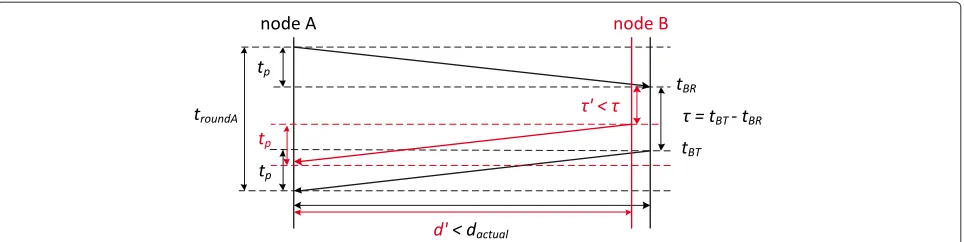
Figure 2Attacking the two-way ranging protocol of the IEEE 802.15.4 standard.A distance-decreasing attack is shown.
back to nodeA. Based on that packet, node A can measure the round-trip time,troundA=tp+τ, and extract the one-way time-of-flight, tp, with respect to its own reference time.
3.1.2 Vulnerability of the two-way ranging protocol
In localizing anomalies, trustworthy distance measure-ments are necessary. According to a recent study [32], however, the two-way ranging protocol of the UWB PHY is vulnerable to ranging attacks. A compromised node B may tamper its processing time asτ in order to manip-ulate the distance measurement and cheat node A about its distance (see Figure 2 for an explanation). Hence, in making the UWB distance measurements immune to ranging attacks, even in the presence of an adversary interfering with the ranging process, ADLU adopts the PHY hacks proposed in [32], which include an energy detection (ED) countermeasure and convolutional plus time-hopping code patches.
Next, we describe the ADLU algorithm in detail. Within our model, we assume that no node can be fully trusted since no pre-existing distributed trust model exists. More-over, we assume that a number of legitimate nodes are tampered with and reprogrammed for an adversary’s pur-pose, i.e., in order to launch an attack against the clus-tering protocol. While an adversary can completely take over the nodes, we assume that such an adversary cannot outnumber legitimate nodes by replicating captured ones or introducing new ones in sufficiently many parts of the network.
3.2 Detailed protocol description
The ADLU algorithm uses a round-based approach towards cluster formation and anomaly detection. At the end of each round (RP), the network is re-clustered and new cluster heads are assigned. A monitoring mecha-nism is introduced to assist the analysis and decision making process of anomaly detection. Finally, anomalies are localized using a geometric, trilateration technique. The different phases of the ADLU algorithm are analyzed below.
3.2.1 Phase 1: secure leader election and cluster formation
In order to establish the clusters, a modified version of the energy-aware self-organizing clustering (EASOC) algo-rithm [33] is used. This protocol is aleader-firstclustering protocol developed for UWB wireless sensor networks. This means that the cluster heads are elected first, based on an energy-aware interference factor (EAIF) shown in Equation (1) and then other nodes join these cluster heads forming a multi-cluster network.
EAIFi=
1
Ni
Ni k=1Dαik
Eresi . (1)
This protocol, however, does not offer the security we need when electing the cluster heads, because internal attackers that do not follow the protocol semantics can lie about their distance or their residual energy to make themselves elected as cluster heads, thus giving them the chance to launch severe attacks. This vulnerability is dealt with by modifying the leader election protocol (LEP). In securing the LEP protocol, a new leader election metric is introduced: thesecure leader election indicator(SLEI). For a nodeiwithNi neighbors, its SLEIi is computed as follows:
SLEIi=EAIFi·Wi=
1
Ni
Ni k=1Dαik Eresi ·
1 Ni
Ni
k=1
θki, (2)
where Dik is the distance between node i and its kth neighbor, α is the path loss exponent, Eresi is the resid-ual energy of nodei,Wi is a weight ranging from 0 to 1, andθki ∈[ 0, 1] is a trust value assigned to nodei by its peers. The rationale behind this definition is that when all nodes have the same EAIFi, we should select the nodes with the highest weighted trust,Wi. Nodes that have lower weighted trusts are avoided from becoming cluster heads, even though they may have higher EAIFi (note that the EAIF indicator is upper bounded).
exchange of ranging-enabled beacons between the neigh-bor nodes and the computation of the EAIFiindicator. In thesecond step, each node floods the network with a table containing its closestNu neighbors, and its locally com-puted EAIFi, which maybe falsified if nodeiis malicious.
Hence, within ADLU, we modify this. Each node floods the network with a table containing its EAIFivalue and the trust valuesθik this node assigns to its closestNu neigh-bors. The trust metric is initialized to 1 and is updated every time a node enters the ‘monitoring and trust update’ phase. Trust updates are based on the trustworthiness of a node. We classify the trustworthiness into three grades: trust, distrust, and uncertain, valued as 1, 0, and 0.5, respectively. Hence, if nodeibehaves maliciously, the trust values assigned to this node by its monitoring neighbors,
θki, will be decreased using a two-step strategy: from 1 to 0.5 and then to 0. Accordingly, Wi and SLEIi will be decreased. At the end of this step, every node constructs a table ofN entries, one for every node in the network. Hence, all nodes have exactly the same global knowledge of the network status.
In thethird step, ADLU’s secure LEP protocol begins. The node with the maximum SLEIiis marked as cluster head, and all its neighbors,Nuat maximum, are removed from the table. This procedure continues until there is no node left to be examined that is not a cluster head. After the cluster heads have been marked, every other node selects the closest one and joins its cluster. In thefourth step, the cluster heads and their cluster members exchange data. The cluster heads then forward the collected data to the BS. When a predefined number of data exchanges is reached, namely RP, the entire procedure starts from the beginning. In each RP, the cluster heads will probably be different from the previous ones, and in this way, the energy-consuming role of the cluster head is reassigned among the nodes of the network, resulting in a more uni-form energy consumption. We do not oversee the cases where a malicious node is elected as cluster head, espe-cially during the network setup when no prior knowledge exists. This is the reason why we introduce a mechanism to monitor the activity of the cluster heads as well.
3.2.2 Phase 2: monitoring and trust update
The next problem we must deal with is the determination of the nodes that will run the ADS, i.e., how many and which nodes should be on duty to detect misbehaviors. In monitoring the cluster members, the intrusion detec-tion funcdetec-tion is activated on the cluster heads. If after an interval equal to amonitoring period(MP) (measured in rounds) a cluster member is judged to be abnormal by its cluster head, it is revoked. In doing so, the trust value of the malicious node as seen by its cluster head is updated (reduced) and is broadcasted as an alarm message to all cluster member nodes.
Cluster heads on the other hand are monitored by their cluster members. Cluster head monitoring is necessary to assure that even in the case the LEP protocol fails, mali-cious cluster heads that went undetected do not retain this role for long. A part of the cluster members, three in total, are activated for monitoring and jointly making final deci-sions on the maliciousness of their CH. In each MP, the cluster member nodes with the second, third, and fourth in succession biggest SLEIivalues compose the monitor-ing team of the CH (recall that the CH has the highest SLEIi value within its cluster). If after the MP interval half of these nodes indicate that the cluster head is mali-cious (majority vote rule), then the cluster head is revoked by the monitoring team. In revoking a malicious cluster head, each member of the monitoring team broadcasts an alarm message containing the reduced trust value of the malicious cluster head, as well as its new EAIFivalue (recall that a change in the EAIFivalue is reflected on the SLEIi value; hence, this information would allow differ-ent cluster member nodes to probably monitor the cluster head in the next MP intervals). Following the identifica-tion and revocaidentifica-tion of the malicious CH, another cluster head, among the cluster members, is elected. In this re-clustering process, the node with the new highest SLEIi value in the attacked cluster becomes its cluster head. This node may retain the role of the CH until the next RP round, unless it is marked as malicious by its cluster members.
With a majority rule being applied when monitoring the activity of a cluster head, if a node from the mon-itoring team is compromised and issues a false alarm trying to revoke a legitimate cluster head, it would have no effect because the majority would prevail. However, since the majority-vote rule represents a cooperative anomaly-detection scheme, there might be the case that multiple malicious nodes with high SLEIi values obtain the role of the monitoring team inside a cluster, enabling them to deceive the majority-vote rule and to revoke a legitimate CH. This situation is identified by the simulation results depicted in Section 4.2 and is indicated with a drop in the detection accuracy of the ADLU algorithm when 40% or more of the nodes behave maliciously. However, this is a highly hostile condition and cannot be dealt effectively by any cooperative anomaly-detection scheme.
3.2.3 Phase 3: anomaly detection and localization
Table 1 Rule definition
Rule description Detection metric Attack detected
When a packet is not forwarded as it should, Packet drop rate Selective forwarding and black hole attacks [34] increase a counter. When this counter reaches a
thresholdtafter MP rounds, raise an alarm.
When a packet does not originate from a Packet origin address Hello flood and sinkhole attacks [35] node with a distance no longer than the radio range
of a single hop, raise an alarm.
When the distance measurements between multiple, Distance matching criterion Sybil [36] attacks at least two, distinct nodes match, raise an alarm.
very attractive in the context of WSNs in the essence that the detection speed and complexity certainly ben-efits from the absence of an explicit training procedure required, for example, in data mining approaches [20]. In rule-based detection, the anomaly detector uses prede-fined rules to classify data points as anomalies or nor-malities. While monitoring the network, these rules are selected appropriately and applied to the monitored data packets. A data packet is discarded after being tested against all rules without violating any of them. On the contrary, if a violation of any of these rules occurs or equivalently if the rules defining an anomaly are satisfied, an anomaly is declared and an alarm will be raised. An alarm generated by a cluster head indicates that a cluster member is an intruder and needs to be revoked. Similarly, if the independent alarms raised by the monitor nodes of a cluster head satisfy the majority-vote rule, then this clus-ter head is revoked and a new clusclus-ter head, among the cluster members, is elected.
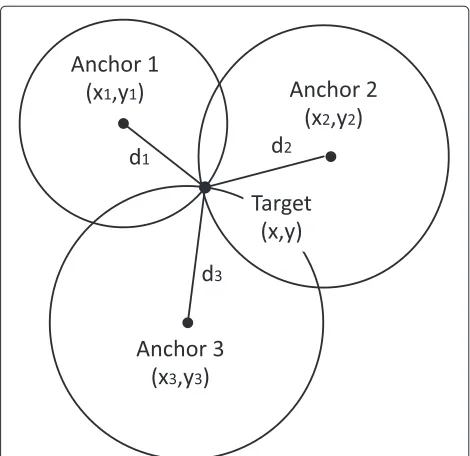
Each time an untrustworthy node is revoked (the revo-cation is indicated by a broadcast alarm message), an UWB ranging-based localization algorithm is executed to identify the location of the attacker. The location-finding algorithm is composed of two steps:rangingand localization [37]. The ranging process is the action of estimating the distance between two devices. Localiza-tion is the mechanism of finding the exact locaLocaliza-tion of a given node by utilizing three or more range estimates. As already analyzed, among the available ranging techniques defined by the IEEE 802.15.4 standard [1], within ADLU, the range estimates are obtained using the two-way time-of-arrival technique depicted in Figure 2. Regarding the localization process, ADLU adopts the time-of-arrival tri-angulation of ranges technique defined by the standard. This technique applies to the general network lacking synchronization between devices and/ora priori organi-zation, and assumes that three rangesd1 = c×t1,d2 =
c×t2, andd3 = c×t3are gathered from three ‘anchor
devices’i=1, 2, 3 with locations (xi,yi) (see Figure 3 for a geometry of this technique). The role of the three anchor nodes is assigned to those cluster member nodes that within the given MP interval have been elected to monitor the CH.
Following the assignment of the anchor nodes, the coor-dinates of the target node in the 2D space are computed by solving a linear least-squares (LLS) problem, which trans-lates to finding the intersection of three circles. As soon as thex,ycoordinates of the malicious node are determined, the anchor nodes are then responsible for forwarding this information to the BS to enable the system administrators and the security professionals to take countermeasures. In doing so, they first transmit the location information to the CH. Then, the CH forwards this information to the BS either directly (if the BS is within range) or via multi-ple hops (inter-cluster routing). Since, there might be the case that the CH is the malicious node the anchor nodes were monitoring and for which they initiated the localiza-tion process, then in this case, the anchor nodes will have to wait for the new CH to be elected before transmitting this critical data to the legitimate one. The three phases of the ADLU algorithm are summarized in algorithmic form within Algorithm 1.
Algorithm 1The ADLU algorithm
{Phase 1: Secure Leader Election and Cluster Formation}
foreach nodeiin the networkdo
Step 1: exchange a ranging-enabled beacon with all its neighbors (closestNu)
Step 1:calculate its EAIFiindicator
Step 2: flood the network with the table {node_ID i, EAIFi,θik=1,∀neighborsk}
end for
Step 2:construct a table from the received messages
foreach nodeiin the table run the LEP protocoldo ifnodes are left in the tablethen
Step 3:mark node with the maximum SLEIias cluster
head (CH)
Step 3:delete the neighbors of this CH from table (Nu
at most)
end if end for
foreach node left in the tabledo Step 4:nodeijoins the closest CH
end for
Step 4:cluster members (CMs) exchange data with their CH
ifRounds>repetition period, RPthen
start from the beginning (Step 1)
end if
{Phase 2: Monitoring & Trust Update}
foreach nodeiin the networkdo ifnodeiis the CHthen
start monitoring your CMs
ifRounds>monitoring period, MPthen
collect data, update, if necessary, the trust values,θik,
and executePhase 3 end if
else
select the cluster member nodes with the 2nd, 3rd,
and 4thin succession biggest SLEIivalues, and start to
monitor the CH
ifRounds>MPthen
collect data, update, if necessary, the trust valueθki
of the CH, and executePhase 3
update, if necessary, the members of the CH’s mon-itoring team based on the updated EAIFivalues of
current monitoring nodes
end if end if end for
{Phase 3: Anomaly Detection and Localization} Apply rules on the collected data packets
ifRules are satisfiedthen
Step 1:Declare the anomaly and start node revocation
Step 2:Execute the time-of-arrival triangulation of ranges algorithm to localize the malicious node
else
Discard the packet and continue operation
end if
4 Performance evaluation
We used a custom-developed simulation tool imple-mented in C++ to evaluate the performance of the ADLU algorithm. As stated earlier, comparison of our algorithm with classical, cluster-based ADSs would not be appropri-ate, as they do not take into account the UWB technology limitations and strengths. We only compare the ADLU algorithm with its ancestor, the EASOC algorithm [33], in an attempt to evaluate the energy and communication overhead it incurs to a clustering algorithm that does not implement the detection and location-attribution engines of the ADLU algorithm.
With regard to the network topology, 100 nodes were randomly placed inside a square area of 100× 100 m2 (the BS was placed at the center). The cluster member-limitation parameter,Nu, was set to 10b. Cluster member nodes where generating packets with an interarrival time equal to two packets per second. We chose to vary the monitoring period and the repetition period as follows: MP = {1, 2, 3}rounds and RP = {80, 140} rounds. The UWB PHY parameters are summarized in Table 2. All the presented results were averaged over 20 simulation runs.
We simulated a security-oriented application support-ing sink-based reportsupport-ing, that is to say, traffic flowsupport-ing from the leaf nodes to the BS (typical case of a sensor net-work). Randomly selected intelligent adversaries include themselves in the network by replicating legitimate (cap-tured) nodes and start launching an attack, as reflected in Table 1. In case of selective forwarding attacks, a mali-cious node selectively drops packets with a probabilitypd. When pd = 1.0, the attacker is executing a black hole attack.
Three metrics were used to evaluate the efficiency of the ADLU algorithm. These are as follows:
1. Thecommunication overhead, defined as the ratio of the total communication overhead in a system that incorporates our detection algorithm against a system that does not
2. Thepercentage reduction in network lifetime, resulting from the incorporation of our detection algorithm
3. Thedetection accuracy, defined as the ratio of the detected attacks to the total number of detected and undetected attacks
4. False negative rate, defined as the rate at which events are not flagged intrusive by the detector, although the attack exists.
4.1 Energy and communication overhead
Table 2 UWB PHY parameters
Property Value
PHY option IEEE 802.15.4 UWB PHY
Frequency band Channel {0} withfc=499.2 MHz and BW = 499.2 MHz
Data rate 0.85 Mbs (mandatory data rate)
Rate-dependent and mean PRF=15.60 MHz,Tdsym=1, 025.64 ns,
Timing-related parameters Tpsym=993.6 ns,Nsync=64 symbols,Nsfd=8 symbols
Power 36.5μW (FCC limit for≈0.5-GHz bandwidth)
Communication range 20 m
DATA packet length 1,038 symbols (+ 64 symbols for SYNC trailer)
Ranging support TW-TOA (mandatory ranging)
Channel access UWB preamble sense based on the SHR of a frame
(clear channel assessment - CCA Mode 5)
Their ratio is denoted as the relative communication over-head. To simulate this scenario, we chose at random a number of network nodes, and we programmed them to selectively launch one of the attacks depicted in Table 1. With regard to selective forwarding attacks (launched only by cluster heads), the attacker was dropping pack-ets with a probability pd = 30%. When pd = 100%, the attacker was executing a black hole attack. We set the threshold value for the percentage of packets being dropped over an interval MP to be t = 20%. Above this threshold, an alarm was generated and node revoca-tion was initiated. Packets dropped at a lower rate were attributed to other factors, such as collisions or node fail-ures and did not produce an intrusion alert. For all other types of attack, distance-related rules are responsible for raising an alarm.
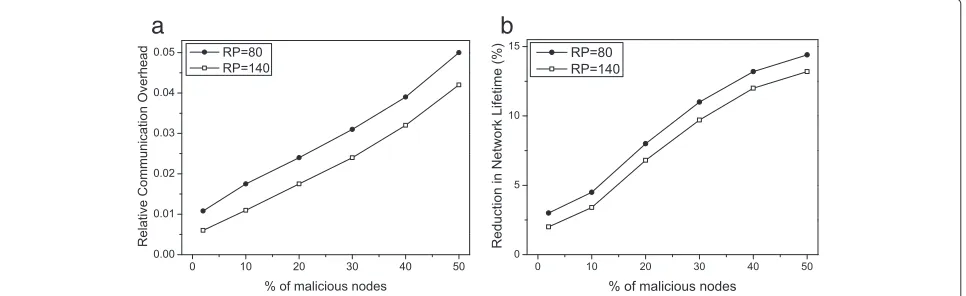
In Figure 4a, the curves show that the relative commu-nication overhead increases smoothly as the percentage of malicious nodes increases. This is because more packet exchanges occur following the introduction, identifica-tion, and revocation of an increasing number of adver-saries. In all cases, however, the communication overhead
is kept at very low ratios, as low as 0.050 and 0.042 for RP = 80 and 140 rounds, respectively. A smaller RP value causes a slightly higher increase to the relative communication overhead, notably because of the slightly higher number of packets being broadcasted as a result of the shorter network re-clustering phase. As expected, the commu-nication overhead is extremely low when the network contains no malicious nodes. No curves are shown with regard to the changing value of the monitoring period, MP. This is because the MP interval by relating to the decision making window of the monitoring phase mostly affects the detection accuracy of the ADLU algorithm.
Figure 4b illustrates the percentage reduction in net-work lifetime when common sensor nodes run our anomaly detection and location attribution algorithm. Once again, the results illustrate that as the percent-age of malicious nodes inside the network increases, the reduction in the network lifetime increases. As the curves highlight, the reduction is slightly higher when RP is equal to 80. As mentioned earlier, smaller RP values cause a slightly higher increase to the relative communica-tion overhead, which also translates to an increase in the
a
b
a
b
Figure 5Detection accuracy of(a)selective forwarding attacks and(b)black hole attacks.
energy dissipation of the nodes. Overall, the network life-time decreases by as high as 14.4% when RP = 80 rounds, and by 13.2% when RP = 140 rounds. The relatively small reduction observed in both cases is due to the fact that within ADLU, the nodes rotate the energy-consuming roles of the CH and that of the monitoring team, and as such, the energy dissipation is uniformly distributed among the network nodes. Since the network lifetime is in comparative levels when compared to a system that does not incorporate our anomaly detection algorithm, this fact can justify the installation of our ADS on the sensor nodes.
4.2 Detection accuracy and false-negative rate
The rest of the figures evaluate the detection accuracy of the ADLU algorithm against the attacks of Table 1 and the false-negative rates that it achieved. In the sub-sequent simulations, and more specifically in each attack scenario presented next, there was always one single type of attacker, which was varied in each simulation.
As an overall observation, we can say that the varia-tion of MP solely affects the detecvaria-tion accuracy of the selective forwarding and black hole attacks illustrated
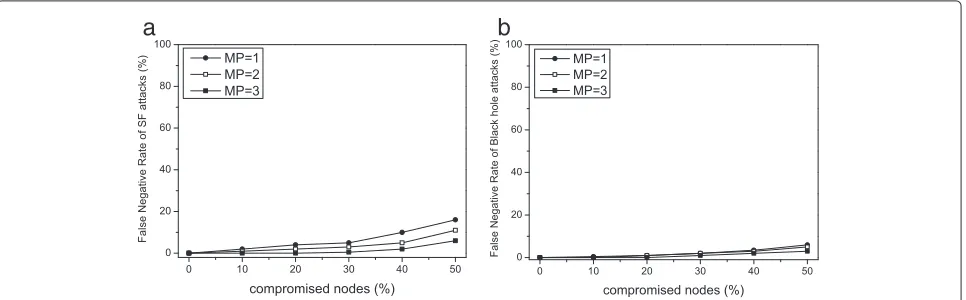
in Figure 5a,b. This happens because these attacks are assessed over a time window, and therefore, their detec-tion accuracy is affected by the monitoring interval, MP. Recall that the interval MP relates to the time window that a monitor node has in order to gather packets and analyze them for signs of intrusion. Since less packets are being collected as a result of the smaller MP interval and given that packets are dropped probabilistically, there might be the case that during a monitoring interval, the dropped packets are less thant=20%, and hence, no alarm is pro-duced, generating false negatives (see Figure 6a). This is less probable to happen when the value of MP gets bigger or when nodes launch black hole attacks, i.e.,pd =100%. In the latter case depicted in Figure 5b, the probability that the dropped packets during an MP interval are less thant, which results in a false negative, is close to zero, and hence, the accuracy in detecting this attack is close to 100% (this is also shown in Figure 6b).
Figure 7a illustrates the detection accuracy of hello flood attacks (similar curves are obtained when the attacker launches a sinkhole attack). In examining these attacks, we chose to vary the accuracy in the UWB
a
b
a
b
Figure 7Detection accuracy of(a)hello flood attacks and(b)Sybil attacks.
distance measurements resembling ranging attacks that went undetected. When the range estimation error r
is equal to 0%, the detection was always close to 100%, notably because of the rule being applied to detect this kind of attack. Another factor that keeps the detection levels high in this case is that these attacks are not mis-taken with occasional network or communication failures, as the previous attack category, and as such, fewer false negatives are generated as shown in Figure 8a. However, an increase in the number of misdetections is obtained in two cases. Firstly, when half or more of the network nodes behave maliciously. In this case, the majority-vote rule being applied fails to prevail. Secondly, when inaccura-cies are introduced in the UWB range estimates, namely, whenris up to 5%. Recall that in these attacks, the rule
being applied depends on the distance measurements. Hence, when range estimation errors exist, the detection effectiveness of the ADLU algorithm drops.
Similar to the previous attack scenario, the accuracy in detecting Sybil attacks depends on the accuracy of the UWB distance measurements. As shown in Figure 7b, the detection accuracy of Sybil attacks ranges between 99%
and 78.8%. The drop in the detection accuracy is higher when compared to the previous attack scenario. This is actually an indication of the higher dependence between the rule being applied to detect this kind of attack and the distance estimation error,r. Apparently, the
distance-matching criterion could not be satisfied when inaccura-cies in the range estimates,r, are introduced. Following
this observation, we then relaxed the matching criterion and adjusted the rule, taking into account errors in the distance estimation in the order of 2%. By doing this, we slightly reduced the number of generated false negatives (see Figure 8b).
5 Conclusions
In this paper, we presented an anomaly detection and localization algorithm specifically designed for hierarchi-cal, cluster-based UWB wireless sensor networks. A novel, trust-aware leader election metric was defined to secure the algorithm’s cluster formation protocol. The simula-tion results showed that the proposed algorithm achieves high detection accuracy and low false-negative rates while maintaining the communication overhead at low levels.
a
b
In the future, we intend to examine the effectiveness of the ADLU algorithm in detail by considering larger net-works as well as the presence of malicious nodes heavily interfering with the UWB ranging process.
Endnotes
aThe packets used for ranging estimation are standard
packets, with the only difference being the value of a specific bit in the PHY header (PHR) called the ‘ranging bit’, which is set by the transmitting PHY for frames intended for ranging. A UWB frame with the ranging bit set to 1 is called a ranging frame (RFRAME). There is nothing else, beyond the ranging bit, that makes an RFRAME unique. RFRAMEs can carry data or can even be acknowledgments.
bNote that the choice of theN
uparameter may affect the operation of ADLU. As such, we have run multiple simulation tests to fine-tune this metric prior to selecting its final value.
Competing interests
The authors declare that they have no competing interests.
Acknowledgements
This work was performed within the framework of the Action ‘Supporting Postdoctoral Researchers’ of the Operational Programme ‘Education and Lifelong Learning’ (Actions Beneficiary: General Secretariat for Research and Technology, GSRT), and is co-financed by the European Social Fund (ESF) and the Greek State.
Received: 25 July 2013 Accepted: 27 December 2013 Published: 17 January 2014
References
1. IEEE,IEEE 802.15.4™-2011: IEEE Standard for Local and Metropolitan Area Networks–Part 15. 4: Low-Rate Wireless Personal Area Networks (LR-WPANs). (IEEE, Piscataway, 2011)
2. E Karapistoli, FN Pavlidou, I Gragopoulos, I Tsetsinas, An overview of the IEEE 802.15.4a Standard. Commun. Mag. IEEE.48(1), 47–53 (2010) 3. N Sastry, D Wagner, Security considerations for IEEE 802.15.4 networks.
Paper presented at the 3rd ACM workshop on wireless security (WiSe), Philadelphia, PA, USA, 1 Oct 2004, pp. 32–42
4. C Karlof, D Wagner, Secure routing in wireless sensor networks: Attacks and countermeasures. Paper presented at the first IEEE international workshop on sensor network protocols and applications, Anchorage, AK, USA 11 May 2003, pp. 113–127
5. D Martins, H Guyennet, Wireless sensor network attacks and security mechanisms—A short survey. Paper presented at 13th international conference on network-based information systems (NBiS), Takayama, Japan, 14–16 Sept 2010, 313–320
6. K Xing, S Srinivasan, M Rivera, J Li, X Cheng, ed. by SCH Huang, D MacCallum, and D-Z Du, Attacks and countermeasures in sensor networks: A survey, inNetwork Security(Springer, New York, 2010), pp. 251–272 7. S Ghose, R Bose, Physical layer security in UWB networks. Paper presented
at the IEEE international conference on microwaves, communications, antennas and electronics systems (COMCAS), Tel Aviv, 7–9 Nov 2011, pp. 1–5
8. M Ko, D Goeckel, Wireless physical-layer security performance of UWB systems. Paper presented at the military communications conference (MILCOM), San Jose, CA, USA 31 Oct–3 Nov 3 2010, pp. 2143–2148 9. SA Camtepe, B Yener, Key distribution mechanisms for wireless sensor
networks: A survey. Technical report, Rensselaer Polytechnic Institute, 2005
10. E Shi, A Perrig, Designing secure sensor networks. IEEE Wireless Commun. Mag.11(6), 38–43 (2004)
11. L Lazos, R Poovendran, SeRLoc: Robust localization for wireless sensor networks. ACM Trans. Sensor Netw. (TOSN).1, 73–100 (2005) 12. S Roy, M Conti, S Setia, S Jajodia, Secure data aggregation in wireless
sensor networks. IEEE Trans. Inf. Forensics Secur.7(3), 1040–1052 (2012) 13. M Flury, M Poturalski, P Papadimitratos, JP Hubaux, JY Le Boudec,
Effectiveness of distance-decreasing attacks against impulse radio ranging. Paper presented at the third ACM conference on wireless network security (WiSec). Hoboken, NJ, USA, 22–24 March 2010, pp. 117–128
14. N Tippenhauer, S Capkun, ID-based secure distance bounding and localization. ESORICS.5789, 621–636 (2010)
15. Y Wang, X Ma, G Leus, An UWB ranging-based localization strategy with internal attack immunity. ICUWB.2, 1–4 (2010)
16. Y Zhang, W Liu, Y Fang, D Wu, Secure localization and authentication in ultra-wideband sensor networks. IEEE J. Select. Areas Commun.
24(4), 829–835 (2006)
17. YH Jazyah, M Hope, ed. by D Taniar, O Gervasi, B Murgante, E Pardede, and BO Apduhan, A review of routing protocols for UWB MANETs, in Proceedings of the 2010 International Conference on Computational Science
and Its Applications, Part III(Springer, Berlin, 2010), pp. 228–245
18. A Becher, Z Benenson, M Dornseif, ed. by J Clark, R Paige, Polack F, and P Brooke, Tampering with motes: Real-world physical attacks on wireless sensor networks, inSecurity in Pervasive Computing, Lecture Notes
in Computer Science, vol. 3934(Springer, Berlin, 2006), pp. 104–118
19. A Farooqi, F Khan, ed. by Slezak D, T Kim, AC Chang, T Vasilakos, M Li, and Sakurai Kouichi, Intrusion detection systems for wireless sensor networks: A survey, inCommunication and Networking, vol. 56(Springer, Berlin, 2009), pp. 234–241
20. M Xie, S Han, B Tian, S Parvin, Anomaly detection in wireless sensor networks: A survey. J Netw. Comput. Appl.34(4), 1302–1325 (2011) 21. V Chandola, A Banerjee, V Kumar, Anomaly detection: A survey. ACM
Comput. Surv.41(3), 15:1–15:58 (2009)
22. Z Sahinoglu, S Gezici, Ranging in the IEEE 802.15.4a Standard. Paper presented at the IEEE annual conference on wireless and microwave technology (WAMICON), Clearwater Beach, FL, USA, 4–5 Dec 2006, pp. 1–5 23. CC Su, KM Chang, YH Kuo, MF Horng, The new intrusion prevention and
detection approaches for clustering-based sensor networks. WCNC.
4, 1927–193 (2005)
24. S Rajasegarar, C Leckie, M Palaniswami, J Bezdek, Distributed anomaly detection in wireless sensor networks. Paper presented at the 10th IEEE international conference on communication systems (ICCS), Singapore, 30 Oct–2 Nov 2006, pp. 1–5
25. S Subramaniam, T Palpanas, D Papadopoulos, V Kalogeraki, D Gunopulos, Online outlier detection in sensor data using non-parametric models. Paper presented at the 32nd international conference on very large data bases (VLDB), Seoul, South Korea, 12–15 Sept 2006, pp. 187–198 26. H Wang, Z Yuan, C Wang, Intrusion detection for wireless sensor networks
based on multi-agent and refined clustering. CMC.3, 450–454 (2009) 27. YY Zhang, W-C Yang, K-B Kim, M-S Park, Inside attacker detection in
hierarchical wireless sensor network. Paper presented at the 3rd international conference on innovative computing information and control (ICICIC). Dalian, Liaoning, 18–20 June 2008, pp. 594–594 28. K Rahul, H Liu, HH Chen, Reduced complexity intrusion detection in
sensor networks using genetic algorithm. Paper presented at the IEEE international conference on communications, Dresden, Germany, 14–18 June 2009, pp 1–5
29. S Rajasegarar, C Leckie, M Palaniswami, J Bezdek, Quarter sphere based distributed anomaly detection in wireless sensor networks. Paper presented at the IEEE international conference on communications, Glasgow, 24–28 June 2007, pp. 3864–3869
30. IM Atakli, H Hu, Y Chen, WS Ku, Z Su, Malicious node detection in wireless sensor networks using weighted trust evaluation. Paper presented at the spring simulation multiconference (SpringSim), Ottawa, Canada, 14–17 Apr 2008, pp 836–843
31. I Krontiris, T Dimitriou, FC Freiling, Towards intrusion detection in wireless sensor networks. Paper presented at the 13th European wireless conference, Paris, France, 1–4 Apr 2007
33. G Koltsidas, E Karapistoli, FN Pavlidou, An energy-aware self-organizing clustering algorithm for UWB wireless sensor networks. Paper presented at the IEEE 19th international symposium on personal, indoor and mobile radio communications (PIMRC). Cannes, 15–18 Sept 2008, pp. 1–5 34. L Bysani, A Turuk, A survey on selective forwarding attack in wireless
sensor networks. Paper presented at the international conference on devices and communications (ICDeCom), Mesra, Algeria, 24–25 Feb 2011, pp. 1–5
35. I Krontiris, T Giannetsos, T Dimitriou, Launching a sinkhole attack in wireless sensor networks: The intruder side. Paper presented at the IEEE international conference on wireless and mobile computing, networking and communication, Avignon, France, 12–14 Oct 2008, pp. 526–531 36. J Newsome, E Shi, D Song, A Perrig, The Sybil attack in sensor networks:
Analysis defenses. Paper presented at the third international symposium on information processing in sensor networks. Berkeley, California, USA, 26–27 Apr 2004, pp. 259–268
37. S Gezici, Z Tian, G Giannakis, H Kobayashi, A Molisch, H Poor, Z Sahinoglu, Localization via ultra-wideband radios: A look at positioning aspects for future sensor networks. Signal Process Mag. IEEE.22(4), 70–84 (2005)
doi:10.1186/1687-417X-2014-3
Cite this article as:Karapistoli and Economides:ADLU: a novel anomaly
detection and location-attribution algorithm for UWB wireless sensor networks.EURASIP Journal on Information Security20142014:3.
Submit your manuscript to a
journal and benefi t from:
7Convenient online submission
7Rigorous peer review
7Immediate publication on acceptance
7Open access: articles freely available online
7High visibility within the fi eld
7Retaining the copyright to your article
![Figure 1 Anomaly detection patterns in hierarchical WSNs [20].](https://thumb-us.123doks.com/thumbv2/123dok_us/879590.1585419/3.595.57.291.89.221/figure-anomaly-detection-patterns-hierarchical-wsns.webp)