Internet of Things and Data Mining: From Applications
to Techniques and Systems
∗
Mohamed Medhat Gaber
†, Adel Aneiba
‡, Shadi Basurra
§,
Oliver Batty
¶Ahmed M. Elmisery
k,Yevgeniya Kovalchuk
∗∗,
Muhammad Habib Ur Rehman
††Article Type:
Advanced Review
Abstract
The Internet of Things (IoT) is the result of the convergence of sensing, computing, and networking technologies, allowing devices of varying sizes and computational capabilities (things) to intercommunicate. This communication can be achieved locally enabling what is known as edge and fog computing, or through the well-established Internet infrastructure, exploiting the computational resources in the cloud. The IoT paradigm enables a new breed of applications in various areas including health care, energy management and smart cities. This paper starts off with reviewing these applications and their potential benefits. Challenges facing the realisation of such applications are then discussed. The sheer amount of data stemmed from devices forming the IoT requires new data mining systems and techniques that are discussed and categorised later in this paper. Finally, the paper is concluded with future research directions.
∗All authors contributed equally to the paper with the first author coordinating the overall project. †School of Computing & Digital Technology, Birmingham City University, Birmingham, United Kingdom ‡School of Computing & Digital Technology, Birmingham City University, Birmingham, United Kingdom §School of Computing & Digital Technology, Birmingham City University, Birmingham, United Kingdom ¶School of Computing & Digital Technology, Birmingham City University, Birmingham, United Kingdom kDepartment of Electronic Engineering, Universidad Tecnica Federico Santa Maria, Valparaiso, Chile ∗∗School of Computing & Digital Technology, Birmingham City University, Birmingham, United Kingdom ††Department of Computer Science, National University of Computer and Emerging Sciences, Lahore,
Introduction
The massive adoption of Internet of Things (IoT) opens a plethora of new use cases,
ap-plications, frameworks, and data processing architectures. A new ecosystem of
support-ing technologies is besupport-ing developed in parallel with IoT to enable resource provisionsupport-ing for
resource-constrained devices and systems (F. Wang, Hu, Hu, Zhou, & Zhao, 2017; Baktir,
Ozgovde, & Ersoy, 2017; Mao, You, Zhang, Huang, & Letaief, 2017). The core of future IoT
systems will be designed by integrating mobile edge computing systems, software-defined
networks, 5G, augmented reality, and data mining (including machine learning and artificial
intelligence) to name a few (Baktir et al., 2017; Mao et al., 2017). Data mining is the process
of discovering hidden knowledge patterns from raw data; therefore, the execution of
knowl-edge discovery processes in IoT environments will leverage the utility of IoT systems. In
essence, data mining will play a vital role in highly interactive and intelligent IoT systems.
The adoption of IoT systems at every level from small and medium organisations to
large-scale multinational enterprises creates unlimited opportunities (Hsu & Yeh, 2017). In
addition, governmental and non-governmental non-profit organisations are willing to adopt
IoT systems to improve their services. The continuous growth of data streams in these IoT
systems will help in developing new business models, improved and massively customised
products, and real-time personalised services (Rehman, Chang, Batool, & Wah, 2016). The
integration of data mining and knowledge discovery processes in IoT applications will
fa-cilitate development of highly intelligent IoT systems considering operational efficiency and
performance of businesses, governmental, and non-governmental organisations (M. M. Gaber,
Gomes, & Stahl, 2014).
Data mining methods in IoT systems are integrated in order to discover a variety of
knowledge patterns using well established supervised, unsupervised, semi-supervised, and
statistical methods (Cao, Wachowicz, & Cha, 2017). These data mining methods enable
classification, clustering, frequent pattern mining, and regression of incoming streaming data
in order to visualise the knowledge and activate the actuators in IoT systems (Patel, Ali,
& Sheth, 2017). Since the data mining methods vary in terms of operations (such as data
actua-tion) and computational complexity (such as memory and CPU utilisaactua-tion), IoT applications
could be scaled up from IoT devices to edge and cloud servers.
Numerous review articles were presented for data mining and IoT in existing systems
whereby researchers focused on ubiquitous environments (Alam, Mehmood, Katib, Albogami,
& Albeshri, 2017), mobile data stream mining applications (Rehman, Sun, Wah, & Khan,
2016), and big IoT data analytics (E. Ahmed et al., 2017). However, to the best of our
knowl-edge, existing articles significantly lack in terms of data mining applications, techniques and
systems. The main objective of this article is to present a review of IoT applications from
data mining perspective considering healthcare, energy, and smart cities use cases and
high-light some important research challenges. To this end, we present a detailed literature review
and discuss the related issues for privacy preservation, networking and deployment of IoT
applications in the edge computing environments. Finally, we present a detailed review of
data mining methods, which were adopted to be deployed on the edge servers that reside at
single-hop distance from IoT devices.
IoT Applications
IoT has opened the door for a sheer number of applications that were otherwise unreleasable.
Out of these applications, healthcare, energy management and smart cities are identified to
be the areas to benefit the most from this rising technological advancement. This is due to
the use of wearables and smart sensing ambiently, enabling applications in these areas. At the
same time, IoT technologies are expected to be adopted in a wide range of other applications.
For example, a system proposed in (Mehmood et al., 2017) uses IoT for enhancing learning
experience through monitoring of the learners’ activities using a variety of devices (things)
including smart watches and smart phones.
IoT in Healthcare Applications
“When a patient is treated, their care is informed not only by their own health data - their
medical history, test results, imaging and so on - but also by the health data of thousands of
and insight, allowing for increases in both access to care and quality of care, as well as
reducing costs (Islam, Kwak, Kabir, Hossain, & Kwak, 2015). The recent rise in IoT-driven
healthcare systems and applications has revolutionised this process, providing the necessary
platform for innovation across all healthcare domains (Niewolny, 2013). Data collected in
this manner may pave the way to an entirely new healthcare paradigm, allowing a focus
aimed more at prevention and early intervention than the responsive methods of present
day.
Mobile devices are now ubiquitous with most people carrying between one and two
de-vices at any time (Konstantinidis, Bamparapoulos, Billis, & Bamidis, 2015). These dede-vices
along with multiple other physiological signal sensor technologies allow for the constant
real-time capture of personal biomedical data. Using IoT, this data may then be leveraged for
use in a broad spectrum of healthcare applications. Data collected through this approach
enables both faster medical intervention during emergencies (Mohammed et al., 2014), as
well as offering potential preventative measures in some cases (Hii, Lee, Kwon, & Chung,
2011), whilst simultaneously reducing equipment costs and other resource usage. These
ap-plications may be split into two classes: those that look to improve health and those that
raise productivity (Manyika et al., 2015). Some of the most prominent uses of IoT within
both categories are reviewed in the following subsections.
Remote Patient Monitoring
Remote patient monitoring provides a prime example of the potential of IoT based healthcare
applications. A wide range of non-intrusive sensors for monitoring various health parameters
have been developed for an array of applications (Islam et al., 2015), allowing for the
real-time monitoring and optimisation of patient care (Cognizant, 2016). By capturing such data
and securely storing it in the cloud, real-time access of a users physiological data may be
accessed by all involved in their care, from the patient and the patients family to medical
professionals (Mohammed et al., 2014).
Bringing monitoring to a patient rather than vice-versa provides a multitude of benefits.
Without constant monitoring, particularly during stages of rehabilitation and recovery (Hii et
on important medical resources in both equipment and medical professionals are reduced
and significantly increased access to care means patients are given the freedom of being able
to live much more independently, greatly improving their quality of life (Niewolny, 2013).
By applying a diverse range of complex analysis algorithms to collected data in real-time,
patients deemed most at risk, such as the elderly and those suffering from chronic conditions,
are far less likely to develop any serious complications, as this constant observation often
allows diagnosis to be made substantially earlier.
However, it should be noted that benefits of such applications are not reserved solely
for the elderly and incapacitated. There is also great scope for such technologies to be
utilised by more able-bodied users. Through monitoring a users general wellbeing whilst
undertaking daily activities, it is possible for diagnosis of potential health concerns to be
made significantly earlier than they otherwise would have been. This allows for a far more
preventative approach to healthcare, where early intervention is critical.
Condition Monitoring and Management
In a similar vein to that of remote patient monitoring, IoT-based applications allow for the
monitoring and management of chronic health conditions. Whilst conventional methods
often involve visiting a hospital or clinic and are therefore costly and time consuming, these
applications bring the potential for in-home monitoring of such conditions (Manyika et al.,
2015). This comes with the additional benefit of much more frequent health parameter
readings over the episodic readings of more traditional methods (for example, when blood
is taken). By using wearable devices, or even devices used intermittently, there has already
been evidence of reduced healthcare costs and improved health in those suffering from COPD
(chronic obstructive pulmonary disease), diabetes and chronic heart failure (Manyika et al.,
2015). Various other research looks at monitoring glucose levels (Istepanian, Hu, Philip, &
Sungoor, 2011), oxygen saturation levels (Larson et al., 2011), blood pressure (Puustjarvi
& Puustjarvi, 2011), electrocardiogram (EKG) (Jara, Zamora-Izquierdo, & Skarmeta, 2013)
and body temperature (Jian, Zhanli, & Zhuang, 2012) through use of a combination of
Assistive Technologies
The integration of IoT into assistive technologies has proven to be a life changing
advance-ment for the disabled and elderly, enhancing both quality of life and allowing for much
im-proved independent living (H. Lee, 2016). Interconnected devices creating automated homes
and other smart environments (G3ict, 2015) are often used in conjunction with brain
com-puter interfaces (BCIs), equipping usually disadvantaged users to better navigate daily life.
By utilising connected sensors and cameras, especially within the users home, and coupling
these with an accessible and intuitive smart phone interface, users may perform tasks, which
would otherwise be impossible or extremely demanding. Other assistive technologies, such
as smart wheelchairs (Abhishek, Manjunatha, Sudarshan, & Reddy, 2016) and wheelchair
management systems (Islam et al., 2015), have also been developed, using IoT to monitor
the status of the user and collect data on their location and surroundings.
Smart home platforms have been adapted to benefit less abled users suffering from a range
of conditions. Home automation applications developed for simple control of appliances
and other home devices, such as security systems and thermostats combined with a smart
phone with compatible screen reader, have proved beneficial for blind and low vision users.
Users with poor mobility have found advantageous applications to manage systems physically
difficult to reach, such as door locking and lighting. Sensors used for these purposes also
have the potential to gather information over a period of time, defining a users typical daily
routine and allowing for remote monitoring by care givers.
Hospital Workflows
Hospital workflows present another area set to greatly benefit with advances in both
inter-operability and digitalisation. The DeepMind Health Streams application, currently being
trialled in a number of the UK NHS hospitals for identifying and treating acute kidney injury
(AKI) (Deepmind, 2017), gives a prime example of this. Analysing blood test results as soon
as they become available and automatically escalating to the relevant medical professional
whenever there appears to be a cause for concern ensures warning signs are picked up and
addi-tional important patient data, including personal information, a linear record of all previous
work since admission and medical history (Connell et al., 2017) allowing for an immediate
diagnosis and prioritised treatment to be made.
Current workflows frequently involve communication between multiple technicians, nurses
and doctors using outdated, often paper based methods and requiring access to a desktop
computer to review results. Alleviating these delays allows for both better coordination of
patient care and ensures those patients most at risk receive the care they need in adequate
time. Applications like this may be developed to cover a wide range of other conditions, as
well as being used to simplify everyday events, such as shift changes and patient handovers.
Issues and Challenges in IoT-enabled Healthcare Applications
Despite the many notable benefits of the healthcare applications discussed, many issues
and challenges are also present, especially regarding the security and privacy of often
sen-sitive gathered medical data and interference with other medical devices. These issues are
often made more challenging by the diversity of IoT components (Abouzakhar, Jones, &
Angelopouloui, 2017). In particular, IoT based healthcare applications rely on
intercon-nected devices exchanging potentially sensitive information (Abouzakhar et al., 2017) and,
as such, are prone to a range of different security and privacy attacks (Al-mawee, 2012).
Multiple questions have been raised regarding gathered personal medical data, specifically
about ownership of the data, who has access rights to it and where it is stored, questions
that must be answered to ensure the integrity of the data and the privacy of the individual
it belongs to. These concerns are often magnified in the case of commercial organisations
being involved (Deepmind, 2017), as more and more private companies gain access to often
intensely personal health data.
Healthcare Applications: a Leap in the Future
The real vision for the future is that the discussed various smaller applications will converge
to form a whole. Emerging applications have the potential to transform a wide range of
health-care therapies and enable remote surgery. Ingestibles and injectables (smart pills
procedures that could offer faster recovery, reduced risk of complications, and lower cost.
IoT solutions can have a real impact on one of the most vexing problems in healthcare today:
human behaviour. Using IoT systems to convince healthy people to change their living habits
and to help sick patients adhere to doctors prescriptions would be a true breakthrough. As
technology evolves, costs will continue to fall, enabling broader adoption and use by a wider
range of patients (Manyika et al., 2015).
Energy Applications
Smart Grid – Energy Consumption Monitoring and Management
Electrical grids continuously grow to meet the increasing power demands, hence, monitoring
and controlling such grids become complicated and far from efficient. Moreover, the growing
shift in Europe and USA to integrate more distributed and renewable energy, originated from
wind, solar and biomass, introduces unpredictability, variability and intermittent power
gen-eration. All these undesirable operational scenarios combined with aging infrastructure cause
electrical grids to constantly operate at their maximum limits. This in turn reduces their life
expectancy, and causes high power disturbances (Gungor et al., 2011). Electrical grids
op-erate under unpredicted circumstances, as they have to cope with rapid changes in seasonal
loads and variation of weather conditions which has increased due to climate change. These
operational circumstances raise challenges in terms of reliability and stability of the grid.
For example, dealing with sudden regional energy demand for cooling due unpredicted heat
can cause energy congestions, rapid change of power patterns, and inefficacy in emergency
loading, etc. (Gungor et al., 2011). To cope with these challenges, a Supervisory Control
And Data Acquisition (SCADA) (Sallam & Malik, 2011) is a widely used situational
aware-ness system to efficiently manage energy in grids. However, SCADA offers a steady state
analysis, which fails to fully monitor and predict the dynamically changing power system.
Due to the recent advances in IoT in terms of communication and its capability in capturing
huge amount of life sensor data, IoT can increase situation awareness through monitoring of
the gird status, which can lead to balancing energy load on transmission lines, controlling
protective automation (Sallam & Malik, 2011).
As an example, Figure 1 shows a community scale energy supply from renewable energy,
where energy is produced and controlled locally. In this scenario, energy delivery at
commu-nity level utilises IoT and data mining to optimise energy distribution and energy allowance
for each property based on occupants usage, tenants habits, property size and house energy
profile. Principles of Multi-Agent System can also be applied here by allowing autonomous
agents to act on behalf of the households. Agents can monitor and perform data mining to
establish adaptive models for the household they represent, as well as use techniques from
Game Theory to efficiently share energy when a household’s energy demand is high at
spe-cific times (e.g., to perform household activities, such as running a washing machine, ironing,
lawn cutting, etc.). Intelligent agents play important role in sustaining the community
self-regulation by monitoring users, activates or situations to prevent selfish behaviour, when a
household asks for more energy than is actually needed or consumes more energy without
being considerate to the entire community. The job of these intelligent agents is to acquire
just enough resources for their household. If household agents are energy literate and decide
to save energy from their daily allowance, then they can feed this saved energy back to the
community grid, or sell it to a house with higher energy demand. Hence, virtual money can
be generated and spent in energy form or other forms of community related activities. This
management system uses storage facilities at household level to store and distribute energy
efficiently without the need for a central storage system that is expensive to maintain and
prone to single point of failure problem.
Despite many benefits, such IoT-based smart grid also raises concerns that were not
present in the classical power grid. Smart grid can be subject to spoofing attacks. This
is when an identity of occupant’s smart meter is stolen and used to pay for the attacker
energy consumption. Data exchanged between a smart meter and energy supplier is subject
to tampering attacks, where an attacker sends wrong information about its tariff or by
pretending that most energy has been consumed during off peak periods. Such attacks
increase household consumptions and overload the grid. Since smart grids are
connectivity-enabled, they are at risk of cyber-attacks, but unlike software attacks that normally damage
Figure 1: Using IoT and data mining, energy generated from renewable sources can be
distributed fairly; energy can be stored and shared through utilisation of private energy
storage systems (batteries) in houses
users, as grids are connected to transformers, circuit breakers, cables and smart meters. The
second challenge concerns with interoperability between IoT devices and legacy devices that
are not compatible with standard TCP/IP (e.g., Zigbee v1 and HART) that allow IP-based
devices to communicate (E.-K. Lee, 2016).
In the UK, the interoperability issue is extended by adoption of modern smart meters
for gas and electricity. In an attempt to reduce energy consumption from buildings, the
UK government has introduced legislation that requires all energy suppliers to install smart
meters in every home in England, Wales and Scotland by 2020 (Department for Business,
prices, & bills, 2013), so that meter reads could be sent to suppliers for more accurate energy
billing. Such smart meters provide consumers with more control of their energy use, allowing
to adopt energy efficiency measures that can help the users to save money. The
interoper-ability issue resides in the fact that smart meters use various communication mediums and
2015). Hence, the absence of a standard communication platform for smart meters makes
it difficult to maintain a comprehensive view required by smart grids to predict operational
problems. Consequently, common IoT solutions can also offer a cheap and rapid solution
to the interoperability issues between meters and smart grids (Bekara, 2014; Erlinghagen et
al., 2015).
Smart Cities Applications
IoT-based Smart Buildings
40% of the total energy consumption is related to residential and commercial buildings.
This has led many governments to introduce new policies in order to improve energy
ef-ficiency in buildings. For example, the directive 2010/31/EU of the European Parliament
and of the Council was first introduced in May 2010 on the energy performance of
build-ings (Commission, 2010). This directive proposed measures to improve the performance of
lighting, heating and ventilation systems in an attempt to reduce the carbon footprint at a
global scale.
With the increasing demand for occupants’ thermal comfort in the form of heating and
cooling, growth in population, expansion of building sector and increase of time spent inside
buildings, building energy consumption will continue to increase by 0.5% - 1.5% per annum
in the UK and Europe (Prez-Lombard, Ortiz, & Pout, 2008) and by 7.80% in China (Zhang,
He, Tang, & Wei, 2015). Personal initiatives together with technological solutions can be
used to decrease energy consumption in buildings. Various measurements are already used
to increase energy efficiency in buildings:
1. The use of renewable energy from wind and solar power via the use of solar panels and wind turbines. These technologies can be deployed at a large-scale in
the form of wind farms that generate energy to cover entire cities, or at a small-scale,
when households install standalone renewable energy systems that can cover some of
their energy needs (M. A. Ahmed, Kang, & Kim, 2015). This is normally accompanied
with energy storage batteries and energy management systems. These systems are
be used when needed (Figure 1). However, managing and controlling the operation
of small-scale energy systems raise various challenges (Bouhafs, Mackay, & Merabti,
2012); to achieve reliable and cost efficient operations in small-scale energy systems,
IoT and communication infrastructure are necessary to make smart grids a reality.
For example, it is important to first analyse how energy is currently consumed in
buildings. If the use of renewable energy is desirable, then IoT sensor data regarding
weather condition, including average wind speeds and sunlight peaks, would enable
determining the size and number of wind turbines, number of solar panels and size of
battery required to store energy for a house (M. A. Ahmed et al., 2015).
2. Retrofitting of buildings. This involves the retrofit of old inefficient buildings
that experience heat loss due to air leakage, aging of windows and wall degradation.
Retrofitting of such buildings includes putting external and internal insulation panels,
fixing double glazed windows and sealing any damage to floor, roof or walls to prevent
any air leaks. To identify the best retrofit package for any house, various parameter
values need to be identified to allow the highest possible performance of a building in
terms of energy consumption, cost and thermal comfort, as well as how such packages
would cope with various weather conditions. These parameters can include the depth
and type of insulation panels, for example. Rapid deployment of sensor networks is
needed to collect the necessary data that help to identify these parameters. Building
simulation can then enable comparison of various energy conservation measures in a
form of theoretical extensions or refinements to the input model to reduce energy
con-sumption in a building, as well as assess various performance optimisation measures
during the operational stage (Basurra & Jankovic, 2016).
All the aforementioned approaches that aim to reduce energy consumption in houses
share a common challenge that makes energy efficiency hard to achieve, and this is largely
due to behaviour of the occupants and their poor energy awareness and training, especially,
in the context of increased demands by occupants on heating, ventilation and air
condition-ing to provide the highest thermal comfort. The findcondition-ings in (Zhao, McCoy, Du, Agee, &
energy efficiency requirements and standards and are usually equipped with energy efficient
appliances and modern thermostatic controls for heating and cooling, are still responsible
for high energy wastage. Hence, ongoing monitoring of home appliances, users’ locations,
motion and habits using a large number of sensors may help predict human behaviour in
the house resulting in better energy management via predictive control and providing
hu-mans with actionable messages to better inform individuals about their consumptions and
behaviour (Abdallah, Basurra, & Gaber, 2017).
Figure 2 depicts a typical household with a family of five members, where various IoT
sensors are placed around the house to measure thermal comfort of the individuals. The term
thermal comfort defines a persons state of mind of whether they feel too hot or too cold.
If thermal comfort is quantified in real time, the thermostat system can be automatically
adjusted to constantly produce the heating/cooling that suits most occupants in a building,
while also focusing on effective use of energy to reduce electricity waste. To achieve this,
various IoT sensors can be used to measure the external temperature, internal temperatures
in separate rooms, as well as motion to identify occupants location (i.e., which rooms are
occupied, and whether the house is empty or not). Thermal cameras can be fitted to
mea-sure the thickness of the clothing occupants are wearing while indoors. Furthermore, body
temperature and levels of activity (e.g., sleeping, sitting or moving around) can be measured
using personal activity trackers such as Fitbit and internal tracking systems. These
mea-surements can be used to calculate the metabolic heat generated by occupants, which is an
important factor of the thermal comfort.
Generating models based on a combination of real IoT data and predictive patterns
identified using data mining techniques that represent evolution of the parameters affecting
energy consumption, can help to develop intelligent building management systems. For
example, research in (Hagras, Callaghan, Colley, & Clarke, 2003), demonstrates a smart
system capable of managing the main comfort services provided in the context of a smart
building, i.e., HVAC and lighting, while user preferences concerning comfort conditions are
established according to the occupants’ locations. In (Moreno, beda, Skarmeta, & Zamora,
2014), the authors studied the main parameters affecting energy consumption of buildings
Figure 2: Using IoT to predict human behaviour in buildings for optimal energy management
control leading to energy savings in buildings
concerning the daily energy consumption in buildings by integrating the most relevant input
data into such models. Once energy usage profiles have been extracted, actions can be
designed to save energy, by proposing strategies to adjust operation times and configuration
of the involved appliances or devices, selecting the optimal distribution of energy to maximise
the use of alternative renewable energies, etc.
IoT for Smart Traffic
Traffic congestion is a major problem in many developing cities. According to TomTom traffic
index (TomTom Traffic Index 2017, 2017) – which is a global leader in navigation, traffic
experienced an increase in traffic by an average of 5% in the year 2016-2017. One of the
contributors to congestions is the behaviour of people in cities and their way of life. According
to (Isa, Yusoff, & Mohamed, 2014), traffic congestions are caused by people travelling to and
from work at the same time each day, which introduces delays, impacts motorists productivity
(as a result of arriving late), and consequently, affects the city economic health. Traffic
congestions also increase fuel consumption due to vehicle frequent acceleration and breaking,
resulting in increased air pollution and more repairs due to rapid wear and tear. Moreover,
congested traffic can increase the response time of emergency vehicles, and may even increase
their chances of being involved in an accident (Nellore & Hancke, 2016).
In addition to human behaviour, congestions are caused by the increasing population
of vehicles and poor road management (Bretzke, 2013). Constructing alternative routes
in big cities to ease congestion is not possible due to the following (Zavitsas, Kaparias,
& Bell, 2010): 1) planning restriction in constructing newer roads on green belt, existing
infrastructure, historical buildings; 2) lack of funding; and 3) that the land value is extremely
high in big cities, hence, local authorities would rather use these lands to build new houses to
accommodate the rapid population growth, rather than using them for constructing roads.
Therefore, many major cities have no option but to work with the existing roads.
One solution to improving management of road capacities is to use IoT technology via
installation of fixed road sensors and vehicle to vehicle sensors to obtain live traffic data (e.g.,
wireless sensor networks (WSN), Radio Frequency Identification (RFID), vehicular ad hoc
network (VANET) and GPS data from drivers and passengers mobile phones). IoT can help
optimising live traffic using load balancing mechanisms to reduce travel time and ensure the
steady traffic flow to prevent the frequent acceleration and breaking in vehicles (Jabbarpour,
Nabaei, & Zarrabi, 2016). In addition, historical traffic data obtained from IoT devices can
be used to predict the locations of traffic congestions and their density, so that vehicles
nearby can be rerouted towards less congested roads while maintaining reasonable traffic
delays (Masek et al., 2016). In (Mittal & Bhandari, 2013), a green wave system is proposed
that uses IoT devices to provide traffic clearance to emergency vehicles. Green wave works
by turning all red lights into green along the path of the emergency vehicle. The system
stolen vehicles and slow the flow down by turning traffic lights along their mobility route
into red. (Arfat et al., 2017) propose to use IoT, social media, and other data sources for a
more accurate awareness of the road conditions along the route for all the users, including
vehicles, bicycles, scooters and pedestrians crossing streets.
Optimising traffic can also lead to challenges. Providing priority measures for emergency
vehicles and public transport can make the situation drastically worse to other vehicles.
Linking all traffic lights into the cloud, which can be configured and controlled in real time,
introduces vulnerability of the system against cyber attacks that could direct traffic with
the purpose of harming the users, or shut down the traffic system for the entire city (Jin,
Zhang, Walton, Jiang, & Singh, 2013).
Challenges/Issues with Current Solutions
From the above overview, it is clear that while applications of IoT in healthcare, energy
management and smart cities can provide many benefits, realisation of such applications is
faced by many challenges. Issues associated with privacy, communication and edge
comput-ing in particular are discussed in this section, along with some of the current solutions to
these issues.
Privacy Issues in IoT
IoT is a promising paradigm, with expected applications in different domains, as discussed in
the previous section. However, this new paradigm faces a new kind of security and privacy
challenges in addition to those inherited from the traditional Internet and have not yet
been properly addressed so far. IoT systems spanning across many vertical domains, with
applications in areas such as remote patient monitoring, smart meters, waste management,
smart cities, intelligent surveillance, and remote and industrial controllers. Most of these
applications demand the privacy preservation of the end-users data, which is something
intuitive, with the current spread of privacy violations (Martin & Palmatier, 2017). Privacy
is an essential requirement for users’ personal data that may contain their preferences, habits,
out to address the issues associated with user privacy in the context of IoT applications is
outlined below.
In (Rutledge & Swire, 2014), the authors provide an abstract framework for analysing
security and privacy concerns for IoT devices.This framework can aid in providing guidance
for where security and privacy analysis may need to be supplemented with other research
fields. In this framework, the authors examined IoT devices that accept inputs for security
concerns and IoT devices that produce outputs for privacy concerns. Using a five-stage
general policy framework for evaluating privacy and security, concerns raised from IoT
de-vices were differentiated from concerns of other contexts such as Big Data, cloud computing,
robotics, and ubiquitous computing. Understanding these contexts is essential to resolve
or mitigate various security and privacy concerns for deployed systems. The research work
in (Evans & Eyers, 2012) suggested the utilisation of data tagging to enhance data
pri-vacy in IoT devices. Various techniques based on information flow control were presented
to assign privacy properties as tags to the data representing network events. These tags
can enable the IoT system to preserve privacy of individuals and to better understand data
flows. However, this solution may not fit all types of IoT devices, since the utilisation of tags
in a resource-constrained IoT devices is an expensive solution in terms of storage,
process-ing and communication. The inserted tags can be too large in comparison with originally
collected data, which can generate an additional overhead in processing and handling such
data. Consequently, this solution may not be appropriate for the IoT domain.
In (Appavoo & Chang, 2016), a lightweight functional encryption for privacy-preservation
based on trust model was proposed. The proposed approach aims to minimise privacy loss
and secondary uses in the presence of untrusted parties. A uniformisation solution was
pro-jected, which utilises device aliasing to conceal the identity of the sensing-source and a
pre-computation initialisation vector that is provided to extract trigger information only to the
relevant services of the appropriate trusted parties. Untrusted parties would not gain any
ad-ditional information about the end-users when the published sensor readings and the trigger
information are not known. Through the use of aliases, the service provider cannot identify
the sensor from which it receives data, and through the uniformisation scheme, it cannot
proposed scheme to demonstrate feasibility of the proposed scheme on resource-constrained
IoT devices.
In (Otgonbayar & Dahal, 2016), the authors proposed an anonymisation algorithm for
publishing data streams generated from various IoT devices using the k-anonymity privacy
model. The proposed scheme examines the similarity of the input tuples when performing
a clustering process, then uses a time-based sliding window technique to anonymise tuples
with similar description into a single cluster under a specific delay constraint. Later, it
has to check if the cluster has enough tuples satisfying the k-anonymity requirement. This
preliminary step facilitates rapid construction of clusters by localising tuples and supports
the cluster merging process. Various clusters can be merged based on their similarity that
is being measured using Jaccards similarity coefficients. Additionally, the proposed scheme
implements resolutions to anonymise tuples with missing values by utilising their
represen-tative values. Finally, the authors presented experimental results on a real dataset, which
indicate that the proposed scheme can successfully publish data streams with less
informa-tion loss and attains faster execuinforma-tion time when compared to conveninforma-tional anonymisainforma-tion
approaches.
The authors in (Tso & Hossain, 2017) studied the use of public key cryptographic
techniques to preclude data leakage in healthcare systems. The expensive nature of these
techniques makes them impractical for a real implementation in the domain of web-enabled
medical IoT systems. Their research proposed a practical approach based on a secure
multi-party framework fairplay to inhibit data disclosure from insider attacks. Their proposed
solution enables software developers to easily implement security protocols in a distributed
IoT systems with multiple participants. Within this approach, the initial setup demands
each IoT node to store only one secret key before communicating with external data servers,
which is appropriate for a small memory size of IoT nodes. This approach is an improved
version of the previously proposed scheme in (J. W. Yi Xun & Nait-Abdesselam, 2013),
which demands each sensor node to store three secret keys before connecting with three data
servers.
The research work in (Prez & Gigante., 2017) studied the need for ensuring privacy of
presented to deal with these issues and to promote acceptance of IoT services to the
end-users. Attribute-based cryptography techniques and AES symmetric encryption scheme
were utilised to construct a novel architecture combining flexibility and expressiveness of
the first techniques with the efficiency of the second scheme. The usage of this architecture
facilitates the execution of secure data exchange and preservation of privacy of
participat-ing parties, since it satisfies security and privacy requirements durparticipat-ing the full lifecycle of
sensitive information. Within this solution, data sources delegate the execution of
attribute-based cryptography operations to a trusted proxy, the IoT cloud platform is responsible for
managing encryption keys and handling of protected data.
A framework for modelling and assessing security of IoT systems was recently proposed
in (Ge & Kim., 2017), which addresses new security issues emerging from this new paradigm.
The framework incorporates five different phases: 1) data processing, 2) security model
generation, 3) security visualisation, 4) security analysis, and 5) model updates. The authors
presented a prototype for three nodes in their framework, an IoT generator, a security
model generator and a security evaluator. The IoT generator assembles an IoT network
from different subnets based on the information gathered from network reachability options
and node vulnerability; the security model generator forms an extended hierarchical attack
representation model (Hong & Kim, 2016) based on the previously assembled IoT network;
the security evaluator inspects security of the IoT network using various security metrics,
which later can be used as an input to the security analysis phase. The presented framework
can be utilised to discover potential attack scenarios in the IoT network, to measure the
overall security of IoT network using purpose-specific security metrics, and to evaluate the
impact of various defense procedures. The authors concluded their paper by evaluating the
proposed framework in three different scenarios to show the capabilities of their framework
in predicting and mapping different attack paths and the suggested strategies to mitigate
their impacts.
A privacy protection mechanism for computerised numerical control information in IoT
was proposed in (Li & Li, 2017) that incorporates a lightweight authentication method for
wireless sensor networks and an Internet data privacy protection strategy based on
tool can be envisioned as a complex network system that consolidates sensor networks,
Inter-net, and mobile communication networks. The lightweight authentication protocol consists
of five parts, namely, system setup phase, sensor node registration phase, user node
registra-tion phase, login phase, and authenticaregistra-tion and session key agreement phases. The Internet
data privacy protection strategy involves central controllers, computerised numerical control
machines, local monitoring centres, cloud server, and the end-user. The authors have
per-formed a series of analysis to demonstrate the efficiency and safety of the proposed solution.
The results presented illustrate that utilising the proposed solution in the cloud computing
setting can guarantee security of control information and privacy of the numerical control
machine tool. However, employing double encryption in the Internet data privacy protection
strategy increases the length of the key, which poses certain restrictions on data transmission
and storage.
The authors in (Elmisery & Aborizka, 2017) proposed a new framework for collective
privacy protection, which utilises the personal gateways at the end-users side to act as
in-termediate nodes between the IoT devices and cloud services. A lightweight middleware is
envisioned to be hosted on these intermediate nodes for an efficient aggregation of end-users
data while maintaining privacy and confidentiality of their collective profiles. The proposed
middleware executes a two-stage concealment process that utilises the hierarchical nature of
the IoT devices. The concealment process utilises a hierarchical topology for data collection,
where different IoT devices and their corresponding intermediate nodes are organised into
a coalition for aggregating their data in specific profiles. This could help to unburden the
constrained IoT devices by performing computationally intensive privacy-preserving
oper-ations. The end-users are empowered with a tool to control privacy of their health data
by enabling them to release their data only in a concealed form. Further processing of the
cloud service continues over the concealed version of the data by applying customized secure
multiparty computation protocols. Additionally, the cloud service uses privacy policies for
specifying their data usage practices. The end-users can describe their privacy constraints
in a dynamically updateable fashion using privacy preferences specification language.
Trust-based concealment mechanism was also utilised in the course of producing different copies of
was integrated into a scenario related to preserving privacy of patients health data when
utilised by a cloud healthcare recommender service to generate health insights. The authors
tested the performance of the proposed solution on a real dataset to measure the overall
accuracy of the results based on various parameters of the two-stage concealment process.
The experimental and analytical results show that privacy increases under the proposed
so-lution without hampering the accuracy of the results. The proposed approach presents a
straightforward solution with accurate results, which are beneficial to both the end-users
and service providers.
Finally, the authors in (Elmisery & Botvich, 2016) presented an attempt to develop an
innovative approach for handling privacy in the current service oriented model. The holistic
privacy framework was developed in complying with the OECD privacy principle. The
proposed framework was implemented as a middleware that was entitled EMCP “enhanced
middleware for collaborative privacy”. The authors presented a novel concealment process,
which provides a complete privacy control to the end-users when sharing their data with
external third-party services. The proposed framework permits a fine-grained enforcement
of privacy policies by allowing the end-users to ensure extracted data for specific queries
do not violate their privacy. This is automatically done by checking whether there is an
APPEL preference corresponding to any given P3P policy. The Fog nodes were utilised to
aggregate multiple end-users’ data obtained from the underlying IoT devices, to encapsulate
them in a group profile, and then to send to an external recommender service. Performance
of the proposed framework was measured by the authors on a case study for a healthcare
recommender service using a real dataset. The presented results depict that privacy increases
under the proposed framework based on off-the-shelf recommendation techniques without
hampering the accuracy of results.
Networking Issues in IoT
This section will address the issue of connectivity and how data are delivered from the source
to their final destination in the context of IoT domain. IoT connectivity is a key element in
the entire IoT ecosystem (Br¨oring et al., 2017) and it is responsible to link up the physical
Providing the fact that different devices with different capabilities are responsible for
creating data in different ways, sensing for example, this heterogeneity requires different
connectivity capabilities in order to achieve the interoperability factor which is a major
component of any distributed system, such as smart city systems. There are many
nication technologies that are in use to meet these requirements. Selecting which
commu-nication technologies (wired and wireless) are appropriate depends on many factors such as
interoperability, availability, cost, reliability, scalability, coverage, power consumption, data
rate, and range (Al-Sarawi, Anbar, Alieyan, & Alzubaidi, 2017). A combination of wired
and wireless connection is the way forward for many scenarios and configurations.
Periph-eral devices are normally connected via wireless technologies that are used for short range
data communications, then collected data can be aggregated and delivered by long range
wireless communications, such as Cellular and LPWAN networks (Bardyn, Melly, Seller, &
Sornin, 2016; Margelis, Piechocki, Kaleshi, & Thomas, 2015). Creating a scalable and
ro-bust communication system for loT is essential for its success (Gubbi, Buyya, Marusic, &
Palaniswami, 2013; Marchiori, 2017).
The diversity of applications that demand use of the IoT communication infrastructure,
make the selection of the appropriate wireless technology option a big challenge (Battle &
Gaster, 2017). Across the entire IoT stack, there are several communication links to be
established and maintained. However, in order to establish a link, many wireless and wired
technologies can be adopted, depending on the IoT network segments requirements. For
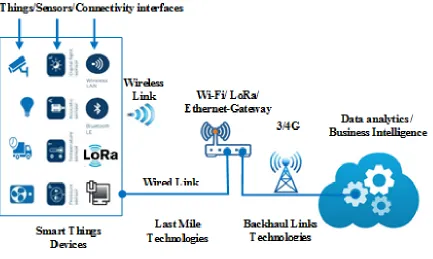
example, there are three major segments (Smart Things Devices, Last Mile Connectivity
Technologies and Backhaul Links Technologies) in IoT connectivity systems available to IoT
developers to select when developing IoT solutions, as shown in Figure 3.
At segment one, where things (these can be anything from machine to appliance or
ve-hicle) can be connected to the gateway in many different ways using long or short range,
licensed or unlicensed wireless technologies. Gateway devices can be smart phones,
sta-tionary WiFi access points (AP), LPWAN gateway (e.g., LoRa Gateway) or even cellular
networks. Low-power communication between the IoT device and gateway device using
sev-eral standards such as Bluetooth, Zigbee, IEEE 802.15.4, or IEEE 802.11 (WiFi) achieves a
Figure 3: IoT Networks Connectivity Options
tend to be less complex than mesh networks since the endpoints can be connected directly to
a gateway or a base station, rather than relying on a relay system to transmit messages ‘last
mile’ connectivity for the IoT connected objects as seen in segment two. At segment three,
which connects the gateway to the backend systems, many backhaul connectivity options
can be used from wireless cellular networks to high speed wired connectivity, such as fibre
optic links.
Unlicensed Short Range Communication Protocols
These protocols are mainly used to connect sensors with IoT boards (sensor nodes) or
con-necting these sensor nodes directly to the gateway; it all depends on the given scenario and
topology. However, these wireless technologies have low power and can be utilised for short
range connectivity scenarios. The choice of a particular technology for a particular
nodes communication capability, according to a recent whitepaper by Ericsson 1. The
ma-jority of these communication technologies use licensed free ISM bands with different radio
frequency rates.
One of the most common short-range wireless technologies with less power consumption
compared to others including the basic Bluetooth is Bluetooth Low Energy (BLE). Bluetooth
and BLE are used for different purposes (Noreen, Bounceur, & Clavier, 2017). Conventional
Bluetooth can handle almost all the variety of data, but it consumes more power and cost.
BLE, on the other hand, is used for low data rate applications, and can, therefore, have
longer battery life time. Like classic Bluetooth, BLE also utilises licensed free ISM band and
offers 40 different channels.
Another solution is the IEEE standard 802.15.4 commonly known as ZigBee, which is the
most popular choice in Low Rate Wireless Personal Area Networks (LR-WPAN) and WSNs.
For example, ZigBee has been proposed as the communication solution for a telemonitoring
health care solution in (Corchado, Bajo, Tapia, & Abraham, 2010). The IEEE standard
802.15.4 has only defined the characteristics of physical (PHY) layer and Medium Access
Control (MAC) layer. Although Bluetooth and ZigBee are low power and low complexity
wireless sensor technologies, they have some limitations, such as low data rate, short range,
and less penetration across obstacles (Noreen et al., 2017).
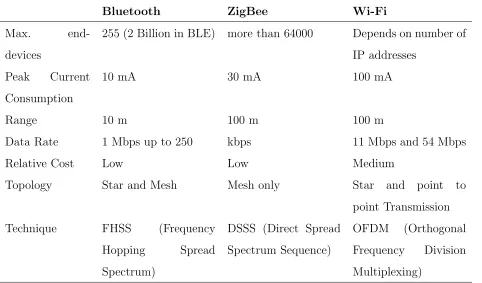
Table 1 shows a comparison of some basic features related to the above mentioned
tech-nologies used in IoT connectivity at segment one. As can be seen from Table 1, Bluetooth
BLE in particular supports much reduced power consumption at a comparable range, but
at a significantly reduced maximum data rate of 1 Mbps, which is well-suited to the most
of the IoT solutions. However, no single technology or solution is perfectly suited to all the
different potential IoT applications. In many cases, Zigbee can be a better choice providing
the underlying scenario. Ideally, the optimal short range IoT connectivity option should
have the right combination of power, coverage, data rate and cost.
Table 1: Comparison of IoT Sort Range Wireless Communication Protocols
Bluetooth ZigBee Wi-Fi
Max.
end-devices
255 (2 Billion in BLE) more than 64000 Depends on number of
IP addresses
Peak Current
Consumption
10 mA 30 mA 100 mA
Range 10 m 100 m 100 m
Data Rate 1 Mbps up to 250 kbps 11 Mbps and 54 Mbps
Relative Cost Low Low Medium
Topology Star and Mesh Mesh only Star and point to
point Transmission
Technique FHSS (Frequency
Hopping Spread
Spectrum)
DSSS (Direct Spread
Spectrum Sequence)
OFDM (Orthogonal
Frequency Division
Multiplexing)
Unlicensed Long Range Communication Protocols
The wireless network industry is gradually changing their interest from the traditional
cel-lular networks to Low Power Wide Area Networks (LPWAN). There are many LPWAN
technologies on the market today (SigFox, LoRa, Weightless-W, WiSUN, etc.), but the most
common ones are LoRa and SigFox. They successfully propose wide area connectivity from
a few to tens of kilometres for low data rate, low power and low throughput applications
(Noreen et al., 2017). They facilitate a large scale of connectivity, especially in large scale
developments such as smart city applications.
LoRa and SigFox are both long range and provide the ability to connect devices that are
very low-power for longer geographic distance. They operate at different radio frequencies
across the world. For instance, in Europe, they operate between 867-869 MHz, while in the
US – between 902-928 MHz. LoRa, the physical layer of LoRaWAN (Augustin, Yi, Clausen,
& Townsley, 2016)2, supports very low power devices (aiming for longer battery life) offering
a maximum date rate of just 27 kbps in exchange for long range, a 2-5 km range in urban
areas and in excess of 10 km in suburban areas (Battle & Gaster, 2017).
Neither LoRa nor SigFox has good indoor signal penetration, but are well suited to IoT
sensors nodes in outdoor scenarios. A key feature of these standards is that they are
low-bandwidth, often each message is limited to 100 or so bytes, and for SigFox, it is even less.
This suits IoT data requirements. Each standard has its drawbacks, but SigFox requires
more expensive chipsets in its gateways, which is not the case for LoRa. When selecting
hardware, it is important to choose the correct frequency for the required region.
Licensed Long Range Wireless Communication Protocols
To achieve longer range communication in the IoT domain, traditional cellular networks
are a visible option to many mobile operators due to the well-established infrastructure
and coverage. However, this solution is relatively expensive and power hungry as current
cellular networks were not designed to support IoT devices (Flore, 2016). Emerging network
standards such as 3GPP aimed at optimised cellular networks for IoT devices are in various
development stages (e.g., LTE-M, NB-IoT, EC-GSM-IoT, etc.), however, these are not yet
widely deployed (Bardyn et al., 2016).
The NB-IoT in particular is designed to meet the IoT device requirements related with low
cost, low power consumption and long battery life-time. This initiative was taken by 3GPP
after attempting to modify the current cellular infrastructure to meet the IoT requirements
(Marchiori, 2017). However, it did not succeeded due to complexity and cost associated
with the cellular networks, as these networks are not designed to meet the IoT applications
requirements in their initial creation.
After looking at various IoT connectivity options, the essential question that the
com-munity should ask is that, which option should be adopted? The answer really depends on
many factors, as mentioned earlier, such as cost, scalability, power consumption, availability,
interoperability, data rate requirements. LPWA IoT networks in the unlicensed bands are
limited in efficiency due to the fact that current duty cycle regulations limit the downlink
capacity, and hence the network to perform, e.g., power control. On the other hand, LPWAN
approach and technology is the way forward for many parties due to the fact that it provides
control over the infrastructure such as LoRa. However, if the national coverage is required
and important, then it probably needs to be LTE-M or NB-IoT in the future (Dama, Sathya,
Kuchi, & Pasca, 2017). This recommendation is based on the fact that the Sigfox option
leaves too many aspects outside of the developer control with no back-up plan.
Perhaps the most controversial part of the deployment cost for cellular networks is the
data plan and the cost to transfer data from the IoT device to the cloud. This cost is not
applied to LPWAN networks. Frequently, analysis of the market stops with the modem
cost, but hardware is not the only thing that should be considered. The next element
of deployment cost is the provisioning cost. Technologies like GSM and LTE provide an
enormous range that aims to provide higher and higher network throughput at the cost of
power consumption. On the other hand, LPWAN, such as LoRa, provides lower throughput
at a much lesser level of power consumption compared to its counterpart in licensed bands
(Saravanan, Das, & Iyer, 2017).
Current cellular networks require more planning and optimisation when it comes to
han-dling IoT traffic, as it requires complex protocols to support hand-off from one IoT gateway
to another where things are mobile (Ozyilmaz & Yurdakul, 2017). By comparison, LoRa
net-works can be “chaotic” with minimal planning required. Furthermore, LPWAN netnet-works do
not have to support anything like a phone-call or guarantees about streamed data; messages
are small and intermittent.
Many players tend to put the above solutions in competition to LPWAN operated in
unlicensed bands. In fact, the operation in licensed bands is more valuable for selected
pro-fessional services, while unlicensed bands provide generally better coverage, lower power and
lower cost, at the expense of a lower QoS and no guaranteed latency. Most
telecommunica-tion operators understood this complementarity and are taking advantage of the earlier time
to market through existing LPWAN solutions in unlicensed bands (Bardyn et al., 2016).
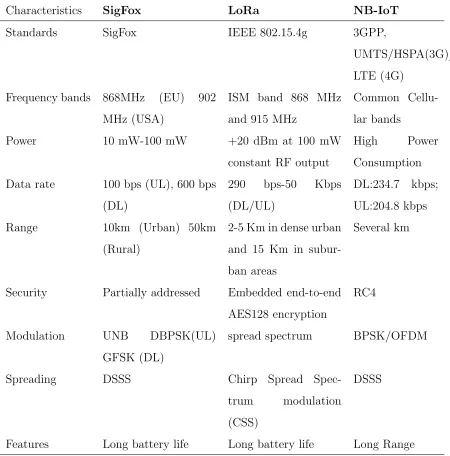
Table 2 summarises the differences among the most common licensed and unlicensed, low
power and long range wireless communication protocols. Finally, the authors strongly argue
that low-power wide-area (LPWA) technologies like LoRa and cellular-based (NB-IoT) will
Table 2: Wireless Communication Protocols
Characteristics SigFox LoRa NB-IoT
Standards SigFox IEEE 802.15.4g 3GPP,
UMTS/HSPA(3G)/
LTE (4G)
Frequency bands 868MHz (EU) 902
MHz (USA)
ISM band 868 MHz
and 915 MHz
Common
Cellu-lar bands
Power 10 mW-100 mW +20 dBm at 100 mW
constant RF output
High Power
Consumption
Data rate 100 bps (UL), 600 bps
(DL)
290 bps-50 Kbps
(DL/UL)
DL:234.7 kbps;
UL:204.8 kbps
Range 10km (Urban) 50km
(Rural)
2-5 Km in dense urban
and 15 Km in
subur-ban areas
Several km
Security Partially addressed Embedded end-to-end
AES128 encryption
RC4
Modulation UNB DBPSK(UL)
GFSK (DL)
spread spectrum BPSK/OFDM
Spreading DSSS Chirp Spread
Spec-trum modulation
(CSS)
DSSS
Edge Computing Constraints
Edge computing refers to bringing the core cloud services, computations, and data at the
close proximity of data sources in IoT, i.e., sensing devices and systems (Mao et al., 2017;
Chiang & Zhang, 2016; Hu, Patel, Sabella, Sprecher, & Young, 2015; Garcia Lopez et al.,
2015). Edge computing benefits by enabling local intelligence and distributed data processing
at the edge of the Internet, hence it reduces backhaul traffic. Since the cost of computing on
the edge is reducing and energy efficiency is increasing, data mining on the edge is a feasible
choice. At the same time, data stream is massively evolving in terms of volume and velocity,
and it contains great value for citizens and organisations.
Data mining applications in IoT devices and systems could be fully deployed on the edge,
but they always require additional support from large-scale cloud infrastructures. The edge
computing network is based on multiple layers including edge devices (i.e., sensors, data
gen-erators, and sensing systems), edge nodes (i.e., smart phones, smart vehicles, or any other
devices or systems having enough computational capabilities to support data processing
re-quirements of edge devices), edge gateway (which provides interface between edge devices and
backend network) (Chiang & Zhang, 2016), and edge computing servers that are based on
micro data centres, cloudlets, edge servers, and RAN servers. Edge computing systems also
encompass SCADA systems, cyber physical systems, software defined networking, network
function virtualisation, and robotic technologies. Edge computing systems enable massively
distributed, resilient, and scalable IoT systems for low latency real-time distributed data
mining systems. In addition, these systems provide access to spatio-temporal data streams,
local and geographically distributed intelligence, and distributed security and privacy
con-trols of data and systems (Montero et al., 2015). Edge computing systems are facilitated
by D2D Communication at the edge, location-awareness, proximal computing, and
context-aware networking (Amento et al., 2016).
Despite immense benefits and high utility, several challenges must be addressed before
full adoption of edge computing technologies. New standards, benchmarks, and
market-places are needed considering the massive heterogeneity in terms of data, devices,
models (Dastjerdi, Gupta, Calheiros, Ghosh, & Buyya, 2016; Varghese, Wang, Barbhuiya,
Kilpatrick, & Nikolopoulos, 2016; Garc´ıa, Fern´andez, Ruiz-Cortes, Dustdar, & Toro, 2017).
In addition, new frameworks, programming models, and languages are needed (Varghese
et al., 2016). The edge-first approach in edge computing systems require lightweight data
mining libraries, APIs, assemblies, and algorithms (Varghese et al., 2016). Considering the
different features of IoT devices, new micro operating systems and data mining specific
micro-services could be adopted. Also, containerisation and virtualisation technologies can
enable fast data processing across the edge networks (Varghese et al.,2016;Farahmandpour,
Versteeg, Han, & Kameswaran, 2017).
Mobility is the primary characteristic of most of IoT devices, however, inconsistent
inter-mittent Internet connectivity and low bandwidth can easily lead towards application failures
which may degrade the quality of service and quality of experience (Liang,2017). Therefore,
data management and data governance strategies are needed in order to ensure seamless
exe-cution of data mining applications in edge computing systems (Rehman, Sun, Wah, & Khan,
2016). In addition, the continuous data transfer in cloud servers increases the cost of data
communication, hence application processing within edge computing systems can decrease
this cost. Efficient resource management across edge computing systems and backend cloud
is required in order to maximise the utilisation of IoT systems (L. Wang, Jiao, Kliazovich,
& Bouvry, 2016). Data mining methods can help in monitoring, detection, and
predict-ing resource-intensive operations in IoT applications in order to develop efficient resource
management schemes. IoT devices has bounded computing, networking, and battery power
resources, therefore, it is quite challenging to orchestrate general purpose computing services
on the edge (Rehman, Sun, Wah, & Khan,2016). Data mining applications are implemented
in the form of complete data pipeline that converts raw data streams into knowledge
pat-terns. The computational complexities and resource consumption of each data conversion
operation vary among different applications, therefore, developing application partitioning
and computation offloading strategies in edge computing systems becomes very hard (Orsini,
Bade, & Lamersdorf, 2015; Rehman, Sun, Wah, & Khan, 2016; Rehman, Sun, Wah, Iqbal,
& Jayaraman, 2016; Samie et al., 2016).
Figure 4: Categorisation of Data Mining Techniques for IoT
which can significantly impact the quality of experience. Although researchers have
pro-posed different recovery schemes for overloaded MEC servers (Satria, Park, & Jo,2017), the
schemes work by offloading the workloads to nearest MEC servers. However, efficient and
intelligent recovery schemes are needed in order to execute computation-intensive processes
(such as virtual reality and computer vision applications) in MEC servers. Alternately,
proactive service replications help in handling overloaded servers but the replicated services
increase the resource consumption and bandwidth utilisation across edge computing system.
Having discussed the major issues and solutions for realising IoT applications including
issue pertaining to privacy-preserving, networking and resource constraints at the edge, the
following section discusses data mining methods and systems suited for IoT applications.
Data Mining Methods and Systems in IoT
Methods
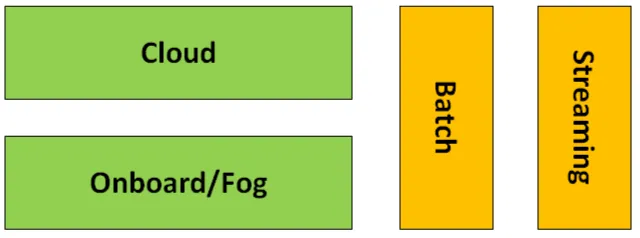
Data mining techniques used in IoT applications can be broadly categorised according to
their execution platform into (1) onboard and (2) cloud-based. They can also be categorised
according to the mode of operation to (1) batch and (2) streaming. Figure4shows these two
classifications of the adopted data mining techniques in IoT. In the following, we provide a
discussion of each category, and the suitability to various IoT applications.
Onboard data miningmethods have the capability to run in resource-constrained
envi-ronments. Onboard data mining algorithms have been developed for wireless sensor networks
of motives make such methods particularly suitable for IoT applications including addressing
privacy issues and networking constraints discussed in the previous section. Early work in
the area of onboard data mining can be traced back to lightweight data mining methods
developed using granularity-based approach (M. Gaber, Krishnaswamy, & Zaslavsky, 2005;
M. M. Gaber & Yu, 2006; M. Gaber, 2009; M. M. Gaber & Philip, 2006). It is worth noting
that the onboard methods may run out of the ‘thing(s)’ at a computational facility closer
to the data source, forming what is usually referred to as fog computing (S. Yi, Li, & Li,
2015). Onboard data mining enables what has been termed as smart objects in (Kortuem,
Kawsar, Sundramoorthy, & Fitton, 2010) to be realised. Smart objects are things that are
not only able to sense the environment they operate in, but also to interpret events and react
to them.
Cloud-based data miningmethods are designed for scalability through parallelisation
and distribution of processes and data sets for large volumes of data. These methods are
best fit for IoT applications that run at a national level, or more generally over a large
geographical area. When data are collected and possibly aggregated from various ‘things’,
they can be used for longer term data mining tasks. Examples of such IoT applications can
be weather forecasting, environmental monitoring, and large scale healthcare applications.
A number of platforms have been developed by giant vendors including Google3, IBM4 and
Microsoft5. For example, the authors in (Loai, Mehmood, Benkhlifa, & Song, 2016) discuss
the use of data mining methods in the cloud to enable efficient healthcare services, utilising
advances in networking capabilities. The use ofcloudlet as a hardware infrastructure between
the cloud and mobile devices used by patients is proposed to reduce latency.
The aforementioned two categories organise the data mining methods applied to IoT
applications according to the executing location. However, regardless to where the data
mining process is done, there are two modes of operating these methods, namely, batch and
streaming.
Batch data mining methods operate on stored data, as the methods are inherently iterative. These methods suit IoT applications that operate on historical data at different
3https://cloud.google.com/iot-core/ 4https://www.ibm.com/internet-of-things