Original Research Article
Esomeprazole versus omeprazole for the eradication of
Helicobacter pylori infection
Rawan Ageeli
1*, Abdullah Binobaid
2, Abdullah Aljadaan
3, Mohammed Alhagbani
3,
Yasser Alotaibi
4, Thamer Alenazi
5, Mohammed Alhajjaj
3, Abdullh Altawili
5,
Fuad Alotaibi
6, Najlaa Felimban
7INTRODUCTION
Proton pump inhibitors (PPIs) suppress gastric acid secretion by inhibiting hydrogen-potassium adenosine
triphosphatase that transports acid from gastric parietal cells into the gastroesophageal lumen. They are specified for the treatment of acid-related diseases, for example, peptic ulcer disease (PUD), gastroesophageal reflux
ABSTRACT
Background: Proton pump inhibitors (PPIs) are one of the most commonly used classes of drugs. Though, the quantum clinical benefit of newer and more expensive PPIs over the older generation PPIs residues undefined. The present meta-analysis ought to assess the safety and clinical profiles of esomeprazole versus omeprazole at pharmacologically equivalent doses in healing gastroesophageal reflux disease (GERD), peptic ulcer disease and eradicating Helicobacter pylori infection.
Methods: PubMed and the Cochrane Library were searched for randomized controlled trials comparing esomeprazole with omeprazole at all doses up to July 2017. Meta-analysis was conducted using a random effects model, and heterogeneity in the estimated effects was investigated using meta-regression.
Results: Eleven trials were included and none of which compared esomeprazole with omeprazole in peptic ulcer disease. In gastroesophageal reflux disease, esomeprazole 40 mg (relative risk (RR) = 1.11; 95% confidence interval (CI) 1.14 to 1.23) and 20 mg (RR=1.08; 95% CI 1.02 to 1.12) significantly improved esophagitis healing when compared with omeprazole 20 mg at week 8. In H. pylori eradication, there was no difference in the treatment effects between esomeprazole 20 mg and omeprazole 20 mg (RR = 1.05;95% CI 1.01 to 1.11).
Conclusions: Esomeprazole established better esophagitis healing rate in patients with GERD than omeprazole at week 8. Though, this clinical advantage reduced when both drugs were given at the same doses at week 4. Superiority of esomeprazole was not perceived in the H. pylori eradication rates.
Keywords: Proton pump inhibitors, Esomeprazole, Helicobacter pylori, Omeprazole
1Jazan University, Jazan, KSA 2Alfaisal University, Riyadh, KSA
3Arabian Gulf University, Manama, Bahrain 4
King Abdulaziz Hospital, Jeddah, KSA
5King Salman Armed Forces Hospital, Tabuk, KSA 6Saudi Red Cresent Authority, Riyadh, KSA 7King Fahad General Hospital, Jeddah, KSA
Received: 14 April 2018 Revised: 24 May 2018 Accepted: 25 May 2018
*Correspondence: Dr. Rawan Ageeli,
E-mail: [email protected]
Copyright: © the author(s), publisher and licensee Medip Academy. This is an open-access article distributed under the terms of the Creative Commons Attribution Non-Commercial License, which permits unrestricted non-commercial use, distribution, and reproduction in any medium, provided the original work is properly cited.
disease (GERD) and Helicobacter pylori (H. pylori) eradication in combination with antibiotics. PPIs are one of the most commonly prescribed classes of drug. The new generation PPIs containing esomeprazole, dexlansoprazole and rabeprazole are intended to have better clinical efficacy and bioavailability than early generation omeprazole.1
Though, indication comparing efficacy of these drugs with the older generation or between different dosing regimens has been varying with regard to symptom resolution, esophagitis healing, and H. pylori eradication. Moreover, many of these trials were commissioned by pharmaceutical company and had compared doses of PPIs licensed by the United States Food and Drug Administration rather than pharmacologically equivalent doses that are used in the real world. Omeprazole, the first in PPI drug class, contains a racemic compound of which only the S-enantiomer is active, while the R enantiomer is not. Esomeprazole contains only the purified S-enantiomer and has been reported to have enhanced bioavailability of 68% compared with omeprazole (60%) at 20 mg, dose for dose.2 This explains better and longer acid suppression and has been suggested to be the basis for improved clinical efficacy.3 Regardless of the advantage in bioavailability, comparative studies between omeprazole and esomeprazole have displayed conflicting data with some meta-analyses presented a small while significant advantage in esophagitis healing, while other studies indicated no significant difference in effectiveness.4,5
This clearly would have a big influence on cost difference where healthcare delivery system in every country is pressed to adopt innovative and new health technologies in an evidence-based manner, while making sure that they can be managed within obtainable resources. It similarly requests the question whether certain acid-related disease groups would benefit particularly from the benefit of esomeprazole and explain its high cost. Thus, we performed a meta-analysis that comprised the most recent head-to-head trials to determine the efficacy and safety of omeprazole compared with esomeprazole at all doses.
METHODS
Search strategy
A systematic search of PubMed and the Cochrane Library was conducted up to July 2017 to recognize relevant trials. We also searched for additional trials included in published systematic reviews and bibliographies of all relevant studies.
Study selection and eligibility criteria
Two reviewers screened abstracts according to predefined study inclusion criteria. Full text articles (published in English) were retrieved and reviewed if a decision on
inclusion could not be made solely based on the abstract. Any disagreements were resolved by consensus between the two reviewers. We included head-to-head randomized controlled trials (RCTs) which compared oral esomeprazole with oral omeprazole, in any dose, in the management of GERD or peptic ulcer disease. The study participants were adults aged 18 years and above who had GERD, peptic ulcer disease or H. pylori infection. The outcomes of interest included resolution of GERD-related symptoms, esophagitis healing, peptic ulcer healing, H. pylori eradication, quality of life and adverse effects. Studies that involved specific patient groups (e.g. elderly), reported only intragastric acidity or pH measurement, and of which the PPIs were used as prophylaxis for NSAID-induced ulcers were excluded.
Data analysis
We performed meta-analyses of outcomes as appropriate by combining trials based on a random effects model in Stata software, version 13.0. Outcomes were summarized as relative risks (RR) with 95% confidence intervals (CI). We also calculated number needed to treat (NNT) from risk difference. Statistical heterogeneity between trials was evaluated using chi-square test at a significance level of p<0.1 and I2 statistic. The value of I2 statistic ranges from 0% to 100%, with 0% representing no observed heterogeneity and larger values indicating increasing heterogeneity. A value of I2 below 25% was chosen to represent low heterogeneity.6 When the P value for the chi-square test was 25%, the heterogeneity would be considered important and meta-regression would be carried out to investigate the heterogeneity where possible. Sensitivity analysis or subgroup analysis was performed to test the robustness of the results and account for any differences in the study level characteristics such as ethnicity, antibiotic regimen and maintenance therapy in H. pylori eradication.
RESULTS
We recognized 468 citations using the search strategy. Of these, we excluded 347 after examining the title and abstract including removal of duplicates. We retrieved and evaluated 23 articles in more detail, of which 12 articles were excluded, leaving 11 RCTs that were eligible for inclusion (Figure 1).7-17
H. pylori treatment.7-11 Table 2 summarized the characteristics and main results of these studies.
The primary outcomes of the studies evaluating RE were the proportion of patients who achieved endoscopically confirmed healing and the proportion who achieved complete resolution of GERD-related symptoms at week 8. Secondary outcomes included esophagitis healing and symptom relief at week 4. The primary endpoint of the study evaluating ENRD was the proportion of patients with complete resolution of heartburn as defined by no heartburn episodes during the previous seven consecutive days. In all of these studies, symptom relief was assessed subjectively by investigator or patients.
Esophagitis healing rates: We meta-analysed the esophagitis healing rates at week 4 and week 8. The RRs for esomeprazole 40 mg and 20 mg compared with omeprazole 20 mg at week 8 were 1.11 (95% CI 1.14 to 1.23) and 1.08 (95% CI 1.02 to 1.12), respectively. The calculated risk differences were 6% and 3.3%, which corresponded to NNT of 17 and 30, respectively. At week 4, the RR of esomeprazole 40 mg versus omeprazole 20
mg was 1.13 (95% CI 1.04 to 1.22) and the corresponding NNT was 12. There was no significant difference between esomeprazole 20 mg versus omeprazole 20 mg (based on one study) (Table 4).
Figure 1: Flow diagram showing the selection criteria of assessed studies.
Table 1: Characteristics and main results of studies evaluating endoscopically confirmed reflux esophagitis.
Study Year Treatment
arms N
Healing rate (week 4) by ITT (%)
Healing rate (week 8) by ITT (%)
Heartburn resolution (week 4) (%)
P value
Schmitt7 2006 E 40 mg QD 576 68.2% 86.9 64.9 p>0.05 O 20 mg QD 572 66.3% 85.8 63.1
Zheng8 2009 E 40 mg QD 68 Not reported 91.2 Not reported p>0.05 O 20 mg QD 68 Not reported 83.8 Not reported
Richter9 2001 E 40 mg QD 1216 78.6% 89.9 68.3 p<0 05 O 20 mg QD 1209 66.6% 80.9 58.1
Lightdale10 2006 E 40 mg QD 588 Not reported 86.5 60.5 p>0.05 O 20 mg QD 588 Not reported 82.3 60.5
Kahrilas11 2000
E 20 mg QD 656 66.5% 83.8 52.4 p>0.05 E 40 mg QD 654 71.1% 87.5 63.7
p<0 05 O 20 mg QD 650 61.4% 81.4 57.2
Table 2: Characteristics and main results of studies evaluating H. pylori infection.
Study Year Treatment
arms Antibiotics Treatment duration
Eradication rates by ITT (%)
Veldhuyzen12 2003 E 20 mg BID Metronidazole 500 mg BID Clarithromycin 500 mg BID
7 days+3 weeks maintenance
75.8
O 20 mg BID 72.5
Subei13 2007 E 20 mg BID Amoxicillin 1 g BID Clarithromycin 500 mg BID
7 days+3 weeks maintenance
74.7
O 20 mg BID 78.7
Sheu14 2005 E 40 mg BID Amoxicillin 1 g BID
Clarithromycin 500 mg BID 7 days
86,00
O 20 mg BID 79,00
Choi15 2007 E 40 mg BID Amoxicillin 1 g BID
Clarithromycin 500 mg BID 7 days
70.3
O 20 mg BID 65,00
Anagnostopoulos16 2004
E 40 mg QD
Amoxicillin 1 g BID
Clarithromycin 500 mg BID 7 days
81,00
E 40 mg BID 96.2
Table 3: Characteristics and main results of study evaluating endoscopy-negative reflux disease.
Study Year Treatment
arms N
Percentage of patients with heartburn resolution at week 4 (95% CI)
Armstrong17
(study A) 2004
E 40 mg QD 425 56.7 (52–62) E 20 mg QD 423 60.5 (52–62) O 20 mg QD 434 58.1 (53–63) Armstrong17
(study B) 2004
E 40 mg QD 347 70.3 (65–75) O 20 mg QD 346 67.9 (63–73) Armstrong17
(study C) 2004
E 20 mg QD 336 61.9 (57–67) O 20 mg QD 334 59.6 (54–65)
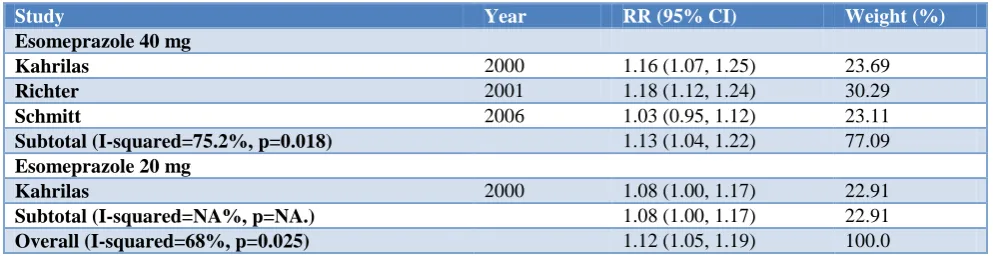
Table 4: Forest plot demonstrating the relative risk (RR) with 95% confidence interval (CI) of esophagitis healing rates of esomeprazole 40 mg and 20 mg compared with omeprazole 20 mg once daily at week 4.
Study Year RR (95% CI) Weight (%)
Esomeprazole 40 mg
Kahrilas 2000 1.16 (1.07, 1.25) 23.69
Richter 2001 1.18 (1.12, 1.24) 30.29
Schmitt 2006 1.03 (0.95, 1.12) 23.11
Subtotal (I-squared=75.2%, p=0.018) 1.13 (1.04, 1.22) 77.09
Esomeprazole 20 mg
Kahrilas 2000 1.08 (1.00, 1.17) 22.91
Subtotal (I-squared=NA%, p=NA.) 1.08 (1.00, 1.17) 22.91 Overall (I-squared=68%, p=0.025) 1.12 (1.05, 1.19) 100.0
Esophagitis healing rates: We meta-analysed the esophagitis healing rates at week 4 and week 8. The RRs for esomeprazole 40 mg and 20 mg compared with omeprazole 20 mg at week 8 were 1.11 (95% CI 1.14 to 1.23) and 1.08 (95% CI 1.02 to 1.12), respectively. The calculated risk differences were 6% and 3.3%, which corresponded to NNT of 17 and 30, respectively. At week 4, the RR of esomeprazole 40 mg versus omeprazole 20 mg was 1.13 (95% CI 1.04 to 1.22) and the corresponding NNT was 12. There was no significant difference between esomeprazole 20 mg versus omeprazole 20 mg (based on one study) (Table 4).
Three of the RE studies reported the proportion of patients with heartburn resolution at week 4.7,9,11 The heartburn resolution rate ranged from 64% to 68% for patients on esomeprazole 40 mg and 57% to 63% for those on omeprazole 20 mg. Meta-analysis for the rate of heartburn resolution was not performed given that the definition of this endpoint differed among the studies. Only one study evaluating ENRD was included.17 In this study, esomeprazole 40 mg and 20 mg were compared with omeprazole 20 mg once daily for 4 weeks in symptomatic patients with ENRD. There was no significant difference in the proportion of patients who achieved heartburn resolution among the groups.
The eradication rate related with esomeprazole (regardless of dose) ranged from 70% to 96%, whereas that for omeprazole ranged from 65% to 88%. The RRs for esomeprazole 40 mg and 20 mg compared with omeprazole 20 mg twice daily were 1.21 (95% CI 1.13 to
1.29) and 1.05 (95% CI 1.01 to 1.11), respectively. Heterogeneity was observed in the analysis of esomeprazole 40 mg dose (I2=49%, p=0.13). However, meta-regression analysis could not be performed due to insufficient number of studies.
DISCUSSION
The present meta-analyses clarifies that esomeprazole 40 mg and 20 mg were statistically more effective than omeprazole 20 mg once daily for esophagitis healing at 8 weeks in patients with GERD. Though, the difference was marginal, with the lower bound of CI approaching 1.0. The corresponding NNT was also not promising. According to a Cochrane systematic review that compared PPIs with H2-receptor antagonists and placebo in the treatment of esophagitis, PPI was associated with a NNT of three and two, respectively.18,19 Esomeprazole 20 mg did not significantly improve the esophagitis healing at week 4. This recommended that esomeprazole would have limited clinical benefit over omeprazole if the duration of PPI treatment was 4 weeks.
When used in combination with antibiotics for H. pylori
antisecretory activity than omeprazole on milligram basis and result in better efficacy. Though, our analysis showed that the efficacy of esomeprazole and omeprazole did not differ significantly in achieving H. pylori eradication when combined with antimicrobial agents (amoxicillin and clarithromycin or clarithromycin and metronidazole) as a standard triple therapy. This was probable as a result of the fact that the extent of bacterial susceptibility to antimicrobial agents contributes to the H. pylori
eradication and that the necessary level of acid inhibition for H. pylori eradication within a standard triple therapy could be achieved with either omeprazole or esomeprazole. It was notable that omeprazole 20 mg was inferior to esomeprazole 20 mg in the absence of omeprazole maintenance therapy. However, these outcomes were derived from the meta-analysis of only two studies. The rate of adverse effects was commonly greater in studies on GERD than H. pylori eradication, which implied that the treatment duration correlated to incidence of adverse effects. Treatment with esomeprazole was related with higher rates of adverse effects such as abdominal pain and headache than omeprazole. Nevertheless, the difference did not reach statistical significance. Generally, both drugs demonstrated similar safety profiles.
The present meta-analyses distinguished itself from previous reviews by comprising most recent comparative trials of esomeprazole and omeprazole. Majority of the previous systematic reviews comparing PPIs in the management of GERD were supported by industry.20,21 These studies assessed the effects of esomeprazole 40 mg versus other PPIs and reported that esomeprazole was superior in healing esophagitis. Furthermore, the treatment difference between esomeprazole at 20 mg and other PPIs was not investigated. In the present meta-analyses study, a rigorous and systematic search strategy was applied, which provides more robust results. To provide a realistic comparison given that esomeprazole is the active enantiomer of omeprazole, which is akin to omeprazole at double dose, we evaluated the effectiveness of esomeprazole versus omeprazole on pharmacologically comparable doses. As esomeprazole is the active enantiomer of omeprazole, it would be more rational to compare omeprazole 40 mg with esomeprazole 20 mg. Though, there were no available clinical studies that compared omeprazole 40 mg with esomeprazole. A potential research area would be to compare the effectiveness of omeprazole 40 mg with esomeprazole in treating gastroesophageal reflux disease.
CONCLUSION
Esomeprazole provided a statistically significant but marginal degree of improvement in esophagitis healing when compared with omeprazole. Though, this clinical benefit in patients with gastroesophageal reflux disease reduced when the treatment duration was within 4 weeks. There was no difference in the H. pylori eradication rates when esomeprazole and omeprazole were given at the
same doses. Based on our analysis, it is practical to consider other factors such as the cost of treatment, severity of esophagitis, bacterial susceptibility to antimicrobial agents and variation in CYP2C19 genotype when prescribing these agents to patients with GERD or
H. pylori infection.
Funding: No funding sources Conflict of interest: None declared
Ethical approval: The study was approved by the Institutional Ethics Committee
REFERENCES
1. Peura DA, Berardi RR, Gonzalez J, Brunetti L. The value of branded proton pump inhibitors: formulary considerations. PT. 2011;36:434–45.
2. Omeprazole (Losec) Capsule Package Insert. Astra Zeneca August 2012. Available at: http://www.hsa.gov.sg
3. Saccar CL. The pharmacology of esomeprazole and its role in gastric acid related diseases. Expert Opin Drug Metab Toxicol. 2009;5:1113–24.
4. Edwards SJ, Lind T, Lundell L. Systematic review of proton pump inhibitors for the acute treatment of reflux oesophagitis. Aliment Pharmacol Ther. 2001;15:1729–36.
5. Ip S, Chung M, Moorthy D, Yu WW, Lee J, Chan JA, et al. Comparative Effectiveness of Management Strategies for Gastroesophageal Reflux Disease: Update. AHRQ Comparative Effectiveness Reviews. Rockville, MD: Agency for Healthcare Research and Quality (US). 2011. 6. Higgins JP, Thompson SG, Deeks JJ, Altman DG.
Measuring inconsistency in metaanalyses. BMJ. 2003;327:4.
7. Schmitt C, Lightdale CJ, Hwang C, Hamelin B. A multicenter, randomized, double-blind, 8-week comparative trial of standard doses of esomeprazole (40 mg) and omeprazole (20 mg) for the treatment of erosive esophagitis. Dig Dis Sci. 2006;51:844– 50.
8. Zheng RN. Comparative study of omeprazole, lansoprazole, pantoprazole and esomeprazole for symptom relief in patients with reflux esophagitis. World J Gastroenterol. 2009;15:990–5.
9. Richter JE, Kahrilas PJ, Johanson J, Maton P, Breiter JR, Hwang C, et al. Efficacy and safety of esomeprazole compared with omeprazole in GERD patients with erosive esophagitis: a randomized controlled trial. Am J Gastroenterol. 2001;96:656– 65.
10. Lightdale CJ, Schmitt C, Hwang C, Hamelin B. A multicenter, randomized, double-blind, 8-week comparative trial of low-dose esomeprazole (20 mg) and standard-dose omeprazole (20 mg) in patients with erosive esophagitis. Dig Dis Sci. 2006;51:852– 7.
improves healing and symptom resolution as compared with omeprazole in reflux oesophagitis patients: a randomized controlled trial. The Esomeprazole Study Investigators. Aliment Pharmacol Ther. 2000;14:1249–58.
12. Veldhuyzen Van Zanten S, Machado S, Lee J. One-week triple therapy with esomeprazole, clarithromycin and metronidazole provides effective eradication of Helicobacter pylori infection. Aliment Pharmacol Ther. 2003;17:1381–7.
13. Subei IM, Cardona HJ, Bachelet E, Useche E, Arigbabu A, Hammour AA, et al. One week of esomeprazole triple therapy vs 1 week of omeprazole triple therapy plus 3 weeks of omeprazole for duodenal ulcer healing in Helicobacter pylori-positive patients. Dig Dis Sci. 2007;52:1505–12.
14. Sheu BS, Kao AW, Cheng HC, Hunag SF, Chen TW, Lu CC, et al. Esomeprazole 40 mg twice daily in triple therapy and the efficacy of Helicobacter pylori eradication related to CYP2C19 metabolism. Aliment Pharmacol Ther. 2005;21:283–8.
15. Choi HS, Park DI, Hwang SJ, Park JS, Kim HJ, Cho YK, et al. Doubledose, new-generation proton pump inhibitors do not improve Helicobacter pylori eradication rate. Helicobacter. 2007;12:638-42. 16. Anagnostopoulos GK, Tsiakos S, Margantinis G,
Kostopoulos P, Arvanitidis D. Esomeprazole versus omeprazole for the eradication of Helicobacter pylori infection: results of a randomized controlled study. J Clin Gastroenterol. 2004;38:503–6.
17. Armstrong D, Talley NJ, Lauritsen K, Moum B, Lind T, Tunturi-Hihnala H, et al. The role of acid suppression in patients with endoscopy-negative reflux disease: the effect of treatment with esomeprazole or omeprazole. Aliment Pharmacol Ther. 2004;20:413–21.
18. Vakil N, Fennerty MB. Direct comparative trials of the efficacy of proton pump inhibitors in the management of gastro-oesophageal reflux disease and peptic ulcer disease. Aliment Pharmacol Ther. 2003;18:559–68.
19. Khan M, Santana J, Donnellan C, Preston C, Moayyedi P. Medical treatments in the short term management of reflux oesophagitis. Cochrane Database Syst Rev. 2007:CD003244.
20. Edwards SJ, Lind T, Lundell L. Systematic review: proton pump inhibitors (PPIs) for the healing of reflux oesophagitis - a comparison of esomeprazole with other PPIs. Aliment Pharmacol Ther. 2006;24:743–50.
21. Gralnek IM, Dulai GS, Fennerty MB, Spiegel BM. Esomeprazole versus other proton pump inhibitors in erosive esophagitis: a meta-analysis of randomized clinical trials. Clin Gastroenterol Hepatol. 2006;4:1452–8.