Original Research Article
Prevalence of diabetes and prediabetes among rural
South Indian population
Akash Gajanan Prabhune
1*, Biwesh Ojha
2, Aparna Manoharan
1INTRODUCTION
The international diabetes federation’s, diabetes atlas 2017, estimates that the global prevalence of diabetes is 424.9 (346.4-545.4) million cases; and is expected to rise to 628.6 (477.0-808.7) million cases by 2045. Globally, 4.0 (3.2-5.0) million death were due to diabetes in 2017. Global prevalence of individuals with prediabetes, defined in terms of impaired glucose tolerance, shows an additional 352.1 (233.5-577.3) million known cases, who
are at higher risk of being diagnosed with diabetes. South-East Asia is home to 8.6% of total global population and with the raw prevalence of diabetes of 8.5% (6.5–10.7%).1–3 Currently, China ranks first in the prevalence of diabetes with 114.4 million diagnosed cases of diabetes, India ranks second with 72.9 million diagnosed cases. India is to rank first in diabetes prevalence, with 134.3 million diagnosed cases of diabetes by 2045.4
ABSTRACT
Background: Objective of this study was to assess the prevalence of self-reported and undiagnosed diabetes and prediabetes cases in rural south Indian population.
Methods: The study was carried as secondary analysis of the data collected in our Health management information system (HMIS) as a part of our health systems initiative in Alakkudi gram panchayat, Thanjavur district, Tamil Nadu, India. We analysed the fasting glucose and post prandial glucose values of 1307 individuals form our database to assess the prevalence of undiagnosed diabetes and prediabetes as per the cut off recommended by Indian Council of Medical Research 2018 diabetes diagnostic criteria. We also presented the descriptive analysis of demographic features, risk behaviour, anthropometric data along with personal and family history of all the individuals analysed in this study. The secondary data retrieved from the HMIS system was free of any personal identifiers.
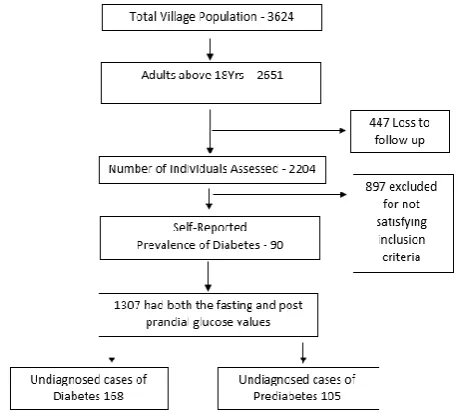
Results: The self-reported prevalence of diabetes among adults in the village was 6.88% (90 out of 1307). The prevalence of undiagnosed diabetes among adults of Alakkudi village was 12.85% (168 out of 1307) and the prevalence of undiagnosed prediabetes among adults of Alakkudi village was 8.03% (105 out of 1307). Proportion of undiagnosed cases of diabetes in the village was 53%.
Conclusions: The proportion of undiagnosed cases of diabetes is quite high in rural India and the proportion of prediabetes is also higher. It is the need of the hour to create awareness regarding diabetes and prediabetes amongst the rural India population and increasing health systems efforts for regular community-based screening among the rural Indians.
Keywords: Rural healthcare, Diabetes burden, Prediabetes
1IKP Center for Technologies in Public Health, Thanjavur, Tamil Nadu, India 2
Department ofPublic Health and Environment Research Center, Lalitpur, Nepal
Received: 13 November 2018
Revised: 10 December 2018
Accepted: 12 December 2018
*Correspondence:
Dr. Akash Gajanan Prabhune, E-mail: [email protected]
Copyright: © the author(s), publisher and licensee Medip Academy. This is an open-access article distributed under the terms of the Creative Commons Attribution Non-Commercial License, which permits unrestricted non-commercial use, distribution, and reproduction in any medium, provided the original work is properly cited.
The diagnosed cases of diabetes present the high burden of non-communicable diseases worldwide. Globally, there exist an estimated 212.4 million undiagnosed cases of diabetes. This implies half of the people aged 20-79 are unaware of their disease. This undetected diabetes presents a huge challenge for health systems and is a matter of concern for policymakers. An estimated 57.6% of undiagnosed cases are in South-East Asia region.
In India, an estimated 4.2 million (57.9%) cases of diabetes were unidentified and unperceived in 2017. 5,6 A study by Indian Council of Medical Research– INdia DIABetes in 2017 estimates overall prevalence of diabetes in India to be 7·3% (95% CI 7·0–7·5) and the overall prevalence of pre diabetes 10·3% (10·0–10·6).7 The data from the study shows that Tamil Nadu a southern Indian state, has a second largest prevalence of diabetes and prediabetes. Urban centers of Tamil Nadu were reporting higher prevalence than rural centers. Objective of this study was to assess the prevalence of self-reported and undiagnosed diabetes and prediabetes cases in rural south Indian population.
METHODS
The study was conducted as a secondary analysis of data collected by out Health care facility based in Alakkudi gram panchayat, Thanjavur district Tamil Nadu. IKP Center for Technologies in Public Health (ICTPH) is a not for profit organization based in Thanjavur district, Tamil Nadu (A Southern Indian State). ITCPH operates a health subcenter level facility in Alakkudi gram panchayat (PIN – 609101) under universal health care policy. The health care facility is housed with AYUSH physician and a Health care worker. The facility is open to all the residents of Alakkudi Gram panchayat and the residents of villages in 3Km. periphery of the Alakkudi gram panchayat. 8
As the part of ICTPH’s health systems initiative, a cross sectional survey of all the residents of Alakkudi is carried out every five years. The survey is carried out by locally haired and trained field agents. The field agents visit each house located within the jurisdiction of Alakkudi gram panchayat. The survey is household based and all the members of a household are enrolled under the name of prime bread winner of the house. The field agents would collect demographic data like age, sex, marital status and anthropometric measurement like weight, height, waist circumference, hip circumference, blood pressure measurements (two successive measurements). Personal history of diabetes and hypertension along with family history was also recorded. Data on smoking, alcohol consumption, smokeless tobacco usage was also collected. Each surveyed individual was handed over a coupon to get his/her blood sugar level tested from the health center. Each coupon was valid for 1 year and the coupon holder could avail two fasting blood glucose and two post prandial glucose test in a year at ICTPH healthcare facility in Alakkudi village.
The data form the survey was recorded and uploaded into the health management information system and the results of the blood glucose tests availed were linked to the person Id in our database. We undertook the analysis of the data collected on blood glucose values of the all the people who availed the blood glucose tests at our heath care facility from August 2016 to July 2017 with and objective to estimate the prevalence of undiagnosed diabetes and prediabetes among village residents. The data was delinked with all kinds of personal identifiers like name, family name, address of residence.
Inclusion criteria
Persons aged 18 years and above, Individuals who had reported to health center for blood glucose test at-least once during the study timeline and will valid values of fasting and post prandial blood glucose values.
Exclusion criteria
Persons aged less than 18 years, individuals with either fasting blood glucose value or post prandial glucose value
Statistical analysis
During the survey, we enrolled 3621 individual residents of Alakkudi from 1105 households. Adults aged 18 years or above were 2651. Out of the 2651 adults 2204 (83%) followed up at health care facility for blood glucose test. Of the 2204 reported 90 were either under glycemic control medication or had a history of diabetes medication. 897 (40.70%) out of 2204 had test values for either fasting blood glucose or post prandial blood glucose hence were excluded from the analysis. 1307 (59.30%) individuals were having the valid values of both fasting blood glucose and post prandial glucose values.
We used Indian Council of Medical Research 2018 criteria for diagnosis of diabetes and prediabetes (defined in terms of impaired fasting glucose).9 For diabetes fasting glucose (FPG) value of ≥126 mg/dl and two-hour post prandial glucose (2-h PG) value of ≥200 mg/dl was the cut of; for prediabetes, impaired fasting glucose was defied as FPG ≥100 mg/dl and <126 mg/dl.
RESULTS
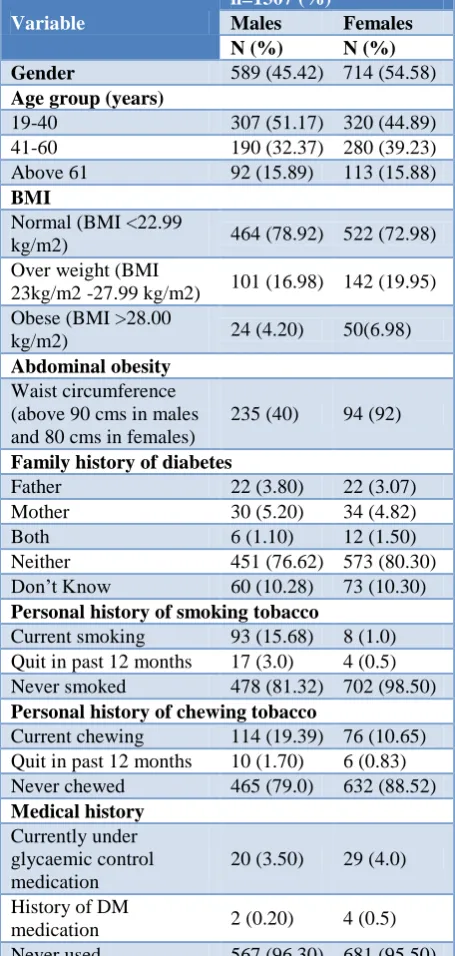
Table 1: Demographics and risk assessment profile for all the residents of Alakkudi village.
Variable
n=1307 (%)
Males Females
N (%) N (%)
Gender 589 (45.42) 714 (54.58)
Age group (years)
19-40 307 (51.17) 320 (44.89) 41-60 190 (32.37) 280 (39.23) Above 61 92 (15.89) 113 (15.88)
BMI
Normal (BMI <22.99
kg/m2) 464 (78.92) 522 (72.98) Over weight (BMI
23kg/m2 -27.99 kg/m2) 101 (16.98) 142 (19.95) Obese (BMI >28.00
kg/m2) 24 (4.20) 50(6.98)
Abdominal obesity
Waist circumference (above 90 cms in males and 80 cms in females)
235 (40) 94 (92)
Family history of diabetes
Father 22 (3.80) 22 (3.07) Mother 30 (5.20) 34 (4.82) Both 6 (1.10) 12 (1.50) Neither 451 (76.62) 573 (80.30) Don’t Know 60 (10.28) 73 (10.30)
Personal history of smoking tobacco
Current smoking 93 (15.68) 8 (1.0) Quit in past 12 months 17 (3.0) 4 (0.5) Never smoked 478 (81.32) 702 (98.50)
Personal history of chewing tobacco
Current chewing 114 (19.39) 76 (10.65) Quit in past 12 months 10 (1.70) 6 (0.83) Never chewed 465 (79.0) 632 (88.52)
Medical history
Currently under glycaemic control medication
20 (3.50) 29 (4.0)
History of DM
medication 2 (0.20) 4 (0.5) Never used 567 (96.30) 681 (95.50)
The over-all prevalence of Diabetes in our study stands at 19.73% (258 out of 1307). The self-reported prevalence of diabetes among adults in the village was 6.88% (90 out
of 1307). When stratified by gender, the prevalence of self-reported diabetes in males was 3.70% and 4.50% in females. When stratified by age, it was higher in age group ≤61 yrs (8.85%). Table 1 presents the demographics and basic risk profiling of the adult residents of Alakkudi village screened during Phase I of the study.
Table 2: Study results and stratification of undiagnosed cases based on age group and gender.
Variables N (%)
(n=1307) Total prevalence of diabetes 258 (19.73)
Prevalence of self-reported
diabetes 90 (6.88)
Prevalence of undiagnosed
diabetes 168 (12.80)
Prevalence of undiagnosed
pre-diabetes 105 (8.03)
Stratification of undiagnosed diabetes cases (n=168)
Males 79 (46.42)
Females 89 (53)
Age group 19 to 40 38 (22.61) Age group 41 to 60 74 (44.04) Age group >61 years 56 (33.34)
Stratification of prediabetes cases (n=105)
Males 45 (42.85)
Females 60 (57.14)
Age group 19 to 40 25 (23.80) Age group 41 to 60 67 (63.80) Age group >61 years 13 (12.98)
The prevalence of undiagnosed diabetes among adults of Alakkudi village was 12.80% (168 out of 1307) and the prevalence of undiagnosed pre-diabetes among adults of Alakkudi village was 8.03% (105 out of 1307). When stratified by gender 46.42% (79 out of 168) male and 53% (89 out of 168) females were having fasting Glucose (FPG) value of ≥ 126 mg/dl and two-hour post prandial glucose (2-h PG) value of ≥ 200 mg/dl. In case of prediabetes 37.14% (39 out of 105) males and 62.85% (66 out of 105) females were having their FPG ≥ 100 mg/dl and <126 mg/dl. Compare to the diagnosed or self-reported cases of diabetes amongst the village residents the proportion of undiagnosed cases was 53% more.
DISCUSSION
undiagnosed diabetes about 12.5%, which is similar to our study results. India faces a dual burden on diseases, with infectious diseases still responsible to significant morbidity and mortality and the Non communicable disease contributing to DAILY’s.5 The burden of
undiagnosed cases of diabetes is still huge in India, our study found the proportion of undiagnosed cases in rural southern community in India to be 53% more than self-reported cases. A review by Akhtar et al of prevalence of diabetes based on large scale surveys in India, classifies Tamil Nadu as the state with higher reported cases of diabetes with prevalence ranging above 16%, similar to our study findings of 19.73%.10 A study from rural Kerala reported self-reported diabetes prevalence on 13.1% which is quite higher than 6.88% reported by our study.11 Another study by Sigh et al reported the self-reported prevalence of diabetes amongst slum residents in Delhi (northern India) wherein the percentage was 5.4% a value lesser than our study.12 A study by Bharathi et al, quotes the prevalence of diabetes at 8.47% in south Indian Union territory of Pondicherry which is quite low when compared to study findings by Akhtar et al, Tiwari et al, and our study findings.13
Over all the prevalence of diabetes varies between various communities and the percentage of self-reported and undiagnosed diabetes cases relates to factors like awareness of the population about the diseases, efforts from health system to detect the undiagnosed cases and availability of healthcare services
Our study adds to the knowledge of diabetes prevalence in rural India, and reiterates the need for allocation of more resources and a planned approach towards the early diagnosis of prediabetes and diabetes in rural areas of India. Importantly it also highlights the differences in study population, the results indicate lack of awareness of diabetes in our population which contributed significantly to the higher number of undiagnosed diabetes cases, it also points towards lack of health systems efforts to detect the undiagnosed cases and place them on anti-hyperglycaemic medication.
Our study was based on secondary data, and the percentage of follow up at the health care facility was 60% (1307 out of 2204) of the total village population. The study has missed on substantial number of individuals with risk of being diagnosed with diabetes and prediabetes. The study estimates are thus more conservative and represent the partial picture of the diabetes and prediabetes in rural India.
CONCLUSION
In our study, we observed the overall diabetes prevalence of 19.73%, with undiagnosed diabetes prevalence 12.80%, these numbers are higher than the national average and also points at the lack of awareness, lack of amongst study population along with lack of health systems ability to tackle the ever increasing burden of
diabetes in rural populations. It is high time efforts are being made to educate rural population on silent killers like diabetes and make efforts to early detect and diagnose by community wide approaches.
ACKNOWLEDGEMENTS
We sincerely thank our Alakkudi Health Centre team, Dr. Murugan Arul, Mr. Alexander Nadimuthu, Mrs. Premavathy Ramachandran, Mr. Sathiyamoorthy, Mr. Raghupathi and the entire team of field executives for their relentless efforts in data collection and all the residents of Alakkudi Gram Panchyat.
Funding: No funding sources Conflict of interest: None declared Ethical approval: Not required
REFERENCES
1. Karuranga S, Fernandes JDR, Huang Y, Malanda B. International Diabetes Federation (IDF). IDF Diabetes Atlas. 8th ed. 2017. Available at: http://www.diabetesatlas.org/. Accessed on 28 November 2017.
2. Ramachandran A, Snehalatha C, Vijay V, Colagiuri S. Detecting undiagnosed diabetes in urban Asian Indians--role of opportunistic screening. J Assoc Physicians India. 2004;52:545–6.
3. Joshi SR, Saboo B, Vadivale M, Dani SI, Mithal A, Kaul U, et al. Prevalence of diagnosed and undiagnosed diabetes and hypertension in India--results from the Screening India’s Twin Epidemic (SITE) study. Diabetes Technol Ther. 2012;14(1):8– 15.
4. Misra A, Ramchandran A, Jayawardena R, Shrivastava U, Snehalatha C. Diabetes in South Asians. Diabet Med J Br Diabet Assoc. 2014;31(10):1153–62.
5. Tripathy JP, Prasad BM. Cost of diabetic care in India: An inequitable picture. Diabetes Metab Syndr. 2018 May;12(3):251–5.
6. Purty AJ, Vedapriya DR, Bazroy J, Gupta S, Cherian J, Vishwanathan M. Prevalence of diagnosed diabetes in an urban area of Puducherry, India: Time for preventive action. Int J Diabetes Dev Ctries. 2009;29(1):6–11.
7. Anjana RM, Deepa M, Pradeepa R, Mahanta J, Narain K, Das HK, et al. Prevalence of diabetes and prediabetes in 15 states of India: results from the ICMR–INDIAB population-based cross-sectional study. Lancet Diabetes Endocrinol. 2017;5(8):585– 96.
8. Prabhune A, Manoharan A. Assessment of Healthcare Utilization in a Community-Centric Model of Primary Healthcare for Rural Populations. Indian J Public Health Res Dev. 2017;8(4):971. 9. Guidelines_for_Management.pdf. Available from:
elines_for_Management.pdf Accessed on 21 September 2018.
10. Akhtar S, Dhillon P. Prevalence of diagnosed diabetes and associated risk factors: Evidence from the large-scale surveys in India. J Soc Health Diabetes. 2017;5(01):28–36.
11. Tiwari RR, Deb PK, Debbarma A, Chaudhuri R, Chakraborti A, Lepcha M, et al. Risk factor analysis in self-reported diabetes in a rural Kerala population. Int J Diabetes Dev Ctries. 2008;28(3):91–4.
12. Singh R. Prevalence of self-reported reported diabetes and treatment in an urban slum of India. Int J Med Public Health. 2014;4(4):526.
13. Bharati DR, Pal R, Kar S, Rekha R, Yamuna TV, Basu M. Prevalence and determinants of diabetes mellitus in Puducherry, South India. J Pharm Bioallied Sci. 2011;3(4):513–8.
Cite this article as: Prabhune AG, Ojha B,
Manoharan A.Prevalence of diabetes and prediabetes among rural South Indian population. Int J