Efficient Data Reporting Protocol for
Wireless Sensor Networks
Siddhartha Chauhan
Department of Computer Science and Engineering, National Institute of Technology, Hamirpur (H.P.), India Email: [email protected]
LalitKumarAwasthi
Department of Computer Science and Engineering, National Institute of Technology, Hamirpur (H.P.), India Email: lalit@ nith.ac.in
---ABSTRACT---
Wireless sensor networks (WSNs) are used for collection of data from the area of interest. WSNs deployment, application requirement and nature of phenomena have an effect on the generation of data. The data generated can be redundant and injection of redundant data into the network reduces the lifetime of energy constrained WSNs. In this paper, we propose anefficient data reporting protocol (EDRP)which filters the redundant data and thereby reduces the energy consumption of sensor nodes (SNs). EDRP can be tuned according to the application requirements. Simulation results show that significant energy is saved by our proposed scheme. Effect of two parameters (acceptable limit and Check) used by EDRP has also been analyzed. Simulation results show that acceptable limit greatly effects the energy consumption of the nodes.
Keywords –Data aggregation, Data reporting, Wireless sensor networks.
--- Date of Submission: October 11, 2011 Date of Acceptance: December 04, 2011
1. INTRODUCTION
W
ireless sensor networks (WSNs) are now a day’s gaining popularity and lot of research has been carried out in this field. WSNs are very different from other networks because of the constraints they have in terms of energy, hardware, bandwidth etc. WSNs are deployed for various diverse applications such as military applications, health care applications etc. and because of the challenges posed by the sensor networks, a great thrust is on the development of new protocols which cater to the need of various applications. Protocols proposed for WSNs and some of the adhoc network protocols which have been modified to adapt to WSNs mainly focus on reduction of energy consumption by SNsin order to improve the life time of WSNs.The sensing nodes in WSNs generate a significant amount of redundant data in the network due to spatial-temporal correlations. Transmission of redundant data in a network causes a lot of wastage of energy hence reduces the network life time. More energy is consumed in transmission and reception of packets as compared to computation hence it is desirable to reduce the packet transmission. Similar data packets can be aggregated or combined to one thereby reducing the packets for transmission. Data aggregation reduces substantial amount of energy. Data aggregation is used by number of routing protocols for achieving energy efficiency. The amount of size by which a data can be reduced by aggregation depends on the application [1].
Our proposedprotocol namely efficient data reporting protocol(EDRP)has been designed to improvethe network
lifetime by not transmitting the redundant data. We focus on a data gathering application, where a collection of SNs report sampled data to sink periodically. EDRP can be tuned for different applications by setting the application specific acceptable limit for the data to be reported. EDRP reduces the transmission of new data if the new data is similar to the one what aggregating node (AN) or SNhad reported earlier (or is within the acceptable range).ERDP makes use of buffers to store the previously sent and received data so that data transmission is reduced.
The rest of the paper has been organized as follows. Section 2 presents the literature review. In section 3 our proposed protocol (EDRP) has been explained. Simulation results and parameters used for analyzing EDRP are discussed in Section 4. The last section i.e. section 5 is of conclusion.
2. LITERATURE REVIEW
various methods have also been proposed to distribute load by rotating roles of cluster heads (CHs), distributing computations across network and coordinating various working modes (wake-up, sleep and sensing) of SNs [7] [8] [9] [10] [11].
In WSNs, aggregation techniques and routing protocols are interdependent. Routing protocol design takes into consideration data aggregation at some network nodes and accordingly decides packet routing mechanism. Data aggregation has significant impact on energy consumption and overall network efficiency. Data aggregation not only reduces network overheads, but also enhances network lifetime. Data aggregation can be done in two ways. The first one is to combine data from different sources to a single data unit. This reduces the size of information to be sent over the network. The second way of aggregation is, if data packets from different sources or nodes are combined in to one large packet. This results in significant reduction of network overheads [12]. Iterative channel adjustment data aggregation routing (ICADAR) algorithm[13] tackles the problem of co-channel interference as it leads to data retransmission due to collision. ICADAR uses greedy incremental tree (GIT) to find the efficient data aggregation tree and then assigns the channel.A practical energy-efficient protocol for aggregator selection (EPAS)[14]achieves the target number of aggregators as aggregation at multiple levels can further reduce energy consumption. EPAS has been extended to Hierarchical EPAS (HEPAS) to provide a multiple-level solution.
Hierarchical routing protocol (HRP)[15] is a cluster based protocol for increasing the life time of a sensor network. HRP first clusters the network and thereby constructs routing tree on CHs for sending the aggregated data to the base station. HRP remarkably extends network life time and the amount of data gathered. A clustering algorithm CODA[16, 17] divides the whole network into groups based on node’s distance from the sink and the routing strategy. CODA removes the imbalance of energy depletion caused by different distances of nodes from the sink. Although CODA improves the life time of the network but it is not scalable as it relies on global information of node position.
In a tree-based network, sensor nodes are organized into a tree where data aggregation is performed at intermediate nodes along the tree and a concise representation of the data is transmitted to the root node. Tree-based data aggregation is suitable for applications which involve in-network data aggregation. An example application is radiation-level monitoring in a nuclear plant where the maximum value provides the most useful information for the safety of the plant. One of the main aspects of tree-based networks is the construction of an energy efficient data aggregation tree. Ding et al. [18] have proposed an energy-aware distributed heuristic (EADAT) to construct and maintain a data-aggregation tree in sensor networks. The algorithm is initiated by the sink which broadcasts a control message. The sink assumes the role of the root
node in the aggregation tree. The disadvantages of EADAT are extensive use of timers and it requires the prior knowledge or support from a given tree root. Tan et al.[19] have proposed a power-efficient data gathering and aggregation protocol (PEDAP). The goal of PEDAP is to maximize the lifetime of the network in terms of number of rounds, where each round corresponds to aggregation of data transmitted from different sensor nodes to the sink. PEDAP is a minimum spanning tree-based protocol which improves the lifetime of the network even when the sink is inside the field. PEDAP minimizes the total energy expended in each communication round by computing a minimum spanning tree over the sensor network with link costs. In [20], Lee and Wong proposed E-Span algorithm, which is an energy-aware spanning tree algorithm. In E-span, the source node which has the highest residual energy is chosen as the root. Gupta et al. [21] have proposed an approach that relies on the construction of connected dominating sets. These sets consist of a small subset of nodes which form a connected backbone and whose positions are such that they can collect data from any point in the network. Nodes that do not belong to these sets are allowed to sleep when they do not have data to send. Some rotation of the nodes in the dominating set is recommended for energy balancing.
The authors in [22] analyzed the symmetric line network with different degrees of correlation among neighboring nodes. A model has been proposed to describe the spatial correlation in terms of joint entropy. Zhu et al. [23] have studied the impact of data correlation on the energy expenditure of data distribution protocols. They focus on various energy-aware data aggregation trees under different network conditions, such as node density, source density, source distribution, and data aggregation degree. In [24], a tree-based aggregation algorithm that exploits data correlation has been proposed. It is based on shallow Length Tree (SLT) that unifies the properties of Minimum Steiner Tree (MST) and Shortest Path Tree (SPT). Cristescuet al. [25] analyze aggregation properties of a tree structure that is based on an SPT of nodes close to the sink node, while nodes that are further away are connected to the leaves of the SPT via paths found by an approximation algorithm for the traveling salesman problem.Al-Karakiet al. [26] investigate which nodes in the network can be exploited as aggregation points for optimal performance. They present exact and approximate algorithms to find the minimum number of aggregation points in order to maximize the network lifetime. Algorithms use a fixed virtual wireless backbone that is built on top of the physical topology. Further, they study tradeoffs between energy savings and the potential delay involved in the data aggregation process.
unique characteristics of WSNs that distinguish them from contemporary wireless ad hoc networks.
3. EFFICIENT DATA REPORTING PROTOCOL (EDRP)
EDRP has been designed to conserve the energy of the nodes and thus improve the life time of WSN. EDRP uses a time division multiple access(TDMA)-based medium access control(MAC) scheme where the time is divided into periodic MAC frames and each MAC frame is composed of multiple time slots. Each SN can transmit one packet in its allocated time slots so that collisions are avoided. EDRP can be implemented for any tree based or cluster based protocols for WSNs. EDRP reduces the transmission of redundant data as every node compares the new data with previously transmitted data (to its parent). Fig. 1 and Fig.2 show a simple tree structure and clustered network forWSNs. The data packets of SN111 and SN112
can be aggregated and transmitted as single packet by AG11 (Fig.1). Likewise AG1 can also transmit single
packet by aggregating the two packets received from AG11
and AG12. The similar aggregation can be implemented in
a clustered network where the CH will aggregate the datapackets received from SNs. In Fig.2 the various data packets of cluster1 can be aggregated to form a single packet by CH1. CH6 aggregates the aggregated data of
CH5and CH4.The reduction in the number of packets
transmitted not only reduces the energy consumption but also improves the life time of the network.
AG11 AG12 AG21 AG22
SN112 SN121 SN122 SN211 SN212 SN221
Sink Node
AG1 AG2
SN222
SN111
AG – Aggregating Node SN – Sensor Node
Figure 1:Tree structure of wireless sensor network.
Figure 2:Cluster network for wireless sensor network.
3.1. Working of EDRP
The EDRP has been designed to reduce the transmissions by not transmitting the data which it had earlier been transmitted to AN. Consider a situations in which a child node has sensed similar data what it had sent previously i.e. if a child node say SN111(Fig.1) had sensed 100C
temperature value at time t1and had sent it to AN11. Now at
time t2,SN111 has sensed same temperature (100C) so
transmitting the same data (reading) at t2 (where t2>t1) will
waste the energy of SN111. SN111 will not only conserve its
energy but energy of AN11 (reception energy) will also be
conserved if SN111 does not transmit its t2 timereading. SN111 can compare the new data with the previously
transmitted data by storing the previously sent data in a buffer. The transmission can further be reduced by setting some acceptable range for the transmission of data packets. Acceptable range can be specified by setting an acceptable limit (which is application specific) in EDRP. Let us assume that if there is a change of 0.250C in
temperature between new reading and previously sent data (stored in the buffer)of SN111. Such minor change if is
within the acceptable range of an application (change need not be reported)then transmission energy of SN111 can be
conserved. AN11which stores in its buffer the data it
received from SN111at t1will assume already available data value of SN111 for t2 time.
ANs may also have similar aggregated data value (what it had previously sent) although data received from CNs is different. Let us assume an aggregating node has three (3) CNs and at time t1, Nodes N1, N2 and N3had sent temperature values 100C, 120C and 150C respectively. CNs
send at their respective data of time t2i.e. 150C, 90C and 80C. If aggregating function is f(x) = Max (T
i); (Where Ti
is the temperature value sent by CNs and i = 1, 2, 3 …..) then AN after applying aggregating function will send the maximum value of the temperature which will is 150C at
time t1 and t2. ANcan conserve its energy by not transmitting aggregated data at t2. Similar to SN the transmission by AN can further be reduced by applying an acceptable limit for the aggregated data.
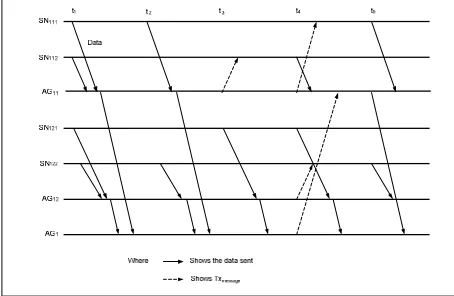
that the child node has similar data to transmit and the second reason can be that the child node is a dead node. EDRP handles the two situations where parent node sends a transmission message (Txmessage) to its child node, which upon receiving this message has to transmit the data packet of similar reading also. The child node upon receiving Txmessagewill transmit new data without comparing it with the previously sent data. The two algorithms of EDRP one for the child nodes and other for the parent nodes have been explained in subsection 3.2 and 3.3.EDRP can be implemented for reducing the data transmission for both tree as well as clustered WSNs. The Scenario for the working of EDRP is shown in figure 3. The nodes SN111and SN112(Fig. 1) transmit data at time
t1to their parent (AG11). Likewise SN121 and SN122 at
t1send data to AG12. AG11 and AG12 transmit the
aggregated data to their parent node (AG1). At t2only SN111 and SN122transmit data to their respective parent
nodes, which are sending the aggregated data to their parent. At t3since AG11 has not received data from SN112it
sends a transmission message (Txmessage) to SN112 to check
whether the node is dead or alive. On receiving the message, SN112 at t4 has to send the message irrespective of whether it has sensed data ornew data is similar to the previous one. At t4 since AG11 has not received any data
from SN111 it sends a Txmessageto it. Similarly at t4,AG1has
not received data packet from AG11so it sends a Txmessage to AG11. At t5, SN111 sends data to AG11 on receiving
transmission message from AG11 at t4and AG11 also sends
a data packet to AG1.
Figure 3: Scenario for the working of EDRP. 3.2. Algorithm 1: EDRP for Child node
The Algorithm 1 is for child nodes where the acceptable range for sensor reading can be set by setting the acceptable limit value i.e. δCN. This value is application specific and it can be set to zero, where any change in the observed reading is to be reported by the SN. In case when it is set to zero the reduction in the transmission of redundant data will be less. The reduction in the transmission by SN depends on the acceptable limit δCN. SN after sensing compares the present data with the previous data sent to its parent node. Previous data is
stored in its buffer i.e.Tx_BUFFER. If the new data is not equal to the previous data and is not in the acceptable range, then it is transmitted and is stored in Tx_BUFFER. Nodes will transmit the data if they receive a transmission message (Txmessage) from its parent node irrespective of the data value.
Pseudo code of Algorithm 1: EDRP for child node.
1. Set application specific value of δCN. // δCN is the application specific acceptable limit.
2. intTx_BUFFER // Buffer for
storing the transmitted data. 3. SN senses environment.
4. if(event is detected) && (Txmessage not received) then
begin
5. if( New_Data == Tx_BUFFER) || ( New_Data
== Tx_BUFFER ± δCN) then begin
6. Go to Step 2.
7. else(Tx_BUFFER= New_Data)
8. Transmit New_Data //Transmit
New_Data to parent node.
9. endif
10. elseif(event is detected) &&(Txmessagereceived)begin 11. (Tx_BUFFER= New_Data)
12. Transmit New_Data// Transmit
New_Data to parent node. 13. endif
14. endif
3.3. Algorithm 2: EDRP for aggregating node
Acceptable range for the ANs can be set by setting the acceptable limit (δAG). Acceptable range of CNs can be different than ANs.EDRP makes use of two buffers at ANs.Buffer Tx_BUFFERstores the previously transmitted aggregated data by AN. Second buffer Rx_BUFFER[ ]
stores the data received from the CNs. ANs apply aggregating function on the data of their Rx_BUFFER[ ]. The aggregated data value is then compared with the previously sent aggregated data stored in Tx_BUFFER. If the new aggregated data value is same or within acceptable range, then it is not transmitted. The acceptable range can be set so that any change in the data is reported, by setting the value of acceptable limit δAG to zero. If AN, receives data from some of its child nodes, then it uses the previous data value (stored in Rx_BUFFER [ ]) of the child nodes, who did not send data. The new data from some of the nodes is stored in Rx_BUFFER[ ]and aggregating function is the applied on the dataof
Rx_BUFFER[ ].
Pseudo code of Algorithm 2: EDRP for aggregating node.
1. Set application specific value of δAG and Check. // δAG
is the application specificacceptable limit and Check is application specific value for generation of TXMESSAGE message to child node
2. Initialize :
3. intTx_BUFFER // Buffer storing the
aggregated data sent to Parent node
4. intNo_of_CHILDNODES // Number of child
nodes of aggregating node
5. intRx_BUFFER[] // Stores data received
from CNs
6. intCheck // Application
specific set for sending Txmessage to child node
7. intCounter = 0 // Counter initialized
to zero
8. Aggregating node is receiving.
9. if(Received from child nodes)&&(Txmessagenot Received)then begin
10. for( i = 1 to i = No_of_CHILDNODES)begin
11. Rx_BUFFER[
No_of_CHILDNODES] =
New_Datai
// New_Datai is data of child nodes
where
i = 1toNo_of_CHILDNODES
12.Apply aggregating function on data storedin
Rx_BUFFERAG[ ]
13.if(New_DataAG==Tx_BUFFER) || (New_DataAG==Tx_BUFFER ±δAG ) 14. Go to step 8.
15. else (Tx_BUFFER= New_DataAG)
16. Transmit New_DataAG
17. endif
18. endfor
19. elseif (Received from all Child Nodes)&&(Txmessage received)then begin
20. for(i = 1 to i = No_of_CHILDNODES)begin
21. Rx_BUFFER[No_of_CHILDNODES] =
New_Datai
// New_Datai is data of
child nodes where i = 1 to No_of_CHILDNODES
22. Apply aggregating function on data stored in Rx_BUFFER[ ]
23. (Tx_BUFFER= New_DataAG) 24. Transmit New_DataAG
25. endfor
26. endif
27.if (not received from child nodes)&&(Txmessagenot received)&&(Counter<Check) then begin
28. ++ Counter
29. Go to step 8. 30. else
29. Send Txmessage 31. endif
32. if(not received from child nodes)&&(Txmessage received)then begin
33. ++ Counter
34. Transmit Data of Tx_BUFFER
35. endif
3.4. Analytical model for EDRP
Suppose there are N numbers of nodes and they form L
clusters. Then the total number of nodes in one cluster will be given by N/ L. Let N/ L = K, where K are the total number of nodes in one cluster. Let the probability of change in data be given by p that is also the probability of transmission in case of EDRP. Then 1-p is the probability of not changing data or it is the probability of nodes not transmitting. Let us assume that K1 nodes are transmitting out the K nodes in a cluster, so K- K1= K2, where K2 are the number of nodes not transmitting. Then for each cluster, according to EDRP at time say t1 either one of the following three cases can be true.
Case 1: When no node transmits.
When nonodes transmit then the probability of transmission is given by (1):
KC
0 qK, whereK1 = 0. (1)
Case 2: When all nodes transmit.
When all nodes transmit then the probability of transmission is given by (2):
KC
kpK, whereK1 = K. (2)
Case 3: When some nodes transmit.
When K1 nodes are transmitting out of K nodes in a cluster, the probability of transmission is given by (3):
1 1 1
k k k k
K
C
p
q
− (3)Rewriting (3) as (4):
)! ( !
! 1
1 K K
K K
− (4)
Applying DeMoivre Laplace transformation on (4) we get (5):
∏
−
−k Kp Kpq e
Kpq
2 / )
( 2
1 2
1
(5)
Subject to following conditions: 1. Kpq>> 1
2. |K1 – Kp| << Kpq
The standard Gaussian distribution function is given by the (6):
) 2 / ) ( ( 2
1 2 2
2 µ σ
σ − −
∏ e x (6)
Hence (5) is equivalent to (6) where:
X= K1,
npq
=
2
σ
andnp
=
µ
Let us assume that K1,K2, K3… KLis the number of nodes transmitting in L clusters in a network. The total nodes in a network that can transmit are N-1as one node is root node or sink and will not transmit. The combined transmitting probability in a network is given by (7):
L
L
K L K K N
K K K
p
p
p
1 2...
2 1
2 1 1
...
−(7)
WhereP1, P2….PL are probability of transmission for each cluster.
4.SIMULATION AND RESULTS
We have considered a clustered WSN where nodes are randomly deployed with single sink. Each SN is capable of sensing and transmitting data packet to its CH. A time division multiple access(TDMA)-based medium access control(MAC) scheme has been employed where the time is divided into periodic MAC frames and each MAC frame is composed of multiple time slots. Each SNtransmits one packet in its allocated time slots in such a way that no collision occurs.
The proposed protocol has been simulated in Omnet++ for variable number of nodes for evaluating its performance and comparing it with the other protocols. It has been assumed that all the nodes have 5J of energy. The constant radio parameters i.e. α11, α12 and α2are chosen with typical values as α11 = 50nJ/bit, α12= 50nJ/bit, and α2 = 10 pJ/bit/m2 (n = 2) or 0.0013 pJ/bit/m4 (n= 4) [26].The
energy model adopted in [26] has been adopted with slight modifications for simulation. The various notations used for energy equations are given in Table 1. The energy consumed by a node to transmit data packet to distance
(d)meters is Ptx (d), where Ptx (d) = (α11+ α2dn) r. Energy consumption by a node to receive data packet is denoted by Prx, where Prx = α12r. The computational energy has been taken into consideration while evaluating the performance. The energy consumption for executing 3000 instructions is taken equivalent to energy consumed for transmitting a bit for 100 m. We have considered a cluster of N nodes having a radius of R withdata transmission rater and the distance between two CHs is D, the expected
energy consumption per second of such a cluster is given by (8):
E [Pcluster] = (N-1)[α12+ α2(2Rn/n+2)r + (α11+ α2Dn)r (8)
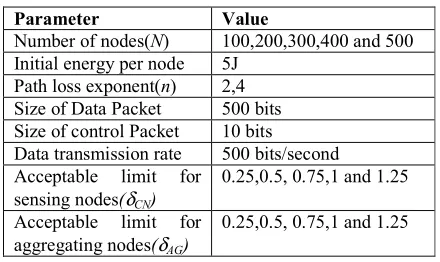
The simulation parameters chosen for calculating the results are presented in Table2.
Table 1: Notations and Definitions Notation Definition
α11 Power to run transmitter circuitry
α12 Power to run receiver circuitry
α2 Power for the transmit amplifier to achieve an acceptable signal to noise ratio
n Path loss exponent that depends on environment.
r Number of bits transmitted per second
N Total number of sensor nodes in a network
R Area radius of a cluster
N Number of sensor nodes in a cluster Table 2: Simulation Parameters Parameter Value
Number of nodes(N) 100,200,300,400 and 500 Initial energy per node 5J
Path loss exponent(n) 2,4 Size of Data Packet 500 bits Size of control Packet 10 bits Data transmission rate 500 bits/second Acceptable limit for
sensing nodes(δCN)
0.25,0.5, 0.75,1 and 1.25 Acceptable limit for
aggregating nodes(δAG)
0.25,0.5, 0.75,1 and 1.25
The average energy consumed per node for different acceptable limits of EDRP and HRP is shown in Fig. 4. The energy consumption in case of HRP is more as compared to EDRP because EDRP reduces the transmission of redundant data. The energy consumption of EDRP is more in case when the acceptable limit is less. This is because of the fact that there are more transmissions in case the acceptable limit is less; hence by increasing the acceptable limit energy can be conserved. Life time of the network as well as node energy can be improved by increasing the acceptable limit. The nodes can be fine tuned according to various application requirements and their acceptable limit can be set according to the application specific requirements.
increases the life time of the network and reduces the energy consumption of the nodes. Results of Fig. 4 and Fig.5 show that the acceptable limit has an effect on the life time of the network and on the energy consumption of the nodes. EDRP can be tuned according to application requirements but if acceptable limit is reduced then the energy consumption of the nodes will be more.
Fig.6 shows the graph between the number of rounds taken for first node to die for variable number of nodes with different acceptable limits of EDRP. Fig. 6 shows that as the accepatble limit is increased it takes more number of rounds for first node to die. Results also show that as the nodes are increased it takes less rounds for first node to die. As the nodes are increased or acceptable limit is reduced the data packets transmitted will be more hence more energy will be consumed.
Figure 4: Average energy consumed per node.
Figure5: Ratio of number of packets received at sink to total number of packet generated for EDRP.
Figure6: First node to die (rounds) Vs Number of nodes.
Figure7: Effect of acceptable limit on EDRP.
Fig. 7, shows the effect of acceptable limit on the ratio of number of packets received at sink versus the total number of packets generated. The results were obtained for network of hundred nodes. As the acceptable limit is increased this ratio decreases thus verifying the results of Fig. 5 and Fig. 6.
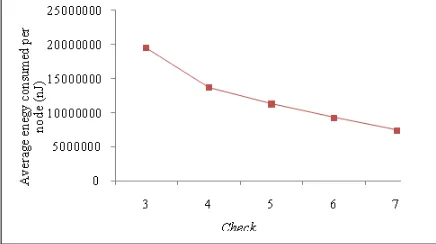
Fig. 8 shows the effect of Check on the energy consumption by the nodes for EDRP. The results were obtained for network consisting of hundred nodes. Results for average energy consumption per node for various values of Checkshow that as the value of Check increases the average energy consumed per node decreases. This is because if the value of Check is less then more transmission messages (Txmessage) and data packets will be transmitted therefore energy consumption of the nodes is more.
6. Conclusion
Injecting redundant data into the network has a great impact on the energy consumption of sensor nodes. Our proposed scheme (EDRP) significantly reducestransmission of redundant data by sensor nodes as well as the aggregating nodes. EDRP disseminatesdata by sensor nodes or cluster heads (aggregating node) only after filtering it against the acceptable limit. Acceptable limit is an application specific limit, which can be set according to the various application requirements. The acceptable limit of aggregating nodes and sensing nodes can be set differently. This parameter has an effect on the data packets being injected in the network. Simulation results show that as the value of acceptable limit increases, the data transmission is reduced. Another parameter that can be set according to application requirement is Check. Results show that as the value of check is reduced the transmission of control and data packets is increased hence energy consumption of nodes is increased.
References
[1] Yuanzhu Peter Chen, Arthur L. Liestman and Jiangchuan Liu, A Hierarchical Energy-Efficient Framework for Data Aggregation in Wireless Sensor Networks,IEEE Transactions on Vehicular Technology, 55(3), 2006, 789-795.
[2] S. Paul, S. Nandi and I. Singh, A Dynamic Balanced-Energy Sleep Scheduling Scheme in HeterogeneousWireless Sensor Network, Proc. 16th IEEE International Conf. on Networks (ICON2008),2008, 1-6.
[3] A. Anand, S. Sachan, K. Kapoor and S. Nandi, QDMAC: An Energy Efficient Low Latency MAC Protocolfor Query Based Wireless Sensor Networks,
Proc. 10th International Conf.on Distributed Computing and Networking, 2009, 306-317.
[4] K. Chowdhury, N. Nandiraju, D. Cavalcanti and D.P. Agrawal, C-MAC–A Multi-Channel Energy Efficient MAC for Wireless Sensor Networks,Proc. IEEE Wireless Communications and Networking Conf., 2006, 1172-177.
[5] M. Ali, T. Suleman and Z.A. Uzmi, MMAC: A Mobility-Adaptive, Collision-Free Mac Protocol for Wireless Sensor Networks,” Proc. 24th IEEE International Performance, Computing, and Communications Conf.,2005, 401-407.
[6] W. Ye, J. Heidemann and D. Estrin, An Energy-Efficient MAC Protocol for Wireless Sensor Networks, Proc. of the IEEE INFOCOM, 2002, 1567-1576.
[7] A.S. Sairam and G. Barua, Bandwidth Management Using Load Balancing,Proc.1st International Conf. on Communication System Software and Middleware
(COMSWARE 2006), 2006.
[8] N. Jain, R. Biswas, N. Nandiraju and D.P. Agrawal, Energy Aware Routing for Spatio-Temporal Queries in Wireless Sensor Networks,” Proc.IEEE Wireless
Communications and Networking Conf. (WCNC),
2005,1860-1866.
[9] B. Dey, S. Akhil, and S. Nandi,Clustering Problem in Large-Scale Sensor Network: Possibilities and Requirements,Proc. International Conf. on Advanced Communication Systems (ICACS-2007), 2007. [10] R. Biswas, N. Jain, N. Nandiraju and D.P. Agrawal,
“Communication Architecture for Processing Spatio-temporal Continuous Queries in Sensor Networks,”
Special issue of the Annals of telecoms devoted to the Sensor Networks,8(7/8), 2005.
[11] S. Paul, S. Nandi and I. Singh, A Dynamic Balanced-Energy Sleep Scheduling Scheme in Heterogeneous Wireless Sensor Network,” Proc. 16th IEEE International Conf. on Networks (ICON 2008),2008, 1-6.
[12] A. McDonald and T. Znati,A Mobility-Based Framework for Adaptive Clustering in Wireless Ad Hoc Networks,IEEE Journal on Selected Areas in Communications (JSAC), 17(8),1466–1486, 1999. [13] H.H. Yen and C.L. Lin, Integrated channel
assignment and data aggregation routing problem in wireless sensor networks” IEEE Transactions in Communications, 3(5), 2009, 784-793.
[14] Yuanzhu Peter Chen, Arthur L. Liestmanand Jiangchuan Liu, A Hierarchical Energy-Efficient Framework for Data Aggregation in Wireless Sensor Networks, IEEE Transactions on Vehicular Technology, 55(3), 2006, 789-796.
[15] Mohammad Zeynali, Amir Mollanejad and Mohammad Khanli, Novel hierarchical routing protocol in wireless sensor network,Proc. of WCIT 2010, 2010, 292-300.
[16] V. Mhatre,C. Rosenberg, Homogenous vsHeterogeneous Clustered Networks: A Comparative Study, Proc.IEEE ICC 2004, 2004. [17] Ming Liu I, Jiannong Cao, Guihai Chen and
Xiaomin Wang,An Energy-Aware Routing Protocol for Wireless Sensor Networks, Sensors, 2009, 445-462.
[18] M. Ding, X. Cheng and G. Xue, Aggregation Tree Construction in Sensor Networks, Proc. IEEE 58th Conf. on Vehicular Technology, 4(4), 2003, 2168– 72.
[19] H. O. Tan and I. Korpeoglu,Power Efficient Data Gathering and Aggregation in Wireless Sensor Networks,” Proc.ACMSIGMOD, 32(4), 2003, 66– 71.
[20] WeinanMarc Lee and Vincent W.S. Wong, E-Span and LPT for data aggregation in wireless sensor networks, Journal ofComputer Communications, 29,
2006, 2506–2520.
[21] H. Gupta, V. Navda, S. R. Das and V. Chowdhary,Efficient Gathering of Correlated Data in Sensor Networks,” ACM Transactions on Sensor Networks (TOSN), 4(1), 2008.
[22] S. Pattem, B. Krishnamachari and R. Govindan,The Impact of Spatial Correlation on Routing with Compression in Wireless Sensor Networks,ACM
Transactions on Sensor Networks (TOSN), 4(4),
[23] Y. Zhu, K. Sundaresan and R. Sivakumar,Practical Limits on Achievable Energy Improvements and Useable Delay Tolerance in Correlation Aware Data Gathering in Wireless Sensor Networks, Proc. IEEE International Conf. on Sensor and Ad Hoc
Communications and Networks (SECON 2005),
2005,328-329.
[24] P. von Rickenbach and R. Wattenhofer, Gathering Correlated Data in Sensor Networks, Proc.ACM Joint Workshop on Foundations of Mobile Computing
(DIALM-POMC 2004),2004,60-66.
[25] J.N. Al-Karaki, R. Ul-Mustafa and A.E. Kamal, Data Aggregation in Wireless Sensor Networks: Exact and Approximate Algorithms, Proc. of the IEEE Workshop on High Performance Switching and Routing (HPSR 2004), 2004, 241-245.
[26] Yan Jin, Ling Wang,Yoohwan Kimand Xiaozong
Yang, EEMC: An energy-efficient multi-level clustering algorithm for large-scale wireless sensor networks, Journal ofComputer Network,52(3), 2008, 542-562.
Authors Biographies
Siddhartha Chauhan is Assistant Professor in Department of Computer Science and Engineering at National Institute of Technology, Hamirpur(H.P.) India. He did his masters in computer science and engineering from IIT, Roorkee. He has teaching and research experience of more than thirteen years. Presently he is pursuing his PhD. His research interests are routing, data dissemination and QoS in wireless sensor networks.
Lalit Kumar Awasthi is Professor in