
e-ISSN: 2278-067X, p-ISSN: 2278-800X, www.ijerd.com Volume 7, Issue 4 (May 2013), PP. 65-70
A Practical Approach for Personalized Access to
Agent-Based Composition of Semantic Web Services for MANET
Monika
1, Yashpal Singh
2, S Niranjan
3 1M.Tech Student, Department of Computer Science & Engg. , PDM College of Engineering for Women.
2
Assistant Professor, Department of Computer Science & Information Technology , PDM College of Technology & Management , Bahadurgarh Jhajjar Haryana.
3
Professor, Department of Computer Science & Information Technology , PDM College of Technology & Management , Bahadurgarh Jhajjar Haryana.
Abstract:- Web services are dominating the current web scenario. Web services are independent and
autonomous, designed to perform a specific task. Discovery, integration and execution of web services is known as semantic web. Composition of these web services are required complex system. The Composition of semantic Web services (SWS) has received much interest to support business-to-business or enterprise application integration. The Composition way that we used in this paper is the Orchestration which deals with describing how a number of services, two or more, cooperate and communicate with the aim of achieving a common goal. The proposed technique considers complex composition by including web services with multiple inputs in composition process. In this paper, we propose an ontology-based framework for the automatic composition of Web services. JADE is an agent development environment where Web services and agents can be linked together to enable semantic Web applications.
Keywords:-Semantic Web Service, JADE Agents, Composition Web Service, Integration Gateway.
I. INTRODUCTION
JADE is a FIPA compliant agent development environment which facilitates the implementation of multi-agent systems. Since Web services middleware has been integrated into JADE, agents implemented in JADE can exploit Web services as computational resources. A Web service can be published as a JADE agent service and an agent service can be symmetrically published as a Web service endpoint. Invoking a Web service is just like invoking a normal agent service. In addition, Web services’ clients can also search for and invoke agent services hosted within JADE containers.
The Web Services Integration Gateway (WSIG) uses a Gateway agent to control the gateway from within a JADE container. Interaction among agents on different platforms is achieved through the Agent Communication Channel (ACC). Whenever a JADE agent sends a message and the receiver lives on a different agent platform, a Message Transport Protocol (MTP) is used to implement lower level message delivery procedures [2]. There are two main MTPs available today to support this inter-platform agent communication - CORBA IIOP-based and HTTP-based MTP. The MTP which we used in this paper is the HTTP-based MTP. The Web service published as a JADE agent service and an agent service symmetrically published as a Web service endpoint. In other words, the JADE agents interact with Web services and produce the output. The WSIG is used as a means to encapsulate and automate the functionality required to connect the two domains, while ensuring minimal human intervention and service interruption. This Gateway is controlled by a software agent, capable of connecting Web Services and software agents, i.e. a Web service becomes able to invoke a registered agent service and vice versa. Once this interconnection is established, software agents capable of comprehending ontology (that contains the semantic) can use the Gateway to enable advanced operational and usage modalities of Web services.
composition requires extracting the meanings from user inputs and then finding initial and intermediate services involved in designing a complete solution. This can be easy in a system that is a defined and has few number of web services. Decision making is easy as many factors in this case are known: like possible paths, how input is analyzed and each services contribution in total processing. However, designing system for automated discovery on a search engine is very difficult. Web is becoming a combination of distributed computing devices, where various services are designed to perform some tasks. Also, it is expected that ubiquitous computing will dominate the society in coming times.
Mobile agent technology provides a new way of communication over heterogeneous network environment. A number of advantages have been proposed and identified which includes: efficiency and reduction of new traffic, asynchronous autonomous interaction, interaction with real-time entities, local processing of data, support for heterogeneous environment and having robust and fault tolerant behaviour.[11]
II. BACKGROUNDANDRELATEDWORK
A. Background
A number of web services exist on the internet. However, in real world, it is often seen that user’s request for a purpose is fulfilled by combination of many web services. For example, a user wants to come to Delhi from Mumbai for some official work. He requires to book flight, reserve hotel room, local travelling taxies or other option and more. It should be good if user can search for best possible combination of these web services. Like user while booking the flight ticket get full information about the ticket price of all the airlines from where Mumbai to Delhi flight is available and so on for other services also. Thus user gets his desired output by just giving the input parameters. Web services search, execution, composition and interoperation are an area of research known as “Semantic web”.
B. Related Work
There are several articles related to automated Web service composition. Ontology-based Web Service Composition [3] aims to generate a composite service out of semantically described existing services. In this work, the possible automatic compositions are obtained through interface-matching, which checks semantic similarities between interfaces of individual services. Different services can be integrated to satisfy user requirement.
Rao et al. [4] Propose GraphPlan algorithm for generating a composite web service. But he uses a lot of interaction from user which drifts his project towards manual composition. His approach does not consider input and output schema. This schema is important in ontology mapping. Also, some services can be compatible without having input and outputs. His approach uses one input to a service. However, in our approach, a service can get input more than one service.
SWORD[5] proposed a rule based system for composition of web service. His approach is not suitable for heterogeneous and changing web services. He emphasizes on composition and did not take into account input and output mismatch. In our technique, system checks the input parameters and more than one parameter can be accepted by a service. Like, input and output mismatch can also detected and provide error report.
Thakkar et al[7] consider dynamic composition of Web services using mediator-based agent system architecture. The mediator takes care of user queries, generates wrappers around information services and constructs a service integration plan.
Paolucci et al[6] evaluate a broker for constructing OWL-S Web services. They also identify some drawbacks of the current OWL-S specification and propose a workaround for the problem. Sycara et al [8] describe a methodology for constructing composite services written in DAML-S.Similarly, the preceding article view ontology-based technique which describe the inputs/outputs and conditions or effects of particular services.
III. AGENT-BASEDWEB-SERVICECOMPOSITION
In real world, it is often seen that user’s request for a purpose is fulfilled by combination of many web services. So, multi-agent environment is required. For example, let us assume that there are three agents TrainNameService, TrainNumberService and CompositeTrainService in the agent system.
TrainNameService has Web service W1 which provide Train detail when Train Name as provide input to the web service W1. TrainNumberService has service W2 which provide Train detail when Train Number as input provided to the web service. CompositeTrainService is the main web service W3 which takes input either Train Number or Train Name and provide output to the user. The composition of web service W1 and web service W2 is done in web service W3.
1) Service registration
This is the way to register the agent service. try {
DFService.register(this, dfad); }
catch (Exception e) {
log.error("Problem during DF registration", e); doDelete();
}
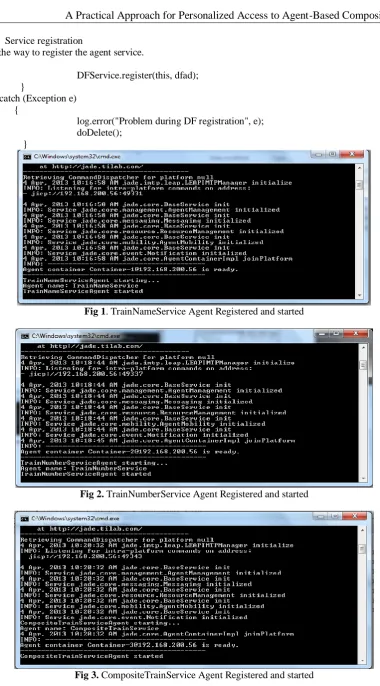
Fig 1. TrainNameService Agent Registered and started
Fig 2. TrainNumberService Agent Registered and started
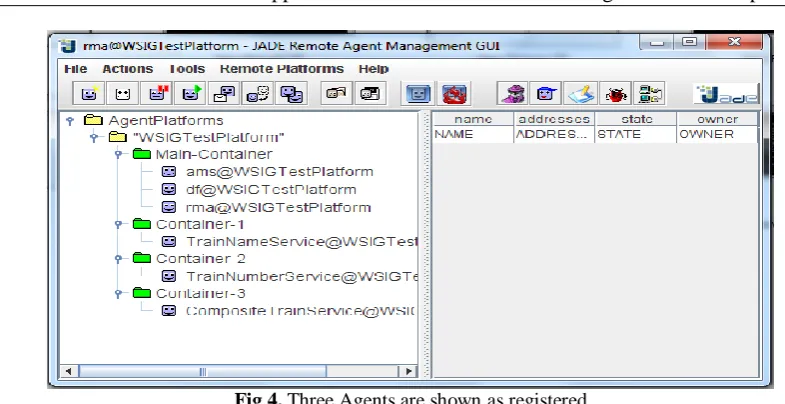
Fig 4. Three Agents are shown as registered
2) Construction of the service graph
In the graph construction phase matching input output of services are logically connected in a way that they form a potential workflow. In our example CompositeTrainService contain the logic how to access the other two web services.
Fig 5. Service integration Graph
3) Service discovery together with composition.
Fig 6. Service Discovery and Composition.
IV. WEB-SERVICEACCESSEDINMANET
Fig. 7 Architecture for Agent Based Mobile Ad-hoc Network.[12]
Response Request Response Request
Fig 8. Web Service Access
V. CONCLUSION
REFERENCES
[1]. Dominic Greenwood, Jozef Nagy, Monique Calisti. “Semantic enhancement of a Web Service Integration Gateway”, Whitestein Technologies AG.
[2]. E. Cortese, F. Quarta, G. Vitaglione, P. Vrba. “Scalability and Performance of the JADE Message Transport System. Analysis of Suitability for Holonic Manufacturing Systems”, exp, 3(3), pp. 52-65, 2002.
[3]. B. Arpinar, B. Aleman-Meza, R. Zhang, A. Maduko. “Ontology-Driven Web Services Composition
Platform. In 2004 IEEE International Conference on E-Commerce Technology (CEC'04)”, July 6-9,
2004, San Diego, California, USA, pp. 146-152, IEEE Computer Society Press, 2004.
[4]. Rao, J., et al., “A Mixed Initiative Approach to Semantic Web Service Discovery and Composition: SAP's Guided Procedures Framework, in The IEEE Intl Conf on Web Services (ICWS'06)”. 2006. [5]. S. R. Ponnekanti, and A. Fox. SWORD: “A Developer Toolkit for Building Composite Web Services”.
11th WWW Conference, Honolulu, 2002.
[6]. M. Paolucci, J. Soudry, N. Srinivasan, K. Sycara. “A Broker for OWL-S Web Services. In Proceedings of the First International Semantic Web Services Symposiu”m, AAAI 2004 Spring Symposium Series,
March 22-24, 2004, pp. 92-99, AAAI Press, 2004.
[7]. S. Thakkar, C. A. Knoblock, J. L. Ambite, C. Shahabi. “Dynamically Composing Web Services from On-line Sources. In Proceeding of 2002 AAAI Workshop on Intelligent Service Integration”,
Edmonton, Alberta, Canada, 2002.
[8]. K. Sycara, M. Paolucci, A. Ankolekar, N. Srinivasan. “Automated Discovery, Interaction and Composition of Semantic Web Services”. Journal of Web Semantics, 1(1), pp. 27-46, 2003.
[9]. Shenghua Liu, Peep Kungas, Mihhail Matskin. “Agent-Based Web Service Composition with JADE and JXTA”. KTH,Sweden and NTNU, Norway.
[10]. “Composing Web Services on the Semantic Web”, The VLDB Journal (2003) 12: 333-351 / Digital Object Identifier (DOI) 10.1007/s00778-003-0101-5.
[11]. Yashpal Singh, Kapil Gulati, S.Niranjan, “Dimension and Issue of Mobile Agent Technology”, International Journal of Artificial Intelligence and Application (IJAIA) , vol. 3 , No. 5, sept.2012. [12]. Yashpal Singh, S.Niranjan, “A Proposed Architecture for Network Management in Mobile Agent
based for CORBA”, International Journal of Computing, vol. 2, issue 1, Jan 2012.
[13]. Yashpal Singh, Kamal deep, S. Niranjan, “ Multiple Criteria Clustering of Mobile Agent in WSN”, International Journal of Wireless and Mobile Network (IJWMN), vol. 4, No. 3, June 2012.
[14]. Yashpal Singh, R. Kumar, S.Niranjan, “A Proposed Architecture for Agent Communication Manager in Mobile Ad-hoc Network”, International Journal of Electronic Circuits and System, vol. 1, issue 1, feb 2012.
![Fig. 7 Architecture for Agent Based Mobile Ad-hoc Network.[12]](https://thumb-us.123doks.com/thumbv2/123dok_us/1376725.1648031/5.595.70.510.64.661/fig-architecture-agent-based-mobile-ad-hoc-network.webp)
