Shuffled Frog Leaping Algorithm for
Hardware/Software Partitioning
Jiayi Du
a, Xiangsheng Kong
b, Xin Zuo
∗∗c, Lingyan Zhang
d, Aijia Ouyang
e,f,
a School of Information Science and Engineering, Hunan Provincial Key Laboratory of Embedded and Network
Computing, Hunan University, Changsha 410082, China Email: [email protected]
b Department of Computer Engineering, Xinxiang University, Xinxiang, Henan, 453003, China
Email:[email protected]
c Office of Information Department, Hunan University, Changsha 410082, China
Email: [email protected]
d College of Information Science and Technology, Jinan University, Guangzhou 510632, China
Email: [email protected]@163.com
eCollege of Computer, Hunan Institute of Traffic Engineering, Hengyang 421001, Hunan, China
f School of Information Science and Engineering, Hunan City University, Yiyang, Hunan 413000, China
Email: [email protected]
Abstract— Reconfigurable system on chip is well known for its flexibility for high performance embedded system-s. The hardware/software (HW/SW) partitioning is the most important phase during the design of reconfigurable system on chip. A great many different algorithms have been adopted for solving the hardware/software partitioning problem. Shuffled Frog Leaping Algorithm (SFLA) is pop-ular for its simple concepts, little parameter adjustment, high calculation speed, strong global search optimization capability and easy execution. In this paper, we apply the SFLA algorithm to solving hardware/software partitioning problem on reconfigurable system on chip with coarse-grained.
The experimental results show that the SFLA algorithm can reduce the time cost by 45.54% on average with three different area constrain, compared with greedy algorithm. The time cost of SFLA algorithm are also reduced by 23.57% and 9.99% on average with simulated annealing algorithm (SA) and combined algorithm with greedy and simulated annealing algorithm (GSA). When area constrain is a half of area cost which all tasks are implemented by hardware will be taken, SFLA algorithm can reduce the time cost by 51.30%, 21.04% and 11.61% on average, compared with that of Greedy algorithm, SA, and GSA, respectively.
Index Terms— Reconfigurable System on Chip, Hard-ware/Software Partitioning, Shuffled Frog Leaping Algorith-m, Coarse-grained, Greedy AlgorithAlgorith-m, Simulated Annealing Algorithm, Combined Algorithm
I. INTRODUCTION
With the development of microelectronics and com-puter technology, especially large-scale emergence of F-PGA programmable devices, real-time circuit remodeling ideas have attracted increasing attention of researchers. In reconfigurable systems, hardware information (config-uration information of programmable devices) can be the same as the software program. This will not only keep
**Corresponding Author: Xin Zuo Email: [email protected]
the performance of computing hardware, but also the flexibility of the software.
HW/SW co-design is popular in designing the embed-ded system. HW/SW partitioning is the most important phase during the HW/SW co-design. As far as we know, HW/SW partitioning problem is a typical optimization problem. If we only take into consideration one cost of the embedded system, the HW/SW is simply a single optimization. Unfortunately, in the real life, the embedded system puts strict requirements on size, power consump-tion, time consumption and reliability. Hence, it becomes a multiobjective optimization problem. Furthermore the multiobjective optimization problem is a NP-complete problem, which we can not find a polynomial time al-gorithm to solve it. For this reason, HW/SW partitioning problem is a NP-complete problem. A lot of researchers have focused on this problem.
In this paper, our problem for large-scale task embed-ded system, so the static partitioning is adopted. In partic-ular, we use the SFLA algorithm for HW/SW partitioning with the area constrain. SFLA algorithm is popular for its simple concepts, little parameter adjustment, fast calcula-tion speed, strong global search optimizacalcula-tion capability and easy execution. The main contributions of our paper are as follows:
• We have been the first to apply SFLA algorithm to solving HW/SW partitioning problem.
• The value of our object function is the completion time of critical path in the DAG. It is more reason-able in the real reconfigurreason-able system on chip.
• We compare three algorithms with SFLA algorithm, which include greedy algorithm, simulated annealing algorithm and the algorithm combining greedy and simulated annealing algorithm.
• Our algorithm is compared with other algorithms in three different area constrains.
The rest of this paper is organized as follows. In the section II, the research background and previous related work are introduced. We outline the hardware model, compute model and problem definition in Section III. It then moves to detail how the shuffled frog leaping algo-rithm is applied to solving HW/SW partitioning problem, as seen, in the Section IV. Experimental are presented in the section V. The conclusions of our paper are presented in Section VI.
II. RELATEDWORKS
A number of researchers have carried research on models of HW/SW partitioning problem. For automate model the partitioning, Adhipathi proposes a novel strat-egy, Process Model Graphs. He simulates and verifies this strategy in his paper [1]. Sapienza et al. propose the meta model for the HW/SW partitioning problem. The meta model enables use for the partitioning and reuse [2]. However, they do not apply algorithm to solving the HW/SW partitioning problem.
Some researchers focus on the partitioning algorithm for the HW/SW partitioning problem. Niemann et al. were the first to propose using integer programming (IP) to solve HW/SW partitioning problem. The merger program-ming can obtain the optimal solution, but it yields poor performance when solving the large scale problem [3]. Resano et al. consider the system performance constrain. They propose a strategy for HW/SW partitioning and task scheduling to reduce the energy consumption [4]. In [5]. Abdelhalim et al. combine several swarm intelli-gence algorithm for the unconstrained design problem in embedded system. According to them, the particle swarm optimization algorithm followed by genetic algorithm, rather than other sequences, can obtain the best results than other sequence [6]. Arato et al. propose a heuristic algorithm which is a polynomial-time algorithm for the HW/SW partitioning problem. Guo et al. focus on the automated HW/SW partitioning problem. Their target is real-time operating system in the SoC. They propose a
discrete Hopfield neural network algorithm to solve this problem [7].
In 2006, Kaizhong et al. model HW/SW partitioning to a 0-1 model over IP cores. This algorithm is called 0-1 algorithm, which makes fully use of the IP core and yields efficient partitioning [8].
In 2007, Mann et al. and Farmahini et al. respec-tively propose a new algorithm [9], based on branch and bound algorithm, and particle swarm optimization algorithm [10].n order to improve the reuse functional-ities of system, Arunachalam et al. propose the genetic algorithm. In this case the system has requirement in functionalities’ concurrency and cost constraints [11]. Liu et al. use improved directed acyclic graph to model the HW/SW partitioning problem, and subsequently make use of the immune algorithm to solve it [12]. Further-more, concerning the multi-objective optimization on HW/SW partitioning problem, they propose an immune algorithm to obtain the parieto optimal solution [13].
In 2013, Pando et al. take a fuzzy approach to solve the HW/SW partitioning problem. This approach is at-tractive for its flexibility [14]. For special application, sensorless current controller, Bahri et al. put forward a non-dominated sorting genetic algorithm with regards to the HW/SW partitioning. This algorithm can obtain the optimal solution [15]. In [16], a reliable delay estimation approach is proposed by Hansan et al. In [17], Han et al. propose a heuristic solution for scheduling and partition-ing on multi-processor system on chips (MPSOC). Wu et al. come up with two methods to solve the HW/SW partitioning problem. This is firstly done by transforming the partitioning problem to an extended 0-1 knapsack problem, which will then be solve it by the heuristic one generated by the first method [18]. Sha, et al focus on the HW/SW partitioning problem on MPSoC. They use a dynamic programming method to minimize the system’s power consumption under time and area constraints, and propose an optimal algorithm and a heuristic one for tree-structured inputs and DAG, respectively [19]. As seen from the literature, the researchers propose their own algorithms for different target systems with different grain. However, they do not use the SFLA algorithm to solve the HW/SW partitioning problem.
improved shuffled frog leaping algorithm (MSFL) for sim-ulation capability scheduling problem in cloud simsim-ulation platform. The simulation capability scheduling problem has a number of multimode constraints [23]. Xu et al. propose an improved SFLA algorithm to solve the hybrid flowshop problem with multiprocessor tasks [24]. In the multidepots vehicle routing problems, Luo et al. bing up an improved SFLA. [25]. However, their technique does not consider using SFLA algorithm for HW/SW parti-tioning problem, either. In this paper, we apply the SFLA algorithm to solving the HW/SW partitioning problem on reconfigurable system on chip with coarse-grained.
III. MODELS
In this section, we will introduce the hardware ar-chitecture model and computing model. The arar-chitecture of reconfigurable system on chip will be touched upon, which will be followed by an introduction of the Task Data Flow Graph (TDFG) model for HW/SW partitioning problem.
A. Hardware model
Our target architecture of hardware architecture is shown in Figure 1. The embedded system consists of CPU and reconfigurable unit. The reconfigurable unit employs Field Programmable Gates Arrays (FPGA). While the main memory uses the non-volatile memory. The Recon-figurable unit and CPU access each other via the share bus and the data is loaded to main memory by bus and will be stored there since then. Non-volatile memories (NVMs) are characterized by low energy consumption, low cost, and high density. Therefore, NVMs likely to be used as the main memory instead of DRAM. For our future work in task schedule on NVMs, we use the NVMs as main memory.
Figure 1. Hardware architecure
B. Computing model
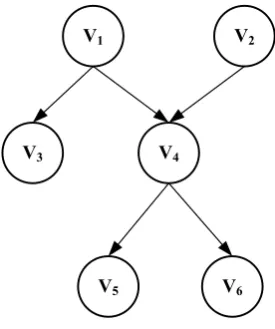
We take the Task Data Flow Graph (TDFG) to model the HW/SW partitioning problem. Hence, the grain of partitioning is on task level. The TDFG graph G =< V, E, T Cost, ACost, X > is a node-weighted directed acyclic graph (DAG). A node setV ={v1, v2, v3, ..., vn} represents a set of tasks. A set E ⊂ V ×V represents dependency relations among tasks. T Costhi represents the execution time of task vi ∈ V on the hardware,
T Costsi represents the execution time of task vi ∈ V on the software. ACostrepresents the area cost of task. When the task is implemented by software, the value of ACost is 0. X is a binary set, which contains two elements, 0 and 1. When the task is implemented by software, X is 0, while if the task is implemented by hardware, X is 1. Our model of HW/SW partitioning problem is based on the task level. Because we take the Coarse-grained to HW/SW partitioning problem, the communication time between CPU and Reconfigurable Unit is taken into consideration.
Figure 2. Compute model
IV. HARDWARE/SOFTWARE PARTITIONING PROBLEM
In this section, we describe the SFLA algorithm in details in the beginning, such as Algorithm parameters, Updating strategy, and so on. Then we introduce in detail the SFLA algorithm which is adopted to solve the HW/SW partitioning problem.
A. SFLA description
(PSO) based on group behaviors. SFLA is characterized by simple concepts, little parameter adjustment, high calculation speed, strong global search optimization ca-pability and easy execution.
Shuffled Flog Leaping Algorithm (SFLA) is developed on the idea that a group of frogs live in a wetland, where many stones are scattered around. The frogs search for stones and leap onto places where there exist more food and each frog exchanges information through mutual cultural communication. Each flog has its own culture, which is defined as one solution to the problem. The whole population of frogs in the wetland is divided into different sub-groups, which has its own culture and executes local search strategies. Accordingly, each frog in the sub-group has its own culture, which influences other frogs. Meanwhile, each frog is subject to the impacts of others and evolves together with the sub-group. Once the sub-group evolves at a certain point, idea exchanges will take place across different sub-groups, namely global information exchange, and further realize the mixed algo-rithm among different sub-groups until the set conditions are met.
Algorithm parameters
Similar to other optimized algorithms, SFLA needs some necessary algorithm parameters, including frogs numberF, number of populationsm, number of frogs in the populations n, maximum allowed step Smax, global best solution Pb, local best solution Pb, local worst solutionPw, the number of frogs in sub-groups ofq, times of local mimetic evolution LS.
Updating strategy
For frog populations, the solution with global best fitness is expressed as Px, while the solution with the best fitness and the one with the worst fitness for each sub-group are expressed asPb andPwrespectively. First, a local search for each sub-group will be conducted, to be more exact, a set of updated operation on individual frogs with the worse fineness in the sub-group.
The updating strategy in distance of frogs is as equa-tion 1:
Ds=rand()∗(Pb−Pw) (1)
The value of each frog after updates is calculated by equation 2:
newDw=oldPw+Ds(−Dmax≤Ds≤Dmax) (2)
Where,Dsrepresents the adjustment vector of individ-ual frog, Dmax represents the maximum allowed step in individual frog [27].
For example, SetPwis [3 5 4 2 1],Pbis [1 5 3 4 2], the maximum allowed stepDmaxis 2, and if the rand is 0.5,
newDw(1) will be3 + max{int[0.5×(1−3)],−2}= 2;
newDw(2) = 5 + min{int[0.5 ×(5−5)],2} = 5. A new solution,newDw= [2 5 4 3 1], can be obtained once the same operation is completed following the updated strategy.
B. SFLA for hardware/software partitioning
In this section, we present the SFLA algorithm in detail. We use the SFLA algorithm to solve the HW/SW partition problem in reconfigurable system on chip. The SFLA algorithm can get an approximate optimal result when satisfying the area constraint. The SFLA algorithm for HW/SW partitioning is presented in Algorithm 1.
Before presenting the details of SFLA algorithm, we define the fitness function denoted by f itness in Equa-tion 3.
f itness= n
∑
i=0
{
T Costhi,if task on hardware
T Costsi,if task on software (3)
whereT Costhirepresents the time cost, when taskVi is executed on hardware.T Costsi represents the time cost, when taskViis executed on software. The fitness function
f itness represents the total completing time cost of all tasks in the critical path. We schedule the tasks with list scheduling algorithm, which is not our key focus in this paper. More details about list scheduling can be found, in [28].
The area cost constrain denoted by Ca in Equation 4.
n
∑
i
ACosti≤Ca (4)
where ACosti represents the area cost of task Vi. The Equation 4 is mean that the total area cost of all tasks is not more than the value of Ca.
algorithm 1Shuffled Frogs Leaping Algorithm for hard-ware/software partitioning (SFLA)
Require: A TDFG graph G. The area constraintCa The max iterationSmax.
The number of frog populationsF. The number of populationsm.
The number of frogs in the populationsn.
Ensure: The optimal or approximate optimal partition-ing.
1: Randomly initialize each node of graph G for each frog.
2: fori←1 to Smax do
3: Compute the fitness f itness of each frog in the swarm by the fitness function in equation 3. 4: Sort all the frogs by descending order off itness. 5: Find the global optimalPx.
6: Divide the frogs into m groups, and each group containsnfrogs.
7: Find the local optimal Pb and the local worst Pw in each groups.
8: Update the each node in each frog by equation 1 and equation 2.
9: end for
10: return Pb.
steps 1, we randomly initialize each node of graph G for each frog, X is randomly set as 0 or 1. From steps 2 to 8, are the procedures of optimization using SFLA algorithm for HW/SW partitioning problem. In steps 3, we compute the fitness function f itness of each frog in the swarm by the fitness function in equation 3. Then we sort all the frogs by descending order off itnessand find the global optimalPxin step 4 and 5. In step 6, we divide the frogs into mgroups, and each group contains
nfrogs. In step 7, we find the local optimal fitnessPband the local worst fitness Pw. Step 8 is the most important phase of the SFLA algorithm. We will update the each node in the frog with the worst fitness by equation 1 and equation 2. When times of iteration is equal toSmax, the SFLA algorithm is terminated.
In this paper, the HW/SW partitioning problem has the area cost constrain. When we randomly initialize and update the node of each frog, we may get the unreasonable solution, which means that the total area cost of all frogs exceed the limit. During the initialization, we sum the each area cost ACosti from 1 to n when X is 1. If the value of total area cost is more than Ca, the procedure of initialization is stopped. We can do the same during updating process.
We will give more details about step 8 as in proce-dure 1.
procedure 1 Local Search about Step 8
1: fori←1 to mdo
2: forj ←1 to LS do
3: Update the frog with the worst fitness Pw by equation 1 and equation 2.
4: ifThe fitness ofnewDwis better thanPw.then
5: Use the new solution newDw instead of the old solutionPw.
6: else
7: Use thePx instead ofPb in equation 1
8: Update as step 3.
9: if The fitness of newDw is worse than Pw.
then
10: Randomly initialize the frog with the worst
Pw.
11: end if
12: end if
13: Sort all the frogs in the group by descending order off itness.
14: Find the local optimalPband the local worstPw in the group.
15: end for
16: end for
According to equation 1, the value ofDscould be be-tween 0 and 1. When we update each frog with equation 2, the values of newDw can take any value between -1 to 1. However, the HW/SW partitioning problem is a binary problem in this paper, so the nodes of each frog value must be chosen from either 1 or 0. Therefore we take the following method to design the values of node.
• If the value ofnewDw is more than 0.5, the value of node is 1, which means that the task will be implemented by hardware.
• While the value ofnewDw is between -0.5 to 0.5, the value of node is as it was.
• The value of node is 0, which means that the task will be implemented by software if the value ofnewDw is lower than -0.5.
V. EXPERIMENTAL
In this section, we will present the experimental results of evaluating the SFLA algorithm when applied to solving the HW/SW partitioning problem. The benchmarks are DFGs randomly generated by Task Graphs For Free (TGFF) [29], which is widely used in embedded system and HW/SW co-design for its flexibility and standardized performance. TGFF can generate the pseudo random task graphs for scheduling and allocation research. In this paper, all experiments are executed on a simulator, which is built with C++ program language, using an Intel(R) Core(TM) Duo Processor i3-3327U 1.90G processor.
We set the experiment parameters as follows:
• A is the area cost when all tasks are implemented by hardware.
• The number of frogsF is 100.
• The number of groupsm is 10.
• The number of frogs in the populationsnis 10.
• The times of local mimetic evolutionLS is 10.
• The max iterationSmax is 10000.
• For our experiments, we choose three different area constrains, which is respectivelyCa =A/3, Ca =
A/2,Ca = 3A/4.
0 20000 40000 60000 80000 100000 120000 140000 160000 180000
200 400 600 800 1000 2000 3000 4000 5000
T
im
e
c
o
st
(
s)
Node number
GA
SA
GSA
SFLA
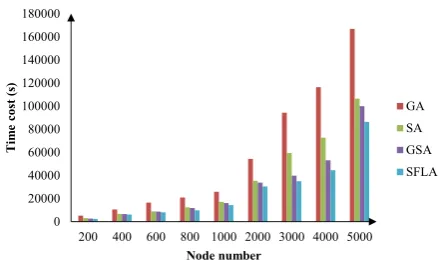
Figure 3. The task completing time results in the experiment, Ca= A/2
TABLE I.
COMPARE WITH THREE ALGORITHMS,Ca=A/3
Bench mark Node number Greedy SA GSA SFLA SFLA vs Greedy SFLA vs SA SFLA vs GSA
Random1 200 5790 3297 2663 2530 56.30% 23.26% 4.99%
Random2 400 11397 9436 8756 7325 35.73% 22.37% 16.34%
Random3 600 17420 15654 12034 9976 42.73% 36.27% 17.10%
Random4 800 21267 18935 16599 14885 30.01% 21.39% 10.33%
Random5 1000 27889 21226 19177 17341 37.82% 18.30% 9.57%
Random6 2000 56740 33018 32022 31067 45.25% 5.91% 2.98%
Random7 3000 97622 59887 39821 36015 63.11% 39.86% 9.56%
Random8 4000 120071 67508 53755 51215 57.35% 24.13% 4.73%
Random9 5000 171547 103490 91579 88123 48.63% 14.85% 3.77%
Average impov. 46.33% 22.93% 8.82%
TABLE II.
COMPARE WITH THREE ALGORITHMS,Ca=A/2
Bench mark Node number Greedy SA GSA SFLA SFLA vs Greedy SFLA vs SA SFLA vs GSA
Random1 200 5254 3083 2727 2430 53.75% 21.18% 10.89%
Random2 400 10596 6736 6586 6134 42.11% 8.94% 6.86%
Random3 600 16573 8902 8706 8054 51.40% 9.53% 7.49%
Random4 800 20991 12486 11837 9873 52.97% 20.93% 16.59%
Random5 1000 25987 17164 16136 14352 44.77% 16.38% 11.06%
Random6 2000 54406 35401 33831 30543 43.86% 13.72% 9.72%
Random7 3000 94340 59426 39880 35015 62.88% 41.08% 12.20%
Random8 4000 116444 72778 53151 44564 61.73% 38.77% 16.16%
Random9 5000 166993 106547 100000 86432 48.24% 18.88% 13.57%
Average impov. 51.30% 21.04% 11.61%
TABLE III.
COMPARE WITH THREE ALGORITHMS.Ca= 3A/4
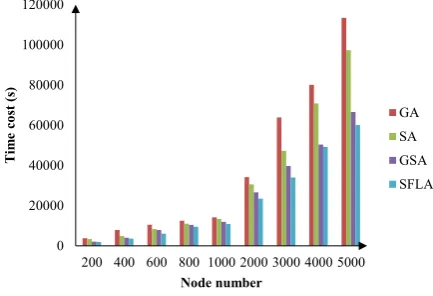
Bench mark Node number Greedy SA GSA SFLA SFLA vs Greedy SFLA vs SA SFLA vs GSA
Random1 200 3740 3353 2087 1934 48.29% 42.32% 7.33%
Random2 400 7879 4822 4021 3605 54.25% 25.24% 10.35%
Random3 600 10460 8409 7837 6012 42.52% 28.51% 23.29%
Random4 800 12446 11014 10375 9432 24.22% 14.36% 9.09%
Random5 1000 14137 13310 11937 10842 23.31% 18.54% 9.17%
Random6 2000 34176 30566 26595 23517 31.19% 23.06% 11.57%
Random7 3000 63858 47231 39685 34015 46.73% 27.98% 14.29%
Random8 4000 80085 70878 50350 49215 38.55% 30.56% 2.25%
Random9 5000 113399 97340 66589 60123 46.98% 38.23% 9.71%
0 20000 40000 60000 80000 100000 120000 140000 160000 180000 200000
200 400 600 800 1000 2000 3000 4000 5000
T
im
e
c
o
st
(
s)
Node number
GA
SA
GSA
SFLA
Figure 4. The task completing time results in the experiment,Ca = A/3
0 20000 40000 60000 80000 100000 120000
200 400 600 800 1000 2000 3000 4000 5000
T
im
e
c
o
st
(
s)
Node number
GA
SA
GSA
SFLA
Figure 5. The task completing time results in the experiment,Ca = 3A/4
As shown in Table V, compared with SA algorithm, with the best in three different area constrain, our algo-rithm can reduce time cost about 41.09%%, as verse it also can reduce about 9.74%.
As shown in Table VI, compared with GSA algorithm, with the best in three different area constrain, our algo-rithm can reduce time cost by 18.99%, as verse it also can reduce about 3.37%.
Based on the three experimental results, while the vulue of area constrainCa is equal toA/2, the performance of SFLA algorithm is the best among three area constrains. The cost of completing time can be reduced by 51.30%,
TABLE IV.
COMPARED WITHGREEDY ALGORITHM
Area constrain Average impov. Max impov. Min impov.
C a=A/3 46.33% 63.11% 30.01%
C a=A/2 50.73% 62.88% 42.11%
C a=A3/4 39.56% 54.25% 23.31%
Average 45.54% 60.08% 31.81%
TABLE V. COMPARED WITHSA
Area constrain Average impov. Max impov. Min impov.
C a=A/3 20.13% 41.08% 8.94%
C a=A/2 27.65% 42.32% 14.36%
C a=A3/4 22.93% 39.86% 5.91%
Average 23.57% 41.09% 9.74%
TABLE VI. COMPARED WITHGSA
Area constrain Average impov. Max impov. Min impov.
C a=A/3 8.82% 17.10% 2.98%
C a=A/2 10.36% 16.59% 4.87%
C a=A3/4 10.78% 23.29% 2.25%
Average 9.99% 18.99% 3.37%
21.04% and 11.61% on average.
VI. CONCLUSIONS
In this paper, we firstly apply SFLA algorithm to solv-ing HW/SW partitionsolv-ing problem on the reconfigurable system on chip. The potential of SFLA algorithm is sub-stantially exploited so that we can get a low completing time cost of the critical path. Compared with greedy algorithm, the experimental results show that the SFLA algorithm can reduce the time cost by 45.54% on average with three different area constrain. The time cost of SFLA algorithm are also reduced by 23.57% and 9.99% on average with simulated annealing algorithm and combined algorithm with greedy and simulated annealing algorithm. And when area constrainCaisA/2, SFLA algorithm can reduce the time cost by 51.30%, 21.04% and 11.61% on average, compared with that of greedy algorithm, SA, and GSA.
In the future, we will do more research on hard-ware/software partitioning algorithm. To be more specific, we will engage ourselves in how to improve the SFLA algorithm, and compare it with more algorithm, such as PSO, GA, Chemical Reaction Optimization (CRO) and so on.
ACKNOWLEDGMENT
REFERENCES
[1] P. Adhipathi, “Model based approach to hardware/software partitioning of soc designs,” Ph.D. dissertation, Citeseer, 2004.
[2] G. Sapienza, T. Secelanu, and I. Crnkovic, “Modelling for hardware and software partitioning based on multiple properties,” inSoftware Engineering and Advanced Appli-cations (SEAA), 2013 39th EUROMICRO Conference on. IEEE, 2013, pp. 189–194.
[3] R. Niemann and P. Marwedel, “Hardware/software parti-tioning using integer programming,” inProceedings of the 1996 European conference on Design and Test. IEEE Computer Society, 1996, p. 473.
[4] J. Resano, D. Mozos, E. P´erez, H. Mecha, and J. Sep-ti´en, “A hardware/software partitioning and scheduling approach for embedded systems with low-power and high performance requirements,” inIntegrated Circuit and Sys-tem Design. Power and Timing Modeling, Optimization and Simulation. Springer, 2003, pp. 580–589.
[5] P. Arat´o, Z. ´A. Mann, and A. Orb´an, “Algorithmic aspect-s of hardware/aspect-software partitioning,” ACM Transactions on Design Automation of Electronic Systems (TODAES), vol. 10, no. 1, pp. 136–156, 2005.
[6] M. Abdelhalim, A. Salama, and S.-D. Habib, “Hardware software partitioning using particle swarm optimization technique,” inSystem-on-Chip for Real-Time Applications, The 6th International Workshop on. IEEE, 2006, pp. 189– 194.
[7] B. Guo, D. Wang, Y. Shen, and Z. Liu, “Hardware– software partitioning of real-time operating systems us-ing hopfield neural networks,” Neurocomputing, vol. 69, no. 16, pp. 2379–2384, 2006.
[8] J. Kaizhong, L. Zhao, and G. Junzhong, “A 0-1 hard-ware/software partitioning algorithm over ip cores,” in
Autonomic and Autonomous Systems, 2006. ICAS’06. 2006 International Conference on. IEEE, 2006, pp. 25–25. [9] Z. ´A. Mann, A. Orb´an, and P. Arat´o, “Finding optimal
hardware/software partitions,” Formal Methods in System Design, vol. 31, no. 3, pp. 241–263, 2007.
[10] A. Farmahini-Farahani, M. Kamal, S. M. Fakhraie, and S. Safari, “Hw/sw partitioning using discrete particle swarm,” in Proceedings of the 17th ACM Great Lakes symposium on VLSI. ACM, 2007, pp. 359–364. [11] V. Arunachalam, S. Sapra, N. Chaitanya, and
J. Prakash Rainac, “Hardware/software partitioning algorithm for embedded systems with repeated functionalities,” in TENCON 2008-2008 IEEE Region 10 Conference. IEEE, 2008, pp. 1–6.
[12] Y. Liu, Q. C. Li, J. X. Liu, and J. Ma, “Study on hard-ware softhard-ware partitioning using immune algorithm and its convergence property,” in Intelligent Computing and Intelligent Systems, 2009. ICIS 2009. IEEE International Conference on, vol. 3. IEEE, 2009, pp. 4–8.
[13] Y. Liu and Q. C. Li, “Hardware software partitioning using immune algorithm based on pareto,” in Artificial Intel-ligence and Computational IntelIntel-ligence, 2009. AICI’09. International Conference on, vol. 2. IEEE, 2009, pp. 176–180.
[14] H. D. Pando, S. C. Asensi, R. S. Lima, J. F. Calder´ın, and A. R. Su´arez, “An application of fuzzy logic for hard-ware/software partitioning in embedded systems,” Com-putaci´on y Sistemas, vol. 17, no. 1, pp. 25–39, 2013. [15] I. Bahri, L. Idkhajine, E. Monmasson, and M. E. A.
Benkhelifa, “Optimal hardware/software partitioning of a system on chip fpga-based sensorless ac drive current controller,” Mathematics and Computers in Simulation, vol. 90, pp. 145–161, 2013.
[16] R. O. Hassan, M. Abdelhalim, and S.-D. Habib, “Reliable pre-scheduling delay estimation for hardware/software
par-titioning,” inCircuits and Systems (MWSCAS), 2013 IEEE 56th International Midwest Symposium on. IEEE, 2013, pp. 1246–1250.
[17] H. Han, W. Liu, J. Wu, and G. Jiang, “Efficient algorithm for hardware/software partitioning and scheduling on mp-soc.”Journal of Computers, vol. 8, no. 1, 2013.
[18] J. Wu, P. Wang, S.-K. Lam, and T. Srikanthan, “Efficient heuristic and tabu search for hardware/software partition-ing,”The Journal of Supercomputing, vol. 66, no. 1, pp. 118–134, 2013.
[19] E. Sha, L. Wang, Q. Zhuge, J. Zhang, and J. Liu, “Power efficiency for hardware/software partitioning with time and area constraints on mpsoc,” International Journal of Parallel Programming, pp. 1–22, 2013.
[20] E. Elbeltagi, T. Hegazy, and D. Grierson, “Comparison among five evolutionary-based optimization algorithms,”
Advanced engineering informatics, vol. 19, no. 1, pp. 43– 53, 2005.
[21] M. Horng, “Multilevel image threshold selection based on the shuffled frog-leaping algorithm.”Journal of Chemical & Pharmaceutical Research, vol. 5, no. 9, 2013. [22] P. Roy, P. Roy, and A. Chakrabarti, “Modified shuffled
frog leaping algorithm with genetic algorithm crossover for solving economic load dispatch problem with valve-point effect,”Applied Soft Computing, vol. 13, no. 11, pp. 4244–4252, 2013.
[23] Y. Xiao, X. Chai, L. B. Hu, C. Yang, and T. Lin, “Modified shuffled frog leaping algorithm for simulation capability scheduling problem,” in AsiaSim 2013. Springer, 2013, pp. 71–81.
[24] Y. Xu, L. Wang, M. Liu, and S.-y. Wang, “An effec-tive shuffled frog-leaping algorithm for hybrid flow-shop scheduling with multiprocessor tasks,” The International Journal of Advanced Manufacturing Technology, vol. 68, no. 5-8, pp. 1529–1537, 2013.
[25] J. Luo and M.-R. Chen, “Improved shuffled frog leaping algorithm and its multi-phase model for multi-depot ve-hicle routing problem,”Expert Systems with Applications, vol. 41, no. 5, pp. 2535–2545, 2014.
[26] M. Eusuff, K. Lansey, and F. Pasha, “Shuffled frog-leaping algorithm: a memetic meta-heuristic for discrete optimization,” Engineering Optimization, vol. 38, no. 2, pp. 129–154, 2006.
[27] E. Afzalan, M. Taghikhani, and M. Sedighizadeh, “Optimal placement and sizing of dg in radial distribution networks using sfla,” International Journal of Energy Engineering, vol. 2, no. 3, pp. 73–77, 2012.
[28] T. Yang and A. Gerasoulis, “List scheduling with and with-out communication delays,” Parallel Computing, vol. 19, no. 12, pp. 1321–1344, 1993.
[29] R. P. Dick, D. L. Rhodes, and W. Wolf, “Tgff: task graphs for free,” inProceedings of the 6th international workshop on Hardware/software codesign. IEEE Computer Society, 1998, pp. 97–101.
[30] J. Grode, P. V. Knudsen, and J. Madsen, “Hardware resource allocation for hardware/software partitioning in the lycos system,” in Proceedings of the conference on Design, automation and test in Europe. IEEE Computer Society, 1998, pp. 22–27.
[31] P. Eles, Z. Peng, K. Kuchcinski, and A. Doboli, “System level hardware/software partitioning based on simulated annealing and tabu search,” Design automation for em-bedded systems, vol. 2, no. 1, pp. 5–32, 1997.
Jiayi Du received his B.S. and M. S. degrees in computer science and technology from Hunan University, China in June 2004 and 2010. He is currently working towards his Ph.D. in computer science and technology at Hunan University, China. His current research interest includes embedded computing and parallel computing. He has published research articles in international conferences and journals of parallel computing and swarm intelligence algorithms. He is also a student member of IEEE Computer Society.
Kong Xiangshengis a Lecturer in the Department of Computer Engineering, Xinxiang University. He received B.E. Degree in 2003 from PLA Information Engineering University, China. He has teaching experience of 11 years. He has published one PHP book, one JAVA book, two MySQL books and seven international papers. His interests are in system analysis & design and software testing.
Xin Zuoreceived his B.S. and M. S. degrees in computer sci-ence and technology, and management from Hunan University, China in 2009 and 2013. He is an officer working Information Department in Hunan University. His current research interest includes information system and corporate governance.
Lingyan Zhangreceived his B.S. and M. S. degrees in computer science and technology of Qingdao Technological University, Qingdao, China in 2003 and 2007. She is an officer in College of Computer Science at Jinan University. Her research interests include computer architecture and operating system.