International Journal of Pharmaceutical Research & Allied Sciences, 2018, 7(4):53-59
Research Article
ISSN : 2277-3657
CODEN(USA) : IJPRPM
Pregnancy Outcome of Nulliparous at Different Age Groups and Nursing
Guidelines
Samaa Mohamed Kotb Selem, Amina Saad Gonied, Hend Salah Eldin Mohamed, Faten
Ibrahim Elsebeiy
Department of Obstetrics and Gynecological Nursing, Faculty of Nursing, Zagazig University, Egypt.
ABSTRACT
Background : The age for maternal reproductiion has been bestimated to be between 15-49 years, but the ages between 20-35 years has been considered as the safest age group for bearing a child. This implies that pregnancy or childbirth below or above this age range can have unpleasant influences on either the mother, the pregnancy, delivery or the child. So, the goal of the present study was to assess pregnancy outcomes of nulliparous at different age groups, and to set guidelines for the nurses for the care of the nulliparous women in the different age groups. A descriptive research design was used, and the study was conducted at the labor ward of labor and childbearing hospital at zagazig university hospitals. The current work registered 195 women to compare the obstetric outcomes of mothers aged less than 20 years (teenage pregnancy, 65); mothers aged 35 years and more (older mothers, 65) with the mothers aged from 20 to 34 (adult group, 65). Personal demographic data summery of pregnancy and labor, and neonatal assessment sheet were used as the tools of this study. The results indicated that adolescent mothers have more threatened abortion, increased gestational age, and post term prolonged labor. And, gestational diabetes mellitus, pregnancy prompted hypertension, and caesarean section have had greater frequency among the older mothers. The total percentage of perineal tears in the third group was of the second degree type compared to 27.8% of the perineal tears in the first group and none in the second group. Post-partum hemorrhage insignificantly occurred with small percentages in the third and second groups compared to none in the first group (4.62%, 3.08% & 0.0% respectively). Lower APGAR score of the total study subjects in the 1st and 5th minutes was found in the first group. Also, neonatal death was found in the first group only, fetal anomalies were found in the third group more than the others. In conclusion, nulliparous advanced maternal age had more complications on the pregnancy outcomes than adolescents and adults. Antenatal counseling for avoiding pregnancy of labor complications especially for this extreme ages(overage-adolescent), has been recommended.
Keywords: Adolescent Mothers, Maternal Age, Teenage Pregnancy, Older Mothers
INTRODUCTION
Adverse outcomes and complications linked to the teenage pregnancy, include : the need for instrumental shipping or emergency caesarean section, postpartum hemorrhage, prematurity, low birth weight, low Apgar rating, neonatal extensive care unit admission and perinatal death [3].
Women who delay childbearing are at the increased danger of having pregnant headaches, together with the ectopic pregnancy, spontaneous abortion, fetal chromosomal abnormalities, a few congenital anomalies, placenta previa, gestational diabetes, preeclampsia, and cesarean transport. Such headaches can also bring about the preterm start, and there's also an increased risk of perinatal mortality [4].
Health care professionals must be references for the pregnant women, and the information that must be given to them before and during the prenatal care is strongly associated with women’s good emotional development in pregnancy. Even though, doctors are the main reference for them, nurses have a key role in providing guidelines on health care during the pregnancy and after the childbirth, cares for the newborn, and supports for these women’s subjective needs [5].
Signifiance of the study:
In recent years, the world is suffering the double burden of teen pregnancy because of the early marriages, and older pregnancies due to the high fertility prices. Many women continue childbearing up to the end of their reproductive age, others start it by the menarche. Therefore, the present study was conducted to assess the pregnancy outcomes of nulliparous at different age groups, and to set guidelines for the nurses for the care of the nulliparous women in the different age groups.
SUBJECTS AND METHODS
Design : A Descriptive design was adopted in this study.
Research Setting :
This study was conducted in the labor ward of labor and childbearing hospital at Zagazig University hospital.
Sample size:
Sample size included 195 nulliparous pregnant women divided into three groups ; First group : with the age less than 20 years old (65 women)
Second groupe : with the age from 20 to 35years old (65women) Third group : with the age more than 35 years old (65women)
Inclusion criteria :
The nulliparous women
Singleton pregnancy
3 age groups were included (less than 20 years old, from 20 to 35, more than 35years old)
Tool of data collection:
An interview questionnaire was designed for the data collection. It consisted of the following parts: • Tool l : Personal demographic data (age, residence, occupation, and education level …etc.) • Tool II : Summary of pregnancy including the pregnancy complications
• Tool III : Summary of labor sheet including : data about the mode of labor, gestational age at the onset of labor, duration of labor, the condition of the uterus after the labor, delivery complications such as genital tract lacerations, immediate presence of post-partum hemorrhage
• Tool V : Neonatal assessment sheet, Apgar score at first and fifth minutes, need or resuscitation admission to neonatal intensive care unit, neonatal weight, and neonatal deaths
Official permission was obtained by the submission of an official letter from the Faculty of Nursing to the responsible authorities of the study setting to obtain the permission for the data collection. Through all the phases of the examination, all the ethical issues were regarded. The researcher assured the subjects to keep their personal information confidential. After introducing herself to the women, the researcher shortly explained the nature and the goal of the examination to every woman before the participation, and the subjects voluntarily enrolled in the study, after the written informed consent.
A Pilot study was conducted on a sample representing about 10% of the main study sample. So, it was carried out on 20 women (who were excluded from the sample). It was done to assess the clarity and applicability of the tools and the arrangement of the items, and it helped to estimate the time needed for filling each sheet. It was found that the average time to fill in the interview sheet ranged from 10 to 20 minutes. Necessary modifications were undertaken in the tool.
After getting the official permission for the pilot testing of the study, and analyzing the tools, the researcher started the data collection for three days per week during the afternoon shifts to have the chance of working there, which was allowed. The researcher interviewed with the parturient women, and explained the purpose of the study, and started data collection. The researcher collected the data through the following phases;
1. Interviewing phase : the researcher attended study the setting for three days per week, and all the women in both groups were interviewed (structured interview). The researcher collected data related to the women's socio demographic characteristics, present medical history, current pregnancy, and the labor condition. 2. Assessment phase : In this phase, the researcher together with the on duty physician started the examination
of the parturient women. Regular assessment of the maternal and fetal conditions started immediately after the admission to the labor and delivery unit. The mode of the labor and its duration were also evaluated. Neonatal assessment was accomplished by the assessment of the Apgar score and finding out any abnormality that needed the admission to neonatal intensive care unit, resuscitation or death. These data were recorded in the summary of labor and newborn sheets.
Statistical analysis: All the statistical analyses were performed using SPSS for windows version 20.0 (SPSS, Chicago, IL).
RESULTS
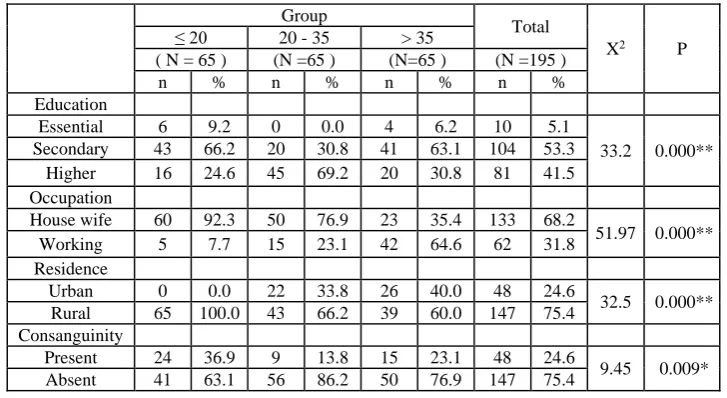
Table 1 illustrates a highly statistically significant difference among the three studied groups regarding education, occupation and residence, (P= 0.000). As for education, a higher percentage of women in the second group were highly educated compared to the third and first groups (69.2% vs. 30.8% &24.6% respectively). This table also shows that, a higher percentage of women in the third group were working compared to the second and first group (64.6% vs. 23.1% &7.7%, respectively). Regarding the residence, the total percentage of women in the first group were rural residents compared the second and third groups (100.0% vs. 66.2% & 60.0% ; respectively). In addition, consanguinity was statistically significant present in a higher percentage of women in the first group compared to the third and second groups (36.9% vs. 23.1% & 13.8% ; respectively, for P= 0.009).
Table 1. Distribution of the studied women according to the socio demographic characteristics (n= 195): Group
Total
X2 P
≤ 20 20 - 35 > 35
( N = 65 ) (N =65 ) (N=65 ) (N =195 )
n % n % n % n %
Education
Essential 6 9.2 0 0.0 4 6.2 10 5.1
33.2 0.000**
Secondary 43 66.2 20 30.8 41 63.1 104 53.3
Higher 16 24.6 45 69.2 20 30.8 81 41.5
Occupation
House wife 60 92.3 50 76.9 23 35.4 133 68.2
51.97 0.000**
Working 5 7.7 15 23.1 42 64.6 62 31.8
Residence
Urban 0 0.0 22 33.8 26 40.0 48 24.6
32.5 0.000**
Rural 65 100.0 43 66.2 39 60.0 147 75.4
Consanguinity
Present 24 36.9 9 13.8 15 23.1 48 24.6
9.45 0.009*
Absent 41 63.1 56 86.2 50 76.9 147 75.4
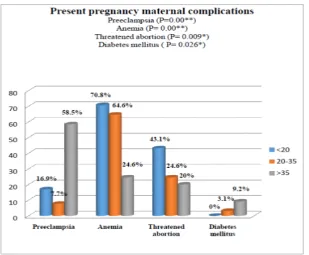
women in the first group were complicated with the threatened abortion than those in the second and third groups (43.1%vs. 24.6% & 20.0% ; respectively, P= 0.009), while diabetes mellitus complicated a statistically higher percentage of women in the third group than those in the second group versus none in the first group (9.2%,3.1% vs.0.0% respectively, P= 0.026).
Figure 1. The distribution of the studied women according to the present pregnancy maternal complications.
Table 2 illustrates that a higher percentage of women in the third group delivered by CS than those in the first and second groups (76.9% vs. 67.7% & 66.2% ; respectively), but the difference didn’t reach the statistical significance. It was also obvious that a statistically higher percentage of women in the third and second groups compared to none in the first group experienced preterm labor (7.7% & 6.2% vs. 0.0% respectively). While a statistically higher percentage of women in the first group experienced post term labor than those in the second and third groups (21.5% vs. 7.7% & 3.1% ; respectively, for P= 0.003).
In addition, the mean gestational age at the onset of labor was statistically higher in the first group than the third and second groups (39.4±1.6 vs. 38.7±1.3 & 38.6±1.3 ; respectively, P= 0.001).
Table 2. The distribution of the studied women according to the route of delivery and gestational age at the onset of labor (n= 195)
Group
Total
X2 P
≤ 20 20 - 35 > 35
(N = 65) (N =65 ) (N =65 ) (N=195 )
n % n % n % n %
Delivery route Vaginal 21 32.3 22 33.8 15 23.1 58 29.7 2.11 0.34
CS 44 67.7 43 66.2 50 76.9 137 70.3
GA
Preterm <37 0 0.0 4 6.2 5 7.7 9 4.6
16.28
0.003*
Term 37-40 51 78.5 56 86.2 58 89.2 165 84.6
Post term >40 14 21.5 5 7.7 2 3.1 21 10.8
Mean±SD 39.4±1.6 38.6±1.3 38.7±1.3 38.8±1.7
F= 6.763 0.001**
Range 37-40 34-41 33-41 33-41
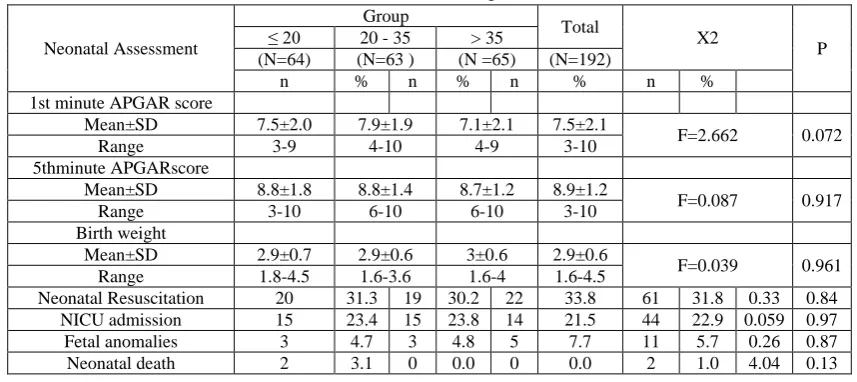
Table 3. Distribution of the studied women according to the neonatal assessment (n= 192):
Neonatal Assessment
Group
Total
X2
P
≤ 20 20 - 35 > 35
(N=64) (N=63 ) (N =65) (N=192)
n % n % n % n %
1st minute APGAR score
Mean±SD 7.5±2.0 7.9±1.9 7.1±2.1 7.5±2.1
F=2.662 0.072
Range 3-9 4-10 4-9 3-10
5thminute APGARscore
Mean±SD 8.8±1.8 8.8±1.4 8.7±1.2 8.9±1.2
F=0.087 0.917
Range 3-10 6-10 6-10 3-10
Birth weight
Mean±SD 2.9±0.7 2.9±0.6 3±0.6 2.9±0.6
F=0.039 0.961
Range 1.8-4.5 1.6-3.6 1.6-4 1.6-4.5
Neonatal Resuscitation 20 31.3 19 30.2 22 33.8 61 31.8 0.33 0.84
NICU admission 15 23.4 15 23.8 14 21.5 44 22.9 0.059 0.97
Fetal anomalies 3 4.7 3 4.8 5 7.7 11 5.7 0.26 0.87
Neonatal death 2 3.1 0 0.0 0 0.0 2 1.0 4.04 0.13
DISCUSSION
The aims of the present study were to: assess the pregnancy outcomes of nulliparous at different age groups, and set guidelines for the nurses on the care of nulliparous women in the different age groups. Age, at both extremities of the reproductive period, was considered a risk factor to the pregnancy outcomes.
The present results showed that women with preeclampsia and gestational diabetes were high significantly (p=0.001**) more likely to be >35 years old. These findings were in agreement with [6] in Muar. [7], in Thailand in their study on the risk factors of preeclampsia in Thai Women have reported that the maternal age > 35 years carried an increased risk of developing preeclampsia and gestational diabetes. This could be related to the modern vascular endothelial harm that happens with mother growing old, and the obstruction of maternal spiral arteriolar lumina by atherosis.
On the other hand, [8] in Egypt, carried out a study with the title of "Risk Factors and Impacts of Pre-Eclampsia: An Epidemiological Study among Pregnant Mothers in Cairo, Egypt", and the results showed that the young (18-21 year) and antique (26-30 year) age companies were at the big danger of elements for preeclampsia.
Concerning job status, the results of this study pointed that the women more than 35 years old included the higher percentage of working than the other age groups (64.6% vs.23.1% &7.7% ; respectively). These findings related to the job status were in agreement with [9] in Ireland, that approximately transported the same results for the nulliparous girls on the extremes of the maternal age, and mentioned that the maternal age ≥40 years was related to being in employment (OR 2.51, 95% CI 1.92–3.28).
On the other hand, the findings were in disagreement with [10] who studied the delayed childbearing, pregnancy and maternal outcomes in Iran, and emphasized that 1.7% of women aged at 18-34 years had a job compared to 6.7% of the older age group more than 35years with a significant difference (p<0.01).
According to the present study’s results, the women of the third group (more than 35years old) also had a high percentage of conception using ART than those in the first (<20years old) and second (from 20-35 years old) groups (12.3% vs.6.2%&6.2% ; respectively). This figure was very close to that revealed by [11] in Japan, that found the approximate association between very advanced maternal age and the adverse pregnancy consequences. And, they stated that women of the older age had a better incidence of being more likely to have conceived through ART (p-values for trend: < 0.001), which was due to the lack of its hazard to get a baby.
Regarding the pregnancy maternal complications of the studied women, the present study revealed that anemia was statistically high in women in the first (less than 20years old ) and second (from 20 -35years old) groups during pregnancy, when it was compared with the third group (more than 35 years old) (70.8% & 64.6%vs. 24.6% ; respectively ).This was consistent with the hypothesis that the proportion of the mothers with severe anemia (Hb less than 7 mg/dl) was significantly higher among all the adolescents [12].
Another study performed on ethiopia showed that anaemia in pregnancy become much more likely to occur in moms with a high parity irrespective of the maternal age [13]. That might be due to lack of nutrition.
old) groups (43.1%vs.24.6%&20.0% ; respectively). This was in disagreement with the opinion of [14] who stated that there was an increase in rate of abortion in the increased maternal age.
Based on this examination, the neonatal death was more common in the adolescent group, but it didn’t attain statistically extensive difference. [15] concluded that the Australian girls who were younger than twenty, experienced higher charges of fetal and neonatal deaths than the Australian women (15.7 as opposed to 7 four total births, and 4.0 versus 2.8 in keeping with 1,000 stay births ; respectively).
On the same line, [16] in British Columbia, in a retrospective cohort study on the effect of the maternal age on the negative start effects, found that older maternal age was not significantly associated with the neonatal death.
Low Apgar score in this study was calculated for the teenagers to be more than adults and advanced maternal age group, but it wasn’t statistically significant, this was close to the opinion of [17] who studied the obstetrics and neonatal outcomes of the adolescents being pregnant.
Regarding the birth weight, this study found that the low birth weight was more in the second and third groups than the first group who were less than 20 years old. On the same line, various research studies discovered the affiliation among the advanced maternal age and the detrimental fetal consequences including the prematurity, low beginning weight, and nevertheless, beginning [2, 16, 18, 19].
On the other hand, in a huge cohort in china, the maternal age less than 20 years, was significantly related to the hazard of handing over a low birth weight [20].
CONCLUSIONS
The study arrived at the conclusion that the nulliparous women aged 20-35years old were highly educated, women more than 35 years old had the higher percentage of working, and the total percentage of women less than 20 years old were living in rural areas with a more common consanguinity.
Previous abortion, preeclampsia, diabetes mellitus and cesarean section were more common among women more than 35 years old.
In addition, women less than 20 years old were more likely to be anemic, and had threatened abortion than post term delivery that prolonged more than 12 hours.
The prolonged third stage of labor was also more common among the women more than 35 years old.
Recommendations
Based on the obtained findings, the following suggestions were recommended: fitness training and counseling of women before being pregnant about the destructive outcomes of being pregnant because of the importance of the early and good enough prenatal care in case of teenage or elderly pregnancy, should be provided. The protection and upgrading of the excellent maternity care with the excessive insurance has been the cornerstone to mitigate the unfavorable effects of minor and older pregnancies. The exact document preserving the complete information merits the extra attention of the supervisors of the number-one health care centers. It is particularly significant for the Egyptian community which is shift from the control to the prevention of the pregnancy at extremes of maternal age to decrease the quantity of pregnancies at young or older maternal age, and deliver a greater maternity care.
REFERENCES
1. Adolescent Pregnancy–World Health Organization Fact Sheet364 [Internet]: World Health Organization; 2012 [cited2014 January 10]. Available from: http://www.who.int/media Centre/fact sheets/fs364/en/ 2. Lee YY, Roberts CL, Patterson JA, Simpson JM, Nicholl MC, Morris JM, et al. Unexplained variation in
hospital caesarean section rates. Med J Aust. 2013;199:348–53.
3. Kurth F, Bélard S, Mombo-Ngoma G, et al. Adolescence as risk factor for adverse pregnancy outcome in Central Africa--a cross-s ectional study. PLoS One 2010; 5:e14367. https://doi.org/10.1371/journal.pone.0014367.
4. Waldenstrom u, cnattingius s vixner l, norman m. advanced maternal age increases the risk of very preterm birth irrespective of parity : apopulation-based register study. BJOG. 2017 Jul;124(8):1235-1244. doi: 10.1111/1471-0528.14368. Epub 2016 Oct 21.
5];39(4):349-57. Available at: http://www.ncbi.nlm.nih.gov/pmc/ articles/PMC3532049/pdf/nihms211829.pdf
6. Lanjutan u, rashed h,and awaluddin s. advanced maternal age and adverse pregnancy outcomes in muar, johar sains malaysiana 45(10)(2016):1537-1542.
7. Luealon P and phupong v. risk factors of preeclampsia in thai women, j med a ssoc thai .2010 jun ;93(6) :667-6
8. El-Moselhy E A ; Hamed O. Khalifa ; Soliman M. Amer ; Khadra I. Mohammad and Hani M. Abd El-Aal ; Risk Factors and Impacts of Pre-Eclampsia : An Epidemiological Study among Pregnant Mothers in Cairo, Egypt. Journal of American Science, 2011;7(5) Available at ; http://www.americanscience.org
9. Vaughan DA, Cleary BJ, Murphy DJ. Delivery outcomes for nulliparous women at the extremes of maternal age–a cohort study. BJOG 2014;121:261–268.
10. Nojomi m, haghighi l, bijari b, rezvani l, and tabatabaee ks. Delay childbearing : pregnancy and maternal outcome ; Iranian journal of reproductive medicine vol.8.no.2. pp :80-85, spring 2010.
11. Ogawa k, urayama yk, tanigaki s, sago h, sato s, saito s, and morisaki n. association between very advanced maternal age and adverse pregnancy outcomes : across sectional Japanese study, bmc pregnancy and child birth (2017)17 :349.
12. Ganchimeg T, Mori R, Ota E, Koyanagi A, Gilmour S, Shibuya K, et al. Maternal and perinatal outcomes among nulliparousadolescents in low- and middle-income countries : a multi-country study. BJOG 2013;120:1622–33.
13. Al-Farsi, Y.M., Brooks, D.R., Werler, M.M., Cabral, H.J., Al-Shafei, M.A. & Wallenburg, H.C. 2011. Effect of high parity on occurrence of anemia in pregnancy: A cohort study. BMC Pregnancy and Childbirth 11(1): 7.
14. Edessy M, Mohamed Abd El Samie, AbdElRaoufOun, Kotb Hassan, AbdElAzeemM.Afefy, Pregnancy outcome in elder women of Lower Egypt ; Int.J. Adv.Res. Biol.Sci.1(9) :(2014) :149–156.
15. Laws pj, tracy sk, and Sullivan ea. Perinatal outcomes of women intending to give birth in birth centers in Australia ; birth,37(1) (2010), pp.28-36.
16. Lisonkova, S., Janssen, P.A., Sheps, S.B., Lee, S.K. & Dahlgren, L. 2010. The effect of maternal age on adverse birth outcomes: Does parity matter. J. Obstet. Gynaecol. Can.32(6): 541-548.
17. Narukhutrpichai MD, Dithawut Khrutmuang MD, Thanin Chattrapiban MD. The Obstetrics and Neonatal Outcomes of Teenage Pregnancy in Naresuan University Hospital, J Med Assoc Thai Vol. 99 No. 4 2016, pp.361-367.
18. Kenny, L.C., Lavender, T., McNamee, R., O’Neill, S.M., Mills, T. & Khashan, A.S. 2013. Advanced maternal age and adverse pregnancy outcome: Evidence from a large contem porary cohort. PLoS One. 2013;8(2):e56583. doi: 10.1371/journal.pone.0056583. Epub 2013 Feb 20.
19. (Yadav, H. & Lee, N. 2013. Maternal factors in predicting low birth weight babies. The Medical Journal of Malaysia 68(1): 44-47.