International Journal of Pharmaceutical Research & Allied Sciences, 2016, 5(1):114-121
Research Article
CODEN(USA) : IJPRPM
ISSN : 2277-3657
Sensorimotor Retraining and its Impact on the UpperExtremity Function in
Patients with Chronic Stroke
Afshin Samaei
1.Mina Sadat Mirshoja
2*, Mohammad Amoozadeh Khalili, Ph.D.
21Department of neurology, Semnan University of Medical Sciences,Semnan, Iran
2Neuromuscular Rehabilitation Research Center, Rehabilitation College, Semnan University of Medical
Sciences,Semnan, Iran Email*: [email protected]
________________________________________________________________________________________
ABSTRACT
Introduction
Background: One of the major concerns for people is sensory-motor dysfunction of the upper extremity after
stroke.Sensorimotorretraining helps active discovery ofhand, sensory discrimination between stimulus, separate movements of fingers and reduced dependence.The aim of this study was to investigate sensorimotor retraining and its impact on upper extremity function in patients with chronic stroke.
Method: A randomized experimental study was conducted with 36 patients in the treatment and control groups of 18
patientswith an average age of (9/03) 57/03 years and disease period48/17(31/3) months.Treatment was carried out for 2 weeks and 5 days a week for 90 minutes per weekwith consideration of rest time for 2.5 minutes between exercises for all patients.
Before and after therapeutic interventions in separate days of therapy sessions, (HORT) Haptic object Recognition Test, 9 - HOLE peg test (9-HPT) and Weinsten Enhanced Sensory Test and WPST) Wrist Position Sense Test were taken.
Results: The results of this study indicate the effectiveness of sensorimotor retraining on the upper extremity
function.Reduced average scores of 9-HIT meant an increased hand speed,lower average test scores HORT meant reduced error,and the average reduction in ankle proprioception error was found in the WPS test.Sensory-motor interventions reduced monofilament test scores and this means increasedperception of fingertips.The difference in test scores in the treatment group is more significant showing the efficacy of this kind of interventions in these patients.
Conclusion: sensory-motor retraining may improve upper extremity function, increasing accuracy and coordination
in picking up, carrying and dropping the objects.
It also improved the ability of individuals in manipulating objects and reduced dependence on daily activities and increased satisfaction and life quality.
Keywords: sensory-motor training, upper extremity function, chronic stroke
_____________________________________________________________________________________________
INTRODUCTION
In the near future, stroke becomes one of the biggest reasons for long-term disability since 15 million people
suffering from stroke worldwide, and among these, 5 million die and another 10million are sensory-motor disabled.
Upper extremity function after stroke is one of the most common problems that negatively affects the ability to search the immediate environment, hand function and returning to normal activities (2).Sensory-motor retraining enabled active discovery ofhand, sensory discrimination between stimulus, distinct and delicate movements of the fingerprints (3).People suffering from sensory disabilities have trouble in coordinating a variety of grab-and-drop tools, controlling objects in the hands and fingers (4).The ability to manipulate objects is one of the high-level skills of upper extremity function. One of the major concerns of the people is sensory-motor dysfunction of the upper extremity after stroke (5).Many interventions have been proposed to improve the performance of sensorimotor in these people.Bobathsensory motor therapies and proprioceptive neuromuscular facilitation are known procedures to improve upper extremity function (6).Meyer et al., (2014) in a study reviewed the relationship between sensory impairmentsand the upper extremity motor function in activities.They found that the ability to discriminate two points in the upper extremity dexterity skills, proprioceptive and sensory perceptionis influential on individual's participation in daily activities and even social participation (5).
Bird et al. (2013) in a study aimed at sensorimotor retraining and nervous reorganization showed that hand- movement training therapies increased gray volume in the brain's sensory motor cortex, motor anterior region, the hypothalamus in both sides in brain and changed brain's plasticity. These changes are effective on the simultaneous improvement of the sensory and motor organs (3).
Doyle et al., (2010) showed that the sensory interventions are effective in improving upper extremity function (7). La connel et al., (2008) studied the sensory-motor dysfunction after stroke. In a 5-6 months follow-up in 70 patients, they showed that the most damage to the sensory-motor organ is related to strognosis skills, proprioceptive dysfunction and sensory perception (8). Nancy et al. (2008) in a study with the aim of investigation of sensory-motor re-training in upper limb function evaluated 45 patients with chronic stroke in three treatment groups and in separate sessions showed that an increase in treatment sessions with sensory-motor training leads to better function. They suggested that the brain's neuroplasticity phenomenon could lead to receiving accurate sensory data and more effective motor function (9). A healthy sense of safety is essential while doing various daily activities (10). In the study, the use of sensory-motor activities enabled active search ability in fingers, separate mobility of the joints to check each texture, size, temperature, and proprioceptive and surface touch (3). Although many interventions focused on improving patients' motor impairments in stroke, few studies have investigated the importance of sensory-motor control retraining in stroke. This study was designed to investigate the effect of sensorimotor training on the upper limb motor function in patients with chronic stroke.
Materials and Methods
Experimental study was conducted in two treatment and control groups. The samples were randomly selected based on the inclusion criteria of stroke patients referred to clinics in Tehran. Inclusion criteria included first stroke experience, injury for at least 6 months, eligibility for sensorimotor retraining (sensory perception in the fingers in mono filaments at acceptable level of 3/84-4/31 and two point discrimination at 7-10 mm) in the hands of the patients (6), minimal motor ability in the upper extremity based on the Brunstruom test in five stage , lack of muscular ability above 1 based on Ashworth benchmark in patient's hand (3), scoring higher than or equal to 44 in Star cancellation (11), scoring higher than or equal to 21 in the Mini mental status examination (12), in the 45 -60 years. Exclusion criteria included stroke, orthopedic, rheumatologic and neurologic problems during treatment, absenteeism and lack of desire to continue treatment. Consent was obtained from participants.
In the study, sensorimotor retraining was carried out for 2 weeks and 5 days a week for 90 minutes per week with consideration of rest time for 2.5 minutes between exercises for all patients.
them alone, the therapist could give a little help (3). Control group received common occupational therapy in equal conditions in sessions and duration of interventions. In this study, two therapists, one familiar to therapeutic intervention and the other as the assessor not aware of the treatment were recruited. All patients were evaluated before and after therapeutic interventions in the separate days of therapy sessions using Haptic object Recognition Test ،9 - HOLE peg test (9-HPT)(HORT),Weinsten Enhanced Sensory Test,Weinsten-monofillament test, Wrist Position Sense Test WPST).
Hole peg test (9-HPT)
It is a finger and hand dexterity test. In this test, the participant is asked to put 6 nuts in the right place as soon as possible and as soon as he put the last nuts, return them the first place. The reaction time of taking the first nut to the last nut is recorded by the therapist (13). The test-retest reliability was reported 83%-99% (3).
Haptic object Recognition Test (HORT)
The test is capable of detecting objects through touch or visual removal. 17 unfamiliar objects made of Lego components are provided into 5 groups for the participants. In the familiarity stage, the participant sees and touches objects and decides to which group it belongs. The participants do the test as quickly and accurately as possible. After a familiarization session, individual’s performance is measured through activity and counting the frequency of errors in three consecutive sessions (14). The reliability of the test was reported 1/3-1/8 (3).
Weinsten Enhanced Sensory Test
It's a test to evaluate the sensory perception. Monofilaments are used perpendicular to the fingertips for 1 second.Then the individual is asked whether he/she sensed it or not (15). The internal validity of the test was reported 0/965 (3).
WPST)Wrist Position Sens Test
The test shows perception ability of wrist posture by visual removal.Forearm and wrist were placed in plastic moldingand then the therapist extends and flexures his wrist at angle of 20 back and forward. The patient predicts that his/her wrist is in what direction and at angle (16). The test - retest reliability of the instrument was reported 0/88-0/92 (3).To analyze the data, Kolmogorov-Smirnov test was utilized to determine normality, paired- t and Wilcoxon at significance level of 5% and the software SPSS18.0.
Results
Findings
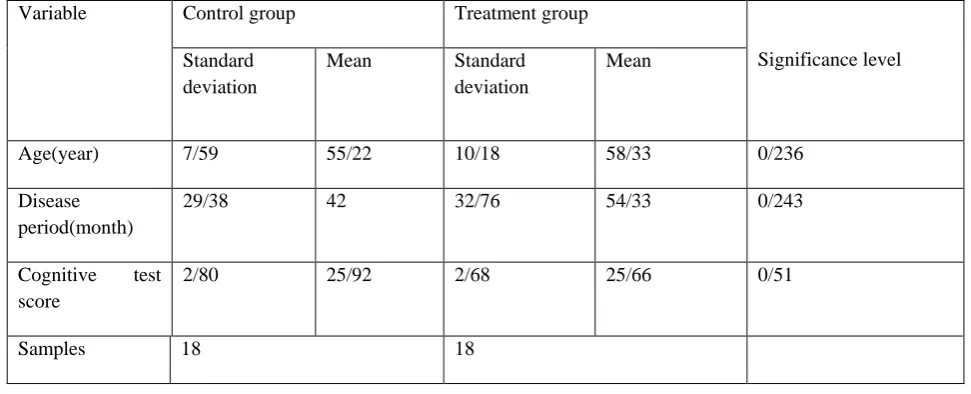
In this study, 36 patients were assigned in two 18 treatment and control groups with an average age (SD) (9/03) 57/3 years and patience period (31/3) 48/17 months.Variables were consistent in treatment and control groups based on the chi-square test in terms of gender distribution, healthy hand and also in independent t-test to evaluate the two groups in terms of age, patience period, stroke, cognitive state, respectively.Since 0.05 <p, the results indicated that both groups were similar in terms of variables. Demographic information for each group is presented in below Table 1 and 2.
Table: Frequency of demographic data of patients (n = 36)
Significance level Control group
Treatment group
157% 50%
9 50%
9 Male
50% 9 50% 9 Female 100% 18 100% 18 Total 138% 55.6% 10 55.6% 10 Right
Patient's hand Left 8 44.4% 8 44.4%
100% 18 100% 18 Total 803% 94.4% 17 94.4% 17 Right Dominant hand 5.6% 1 5.6% 1 Left 100% 18 100% 18 Total
Table 2: Mean and standard deviation of age, patience period, cognitive test between two groups (n = 36)
Significance level Treatment group Control group Variable Mean Standard deviation Mean Standard deviation 0/236 58/33 10/18 55/22 7/59 Age(year) 0/243 54/33 32/76 42 29/38 Disease period(month) 0/51 25/66 2/68 25/92 2/80
Cognitive test
score
18 18
Samples
.
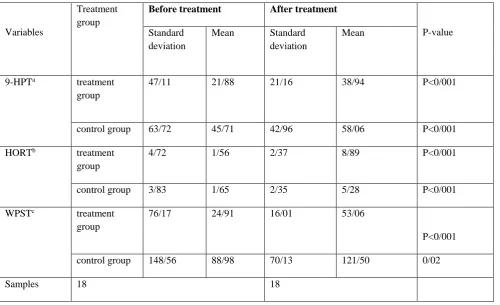
Table 3: Mean, standard deviation, before and after treatment of the upper extremity function tests between two groups (n = 36)
P-value
After treatment Before treatment
Treatment group
Variables Standard Mean
deviation Mean Standard deviation P<0/001 38/94 21/16 21/88 47/11 treatment group 9-HPTa P<0/001 58/06 42/96 45/71 63/72 control group P<0/001 8/89 2/37 1/56 4/72 treatment group HORTb P<0/001 5/28 2/35 1/65 3/83 control group P<0/001 53/06 16/01 24/91 76/17 treatment group WPSTc 0/02 121/50 70/13 88/98 148/56 control group 18 18 Samples
To compare the treatment effect in two groups, Mann-Whitney test was used which its result is presented in Table 4.
Significance level
Difference between two groups
Treatment group
Variables Before treatment After treatment
0/02 control group
27/06 18/85
Sensory perception changes in Weinsten- monofilament Test before and after the intervention are presented in the below chart.
Chart 1: Sensory perception changes in Weinsten- monofilament test before and after the intervention in treatment group (black column: before treatment and grey column: after treatment)
Chart 2: Sensory perception changes in Weinsten- monofilament test before and after the intervention in control group (black column: before treatment and grey column: after treatment)
Discussion
Sensory-motor dysfunction associated with upper extremity after stroke is very common (8) causing prolonged duration of hospitalization and rehabilitation, dependence in daily activities (5).Sensory motor retraining therapies facilitate voluntary movement in joints (1) and increase the quality of the mobility return (4). The aim of this study was to investigate the effect of sensorimotor retraining on the sense and upper extremity function in patients with chronic stroke.The results of this study indicate the effectiveness of the upper extremity sensorimotor retraining function. Average scores of 9-HPT test declined in both groups after treatment and this means increasing the speed of picking up and leaving test nuts.
In addition, the difference in test scores in the treatment group was more significant showing the effectiveness of interventions in these patients. The HORT mean scores were decreased in both groups showing a reduction of error in the detection of unfamiliar objects. Reduced error difference in the treatment group control was more significant. In wrist position detection test, average proprioception error was reduced. This decline reflects the improved proprioception in the wrist. Charts 1 and 2 indicate sensory perception changes in Weinsten- monofilament test before and after the intervention between two groups.
Black columns represent the sensory perception of each finger before the intervention and gray columns represents sensory perception of each finger after the intervention.
As can be seen, sensory-motor interventions reduced mono-filament test scores and it means increased awareness and perception of the person's fingertips to thinner mono-filament with less density. Bird et al., (2013) in similar study using FMRI showed that sensory-motor retraining increases sensory-motor cortex. It facilitates motor function in everyday activities. Schabrun et al., in a review showed that sensory and motor function linked together. Improved sensory function has positive impact on upper limb function (17).
The results of this study are also consistent with Tyson et al., results since they showed that sensory damages have significant impact on people's movement and independence in everyday activities (18).
On the other hand, Coupar F et al., in a review showed that some motor and sensory interventions in the short term may not show significant changes in upper extremity function. In the conclusion of their study, duration for intervention, the injury intensity and quality of care were important factors(5, 19). In summary, a large number of studies indicated the relationship between sensory and motor functions and the effects of sensory intervention in the performance of affected limb.
in some individuals. Therefore, it is suggested that before the intervention, the importance of a healthy sense in daily functioning for patients with stroke is described. Also the use of more industrialized sensorimotor retraining tools helps increased patient motivation in therapy active participation. The effect of therapeutic intervention should be examined using brain imaging.
Conclusion
The results of this study showed that sensory-motor retraining may improve upper extremity function, increasing accuracy and coordination in picking up, transporting and dropping the objects. It also improved the ability of individuals in manipulating objects, reducing dependence on daily activities and increasing satisfaction and quality of life.
Acknowledgment
I wish to thank all the participants who helped us in conducting this study; especially Mrs. ParvanehTaghavie in charge of hospital's occupational therapy department.
References
1. Winter JM, Crome P, Sim J, Hunter SM. Effects of mobilization and tactile stimulation on chronic
upper-limb sensorimotor dysfunction after stroke. Archives of physical medicine and rehabilitation. 2013;94(4):693-702.
2. Carey L, Macdonell R, Matyas TA .SENSe: Study of the Effectiveness of Neurorehabilitation on Sensation
A Randomized Controlled Trial. Neurorehabilitation and neural repair. 2011;25(4):304-13.
3. Bird T, Choi S, Goodman L, Schmalbrock P, Nichols-Larsen DS. Sensorimotor training induced neural
reorganization after stroke: a case series. Journal of neurologic physical therapy: JNPT. 2013;37(1):27.
4. Hsu H-Y, Lin C-F, Su F-C, Kuo H-T, Chiu H-Y, Kuo L-C. Clinical application of computerized evaluation
and re-education biofeedback prototypefor sensorimotor control of the hand in stroke patients. J Neuroeng Rehabil. 2012;9(1):26.
5. Meyer S, Karttunen AH, Thijs V, Feys H, Verheyden G. How do somatosensory deficits in the arm and
hand relate to upper limb impairment, activity, and participation problems after stroke? A systematic review. Physical therapy. 2014.
6. Pendleton HM, Schultz-Krohn W. Pedretti's occupational therapy: practice skills for physical dysfunction:
Elsevier Health Sciences; 2013.
7. Doyle S, Bennett S, Fasoli SE, McKenna KT. Interventions for sensory impairment in the upper limb after
stroke. The Cochrane Library. 2010.
8. Connell LA, Lincoln N, Radford K. Somatosensory impairment after stroke: frequency of different deficits
and their recovery. Clinical Rehabilitation. 20.67-758:)8(22;08
9 Byl NN, Pitsch EA, Abrams GM. Functional outcomes can vary by dose: learning-based sensorimotor
training for patients stable poststroke. Neurorehabilitation and neural repair. 2008;22(5):494-504.
10. Scalha TB, Miyasaki E, Lima NMFV, Borges G. Correlations between motor and sensory functions in
upper limb chronic hemiparetics after stroke. Arquivos de neuro-psiquiatria. 2011;69(4):624-9.
11. Bailey MJ, Riddoch MJ, Crome P. Evaluation of a test battery for hemineglect in elderly strokepatients for
12. Foroughan M JZ, ShirinBayan P, GhaemMagham Z, Rahgozar M. Validation of mini-mental state examination
(MMSE) in older people of Tehran city. Journal of News in Cognitive Science. 2008;10(2):29-37.
13. Earhart GM, Cavanaugh JT, Ellis T, Ford MP, Foreman KB, Dibble L. The 9-hole PEG test of upper
extremity function: average values, test-retest reliability, and factors contributing to performance in people with Parkinson disease. Journal of Neurologic Physical Therapy. 2011;35(4):157-63.
14. Kalisch T, Kattenstroth J-C, Kowalewski R, Tegenthoff M, Dinse HR. Cognitive and tactile factors
affecting human haptic performance in later life. PLoS One. 2012;7(1):e30420.
15. Kerry Poole HM. The value of the WEST monofilaments in
detecting neurosensory deficit caused
by hand-arm vibration exposure Health and Safety Laboratory 2009.
16. Carey LM, Oke LE, Matyas TA. Impaired limb position sense after stroke: a quantitativetest for clinical
use. Archives of physical medicine and rehabilitation. 1996;77(12):1271-8.
17. Schabrun S, Hillier S. Evidence for the retraining of sensation after stroke: a systematic review. Clinical
Rehabilitation. 2009;23(1):27-39.
18. Tyson S, Hanley M, Chillala J, Selley AB, Tallis RC. Sensory loss in hospital-admitted people with stroke:
characteristics, associated factors and relationship with function. Neurorehabilitation and Neural Repair. 2007.
19. Coupar F, Pollock A, Rowe P, Weir C, Langhorne P. Predictors of upper limb recovery after stroke: a