ISSN 1392 – 2785 Inzinerine Ekonomika-Engineering Economics(4).2009
ECONOMICS OF ENGINEERING DECISIONS
Management of Project Properties in “Virtual Archive” for Building Design Industry
Linas Gabrielaitis, Romualdas Bausys
Vilnius Gediminas Technical University
Sauletekio av. 11, LT-10223 Vilnius, Lithuania [email protected], [email protected]
The aim of this research is to reduce a project development time and costs in building design and construction industry. It is performed by managing project technical documentation and digital data, which involves the complete life cycle of design documentation and design-related data inside CAD applications. Life cycle of design documentation and design-related data is achieved through the engineering document management system (EDM). EDM system founded on electronic archive system, which stores and distributes all technical information. The electronic archive is based on reference model for an Open Archival Information System (OAIS). As OAIS is a universal and uniform system, a technological development is required for customizing it to a specific industry (such as, building design and construction industry). Such development is presented in this work with an emphasis on management of projects document properties and their inheritance. The document properties play an important role in an archive, as they represent an instrument for performing any manipulations with a document (such as submission, distribution, search, modification and so on). Thus, any document placed in an archive has to be accompanied by document properties. This issue is addressed because the straightforward attachment of properties directly to a document introduces a lot of mistakes. This may lead to misplacement of document in archive system. Instead of this, in a proposed approach the properties were attached to the project structure (also called hierarchal tree).
The previous developments in management of electronic archive were focused on the automatization of data gathering, processing and submitting. It allows storing the technical documentation according to the rules, which were based on the flow of documentation in a building design company. It was insured by additional models enclosed into the system - now called the “monolithic archive”. However, the growing requirements of engineers, and internal collaboration required across engineering departments, lead to the constant modification of “monolithic archive” and the basis of OAIS model. This introduces delays in engineering product design processes and requires an implementation of trainings and instructions. Therefore, the “monolithic” archive was fundamentally restructured rejecting all intermediate OAIS models. It was named as a “virtual” archive, since it operates from a “virtual” vault rather than a centralized vault.
The objective of this work is to propose and implement a new development of an electronic archive system (named
“virtual” archive) that offers a management of project document properties and inheritance in a structural way. A “virtual archive” was built for storing files that do not lock engineering documents into proprietary data vault. This open architecture prepares engineering to merge into a corporate environment without changing usually work routines. The document management and search in a distributed network can be performed by using Window File explore, Word, Excel, or CAD applications, thus avoiding any intermediate links. It provides all essential document management capabilities, property management, version control, advanced searching, user and work group management. A “virtual archive” maintains project properties, metadata and related files so that it enables properties inheritance and management of document properties. Property inheritance is established according to the project structure and components. It takes a form of hierarchical tree, which reflects the main phases of the construction process.
Keywords: engineering document management (EDM), electronic archive, virtual archive.
Introduction
On the other hand, the change from designing product and plants using manual drawing boards to using a computer terminal or workstation and a CAD application resulted in an explosion of digital data. Because those design applications created many digital files, it became increasingly difficult to effectively capture, manage, and control the output of those systems.
Users had more and more difficulty locating required information and companies were losing control of the change processes associated with that information. The importance of proper information tracking and document control is paramount in the last phase of the construction, commissioning, etc.
The development of a full-fledged information system to encompass all types of construction projects, project organizations, and contracts of a construction company is a very difficult task. The environment of engineering document management system (EDM) must be flexible in order to acknowledge the specifics of each construction project, as well as to support individual expertise and preferences and changing requirements.
The Product Data Management (PDM) systems of the 1980’s and early 1990’s performed evolution to the comprehensive Product Lifecycle Management (PLM) systems. The PLM systems can be defined as a strategic business approach that applies a consistent set of business solutions in support of the collaborative creation, management, dissemination, and use of product definition information across company from concept to the end of life – integrating people, processes, business systems, and information. It is composed of multiple elements including: foundation technologies and standards (e.g., XML, visualization, collaboration, and enterprise application integration), information authoring and analysis tools (e.g., AEC, MDA, FEA, EDA, CASE, and technical publishing), core functions (e.g., data vaults, document and content management, workflow management, classification management, and program management), applications (e.g., configuration management), spatial data infrastructure (Beconyte et al., 2008).
The industry started with CAD data management, where PDM is now considered as a core component of a comprehensive PLM solution. PDM includes the following basic elements of PLM solutions:
• Data vault and document management.
• Product structure management.
• Workflow management.
• Classification management.
• Program and project management.
As a side effect of this development, many processes in construction industry are fragmented due to many enterprises and phases involved in a construction projects. The project teams require terms of project management the ability to manage and share the project documents.
Difficulties in management of technical information are the following ones:
• Projects in building design and construction industry generate enormous amounts of documentation, so an effective document management can significantly reduce the cost and improve quality control of the project.
• Information flows in construction projects are usually numerous, unstructured and very complex.
• Construction project teams cannot perform effectively without an adequate, accurate and timely flow of information.
Engineering document management (EDM) system enables to centralize the information specific to a project of interest in user-friendly environment, allowing users to store, access and modify information quickly and easily. The EDM is based on electronic archive of an Open Archival Information System (OAIS).
The research object is the technological development of electronic archive system, that it could reach the requirements of flexibility in designer-archive-consumer chain. The emphasis is placed on management of projects document properties and their inheritance. The document properties play an important role in an archive, because they represent an instrument for performing any manipulations with a document (such as submission, distribution, search, modification and so on). Thus, any document placed in an archive has to be accompanied by document properties. This issue is addressed, because in previously developed approach (called “monolithic” archive), the straightforward attachment of properties directly to a document produces technological restrictions. The development was inflexible and could not be easily modified, as the routines of document flow were embedded in the additional OAIS models. For any improvement, these models have to be rebuilt. Therefore, the new development (called “virtual” archive) has considered the attachment of properties to the project structure, which could be framed without any restrictions. For this, the “monolithic” archive was fundamentally restructured rejecting all intermediate OAIS models and “virtual” archive was developed.
The “virtual” archive was applied in the building construction industry. The company UAB „SWECO BKG LSPI“ uses CAD standard as a primary agent which initiates design process in existing design groups, where implemented “virtual archive” enables to cover all information produced by CAD standard. The implemented and improved solution provides complete control of digital design data which are archived and stored in one structured way and ready for re-use.
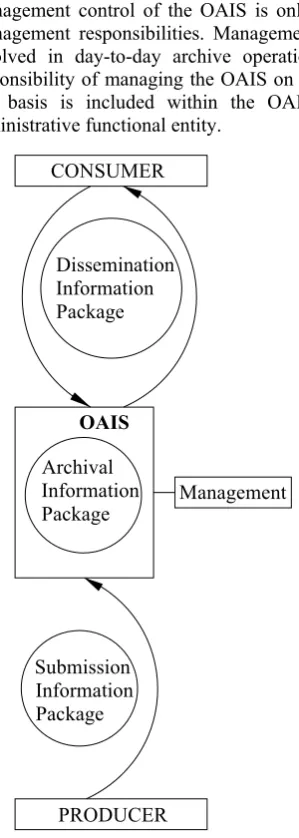
Environmental model of Open Archival Information System (OAIS)
repository system (Woodbury R. et al., 2004; Schapke S. E. et al., 2002) (Figure 1).
The role provided by each of the entities in OAIS can be described briefly as follows:
• Producer represents all departments of the building design and construction company, which provide the information to be preserved.
• Management represents information technology (IT) department, who sets overall OAIS policy as one component in a broader policy domain. Management control of the OAIS is only one of Management responsibilities. Management is not involved in day-to-day archive operations. The responsibility of managing the OAIS on a day-to-day basis is included within the OAIS in an administrative functional entity.
PRODUCER CONSUMER
Submission Information Package
Archival Information Package
OAIS
Dissemination Information Package
Management
Figure 1. Environmental model of an Open Archival Information System
• Consumer interacts with OAIS services to find and acquire preserved information of interest. In our case Consumer is a contractor, subcontractor or person, who needs to achieve the virtual archive with information flows in the both directions of the design process chain producer-archive-consumer.
Every submission of information by a Producer, and dissemination of information to a Consumer, occurs as one or more discrete transmissions. Therefore, it is convenient to have three different types of the packages:
• Submission Information Package (SIP) is a package that is delivered by the Producer to the OAIS for use in the construction of Archival Information Package.
• Archival Information Package (AIP) is a package, consisting of the Content Information and the associated Preservation Description Information.
• Dissemination Information Package (DIP) is a package derived from AIP and received by the Consumer in response to a request to the OAIS. Having an archive inside the company sometimes becomes an extra load for the designer, who is involved in design chain and usually not qualified to maintain it.
The initialization of the new project structure in SIP and AIP occurs through the Ingest module. It provides the services and functions to accept Submission Information Packages from Producers and prepare the contents for storage and management within the archive. More information about Ingest model can be found in the work by Gabrielaitis et. al., 2005. This tool is managed by a projectleader or the administrator of the archive.
The design process in the chain (producer-archive-consumer), according conventional Open Archival Information System, become inefficient. It occurs due to time consuming and inflexible way in which the documents and their properties were managed in SIP package. Therefore, the OAIS system was customized to satisfy the requirements in building design industry.
Environmental model of information flow in previously used technology – “monolithic” archive
All design information in one step is transformed by archive administrator from SIP into AIP. The primary goals of “monolithic” archive are to check the design data and to transform the Submission Information Package (SIP) to an Archival Information Package (AIP). In AIP all project documentation gains “Released” status and if all information is correct documents gain “Archived” status.
After transforming from SIP into AIP all project documentation obtains metadata properties. There is underway of automated attribution of properties and all documentation is placed in to project structure adequate catalogues.
Hereby all project information is accessible for users and groups according to permissions for each document type. The system also provides different levels of access rights to documents View/Copy, Check Out/In, Release, Archive, and Delete.
into design chain “producer-archive-consumer” allowed refusing Dissemination Information Package.
However, the “monolithic” archive has considerable disadvantages:
• The complete system is a mix of different subsystems which are connected by some application logic. This makes installation, administration and back-up rather difficult or unpredictable because of the possibly unclear dependencies.
• Integration of those applications might not be as easy as expected, since they might be developed following different philosophies, using different databases, and different programming languages.
• Each extension of one of the applications might create additional problems when trying to patch or update this particular application.
• And finally, and this may be one of the main problems: the complete system is not homogeneous; neither for the end-user (unless a complete new user interface is developed only using the other applications or protocols in the back-end) nor for the administrator.
Moreover, the complex and ever growing engineers needs, especially if the engineers are spread across organization in distributed teams, lead to the constant modification of “monolithic archive”. This introduces delays in work process and unnecessary complexity of the system with possible breakdowns in engineering product design processes. The rapid pace of business requires flexibility of modelled designer-archive-consumer chain. Therefore, the new improvement was developed to address the needs of multiple enterprises without forcing IT to revamp existing infrastructure.
To overcome such difficulties, a new technology was developed that operated from a “virtual archive”.
Management of project properties in “virtual” archive
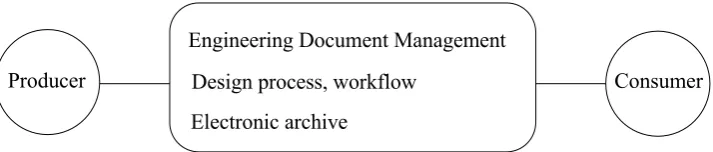
To address this issue, a new technology was implemented that operates from a “virtual archive” rather than a centralized vault. Information submission, preservation and dissemination occurring in Submission Information Package (SIP), Archive Information Package (AIP) and Dissemination Information Package (DIP), are proceed though a united block indentified as a “virtual” archive. The structure of “virtual” archive is presented in Figure 2. The design process in the chain ( producer-archive-consumer) now covers three main parts: Engineering Document Management (EDM) system, Design process and workflow, and electronic archive. They are now established as a united system.
A “virtual archive” was built for storing files that do not lock engineering documents into proprietary data vault. This open architecture prepares engineering to merge into a corporate environment without changing usual work routines. The document management and search in a distributed network can be performed by using Window File explore, Word, Excel, or CAD applications, thus avoiding intermediate links. It provides document management capabilities, property management, version control, advanced searching, user and work group management, by applying “drag and drop” principle. “Virtual archive” maintains all document metadata, properties, file uses, mark-ups, related files, where the document has been used.
Producer
Engineering Document Management
Electronic archive
Consumer Design process, workflow
Figure 2. Environment Model of a Virtual Archive
Furthermore the proposed system can be seen as a system of the integrative effort, allowing even rather unskilled users to handle complex IT infrastructure by providing a single point of access. Hence this knowledge management system is a kind of knowledge or information proxy.
In the developed system, Engineering Document Management has the following features (Löwnertz, K. 1998):
1) A multi-level hierarchical structure, where documents are cascaded from higher to lower levels. When a version or contents of a document change at a parent level, it will affect the changes of the children levels. Hence document control should provide change traceability from one level to the other level;
2) Horizontal process and document linkages-internal collaboration across engineering departments. The flow of documents through the entire design processes is cross-referenced and linked to validate the process quality. 3) Linkage between documents and product data.
The documents both act as input to the product development processes (most product designs are driven by some kind of specification or requirements document) and are output as well. 4) Documents have various statuses and versions.
Methods applied for developing “virtual” archive
The “virtual” archive system supports databases MS SQL Server, Sun MySQL and Oracle. The system can work on Microsoft Server 2003, UNIX Platforms, Microsoft XP and Microsoft Vista.
The “virtual” archive uses Java Content Repository (JCR) built on the JSR-170 industry standard. This open document repository allows geographically dispersed work teams to collaborate in real-time on original source documents.
The “virtual” archive is an open, integrated portfolio of Web service products. The components were built using the J2SE/J2EE platforms, JCR-170/JSR-170, and other Java and NET technologies to ensure interoperability between “virtual” archive and other application environments including Windows File Explorer and Native applications.
The functions of the “virtual” archive can be embedded into Windows File Explorer, Microsoft Word, Excel and Open Office desktop applications. Using the familiar tools facilitates the managing of complex files.
Management of document property inheritance
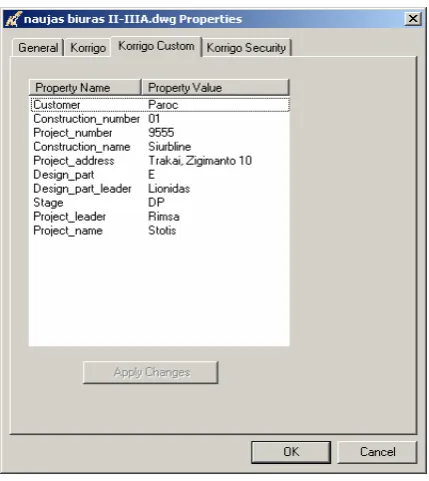
Management of document properties is very important aspect in a proposed “virtual archive”. When a document is placed in archive, it has to be accompanied by a uniformly defined meta-data (also called reference data). Meta-data are signified by their objective – to describe the properties of the entire document. A familiar example of meta-data is the information about publications that is kept in bibliographic databases, including author, title, keywords, publisher, year of publication, number of pages, even a short abstract. It is like an envelope that helps a potential reader to find and retrieve the contents of the book, which can be regarded as the primary data. Examples of meta-data for a construction document can be the document type (working drawing, specification, time schedule, order), revision, responsible agent. Such meta-data are used in manual practice for sorting documents into binders or drawing archives. In document management system, the internal structure of the documents and its references to a model are treated. For example, the revision may be made for the individual object rather than the documents, but still refer to the documents affected by the changes. In such a case, revision status, date, responsible person and other notes attached to each object will be exchanged as meta-data. Some meta-data that are commonly used in construction projects have been standardized in the form of industry agreements on title blocks, drawing designation, etc. Revision notes constitute an area where meta-data have been quite thoroughly defined. The standards and agreements are primarily concerned with drawings and technical specifications for the phases of the construction process, in which documents are of major legal importance, documents for a building permit, contract and working documents. The attributing of properties (i.e., meta-data) to a document is a time consuming task. The example of
possible document properties is presented in Figure 3. In a large project containing hundreds of documents, every document has at least ten entries (project number, project name, address, project leader, and so on) which have to be filled carefully. Any mistake in the entries causes a misplacement of document in archive system. Therefore, the straightforward filling of the document properties was dismissed in the presented approach and management of document property inheritance was established.
Figure 3. The example of document properties
The objective of the management of document property inheritance is to suspend the attachment of properties directly to the document. Properties were attached to the project structure (also called hierarchal tree, which is described below) instead. The core of the first approach is the document; while in the second approach the properties are the most important part, and they can be managed effectively. This management can be done in the following ways:
- first, the information of project hierarchal tree with properties can be exported into XML file. In this file, there are properties of the documents without the actual documents. These properties (together with a hierarchal tree) can be managed so they or part of them can be directly used in a new project. This reduces time required to attach the properties to the folders of a new project.
- second, a document which is placed in a folder of hierarchal tree receives the properties attached to an entire folder. Thus, a document gains all sets of necessary properties from a folder. The project participant does not have to consider creating the properties for every document, as this was managed beforehand.
information (such as layers, text style, dimension style and so on) by the means of property inheritance. This technical and internal information, in other words properties, can be managed in many ways. They can be extracted, modified and searched by a given criteria. Firstly, project properties can be applied when filling the stamp, which is a mandatory feature of any technical drawing. The following properties, required in a stamp, are generated from EDM system:
• project name,
• construction name,
• document name and code,
• document release,
• project leader and the date of the release,
• design part leader and the date of the release,
• document producer and the date of the release,
• customer.
These properties are collected from the established hierarchical project structure and file naming scheme. When the properties are changed in the project structure, all modifications are displayed in the drawing stamp. Secondly, properties can be searched by the given criteria. The search criteria, in our case, are any determined properties of the project or the combination of several properties. In this context, this system can be considered a filter, managing the parameters needed to select appropriate information for a certain document or type of a document, and presenting that information in a way suited to the purpose.
Moreover, there is an economical effect of this approach. The position of an archive administrator, which usually fills the document properties, is not longer required. The attachment of properties is performed automatically, while modifications can be fulfilled by project participants.
Management of property inheritance is established according to the project structure and components. Project structure, described in a form of hierarchal tree, represents the classified information for the phases of the construction process, starting with communication to clients and consultants and concluding with documents for suppliers and subcontractors. Due to the project-centric nature of the construction industry the structure of a hierarchical tree reflects the main parts of the construction process. For this, a documents classification system has to be applied, which helps to avoid overcrowded hierarchical tree and misplacement of design documents. Document classification systems proposed by Gabrielatis (2006) were implemented here. They are based on Lithuanian standard “Construction Technical Regulation” (2005) and associated with naming schema for files and project folders in a hierarchical tree. Both, the structure of a hieratical tree and naming schema plays an essential role in the management of the project data, because, if it is successful, it can be used as a template for further projects. It also provides a framework for archiving of digital design information.
The management of property inheritance is performed through project folders established in the hierarchical directory of the project. A folder can have certain
properties and property values associated with them. Additionally, sub-folders, configured according to the requirements, inherit properties of parent folders and the document created into the sub-folders will inherit the properties of the sub-folder and any other high level folders. This physical-level data model supports class inheritance and data embedding.
The algorithm essentially involves a dynamic construction of a composite record which includes fields from all the parent records. To handle properly the cases when the same field occurs in more than one of the parent records (or in a parent record and in a given record), multiple field occurrences within a record are allowed. This feature is used to support class inheritance (by representing class definitions as records with some fields pointing to their attributes).
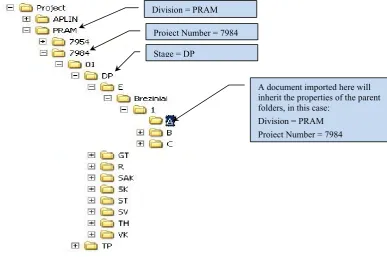
The example of hierarchical directory structure with project folders is presented in Figure 4. The assigned inheritable properties are also depicted there for each folder. Documents and folders created, copied, or dragged and dropped into folders configured with property inheritance will retain their existing properties, but also inherit those pre-defined properties of the folder. When new projects are created from templates, the management of property inheritance can be setup, so that new files will inherit a standard set of properties based on the location of where the file was placed.
For example, a file hierarchy has the top level as Division and second layer as Project Number. The specific Division (such as “PRAM”) can be associated with the top level and all sub-folders contained within it (see Figure 5). Any files imported into the “PRAM” folder and any of its sub-folders will automatically inherit the property value of “PRAM”. The second level could have the value of “7984” for the Project Number property. Any files placed within the Project Number folder or its sub-folders will automatically inherit the value “7984” for the Project Number property as well as “PRAM” for the Division (Figure 5).
Figure 4. Hierarchical directory of the project structure with assigned inherited properties
Division = PRAM
Project Number = 7984
Stage = DP
A document imported here will inherit the properties of the parent folders, in this case:
Division = PRAM Project Number = 7984
Figure 5. Property management through the hierarchical directory structure
In addition, the proposed system has the following features:
• It is easier to build a web-application that presents the functionality homogeneous to both the end-user and to the administrator.
• The software is easier to install as it is “one package” to be installed in an application server.
Conclusions
1. The “virtual” archive was developed to manage technical information in building design and construction industry. It offers particular features of management of project document properties and inheritance.
2. The new structural approach of document property management was developed, which instead of attachment of properties directly to the document, propose the attachment of properties to the project structure. The economical effect is achieved since the position of an archive administrator, which usually fills the document properties, is not longer required. 3. An algorithm of managing the property inheritance
was demonstrated. The management of property inheritance is performed through project folders established in the hierarchical directory of the project. As folders have a certain properties and property values associated with them, a sub-folder inherits properties of parent folders and the document created into the sub-folders will inherit the properties of the sub-folder and any other high level. 4. The methodology of development of project
hieratical tree and file naming schema were depicted in the presented work, as they provided framework for archiving of digital design information. The construction of templates for project structure and document properties was also discussed.
5. The new concept of the “virtual archive” was implemented in UAB SWECO BKG LSPI, which insures economical daily routines and engineering product design processes.
References
1. Abduh, M., & Skibniewski, M. J. (2002). Optimal configuration of electronic networking technologies for supporting D/B projects. Journal of Civil Engineering and Management, Vilnius: Technika, 8(4), 240-254.
2. Beconyte, G., Govorov, M., Ningal, T. F., Parseliunas, E., & Urbanas, S. (2008). Geographic information e-training initiatives for national spatial data infrastructures. Technological and Economic Development of Economy, 14(1), 11-28.
3. Biruk, S., & Jaskowski, P. (2008). Simulation Modelling Construction Project with Repetitive Tasks Using Petri Nets Theory. Journal of Business Economics and Management, 9(3), 219-226.
4. Björk, B. C. (2002). The Impact of Electronic Document Management on Construction Information Management. Proceedings of International Council for Research and Innovation in Building and Construction CIB w78 conference, 12 – 14 June, Denmark.
5. Brauers, W. K. M., Zavadskas, E. K., Turskis, Z., & Vilutiene, T. (2008). Multi-Objective Contractor's Ranking by Applying the Moora Method. Journal of Business Economics and Management, 9(4), 245-255.
6. Construction Technical Regulation (2005). “Building Construction Design”.STR 1.05.06.
7. Consultative Committee for Space Data Systems, Reference Model for an Open Archival Information System (OAIS). Washington DC: National Aeronautics and Space Administration, January 2002. http://www.classic.ccsds.org/documents/pdf/ CCSDS-650.0-B-1.pdf
8. Ekholm, A. (1996). A conceptual framework for classification of construction works. Electronic Journal of Information Technology in Construction, vol. 1, http://itcon.org/1996/2/
9. Gabrielaitis, L., & Bausys, R. (2005). Case Study of Project Document Management in Building Design. 11th Joint CIB International Symposium “Advancing Facilities Management and Construction through Innovation”. Helsinki/Finland/June 13-16.
10.Gabrielaitis, L., & Bausys, R. (2006). Electronic document management in building design. Journal of Civil Engineering and Management, Vilnius: Technika. 12(2), 103-108.
11.Hajjar, D., S. & AbouRizk, M. (2000). Integrating document management with project and company data, Journal of Computing in Civil Engineering, 14 (1), 70–76.
12.Juodis, A., & Apanaviciene, R. (2005). Predicting effectiveness of construction project management: Decision-Support Tool for competitive bidding. CITC-III: Proceedings of the Third International Conference on Construction in the 21st Century: Advancing Engineering, Management and Technology, September 15-17, 2005, Athens, Greece. Athens, 1053-1058.
13.Löwnertz, K. (1998). Change and Exchange Electronic document management in building design. Licentiate thesis. Construction Management and Economics Royal Institute of Technology Stockholm, Sweden.
14.Neverauskas, B., & Stankevicius, V. (2008). Project Management: Research and Studies at the Faculty of Economics and Management of Kaunas University of Technology. Inzinerine Ekonomika-Engineering Economics(4), 59-66.
15.Pellicer, E., & Victory, R. (2006). Implementation of project management principles in Spanish residential developments, International journal of strategic property management. Vilnius: Technika, 10(4), 233-248.
16.Schapke, S. E., Menzel, K., & Scherer, R. J. (2002). Towards Organizational Memory Systems in the Construction Industry. eSM@RT and CISEMIC. 17.Stankeviciene, J., Sedziuviene, N., Vveinhardt, J., &
Mitkuviene, D. (2007). Data management in modern organization: the aspect of project designing. Inzinerine Ekonomika-Engineering Economics(1), 91-102. 18.Winch, G. M. (2002). Managing construction
projects, London: Blackwell Pub. Co.
Cultural Artefacts. Itcon 10: 143-159. Available online at: http://www.itcon.org/2004/10/
20.Zavadskas, E. K., Kaklauskas, A., & Gulbinas, A. (2004). Multiple criteria decision support web-based system for building refurbishment, Journal of Civil Engineering and Management. Vilnius: Technika, 10(1), 77–85.
21.Zavadskas, E. K. (2008). Methods and Models of Research in Construction Project Engineering. Journal of Business Economics and Management, 9(3), 240-243.
22.Urbanskiene, R., Zostautiene, D., & Chreptaviciene, V. (2008). The model of creation of customer relationship management (CRM) system. Inzinerine Ekonomika-Engineering Economics(3), 51-59.
Linas Gabrielaitis, Romualdas Baušys
Projekto savybių valdymas „virtualiajame” statinių projektavimo įmonės archyve
Santrauka
Projektavimo organizacijos galutinis rezultatas yra pateikiamas projektais. Tai techninės dokumentacijos visuma, atspindintį
suprojektuotą objektą. Daugėjant atliekamų projektų per laiko vienetą, kyla sunkumų valdant projektavimo proceso metu sukuriamus informacijos srautus. Pasiekusi tam tikrą kritinę dokumentų išleidimo masę ir nieko nekeisdama, įmonė pradeda nebevaldyti projektavimo procesų, nuo ko nukenčia projektavimo kokybė, krinta produktyvumas ir įmonės rodikliai.
Projekto valdymą galima apibūdinti kaip dokumentų gyvavimo ciklo kontrolę. Dokumentai sukuriami naudojant įvairią programinę įrangą ir jie yra elektroninės formos. Kol neišspęsta elektroninio parašo problema, paprastai dokumentai dubliuojami popierine forma. Dokumentai (t. y. bet kokia elektroninės formos duomenų byla: CAD sistemos brėžinys, elektroninė lentelė ir t. t.) turi savo gyvavimo ciklus ir jiems prižiūrėti yra formuojama tam tikra projektinės organizacijos struktūra ir veikimo taisyklės. Taip dokumentas pradeda savo gyvavimą tam tikrame organizacijos taške, vėliau „keliauja“ per numatytas organizacijos instancijas suderinti, papildyti, publikuojamas naudoti, „gula“ į archyvą ir vėl gali būti panaudotas kaip prototipas naujam dokumentui arba kitai versijai gauti. Šiems informaciniams srautams suvaldyti reikalingi sprendimai, kurie leistų šiuos duomenis optimaliai tvarkyti ir panaudoti kitose verslo srityse. Poreikis diegti naujas techninės dokumentacijos valdymo sistemas atsiranda naudojant kompiuterinio projektavimo technologijas, kurios leidžia kurti vis sudėtingesnius projektus. Kitas faktorius, verčiantis ieškoti naujų sistemų, - spartėjantis produkcijos atsinaujinimo poreikis. Apskaičiuota, kad konstruktorius didžiąją savo laiko dalį sugaišta ieškodamas reikiamo dokumento ir tik ketvirtadalį laiko užima pats darbas su dokumentu.
Minėtiems sunkumams spręsti buvo pasitelkta techninės dokumentacijos valdymo sistema (toliau – EDM, Engineering Document Management). Tokiose sistemose vienas iš svarbiausių
komponentų yra elektroninis archyvas. Elektroniniam archyvui konstruoti buvo pritaikytas atviros archyvavimo informacinės sistemos (OAIS) modelis. Tai yra universalus modelis, kuris gali būti plėtojamas norint jį pritaikyti konkrečioje pramonės šakoje, – statinių
projektavimo ir gamybos įmonėje. Atvirojo archyvo informacinės sistemos (OAIS) modelio schema yra pateikta 1 pav. Joje, be projektuotojų, archyvo ir vartotojų, remiantis ISO standartu, yra papildomi moduliai, leidžiantys sujungti visus projekto kūrimo procese dalyvaujančius veikėjus į vientisą grandinę:
• SIP – informacijos pateikimo modulis;
• AIP – informacijos archyvavimo modulis;
• DIP – informacijos platinimo modulis.
Ši schema atspindi techninės dokumentacijos eigą organizacijos struktūroje. Tam, kad projektuotojas galėtų efektyviau padėti
projektinę dokumentaciją į elektroninį archyvą (prieš padedant dokumentąį archyvą, reikia užpildyti visą atributinę informaciją apie patį dokumentą, kas atimdavo labai daug laiko ir įveldavo sistemoje klaidų), buvo sukurtas papildomas, tarpinis modulis (Gabrielaitis, L. ir Baušys, R. 2005, 2006), leidžiantis automatizuoti duomenų surinkimą, apdorojimą ir padėjimąį elektroninį archyvą. Taip buvo sukonstruotas „monolitinis“ archyvas, kuris leido kaupti projektinę dokumentaciją tik pagal iš anksto aprašytas taisykles.
Dėl vis atsirandančių naujų projektavimo technologijų ir poreikio optimaliau valdyti projektavimo darbų procesą, sistemoje esantis „monolitinis“ archyvas tapo nelankstus. Reikėjo atlikti modifikaciją
pačioje OAIS. Dėl to vėl būtų reikalingi papildomi finansiniai resursai sistemai pertvarkyti ir žmonėms mokyti. Todėl „monolitinis“ archyvas buvo iš esmės perprojektuotas, atsisakant visų tarpinių OAIS modulių. Naujas sprendimas yra pateikiamas „virtualiajame“ archyve. „Virtualiajam“ archyvui būdinga: plačios projekto dokumentų
valdymo galimybės, užtikrina bet kokią projekto struktūros hierarchiją
ir projekto savybių paveldimumą, palaiko visą techninės dokumentacijos gyvavimo ciklą, kuris atspindi projekto eigos grandinę
projektuotojas ↔ archyvas ↔ vartotojas.
„Virtualiajame“ archyve buvo įdiegta projekto struktūros hierarchija su projekto savybių paveldimumu. Projekto savybės šiuo atveju suprantamos kaip atributinė informacija, kurią „monolitiniame“ archyve paprastai pildydavo ir kiekvienam dokumentui priskirdavo pats dokumento kūrėjas – projektuotojas. „Virtualiajame“ archyve projekto vadovas, pradėdamas naują projektą, kiekvienam statinio projekto struktūros katalogui (2 pav.) priskiria atributinę informaciją, t. y. paveldimąsias savybes, kurios yra pastovios viso projekto
įgyvendinimo laikotarpį ir jas paveldi visi dokumentai, „ateinantys“ į
šiuos katalogus. Dokumentas įkeliamas į projekto medį interaktyviu budu (drag and drop). Paveldimosios savybės projekto numeris,
stadija, dokumento rūšis, raidinis žymuo, bylos eilės numeris ir t. t.(2
pav.) dokumentui automatiškai skiriamos iš statinio projekto struktūros. Pagal šias paveldimąsias savybes galima suprasti, kokio projekto lygio yra dokumentas, koks jo statusas, arba tiesiog jį rasti elektroniniame archyve. „Virtualiojo“ archyvo projekto struktūros hierarchija, katalogų ir projektinės dokumentacijos pavadinimai yra suklasifikuoti remiantis metodika, kuri yra pateikta Statybos techniniame reglamente.
„Virtualiajame“ archyve yra nustatyti informacijos kontrolės lygiai skirtingiems vartotojams. Vartotojas gali būti tos pačios projektavimo organizacijos projektuotojas, užsakovas ar rangovas. Vartotojas, kuris nedalyvauja projektavimo procese, bet dalyvauja
įgyvendinant projektą, turi galimybę tiesiogiai jungtis į šią grandinę iš išorės, kad prieitų prie techninės dokumentacijos turinio redagavimo, peržiūros, galėtų padaryti pastabas ir išsaugoti grandinėje naują
dokumentą, atitinkantį vykdomo projekto struktūrą.
Naudojant šią sistemą, kiekvienas projektuotojas, dirbdamas savo raidiniame projektuojamos dalies kataloge, gali įsikelti į savo CAD dokumentą kitą projektuojamojo statinio dalies bylą. Pvz., konstruktorius gali įsikelti architekto suprojektuotą statinio dalį kaip neleidžiamą redaguoti CAD bylą, kuri suteiks galimybę konstruktoriui matyti paskutinę projektuojamos architektūrinės dalies informaciją. Architektui, atlikus redagavimą ar įrašius papildomos informacijos, sistema automatiškai informuoja konstruktorių apie atsiradusius pakitimus. Tuomet konstruktorius atnaujina įkeltą architekto CAD bylą, dėl to realiame laike gali stebėti paskutinę statinio architektūrinės dalies versiją. Visa tai leidžia išvengti laiko sąnaudų suderinant tarpusavyje atskiras projekto dalis.
Šio „virtualiojo“ archyvo diegimas UAB „SWECO BKG LSPI“
įmonėje leido efektyviau valdyti projektinę dokumentaciją, dokumentacijos atributiką ir sumažinti projektų įgyvendinimo laikotarpį. Ši sistema leido optimaliai valdyti techninę dokumentaciją, esant bet kuriai jos kūrimo stadijai, sumažino pačio projekto išleidimo laiką ir kainą, suteikdama galimybę rangovams, užsakovams ir projektuotojams dalytis ir keistis technine informacija realiame laike
įmonės viduje ir už jos ribų.
Raktažodžiai: projektinės dokumentacijos valdymas, elektroninis archyvas, „virtualusis archyvas“.