105
International Journal of Pharmaceutical Sciences and Drug Research
2015; 7(1): 105-109
Research Article
CODEN (USA): IJPSPP
ISSN: 0975-248X
A Novel RP-HPLC Method Development and Validation for Simultaneous
Estimation of Trifluoperazine and Isopropamide in Tablet Dosage Form
Suman Pattanayak
*, Ash Rani. Y
Department of Pharmaceutical Analysis and Quality Assurance, Avanthi Institute of Pharmaceutical Sciences, Gunthapally, Hyderabad, Andhra Pradesh, India
ABSTRACT
The present paper describes a reverse phase HPLC method for simultaneous estimation of Trifluoperazine and Isopropamide from their combined tablet dosage form. The proposed RP-HPLC method utilizes an Agilent Zorbax, C18 column (250 × 4.6 mm, 5μm particle size) using a mobile phase consisting of mixture of Buffer:
Acetonitrile (80: 20 v/v) mobile phase flow rate of 0.8 ml/min; and UV detection at 227nm. The retention time for Trifluoperazine and Isopropamide were 2.4 and 3.62 minutes respectively. The method was linear in the range of 40-120μg/ml and 100-300μg/ml and correlation coefficients were 1.00 and 1.00 for Trifluoperazine and Isopropamide respectively. The limit of detection was found to be 2.963 and 2.985µg/ml for Trifluoperazine and Isopropamide respectively. Limit of quantification was found to be 9.877 and 9.9502 for Trifluoperazine and Isopropamide respectively. The percentage recoveries for Trifluoperazine and Isopropamide ranged from 100.03-100.36% and 100.00-100.07 % respectively. The percentage of RSD for precision of the method was found to be less than 2%. The proposed method can be used for the routine analysis for the estimation of these drugs in combined dosage form.
Keywords: Trifluoperazine, Isopropamide, RP-HPLC, Validation.
INTRODUCTION
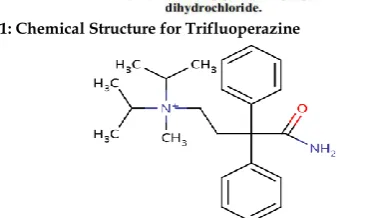
Trifluoperazine (TFP), 10-[3-(4-methylpiperazin-1-yl) propyl]-2-(trifluoromethyl)-10H-phenothiazine,
dihydrochloride (Fig. 1) is an anti-psychotic drug. Its molecular weight is 480.42 g/mol with an empirical formula C21H24F3N3S. It is potent It is believed to work
by blockading dopamine D1 and D2 receptors in
the mesocotical and mesolimbic pathways, relieving or
*Corresponding author: Dr. Suman Pattanayak,
Head of the Department, Department of
Pharmaceutical Analysis and Quality Assurance, Avanthi Institute of Pharmaceutical Sciences, Plot No 3-4-875/1, Gunthapally Near Ramoji Film City, Hayat Nagar, Hyderabad- 500036, Andhra Pradesh, India;
Tel.: +91-7569201869; E-mail: [email protected]
Received: 24 August, 2014; Accepted: 08 September, 2014
minimizing such symptoms of schizophrenia
as hallucinations, delusions etc.
Isopropamide (IPP), 3-carbamoyl-3,
3-diphenylpropyl)diisopropyl methylammonium, iodide (Fig. 2) is a anticholinergic drug. Its molecular weight is 480.43 g/mol with an empirical formula C23H33N2O. It
is used in the treatment of peptic ulcers and other gastrointestinal disorders involving hyperacidity (gastrointestinal acidosis) and hypermotility. The combination of this cholinergic, anti emetic, anti-psychotic drugs are used for peptic ulcer and irritable bowel syndrome. [1-2]
The literature survey, it was found that Trifluoperazine
and Isopropamide estimated individually or
combination with other drugs by analytical methods such reversed-phase high performance liquid
Int. J. Pharm. Sci. Drug Res. January-February, 2015, Vol 7, Issue 1 (105-109)
spectrophotometric methods like mass
spectrophotometry. [3-16] The HPLC method has its
relative merits but the majority of them are carried out at elevated temperatures, time consuming, use relatively expensive reagents, involve extraction, use of buffer system. In this report, we present one simple, sensitive, cost-effective and accurate method for the simultaneous determination of Trifluoperazine and Isopropamide The main objective of the present study is to develop simple, sensitive, accurate and precise RPHPLC method for simultaneous estimation of TFP and IPP in bulk and tablet dosage forms. The proposed method was validated according to ICH guidelines. [17-21]
Fig. 1: Chemical Structure for Trifluoperazine
Fig. 2: Chemical Structure for Isopropamide
MATERIALS AND METHODS
Chemical and reagent: Trifluoperazine and Isopropamide were obtained as gift samples from Rainbow pharma training lab Ltd, Hyderabad. Trifluoperazine and Isopropamide combined dosage form tablets were purchased from local market. HPLC grade water, acetonitrile, methanol and analytical grade potassium dihydrogen phosphate, orthophosphoric acid was obtained from Qualigens Fine Chemicals Ltd, Mumbai. Milli-Q water was used throughout the experiment dispensed through 0.22μ filter of the Milli-Q water purification system from Merck Millipore.
Equipment: pH of the mobile phase was checked on a
pH/ion analyser (Lab India, PHAN, India).The HPLC
system employed in method development and assay
method validation was Waters 515pump, Detector 2487 and N2000 chromatographic software as data integrator. The ultra-sonicator of ENERTECH (SE60US) used for the removal of dissolved gases in solvent and mobile phases.
Optimized chromatographic condition: The chromatographic separation was achieved on Agilent Zorbax, C18 column (250 × 4.6 mm, 5μm particle size)
using a mobile phase consisting of mixture of Buffer: Acetonitrile (80: 20 v/v). All reagents were filtered through the 0.45μm filter paper and sonicated before
use. The injection volume was 20μl the UV-Vis detector
was set at the wavelength 227nm. The assay was
performed at 25°C and the flow rate was fixed at 0.8 ml/min.
Preparation of Buffer: The pH of 800 mL of Milli Q HPLC grade water adjusted to 6.0 with o-phosphoric acid.
Preparation of Mobile Phase: A mixture of above prepared buffer 800 mL (80%), 200 mL of HPLC grade Acetonitrile (20%) mixed and degassed in ultrasonic water bath for 5 minutes. The mobile phase was filtered through 0.45µ filter under vacuum.
Diluent Preparation: A mixture of HPLC grade Acetonitrile and Water mixed in 20: 80 ratio was prepared degassed in ultrasonic water bath for 5 minutes and filtered through 0.45µ filter under vacuum, used for the solvent of standard and sample preparation.
Preparation of Standard Solution: Accurately weighed and transferred 20 mg of Trifluoperazine and 50 mg of Isopropamide working standard into a 50 ml clean dry volumetric flask and added about 35 ml of diluents. It was sonicated to dissolve completely and made volume up to the mark with the same diluents (Stock solution) (400, 1000µg/mL). From this, 5 ml of the solution was pipetted into another 25 ml volumetric flask and diluted up to the mark with diluents (80, 200µg/mL).
Preparation of Sample Solution: The marketed tablet Gastabid containing TFP and IPP in ratio of 2 mg: 5mg. Accurately weighed and transferred fine tablet powder equivalent to 2 mg of TFP into a 25 ml clean dry volumetric flask and added about 15 mL of diluents. It was sonicated to dissolve completely and made volume up to the mark with the same diluents. The resulting solution has TFP and IPP concentration 80, 200µg/ml respectively.
Procedure: 20µL of the standard and sample solutions were injected into the chromatographic system and areas for the TFP and IPP peaks were measured.
Method Development and Validation of HPLC Method: The proposed analytical method was validated according to ICH guidelines with respect to certain parameters such as accuracy, precision, linearity, specificity and system suitability.
System suitability: System suitability test was carried out on freshly prepared standard solution of TFP and IPP and it was calculated by injecting solution and the values of different system suitability parameter were recorded.
Accuracy: Accuracy was determined in terms of
percentage recoverythe accuracy study was performed
for 50%, 100% and 150 % for TFP and IPP. Standard
and sample solutions areinjected into HPLC system in
triplicate and percentage recoveries of TFP and IPP were calculated. The area of every level was used for calculation of % recovery.
Precision: Express the closeness of agreement between
Int. J. Pharm. Sci. Drug Res. January-February, 2015, Vol 7, Issue 1 (105-109)
sampling of same homogeneous sample under the
prescribed conditions. Method precision was
determined in terms of repeatability (injection and analysis). In order to determine precision, six independent sample solution preparations from a single lot of formulation 80μg/ml for TFP and 200μg/ml for IPP were injected in to HPLC system, the retention time and peak area was determined and expressed as mean and %RSD calculated from the data obtained which are found to be within the specified limits.
Linearity: Express ability to attain test results where directlyproportional to the concentration of analyte in the sample.The linearity of the method was established by a spiking a series of sample mixtures of TFP and IPP, the solutionsof five different concentration levels 40-120μg/ml (TFP) and 100-300μg/ml (IPP) are injected into theHPLC system. Construct the calibration curves for the standard solutions by plotting their response ratios (ratios of the peak area of the analytes) against their respective concentrations linear regression was
applied and slope,intercept, and correlation coefficient-R2 were determined.
Sensitivity: The Limit of Detection (LOD) was determined as lowest concentration giving response and Limit of Quantification (LOQ) was determined as the lowest concentration analyzed with accuracy method were determined by injecting progressively low concentrations of the standard solutions using the developed RP-HPLC method.
Specificity: The specificity was carried out to determine whether there are any interference of any
impurities (presence ofcomponents may be unexpected
to present) in retention timeof analytical peaks.
Robustness: Robustness of the developed method was investigated by evaluating the influence of small deliberate variations in procedure variables like flow rate (± 6.6%),change in mobile phase composition (±
2.0%) change in column temperature (± 5°C). The
robustness was performed for the flow rate variations from 0.7 ml/min to 0.9 ml/min.
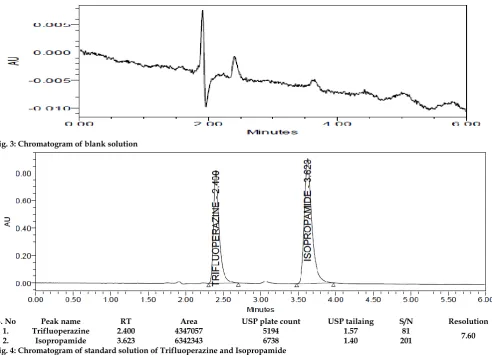
Fig. 3: Chromatogram of blank solution
S. No Peak name RT Area USP plate count USP tailaing S/N Resolution
1. Trifluoperazine 2.400 4347057 5194 1.57 81 7.60
2. Isopropamide 3.623 6342343 6738 1.40 201
Fig. 4: Chromatogram of standard solution of Trifluoperazine and Isopropamide
RESULTS AND DISCUSSION
Mobile phase and flow rate selection were based on
peak parameters (symmetry, tailing), run time,
resolution, ease of preparation, and cost. A typical
chromatogram for TFP and IPP using the Agilent
Zorbax, C18 column (250 × 4.6 mm, 5μm particle size)
with a mobile phase consisting of mixture of Buffer: Acetonitrile (80: 20 v/v) at a flow rate 0.8ml/min. The
Int. J. Pharm. Sci. Drug Res. January-February, 2015, Vol 7, Issue 1 (105-109)
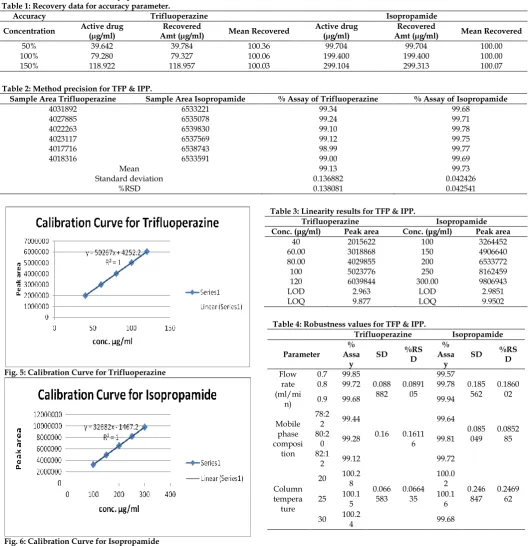
important for routine analysis. System suitability was performed and peaks of both drugs are separated with good resolution (Fig. 4). No interferences from the diluents, impurities, or excipients present in pharmaceutical formulations were observed at the detection wavelength (Fig. 3). The accuracy study was performed in 50%, 100% and 150% .The percentage recovery was determined for TFP and IPP was found to be 100.15% and 100.02% presented in Table 1. The precision of the method was ascertained from determinations of peak areas of six replicates of sample solution. The %Relative Standard Deviation for method precision presented in Table 2 was found to be 0.138 and 0.042. In the linearity parameter calibration curve
was constructed by plotting response factor against respective concentration of TFP and IPP. The plots of peak area Vs respective concentration of TFP and IPP were found to be linear in the range of 40-80μg/ml and 100-300μg/ml with coefficient of correlation (r2) 0.999 and 1.00 for TFP and IPP respectively(Fig. 5, 6 & Table 3). The limit of detection (LOD) and limit of quantification (LOQ) were found to be 2.963μg/ml and 2.9851μg/ml for TFP and 9.877μg/ml and 9.9502μg/ml for IPP. The LOD and LOQ showed that the method is sensitive for TFP and IPP. The robustness was carried out with minor but deliberate changes in parameters i.e., column temperature, and flow rate (Table 4).
Table 1: Recovery data for accuracy parameter.
Accuracy Trifluoperazine Isopropamide
Concentration Active drug (µg/ml)
Recovered
Amt (µg/ml) Mean Recovered
Active drug (µg/ml)
Recovered
Amt (µg/ml) Mean Recovered
50% 39.642 39.784 100.36 99.704 99.704 100.00
100% 79.280 79.327 100.06 199.400 199.400 100.00
150% 118.922 118.957 100.03 299.104 299.313 100.07
Table 2: Method precision for TFP & IPP.
Sample Area Trifluoperazine Sample Area Isopropamide % Assay of Trifluoperazine % Assay of Isopropamide
4031892 6533221 99.34 99.68
4027885 6535078 99.24 99.71
4022263 6539830 99.10 99.78
4023117 6537569 99.12 99.75
4017716 6538743 98.99 99.77
4018316 6533591 99.00 99.69
Mean 99.13 99.73
Standard deviation 0.136882 0.042426
%RSD 0.138081 0.042541
Fig. 5: Calibration Curve for Trifluoperazine
Fig. 6: Calibration Curve for Isopropamide
Table 3: Linearity results for TFP & IPP.
Trifluoperazine Isopropamide Conc. (μg/ml) Peak area Conc. (μg/ml) Peak area
40 2015622 100 3264452
60.00 3018868 150 4906640
80.00 4029855 200 6533772
100 5023776 250 8162459
120 6039844 300.00 9806943
LOD 2.963 LOD 2.9851
LOQ 9.877 LOQ 9.9502
Table 4: Robustness values for TFP & IPP.
Trifluoperazine Isopropamide
Parameter
% Assa
y SD %RS
D % Assa
y SD %RS
D Flow
rate (ml/mi
n)
0.7 99.85 0.088
882 0.089105 99.57
0.185
562 0.186002
0.8 99.72 99.78
0.9 99.68 99.94
Mobile phase composi
tion 78:2
2 99.44
0.16 0.1611 6
99.64 0.085
049 0.085285 80:2
0 99.28 99.81
82:1
2 99.12 99.72
Column tempera
ture
20 100.28 0.066
583 0.066435 100.0
2 0.246
847 0.246962
25 100.15 100.16
Int. J. Pharm. Sci. Drug Res. January-February, 2015, Vol 7, Issue 1 (105-109)
The developed method is fast and use simple reagents with minimal sample preparation procedure. The method was found to be precise accurate and linear for determination of Trifluoperazine and Isopropamide. All validation parameters tested were found to be within limits. The developed HPLC method is simple, precise, specific and accurate and the statistical analysis proved that method is reproducible and selective for the analysis of Trifluoperazine and Isopropamide in a combined tablet dosage form.
REFERENCES
1. Tripathi KD. Essential of Medical Pharmacology, Edn 6, Jayee Brothers Medical Publishers (P) Ltd, 2008, pp. 106, 110, 424, 427, 428.
2. United States Pharmacopoeia. National Formulary USP30, Arabswell Edition, Inc., 2000, pp. 926, 1703.
3. Sharma MC, Sharma S. Development and Validation of Method for Simultaneous Estimation of Trifluoperazine hydrochloride from Capsule Dosage Form Using Citric Acid. World Journal of Chemistry 2011; 6:80-84.
4. Watson JR, Fumi M, French WN. Trifluoperazine tablets, Alternative methods of analysis. J. Pharmac. Sci. 1997; 59:391-394.
5. El-Gindy A, El-Zeany B, Awad T, Shabana MM. Spectrophotometric determination of Trifluoperazine HCl and Isopropamide iodide in binary mixture using second derivative and second derivative of the ratio spectra methods. J. Pharm. Biomed. Anal. 2001; 26:203-10.
6. Laassis B, Maafi M, Aaron JJ, Mahedero MC. Fluorimetric and photochemically induced fluorimetric determination of ethopropazine, levomepromazine, thioproperazine and Trifluoperazine. J. Analytical Lett. 1997; 30:1541-54.
7. Perez-Ruiz T, Martinez-Lozano C, Tomas V, Sidrach DE, Cardona C. Flow-injection fluorimetric determination of trimeprazine and trifluoperazine in pharmaceutical preparations. Talanta. 1993; 40:1361-65.
8. El-Gindy A, El-Zeany B, Awad T, Shabana MM. Derivative Spectrophotometric, thin layer chromatographic densitometric and high performance liquid chromatographic determination of Trifluoperazine hydrochloride in presence of its hydrogen peroxide induced degradation product. J. Pharm. Biomed. Anal. 2002; 27:9-18.
9. Midha KK, Roscoe RMH, Hall K, Hawes EM. A gas chromatographic mass spectrometric assay for plasma Trifluoperazine concentrations following single doses. Biological Mass Spectroscopy 2001; 9:186-190.
10. Mahadik KR, Aggarwal H, Kaul N. Simultaneous HPTLC estimation of trifluoperazine HCL, trihexyphenidyl HCL and chlorpromazine HCL in tablet dosage form. J. Indian Drugs. 2003; 40:340-341.
11. Pradas TN, Sivakumar M. HPLC quantification of a tri-component psychiatric formulation containing chlorpromazine, trifluoperazine and trihexyphenidyl. J. Pharmazie. 1992; 47:231.
12. Laassis B, Maafi M, Aaron J J, Mahedero MC. Fluorimetric and photochemically induced fluorimetric determination of ethopropazine, levomepromazine, thioproperazine and trifluoperazine. J. Analytical letters. 1997; 30:1541-54. 13. Hassib ST, Moussa BA, Hashim HA, El-Zaher AA.
Determination of certain antispasmodic drugs as single ingredient, mebeverine hydrochloride, and in two component mixtures, mebeverine hydrochloride-sulpiride and isopropamide iodide-trifluoperazine hydrochloride. IBID. 2002; 35:43.
14. Abd-El-Hamid NA. Simultaneous determination of phenylpropanolamine hydrochloride and isopropamide in capsule by HPLC using Crownpak column. Anal Lett. 1993; 26:1153.
15. Hassib ST, El-Kousy NM, Alian Al-Shimaa M. Three reversed phase liquid chromatographic methods for the determination of some anticholenergic drugs in the presence of their degradation products and / or in mixture with other drugs. Bull. Pharm. Sci. 2011; 34(2):131-140.
16. Javaid JI, Dekirmenjian H, Davis JM. GLC analysis of Trifluoperazine in human plasma. Journal of Pharmaceutical Sciences 2012; 71:63-66.
17. Turabi ZM, Khatatbeh OA, Al-Abed DN. RP-HPLC method development and validation for the simultaneous determination of mebendazole and the two preservatives methylparaben and propylparaben in pharmaceutical oral suspension dosage form. International Journal of Pharmaceutical Sciences and Drug Research 2014; 6(1):70-74. 18. Rasheed A, Pattanayak S, Rama Rao T. Analytical method
development and validation for the simultaneous estimation of aspirin, clopidogrel bisulphate and atorvastatin calcium in tablet dosage form. Am. J. PharmTech Res. 2014; 4:534-541. 19. ICH, Q2 (R1) Validation of Analytical Procedures: text and
methodology, 2005.
20. Code Q2A-Text on Validation of Analytical Procedure Step-3 Consensus Guideline, 1994, ICH Harmonised Tripartite Guideline.
21. Code Q2B-Validation of Analytical Procedures Methodology Step-4 Consensus Guideline, 1994, ICH Harmonised Tripartite Guideline.