Aging Face Recognition System using Local
Pattern Selections
Trupti Hankare Shraddha Kasbe
UG Student UG Student
Department of Computer Engineering Department of Computer Engineering Bharati Vidyapeeth College of Engineering Bharati Vidyapeeth College of Engineering
Pranali Mhatre Pratiksha Musale
UG Student UG Student
Department of Computer Engineering Department of Computer Engineering Bharati Vidyapeeth College of Engineering Bharati Vidyapeeth College of Engineering
Prof. Madhuri Ghuge
Assistant Professor
Department of Computer Engineering Bharati Vidyapeeth College of Engineering
Abstract
Aging is the biological process of growing older in a deleterious sense. Automatic Face Recognition is based on recognizing the faces of same person across different ages which has many real time applications such as identifying missing children, identifying criminals. The major cause of aging is facial features of same person is changed due to aging process. Intra-user dissimilarity is used to describe the changes that happened to the same person’s facial features due to aging. This paper is proposed to solve the problem by introducing an effective method with hierarchical learning model based on Local Pattern Selection (LPS). LPS algorithm is used for low-level learning visual structures. It minimizes the intra-user dissimilarity. The first level, low level features are extracted using LPS descriptor and at the second level the output of first level is used as an input to the second level to produce refined and accurate results.
Keywords: Aging Face, Face Recognition, Intra-User Dissimilarity, Feature Descriptor
________________________________________________________________________________________________________
I. INTRODUCTION
Automatic face recognition is the biometric identification by scanning a person’s face and matching it against a library of known faces. Automatic age estimation has great interest because of its many useful real-world applications-finding missing children, identifying criminals based on identity ‘mug shots’ [5] [9]. Automatic face recognition is a particularly attractive biometric approach, since it focuses on the same identification that humans use primarily to distinguish one person from another: their faces. One of its main goals is the understanding of the complex human visual system and the knowledge of how humans represent faces in order to discriminate different identities with high accuracy. Many methods of face recognition have been proposed. Basically they can be divided into holistic template matching based schemes, geometrical local feature based schemes and hybrid schemes of all these types have been successfully applied to the task of face recognition. Intra-user dissimilarity makes the task very difficult [1].
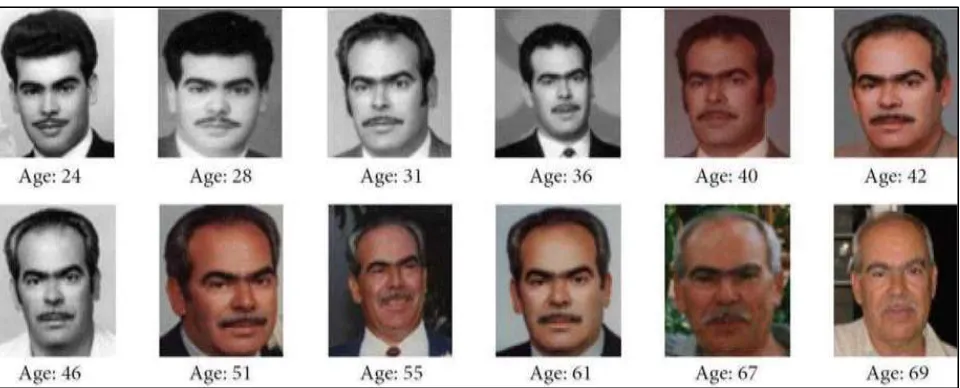
Fig. 1: Example faces for one of the subjects in the MORPH Database
II. SYSTEM OVERVIEW
In this paper, a two-level learning model is used to address the problem of intra-user dissimilarity [18]. In this system, effective features are learned from low-level microstructures based on the feature descriptor called Local Pattern Selection (LPS). LPS selects low level common information between cross-age faces. Then higher level visual information is further refined based on output from first level. Usually, in all image related projects, LBP feature extraction technique is used. Local Binary Pattern (LBP) is simple and accurate but it maximizes the intra-user dissimilarity where as LPS is used to minimize intra-user dissimilarity [16] [17].
III. FEATURE EXTRACTION
LPS is the feature extraction method used here. Feature extraction is the technique of extracting features of the image like its mean, variance, standard deviation, entropy etc. Now these features stand instead of the image. [2]
Motivation
Facial image provides a pool of information. The information regarding age, gender, identity, etc. Aging estimation is the technique of estimating age from face. Aging occurs to different person at different rates. Aging rate depends on the intrinsic factors and extrinsic factor. Due to this persons of same age look quite differently from one another. Intra user dissimilarity is the technical term used here. Intra user dissimilarity is defined as the changes happening to the same person during the process of aging. Sometimes due to the stressful working condition intra user dissimilarity is very high because of that person at two different age appears to be two different individuals. To overcome this challenge the LPS is used. It reduces intra user dissimilarity and increases common information thus increases the reliability of the system. The implementation of feature extraction needs three steps-Pixel feature formation, encoding tree and code assignment [2].
Pixel Feature Formulation
Pixel features are the identity of the pixel. Pixel feature is a 8 dimensional vector that is formed by comparing central pixel with adjacent 8 neighbors taken at a radius r. The radius can take values r = (1, 3, 5, 7). Here r is selected as 3. [18]
Encoding Tree
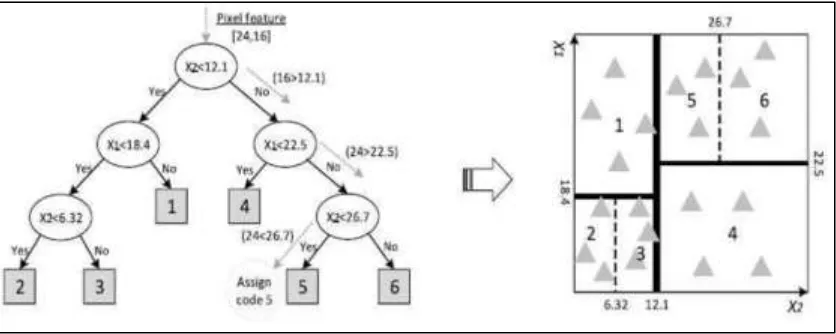
Encoding tree is a binary tree means zero or one. Here zero stands for NO and one stands for YES. The encoding tree consist of leaf nodes and internal nodes. Leaf nodes are identified by integers and internal nodes are identified by attributes and threshold
Fig. 3: Encoding tree with internal and leaf nodes
The pixel passes through the encoding tree, it is either routed to left or right [18]. Attributes are the element of the pixel feature that is to be encoded. If the pixel meets the threshold, it is routed to the right part otherwise to the left part. All the pixel that falls to the same leaf nodes are provided with same codes.
Code Assignment
The pixels falls under the same leaf nodes are provided with same code. For example, all the pixel that comes under the leaf node 5 are assigned with the decimal code 5. [18] Thus minimizes the intra user dissimilarity which is stated as the major challenge.
IV. SYSTEM ALGORITHM
The basic idea of this algorithm is to grow the encoding tree incrementally until it reaches the expected number of leaf nodes L. At each step, the node that maximizes the increase in utility for expansion is selected.
The corresponding pixel features of these image pairs are denoted as:
A = {(x-nm, y-nm)|m=1,…,M; n=1,…,N} (1) Where, M = H _W is the total number of pixels in an image.
We say x-nm and y-nm are matching pixel features as they belong to the same pixel location in the images of the same subject [18]. For any encoding tree T of L leaf nodes, suppose the T assigns each pixel feature in A with a code based on which leaf node that pixel finally reaches, resulting in an encoded set:
C= {(u-nm, u-nm)|m=1,…,M; n=1,…,N} (2) Let’s denote the tree with K leaf nodes (1 _ K < L) as
TK and the corresponding utility as UK. Now we extend TK into TK+1 by splitting node w into two children nodes wl and wr. Denote the sets of support pixel features of node w as:
S1w = (I1(1),….,In1(1) | Ii(1) €1,…,M*N} (3)
S2w = (I1(2),….,In2(2) | Ii(2) €1,…,M*N} (4)
Algorithm 1: Local Patterns Selection
Input: The number of leaf nodes L, the tradeoff factor _and training image pairs (I1n, I2n) n=1,…N} [18]. Output: Encoding tree T.
/* Pixel features extraction. */ begin
Convert images into a set of pixel features as described in Eqn (1): = {(x-nm, y-nm)|m=1,…,M; n=1,…,N}
/* Encoding tree initialization. */ begin
Initialize encoding tree T by adding one leaf node w, whose indices of support pixel features are: S1w = (I1(1),….,In1(1) | Ii(1) €1,…,M*N}
/* Encoding tree learning */ begin
for step = 2← L do for each leaf node w do if w.∆u ≠ -inf then
/* Node has been evaluated. */ continue;
else
for k = 1←8 do
for z = min(S1w,S2w) → max(S1w,S2w)do
Evaluate increase of utility ∆u with attribute = k and threshold = z. Let maximum ∆u* is achieved at (k*; z*).
Update: w.∆u = ∆u*, w.a ←k*, w.t← z*. Let w*has maximum _u over all leaf nodes. Split w* into two children nodes l and r. l.a ←0, l:t 0, and l.∆u ← -inf.
r.a ←0, r:t 0, and r.∆u ← -inf.
Update S1l ,S2l, S1r ,S2r based on Eqn (3),(4). Assign distinct codes to leaf nodes, and return T. [18]
V. LPS BASED FEATURE EXTRACTION
The Algorithm 1 learns an encoding tree that encodes given image by converting each pixel into decimal codes based on the leaf node that pixel reaches in the tree. In this part, we briefly introduce how we extract over-completed features based on encoded images. The techniques we use include multiple scaling and dense sampling [8]. Specifically, we first train multiple encoding trees based on different sampling radii (e.g.1; 3; 5; 7) as illustrated in Figure 2. Then for each encoded image, we extract local features by calculating the histograms of small patches formed by dividing image into overlapping (with overlapping factor 0:5) fixed size (e.g. 16 _ 16) areas. The final features of an image are formed by concatenating local features at all sampling radii.
VI. INFORMATION REFINEMENT
Feature extraction technique LPS is used to collect low level visual structures. The features collected using LPS are of high dimension due to the employment of multiple scaling and dense sampling technique. The high dimension features arises problems in storage and matching. Same features may be there for many times. Redundant data and noise may mislead to wrong decision. So it is essential to filter out these redundant data and noise, thus making set of features more precise. Filtering points to the need of refinement technique [2]. The most popular refinement technique commonly used in image processing is Fisher linear discriminant analysis or universal subspace analysis (USA). It deals with the eigen decomposition of a matrix of size Min (N, D) where N is the number of training image pairs and D is the dimension of features. The time complexity of eigen decomposition is around min {O (N3), O (D3)}.Thus making it not suitable for very large values of N and D [2] [18]. Here this part presents a refinement technique that successfully eliminates redundant data and noise, thus provides crucial data for the classification. This refinement technique has two stages. First one is the bootstrap aggregating and the second is random subspace classifiers.
Bootstrap Aggregating: Divide Data by Sampling
Bootstrap aggregating is otherwise known as bagging. The one line definition of the technique is dividing data by sampling. The data set include pictures of 10,000 persons that means N = 10,000, N is defined as the no: of training image pairs. In the data set two photographs of same person taken at a large age gap are included. . Bagging technique is used to select a series of subset M (M<N). Using these series of subset series of classifiers are trained. For more accurate result it is advisable to use a series of classifiers instead of using one[18]. Let M = 2000, N = 10,000 and K = 20, K is the number of the training set. From 10,000 person set 20 training sets are formed each training set photographs of 2000 person. Same persons are included in many training set to check whether all the classifiers produces the same result. When the value of N increases, the value of K also increases. The increase in K leads to an increase in computational time.
Random Subspace: Divide Features by Sampling
Discussion
The second level classification framework is designed to be scalable. As described in Section III-A, as the number of training samples increases, the training time increases linearly. Specifically, for the Morph 2 dataset, the major computational cost involves 2000x2000 square matrix eigen decomposition. There are K=20 of these decompositions, and these decompositions can be computed in parallel [18]. On a 6-core machine it takes 3.64 seconds for each of the decomposition, and 74.31 seconds in total for the second level (including other overhead). This paper is focused on training time analysis, since for testing, it only involves matrix-vector multiplication, and thus it is very fast.
VII. CONCLUSION
Automatic age estimation along with personal information gathering can be used as a helping hand to determine the criminals more efficiently and accurately by comparing the data set of criminals with mug shot. Aging estimation is the process of determining the specific age or age range of a subject based on a facial image. Automatic age estimation has growing interest due to its applications in real life. New and new projects are developing on the topic automatic age estimation, but still it is not that easy to determine age from face. Because aging rate for different person will be different. Aging rate greatly depend on the intrinsic factors and extrinsic factors. Intrinsic factors are genetic factors and extrinsic factors are lifestyle, expression, and environment. As a result, different people with the same age possess quite different appearances due to different rates of facial aging. To overcome this problem here LPS feature extraction technique is used. LPS is taken because of its ability to minimize intra user dissimilarity and at the same time maximizes common information, thus increasing the accuracy of the system [2].
REFERENCES
[1] Yun Fu and Thomas S. Huang,”Human age estimation with regression on discriminative aging manifold,” IEEE Transactions on Multimedia, vol. 10,no. 4, pp. 578-584, 2008.
[2] Ancy Anna Varghese, Devi Murali, ”Aging Face Recognition Along with Personal Identification using Local Patterns Selection” Vol. 7, no. 5, 2017 [3] G. Guo, Y. Fu, C. R. Dyer, and T. S. Huang, “Image-based human age estimation by manifold learning and locally adjusted robust regression,” IEEE Trans.
Image Process., vol. 17, no. 7, pp. 1178–1188, Jul. 2008.
[4] H. Ling, S. Soatto, N. Ramanathan, and D. W. Jacobs, “Face verification across age progression using discriminative methods, ” IEEE Trans. Inf.Forensics Security, vol. 5, no. 1, pp. 82–91, Mar. 2010.
[5] Andreas Lanitis, ”survey of the effects of aging on biometric identity verification,” Int. J. Biometrics, vol. 2, no. 1, pp. 34-52, Dec. 2010.
[6] Y. H. Kwon and N. da Vitoria Lobo, “Age classification from facial images,” in Proc. IEEE Conf. Comput. Vis. Pattern Recognit., Jun 1994, pp. 762–767 [7] Xin Geng, Zhi-Hua Zhou, and Kate Smith-Miles, ”Automatic age estimation based on facial aging patterns,” IEEE Trans. Pattern Anal. Mach. Intell., vol.
29, no. 12, pp. 2234-2240, 2007.
[8] D. Gong, Z. Li, D. Lin, J. Liu, X. Tang, ”Hidden Factor Analysis for Age Invariant Face Recognition,” ICCV 2013.
[9] Narayanan Ramanathan, Rama Chellappa, and Soma Biswas, ”Computational methods for modeling facial aging: A survey, J. Vis. Lang. Comput., vol. 20, no. 3, pp. 131-144, 2009.
[10] G. Mu, G. Guo, Y. Fu, and T. S. Huang, “Human age estimation using bio-inspired features,” in Proc. CVPR, 2009, pp. 112–119.
[11] Z. Li, U. Park, and A. K. Jain, “A discriminative model for age invariant face recognition,” IEEE Trans. Inf. Forensics Security, vol. 6, no. 2, pp. 1028–1037, Sep. 2011.
[12] U. Park, Y. Tong, and A. K. Jain, “Age-invariant face recognition” IEEE Trans. Pattern Anal. Mach. Intell., vol. 32, no. 5, pp. 947–954,May 2010 [13] Ling Shao, Li Liu, and Xuelong Li, ”Feature learning for image classification via multi objective genetic programming,” IEEE Trans. Neural Netw. Learn.
Syst. vol. 25, No. 7, pp. 1359-1371, 2014.
[14] Timo Ojala, Matti Pietik ainen, and Topi Maenp, ”Multi resolution gray-scale and rotation invariant texture classification with local binary patterns,” IEEE Trans. Pattern Anal. Mach. Intell., vol. 24, no. 7, pp. 971-987, 2002.
[15] Karl Ricanek Jr. and Tamirat Tesafaye, ”Morph: A longitudinal image database of normal adult age-progression,” in FG, 2006, pp. 341-345. [16] Y. Sun, X. Wang, X. Tang, ”Deeply Learned Face Representations are Sparse, Selective, and Robust”, arXiv:1412.1265,2014.
[17] Y. Sun, X. Wang, X. Tang, ”Deep Learning Face Representation from Predicting 10,000 Classes”, CVPR 2014. [18] Zhifeng Li,Senior Member, IEEE, Dihong Gong, Xuelong Li, Fellow, IEEE, and Dacheng Tao, Fellow,IEEE