ISSN (e): 2250-3021, ISSN (p): 2278-8719
Vol. 08, Issue 6 (June. 2018), ||V (VII) || PP 49-60
An Optimal Analysis of Flow and Heat Transfer over a Slender
Permeable Elastic Sheet with Variable Fluid Properties
Hanumesh Vaidya
Department of Mathematics, SSA Government First Grade College (Autonomous),Ballari-583 101, Karnata-ka, India
Abstract:
The present article examines the influence of variable liquid properties on flow and heat transfer over a permeable stretching sheet with variable thickness. The transformed system of coupled non-linear or-dinary differential equations is solved analytically via optimal homotopy analysis method (OHAM). Numeri-cal results are analyzed graphiNumeri-cally. Wall thickness parameter exhibits dual nature for flow and heat transfer patterns when it takes the value greater than 1 or less than. The skin friction and the wall temperature gradient are examined for influential parameters in this consideration.Keywords: Variable thickness; Permeability; Skin friction; Nusselt number; OHAM.
--- --- Date of Submission: 15-06-2018 Date of acceptance: 30-06-2018 --- ---
I.
INTRODUCTION
Fluid flows through permeable media are of enthusiasm for some fields of engineering and natural sciences, for example, oil recuperation, soil mechanics, material adsorption on solids, filtration, and p olymer property estimations. In these designing and applied research fields, the flow through a permeable medium is normally treated by a basic relationship broadly referred to in a summed up frame as the K ozeny or Darcy law. In view of these application Abel et al. [1] examined the impact of permiablity on the flow and heat transfer of a non-Newtonian liquid over a non-isothermal stretching sheet. Pal and Mondal [2] applied Soret and Du-four effects, chemical reaction and thermal radiation on flow field over a porous stretching sheet. Stret-ching/shrinking porous sheet geometry is considered by Rosali et al. [3] and re corded the enhancement in the skin friction coefficient and the local Nusselt number for increasing permeability parameter. Recently, Bhatti et al. [4] continued the work of Ref. [3] by considering shrinking porous sheet. One of the important facts that all these researchers have concentrated on the pioneering work of Crane [5] and moreover numerous r e-searchers have examined the nature of fluid flow by considering the geometry proposed by Crane[5](See Shehzad et al.[6], Prasad et al.[7], Vajravelu et al.[8], Hayat et al.[9], Zeeshan et al.[10])
All the above researchers have explored the nature of flow and heat transfer of a Newtoni an/non Newtonian fluid by considering linear/ nonlinear stretching sheet. However, there is one more special type of nonlinear stretching of the sheet recorded in the literature, namely, nonlinear stretching with variable thick-ness. Here, the boundary conditions are different from conventional nonlinear stretching sheet problems such as
0
m w
u x U x b at y = A
x b
1m2. For all practical purposes deforming substances like needles and nozzles were the base for variable sheet thickness. A stretching sheet with a variable thickness can be more close to the situation in practical applications. In the year 2012 Fang et al. [11] coined the word „varia-ble thickness‟ and analysed the flow pattern numerically. Many researchers extended the work of Fang et al. [11] with the addition of heat and mass transfer ( Khader and Megahed [12], Prasad. et al.[13], Salahuddin et al. [14], Prasad et al.[15-17]).The object of present analysis is to predict the impact of variable liquid properties on the flow and heat transfer of fluid towards permeable stretching sheet of variable thickness. The relevant problems are formulated. Convergent series solutions of governing equations are constructed by optimal homotopy analysis method (OHAM) ([18]-[20]). Graphical results are used to elaborate the impacts of involved parameters.
II.
MATHEMATICAL FORMULATION
pa-rameter). The problem statements in the absence of pressure gradient are:
v
0,
u
x
y
(1)
v
( )
T
,
u
u
u
u
T
u
x
y
y
y
K
(2)
v
p
T
T
T
c
u
k T
x
y
y
y
. (3)Fig.1 Physical description of the problem.
where, (u,v) are the fluid velocity components in the stream wise and cross-stream directions, re-spectively. The subscript denotes partial differentiation with respect to the independent variables
is the constant fluid density,
T
is the coefficient of viscosity and K is the permeability of the porous me-dium. Here in this work
T
is considered to vary as an inverse function of temperature (see for details Prasad et al. [18]). The appropriate boundary conditions for the problem are
1 2 0
,
, v ,
0,
,
,
,
0,
,
.
m r m
w w
C
u x y
U
U x b
x y
T x y
T
x b at y A x b
l
u x y
T x y
T as y
(4)
Let the dimensionless similarity variable be
1
0 2
1
(
)
2
m
U
m
y
x b
, (5)
1
2 0
2
( , )
( )
,
1
m
w
x y
f
U
x b
T
T
T
T
m
(6)
where
x
,
y
identically satisfies the continuity Eq. (1), the velocity components can be written as1 2 0
1
1
( )
v
(
)
( )
( )
.
2
1
m w
m
m
u
U f
and
U
x b
f
f
m
(7)
1
r
(
2
1)
2(1
r)
0,
f
m
K
ff
f
f
m
(8)
2
1
Pr
0,
1
r
f
f
m
(9)and the corresponding boundary conditions are
m
1
1
,
1 ,
1,
0,
0
1
m
f
f
f
m
. (10)The non-dimensional parameters, namely, variable thickness
,the fluid viscosity parameter
r , the porous parameter
K and the Prandtl number
Pr are defined as
0
1 1
= , , , Pr = .
2
r r
w w
U T T
m
A K K b
T T T T
The value ofris determined by the viscosity of the fluid and = = 1 0 2 U m A
is the plate surface. In
order to facilitate the computation, we define
f
( )
f
=
f
and ( ) = (
) = ( ).
Now the equations become
1
r
(
2
1)
2(1
r)
0,
f
m
K
ff
f
f
m
(11)
2
1
Pr
0,
1
r
f
f
m
(12)and the corresponding boundary conditions are
m1
0
1
,
0
1 ,
0
1,
0,
0
1
m
f
f
f
m
, (13)where the prime denotes the differentiation with respect to
. With reference to variable transformation, the integration domain will be fixed from 0 to ∞. The shear stress and the wall temperature gradient respectively become f
=f(0) and ( )= (0). The values of engineering interest are the local skin frictionC
fx and the local Nusselt numberNu
x defined as
1 2 1 2 1 2 2 1 22
2
1) 2
Re
0 ,
1) 2
Re
0 ,
m
x
m
y y A x b
f x
w
y y A x b
x x
w
u
C
m
f
U
x
b T
Nu
m
T
T
(14)where Re =x Uw(xb)is the local Reynolds number.
III.
SEMI-ANALYTICAL NUMERICAL SOLUTION METHOD
The governing equations are highly nonlinear, coupled ODEs with variable coefficients. We use the optimal homotopy analysis method (OHAM) to obtain appropriate analytic solutions to equations (11) and (12) with associated boundary conditions (13). The OHAM has been successfully applied to a wide variety of nonlinear problems (see [18-20]).
3
3
,
f
d
d
d
d
L
2
2
,
d
f
d
L
and2
2
.
d
f
d
L
(15)
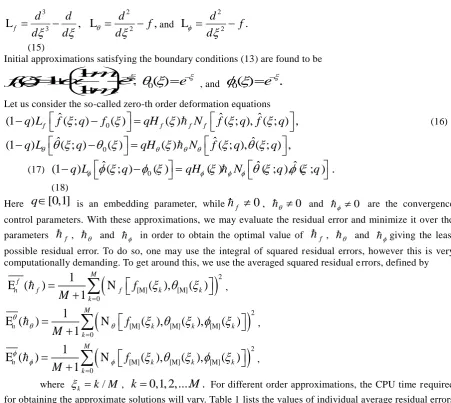
Initial approximations satisfying the boundary conditions (13) are found to be
0
1
() 1
,
1
m
f
e
m
0( )
e
, and 0
( )
e
.
Let us consider the so-called zero-th order deformation equations
0
ˆ
ˆ
ˆ
(1
q L
)
f
f
( ; )
q
f
( )
qH
f( )
fN
f
f
( ; ), ( ; ) ,
q
f
q
(16)0
ˆ
ˆ
ˆ
(1
q L
)
( ; )
q
( )
qH
( )
N
f
( ; ), ( ; ) ,
q
q
(17)(1
q L
)
ˆ
( ; )
q
0( )
qH
( )
N
ˆ
( ; ), ( ; ) .
q
ˆ
q
(18)
Here
q
[0,1]
is an embedding parameter, while
f
0
,
0
and
0
are the convergencecontrol parameters. With these approximations, we may evaluate the residual error and minimize it over the parameters
f ,
and
in order to obtain the optimal value of
f ,
and
giving the least possible residual error. To do so, one may use the integral of squared residual errors, however this is very computationally demanding. To get around this, we use the averaged squared residual e rrors, defined by
20
[M] [M]
(
)
1
( ),
(
1
)
f
n f f k
M
k k
M
f
E
N
,
[M] [M] [M
2
] 0
(
)
1
( ),
(
1
),
( )
M n
k
k k k
M
f
E
N
,
[M] [M] [M
2
] 0
(
)
1
( ),
(
1
),
( )
M n
k
k k k
M
f
E
N
,where
k
k M
/
,k
0,1, 2,....
M
.
For different order approximations, the CPU time required for obtaining the approximate solutions will vary. Table 1 lists the values of individual average residual errors by considering the optimal values of
f
1.20389
,
1.021035
,
1.026977
, whichhave been obtained by minimizing the averaged residual errors at the 10th order approximation. Results are validated by comparing the present results with the results available in the literature (See Table.2).
IV.
RESULT AND DISCUSSION
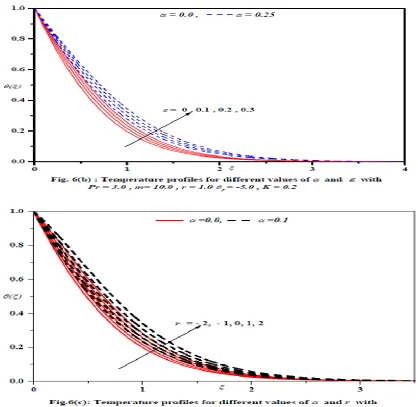
In order to understand the mathematical model, we present the numerical results graphically for the horizontal velocity profile fand the temperature profile
with for different values of
and parameters m, K , r, Pr,
and r in Figs. 2 to 6. The skin friction f(0) and the wall temperature gradient(0)
are tabulated in Table 3.
fand hence on the skin friction.
We shall now turn our attention to the influence of various parameters on the temperature field
.The effect of m on
is exhibited in Fig. 4(a) and Fig. 4(b). The effect of increasing values of m is to increase the temperature distribution. This is in conformation with the fact that an increase in m leads to an increase in the thermal boundary layer thickness which is also true even for non-zero values of K. As explained above, increase in K increases the temperature as shown in Fig. 5(a). Moreover, the rate of cooling of the end product is impor-tant in several manufacturing processes such as metal and polymer extrusion, which will confirm the quality of the end product. Fig. 5(b) explains effect of ron
. From the graphical representation it is seen that the effect of increasing value of ris to enhance the temperature. That is, an increase in rresults in an increase in the thermal boundary layer thickness. The effect of Pr on
can be found from Fig. 6(a). The figure demonstrates that an increase in Pr (means decrease in the thermal conductivityk
)
leads to a decrease in the temperature. Hence the thermal boundary layer thickness decreases as Pr increases. This is because fluid with a higher values of Pr posses a large heat capacity and hence intensifies the heat transfer. Therefore, cooling of the heated sheet can be improved by choosing a coolant with a large Pr. Fig. 6(b) displays the effects of
on
. Fluid temperature is found to increase with increasing values of which leads to a fall in the rate of heat transfer. That is, the assumption of temperature dependent thermal conductivity suggests a reduction in the magnitude of the transverse velocity by a quantity k T( ) ywhich can be seen in Eq. (2.3).Therefore, the rate of cooling is much faster for the coolant material having small thermal conductivity parameter. Fig. 6(c) elucidates the effect of r on
in the boundary layer. An increase in the value of r leads to decrease in
and this is because when r > 0, heat flows from the stretching sheet into the ambient medium and, when r < 0, the temperature gradient is positive and heat flows into the stretching sheet from the ambient medium.An interesting observation from the above results is that the velocity and temperature distributions depend heavily on the parameters m and
. It is noticed that the velocity at any point near the plate decreases monotonically as
increases form < 1. Also it is obvious from the figures that the thickness of the boun-dary layer becomes thinner for higher values of
when m < 1, but the reverse is true for m1 (see Fig. 2(a) and Fig. 2(b)). This is due to the induced mass transfer. This momentum transfer accelerates the fluid particle at the downward region. This kind of significant change in the velocity can also be seen for pos itive values of m, the stretching sheet case. For higher values of
, thermal boundary layer becomes thinner form < 1 when compared with m1(See Fig. 4(a) and Fig. 4(b)).The effects of the physical parameters on the skin friction f(0) and the Nusselt number (0)
are presented in Table 3. It is noticed that the effect of increasing values of the parameters m, K,r,is to decrease f(0)and to increase (0). The effect of increasing values of r and the Pr is to decrease(0). Further it is observed that an increase in
leads to a decrease in f(0)as well as (0)for m < 1, whereas an opposite trend is observed as m > 1.V.
CONCLUSIONS
The important findings are as follows:
The dimensionless velocity and temperature distributions at any point near the plate d ecrease when m < 1 and the thickness of the boundary layer becomes thinner when m < 1 and a reverse is true for m ≥ 1.
In the presence of temperature dependent thermo-physical properties, the effect of increasing porous pa-rameter is to decrease the velocity field. However, quite opposite is true with the thermal boundary layer.
The non-dimensional heat transfer rate reduces for increasing m.
The effect of the Pr is to decrease the thermal boundary layer thickness and the wall temperature gr a-dient.
The effect of
is to enhance the temperature in the flow region and is reversed in the case of t he r. Of all the parameters, the variable thermo-physical property parameters have strong effects on the drag, heat transfer characteristics, the horizontal velocity field and the temperature field.
ACKNOWLEDGMENTS:
REFERENCES
[1]. M.S. Abel, S.K. Khan, K.V. Prasad, Study of visco-elastic liquid flow and heat transfer over a stretching sheet with variable viscosity, Int. J. Nonlinear Mech. 37 (1) (2002) 81–88.
[2]. D. Pal, H. Mondal, Influence of chemical reaction and thermal radiation on mixed conve ction heat and mass transfer over a stretching sheet in Darcian porous medium with Soret and Dufour effects, Energy Conv. Manage. 62 (2012) 102–108.
[3]. H. Rosali, A. Ishak, I. Pop, Micropolar fluid flow towards a stretching/shrinking sheet in a porous me-dium with suction, Int. Commun. Heat Mass Transfer 39 (2012) 826–829.
[4]. M.M.Bhatti, A.Shahid, M.M.Rashidi , Numerical simulation of Fluid flow over a shrinking porous sheetSuccessive linearization method, Alexandria Engineering Journal, Vol. 55(1),(2016)51 -56. [5]. Crane, L.J., “Flow past a stretching plate”, Zeitschrift für angewandte Mathematik und Physik, 21, pp
645–647 (1970).
[6]. Shehzad, S.A., Hayat, T. and Alasidi, A., “Influence of convective heat and mass conditions in MHD flow of nanofluid”, Bulletin of the polish academy of sciences technical sciences, 63, No. 2.(2015). [7]. Prasad, K. V, Vajravelu, K, Shivakumara, I. S, Vaidya Hanumesh, Basha, Neelufer. Z., Flow and
Heat Transfer of a Casson Nanofluid Over a Nonlinear Stretching Sheet, Journal of Nanofluids, Vol.5, 2016, pp. 743-752(10).
[8]. K. Vajravelu. K. V. Prasad, Hanumesh Vaidya, Neelufer Z. Basha, Chiu-On Ng, Mixed Convective Flow of a Casson Fluid over a Vertical Stretching Sheet, Int. J. Appl. Comput. Math (2017) 3: 1619. https://doi.org/10.1007/s40819-016-0203-6
[9]. T. Hayat, M. Zubair, M. Ayub, M. Waqas, A. Alsaedi, Stagnation point flow towards nonlinear stre t-ching surface with Cattaneo–Christov heat flux, Eur. Phy. J. Plus 131 (2016) 355.
[10]. Zeeshan, A., Shehzad, N., Ellahi, R., “Analysis of activation energy in Couette -Poiseuille flow of na-nofluid in the presence of chemical reaction and convective boundary conditions”, Results in Physics, 8, pp. 502-512(2018).
[11]. Fang, T., Zhang, J., Zhong, Y., “ Boundary layer flow over a stretching sheet with variable thic kness”, Applied Mathematics and Computation, 218, pp 7241-7252 (2012).
[12]. Khader, M. M., Megahed, A.M., “ Boundary Layer Flow Due to a Stretching Sheet with a Variable Thickness and slip Velocity”, Journal of Applied Mechanics and Technical Physics, 56, pp 241–247 (2015).
[13]. Prasad. K. V, Vajravelu. K, Hanumesh Vaidya. Hall effect on MHD flow and heat transfer over a stre t-ching sheet with variable thickness, International Journal for Computational Methods in Engineering Science and Mechanics, DOI: 10.1080/15502287.2016.1209795,2016.
[14]. T. Salahuddin, M.Y. Malik, Arif Hussain, S. Bilal, M. Awais, MHD flow of Catta nneo-Christov heat flux model for Williamson fluid over a stretching sheet with variable thickness: Using numerical ap-proach, Journal of Magnetism and Magnetic Materials, Vol. 401, 2016, Pages 991 -997
[15]. K.V. Prasad, K. Vajravelu, Hanumesh Vaidya, Robert A. Van Gorder, MHD flow and heat transfer in a nanofluid over a slender elastic sheet with variable thickness, Results in Physics 7 (2017) 1462–1474 [16]. Prasad, K.V., Vaidya, H., Vajravelu, K. and Rashidi, M., “Effects of Variable Fluid Properties on
MHD Flow and Heat Transfer over a Stretching Sheet with Variable Thickness”, Journal of Mechanics, 33(4), pp. 501-512(2017).
[17]. K. V. Prasad, Hanumesh Vaidya, K. Vajravelu, and V. Ramanjini , Analytical Study of Catt a-neo-Christov Heat Flux Model for Williamson-Nanofluid Flow Over a Slender Elastic Sheet with Va-riable Thickness , J. Nanofluids 7, 583–594 (2018).
[18]. Liao S. A new branch of solutions of boundary-layer flows over a permeable stretching plate, Int. J. of Non-Line. Mech., Vol. 42, no. 6, pp 819-830, 2007.
[19]. Liao, S., “An optimal homotopy-analysis approach for strongly nonlinear differential equations”, Commun Nonlinear Sci Numer Simul, 15(8), pp.2003–2016(2010).
Table 1: Individual average residual error as a function of the number of iterations. CPU time required to calculate the solution is also listed. Parameter values are fixed at
Pr
1.09,
1 2
2.0,
0.1,
r,
Le
1
,
1
,
0.
2
m
3
K
We have optimal convergence controlpa-rameter values of
f
1.20389
,
1.021035
,
1.026977
.n
fn
nn
CPU time (Sec)Table 2. Comparison of skin friction
f
0
for different values of m and
with,
0.0.
r
K
m
0
f
1
2
1
4
Fang et al.[11]
Khader and Me-gahed [12] when
0.0
Present Work by OHAM
Fang et al.[11]
Khader and Megahed [12] when
0.0
Present Work by OHAM 10.0 1.0603 1.0603 1.06032 1.1433 1.1433 1.14331 5.0 1.0486 1.0486 1.04866 1.1186 1.1186 1.11862 1.0 1.0000 1.0000 1.0000 1.0000 1.0000 1.0000 0.0 0.9576 0.9577 0.95773 0.7843 0.7843 0.78441 -1/3 1.0000 1.0000 1.0000 0.5000 0.5000 0.5000 -1/2 1.1667 1.1666 1.16659 0.0833 0.8322 0.83221
Table 3. Variation of skin friction and wall-temperature gradient for different values of physical para-meters.
Pr
r
rK
m
0.0
1
10
1
4
(0)
f
(0)
f
(0)
(0)
f
(0)
(0)
1.0 0.1 1.0 -5. 0 0.0
-1/ 2 0.580 523 -1.819 807 0.55434 0 -1.982 426 -0.22406 0 -2.08570 6 -1/ 3 -0.040 846 -1.647 321 -0.2133 54 -1.686 796 -0.60039 2 -1.75893 4 0. 0 0.732 229 -1.243 645 -0.8100 50 -1.282 226 -0.93467 4 -1.33396 1 1. 0 -1.178 604 -0.881 745 -1.1786 04 -0.881 745 -1.17860 4 -0.88174 5 5. 0 -1.410 420 -0.881 745 -1.3687 23 -0.599 053 -1.30872 4 -0.55414 4 10 .0 -1.458 498 -0.572 057 -1.4078 02 -0.532 096 -1.33547 3 -0.47579 9
1.0 0.1 1.0 -5. 0 0.2
-1/ 2 0.673 353 -1.901 353 0.44509 4 -2.033 648 -0.45748 1 -2.11503 6 -1/ 3 -0.264 173 -1.585 368 -0.4807 40 -1.632 266 -0.81915 2 -1.71483 5 0. 0 -0.888 657 -1.214 101 -0.9649 20 -1.247 645 -1.08382 6 -1.29976 0 1. 0 -1.290 938 -0.858 403 -1.2909 37 -0.858 401 -1.28943 7 -0.85129 3 5. 0 -1.507 071 -0.614 852 -1.4648 36 -0.583 143 -1.40290 0 -0.52180 7 10 .0 -1.552 348 -0.558 263 -1.5009 69 -0.518 078 -1.42651 8 -0.44233 1
1.0 0.1 1.0 -1 0.0 0.0 10 .0 -1.350 809 -0.570 495 -1.3066 84 -0.529 089 -1.26423 9 -0.48926 3 0.5 -1.559
542 -0.534 179 -1.5142 79 -0.491 750 -1.47046 8 -0.45151 0 1.0 -1.742
674 -0.515 136 -1.6967 65 -0.480 624 -1.75150 2 -0.38977 2 1.0 0.1 1.0
-1
0 071 852 36 143 1 9 -2. 0 -1.798 244 -0.601 746 -1.7390 80 -0.569 686 -1.68209 5 -0.54086 8
1.0 0.1 -2.0
-5. 0 0.2
10 .0 -1.552 788 -0.355 966 -1.5011 37 -0.309 924 -1.45152 4 -0.27021 6
-1.0 -1.552
633 -0.425 808 -1.5010 77 -0.381 940 -1.45156 4 -034383 9
0.0 -1.552
486 -0.493 188 -1.5010 21 -0.451 264 -1.45160 4 -0.41459 5
1.0 -1.552
348 -0.558 263 -1.5009 69 -0.518 078 -1.45164 3 -0.48268 4
2.0 -1.552
217 -0.6211 79 -1.5009 21 -0.582 551 -1.45168 2 -0.54829 3 1.0 0.0
1.0 -5. 0 0.2
10 .0 -1.552 152 -0.615 189 -1.5008 81 -0.568 135 -1.45146 1 -0.52346 0
0.1 -1.552
349 -0.558 262 -1.5009 69 -0.518 077 -1.45146 5 -0.47991 9
0.2 -1.552
525 -0.514 121 -1.5010 52 -0.479 130 -1.45147 5 -0.44590 2
0.3 -1.552
683 -0.478 737 -1.5011 30 -0.447 831 -1.45149 0 -0.41847 9 0.7 1
0.1 1.0 -5. 0 0.2
10 .0 -1.552 851 -0.463 371 -1.5012 99 -0.438 500 -1.45189 6 -0.41892 2
1.0 -1.552
347 -0.558 264 -1.5010 54 -0.519 363 -1.45185 0 -0.48567 4
2.0 -1.550
947 -0.863 580 -1.5004 00 -0.776 217 -1.45175 7 -0.69477 8
5.0 -1.549
337 -1.534 385 -1.4997 75 -1.866 861 -1.45191 7 -1.11338 9 7.0 2 -1.549 028 -1.874 454 -1.4997 81 -1.569 589 -1.45214 5 -1.29275 1 10. 0 -1.548 910 -2.296 484 -1.4999 42 -1.866 861 -1.45248 4 -1.48449 3