A NEW APPROACH FOR BORDER
EXTRACTION USING
MORPHOLOGICAL METHODS
M Rama Bai Research Scholar JNTU (K)
Associate Professor, MGIT
Abstract - The objective of border detection is to mark the points in a digital image at which the luminous intensity changes sharply. Acute changes in image features usually reflect important events and changes in properties of the world. These include (a) discontinuities in depth (b) discontinuities in surface orientation (c) changes in material properties and (d) variations in scene illumination. A novel algorithm based on multi-scale morphological method for the purpose of border detection is introduced. Standard morphological border detection methods use single and symmetrical structure elements which are used exhaustively in image processing. They could detect the alterations of gray level, but are difficult to detect complex border feature because they are only sensitive to image border which has the same direction of structure elements. A new border detection method based on multi-structure element morphology of eight different directions is proposed. The ability of the proposed detection method is that we get eight different border detection results by using morphological gradient algorithm respectively and final border result is obtained by using synthetic weighted method. The experimental result shows that the proposed algorithm obtains clear and exact borders of the image by retaining the image details and it out performs the conventional morphological border detection algorithms and differential border detection operators. This technique shows the worth of border detection and the ability of detecting sharp complex borders.
Index Terms - Border detection, mathematical morphology and multi-structure elements.
I. INTRODUCTION
Border detection is an important function for object identification and is also a critical pre-processing step in image segmentation. Result of the final processed image is obtained by the detection of borders of an image. Mathematical Morphology (MM) is a new mathematical theory which can be used to process and analyze the images. It provides an alternative approach to image processing based on shape concept stemmed from set theory, not on classical mathematical modeling and analysis. In the MM theory, images are treated as sets and morphological transformations which derived from Minkowski addition and subtraction are defined to extract features in images. The structuring element (SE) decides the performance of morphological operation. How to optimize and choose the SE adaptively and applied is a complex and most researched field of MM. For general morphological border detection, some simple and symmetrical shape structure elements such as crisscross, diamond and disk are adopted. But they are only sensitive to image border which has the same direction of structure elements, and are not so effective to the border which has the direction other than the structure elements. They are not adaptive to the image to be processed. Hence, they find it difficult to detect complex border features. In this paper, a novel border detection algorithm based on multi-structure elements morphology of eight different directions is introduced. These structure elements comprise almost all the directions of lines that extend in the image. By using morphological gradient border detectors consecutively, we will obtain 8 different border detection results. The final border result is obtained by using synthetic weighted method.
II. BASICTHEORYOFMATHEMATICALMORPHOLOGY
which will be processed by MM theory must be changed into set. Mathematical Morphology is a powerful tool for dealing with various problems in image processing and computer vision. It is
composed by a series of morphological algebraic arithmetic operators. The basic morphological operations, namely erosion, dilation, opening, closing etc. are used for detecting, modifying, manipulating the features present in the image based on their shapes. The shape and the size of SE play crucial roles in such type of processing and are therefore chosen according to the need and purpose of the associated application. In the following, we introduce some basic MM operators of gray-scale images.
In the two-dimensional Euclidean space Z2, Let D(i, j) denote a gray-scale two dimensional image, E
denote SE.
Dilation of a gray-scale image D(i, j) by a gray-scale SE E(x, y) is denoted by
(D E) = { z | (Ê )z ∩ D ≠ ø } (1) Erosion of a gray-scale image D(i, j) by a gray-scale SE E(x, y) is denoted by
(D E)= {z | (E)z < D} (2)
Opening and closing of gray-scale image D(i, j) by gray-scale SE E(x, y) are denoted respectively by
D○ E= (D E) E (3) D● E= (D E) E (4)
Erosion basically decreases the gray-scale value of an image by applying shrinking transformation while dilation increases the gray scale value of the image by applying expanding transformation. Both of them are sensitive to the image border whose gray-scale value changes. Erosion filters the inner image while dilation filters the outer image. Opening is erosion followed by dilation and closing is dilation followed by erosion. Opening generally smoothes the contour of an image, breaks narrow gaps. As opposed to opening, closing tends to fuse narrow breaks, eliminates small holes, and fills gaps in the contours. Therefore, morphological operation is used to detect image border, and at the same time, denoise the image.
The dilation and closing operations will expand the processed image while erosion and opening operations shrink it keeping the processed image similar to the original image.
Hence the following algorithms are used for detection of borders in the image.
The dilation residue border detector can be defined using the following equation
Gd(D) = (D E) – D (5)
where Gd(D) denote the border of the image D. It is defined as the difference set of the dilation of D and the domain of D.
The erosion residue border detector can be defined using the following equation Ge(D) = D – (D E) (6)
where Ge(D) denote the border of the image D. It is defined as the difference set of the domain of D and the erosion domain of D.
The morphological gradient of image D is computed using dilation and erosion and can be defined using the following equation
G(D) = (D E) – (D E) (7)
The morphological gradient G(D) defined above represents the sharp gray level transition in the input image. Hence is used as border detector.
III. MULTI-STRUCTUREELEMENTSMORPHOLOGICALBORDERDETECTIONALGORITHM
elements. In this section, a novel multi-structure elements morphology algorithm is proposed to detect the borders of image.
A. How to choose Structure Elements
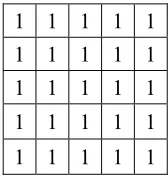
The choosing of structure element is a key factor in morphological image processing. The size and shape of SE decide the final result of detected borders. The basic theory of multi-structure elements morphology is to construct different structure elements in the same square window. And these structures elements comprise almost all the line extending directions in the square window.
Let {D (i, j)} (i, j
Є
Z) is a digital image, and (i, j) is its centre, then structure elements in (2N+1) * (2N+1) squarewindow can be denoted by
Er = { D(i + i0 , j+j0 ), θr = r * α |- N < i0 , j0 ≤ N} (8)
Where r = 0, 1, … 4N -1,α = 180º / 4N and θr = is the direction angle of SE.
Here, we choose N=2, then in the 5×5 square window, the direction angles of all structure elements are 0º, 22.5º, 45º,
67.5º, 90º, 112.5º, 135ºand 157.5º. And these structure elements are shown in Fig.1, where “1” denotes the components of SE. In fact, structure 125elements Ercan be got by decomposing 5×5 square SE E as shown in Fig.2.
Therefore, Erand E satisfy:
E1U E2 U E3 U E4 U E5 U E6 U E7 U E8 = E (9)
(a) SE with 0° direction angle
0 0 0 0 0 0 0 0 0 0 1 1 1 1 1 0 0 0 0 0 0 0 0 0 0
(b) SE with 22.5° direction angle
0 0 0 0 0 0 0 0 0 1 0 0 1 0 0 1 0 0 0 0 0 0 0 0 0
(c) SE with 45° direction angle
0 0 0 0 1 0 0 0 1 0 0 0 1 0 0 0 1 0 0 0 1 0 0 0 0
(d) SE with 67.5° direction angle
0 0 0 1 0 0 0 0 0 0 0 0 1 0 0 0 0 0 0 0 0 1 0 0 0
(e) SE with 90°direction angle
0 0 1 0 0 0 0 1 0 0 0 0 1 0 0 0 0 1 0 0 0 0 1 0 0
(f) SE with 112.5° direction angle
0 1 0 0 0 0 0 0 0 0 0 0 1 0 0 0 0 0 0 0 0 0 0 1 0
(g) SE with 135° direction angle
1 0 0 0 0 0 1 0 0 0 0 0 1 0 0 0 0 0 1 0 0 0 0 0 1
(f) SE with 157.5° direction angle
0 0 0 0 0 1 0 0 0 0 0 0 1 0 0 0 0 0 0 1 0 0 0 0 0
Fig 1: 8 different directional structure elements in 5 x 5 square window
1 1 1 1 1 1 1 1 1 1 1 1 1 1 1 1 1 1 1 1 1 1 1 1 1
B.Multi-structure elements morphological border detection algorithm
Equations (5), (6) and (7) can be used to detect border of an image. In this paper, we select morphological gradient border detector denoted by (7) to detect image borders. In the following section, we will propose multi-structure elements morphological border detection algorithm.
Phase1: Construct structure elements Erof different directions according to the method presented above.
Phase2: Use the structure elements got in phase1 respectively to detect the borders Gr (D) of original image by
morphological gradient border detector.
Phase3: According to every detected border Gr (D) in phase2, use synthetic weighted method to calculate final
detected border by: m
G (D)=
Σ
wr Gr (D) (10)r=1
Where G (D) is the final detected border of original image, m is the number of structure elements and wris the
weight of different detected border information. It can be calculated by different methods. In this paper, we calculate wr by w = 1/ m.
IV. WHYTHISALGORITHM?
In this algorithm we not only overcome all the difficulties of existing one’s but also enhance the image details to a larger extent while detecting the border. When compared to existing algorithms our proposed Algorithm doesn't include any kind of differential operators or any complex calculations. We use concept of mathematical morphology which provides solution to various computer vision problems and also in image analysis.
V. CONCLUSION
In this paper, a novel multi-structure elements morphological border detection algorithm is proposed to detect image border. The experimental results show that the algorithm is more efficient than the usually used single SE morphological border detection operator and differential border detection operators such as Robert operator, Sobel operator and Prewitt operator etc. The detected border is more pinpointed, integral and continual, and the border information is more abundant. Moreover, the novel proposed algorithm can filter the noise more successfully than other operators.
VI. RESULTSANDCOMPARISIONS
Color
Image
Gray
Image
Results obtained by gradient method
a. Dilation - Erosion
b. Close - Open
c. Using multi-structuring Element
Acknowledgement
The researcher would like to express her gratitude and thanks to Dr..V.Vijaya Kumar and Dr.V.Venkata Krishna for his invaluable suggestions and constant encouragement that led to improvise the presentation quality of this study. I also thank anonymous reviewers for their valuable comments and members of SRRF-GIET for their suggestions and true help.
REFERENCES
[1] J. Serra, Image Analysis and Mathematical Morphology,Academic Press, London, 1982. [2] L. Sobel, Camera Models and Machine Perception. PhD thesis. Standford University, CA, 1970. [3] J. Prewitt, “Object Enhancement and Extraction”, Picture Process Psychopict, 1970, pp. 75-149. [4] D.C Marr, E. Hildreth, “Theory of Edge Detection”, Proc Roy Soc London, 1980, vol. B275, pp. 187-217.
[5] J. Canny, “A computational approach to edge detection”,IEEE Trans. on Pattern Analysis and Machine Intelligence,1986, vol. 8, pp. 679-698.
[6] X. Song, Y. Neuvo, “Robust Edge detector based on Morphological filters”, Pattern Recognition Letters, 1993,vol. 14, pp. 889-894. [7] B. Chanda, M.K. Kunda and Y.V. Padamaja, “A Multiscale Morphologic Edge Detection”, Pattern Recognition,1998, vol. 31, pp.
1469-1478.
[8] J. Lee, R. Haralick and L. Shapiro, “Morphologic edge detection”, IEEE Journal of Robotics and Automation, 1987,vol. 3, no. 2, pp. 142-156.
[9] A. Morles, R. Acharya, “Nonlinear Multi-scale Filtering Using Mathematical Morphology”, Computer Vision andPattern Recognition, 1992, pp. 572-578.
[10] H. Zhuang, F. Hamano, “A new type of effective morphologic edge detectors”, The Twentieth Southeastern Symposium on System Theory, 1988, pp. 304-311.
[11] K.A. Morsy, Y. Kanayama, “A new straight edge detection algorithm using direction-controlled edge tracking and random hitting”, IEEE International Symposium on Computational Intelligence in Robotics and Automation,1997, pp. 398-405.
[12] R.C. Gonzalez, R.E. Woods, Digital Image Processing Second Edition, Publishing House of Electronics industry,2002.
AUTHOR’S PROFILE
M.Rama Bai received B.E. (CSE) degree from Bharathiar University, Coimbatore (T.N) in 1994. She worked as lecturer in