Flavor Programming During Infancy
Julie A. Mennella, PhD; Cara E. Griffin, BS; and Gary K. Beauchamp, PhD
ABSTRACT. Objective. Although individuals differ substantially in their flavor and food preferences, the source of such differences remains a mystery. The present experimental study was motivated by clinical observations that early experience with formulas estab-lishes subsequent preferences.
Design. Infants whose parents had chosen to formu-la-feed them were randomized into 1 of 4 groups by the second week of life. One group was assigned to be fed a milk-based formula (Enfamil), whereas another was as-signed to be fed (Nutramigen), a particularly unpleasant-tasting protein hydrolysate formula. The remaining groups were assigned to be fed Nutramigen for 3 months and Enfamil for 4 months; the timing of exposure dif-fered between the groups. After 7 months of exposure, infants were videotaped on 3 separate days while feed-ing, in counterbalanced order, Enfamil, Nutramigen, and Alimentum, a novel hydrolysate formula.
Results. For each of the 4 interrelated measures of behavior (intake, duration of formula feeding, facial ex-pressions, and mothers’ judgments of infant acceptance), previous exposure to Nutramigen significantly enhanced subsequent acceptance of both Nutramigen and Alimen-tum. Seven months of exposure led to greater acceptance than did 3 months.
Conclusions. The bases for clinical difficulties in in-troducing hydrolysate formulas during older infancy are clarified in this study. More broadly, variation in for-mula flavor provided a useful model for demonstrating experimentally the effects of long-term exposure differ-ences on later acceptance. Such early variation, under more species-typical circumstances (eg, via exposure to different flavors in amniotic fluid and mothers’ milk), may underlie individual differences in food acceptability throughout the life span. Pediatrics 2004;113:840 – 845;
protein hydrolysate, formula, taste, flavor, infants, pro-gramming, development, nutrition.
ABBREVIATIONS. E, Enfamil; N, Nutramigen; ANOVA, analysis of variance.
S
ources of individual differences in food prefer-ences and habits are one of the most fundamen-tal mysteries of human behavior. Although ge-netic differences may underlie some of these differences,1,2 for omnivores such as humans, it is important that there not be too many genetically determined restrictions on what constitutes an ac-ceptable food.3 Instead, as suggested by a growingbody of data from other sensory and motor sys-tems,4 – 6 experience may have important influences on later functioning and preferences. We hypothe-sized that there are sensitive periods during which the human infant is particularly likely to form flavor preferences and aversions that, in turn, serve as the foundation for lifelong food habits.7
Recently, we suggested that a particularly apt model system to explore potential early sensitive periods in flavor learning involves the inherent fla-vor variations characteristic of infant formulas and the ontogenic changes in acceptance/rejection of par-ticular flavors.7–9 Within each of the 3 classes of commercially available formulas (ie, cow’s milk based, soy protein based, and hydrolyzed protein based), and in particular between the hydrolysate-and milk-based varieties, differences in sensory qual-ity (flavor) are profound. Milk-based formulas are often described as having low levels of sweetness and being “sour and cereal-like,” whereas hydro-lyzed protein-based formulas are of a most unpleas-ant character, with a bitter and sour taste profile, unpleasant odor volatiles, and a horrible after taste.10,11The extreme unpalatability of hydrolysates, which supply protein nutrients in a “predigested” form, is likely caused by both its processing and composition, because many amino acids and small peptides taste sour and bitter and are characterized by unpleasant volatile components.12
There are striking developmental changes in in-fants’ acceptance of hydrolysate formulas. Infants⬍4 months old readily accept these formulas on first exposure, whereas older infants strongly reject them within the first few minutes of feeding.8,9,13 Clini-cians report that infants who consume a hydrolysate formula from early infancy readily continue to accept it well after 5 months of age.7 These observations suggest that there is a profound change at ⬃4 months of age in the infants’ perception of these formulas and that early experience modifies later acceptance.
To test rigorously the suggestion derived from such cross-sectional data, we designed a longitudinal experimental study wherein infants were assigned randomly to different experience groups. This per-mitted precise control of exposure history and con-sequently is the ideal test of the hypothesis that prior exposure to a particular flavored formula impacts later acceptance of that and other formulas. More generally, this experimental study can provide a con-venient and powerful model system for investigating the existence of sensitive periods in the development of human flavor preferences.
From the Monell Chemical Senses Center, Philadelphia, Pennsylvania. Received for publication May 5, 2003; accepted Sep 29, 2003.
Address correspondence to Julie A. Mennella, PhD, 3500 Market St, Phila-delphia, PA 19104-3308. E-mail: [email protected]
METHODS Subjects
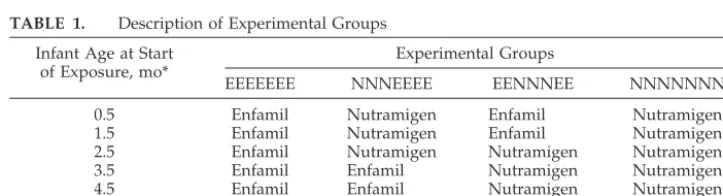
Mothers who had chosen previously to formula feed their term newborns were recruited by advertisements in local newspapers. When the infant was⬍3 weeks old and the mother’ s decision not to lactate was well established, the mother-infant pairs (24% Af-rican AmeAf-rican and 76% white) were randomized into 1 of 4 groups (Table 1) differing in the timing and type of formula (ie, Enfamil: milk-based formula [E]; Nutramigen: protein hydrolysate formula [N]) that the infant was fed during each month of the 7-month study. One group, EEEEEEE (hereafter referred to as the control group;n ⫽14), was assigned to a milk-based formula, Enfamil, whereas another group, NNNNNNN (n⫽12), was as-signed to the protein hydrolysate formula Nutramigen during the entire 7-month period of the study. The 2 other groups, NNNEEEE (n⫽15) and EENNNEE (n⫽12), were assigned to feed Nutramigen for specified periods during their first 7 months of life, as indicated by the Ns and Es in the groups’ names. Infants were fed on demand and ad libitum. All procedures used in this study were approved by the Office of Regulatory Affairs at the University of Pennsylvania, and informed consent was obtained before entry into the study. Mothers were compensated for their participation in the study.
Monthly Procedures
At the start of the study and then again at the beginning of each 1-month cycle, mothers came to the Monell Center (Philadelphia, PA), where they were videotaped feeding their infants the formula consumed since the last visit. The infants’ weights and heights before feeding and the amount of formula consumed during this midday feed were recorded. These monthly evaluations were performed to ensure compliance with the study protocols, to chart infants’ acceptance of the assigned formulas, and to obtain accu-rate information on the introduction of cereal, fruits, and vegeta-bles. The next month’s supply of formula (with the labels re-moved) then was distributed. Mothers were informed that the formula was either Enfamil or Nutramigen. Mothers completed questionnaires to evaluate their food and general neophobia at the end of the first and last monthly visit14as well as questionnaires related to infant temperament at 0.5, 3.5, and 7.5 months.15,16
Test Procedures at the End of the 7-Month Exposure Period By using methodologies established in our laboratory,8,9infants were tested on 3 separate days within 1 week. At the same time of day and 4.1⫾0.2 hours after their last formula feed, each infant was videotaped feeding the hydrolysate formula Nutramigen on 1 test day, the milk-based formula Enfamil on another day, and Alimentum (a novel hydrolysate formula to all infants) on yet another test day. Testing occurred under naturalistic conditions in which the infants determined the pacing and duration of feeding. The order of testing was counterbalanced between and within groups, and the mothers were not aware of the hypothesis or which formula was being fed to the infant during each of the 3 test sessions. The mothers refrained from talking or making faces during the feeding sessions to eliminate any potential influence of the mother’s verbal or facial responses on her infant’s behaviors17; replays of the videotapes verified that this indeed was the case. Mothers were instructed to feed the infants at their customary pace until the infant refused the bottle 3 consecutive times, using
the criterion that the infant exhibited such behaviors as turning his or her head away, pushing the bottle away, crying, or becoming playful. The experimenter, who was unaware of the hypothesis of the study, sat behind the video camera, which was placed at the far corner of the testing room⬃10 to 12 feet from the mother-infant dyad, and was out of view of the mother and her mother-infant. Immediately after each feeding session, the mothers then rated how much they thought their infant liked the formula on a 9-point scale.8,9Intermediate ratings were to be marked at the appropriate locations between the extremes such that ratings could range from 1 (did not like at all) to 9 (liked very much).
Trained raters who were unaware of the experimental condi-tions and hypothesis of the studies scored the videotaped records to determine the length of the formula feed and frequency of various facial expressions. During scoring, the sound was turned off so that the raters would not be influenced by the infants’ vocalizations. The Ekman and Friesen Facial Action Coding Sys-tem,18an anatomically based system that specifies facial move-ments in terms of minimally distinguishable actions of the facial muscles (termed action unit), was used to code a variety of facial expressions. Based on previous research of the type of facial responses made by human infants and other primates to a variety of taste and olfactory stimuli that differed in hedonic valence,19 –21 we determined the frequency of 4 negative facial expressions (ie, nose wrinkling, frowning, upper-lip raise, and gaping). Two ob-servers individually scored the videotapes of 41 feedings selected at random. Reliability for scoring of each of the facial responses and the length of the feeding was⬎85% (P⬍.0001).
Statistical Analyses
For each infant, we determined the total intake (milliliters) and length (minutes) of each feed, the frequency of negative facial expressions during the first 2 minutes of feeding, and mothers’ ratings of their infants’ enjoyment of the formulas during each of the 3 test sessions conducted at the end of the 7-month exposure period. To determine whether there were significant differences among the 4 groups, we conducted separate repeated-measures analyses of variance (ANOVA) with group (n⫽4) as the grouping factor and type of formula (n⫽3) as the within-subjects factor. Significant effects in the ANOVA were probed by Tukey honest significant difference tests to determine whether the 3 exposure groups differed from each other as well as the control group. All summary statistics are expressed as mean⫾standard error, and the level of significance wasP⬍.05 for the ANOVA andP⬍.02 for the Tukey tests.
RESULTS Subject Characteristics
There were no significant differences among the 4 groups in the ages of mothers and infants, the num-ber of females/males, or the infants’ weights and lengths at the start of the study. There also were no significant group differences for any of the various measures of infant temperament, the age at which infants were introduced to solid foods, or maternal measures of food and general neophobia (allP val-ues⬎ .10).
TABLE 1. Description of Experimental Groups Infant Age at Start
of Exposure, mo*
Experimental Groups
EEEEEEE NNNEEEE EENNNEE NNNNNNN
0.5 Enfamil Nutramigen Enfamil Nutramigen
1.5 Enfamil Nutramigen Enfamil Nutramigen
2.5 Enfamil Nutramigen Nutramigen Nutramigen
3.5 Enfamil Enfamil Nutramigen Nutramigen
4.5 Enfamil Enfamil Nutramigen Nutramigen
5.5 Enfamil Enfamil Enfamil Nutramigen
6.5 Enfamil Enfamil Enfamil Nutramigen
Infants’ Formula Acceptance Throughout the 7-Month Study
There were no significant differences between the groups in the infants’ acceptance of the formula that they were fed during the previous month throughout the 7-month study (F[3,49 df] ⫽ 0.91; P⫽ .44; data not shown), thus indicating compliance with study procedures.
Infants’ Acceptance of Hydrolysate Formulas at 7.5 Months of Age
There was a significant interaction between groups and the infants’ acceptance of the 3 brands of formu-las when tested at the end of the 7-month exposure period (intake: F[6,98 df] ⫽ 8.12 and P ⬍ .000000; duration of feed:F[6,98 df]⫽ 5.60 andP ⬍ .00005). The 3 groups of Nutramigen-exposed infants drank significantly more and spent more time feeding Nu-tramigen and Alimentum when compared with those infants who were fed only Enfamil during the first 7 months of life (Table 2 and Fig 1; allPvalues⬍ .05). However, exposure to Nutramigen for 7 months (group NNNNNNN) resulted in greater acceptance of the Nutramigen when compared with exposure for 3 months (groups NNNEEEE and EENNNEE).
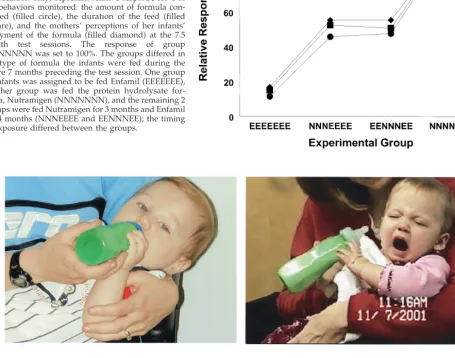
There was also a significant effect of group on the number of negative facial actions displayed while feeding the formulas (F[6,98 df] ⫽ 2.51; P ⬍ .05). Infants in groups NNNNNNN, NNNEEEE, and EENNNEE made significantly less negative facial responses while ingesting Nutramigen when com-pared with infants exposed only to the milk-based Enfamil formula (Fig 1). Differences in facial re-sponses made while feeding Nutramigen are also illustrated in Fig 2.
Mothers’ Perceptions
There was a significant group-by-formula interac-tion (F[6,96 df]⫽ 9.96;P⫽ .00000) in mothers’ per-ceptions of their infants’ behaviors that was consis-tent with the infants’ acceptance patterns (Table 2). Mothers of infants in the 3 groups who had previous exposure to Nutramigen were significantly more likely to report that their infant enjoyed feeding Nu-tramigen when compared with the infants who had never been exposed to Nutramigen. In addition, mothers of infants who were exposed only to Nutra-migen during the first 7 months of life were signifi-cantly more likely to report that their infants liked feeding Alimentum but disliked feeding Enfamil when compared with the group never exposed to Nutramigen (P ⬍.0001).
DISCUSSION
Previous exposure to a hydrolysate formula, Nu-tramigen, enhanced its later acceptance. Infants who were never fed Nutramigen during the first 7 months of life strongly rejected it when it was first offered at 7.5 months, whereas those who were regularly fed this formula during most of their infancy responded to it as if it were very acceptable at 7.5 months of age. Between these 2 extremes, infants fed Nutramigen either during their first 3 months of life or during months 3 through 5 were generally more accepting than those who had never been fed this formula but less so than those fed Nutramigen for the entire 7 months. No differences were evident between these 2 midexposure groups, providing no evidence for dif-ferential potency of exposure during different por-tions of early infancy.
TABLE 2. Infants’ Feeding Behaviors and Mothers’ Perceptions After the 7-Month Exposure Period Experimental Group
EEEEEEE NNNEEEE EENNNEE NNNNNN
Intake, ml
Enfamil 160.9⫾22.3 237.1⫾21.6* 158.8⫾24.1 119.1⫾22.9
Nutramigen 22.7⫾21.7 88.9⫾21.0*† 92.6⫾23.4*† 194.3⫾23.4*
Alimentum 43.9⫾21.2 120.7⫾20.4* 145.5⫾22.9* 119.3⫾24.1*
Duration of feed, min
Enfamil 7.2⫾1.3 12.0⫾1.2* 7.3⫾1.4 7.1⫾1.4
Nutramigen 1.8⫾1.2 6.2⫾1.1*† 6.0⫾1.3*† 11.8⫾1.3*
Alimentum 3.1⫾1.5 8.1⫾1.5* 8.4⫾1.6* 8.1⫾1.6*
Frequency of negative facial action units during first 2 min of feed
Enfamil 3.9⫾1.8 1.5⫾1.8 3.8⫾2.0 6.4⫾2.0
Nutramigen 9.5⫾1.5 4.5⫾1.4* 4.8⫾1.6* 1.1⫾1.6*
Alimentum 5.7⫾1.3 3.3⫾1.2 4.3⫾1.4 4.2⫾1.4
Mothers’ ratings of infants’ acceptance of formula: (range: 1–9; 1⫽did not enjoy at all)
Enfamil 7.7⫾0.6 8.5⫾0.6† 7.3⫾0.7† 4.9⫾0.7*
Nutramigen 1.4⫾0.7 4.6⫾0.6*† 4.6⫾0.7*† 8.3⫾0.7*
Alimentum 2.6⫾0.8 4.2⫾0.8 5.3⫾0.9 6.1⫾0.9*
No. of subjects (females/males): 14 (7:7) 15 (6:9) 12 (8:4) 12 (5:7)
The amount of formula consumed, the duration of the feeding, the frequency of negative and positive facial action units displayed, and the mothers’ ratings of their infants’ acceptance of formula are shown for each of the 3 testing sessions in which 7.5-month-old infants consumed, in counterbalanced order, Enfamil, Nutramigen, and Alimentum. The groups differed in the type of formula consumed during the first 7 months of life. Group EEEEEEE was assigned to be fed Enfamil and group NNNNNNN was assigned to be fed the protein hydrolysate formula Nutramigen during the entire 7-month period of the study. Groups NNNEEEE and EENNNEE were assigned to feed Nutramigen for 3 months and Enfamil for 4 months; the timing of exposure differed between the groups. The values shown are means⫾
standard error.
*P⬍0.05 for the comparison with the EEEEEEE group.
Sensory Basis for Differential Responsiveness
The remarkable consistency among the 3 indices of acceptance (Fig 1) suggests that these measures re-flect a common underlying factor that is most likely differential responses to the formulas based on their chemosensory attributes. Strengthening this conclu-sion are the data on expressive responses (mothers’ judgments and analyses of facial expressions) that most likely directly reveal hedonic responses to sen-sory stimuli. Based on adult sensen-sory profiling of these formulas, the 2 primary sensory pathways in-volved are likely taste and olfaction.7
Concerning taste, hydrolysate formulas taste more bitter and sour than most traditional milk-based for-mulas including Enfamil. Thus, it would not be sur-prising that hydrolysate formulas would be rejected more strongly, because newborns reject bitter and very sour stimuli.20 –23 What makes this hypothesis questionable is that rejection does not occur until after 4 months of age. However, at least as it concerns
bitterness perception, there are multiple classes of bitter compounds presumably recognized by mem-bers of a large family of bitter receptors.24 The bit-terness of hydrolysate formulas, probably caused by bitterness of free amino acids and small peptides12 and possibly other substances produced during pro-cessing, may be detected by receptors that do not mature until the infant is several months old.
Concerning olfaction, that the cloying, unpleasant, nauseating flavor and aftertaste of hydrolysates can be reduced substantially if the olfactory component is eliminated by tasting hydrolysates with the nares held closed, implicates olfaction in the adults’ and perhaps the infants’ hedonic judgments. It has been suggested that although hedonic judgments for tastes are relatively “hard wired” or determined in-nately,25hedonic responses to the olfactory compo-nents of flavor are influenced strongly by experi-ence.26Thus, the observed changes in response to the hydrolysate formulas with age and prior experience
Fig 1. Relative responses of the 4 groups of infants
(groups EEEEEEE, NNNEEEE, EENNNEE, and
NNNNNNN) to Nutramigen at the 7.5-month test ses-sion. The points (connected by lines to enhance visual appreciation only) represent relative response for 4 of the behaviors monitored: the amount of formula con-sumed (filled circle), the duration of the feed (filled square), and the mothers’ perceptions of her infants’ enjoyment of the formula (filled diamond) at the 7.5 month test sessions. The response of group NNNNNNN was set to 100%. The groups differed in the type of formula the infants were fed during the entire 7 months preceding the test session. One group of infants was assigned to be fed Enfamil (EEEEEEE), another group was fed the protein hydrolysate for-mula, Nutramigen (NNNNNNN), and the remaining 2 groups were fed Nutramigen for 3 months and Enfamil for 4 months (NNNEEEE and EENNNEE); the timing of exposure differed between the groups.
may depend on developmental and experiential changes (“olfactory imprinting”)27,28 in response to the volatile components of the formulas.
Persistence
There are indications that the effects of early expe-rience to hydrolysate formulas may be long lived. In a prior study, we found that 4- to 5-year-old children who were fed hydrolysates during their infancy ex-hibited more positive responses to sensory attributes associated with them (eg, sour taste and aroma) sev-eral years after their last exposure to the formula when compared with same-aged children without such experience.26,29 In addition, clinical studies on adolescent children with phenylketonuria who went off their modified hydrolysate formula suggest that they can often, albeit with some difficulty, return to formulas on which they were reared as infants.30 –32 Because these formulas are unpalatable to adoles-cents who have not had infant exposure, this relative ease of return could reflect the long-term effects of prior experience.33
Generality
The effects observed in these studies are likely of substantially broad significance, revealing a funda-mental feature of mammalian dietary learning. Stud-ies of humans and other animals have shown that fetuses are bathed in flavored amniotic fluids that reflect in part the pregnant animals’ diet.34 After birth, mammals are exposed further to milk that is flavored by the diet the nursing mother is consum-ing. Consequently, even during very early develop-ment, mammals usually sample a large and varied set of flavor compounds. We suggest that these “nat-ural” experiences with flavored amniotic fluid and milk serve to familiarize the young infant with fla-vors of the dietary constituents the mother consumes and establish them as acceptable and preferred.35 Culturally determined flavor preferences, one of the most enduring characteristics of an ethnic group,36,37 can be understood in the context of early flavor exposure. Flavors common to an ethnic group are experienced early in life, at a time when the pregnant or lactating mother is most likely being fed foods most characteristic of and most revered by that par-ticular culture.37
Clinical Implications
Some of the original impetus for this work came from questions raised by clinicians concerning the practical difficulties in introducing hydrolysate for-mulas to older infants as well as the long-term effects of early feeding.38 Our studies reveal the basis for these clinical impressions and suggest some reme-dies.
First, if infants are to be placed on hydrolysate formulas, they should be introduced as early as pos-sible and certainly before 4 months of age. A strategy of gradually introducing hydrolysates to older in-fants by mixing it with regular, milk-based formula at increasing proportions seems reasonable39 but to our knowledge has not been experimentally tested.
Second, caregivers who feed infants recognize hy-drolysates are very unpalatable. They may feel that they are punishing their child by feeding such an offensively flavored formula. Our studies make it clear that this is not the case if infants are started early, however. The infant will not only accept it readily but will find it palatable.
Third, there is room to develop more palatable hydrolysate formulas. The first step in such a pro-gram should be to determine the specific sensory aspects of these formulas that are offensive to the naive infant and preferred by the exposed infant. Such information would help suggest a rational strat-egy for favorably modifying current formulations.
CONCLUSIONS
These data underscore one of the most fundamen-tal differences in the experiences of the formula- and breastfed infants. To be sure, the nutrient composi-tion of formula is held to standards and regulacomposi-tion that are based, in part, on the analyses of human milk. However, unlike breast milk, the flavors of all types of formulas are monotonous and lack sensory information on the dietary choices of the mother. Thus, the formula-fed infant is being deprived of rich and varied sensory experiences that at one time were common to all mammalian young. How this impacts on later food habits and flavor preferences remains to be determined, but it seems likely that the conse-quences could be profound.
ACKNOWLEDGMENTS
This research was supported by National Institutes of Health grant HD37119, and the research apprenticeship of Ms Jhamirah Howard was supported by grants from The Annenberg Founda-tion and Mrs Patricia Kind. We also thank the NutriFounda-tional Division of Mead Johnson for supplying the Enfamil and Nutramigen.
We appreciate the expert technical assistance of Ms Jhamirah Howard and Ms Coren Jagnow.
REFERENCES
1. Duffy VB, Bartoshuk LM. Food acceptance and genetic variation in taste.J Am Diet Assoc. 2000;100:647– 655
2. Drewnowski A, Henderson SA, Barratt-Fornell A. Genetic taste markers and food preferences.Drug Metab Dispos. 2001;29:535–538
3. Rozin P. The selection of foods by rats, humans, and other animals. In: Rosenblatt JS, Hind RA, Shaw E, Beer C, eds.Advances in the Study of Behavior. Vol 6. New York, NY: Academic Press; 1976:21–76
4. Hurford JR. The evolution of the critical period for language acquisition.
Cognition. 1991;40:159 –201
5. Elston JS, Timms C. Clinical evidence for the onset of the sensitive period in infancy.Br J Ophthalmol. 1992;76:327–328
6. Kuhl PK, Williams KA, Lacerda F, Stevens KN, Lindblom B. Linguistic experience alters phonetic perception in infants by six months of age.
Science. 1992;255:606 – 608
7. Beauchamp GK, Mennella JA. Sensitive periods in the development of human flavor perception and preference. In:Annales Nestle´, Nestle´ Nu-trition Workshop Series. Vol 56. Vevey, Switzerland: Nestec Ltd; 1998: 19 –31
8. Mennella JA, Beauchamp GK. Developmental changes in the infants’ acceptance of protein-hydrolysate formula and its relation to mothers’ eating habits.J Dev Behav Pediatr. 1996;17:386 –391
9. Mennella JA, Beauchamp GK. Development and bad taste. Pediatr Asthma Allergy Immunol. 1998;12:161–163
10. Cook DA, Sarett HP. Design of infant formulas for meeting normal and special need. In: Lifshitz F, ed.Pediatric Nutrition: Infant Feeding, Defi-ciencies, Disease. New York, NY: Marcel Dekker, Inc; 1982
12. Schiffman SS, Dackis C. Taste of nutrients: amino acids, vitamins, and fatty acids.Percept Psychophys. 1975;17:140 –146
13. Mennella JA. Development of the chemical senses and the program-ming of flavor preference. In:Physiologic/Immunologic Responses to Di-etary Nutrients: Role of Elemental and Hydrolysate Formulas in Management of the Pediatric Patient. Report of the 107th Conference on Pediatric Research. Columbus, OH: Ross Products Division, Abbott Laboratories; 1998:201–208
14. Pliner P, Hobden K. Development of a scale to measure the trait of food neophobia in humans.Appetite. 1992;19:105–120
15. Medoff-Cooper B, Carey WB, McDevitt SC. The early infancy temper-ament questionnaire.J Dev Behav Pediatr. 1993;14:230 –235
16. Carey WB, McDevitt SC. Revision of the Infant Temperament Question-naire.Pediatrics. 1978;61:735–739
17. Meltzoff AN, Moore MK. Imitation of facial and manual gestures by human neonates.Science. 1977;198:75–78
18. Ekman P, Friesen W.The Facial Action Coding System. Palo Alto, CA: Consulting Psychologists Press; 1978
19. Soussignan R, Schaal B, Marlier L, Jiang T. Facial and autonomic re-sponses to biological and artificial olfactory stimuli in human neonates: re-examining early hedonic discrimination of odors.Physiol Behav. 1997; 62:745–758
20. Steiner JE, Glaser D, Hawilo ME, Berridge KC. Comparative expression of hedonic impact: affective reactions to taste by human infants and other primates.Neurosci Biobehav Rev. 2001;25:53–74
21. Rosenstein D, Oster H. Differential facial responses to four basic tastes in newborns.Child Dev. 1988;59:1555–1568
22. Kajuira H, Cowart J, Beauchamp GK. Early developmental changes in bitter taste responses in human infants.Dev Psychobiol. 1992;25:375–386 23. Steiner JE. Facial expressions of the neonate infant indicating the hedo-nics of food-related chemical stimuli. In: Weiffenbach JM, ed.Taste and Development: The Genesis of Sweet Preference. Washington, DC: US Gov-ernment Printing Office; 1977
24. Chandrashekar J, Mueller KL, Hoon MA, et al. T2Rs function as bitter taste receptors.Cell. 2000;100:703–711
25. Bartoshuk LM, Beauchamp GK. Chemical senses.Annu Rev Psychol. 1994;45:419 – 449
26. Mennella JA, Beauchamp GK. Flavor experiences during formula
feed-ing are related to preferences durfeed-ing childhood.Early Human Dev. 2002;68:71– 82
27. Woo CC, Leon M. Sensitive period for neural and behavioral response development to learned odors.Brain Res. 1987;433:308 –313
28. Sullivan RM, Landers M, Yeaman B, Wilson DA. Good memories of bad events in infancy.Nature. 2002;407:38 –39
29. Liem DG, Mennella JA. Sweet and sour preferences during childhood: role of early experiences.Dev Psychobiol. 2002;41:388 –395
30. National Institutes of Health Consensus Development Panel. National Institutes of Health Consensus Development Conference statement: phenylketonuria: screening and management, October 16 –18, 2000. Pe-diatrics. 2001;108:972–982
31. Schuett VE, Gurda RF, Brown ES. Diet discontinuation policies and practices of PKU clinics in the United States.Am J Public Health. 1980; 70:498 –503
32. Schuett VE, Brown ES, Michals K. Reinstitution of diet therapy in PKU patients from twenty-two clinics.Am J Public Health. 1985;75:39 – 42 33. Owada M, Aoki K, Kitagawa T. Taste preferences and feeding
behav-iour in children with phenylketonuria on a semisynthetic diet.Eur J Pediatr. 2000;159:846 – 850
34. Mennella JA, Johnson A, Beauchamp GK. Garlic ingestion by pregnant women alters the odor of amniotic fluid.Chem Senses. 1995;20:207–209 35. Mennella JA, Jagnow CJ, Beauchamp GK. Prenatal and postnatal flavor learning by human infants. Pediatrics. 2001;107(6). Available at: www.pediatrics.org/cgi/content/full/107/6/e88
36. Rozin P. The acquisition of food habits and preferences. In: Mattarazzo HD, Weiss SM, Herd JA, Miller NE, Weiss SM, eds.Behavioral Health: A handbook of Health Enhancement and Disease Prevention. New York, NY: John Wiley and Sons; 1984:590 – 607
37. Mennella JA. The flavor world of infants: a cross-cultural perspective.
Nutr Today. 1997;32:142–151
38. Beauchamp GK, Mennella JA. Early feeding and the acquisition of flavor preferences. In: Boulton J, Laron Z, Rey J, eds.Long-Term Conse-quences of Early Feeding. Nestle´ Nutrition Workshop Series Book 36. Philadelphia, PA: Lippincott–Raven Publishers; 1996:163–177 39.Coping With Colic: Helpful Tips for Parents[audiotape]. Evansville, IN:
Mead Johnson; 1990
AGE OF PRIM PARA
“The average age at which American women are having their first child has climbed to a record 25.1, the government said. The rise reflects a drop in teen births and an increase in the number of women who are putting off motherhood until their 30s and 40s. The age of first-time American moms has risen steadily during the past three decades from an average of 21.4 in 1970. The latest figure, for 2002, was released by the Centers for Disease Control and Prevention.”
Associated Press. Average age its 25.1 for first time moms.Wall Street Journal. December 18, 2003
DOI: 10.1542/peds.113.4.840
2004;113;840
Pediatrics
Julie A. Mennella, Cara E. Griffin and Gary K. Beauchamp
Flavor Programming During Infancy
Services
Updated Information &
http://pediatrics.aappublications.org/content/113/4/840 including high resolution figures, can be found at:
References
http://pediatrics.aappublications.org/content/113/4/840#BIBL This article cites 29 articles, 6 of which you can access for free at:
Subspecialty Collections
http://www.aappublications.org/cgi/collection/nutrition_sub Nutrition
sub
http://www.aappublications.org/cgi/collection/fetus:newborn_infant_ Fetus/Newborn Infant
following collection(s):
This article, along with others on similar topics, appears in the
Permissions & Licensing
http://www.aappublications.org/site/misc/Permissions.xhtml in its entirety can be found online at:
Information about reproducing this article in parts (figures, tables) or
Reprints
DOI: 10.1542/peds.113.4.840
2004;113;840
Pediatrics
Julie A. Mennella, Cara E. Griffin and Gary K. Beauchamp
Flavor Programming During Infancy
http://pediatrics.aappublications.org/content/113/4/840
located on the World Wide Web at:
The online version of this article, along with updated information and services, is
by the American Academy of Pediatrics. All rights reserved. Print ISSN: 1073-0397.