A thesis subm itted for the Degree
of
Doctor of Philosophy of the University of London
by
David W onnacott
D e p a rtm e n t o f P h y sic s & A stro n o m y
U n iv ersity C ollege L o n d o n
U n iv e rsity o f L o n d o n
ProQuest Number: 10609784
All rights reserved
INFORMATION TO ALL USERS
The qu ality of this repro d u ctio n is d e p e n d e n t upon the q u ality of the copy subm itted.
In the unlikely e v e n t that the a u th o r did not send a c o m p le te m anuscript and there are missing pages, these will be note d . Also, if m aterial had to be rem oved,
a n o te will in d ica te the deletion.
uest
ProQuest 10609784
Published by ProQuest LLC(2017). C op yrig ht of the Dissertation is held by the Author.
All rights reserved.
This work is protected against unauthorized copying under Title 17, United States C o d e M icroform Edition © ProQuest LLC.
ProQuest LLC.
789 East Eisenhower Parkway P.O. Box 1346
To m y parents.
.. .every strong in te lle c t.. .is a guardian of integrity.
Dr. Jacob Bronowski — The A scent o f M an
would have been im m easurably lessened.
I should like to offer my sincerest thanks to Ian H ow arth for the supervision he has bestowed upon me in the years since I set out to produce this thesis. It w ouldn’t have been the same w ithout him. My grateful thanks also go to R am an P rinja, Ia n ’s m ore-than-able stand-in during my th ird year, and to Professor Sir R obert Wilson who had the foresight to place me under their guidance.
Thanks too, go to Ian, Ram an, Nicole, Julie, Dave P. and K eith for being such able proof-readers and spotters-of-mistakes, and to my friends and colleagues at U.C.L. and at R.A.L. for their tim e, sufferance and encouragem ent, notably P aul (atom ic physics) and Mike (spectroscopy).
I m ust not fail to m ention the indom itable squaddies from ‘E 3’ (lately of ‘A25’). Daily life w ith K eith, Des and ‘B arry’ was a perm anent source of debate, education, fun and sticky buns. I could not have wished for more stim ulating companions to pass my tim e w ith. I only hope th a t they remember me w ith the same fondness.
Finally, there are three people for whom I cannot express the full extent of my gratitu de in words: Julie, my fiancee, who had (and still has) the soundness of mind to make me work when I really didn’t w ant to and who was always there when I needed her to be, and my M other and Father who have contributed to this thesis more th an they could ever know and to whom I shall be more grateful th a n I can ever say.
A b stra ct
International Ultraviolet Explorer satellite spectra of the Algol-type interacting binary system C X D ra (B2.5 Ve + F?) have been analysed in detail, revealing a new phenomenon, to w hit, C X D ra possesses a m a tter stream which at certain orbital phases disappears from the line-of-sight almost entirely. This has been dubbed ‘stream dipping’.
Two possible alternative interpretations of these observations have been exam ined. E ither the stream is undergoing a rapid change in its ionization balance, or the stream is collapsing towards the orbital plane as it gains speed. More complex models involving, for example, variable stellar winds or distortion of the stream trajecto ry by magnetic forces can be excluded to varying degrees by the velocity structure seen in the resonance lines.
Several scale-independent numerical models of interacting binary systems have been generated and applied to CX D ra in order to gain an insight into the geom etry which is responsible for this effect. U Cep, with its well-known system param eters, has been used as a benchm ark for the models. Those models w ith inviscid stream s have failed to reproduce the observations, bu t th e viscous stream s, modelled using a cell-averaging technique, reproduce not only th e observed velocity stru cture but the phase-dependency of the profiles too. Profile fitting then yields the chemical composition of the stream (these results indicate a high degree of CNO-processing), and allows a lower lim it to be placed on the inclination of th e orbital plane.
The density structure of the models has also been used to predict the variations
A ttention is drawn to the inclusion of an addendum which contains the results of a detailed investigation into the properties and possible failings of the numerical model employed in this work, in particular to the non-conservation of angular mo m entum . The results derived from this model are, however, largely insensitive to this flaw.
1 To B e or n ot to B e . .. 12
1.1 In tro d u c tio n ... 12
1.2 The present state of p la y ... 14
1.2.1 The optical spectrum ... 14
1.2.2 The infrared s p e c tr u m ... 15
1.2.3 The radio frequencies ... 16
1.2.4 T he ultraviolet spectrum ... 16
1.2.5 The X-ray s p e c t r u m ... 17
1.2.6 P o la r im e try ... 18
1.2.7 Evolutionary statu s ... 18
1.2.8 The Be Phenomenon as the product of binary star interaction 19 1.3 Summary and a i m s ... 20
1.4 C X D ra c o n is... 21
1.5 Thesis o u tlin e ... 22
2 IU E o b se rv a tio n s 24 2.1 In tro d u c tio n ... 24
2.2 Reduction of the IU E d a t a ... 25
2.3 The velocity-phase v a r i a t i o n s ... 26
2.4 E xtraction of the stream p r o f i l e s ... 31
2.4.1 The choice of the standard ... 31
2.5 I n te rp r e ta tio n ... 34
7
3 T h e S in g le P a r tic le M o d el 39
3.1 In tro d u c tio n ... 39
3.2 The Model ... 40
3.3 Comparison w ith the d a t a ... 44
3.4 D iscu ssio n ... 45
3.5 The conditions for an escaping s t r e a m ... 46
4 T h e v isco u s m o d el 50 4.1 In tro d u c tio n ... 50
4.1.1 Possible stream -supporting m e c h a n is m s ... 50
4.1.2 Viscosity ... 53
4.2 The viscous m o d e l ... 54
4.2.1 Prendergast & Taam visco sity ... 54
4.2.2 Im p lem en tatio n ... 54
4.3 Tests of the M o d e l ... 58
4.4 R e s u lts ... 63
4.5 Scale-height p r e d ic tio n s ... 66
5 U ltr a v io le t lin e sy n th e sis 69 5.1... In tro d u c tio n ... 69
5.2 Profile synthesis: A b s o r p t i o n ... 70
5.2.1 The ‘slab’ m o d e l ... 70
5.2.2 Results ... 74
5.3 Profile synthesis: S c a tte r in g ... 75
5.3.1 The scattering m o d e l... 75
5.3.2 Prelim inary a n a l y s i s ... 78
5.3.3 Results ... 81
6 P o la riz a tio n in A lg o ls 91 6.1 In tro d u c tio n ... 91
6.2 Polarization t h e o r y ... 94
6.3 Prelim inary Results ... 97
6.4 The behaviour of the polarization of other Algol s y s te m s ... 100
6.5 D iscu ssio n ... 103
6.6 R e s u lts ... 107
7 C o n c lu sio n s 113 7.1 Summary of the results and te c h n iq u e s... 113
7.2 Further w o r k ... 115
A IU E sp e c tr a 126 A .l In tro d u c tio n ... 126
List o f T ables
2.1 Superion lines observable with IU E... 25 2.2 S i I I I A1296 orbital parameters o f C X D ra... 27 2.3 Cross-correlation orbital parameters o f C X D ra... 33
5.1 Adopted radiation temperatures fo r the ionization balance calculations o f C XD ra and UCep... 88
5.2 Derived elemental abundances fo r the streaming material in CXD ra. 89 5.3 Derived elemental abundances for the streaming material in UCep. . 89
6.1 Results o f the optically-thick model fits... I l l
B .l Journal o f IU E observations... 145
2.1 Fitted radial velocity curve to C XD ra Si I I I A1296 velocity data. . . 28
2.2 F e III A1895 data from C X D ra... 29
2.3 Superion data from C X Dra... 30
2.4 A comparison between the silicon photospheric feature in C XD ra and the standard o Sgr... 32
2.5 A comparison between a photospheric region in C X D ra and the stan dard o Sgr 32 2.6 Examples o f the various types o f profile seen in C X D ra... 36
3.1 Model geometry fo r an example system with p = 0.6... 41
3.2 Ballistic stream trajectories... 43
3.3 Ballistic model fit to F e l l l A1895 data o f C X D ra... 45
3.4 Test fo r escaping streams in a system with p = 0.5... 48
3.5 Test fo r escaping streams in a system with p = 0.9... 48
4.1 Surface density plot fo r U Cep... 59
4.2 Velocity plot fo r U Cep... 60
4.3 log10 (scale height) plot fo r U Cep... 61
4.4 Surface density plot fo r C X Dra... 63
4.5 Velocity plot fo r C X Dra... 64
4.6 log10 (scale height) plot fo r C X D ra... 65
4.7 Anisotropy o f the particle escape in C X D ra... 66
4.8 Comparison o f the density scale-heights produced by various models. 67
11
5.1 Simulated absorption profiles o f C X Dra... 75
5.2 Different qualities o f fit between C X D ra observations and the models. 80 5.3 Synthetic C I V profiles at various inclinations fo r U Cep observed at phase (f> = 0.9022... 83
5.4 Synthetic N V profiles at various inclinations fo r C X D ra observed at phase <j> = 0.9466... 84
5.5 Phase variation o f the abundance parameter qik A,- fo r various ions. . 86
6.1 C X D ra Q-U data from Huang, Hsu & Guo (1989)... 98
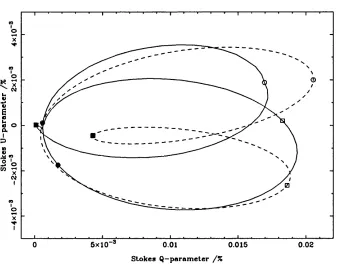
6.2 Computed Q-U locus fo r the optically-thin model o f C X D ra... 98
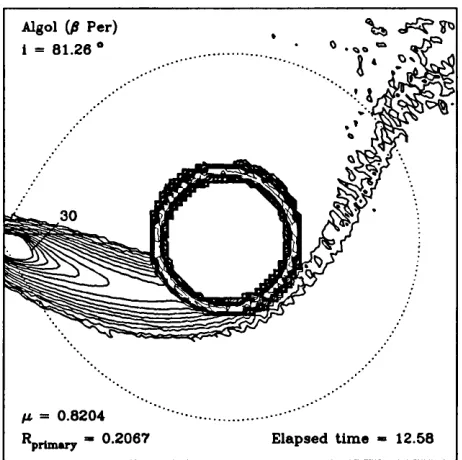
6.3 Viscous model o f Algol, showing the surface density...101
6.4 The optically-thin model Q-U locus fo r Algol...101
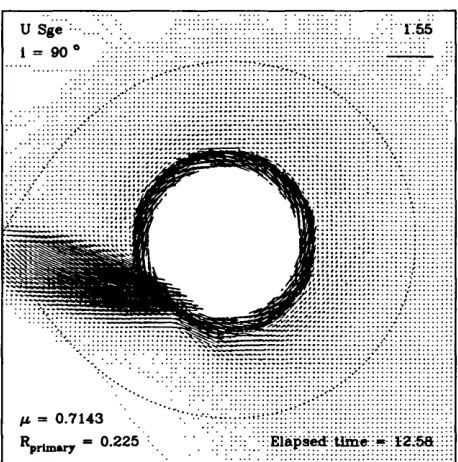
6.5 Viscous model o f USge, showing the velocity structure... 102
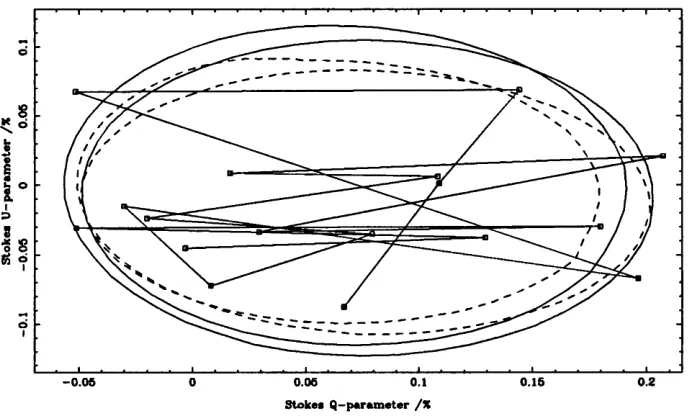
6.6 Comparison o f the optically-thick model Q-U locus o f Algol and the data... 106
6.7 Comparison o f the optically-thick model Q-U locus o f C X D ra and the data... 109
6.8 Comparison o f the optically-thick model Q-U locus o f USge and the data... 110
A .l The N V spectral region... 127
A.2 The S i I V spectral region... 131
A .3 The C I V spectral region... 135
To B e or n ot to B e . ..
The gods did not reveal, from the beginning, All things to us; b ut in the course of time,
Through seeking we may learn, and know things b etter.
Xenophanes
1.1
In tro d u ctio n
Be stars axe classified under the (adm ittedly broad) criterion of “non-supergiant B-type stars whose spectra have, or have had at one tim e, one or more Balmer lines in emission” (e.g. Collins 1987). They form a wide class of stars covering the tem perature range BO to B9, occasionally taking in 0 9 and AO stars, constitute about 20 % of all B-type stars, and have a population peak near spectral type B2.5.
As their definition suggests, Be stars are prim arily classified on the basis of the appearance of their visual spectra where some or all of the Balmer lines are in emission and typically have two peaks. This ‘doubled’ emission is subject to erratic variations on timescales ranging from m inutes to decades (e.g. 7r A qr, McLaughlin 1961). Further complications arise w ith the unpredictable appearance of sharp ‘shell’ absorption lines of some m etals (predom inantly F e ll) whose w idths are small in
Chapter 1 13
comparison w ith the very broad lines of the Balmer series. Be stars are also known to be abnorm ally rapid ro tators for their spectral types (Slettebak 1976).
Early work on understanding these objects includes th a t of O tto Struve (1931), in which he proposed th a t the broad emission profiles were due to the observed rapid ro tatio n of the Be stars. This ro tatio n was supposed sufficient to trigger or enhance mass loss about the equatorial regions of these stars, thus creating and sustaining an elliptical, precessing ring of m aterial of variable thickness which gives rise to b o th the variable hydrogen emission and, when optically thick, to the ‘shell’ lines. This concept, although now known to be considerably more complex than originally proposed, embodies the key elements of the generally-accepted, modern picture of an equatorially-confined disc of plasm a girdling these objects.
The odd behaviour of Be stars is not restricted to th e visual region of the spec trum . In the ultraviolet they exhibit anomalously high ionization stages for their photospheric tem peratures, the former appearing as broad, outflowing ‘w ind’ lines (e.g. M arlborough & P eters 1986), often w ith narrow com ponents superimposed (G rady, Bjorkm an & Snow 1987). Some Be stars are also X-ray sources1 (e.g. 7
Cas, B radt et al. 1977). A t lower energies, they often show large infrared excesses (Allen 1973) and are strongly polarized (up to 3% , Jones 1979). ‘Classical’ Be stars have only recently been found to be very weak radio sources (Taylor et al. 1990), bu t Be-binaries were not detected in this survey.
The above definition of the Be class is not very specific and it is hardly surprising to find th a t it encompasses several different types of object which appear superficially similar. The Be phenomenon probably arises by one of (at least) two mechanisms: one taking place in single stars (the ‘classical’ Be stars) and another being associated w ith mass transfer from a binary companion. The division in to these two groups arises because although it has been suggested th a t all Be stars are binary systems
(Haxmanec & K hz 1976), the population statistics of these objects are such th a t there are fax too few eclipsing Be stars for all Be stars to be members of this class (Plavec 1976). Nevertheless, the presence of radial velocity shifts which repeat w ith a well-defined period in the spectra of some of this class of stars is strongly indicative th a t a t least some Be stars are Be-binaries (e.g. H R 2142, Peters 1982).
Plavec (1987) has also pointed out th a t non-eclipsing Algol systems w ith pri maries earlier th an AO would most likely be observed as Be stars, and in fact m any Be-binaries are expected to occupy the same evolutionary niche as Algol systems, w ith an evolved, less luminous companion filling its Roche lobe and transferring pro cessed m aterial to a h o tter and more massive main-sequence prim ary. (The nam ing convention used here is th a t the star which accretes the transferred mass will be re ferred to as ‘the prim ary’ whilst the mass-losing star will be called ‘the secondary’). The mass transfer rate in these systems can be highly variable (sometimes changing by orders of m agnitude) and so, by altering the structure of the circum stellar enve lope, this leads to the erratic or episodic strengthening and fading of the Be —► B
—> Be phases which are so characteristic of these stars.
This chapter will review the statu s of multi-wavelength observations of Be stars (and to a lesser extent of Algol systems) in some depth, making reference to some of the current weaknesses in th e interpretation of the d a ta where unrealistic or oversimplified models have been used. This will be followed by a description of the model of Be-binaries th a t is implied by the observations. The aims of this work will then be presented, the current state of understanding of the system under prim ary study, CX D ra, will be reviewed, and the purpose of each chapter in tu rn outlined.
1.2
T h e p resen t s ta te o f play
1.2.1 T h e o p tic a l sp e c tr u m
Chapter 1 15
if assumed to be in a Keplerian orbit, gives an estim ate of M */R di8C. Thus the double peaks are characterised by quite narrow velocity distributions, or equivalently, discs not much larger th an the primary. Dachs et al. (1986) com pute ‘cylindrical’, homogeneous disc sizes displaying this tendency in a num ber of Be stars including the binary <£Per. It m ight be expected th a t in reality the discs would be substantially larger th an their prim aries as they will certainly not have density distributions which are uniform, as assumed in the above analysis, and are likely to be spread more tenuously on their outer edges. This is in agreement w ith the ten Algol systems observed by Peters (1989) who showed from the disc eclipses th a t the H a-em itting region fills a significant portion ( ^ 90 %) of the Roche lobes of the prim aries.
1 .2 .2
T h e infrared sp e c tr u m
Extension of the optical continuum photom etry into the infrared allows the pho tom etric excesses there to be modelled. Gerhz, Hackwell & Jones (1974) by using spherical shells, and Dachs, Engels & Kiehling (1988) by using cylindrical discs, predict very similar emission measures (E = f v n \ d V) of 2.3 x 10⁶Ocm-3 (0 P e r) and 1.1 x lO ^ c m-3 (HR 2142) respectively. The former group also show from the slope of the infrared continuum th a t the excesses are due to free-free emission; the possibility of significant therm al emission from dust grains is excluded as no ‘dust features’ are observed near 10 p m .
Infrared photom etry by Ashok et al. (1984) has shown th a t the em itting volume of the infrared radiation is much larger th an th a t of the optical (e.g. V m /V n a ~ 12
for <f>Per).
obviously apply to the accretion disc in an interacting binary system as well as to a lone, ‘classical’ Be star, but it should be remembered th a t the infrared outflow is an assum ption of their model rath er th an an observational fact. The infrared excesses only measure the am ount of circum stellar m aterial, not its velocity structure.
1 .2 .3
T h e radio freq u en cies
Taylor et al. (1990) have very recently completed observations of a sample of Be stars at 2 cm. They conclude th a t the typical size of th e em itting volume is generally of the order of 100 R©, continuing the tren d noted by Ashok et al. (1984) of larger em itting volumes being seen at longer wavelengths; this being m ost probably due to th e circum stellar m aterial becoming optically thick to longer-wavelength emission at larger stellar distances. Further, they postulate th a t their observed lack of radio active Be-binaries is due to the disruption of the large em itting volume by tid al action of the companion.
1 .2 .4
T h e u ltra v io let sp e c tr u m
The m ajority of Be stars are of earlier B-types and em it most of their flux in the ultraviolet, making this spectral region particularly im p o rtan t for the study of these objects, principally because the resonance transitions of C3+, N4+, Si3+, and Al2+ appear there.
Snow, Peters & M athieu (1979) have compared Copernicus scans of Be and shell stars w ith those of supergiants and point out considerable similarities, notably, the large num ber of F e ll lines present. They rem ark th a t, in supergiants at least, these lines could be indicators of extended atm ospheres, a result which agrees well w ith the canonical picture of Be sta rs’ envelopes.
Chapter 1 17
distribution of velocities. The first of the aforementioned observations would be a n atu ral consequence of an im pacting stream in a close binary system, whilst the turbulence thus caused could easily produce ‘blobs’ of m aterial moving w ith discrete velocities. Such effects are readily seen in Algol systems; for example, U Cep has been extensively observed by Kondo, McCluskey & Stencel (1981) who show m any profiles of Mg II which exhibit the above properties more or less continuously in time.
1 .2 .5
T h e X -ra y sp e c tr u m
There is a paucity of work in the X-ray region on bo th Be stars and on Algols (Bolton 1989). W hat little research has been done seems to indicate th a t the source of the X-rays in these objects, at least in the Be-binaries, is the chromospheric activity of the late-type secondary. This is presumed to be due to enhanced dynam o action caused by the synchronous rotation of the secondary.
1 .2 .6
P o la r im e tr y
Coyne & McLean (1982) stress th a t “The mere fact th a t the optical radiation from Be stars is observed to be intrinsically linearly polarized provides perhaps our most conclusive clue th a t the circum stellar shells of these stars are disklike in n a tu re ” . Strong variations in the polarization are often observed, and this can be attrib u ted most naturally to the perceived (or real) changes in the structure of the circum stellar m aterial as the stars ro tate past on their axes (in the case of ‘classical’ Be stars) or progress along their orbital paths (as in Be-binaries). Models of circum stellar discs are often invoked (Rudy & Kemp 1976,1978) but no-one has yet explicitly attem p ted to allow for the effects of a gas stream on the polarized light from an interacting binary. Typical derived param eters are Rdisc ~ 5 R* and ne ~ 1011 cm- 3 .
1 .2 .7
E v o lu tio n a r y sta tu s
Chapter 1 19
1 .2 .8
T h e B e P h e n o m e n o n as th e p ro d u ct o f b in a ry sta r in te r a c
tio n
The circum binary m aterial, as proposed above, divides naturally into three compo nents: the stream of m a tter from the inner Lagrangian (L I) point down onto the prim ary, the im pact zone over which the effects of the photospheric im pact are felt, and the circum prim ary accretion disc (if one forms).
The stream consists of m aterial which evaporates from the Roche Lobe of th e secondary and is accelerated down into the gravitational well of the prim ary. The speed of the gas rapidly becomes hypersonic (M ach num bers of the order of 20-40 are expected) and by the tim e the stream strikes the prim ary, it is highly ionized by numerous interparticle collisions and turbulent shocks.
The im pact zone is the region of the prim ary’s surface where the stream will deposit most of its kinetic energy and, as the stream is travelling w ith a significant fraction of the escape velocity of the star (m any hundred k m /s), this am ounts to a su bstantial injection of mechanical energy into the photosphere. The X-ray emission from Be-binaries may be produced in this region (and by coronal activity in the secondary, if there is any), but the object itself m ay not appear X -ray-bright if the circum stellar m aterial is rich in m etals an d /o r dense enough to blanket the radiation. This region is also likely to be very bright in the ultraviolet and optical, and further ionization can occur locally. The effects of this extra heating on the photosphere are unknown. Ulrich & Burger (1976) attem p t a simplified analysis and conclude th a t ap art from a small increase in radius, the prim ary is unaffected. However, they omit several im po rtant processes which are certain to have an effect, such as the inp ut of angular m om entum into the photosphere of the accreting star.
w idth of the ultraviolet resonance lines are the product of the stream im pact and of turbulence, the observed polarization arises autom atically from electron scattering in the flattened geometry of the disc, and the large num ber of absorptions in the plasm a will reprocess th e radiation to lower energies (via bound-free and free-free interactions) to produce the infrared excesses seen in Be-binaries.
1.3
Sum m ary and aim s
Be stars, both single and in binary systems, have been studied at almost all wave lengths for decades, yet no definitive model(s) exist for these objects. Much has been made of general argum ents in deducing the structure of the flattened distributions of circum stellar m aterial, but in term s of obtaining accurate values of the physical param eters th a t describe the non-stellar m aterial about Be stars, to date only sim plified models have been tested against the d ata (e.g. Lubow & Shu 1975). W hilst the usefulness of these models cannot be denied, there is a definite need to improve on them as m odern observations become more precise and make more demands on theory. Only the work of Prendergast &: Taam (1974) deals w ith mass transfer in Algol systems in sufficient detail to be properly tested against the observations. U nfortunately, the details of the calculations have never been published in full.
Chapter 1 21
1.4
C X D r a c o n is
CX D raconis (HD 174237, B2.5Ve + F?) was first listed as a Be star in 1949 by Miczaika in a spectrographic study of selected Be and Ae stars. Lacoarret sub sequently reported rapid spectral variations in 1962. In 1978, Koubsky gathered sufficient spectroscopic observations to identify it as a binary and deduce a period of 6.d69728. The period was later revised slightly to 6.d69606 (Koubsky et al. 1980). He also a ttrib u ted the variations seen in H a and other species to m a tter stream ing from th e (unseen) cool companion onto the B star. The scatter in the radial velocity curve is almost as large as the velocity variations themselves and certainly suggest th a t a strong, erratic source of absorption and emission is present, superimposed on the more regular stellar motions. If such a stream exists, it m ust be highly variable or give rise to some circum stellar structure which is only quasi-static.
This variability has been dem onstrated to occur on widely different timescales by Percy et al. (1988) who undertook long-term B V m onitoring of selected Be stars. They observed CX D ra over two seasons of 50 and 70 days and noted random vari ations w ith an am plitude of about 0.ml in both B and V in one season, and, in complete contrast, they observed a sm ooth decline of about 0.m2 in both m agni tudes a year later.
Only one study of any depth exists of C X D ra in the ultraviolet. Peters & Polidan (1984) used IU E spectra taken a t various phases to deduce the presence of a low-density, high-tem perature (n e ~ 109cm- 3 , Te ~ 105K) region located on the trailing hemisphere of the prim ary, probably caused by the im pact of the m atter stream . Their phase coverage is incomplete however, and so their investigation of the circum stellar m aterial is restricted to one half of the orbital cycle between <f> ~ 0.4 and <j> ~ 0.9.
make the case for the presence of circumstellar m aterial is quite compelling.
E instein observations of C X D ra (G uinan, Koch & Plavec 1984) are best fitted by a therm al brem sstrahlung source of X-rays w ith a characteristic tem perature of 9.6 x 10⁶ K. No short-timescale variations (between 6 and 30 m inutes) are seen, and as the X-ray luminosity, Lx ~ 1031 erg s- 1 , is com parable to th e X-ray lum inosity of single late-type stars, it is probable th a t the principal source of the X-rays in CX D ra is coronal activity in the secondary rath er th a n hot shocks in the accreting stream . Very similar results have been found for Algol (W hite et al. 1986) and the identical conclusion is confirmed by the absence of an X -ray eclipse in this system.
CX D ra has only recently been observed polarim etrically and substantial varia tions in b oth the degree of polarization and in the position angle have been found (Huang, Hsu & Guo 1989).
1.5
T h esis o u tlin e
C hapter 2 attem p ts to obtain the param eters describing the orbital motion of CX D ra using radial velocity curves derived from various ions present in the IU E SW P spec tra l range (AA 1150-2000). Disturbances in the profiles of m any lines of differing ionization potential are found to distort the orbital solution from th a t expected on the grounds of physical arguments. To overcome this problem , spectra of C X D ra w ith the disturbed lines removed are cross-correlated w ith the spectrum of a stan dard star, thus utilizing the inform ation in the whole binary spectrum and producing a much more reliable solution. The solution is used to correct the velocity shift of the standard relative to CX D ra prior to division of the spectra to produce ‘stream only’ profiles which are then examined for the effects of the stream ing m a tter alone. A physical model of the mass distribution is discussed.
Chapter 1 23
a contradictory set of physical properties for the prim ary and secondary. On these grounds the simple model is rejected.
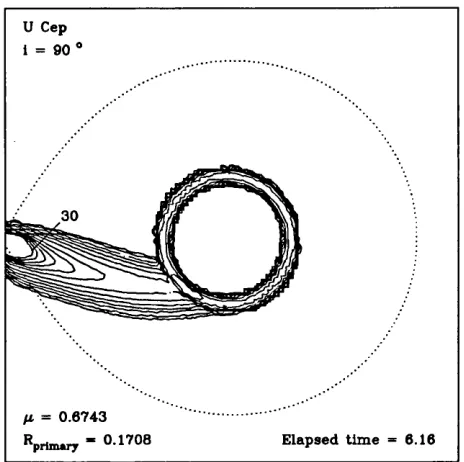
C hapter 4 extends the simple models using a hydrodynam ic, viscous treatm ent to sim ulate the spreading of m aterial by the viscous tran sp o rt of linear and angular m om enta. The model is tested successfully against the interacting binary system U Cep, and the model of CX D ra is found to be in good qualitative agreement w ith a general model deduced from the IU E observations.
C hapter 5 deals w ith the application of the models of chapter 4 to the problem of th e distortions observed in the profiles of atom ic transitions occurring in the ultraviolet. Two extreme models of the radiation transfer are tested; the absorption model being rejected, the scattering model being preferred. Line profiles are fitted to m any of the available lines in the observations of C X D ra to deduce a strong lim it on the inclination of the orbital plane of the binary system, to infer the spatial distribution of ionization and to obtain the chemical abundances of several im p ortant elements from a model of the ionization balance. The quality of th e profile fits increases confidence th a t the model is correct.
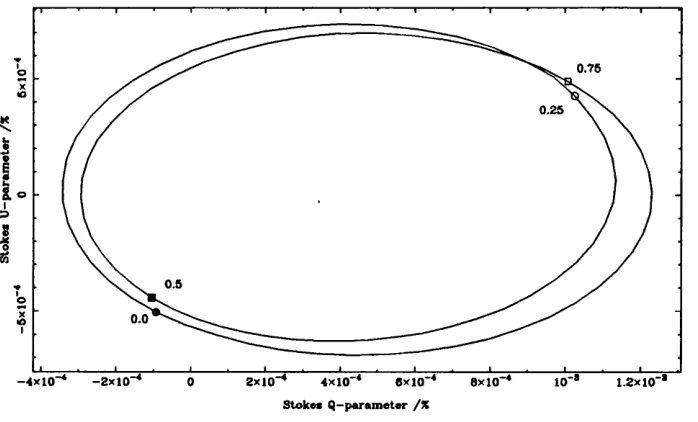
C hapter 6 is concerned w ith the analysis of polarim etric data. Using th e models of chapter 4, predictions of polarization variations are compared w ith the d a ta for CX Dra. Interpretations are aided by comparison w ith polarization d a ta from other known systems (Algol and U Sge). The models are appropriately revised and recal culated before being fitted to observations of several systems to derive param eters related to the geometry of the systems and to their mass transfer rates.
IUE ob serv a tio n s
. . . the spectroscope, to which he had at once resorted, indicated a mass of flaming gas, mostly hydrogen, moving w ith enormous v elo city...
H. G. Wells — The War o f the Worlds
2.1
In tro d u ctio n
Several im po rtant phenomena of interacting binary systems are visible in the ul traviolet region of the spectrum , making IU E a particularly powerful tool for their study. M any of the prim aries of interacting binary systems are early-type stars which em it most of their flux in the IU E-sensitive region. A nother im p o rtan t as pect of their ultraviolet spectra lies in the appearance of particular ground-state transitions of m any-tim es ionized species, specifically, the resonance transitions of the so-called superionic states which often require tem peratures far in excess of the available photospheric tem peratures to produce them (e.g. N V does not appear in norm al B-stars later th an BO V, an effective tem perature of ~ 30 000 K, b ut it is seen in B2.5Ve stars). Superions found w ithin the IU E spectral range are given below in table 2.1.
Chapter 2 25
N V
X X
1238.81, 1242.80 Si IVX X
1393.76, 1402.77 C IVX X
1548.20, 1550.77a i i i i
X X
1854.72, 1862.78Table 2.1: Superion lines observable with IUE.
Since these transitions are observed to be quite strong in stars whose tem pera tures axe too low to produce them by norm al therm al processes, there m ust be some other non-therm al process(es) operating. Superions can easily be m anufactured by collisional ionization, so it may be supposed th a t the binary system in question has a region where the plasm a is strongly shocked or mechanically heated in some, as yet unspecified, manner.
The analysis of this chapter is concerned w ith gaining some insight into the ve locity structure of the superionized regions and of their overall geometry. To do this, a baseline for comparison is required; this will be the binary m otion of the primary. Subsequent analysis will use the observed variations in th e orbital characteristics (e.g. phase lags, velocity semi-amplitudes, eccentricities) to derive a self-consistent geometry for CX Dra. Furtherm ore, an attem p t will be m ade to isolate the structure of the high-energy region more precisely by removing the photospheric contribution to the line profiles.
2.2
R ed u ctio n o f th e
IUE
d a ta
from M arch 1980 to O ctober 1986 (see appendix B).
The d a ta were reduced using the STARLINK software package IUEDR (Hook & Giddings 1985; Rees 1987). The appearance of scattered light in the spectrograph and in the echelle inter-order overlap was corrected for by setting the cores of the Lya lines to be completely black (some geocoronal emission was noted but this was also dealt w ith as above). The order-dependent wavelength shifts were removed by forcing the wavelengths of several interstellar lines (N I A1220, F e ll A1608, S ill A1808) to have their laboratory values, thus placing them at rest.
2.3
T h e v elo city -p h a se variations
Prelim inary exam ination of the d ata indicates th a t there is a great deal of time- variation in the structure of m any of the line profiles of C X D ra, notably in the m etastable F e lll lines near 1900
A,
and in the lines of the superionized species (N V , SiIV , C IV and A1III).Chapter 2 27
This work Koubsky (1978) Period, P 6.d6935 ± 0.d0011 6.d69827 ± 0.d00005 Epoch of prim ary minimum, Eq 4326.9 ± 0.4 2181.79 ± 0.14
(H JD - 2440000)
Eccentricity, e 0.53 ± 0.14 0.0
Systemic velocity, 7 (km /s) - 0 .8 ± 3.9 -2 .2 7 ± 0.81 Velocity semi-amplitude, K \ (k m /s) 33.5 ± 4.5 35.6 ± 1.2 Prim ary orbital radius, a\ sin i (R©) 3.77 ± 0.63 4.716 Longitude of periastron, u> — ll.°2 ± 16.°5
---Table 2.2: S i I I I X 1296 orbital parameters o f C XD ra.
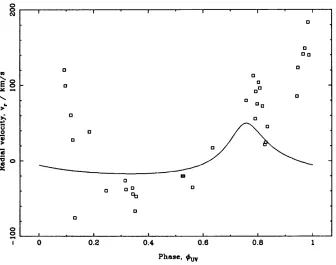
and their standard errors are presented in table 2.2. The residuals on the fit have a standard deviation of 15.51 km /s.
o tfi
n
6 x
o o 73
>
"3
•8 ° «
0 0.2 0.4 0.8 0.8 1
Phase, ^jy
Figure 2.1: Fitted radial velocity curve to C X D ra S i I I I A 1296 velocity data.
secondary), and the non-zero eccentricity of the orbit. The eccentricity of CX D ra is expected to be very close to zero because of tidal circularization of the stellar orbits in this close binary system occurring on timescales much shorter th an the evolutionary timescales of the stars (Zahn 1966; Tassoul & Tassoul 1990 and references therein). However, the derivation of both the eccentricity and the epoch of prim ary minimum are almost certainly affected by absorption by circum stellar m aterial which distorts the line profiles.
Chapter 2 29
o
CM
□ a n
^ ° JXC o —
b
>
►» o
o
>
a i ° «
o
o
0.8
0 0.2 0.4 0.6 1
Phase, ^jy
Figure 2.2: F e l l l X 1895 data from C X Dra with Si I I I solution curve fo r comparison.
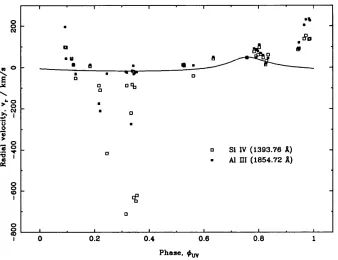
Deviations of Si IV and A1III from the Si III curve (figure 2.3) are even more extreme. The superions m aintain the same period and phasing as the F e lll but they vary from deep, narrow profiles to shallow broad ones, they do not m aintain their equivalent w idths, implying a considerable range of column densities, and neax <t>uv rs> 0.3 they exhibit m ultiple components w ith very strong blueshifts.
•i
■ s
Si IV (1393.76 A) A1 El (1854.72 A)
0.8
0.2 0.4 0.6
Phase,
Figure 2.3: Superion data from C XD ra with S i I I I solution curve. Notice the large blueshifted feature in both superions.
Chapter 2 31
2.4
E x tra ctio n o f th e strea m profiles
To gain a clearer picture of the velocity structure of the CSM alone, the photospheric contribution m ust be removed. To do this properly would require the deconvolution of the photospheric source function from the to tal flux integral. In practice, this is impossible and something less rigorous m ust be settled for. It is assumed, therefore, th a t the CSM acts like a simple, plane-parallel slab of absorbing m aterial, producing no emission, and w ith no radiative coupling to the photosphere. Thus, given a suitable reference photosphere, it m ay be divided out of th e to tal profile to yield, at least to first order, the line profile due only to the CSM.
The secondary of CX D ra is given the spectral type of F 5-G 0 by P eters & Polidan (1984) and a value of Teff ~ 6500 K by Guinan, Koch & Plavec (1984), based on the thirteen-colour photom etry of Shuster & Alvarez (1983). This means th a t it will not contribute significantly to the ultraviolet spectrum of CX D ra, leaving only the spectrum of the prim ary to be m atched and removed.
2 .4 .1 T h e ch oice o f th e sta n d a rd
The list of MK standard stars (M organ &: Keenan 1973) includes several which have been observed by IUE. From these, three were chosen to bracket the expected spectral type of C X D ra (B2.5Ve): 2 2Sco (B2 V), crSgr (B 2.5V ), and ?;Aur (B 3V ). Comparison of the photospheric regions of each of these spectra w ith CX D ra, showed th a t <rSgr provides the best agreement with C X D ra (see figures 2.4 and 2.5), both in term s of their spectral types and their ro tation al velocities (v sin* = 180 and
201 k m /s for C X D ra and <rSgr respectively): trSgr was therefore adopted as the standard for comparison.
Seven SW P images of a Sgr were acquired from the W orld D ata Centre Archive, processed as above, rectified, and merged to increase the S /N using their exposure times as linear weights.
8
n
x
P E
o
■o CX Dra
a Sgr
1280 1290 1300 1310 1320 1330
Wavelength / A
Figure 2.4: A comparison between the silicon photospheric feature in C X D ra and the standard a Sgr.
8
■
\ £ ° \
X
p
E
CX Dra o
CM a Sgr
1600 1806 1610 1615 1620 1630 1635 1640
Wavelength / A
Chapter 2 33
This work Koubsky (1978) Period, P 6.d6946 ± 0.d0019 6.d69827 ± 0.d00005 Epoch of prim ary minimum, Eq 4329.4 ± 0.3 2181.79 ± 0.14
(HJD - 2440000)
Eccentricity, e 0.07 ± 0.15 0.0
Systemic velocity, 7 (km /s) -1 3 .1 ± 3.2 - 2 .2 7 ± 0.81 Velocity semi-amplitude, K \ (km /s) 30.0 ± 4.3 35.6 ± 1.2 Prim ary orbital radius, ai sin* (R©) 3.96 db 0.57 4.716 Longitude of periastron, u —71.°5 ± 68.°8
---Table 2.3: Cross-correlation orbital parameters o f CXD ra.
and subject spectra were cross-correlated using the IUEXCOR program of Rees (1987). To maximize the efficiency of the program , all lines which are obviously non-photospheric in origin (e.g. interstellar lines, superions etc.) were removed. This helps to ensure th a t it is the photospheres th a t are compared, w ith as little contam ination as possible. The derived relative shifts can also be used to extract the binary m otion of the prim ary (relative to the tem plate) and hence provide a more reliable check on the orbital param eters th an those found from the profiles of an individual line. The d a ta in table 2.3 are from an orbital fit to the cross-correlation shifts; the residuals from the fit have a standard deviation of 15.37km /s.
eccentricity approaches zero and so should not be regarded as reliable.
The most im p ortan t deviations from the earlier param eters derived in the u ltra violet (from the Si III lines) are the changes in the epoch of prim ary minimum and in the eccentricity. The epoch now deviates by 0.05 and 0.11 in phase from K oubsky’s 1978 and 1980 ephemerides respectively, as compared to th e previous results of 0.28 and 0.22 for the fit to the Si III data. For the eccentricity, the cross-correlation gives a value which is zero to w ithin the errors, and is in excellent agreement w ith the optical d a ta of Koubsky 1.
The <7 Sgr tem plate was shifted by a velocity appropriate to th a t of the derived binary model at the phase of observation before dividing it into each CX D ra spec tru m to yield a ‘CSM only’ profile. Montages of these reduced spectra are given for each of the superionic lines N V, Si IV, C IV and A1 III in appendix A where the quality of the photospheric m atch can be readily judged from the constancy of the spectral regions away from the resonance lines, at phases where the CSM is expected to be localized in velocity space (e.g. 0.0 ^ <£ ^ 0.2; see section 2.5). In general this division is more than satisfactory; any deviations from uniform ity due to tem plate m ism atch are small, w ith the other variations being ascribable to the presence of the CSM.
2.5
In terp reta tio n
The profiles divide naturally into several distinct types (see figure 2.6). There are sym m etric lines pointing to a n atu ral symmetry to the flow p attern (e.g. A1III,
1 Although the agreement of both /t/F -b ased datasets with the optical data of Koubsky is quite good, for the purposes of assigning a phase to each IUE observation, the ephemeris of the latter work will be used because of the far greater S /N available with optical data and the greater phase-coverage used for the analysis making such measurements inherently more reliable. Koubsky’s 1980 ephemeris is:
Chapter 2 35
<f> = 0.4799), and some profiles are ‘saw tooth’ in appearance (e.g. N V , ^ = 0.9466) indicating a decrease in the column density of absorbers (due to a density a n d /o r ionization change) w ith increasing m agnitude of velocity. Some profiles display m ul tiple components (e.g. Si IV, <f> = 0.3578) implying a fragm entary flow, probably due to shock disruption of an otherwise well-ordered stream ing, and m any exhibit an ‘emission’ component (e.g. A1III, 4> = 0.8613) which, it m ust be stressed, probably appears because of a lack of absorption in the d a ta over th e tem plate and so is not necessarily due to a real emission process.
W hilst no two observations have been taken a t precisely the same phase, the above-listed forms of profile are consistently seen to repeat a t or near the phases given; thus the velocity structure depends almost entirely on the phase of an obser vation, and only weakly on its epoch.
Is there a simple, consistent model which explains this cycle-independent phase distribution of velocities?
Consider the 0.25 phase-lag of th e redshifted lines behind the orbital m otion of the prim ary. This implies th a t the CSM apparently moves (approxim ately) along the line-of-centres of the stars, towards the prim ary where it probably accretes. This requires th a t it originates either from, or in the vicinity of, the evolved secondary. The blueshifted components meanwhile, lead the binary m otion and are m ultiple, which m ay be due to turbulent m aterial leaving the system in a direction 0.25 ahead of the infalling flow in phase, i.e. at right-angles to the la tte r and in the direction of m otion of the prim ary in its orbit.
in CM H
<o GO
ro
9 1 i 9 021 T 8 0 9 0
xnjj psnpisan xnu jBnptsan
in co GO H
o CO 00 «G
05 05
I 8 0 9 0
9 0 VI 21
21 T 8 0
xnjj p n p is a ji xn jj |B np is3^
Figure 2.6: Examples o f the various types o f profile seen in C XD ra.
W
avelength
/A
W
a
v
e
le
n
g
Chapter 2 37
The accretion process also offers an explanation for the fact th a t the prim ary of CX D ra is ro tatin g faster than is norm al for stars of its spectral type, in th a t the accreting stream applies a torque to the star, which then spins it up.
There is also a surprising feature of the montages of CX D ra which appears in all four superions, most noticeably in N V. Between phases 0.6580 and 0.6899, in a tim e A t £ 5h, the stream ing m aterial almost entirely disappears. Then, between 4> = 0.7453 and <j> = 0.8613 ( A t £ 19h), it reappears. The two spectra in this interval (S W P 10242 and SW P 14703) were taken m any cycles ap art, dem onstrating th a t this phenomenon is repeatable. This effect is seen consistently across a wide range of ionization tem peratures and is therefore unlikely to be due (solely) to a change in the local ionization balance. The most probable cause is a geometric a n d /o r dynamical one. As the m a tter falls in from the LI point, it accelerates and reaches the photosphere where a fraction of it is accreted. In accordance w ith Bernoulli’s Theorem, these processes lead to a pressure drop w ithin the plasm a as it circles the prim ary. This means th a t the stream will collapse towards the orbital plane, causing it to drop out of the line-of-sight to the prim ary. The reverse situation occurs when the stream emerges from the fax side of the prim ary where the flow is decelerated as it climbs out of the gravity well of the system. The internal pressure in the stream rises causing it to expand back into view. This phenomenon will be referred to as ‘stream dipping’.
The origin of this m aterial is most likely to be simple Roche lobe overflow (RLOF) at the LI point due to the secondary having evolved into its giant phase and filled its Roche lobe. Recent observations of the H a line by Koubsky (1978, 1989) tend to reinforce this model. His la tte r series of observations show a phase-dependent variation w ith broad absorption lines appearing a t <f> ~ 0.85-0.95 where one would expect to be looking straight along the accretion stream and sampling a large range of velocities. Narrow absorption appears at 0 ~ 0.6-0.85 where the flow is virtually
Peters & P olidan (1984) also adopts this RLOF model. They derive the condi tions in the ‘h o tsp o t’ and posit the existence of a high-tem peratnre accretion region w ith a tem perature ~ 105 K, an electron num ber density n e ~ 109 cm- 3 , and a car bon depletion C ~ 0.03 C q. The carbon underabundance is taken as an indicator th a t the m a tte r in the stream originates from the evolved secondary.
C h ap ter 3
T h e S in gle P a rtic le M o d el
W here there is m atter, there is geometry.
Johannes Kepler
3.1
In tro d u ctio n
To sim ulate, in detail, a stream of plasm a falling between two stars in a binary system would be a task of Herculean proportions, involving a full m agnetohydrodynam ic treatm en t, radiation transp ort in a moving, probably-shocked medium and a very complicated ionization balance.
In order th a t some headway may be made, the problem of generating a model of circum stellar flow has to be greatly simplified. Early work has concentrated m ainly on simple ballistic paths traced out by single ‘massless’ particles in a binary potential. W arner & Peters (1972) applied a restricted three-body calculation of stream trajectories to cataclysmic variables to dem onstrate th a t the ‘hotsp ots’ in the light curves of these systems are due to m aterial accreting onto a ring surrounding the prim ary from the secondary. Flannery (1974) corrected an error in the previous work and noted th a t viscosity has an im po rtant role to play in determ ining the size of the accretion ring and hence the position of the ‘h o tsp o t’. Perhaps the most
refined treatm en t of gas dynamics in semi-detached binary systems is the work of Lubow & Shu (1975, hereafter LS) in which the problems of three-body flow are examined analytically using p erturbation theory.
As a first approxim ation to such a model, a com bination of the work done in the three papers mentioned above will be used to generate single-particle stream lines in binary systems of a given mass ratio. These streamlines are then used to construct simplified velocity-phase curves to compare w ith the data. The models are also used to find the mapping of the param eter space covering the initial velocity of the stream at the LI point onto the param eter space covered by the maxim um velocity and the im pact param eter. This enables the plausibility of an escaping m a tter stream to be more rigorously discussed.
3.2
T h e M od el
The geometry of the model is shown in figure 3.1. The system consists of a giant- class secondary star (on the left) which is presumed to be filling its Roche lobe and transferring m atter to the Main Sequence prim ary (on the right). The secondary plays little p art in the model except in th a t it contributes a point-like gravitational potential to the system. The mass in the distorted outer layers of the giant is as sumed to be negligible and any circulation currents near th e Inner Lagrangian point are taken to have no effect on the initially sub-sonic flow of m aterial through th a t region. The system is rotating in a right-handed sense and all motion is restricted to the orbital plane. For com putational purposes, all dimensional quantities are expressed in units of some characteristic scale of the problem. Lengths are in units of the binary separation, a, tim e intervals are given in units of the reciprocal of the orbital angular velocity, 12_1, and masses are scaled by the to tal mass of the system, M \ + M2. This has the useful property th a t the results can be applied to any given semi-detached binary simply by using dimensional scales appropriate to th a t system.
fig-Chapter 3 41
't
o
N o
o
C.o.M.
N 6i
01
- 1 —0 .8 -0.6 -0.4 —0 .2 0 0 .2 0.4 0.6 0 .6 1
Figure 3.1: Model geometry fo r an example system with p = 0.6.
ure 3.1), the equations of motion for a ‘massless’ test particle (i.e. m «C M ) are
x = 2y + x + p(x - Xi) (! - A*)(x - x 2) (3.1)
y = - 2 x + y - p ^ - ( l - p )!L (3.2)
where
p = M i I (M i + M 2), r \ = (x - x i ) 2 + y2, x i > 0 r \ = (x - x 2)2 + y2, x 2 < 0
the right-hand sides of equations 3.1 and 3.2 are the Coriolis term s; th e second term s constitute the centrifugal accelerations and the rem aining term s make up the gravitational effects of the prim ary and secondary, respectively.
The Inner (or F irst) Lagrangian point is located by solving the quintic equation th a t describes the total force on a test mass for the root th a t lies on the sym m etry axis of the binary system (i.e. the root th a t has a zero-valued im aginary paxt). The to ta l force is the sum of the centrifugal and gravitational com ponents, thus
p 1 — p _
XL1 + ( z l i - 1 + p )2 ( z l i + p )2 where (x l i, 0,0 ) are the coordinates of the LI point.
The test particle is placed at the Inner Lagrangian point w ith a photospheric therm al velocity e which is small (see LS), and allowed to evolve under the influence of the potential given by equations 3.1 and 3.2.
To solve these equations for the particle m otion, they are cast in the form of two pairs of coupled first-order differential equations and solved using a Runge-K utta-M erson technique (NAG routines D02BHF and D02BBF). The integrated solutions of equations 3.1 and 3.2 then yield bo th the trajectory of the stream and the velocity variations along the stream . A sample of stream paths is given in figure 3.2, calculated for various values of p. The centres of the prim ary and secondary lie at 1 — p and —p respectively in this coordinate system. C om putation is term inated at the hypothetical disc-edge, defined as the point where the particle’s instantaneous specific angular m om entum about the prim ary becomes equal to the specific Keplerian orbital angular m om entum at th a t point, i.e.
Chapter 3
to
o
3 0 0 3 0 f 0
X
Figure 3.2: Ballistic stream trajectories.
-0.
8
-0.
6
-0.
4
-0.
2
0
0.
2
0.
4
0.
6
0
3.3
C om parison w ith th e d ata
To compare this model w ith the IU E F e lll d ata obtained in the previous chapter, the radial velocity curve for a given model is required. R ather th an com pute an absorption line profile under this simple model, the velocity at maxim um stream density along the projected p art of the stream is found under the assum ptions th a t the tim e-independent conservation equation (3.3) holds and variations in velocity and density are confined to the orbital plane, i.e.
V .(p v ) = 0 (3-3)
or, alternatively,
pv8 = M /A = constant
where v8,p , M, and A are the velocity parallel to the stream , the stream density, the mass-flow rate along the stream and the stream cross-sectional area norm al to the flow respectively. Hence the m aximum density lies at the point of minimum velocity. This was expected to approxim ate the point of maxim um extinction in the observed profiles.
Chapter 3 45
o
CM
Inclination, i = 15?5 mo
H - 0.5077
8
BJ
6
x
5 o o V
►
■3 <2 o
o o iH
0.8 1
0.6
0.2 0.4
0
Phase,
Figure 3.3: Ballistic model fit to F e l l l X 1895 data o f CXD ra.
Radial velocity curves were constructed for various values of the inclination of the system using the appropriate values of p and r i from Koubsky (1978). The best fit as judged by eye is shown in figure 3.3.
3.4
D iscu ssion
velocities noted in the previous chapter? The maximum observed stream velocity is ~ 700 km /s. Allowing for an inclination to the line of sight of 15.°5, th e stream has a velocity in excess of 2600 km /s. The prim ary is neither massive enough to accelerate an infalling stream to this speed nor hot enough to drive a wind of this m agnitude. Furtherm ore, the low inclination implies th a t the mass ratio of the system is approxim ately unity. If this is so, then it becomes rath er unlikely th a t the secondary could have evolved as far as the giant branch w ithout the prim ary also leaving the Main Sequence.
It is clear then th a t the inclination m ust be larger th an the value derived above and th a t this discrepancy m ust explained. Firstly, it can be seen th a t a m ajor portion of the fit occurs over the p a rt of the velocity curve where the stream is occulted, yielding no inform ation concerning the transfer of m atter. Secondly, the d a ta do not accurately constrain the phase at which the rapid drop seen in the velocity curve near <f> ~ 0.1 begins. The only ‘peak’ in the d a ta consists of a small cluster of points at <f> ~ 0.95. Given th a t these lie on the tail of the turbulent region, to base a value for the inclination on these points alone seems unjustified.
W hat is needed is some criterion by which the validity (or otherwise) of these ballistic models under these circumstances can be judged.
3.5
T h e co n d itio n s for an escap in g strea m
M aterial is observed emerging from C X D ra at high speed, narrowly confined to phases near <f> ~ 0.3. This cannot be attrib u ted to m aterial spilling over the La grangian (L2) point behind the prim ary as the absorption would be observed at <f> = 0.5 and later phases, and this is not the case. To obtain a collimated je t of m aterial as observed, the stream from the LI point m ust a t least p artly circle the prim ary, and escape near phase (f) ~ 0.3. By generating a series of ballistic models, the applicability of such simple models to these observations can be tested.
Chapter 3 47
point-m ass prim ary, 6, and the maximum velocity attain ed by the stream , Vmax- Figures 3.4 and 3.5 show the results of such calculations for binaries of reduced prim ary masses p = 0.5 and p = 0.9 respectively.
For example, from figure 3.4, a stream launched at an angle of 30° (m easured clockwise from the line joining the stellar centres) and at a speed of 3 aQ, in a p = 0.5 system , attain s a maxim um velocity of ~ 3.2 ail and passes closest to the prim ary at a distance of rsj 0.28 a.
By imposing conditions on Vj^x and 6, lim its may be placed upon the flow conditions at the L I point. In order th a t a stream of plasm a escapes from the system it is required th at:
1. the stream m ust miss the prim ary, i.e. b m ust be greater th an the prim ary radius, and
2. at some point along the trajectory, the speed of the flow m ust be greater th an th e escape velocity from th a t point.
Typical minimum values for v ^ x and 6, which meet these conditions, are 2.08 and 0.134 respectively for p = 0.5, and 2.35 and 0.151 for p = 0.9. These axe also plotted on figures 3.4 and 3.5. Escaping stream s will only form in the context o f this ballistic model in the upper right-hand quadrant of th e param eter space. This appears to lim it the initial conditions to mostly supersonic launch speeds at angles which are not along the line-of-centres of the system.
The la tte r condition is easily fulfilled as the stream is always deflected from the line-of-centres by the Coriolis force through an angle between 19.°5 and 28.°4 as it leaves the LI point (see LS). The former condition, however, is not so easy to satisfy.
45'
D .
*-» oil w
30'
5. °
Maximum velocity attained,
Figure 3.4: Test fo r escaping streams in a system with p = 0.5. Contours are labelled with the launch angle and the dimensionless launch speed.
©
45(
u * 2 B °
£
0 a
wo
0 o. s
30*
15° N
o
o
7
0 1 2 3 4 5 6
Maximum velocity attained, vm..
Chapter 3 49
‘funnel’ through the LI point (S0rensen, M atsuda & Sakurai 1974). B oth of these processes are nearly spatially axisymmetric (about the secondary) and if either was sufficiently strong to produce the observed lines, it would also be likely to produce substantial asymm etric absorption at all phases, an effect which is not seen. To obtain speeds of the order of afl by therm al means would require gas tem peratures higher than 2 x 10⁶ K at the inner face of the secondary. The only possible source of such heating (aside from chromospheric activity in the secondary which can be ruled out on the basis th a t it would be likely to be observed to occur over the whole star) would be X-ray heating of the secondary by the radiation from the im pact zone. C X D ra is a known X-ray source (G uinan, Koch & Plavec 1984), b ut as the stream itself lies between the im pact zone and the LI point it is probable th a t most of the X-rays from the ‘h o tsp o t’ (if th a t is where they are produced) will be absorbed before they reach the photosphere of the secondary.
T h e v isco u s m od el
Big whirls have little whirls T h at feed on their velocity,
And little whirls have lesser whirls And so on to viscosity.
Lewis F. Richardson
4.1
In tro d u ctio n
4 .1 .1
P o ssib le str e a m -su p p o r tin g m ech a n ism s
The ballistic, inviscid model of RLOF constructed in the previous chapter fits the observed F e lll d ata well, but by no means unambiguously. W hen th e same model is applied to the superions’ velocity-phase curve, it is found to be quite inadequate near <f> ~ 0.2. A mechanism which supports at least some of the infalling m aterial over the prim ary’s horizon is required in order to produce the stream er of escaping m a tter traced out by the superions. There are several possible candidates for stream - supporting processes:
1. A radiation-driven stellar wind from the prim ary,
Chapter 4 51
2. A m agnetic field surrounding the prim ary, and
3. Viscosity in the stream ing m aterial.
Consider each in turn.
1. To deflect the stream , a stellar wind would be required to dum p an am ount of m om entum in the stream of the same order as th a t which th e stream itself carries (in a radial direction), i.e.
Pwind^-wind =
O
(P stream U gtream )If ^stream ~ few 102 km /s ~ uwjnd (typical of norm al early B -star winds; see P rin ja 1989 and Grady, Bjorkm an & Snow 1987), then pwind = 0 ( p stream) ~ m H X l09cm- 3 . This constitutes a minimum mass loss ra te at the stellar surface of 10-9 M@/yr which would certainly be observable w ith IU E under ‘norm al’ ionization conditions (P rin ja 1989), whereas C X D ra shows no signs of such a wind at <f> ~ 0.1, where the stream is minimally present; in fact, the velocity profiles indicate an infalling of m atter.
2. To decide whether a (putative) magnetic field around the prim ary would be able to support the stream , a measure of the compressibility of the m agnetic field is needed. Shih-I Pal (1962) gives the param eter 7£h as ju st such a measure.
^ _ M agnetic pressure _ B2//x0 Dynamic pressure pu 2