ISSN: 2149-214X
www.jeseh.net
Nature of Science as Portrayed in the
Middle School Science and Technology
Curriculum: The Case of Turkey
Kemal Izci
Necmettin Erbakan University
To cite this article:
Izci, K. (2017). Nature of science as portrayed in the middle school science and technology
curriculum: The case of Turkey.
Journal of Education in Science, Environment and Health
(JESEH), 3
(1), 14-28.
This article may be used for research, teaching, and private study purposes.
Any substantial or systematic reproduction, redistribution, reselling, loan, sub-licensing,
systematic supply, or distribution in any form to anyone is expressly forbidden.
Authors alone are responsible for the contents of their articles. The journal owns the
copyright of the articles.
Nature of Science as Portrayed in the Middle School Science and
Technology Curriculum: The Case of Turkey
Kemal Izci
Article Info
Abstract
Article History
Received: 23 June 2016
Representation of nature of science (NOS) within curricula including standards, grade level expectations, and textbooks and their alignment with each other to achieve teaching NOS is crucial. Thus, the aims of the study were to a) assess how NOS is portrayed in standards, grade level expectations and a teacher edition of seventh grade textbook of science and technology curriculum of Turkey and demonstrate b) how they aligned with each other to support teaching of NOS. A conceptual analysis was used to achieve the aims of the study by focusing on aspects of NOS , namely: the empirical, tentative, inferential, creative, theory-laden, and social dimensions of NOS; myth of “The Scientific Method”; nature of theories and laws; and social and cultural embeddedness of science. Analyses indicated that the targeted NOS aspects were insufficiently portrayed in these documents in that some important aspects of NOS (e.g., scientific theories and laws) are not included while some others (e.g., inferential and theory-driven) are implicitly represented. The findings also showed that the alignment between the curriculum and the textbook is not adequate to transfer the aims of the curriculum for NOS into classroom practices. Implications for curriculum developers and textbook publishers were also discussed.
Accepted: 18 November 2016
Keywords
Nature of science Science curricula Textbooks
Introduction
Accomplishing practical scientific literacy requires people to have an understanding of scientific concepts and knowledge as well as an understanding of the enterprise of science and the nature and function of scientific knowledge (Roberts, 2007; Ryder, 2001). Nature of science (NOS) consists of the social and epistemological part of science and scientific knowledge, and focuses on how scientific knowledge is constructed and how it progresses (Khishfe & Lederman, 2006). Thus, an understanding of the NOS is regarded as a major part of accomplishing scientific literacy for all nations and globally advocated as a general aim of school science (Driver, Leach, Millar, & Scott, 1996; McComas, Clough, & Almazroa, 1998; Millar & Osborne, 1998; National Research Council [NRC], 1996, 2012). Turkey is one of these nations and Turkish science and technology curriculum aims to improve students‟ scientific and technological literacy by incorporating various aspects of NOS (National Ministry of Education [NME], 2006, 2013). Scientific and technological literacy is emphasized in the Turkish science and technology curriculum as an understanding of the development and nature of scientific knowledge. The interactions among science, technology, society, and environment and using this understanding to solve daily life problems are also highlighted as an important construct in the curriculum (NME, 2006, 2013). The role of reform documents and science education standards are emphasized as crucial in leading educational systems (NRC, 2012). Additionally, the role of teachers and science textbooks are vital to achieve a satisfactory level of scientific literacy (Chiappetta & Fillman, 2007; NRC, 1996). Turkey‟s National Science Education Standards (TNSES) and science and technology curriculum in the Turkish educational system intend to build on current research findings including research on NOS to improve students‟ learning and interest in science. Therefore, the science and technology curriculum is one of the main promoters of NOS for Turkey and needs to be aligned with educational research findings about NOS. Doing so may provide better NOS instruction that is research-informed and well-designed.
what extent the textbooks respond to the science education reform documents (Abd-El-Khalick et al., 2016; Abd-El-Khalick, Waters, & Le, 2008; Irez, 2009; McComes & Olson, 2002; Niaz, 2010; Vesterinen, Aksela, & Lavonen, 2013).
Research on analyzing science education standards and textbooks has mainly focused on the representation of scientific literacy and the accuracy and presentation of specific science content. There has also been limited research that focuses on how NOS is portrayed in middle school science textbooks. Furthermore, a few studies conducted in Turkey on middle school curricula (Erdogan & Köseoglu, 2012; Sardag et al., 2014; Ozden & Cavlazoglu, 2015) focused on only the science curriculum or science textbooks and did not investigate their alignment with each other to support teaching and learning of NOS. One of the most important documents leading a nation‟s educational system is educational standards. These educational standards determine goals of teachers for their teaching and textbooks, and support teachers to reach these goals in each grade level (Koulaidis & Tsatsaroni, 1996). In terms of science education, science education standards lead what objectives should be targeted and how they need to be taught. Therefore, a nation‟s science education standards and science curriculum and textbooks are the main documents that show how this nation considers NOS in its educational system as a goal and supports its teachers to reach this goal. Thus, this study aims to investigate how Turkish science curriculum (NME, 2006) and Turkish middle school science textbooks (NME, 2011) align with each other and to what extent they contain current research suggestions to aid instruction and understanding of NOS.
Review of Literature
Enhancing teachers‟ and students‟ understanding of NOS to accomplish scientific literacy has been a major part of science education research efforts. These efforts include designing courses and curricula to help teachers and students to improve their views of NOS, assessing students‟ and teachers‟ understanding of NOS, and providing educational materials and practices to promote transformation of NOS into classroom practices (Abd-ElKhalick & Lederman, 2000; Akerson & Hanuscin, 2007; Khishfe & Abd-El-Khalick, 2002). Although there has been progress to advance students‟ and teachers‟ understanding of NOS, recent research shows that teachers and students still hold naïve views about some particular aspect of NOS such as the tentative nature of scientific knowledge (Abd-El-Khalick, 2005; Abd-El-Khalick & Akerson, 2004; Bora, Aslan, & Cakiroglu, 2006). Many obstacles such as limited implementation of NOS in pre-service and in-service teacher education programs, the inconsistency between reform documents and textbooks regarding their NOS perspectives, the difficulty of integrating NOS into curriculum, and representation of NOS in science textbooks have been found to be some of the common reasons behind the limited understanding of NOS (Abd-El-Khalick et al., 2016; Driver et al., 1996; McComas, et al., 1998; Rudolph, 2002).
Teaching Nature of Science
Studies in the literature focus on various ways of teaching NOS to promote scientific literacy. The recent research on teaching NOS has shown that the most effective way of teaching NOS is use of an explicit-reflective approach of instruction (Akerson & Hanuscin, 2007; Koksal & Cakiroglu, 2010). In contrast, some researchers think that implicit teaching approaches that address NOS by engaging students in hands-on inquiry and laboratory activities would improve learners‟ understanding of NOS. However, research results have shown that the implicit approach for teaching NOS is not as effective as explicit approaches (Abd-El-Khalick & Akerson, 2004; Khishfe & Abd-El-Khalick, 2002). Explicit teaching of NOS refers to intentionally focusing on some aspects of NOS in teaching and designing lessons by incorporating specific examples, activities, questions, and reflection times to facilitate learners‟ understanding of intended aspects of NOS (Clough, 2006). Researchers have illustrated that explicit approaches provide activities about aspects of NOS and encourage learners to reflect on NOS activities to help learners develop a better understanding of NOS (Akerson & Hanuscin, 2007; Khishfe & Abd-El-Khalick, 2002; McComas, 2003).
for teaching NOS (Akerson & Hanuscin, 2007; Clough, 2006; Matkins & Bell, 2007). Researchers appreciate the contribution of the explicit nonintegrated teaching approach to students‟ understanding of NOS aspects, but they claim that the explicit integrated approach is more likely to give the sense of doing science to students, improve science content knowledge, and reduce the time anxiety of teachers (Clough, 2006; Clough & Olson, 2001). It is clear that many researchers have indicated explicit NOS instruction is the most effective way of teaching to improve students‟ understanding of NOS. However, how teachers can be supported to adopt explicit teaching approach to improve students‟ learning of NOS still needs to be addressed.
Analysis of Materials for Representations of Nature of Science
Currently, there is a lack of research that particularly analyzes the representation of NOS in middle school science textbooks and their alignment with science education reforms (Ozden & Cavlazoglu, 2015). A few studies analyzed middle school science textbooks, but they focused on the content, structure, curriculum, and major concepts rather than focusing on NOS (Chiappetta, Sethna, & Fillman, 1993; Stern & Roseman, 2004). Chiappetta, Sethna, and Fillman (1993) analyzed five middle school life science textbooks in the United States to document how these textbooks provide a balance of scientific literacy themes, which requires equally highlighting scientific, technological, and societal sides of scientific knowledge and its development. They reported that these textbooks highlighted the teaching of content and did not provide a balanced view of scientific literacy. Abd-El-Khalick (2002) analyzed middle school-level science trade books published in the United States to see their representation of the NOS images. He used some aspects of NOS such as empiricism, imagination, and creativity and found that these science trade books did not explicitly represent any aspects of NOS.
documents. They also indicated that rather than the reform efforts, the authors of the textbook had a greater role in terms of representing aspects of NOS.
There is also a lack of research analyzing the representation of NOS in different reform documents and science education standards to show how they align with recent research findings on NOS. McComes and Olson (1998) analyzed how different countries and states directed science education standards of NOS in their K-12 learning environments. In their study, McComes and Olson (1998) analyzed the following reform documents in the United States for their inclusion of NOS: Benchmarks for Science Literacy (American Association for the Advancement of Science [AAAS], 1993); Science Framework for California Public Schools (California Department of Education, 1990); National Science Education Standards (NRC, 1996); The Liberal Art of Science (AAAS, 1990). They also looked at reform documents such as: A Statement on Science (Curriculum Corporation, 1994) in Australia; Science in the National Curriculum (Department of Education, 1995) in England/Wales; Science in the New Zealand Curriculum (Ministry of Education, 1993) in New Zealand; and Common Framework (Council of Ministers of Education, 1996) in Canada to analyze how these reform documents from five different countries portrayed NOS. The results of their analysis showed that all documents emphasized the role of NOS in science education standards. However, these documents did not include “the notion of paradigm, the objectivity aspect of science and the idea that science has inherent limitations,” and their importance on student understanding of scientific enterprise (McComes & Olson, 1998, p. 49). The results also showed that these documents generally failed to provide definitions of terms such as scientific law and theory. Erduran and Dagher (2014) analyzed the draft of Irish middle school curriculum in terms of its depiction of NOS. While they found most of the aspects of NOS were represented within the curriculum, they suggested that some of the other aspects, such as a nuanced view of NOS, should be more developed and integrated within the curriculum.
Additionally there are a few studies conducted on Turkish science curriculum (e.g., Erdogan & Köseoglu, 2012; Sardag et al., 2014; Ozden & Cavlazoglu, 2015). Erdogan and Koseoglu (2012) analyzed some curricula documents published in 2008 including TNSES and grade level expectation (GLEs) for high school biology, physics and chemistry. Their findings showed that while science as accumulation of knowledge aspect was highlighted in the chemistry curriculum, the aspect of science as inquiry was mostly emphasized in biology and physics curricula. However, their findings also showed that none of the three curricula emphasized science as a way of thinking. Similarly, Sardag et al. (2014) analyzed the GLEs in high school biology, physics and chemistry curricula published in 2013 by Turkey‟s NME. Their findings also showed that the representations of aspects of NOS were not adequate in these documents; moreover, none of these documents represented imagination and creativity in science aspects. Lastly, Ozden and Cavlazoglu (2015) analyzed middle school science curricula published in 2005 and 2013 to compare their inclusions of NOS aspects and approaches to teaching NOS. Their findings showed that both 2005 and 2013 middle school science curricula did not support explicit approaches of NOS. They also found that although the experimentation in science, scientific method, and socio-cultural embeddedness of science aspects were included within the standards of each curricula, they were not included within the GLEs. Interestingly, they indicated that the 2005 curriculum was more successful than 2013 curriculum in terms of NOS because the standards in 2005 curriculum explicitly provided detailed knowledge about NOS while the 2013 curriculum did not provide any knowledge within its standards. All the three studies (i.e., Erdogan & Köseoglu, 2012; Sardag et al., 2014; Ozden & Cavlazoglu, 2015) merely utilized the TNSES and GLEs within the science curricula. However, textbooks are still the main sources that teachers use to shape their instruction (Weiss et al., 2001). Thus, a more comprehensive analysis including the TNSES, the GLEs, and science textbooks need to be taken into account to illustrate how the Turkish science curriculum and science textbooks support teachers and students in teaching and learning NOS.
Conceptual Framework
appropriate professional development activities (in the enacted curriculum) should be offered. Second, textbooks should provide appropriate learning activities and guidelines that explicitly address NOS aspects and support teachers‟ explicit NOS instruction (Akerson & Hanuscin, 2007). Otherwise, one cannot expect teachers to use explicit instruction of NOS by simply emphasizing explicit NOS instruction in the standards (planned curriculum) while textbooks (experienced curriculum) do not include and discuss NOS explicitly (Akerson et al., 2010).
Conceptual frameworks are important as they guide and provide maps to decide how to analyze any form of information (Marsh & Willis, 2007). Researchers use various conceptual frameworks to analyze textbooks to test their usage and representation of some specific content, concept, image, and their epistemological orientation to learning and teaching (Chiappetta & Fillman, 2007). In conceptual analysis, a specific concept or content is chosen for assessment, and the conceptual analysis process looks for quantification and the presence of the specific concept or content. The conceptual framework helps researchers identify and limit the examined concepts to reach a meaningful result in a practical and structured way to facilitate document analysis. We explain the identified and examined aspects below.
Aspects of NOS
In the literature, researchers use various conceptual frameworks to analyze the existence of NOS in science textbooks. While there is not an agreed upon definition of NOS, “there is a strong consensus about characteristics of the scientific enterprise that should be understood by an educated citizen” (NRC, 2012, p. 78). Based on this consensus, Abd-El-Khalick et al. (2008) employed ten aspects of NOS which researchers and various reform documents agreed upon to analyze 14 high school chemistry textbooks for their depiction of NOS. These aspects of NOS, as mentioned earlier, include empirical, inferential, creative, theory-driven, and tentative aspects of science, the myth of the scientific method, scientific theories, scientific laws, social dimension of science, and social and cultural embeddedness of science. These aspects of NOS are also supported by various reform documents (AAAS, 1993; NRC, 1996, 2012) and other national and international researchers (Abd-El-Khalick & Lederman, 2000; McComas, 1998; McComas & Olson, 1998; Osborne et al., 2003). This study also employs the ten aspects of NOS to analyze the science and technology curriculum and related textbooks.
Method
In this study, we employed the purposeful sampling method (Meriam, 2009) to choose specific documents to analyze how NOS is portrayed in these documents. We used 2006 middle school science and technology curriculum for grade 6th, 7th and 8th including TNSES, GLEs, and the teacher edition of the middle school science and technology textbook for the 7th grade. All selected documents and the textbook were published by Turkey‟s NME. We purposefully chose NME‟s science and technology curriculum published in 2006 and the 7th grade teacher guidebook published in 2011. Although NME published a new science curriculum in 2013, the curriculum did not explicitly address NOS in its standards (Ozden & Cavlazoglu, 2015). In addition, a teacher‟s guidebook has not been published yet for the 2013 curriculum to guide teachers about how to address NOS in their teaching. Thus, we purposefully chose to analyze the 2006 science curriculum and the 7th grade teacher‟s guidebook. Our analyses focused on the curriculum for grade 6, 7, and 8, which form the middle school years within the school system in Turkey. We conducted a conceptual analysis method by considering the aspects of NOS provided by Abd-El-Khalick et al. (2008). As indicated in Abd-El-Khalick et al.‟s (2008) conceptual analysis method, we utilized explicit versus implicit and integrated versus nonintegrated teaching approaches of NOS as a guiding framework. Overarching research question guiding our study was; How is NOS portrayed in the Turkish middle school science and technology curriculum and the 7th grade teacher‟s edition science and technology textbook? More specific questions guiding this study were;
a) What aspects of NOS are portrayed in the middle school science and technology curriculum, and the 7th grade teacher‟s edition science and technology textbook?
b) To what extent does the 7th grade teacher‟s edition science and technology textbook align with the science and technology curriculum in terms of representing NOS?
Data Sources
In 2006, NME in Turkey changed and revised middle school science curriculum by incorporating new scientific and technological findings and considering international science education reform documents and standards. NME named the program Science and Technology and modified the curriculum and textbooks to achieve nationwide implementation of this program. Turkey has a national curriculum and all textbooks are published or approved by NME and distributed to teachers and students for free. Recently, NME provided an option for teachers to use textbooks from private publishers if NME approved the publishers‟ textbooks, but all textbooks still need to be aligned with the national curriculum. Thus, all middle school science teachers are expected to use the national science and technology curriculum and textbooks in their classrooms. The purpose of this paper was to analyze how NOS is portrayed in 2006 science and technology curriculum including textbook for the 7th grade. Therefore, the science and technology curriculum including TNSES (NME, 2006), GLEs (NME, 2006), and the 7th grade teacher‟s edition textbook (NME, 2011) constituted the primary data sources for this study. We did not include students‟ edition of the textbook because the teacher‟s edition incorporates the students‟ edition in it with additional information about curriculum expectations and instructional supports.
Selection of Sections for Analysis
The published 2006 science and technology curriculum includes two parts. The first part contains the TNSES for this program and the second part consists of GLEs. For the first part, the essentials of TNSES and the organizational sections of the TNSES, namely, (a) the role of knowledge, (b) science, technology, society, and environment, (c) science process skills, and (d) attitudes and values were selected for analyzing aspects of NOS. On the other hand, GLEs include seven sections and were analyzed for the purpose of the study. Three of the general expectations include science process skills; science, technology, society, and environment; and attitudes and values embedded in content units. The other four sections consist of content unit expectations and consist of „physical phenomena,‟ „matter and change,‟ „living beings and life,‟ and „earth and universe‟ content units.
We chose to analyze the 7th grade teacher edition of the science and technology textbook because it includes the same general instructional suggestions for sixth and eighth grade textbooks for teachers. Moreover, the textbook contains the content units related with astronomy, biology, chemistry, environment, and physics; which we thought presented a more general representation of science domains. In the teacher‟s edition of the 7th grade science and technology textbook, various suggestions were provided to facilitate teachers‟ implementation. One of the sections within general suggestions focuses on NOS and science, technology, society, and environment relations which we thought appropriate to analyze for the aim of this study. Furthermore, in each content unit, there are two sections namely “Starting the unit” and “Where is it in our lives?” intended for target gains about scientific process skills and science, technology, society, and environment. We also included these two sections in our analysis to determine the representation of NOS in science content units.
Analysis
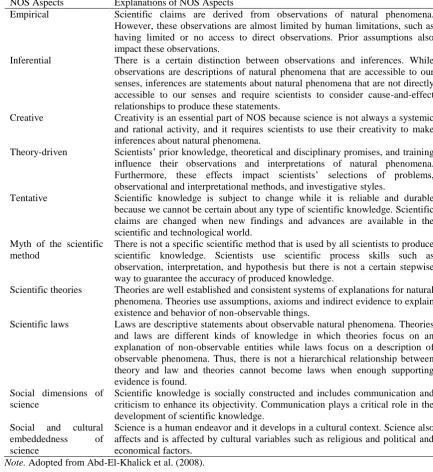
A conceptual analysis method using phrases as units of analysis was employed to determine how TNSES and GLEs for middle school science and technology curriculum, and the 7th grade teacher‟s edition of science and technology textbook portrayed NOS. Two different stages of analysis were carried out. Firstly, we identified the emphasized aspects of NOS by using the ten aspects of NOS, which we adopted from Abd-El-Khalick et al. (2008) and described it in Table 1. Then, we analyzed these documents for which teaching approaches containing explicit versus implicit and integrated versus nonintegrated instruction of NOS these documents chose to use (Akerson & Hanuscin, 2007; Clough, 2006; Matkins & Bell, 2007). Furthermore, we used a scoring rubric which includes four different classifications (see Table 2). If an analyzed document did not present a specific aspect of NOS, we classified it as not represented. If the document inaccurately represented a specific aspect or implicitly causes a misunderstanding of a specific aspect of NOS, we classified it as misrepresented. If the document implicitly presented or did not provide any explanation about the function of a specific aspect of NOS throughout its discussions, we classified it as implicitly represented. If the document explicitly presented a specific aspect of NOS and explained its role and function in the development process of scientific knowledge, we classified it as explicitly represented.
and GLEs (theoretical realm) with the 7th grade teacher‟s edition textbook (practical realm) to show how science and technology teachers were encouraged to teach NOS in their classrooms.
All the coding and comparison schemas were performed independently by two researchers to provide interrater reliability. Both researchers independently analyzed and scored a sample of selected documents and textbook materials by considering the ten aspects of NOS and the teaching approaches promoted in these materials to teach NOS. Once independent coding was finalized, the coders compare their codes for coding reliability. Inter-rater reliability coefficient was calculated as % 91 (Miles & Huberman, 1994). Confusions in the coding process were resolved through discussion and negotiation to come up with a consensus.
Table 1. The NOS aspects targeted in the analysis of the curriculum NOS Aspects Explanations of NOS Aspects
Empirical Scientific claims are derived from observations of natural phenomena. However, these observations are almost limited by human limitations, such as having limited or no access to direct observations. Prior assumptions also impact these observations.
Inferential There is a certain distinction between observations and inferences. While observations are descriptions of natural phenomena that are accessible to our senses, inferences are statements about natural phenomena that are not directly accessible to our senses and require scientists to consider cause-and-effect relationships to produce these statements.
Creative Creativity is an essential part of NOS because science is not always a systemic and rational activity, and it requires scientists to use their creativity to make inferences about natural phenomena.
Theory-driven Scientists‟ prior knowledge, theoretical and disciplinary promises, and training influence their observations and interpretations of natural phenomena. Furthermore, these effects impact scientists‟ selections of problems, observational and interpretational methods, and investigative styles.
Tentative Scientific knowledge is subject to change while it is reliable and durable because we cannot be certain about any type of scientific knowledge. Scientific claims are changed when new findings and advances are available in the scientific and technological world.
Myth of the scientific method
There is not a specific scientific method that is used by all scientists to produce scientific knowledge. Scientists use scientific process skills such as observation, interpretation, and hypothesis but there is not a certain stepwise way to guarantee the accuracy of produced knowledge.
Scientific theories Theories are well established and consistent systems of explanations for natural phenomena. Theories use assumptions, axioms and indirect evidence to explain existence and behavior of non-observable things.
Scientific laws Laws are descriptive statements about observable natural phenomena. Theories and laws are different kinds of knowledge in which theories focus on an explanation of non-observable entities while laws focus on a description of observable phenomena. Thus, there is not a hierarchical relationship between theory and law and theories cannot become laws when enough supporting evidence is found.
Social dimensions of science
Scientific knowledge is socially constructed and includes communication and criticism to enhance its objectivity. Communication plays a critical role in the development of scientific knowledge.
Social and cultural embeddedness of science
Science is a human endeavor and it develops in a cultural context. Science also affects and is affected by cultural variables such as religious and political and economical factors.
Note. Adopted from Abd-El-Khalick et al. (2008).
Findings
our analysis of the textbook illustrates that the textbook was not successful in embedding the addressed aspects of NOS into content units as it implicitly addressed a few of the NOS aspects and did not integrate most of them into the content units (see Table 3). Besides, our analyses show that the curriculum uses implicit and non-reflective approach of NOS teaching and aligning with that the textbook also supports this approach by implicitly integrating a few of the aspects within content units without providing special activates for teachers to support NOS instruction (see Table 3 and Table 4).
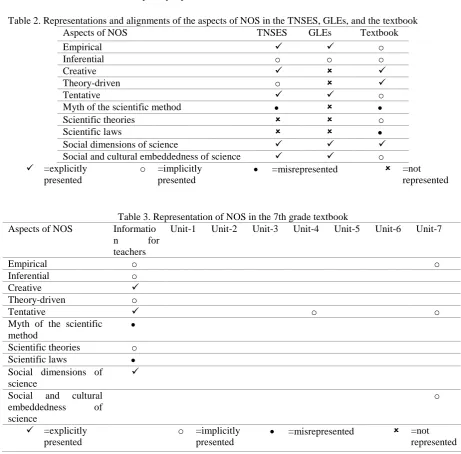
Our first research question focused on what aspects of NOS were portrayed in the middle school science and technology curriculum and the 7th grade teacher‟s edition science and technology textbook. Table 2 shows that five aspects of NOS including empirical, creative and tentative aspects of science, social dimensions of science, and social and cultural embeddedness of science are explicitly stated in TNSES. We found that two aspects of NOS including inferential and theory-driven aspects were implicitly presented in TNSES. We also found that one aspect of NOS, which is the myth of the scientific method, was misrepresented. Furthermore, explanations of scientific theories and laws, two important aspects of NOS, were not representedin TNSES.
Furthermore, our analysis of the GLEs showed (see Table 2) five crucial aspects of NOS (i.e., creativity, theory-driven, myth of the scientific method, scientific theories, and scientific laws) were not represented in the GLEs. While two aspects of NOS including empirical and inferential were implicitly stated, three aspects of NOS consisting of the tentativeness of science, social dimensions of science, and the social and cultural embeddedness of science were explicitly represented in the GLEs.
Table 2. Representations and alignments of the aspects of NOS in the TNSES, GLEs, and the textbook
Aspects of NOS TNSES GLEs Textbook
Empirical o
Inferential o o o
Creative
Theory-driven o
Tentative o
Myth of the scientific method
Scientific theories o
Scientific laws
Social dimensions of science
Social and cultural embeddedness of science o
=explicitly presented
o =implicitly presented
=misrepresented =not
represented
Table 3. Representation of NOS in the 7th grade textbook Aspects of NOS Informatio
n for
teachers
Unit-1 Unit-2 Unit-3 Unit-4 Unit-5 Unit-6 Unit-7
Empirical o o
Inferential o
Creative
Theory-driven o
Tentative o o
Myth of the scientific method
Scientific theories o
Scientific laws
Social dimensions of science
Social and cultural embeddedness of science
o
=explicitly presented
o =implicitly presented
The findings of our analysis of the 7th grade teacher‟s edition of the science and technology textbook show that, as seen in Table 2, three aspects of NOS (creative, theory-driven, and social dimension of science) are explicitly represented to promote teachers‟ instruction of NOS. Five aspects of NOS (empirical, inferential, tentative, scientific theories, and social and cultural embeddedness of science) are implicitly represented while two central aspects of NOS (the myth of the scientific method and scientific laws) are misrepresented in this textbook. Even though the ten aspects of NOS are represented in the 7th grade teacher edition of the science and technology textbook, our analysis showed that, as seen in Table 3, nine aspects of NOS are presented in the first part of this textbook that includes suggestions for teachers and just three aspects of NOS (empirical, tentative, and social and cultural embeddedness of science) are implicitly integrated into content units to promote teaching of NOS. If an aspect of NOS was explicitly provided within the information for teachers and this aspect of NOS was not provided or implicitly provided in any of the content units, we took into consideration the representation in content units because teachers employed these units in their instruction.
Our second research question was concerned with the alignment between the science and technology curriculum and the science and technology textbook in terms of depiction of NOS. The alignment of the aspects of NOS among the TNSES, GLEs, and science and technology textbook are shown in Table 2. GLEs are built based on the TNSES and science and technology textbooks are constructed on both TNSES and GLEs. However, our analysis of these documents shows that there are many inconsistences among these three documents in terms of representation of the aspects of NOS. For instance, TNSES emphasizes creativity, theory-driven scientific knowledge, and the myth of the scientific method aspects of NOS. While GLEs do not include these aspects of NOS, the teacher‟s edition of the textbook does.
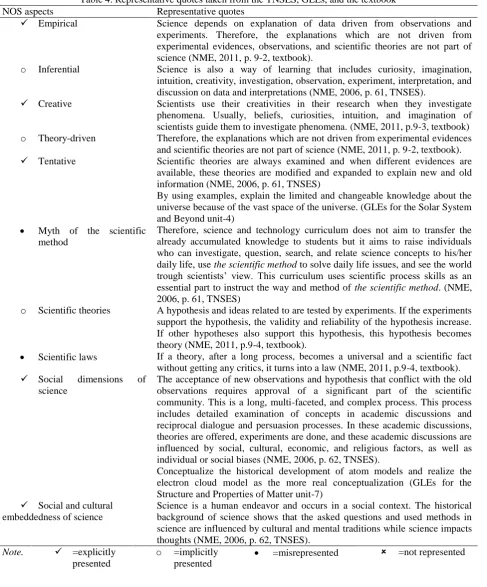
Furthermore, although empirical, tentative, and social and cultural embeddedness of science aspects of NOS are explicitly represented in TNSES and GLEs, the science and technology textbook only implicitly represents these aspects of NOS. The following quote shows how the social and cultural embeddedness of science aspect of NOS is implicitly represented in the textbook: “The text aims to help students to conceptualize how the notion of element was constructed, the historical development of element concept, and how social occasions influence scientific development during the historical time” (NME, 2011, p. 133). Moreover, the following quote shows how the tentativeness aspect of NOS is implicitly portrayed in the textbook: “Currently, ignoring to use old atom models does not mean the scientists, developers of these models, did not think critically, but it indicates the knowledge in that time was very less than we have now” (NME, 2011, p. 154). Moreover, the textbook misrepresents the two aspects of NOS (scientific laws and the myth of the scientific method) while GLEs do not include these two aspects and TNSES includes one of them. For example, the following quote illustrates how the textbook misrepresents the relationship between theory and law: “If a theory, after a long process, is universally accepted and becomes a scientific fact without getting any criticisms, it will turn into a law” (NME, 2011, p. 9).
In our analysis of the science and technology textbook, we focused on two specific parts in each unit that are “Starting the unit” and “Where is it in our lives?” because these two parts are intended by the textbook authors to take teachers‟ attention to the TNSES and GLEs for each specific content unit. Our analyses of the curriculum and the textbook show that while the curriculum aims to embed the aspects of NOS, the textbook does not sufficiently embed the aspects of NOS into specific content units to support teachers in promoting students‟ understanding of NOS. Moreover, even if the suggestions for teachers in the first part of the textbook consist of the nine aspects of NOS as seen in Table 3, just three aspects of NOS (empirical, tentative, and social and cultural embeddedness of science) are implicitly embedded into content units throughout the textbook to guide teachers to teach these aspects of NOS. The findings show that the aim of the science and technology curriculum, which is to achieve the incorporation of NOS aspects into content units, is not reflected by and align with the 7th grade teacher‟s edition textbook.
Our third research question focuses on how the representation of NOS in the science and technology curriculum and the textbook reflect the research findings on NOS to support teachers‟ adoption of NOS. Our analysis of the curriculum shows that the science and technology curriculum promotes implicit and non-reflective instruction of NOS which is not an effective instructional approach. Aligning with the science and technology curriculum, the textbook also uses implicit and non-reflective approaches for teaching NOS by incorporating a few aspects of NOS into science content units without providing any specific activity or reflective questions for students to emphasize a specific aspect of NOS during instruction.
examples for teachers to integrate them into their instruction. Moreover, while the science and technology curriculum promotes the implicit integration of NOS aspects into science content units, the textbook does not integrate most aspects of NOS into science content units. Even if the textbook incorporates a few standards related with NOS into its “Starting the unit” part in each unit, our analysis shows that these intended standards are not explicitly addressed in any content activities or instruction by incorporating specific activities or structured questions to facilitate teachers‟ instruction and learners‟ understanding of NOS.
Table 4. Representative quotes taken from the TNSES, GLEs, and the textbook
NOS aspects Representative quotes
Empirical Science depends on explanation of data driven from observations and experiments. Therefore, the explanations which are not driven from experimental evidences, observations, and scientific theories are not part of science (NME, 2011, p. 9-2, textbook).
o Inferential Science is also a way of learning that includes curiosity, imagination, intuition, creativity, investigation, observation, experiment, interpretation, and discussion on data and interpretations (NME, 2006, p. 61, TNSES).
Creative Scientists use their creativities in their research when they investigate phenomena. Usually, beliefs, curiosities, intuition, and imagination of scientists guide them to investigate phenomena. (NME, 2011, p.9-3,textbook)
o Theory-driven Therefore, the explanations which are not driven from experimental evidences and scientific theories are not part of science (NME, 2011, p. 9-2,textbook). Tentative Scientific theories are always examined and when different evidences are
available, these theories are modified and expanded to explain new and old information (NME, 2006, p. 61, TNSES)
By using examples, explain the limited and changeable knowledge about the universe because of the vast space of the universe. (GLEs for the Solar System and Beyond unit-4)
Myth of the scientific method
Therefore, science and technology curriculum does not aim to transfer the already accumulated knowledge to students but it aims to raise individuals who can investigate, question, search, and relate science concepts to his/her daily life, use the scientific method to solve daily life issues, and see the world trough scientists‟ view. This curriculum uses scientific process skills as an essential part to instruct the way and method of the scientific method. (NME, 2006, p. 61, TNSES)
o Scientific theories A hypothesis and ideas related to are tested by experiments. If the experiments support the hypothesis, the validity and reliability of the hypothesis increase. If other hypotheses also support this hypothesis, this hypothesis becomes theory (NME, 2011, p.9-4, textbook).
Scientific laws If a theory, after a long process, becomes a universal and a scientific fact without getting any critics, it turns into a law (NME, 2011, p.9-4, textbook). Social dimensions of
science
The acceptance of new observations and hypothesis that conflict with the old observations requires approval of a significant part of the scientific community. This is a long, multi-faceted, and complex process. This process includes detailed examination of concepts in academic discussions and reciprocal dialogue and persuasion processes. In these academic discussions, theories are offered, experiments are done, and these academic discussions are influenced by social, cultural, economic, and religious factors, as well as individual or social biases (NME, 2006, p. 62, TNSES).
Conceptualize the historical development of atom models and realize the electron cloud model as the more real conceptualization (GLEs for the Structure and Properties of Matter unit-7)
Social and cultural embeddedness of science
Science is a human endeavor and occurs in a social context. The historical background of science shows that the asked questions and used methods in science are influenced by cultural and mental traditions while science impacts thoughts (NME, 2006, p. 62, TNSES).
Note. =explicitly presented
o =implicitly presented
Discussion
By using document analysis method, the study shows the success in depiction of NOS within the Turkish science and technology curriculum including TNSES, GLEs and the 7th grade teacher‟s edition science and technology textbook. The findings show that the portrayal of targeted NOS aspects is insufficient. Some important aspects of NOS (e.g., scientific theories and laws) are not included while some other significant aspects (e.g., inferential and theory-driven) are implicitly portrayed in these documents. On the other hand, the findings also show that the alignment between the curriculum and the textbook is not adequate in order to transfer the aims of the curriculum for NOS into classroom practices.
Recent research has shown that teachers and students in Turkey and other countries still hold naïve and uninformed views about some certain aspects of NOS while there have been many efforts and progresses made to advance students and teachers‟ understanding of NOS (Abd-El-Khalick, 2005; Abd-El-Khalick & Akerson, 2004; Bora et al., 2006; Dogan & Abd-El-Khalick, 2008; Irez, 2006; Koksal & Cakiroglu, 2010). One part of these efforts has focused on designing courses and professional development activities for pre-service and in-service teachers to improve teachers‟ understanding of NOS (Abd-El-Khalick, 2005; Abd-El-Khalick & Akerson, 2004). Though researchers have shown the benefits of such courses and professional development activities (enacted curriculum), these efforts have been insufficient to transform teachers‟ understanding of NOS into classroom practices because of insufficient emphasis on NOS in curriculums (planned curriculum) and textbooks (experienced curriculum) (Abd-El-Khalick et al., 2016;Dogan & Abd-El-Khalick, 2008). The results of the study also evidenced the lack of alignment between the planned curriculum and experienced curriculum for Turkish middle school science and technology curriculum. Because of the high reliance on textbooks to teach science, it stands to reason that inclusion of NOS in the textbooks is a necessary step to align planned and experienced curriculum to scaffold teachers‟ instruction and improve students‟ learning of NOS.
Many internal factors such as teachers‟ confidence in their understandings about NOS, teachers‟ perceptions and prioritization of NOS in their instruction, and their students‟ interests and abilities to engage in NOS instruction have been discussed as factors that impact teachers‟ use of NOS aspects in their instruction (Abd-El- Khalick & Lederman, 2000; Akerson & Hanuscin, 2007; Khishfe, 2008; Khishfe & Lederman, 2006). Moreover, researchers have also talked about external factors such as reform documents, special educational materials, and textbooks that are thought to mediate and support the transformation of teachers‟ understanding of NOS into classroom practices to advance students‟ conceptualization of NOS (Driver et al., 1996; McComas et al., 1998; Rudolph, 2002). In this study, we examined the Turkish science and technology curriculum as a reform document and science and technology textbook to show how these external factors portray NOS to support and mediate Turkish teachers‟ instruction and students‟s learning of NOS. As earlier studies indicated the critical role of reform documents in guiding school districts, teachers and textbook publishers to prioritize and give more attention to some instructional units such as NOS (Abd-El-Khalick et al., 2016; Dogan & Abd-El-Khalick, 2008), this study also showed the role of reform document in the Turkish educational system in guiding and motivating teachers, students and textbooks to prioritize NOS as a main aim of science education to produce scientifically literate citizens. Unfortunately, the results of the study showed that the Turkish science curriculum including TNSES, GLEs and teacher‟s edition textbook is not capable at a high level of guiding and motivating teachers and students in terms of NOS. The results are also in parallel with what Erdogan and Koseoglu (2012), Ozden and Cavlazoglu (2015) and Sardag et al. (2014) found after their analysis of the middle school and high school science curricula of Turkey.
The role of textbooks on teaching and learning has been well documented by researchers. It has been shown that students first experience science during interaction with textbooks and textbooks determine the curriculum and main concerns for science teachers (Chiappetta et al., 2006; Weiss et al., 2001). This study shows that NOS is not a main part of the science and technology textbook and is not represented in an organized and consistent way to promote teachers‟ adoption and students‟ conceptualization of NOS. Some aspects of NOS (the myth of the scientific method and scientific theories and laws) are misrepresented in this textbook. These naïve representations can cause teachers and students to have misunderstandings and naïve views about these aspects of NOS (Dogan & Abd-El-Khalick, 2008; Irez, 2006; Koksal & Cakiroglu, 2010). Aspects of NOS that are implicitly presented throughout the textbook cause insufficient understanding of NOS, and are also inconsistent with current research findings. This is also supported by Ozden and Cavlazoglu‟s (2015) findings as they found that both the 2005 and 2013 curricula did not explicitly address NOS aspects.
The inconsistency between reform documents and textbooks is also mentioned in the literature as an inhibiting factor that limits teachers‟ ability to transform their conceptualization of NOS into classroom practices (Driver et al., 1996; McComas et al., 1998). Our analysis of the science and technology curriculum including TNSES and the GLEs and the textbook show that there is not a strong alignment between the science and technology curriculum (planned curriculum) and the textbook (experienced curriculum) in terms of portrayal of NOS aspects. The findings of this study show that the attention given to NOS in the curriculum and the textbook is not adequate for teachers to prioritize NOS in their instruction because of the attention given to content knowledge. Moreover, the inconsistency between the planned and experienced curriculum limits teachers‟ adoption of NOS to promote students‟ conceptualization of NOS and causes students to have naïve ideas of NOS and scientific knowledge (Abd-El-Khalick et al., 2016; Dogan & Abd-El-Khalick, 2008). The findings of this study provide information which shows a possible contributing factor to Turkish teachers‟ and students‟ naïve ideas about some aspects of NOS and why they do not have a good understanding of NOS, which were found by researchers in Turkey (Dogan & Abd-El-Khalick, 2008; Irez, 2006; Koksal & Cakiroglu, 2010). The alignment between reform documents and textbooks on the promoted instructional approach is also important in reaching the aims of reform documents. In terms of NOS, explicit-reflective teaching approach has been highlighted as the most effective way of NOS instruction (Abd-El-Khalick & Akerson, 2004; Khishfe & Abd-El-Khalick, 2002). However, the results of our study show that the science and technology curriculum aims to promote implicit-non reflective teaching approach for NOS, which conflicts with researchers‟ findings. Moreover, they encourage teachers and textbook publishers to embed the aspects of NOS rather than a separate unit of instruction that addresses NOS. Encouraging teachers and textbook publishers to embed NOS into content units may be a good way to improve learners‟ understanding of NOS, but it should be explicit and reflective (Akerson & Hanuscin, 2007; Clough, 2006; Matkins & Bell, 2007). Otherwise, it will result in neglecting instruction of NOS by giving more emphasis and time to the instruction of content knowledge. Aligning with this, the findings of our study show that even though the curriculum aimed to embed NOS aspects into content units, the textbook mostly emphasized content knowledge and implicitly integrated a few aspects of NOS into content units. The lack of alignment between the curriculum, textbook, and research findings in terms of instructional approaches of NOS limits students‟ learning of NOS, teachers‟ NOS instruction, causes deviation from the goals of curriculum, and results in unproductive instruction of NOS (Akerson et al., 2010; Bakah et al., 2012; Marsh & Willis, 2007).
Limitations and Implications
The findings are limited by some factors as the study only focuses on the science and technology curriculum and the related 7th grade textbook. Other textbooks may provide a more comprehensive way for representation of NOS aspects and teaching of them. Furthermore, the study analyzed the 2006 science and technology curriculum because of its appropriateness for our aims. The results are also connected with Turkey‟s context and limited by the developers of the curriculum as well as the authors of the textbook.
instruction for preparing scientifically literate citizens, which is the ultimate goal of science instruction (Driver et al., 1996; McComas et al., 1998; Millar & Osborne, 1998; MNE, 2013; NRC, 1996, 2012). Decision makers should consider scientific findings rather than political factors to publish and choose appropriate standards and textbooks to support scientific literacy including NOS. Second, the curriculum and textbook writers need to be informed about effective instructional ways for teaching NOS.
In terms of enacted curriculum, the agreed upon aspects of NOS should be explicitly stated in standards and GLEs by incorporating required explanations that facilitate teachers‟ understandings and practices of these aspects of NOS. Furthermore, curricula and textbooks should promote the embedded or separated explicit-reflective instruction of NOS by providing appropriate educational materials for teachers to produce similar materials for their instructions as favored based on research findings.
For the experienced curriculum, textbooks should provide explicit embedded or integrated approach of NOS instruction by incorporating the common aspects of NOS. To facilitate teachers‟ instruction of NOS aspects, textbooks should provide appropriate teaching materials and strategies to improve instruction and learning. Moreover, appropriate professional development activities including proper teaching activities and examples need to be provided for teachers to facilitate their practices of curriculum including NOS instruction.
Lastly, a group of researchers could use same criteria used by successful reform documents to assess the curricula and textbooks for their alignment with standards. This assessment requires a consistent framework for NOS, which needs to be produced by science education researchers based on recent research findings to promote a successful integration of NOS into science curriculum.
Acknowledgment
I would like thank Suleyman Cite, a PhD candidate of Science Education for his contribution as a peer reviewer, and Deborah Hanuscin, Associate Professor of Science Education, for her critical review and suggestions on the whole manuscript.
References
Abd-El-Khalick, F. (2005). Developing deeper understandings of nature of science: The impact of a philosophy of science course on preservice science teachers‟ views and instructional planning. International Journal of Science Education, 27(1), 15–42.
Abd-El-Khalick, F., & Akerson, V.L. (2004). Learning about nature of science as conceptual change: Factors that mediate the development of preservice elementary teachers‟ views of nature of science. Science Education, 88(5), 785–810.
Abd-El-Khalick, F., & Lederman, N.G. (2000). Improving science teachers‟ conceptions of the nature of science: A critical review of the literature. International Journal of Science Education, 22(7), 665–701. Abd-El-Khalick, F., Waters, M., & Le, A. P. (2008). Representations of nature of science in high school
chemistry textbooks over the past four decades. Journal of Research in Science Teaching, 45(7), 835-855.
Abd-El-Khalick, F. (2013). Teaching with and about nature of science, and science teacher knowledge domains. Science & Education, 22(9), 2087–2107.
Abd-El-Khalick, F. (2014). The evolving landscape related to assessment of nature of science. In N. G. Lederman & S. K. Abell (Eds.), Handbook of research on science education (2nd ed.) (pp. 621–650). Mahwah, NJ: Lawrence Erlbaum.
Abd-El-Khalick, F., Myers, J. Y., Summers, R, Brunner, J., Waight, N., Wahbeh, N., Zeineddin, A. A. and Belarmino, J. (2016). A longitudinal analysis of the extent and manner of representations of nature of science in U.S. high school biology and physics textbooks. Journal of Research in Science Teaching. doi. 10.1002/tea.21339
Akerson, V. L., Cullen, T. A., & Hanson, D. L. (2010). Experienced teachers‟ strategies for assessing nature of science conceptions in elementary classrooms. Journal of Science Teacher Education, 21, 723–745. Akerson, V. & Hanuscin, D.L. (2007). Teaching nature of science through inquiry: Results of a 3-year
professional development program. Journal of Research in Science Teaching, 44(5), 653-680.
Bakah, M. A. B., Voogt, J. M. and Pieters, J. M. (2012), Curriculum reform and teachers' training needs: the case of higher education in Ghana. International Journal of Training and Development, 16(1), 67-76. Bora, N. D., Aslan, O. & Cakiroglu, J. (2006). Investigating science teachers’ and high school students’ views
on the nature of science in Turkey. Paper presented at the annual meeting of the National Association for Research in Science Teaching, San Francisco, CA.
Chiappetta, E. L., Fillman, D. A., & Sethna, G. H. (1993). Do middle school life science textbooks provide a balance of scientific literacy themes? Journal of Research in Science Teaching, 30, 787-797. Chiappetta, E. L., & Fillman, D. A. (2007) Analysis of five high school biology textbooks used in the United
States for inclusion of the nature of science. International Journal of Science Education, 29(15), 1847-1868.
Clough, M.P. (2006). Learners' Responses to the Demands of Conceptual Change: Considerations for Effective Nature of Science Instruction. Science & Education, 15(5), 463-494.
Driver, R., Leach, J., Millar, R., & Scott, P. (1996). Young people’s images of science. Buckingham, England: Open University Press.
Erdogan, M.N. & Koseoglu, F. (2012). Ortaogretim fizik, kimya ve biyoloji dersi ogretim programlarının bilimsel okuryazarlık temaları yonunden analizi. Kuram ve Uygulamada Egitim Bilimleri, 12(4), 2889-2904.
Erduran, S., & Dagher, Z.R. (2014) Regaining focus in Irish junior cycle science: Potential new directions for curriculum and assessment on Nature of Science. Irish Educational Studies, 33(4), 335-350.doi: 10.1080/03323315.2014.984386.
Irez, S. (2006). Are we prepared? An assessment of preservice science teacher educators‟ beliefs about nature of science. Science Education, 90(6), 1113–1143.
Irez, S. (2009). Nature of science as depicted in Turkish biology textbooks. Science Education, 9(3), 422- 447. doi: 10.1002/sce.20305
Khisfe, R., & Abd-El-Khalick, F. (2002). Influence of explicit and reflective views versus implicit 'inquiry orientated' instruction on sixth graders views of the nature of science. Journal of Research in Science Teaching, 39(7), 551–578.
Kishfe, R., & Lederman, N. (2006). Teaching nature of science within a controversial topic: Integrated versus nonintegrated. Journal of Research in Science Teaching, 43(4), 395–418.
Koksal, M. S. (2010). The effect of explicit embedded reflective instruction on nature of science understandings, scientific literacy levels and achievement on cell unit. (Unpublished doctoral dissertation). Middle East Technical University, Ankara, Turkey.
Koksal, M. S. & Cakiroglu, J. (2010). Examining science teacher‟s understandings of the NOS aspects through the use of knowledge test and open-ended questions. Science Education International, 21(3), 197-211. Koulaidis, V., & Tsatsaroni, A. (1996). A pedagogical analysis of science textbooks: How can we proceed?
Research in Science Education, 26, 55-71.
Marsh, C. J. & Willis, G. (2007). Curriculum: Alternative Approaches, Ongoing Issues. (4th ed.). Upper Saddle River, NJ: Pearson Merrill Prentice Hall.
Matkins, J. J., & Bell, R.L. (2007). Awakening the scientist inside: Global climate change and the nature of science in an elementary science methods course. Journal of Science Teacher Education, 18, 137-163. McComas, W. F. (1998).The nature of science in science education: Rationales and strategies. Dordrecht, the
Netherlands: Kluwer.
McComas, M.R. (2003) A textbook case of the nature of science: Laws and theories in the science of biology. International Journal of Science and Mathematics Education, 1(2), 141–155.
McComas, W. F., & Olson, J. K. (1998). The nature of science in international science education standards documents. In W. F. McComas (Ed.), The nature of science in science education: Rationales and strategies (pp. 41 – 52). Dordrecht, the Netherlands: Kluwer.
McNeil, J. (2003). Curriculum: The teacher's initiative (3rd ed.). Upper Saddle River, NJ: Merrill Prentice Hall. Merriam, S. B. (2009). Qualitative research: A guide to design and implementation. San Francisco: Jossey-Bass Miles, M. B., & Huberman, A. M. (1994). Qualitative data analysis: An expanded sourcebook (2nd ed.).
Thousand Oaks: Sage Publications.
Millar R. & Osborne J.F.(1998). Beyond 2000: Science education for the future. London: King‟s College London. National Ministry of Education. (2006). Elementary education science and technology curriculum
(Grade 6, 7, and 8). Ankara; Talim Terbiye Kurulu Baskanlıgı.
National Ministry of Education (2011). Elementary school science and technology: Teacher guide. Ankara, Turkey: Devlet Kitaplari.
National Ministry of Education (2013). Primary school (elementary and middle school) science curriculum (for grade 3, 4, 5, 6, 7 and 8). Ankara: Talim Terbiye Kurulu Baskanlıgı.
National Research Council. (1996). National science education standards. Washington, DC: National Academic Press.
National Research Council (2012). A framework for K-12 science Education: Practices, crosscutting concepts, and core ideas. Washington, DC: The National Academies Press.
Niaz, M. (2010). Science curriculum and teacher education: The role of presuppositions, contradictions, controversies and speculations vs Kuhn‟s „Normal Science‟. Teaching and Teacher Education, 26(4), 891-899.
Roberts, D. (2007). Scientific literacy/science literacy. In S. Abell & N. Lederman (Eds.), Handbook of research on science education (pp. 729–780). Mahwah, NJ: Lawrence Erlbaum Associates
Rudolph, J. L. (2002). Portraying epistemology: School science in historical context. Sci Ed, 87, 64-79.
Ryder, J. (2001). Identifying science understanding for functional scientific literacy. Studies in Science Education, 36, 1-44.
Sardag M., Aydın S., Kalender N., Tortumlu, N., Ciftci, M., Perihanoglu S., (2014). The integration of nature of science in the new secondary physics, chemistry, and biology curricula. Educ. Sci., 174(39) 233–248, DOI: 10.15390/EB.2014.3069.
Stern, L., & Roseman, J.E. (2004). Can middle-school science textbooks help students learn important ideas? Findings from project 2061‟s curriculum evaluation study: Life science. Journal of Research in Science Teaching, 41(6), 538–568.
OECD (2003). The PISA 2003 assessment framework: Mathematics, reading, science and problem solving knowledge and skills. Paris: OECD.
Osborne, J., Collins, S., Ratcliffe, M., Millar, R., & Duschl, R. (2003). What „ideas-about-science‟ should be taught in school science? A Delphi study of the expert community. Journal of Research in Science Teaching, 40(7), 692 – 720.
Ozden, M. & Cavlazoglu, B. (2015). Ilkogretim fen dersi ogretim programlarında bilimin dogası: 2005 ve 2013 programlarının incelenmesi. Egitimde Nitel Arastırmalar Dergisi-Journal of Qualitative Research in Education, 3(2), 40-65.
Vesterinen, V.-M., Akesla, M., & Lavonen, J. (2013). Quantitative analysis of representations of nature of science in Nordic upper secondary school textbooks using framework of analysis based on philosophy of chemistry. Science & Education, 22, 1839–1855.
Wahbeh, N.,&Abd-El-Khalick, F. (2014). Revisiting the translation of nature of science understandings into instructional practice: Teachers‟ nature of science pedagogical context knowledge. International Journal of Science Education, 36(3), 425–466.
Weiss, I.R., Banilower, E.R., McMahon, K.C.,&Smith, P.S. (2001). Report of the 2000 national survey of science and mathematics education. Chapel Hill, NC: Horizon Research.
Author Information
Kemal Izci
Necmettin Erbakan University