Security and Law
Security and Law
Volume 14 Number 2 Article 4
6-30-2019
Enhancing Forensic-Tool Security with Rust: Development of a
Enhancing Forensic-Tool Security with Rust: Development of a
String Extraction Utility
String Extraction Utility
Jens Getreu
Taltech,Tallinn University of Technology
Olaf Maennel
Taltech, Tallinn University of Technology
Follow this and additional works at: https://commons.erau.edu/jdfsl
Part of the Computer Law Commons, and the Information Security Commons
Recommended Citation Recommended Citation
Getreu, Jens and Maennel, Olaf (2019) "Enhancing Forensic-Tool Security with Rust: Development of a String Extraction Utility," Journal of Digital Forensics, Security and Law: Vol. 14 : No. 2 , Article 4. DOI: https://doi.org/10.15394/jdfsl.2019.1607
Available at: https://commons.erau.edu/jdfsl/vol14/iss2/4
This Article is brought to you for free and open access by the Journals at Scholarly Commons. It has been
accepted for inclusion in Journal of Digital Forensics, Security and Law by an authorized administrator of Scholarly Commons. For more information, please contact [email protected].
SECURITY WITH RUST: DEVELOPMENT
OF A STRING EXTRACTION UTILITY
Jens Getreu, Olaf Maennel
Taltech, Tallinn University of TechnologyEhitajate tee 5 19086 Tallinn, Estonia
ABSTRACT
The paper evaluates the suitability of the Rust ecosystem for forensic tool development. As a case study, a forensic tool named Stringsext is developed. Starting from analyzing the specific requirements of forensic software in general and those of the present case study, all stages of the software development life-cycle are executed and evaluated.Stringsext is a re-implementation and enhancement of theGNU-strings tool, a widely used program in forensic investigations. Stringsext recognizes Cyrillic, CJKV East Asian characters and other scripts in all supported multi-byte-encodings whileGNU-strings fails in finding these in UTF-16 and other encodings. During the case study it has become apparent that the Rust ecosystem provides good support for secure coding principles and unit testing. Furthermore, the bench-marks showed a satisfactory performance of the resulting Stringsext binaries comparable to the original C version.
Keywords: Forensic analysis, string search, multi-byte encoding, Rust language,
Stringsext-tool
1.
INTRODUCTION
Human interaction with electronic devices leaves traces in their electronic memory. In the age of cloud computing most human in-teraction triggers requests to distant servers leaving traces not only in their log files, but also in many intermediate network devices. Due to the cross-linked nature of computer systems the data that needs to be taken into consideration when investigating a crime is enormous. In this huge amount of informa-tion the investigator has to find those spe-cific bits of information constituting digital evidences. In the domain of digital forensics
is relative to the hypotheses tested. It em-bodies any “item of interest that helps an in-vestigation move forward.” (Harichandran, Walnycky, Baggili, & Breitinger, 2016, p. 125)1.
Forensic examiners, the law enforcement personnel who deal with digital evidence, face inter alia two challenges: to collect and to preserve the huge amount of data that may be related to a crime and to search and detect artifacts in the collected data. The latter aspect implies the so calledstring search which is useful when dealing with unknown binary data. Most binary data contain human readable character sequences called strings. A very commonly used pro-gram to extract strings from a binary data is the so called GNU-strings program. Al-though still widely used, GNU-strings has only a very rudimentary support for multi-byte encodings such as Unicode. Further-more, it was subject several to memory safety vulnerabilities which exclude the han-dling of potentially harmful forensic data. The software tool Stringsext, developed in this present work, is made for same purpose. The new development is designed to over-come both shortcomings. Where possible, it maintains GNU-strings’ user-interface.
In the following section we analyze gen-eral tool requirements in digital forensics. Together with the shortcomings of the orig-inal GNU-strings tool, it becomes obvious that the C++ programming language does not satisfy the indispensable security re-quirements in the field of forensic software. The remaining sections show how the
Rust-1Cf. Harichandran (Harichandran et al., 2016,
language mitigates them and what should be observed during implementation.
2.
TOOL
REQUIREMENTS IN
DIGITAL FORENSICS
2.1
Multi-byte character
encoding support
Like in other established forensic disciplines the forensic soundness and reliability of dig-ital evidence depend on the validity and cor-rectness of the forensic software used in ex-amination. In other words, to guarantee that the digital evidence is forensically sound, all tools used to collect, preserve and analyze digital evidences must be validated. Tool validation can also be formally required by standards like theISO 17025 Laboratory Ac-creditation standard.
Validation is the confirmation by examina-tion and the provision of objective ev-idence that a tool, technique or proce-dure functions correctly and as intended (Craiger, Swauger, Marberry, & Hen-dricks, 2006, p. 92).
One way of establishing a set of requirements for a new forensic tool is to analyze how sim-ilar existing tools are validated. Beckett and Slay (Beckett & Slay, 2007) propose a func-tionality oriented validation method called Model of tool neutral testing. Instead of test-ing if a software product meets all its re-quirements, an independent set of forensic functions is defined and later tested. The digital forensic discipline can be broadly de-fined in terms of the key functions Iden-tification, Data Preservation, Data Analy-sis and Presentation of Digital Evidence. Each key function is further divided into subcategories. For example Data Analysis
breaks down into: Searching, File Render-ing, Data Recovery, Decryption, Identifica-tion, Processing, Temporal Data and Pro-cess Automation. The first item searching relates to finding and locating information of interest in digital memories. Form a func-tional point of view the searching falls into the searching domain (where), the searching mode (how) and the searching target (what). This breakdown of forensic functions into de-tailed categories allows to decouple the val-idation procedure from the implementation of the forensic tool itself. Based on this cat-egorization, independent test environments are set up for each specific function. For ex-ample, a test may certify if the software is able to run a fuzzy search for strings in the unallocated disk space.
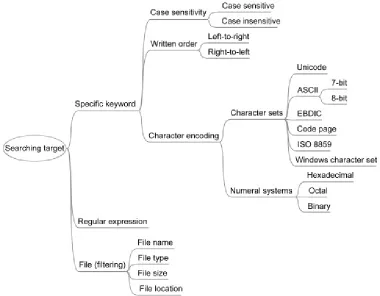
Beyond validation, the categorization of forensic functions is also helpful to define requirements for improvement existing tools — in our case GNU strings. For exam-ple, Searching can be further classified into groups as shown in the Figure 1 (Beckett & Slay, 2007, p. 17). The leaves in the diagram list typical capabilities a Search-ing-software can implement. For example the subcategory “Character encoding” illus-trates the main deficit of GNU-strings as it supports only ASCII encoding. In a global cyberspace, forensic tools must identify a multitude of encodings. This leads us to the main motivation and requirement of String-sext: multibyte character encoding support.
The functionality oriented validation can be classified as “black box testing” examin-ing functionality without any knowledge of the internal implementation, even without having access to the source code. Its advan-tage is, that it allows to reuse the test envi-ronment thus reducing costs. Black box test-ing is sometimes also referred as “behavioral testing” as it feeds the tool with known test case data and observes if the tool outputs the expected results. In the context of this
work black box testing is used to assert that the developed toolStringsext deals correctly with big real-world input data: Stringsext has been designed to produce, as a special case, bit-identical output to that of GNU-strings. This way the comparison of the out-put data of both tools allowed to confirm that stringsext is working correctly when dealing with big data.
In addition to the above black box test-ing, Rust’s build in test harness (unit test) is used in conjunction with thetest driven de-velopment in order to guarantee maximum security and correctness of the developed tool.
2.2
Security
“Make it hard for them to find you and im-possible for them to prove they found you”. With this concise word Berinato (2007) char-acterizes the relation between the criminal and the forensic investigator. In digital forensics this “hide-and-seek” game might soon take a new dimension: Eggendorfer (2016) stresses with good reasons that foren-sic tools are software too and therefor vul-nerable to attacks: A vulnerability found in 2017 in a common forensic tool En-Case Forensic Imager demonstrates exem-plary the pertinence of the risk (Consult, 2017):
Figure 1. The search target mapping, cf. (Beckett & Slay, 2007, p. 8)
flaw, EnCase Forensic Imager can be tricked into executing data read from the storage device. Afterwards the code provided by the attacker has full control of the investiga-tor’s machine and can be used by the suspect to manipulate evidence (Consult, 2017).
its potential impact:
• The adversary may be warned about an ongoing investigation.
• The adversary may gain control of the investigator’s machine and alter evi-dences.
TheStringsext-project addresses this risk by choosing the programming language Rust. Rust offers some outstanding security guar-antees which are presented in Section 4.
2.3
Code efficiency
The searching domain in forensic investiga-tions is often as large as the seized data-carrier. Nowadays hard-disk images hold several TiB of data. Memory images of the RAM are smaller, but still some GiB in size. In order to address so big search do-mains, forensic software must operate very efficiently. This is why forensic software Confronted with this vulnerability report,
is often programmed in C or C++. But not only the programming language matters: Efficient code also requires carefully cho-sen abstractions, efficient algorithms avoid-ing unnecessary data-copies and program-loops. Concerning the choice of the pro-gramming language we define the following requirements: The programming language should:
• allow a fine control over pointers and memory allocation,
• offer zero cost abstractions,
• have no or a minimal runtime system. The above motivates the choice of develop-ingStringsext in Rust. Chapter 4 shows how Rust meets the above requirements by its memory safety guarantees and zero cost de-sign goal.
3.
GNU-STRINGS
’
SHORTCOMINGS IN
FORENSICS
This section first analyzes GNU-strings’ limitations concerning multi-byte-encodings and international scripts. Based upon this we derive a set of additional requirements for Stringsext. Many forensic practitioners use the GNU program strings, hereafter re-ferred as GNU strings, to get a sense of the functionality of an unknown program by ex-tracting human readable strings from binary data. Of special interest are for example strings containing URLs to malicious sites, often an indicator of malware activity. But also, user prompts, error messages, and sta-tus messages can give valuable hints.
3.1
International character
encodings
As discussed above the main motivation for developing Stringsext is the missing
multi-byte character encoding semantics in GNU-strings. GNU-strings encoding support con-sists of a rudimentary filter accessed with the option--encoding. Please consult the man-ual page for more details. How well does GNU-strings detect Unicode? The Figure 2 shows the content of a text file chosen as test case. To find out how well GNU
Figure 2. Test case international character encodings
Strings deals with different Unicode encod-ings, the text-file is then is converted into
UTF-8, UTF-16LE, UTF-16BE, UTF-32LE and
UTF-32BE, each encoding in one file. In or-der to observe GNU-strings Unicode detec-tion capabilities, all the test-files are then searched for valid graphic strings with the command strings using all possible vari-ation of its encoding filter. The Figure 3 shows exemplary GNU-strings output for a UTF-16 little endian encoded input.
Figure 3. GNU-strings with UTF-16LE en-coded input
Results: UTF-8 is the only encoding in which GNU strings is able to find interna-tional characters. The Figure 3, chosen as an example, shows that with UTF-16 input, GNU stringsfails to recognize all non-ASCII characters. The same holds true for UTF-32
binutils 2.24 and earlier allows remote attackers to cause a denial of service (crash) and possibly execute arbitrary code via crafted section group headers in an ELF file.
Zalewski headlined his bug report “Don’t run strings on untrusted files.” Needless to say that this advice can not be followed in the context of a forensic investigation. In the meantime the bug was fixed but users remain confused and bewildered.
Of particular importance is that the above bugs are part of a vulnerability class related to memory safety problems. GNU strings is written in C, a language whose abstrac-tions can not guarantee memory safety. In order to exclude potential vulnerabilities of the same kind from the outset, Stringsext was developed in theRust programming lan-guage.
4.
THE RUST
PROGRAMMING
LANGUAGE
In the Section 2 we showed that the re-quirements code efficiency and security are of paramount importance. This section il-lustrates how Rust supports these require-ments with its zero cost abstractions and its guaranteed memory safety (The-Rust-Team, 2019) motivating the choice of implementing Stringsext in Rust.
4.1
Memory safety
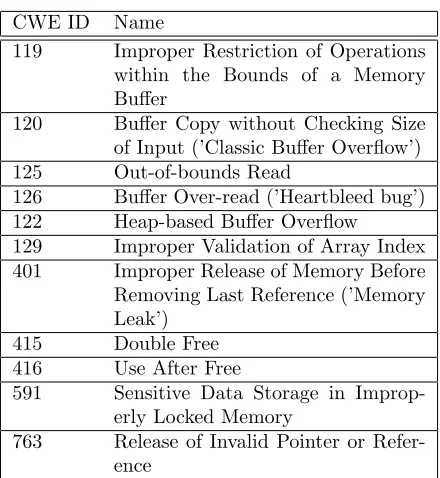
All memory-related problems inC andC++ come from the fact that C programs can unrestrainedly manipulate pointer to vari-ables and objects outside of their memory location and their lifetime. The Table 1 shows a selection of most common memory safety related vulnerabilities (Corporation, of particular importance in forensic
investi-gations: The Microsoft-Windows operating system handles Unicode characters in mem-ory as 2 byte UTF-16 words. As a result whendealingwithMicrosoft-Windows mem-ory images, GNU-strings is not able to de-tect any international characters! It should notbeforgottenthatGNU-strings isnot de-signed to analyze multi-byte encodings in general. This is why other very common encodings e.g. big5 or koi8-r are not sup-ported at all even though they are widely used. The above-outlined limitations leads to Stringsext’s main requirement: character encoding support.
3.2
Secure
coding
In the narrow sense, “secure coding” is rather a design goal than a functional re-quirement. Secure coding denotesthe prac-tice of developing computer software by re-ducing the accidental introduction of secu-rity vulnerabilities by preventing coding er-rors or discovering and eliminating security flaws during implementation and testing. Fromthe securecoding pointofviewthe re-quirement character encoding support is the most critical: The NIST National Vulnera-bilityDatabase listsundertheheading “char-acter encoding”22vulnerabilities. Notonly new complexforensic software isaffected by vulnerabilities. It also concerns other well-establishedproducts: ThetoolGNU-strings, part of the GNU binutils collection, became publiclyavailablein1999(Cygnus-Solutions, 1999). Today ithas reached the notableage of 17years. GNU-strings isa comparatively smallprogramwith724linesofcodeonly. It isallthemoresurprisingthatin2014the se-curityresearcher Zalewski(2014) discovered a serious security vulnerability CVE-2014-8485 :
The setup group function in
2016). Memory safe languages like Java do not give programmers direct and uncon-trolled access to pointers. For example, in Java memory safety is guaranteed through a resource costly runtime and a garbage col-lector. The related additional costs in terms of runtime resources exclude programming language like Java for most forensic tool de-velopment.
For many years program efficiency and memory safety seemed to be an insurmount-able discrepancy. Now, after 10 years of development, a new programming language called Rust promises to cope with this bal-ancing act. Rust’s main innovation is the introduction of semantics definingdata own-ership. This new programming paradigm allows the compiler to guarantee memory safety at compile-time. Thus, no resource costly runtime is needed for that purpose. In Rust most of the weaknesses listed in Ta-ble 1 are already detected at compile time. Moreover, theRust compiler guarantees that none of these weaknesses can result in an un-defined system state or provoke data leakage. Rust’s main innovation is the introduc-tion of new semantics defining ownership andborrowing. Put in simplified terms, they translate to the following three rules which Rust’s type system enforces at compile time:
1. All resource (everything that can be bound to a variable, e.g. integers, vec-tors, structures) has a unique owner.
2. Others can borrow from the owner (technically borrowing means that an-other scope sets a pointer to the owner’s resource).
3. The owner cannot free or mutate the re-source while it is borrowed.
By enforcing the above rules Rust organizes how resources are shared among different scopes. Memory problems occur for instance
CWE ID Name
119 Improper Restriction of Operations within the Bounds of a Memory Buffer
120 Buffer Copy without Checking Size of Input (’Classic Buffer Overflow’) 125 Out-of-bounds Read
126 Buffer Over-read (’Heartbleed bug’) 122 Heap-based Buffer Overflow
129 Improper Validation of Array Index 401 Improper Release of Memory Before Removing Last Reference (’Memory Leak’)
415 Double Free 416 Use After Free
591 Sensitive Data Storage in Improp-erly Locked Memory
763 Release of Invalid Pointer or Refer-ence
Table 1. Common weaknesses in C/C++ that affect memory
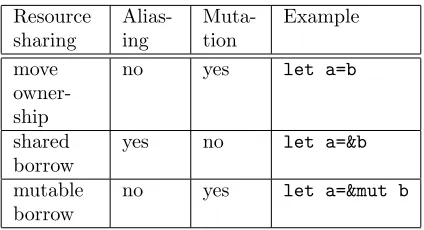
when a resource is referenced by multiple pointers (aliasing) and when more than one pointer writes to the same memory at the same time (mutation). In contrast to other languages, Rust’s semantics allow the type system to ensureat compile time that simul-taneous aliasing and mutation mutually ex-clude each other (cf. Table 2). As the check is performed at compile-time, no run-time code is necessary. Furthermore, Rust does not need a garbage-collector: when owned data goes out of scope it is immediately de-stroyed.
Resource sharing
Alias-ing
Muta-tion
Example
move owner-ship
no yes let a=b
shared borrow
yes no let a=&b
mutable borrow
no yes let a=&mut b
Table 2. Resource sharing in Rust
fn as_str(data: &u32) -> &str { let s = format!("{}", data); return &s
}
Here the corrected memory safe code per-forming a byte-copy at the end of the func-tion.
fn as_str(data: &u32) -> String { let s = format!("{}", data); return s
Improper Validation of Array Index” (cf. Table 3 (Corporation, 2016)).
CWE ID Name
119 Improper Restriction of Operations within the Bounds of a Memory Buffer
125 Out-of-bounds Read
129 Improper Validation of Array Index
Table 3. Common weaknesses in C/C++ affecting memory avoidable with iterators (Corporation, 2016)
In addition to traditional imperative loop control structures, Rust offers efficient iter-ation with functional style iterators. Like in Haskell iterators are lazy and avoid al-locating memory for intermediate struc-tures (you only allocate just when you call
.collect()). Iterators considerably en-hance the robustness and safety of pro-grams. They enable the programmer to iter-ate through vectors without explicitly nam-ing neither the index nor its bounds, thus avoiding common mistakes. The Figure 4 shows an example.
fet p: Vec<u8> = s.into_bytes();//plaintext let mut c: Vec<u8> = vec![]; //ciphertext
for (cypherb, keyb) in p.iter()
.zip(key.iter().cycle().take(p.len())){
c.push(*cypherb ^ *keyb as u8);
}
Figure 4. Vigen`ere cipher in Rust
4.3
Zero-Cost Abstractions
It is the language design goalZero-Cost Ab-stractions that makes the C/C++ language so efficient and suitable for system program-ming. It means that libraries implementing abstractions, e.g. vectors and strings, must be designed in a way that the compiled bi-nary is as efficient as if the program had been
}
The push()methodinline 3of thenext ex-amplecauses thebacking storageof data to be reallocated. As a result we have a dan-gling pointer vulnerability! Again, the Rust compilerdetectstheerrorandcodedoesnot compile.
let mut data = vec![1, 2, 3];
let x = &data[0]; data.push(4);
println!("{}", x);
Herethecorrectedmemorysafeversionthat compiles:
let mut data = vec![1, 2, 3]; data.push(4);
let x = &data[0];
println!("{}", x);
4.2
Iterators
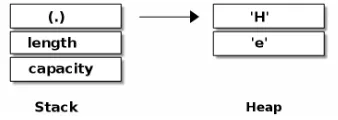
written in Assembly. This is best illustrated with memory layouts: Figure 5 shows a vec-tor in Rust. Its memory layout is very sim-ilar is to a vector in C++. In contrast, the
Figure 5. Memory layout of a Rust vector
memory safe language Java enforces a uni-form internal representation of data. In Java a vector has 2 indirections instead of 1 com-pared to Rust and C/C++ (cf. Fig. 6). As the data could be represented in a more effi-cient way in memory, we see thatJava does not prioritize Zero-Cost-Abstraction as pri-mary objective.
Figure 6. Memory layout of a Java vector
5.
USE CASE:
DEVELOPMENT OF
THE
STRINGSEXT
-TOOL
In the Section 2 we have analyzed the spe-cial requirements for tools in digital foren-sics: code efficiency and security. The Sec-tion 4 showed that Rust’s core properties zero cost abstractions and memory safety in theory meet well our requirements.
But how well is the Rust ecosystem suited for forensic tool development? In order to evaluate also the practical aspects of Rust,
the tool Stringsext (Getreu, 2018)(Getreu, 2017) was developed. The technical chal-lenges such as concurrent batch processing of multi-byte character streams revealed to be sufficiently complex, thus allowing us to de-duce general recommendations for forensic-tool development.
5.1
Encoding support
The initial motivation for developing String-sext were the various shortcomings of GNU-strings especially when it comes to han-dle international character encodings. Does Stringsext support foreign scripts better? Is it as fast?
To evaluate Stringsext’s capabilities to handle international scripts with Unicode, we choose the same input text file (cf. Fig-ure 2) we used withGNU-strings in the Sec-tion, 3.1. Stringsext’s output (cf. Figure 7) confirms that all international characters are found correctly. Furthermore, Figure 8 illustrates how Stringsext’s formats its out-put when it operates in simultaneous multi-encoding scanning mode.
Figure 7. Stringsext’s output withUTF-16LE
encoded input
Figure 8. Stringsext’s output in
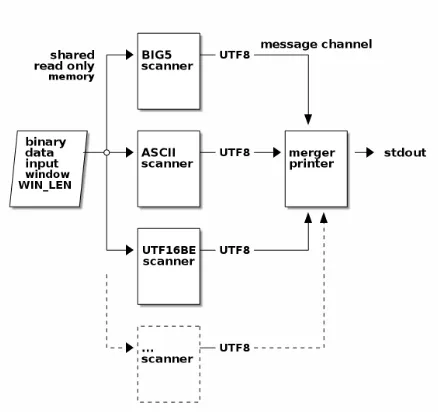
multi-Figure 9. Data processing and threads
5.3
Algorithm
Batch processing of multibyte character streams turned out to be more difficult than expected. As we want to keep the scan-ning process as stateless as possible, we in-troduced overlapping windows: This allows reading beyond the memory page’s edge in case a found string terminates in the next memory page. However, strings can be so long that you can’t but cut them somewhere. In this case we need to make sure not to cut in the middle of a multi-byte character which can be up to 6 bytes long. As a result a scan-ner is not completely stateless: between each scanner run the position where the last run stopped and a flag indicating the forced cut of a string is passed.
The scanner decodes the input stream in two phases: first it uses the Encod-ing-crate library to identify valid code se-quences and transcodes them into valid UTF-8 strings. Such a valid string may con-tain non-graphical and graphical characters. As we are only interested in the latter, a sec-ond filter extracts graphical substrings while meeting additional criteria, e.g. minimum encoding scanning mode
5.2
Concurrency
The Figure 9shows the data flow in String-sext. All scanner instances as well as the merger-printer are designed as threads. Rust uses OS-level threads and its type andownershipmodelguaranteestheabsence of data races. Rust supports by default two models of inter-thread communication: shared memoryand message channels.
length or Unicode-range restriction rules.
6.
DEVELOPMENT
PROCESS
EVALUATION
Besides the contribution of the new tool Stringsext to the forensic community a more general consideration is of scientific interest: Seeing that Rust is a very young program-ming language: how well is the Rust ecosys-tem suited for forensic tool development?
Forensic tools have to fulfill stringent re-quirements concerning their quality: In gen-eral, huge amount of data has to be pro-cessed which leads to most demanding re-quirements in terms code efficiency (cf. Sec-tion 2.3). Furthermore, the data to be ana-lyzed is potentially dangerous: it may con-tain malicious payload targeting common vulnerabilities (cf. Section 2.2). Finally, in order to fulfill legal requirements forensic tools must be extensively tested.
The present case study confirms our initial hypothesis that Rust meets these require-ments: Rust, as system programming lan-guage, is designed for code efficiency. In ad-dition Rust guarantees memory safety, the cause for a common category of vulnerabil-ities. It’s build in unit testing feature sup-ports software verification as defined in the Section 2.1.
Memory safety is checked at compile time by Rust’s borrow checker: When a Rust source code compiles, the resulting binary is guaranteed to be memory safe. In conse-quence, such a binary is immune to mem-ory safety related attacks: e.g. out-of-bounds read, buffer over-read, heap-based buffer overflow, improper validation of array index, improper release of memory before re-moving last, double free, use after free. As Stringsext and all its used libraries are solely Rust components,Stringsextis memory safe.
We compared the code efficiency of GNU-strings implemented in C and Stringsext implemented in Rust: When Stringsext is run in ASCII-only mode, both produce bit-identical output. The field experiment yielded that even though Stringsext’s 2.4 times slower, the speed is within the same order of magnitude. However, Stringsext’s design implies much more complex compu-tations, hence the result is not surprising.
How about the efficiency of Rust’s ab-stractions and its overall performance? A good estimation is to compare benchmarks of small and simple programs. Too com-plex programs should be avoided for this purpose because variations of the program-mer’s skills may bias the result. Accord-ing to the “Computer Language Bench-mark Game” (Fulgham & Gouy, 2019) Rust andC/C++have similar benchmark results, which confirms our above measurements.
Forensic tools have to operate on many architectures. Here enters Rust’s cross-compiling feature on scene. As Rust uses the LLVM framework as back-end, it is available for most platforms. rustc --print target-list lists 80 compiler tar-gets (rustc version 1.27).
no guaranty that the compiled code is mem-ory safe. Not only that the lack of memmem-ory safety is one of the principal causes for most software vulnerabilities, forensic software is particularly exposed to such risks as it pro-cesses binary data of unknown origin con-taining all kinds of malware. As an alterna-tive to C and C++, the relaalterna-tively new pro-gramming language Rust offers guarantied memory safety by design, while being as fast as C. The match-making of general forensic tool requirements and the theoretical prop-erties of the Rust programming language makes it an ideal alternative to the hitherto dominant programming language C++. But a general recommendation for a shift in pro-gramming practises can not be deduced from theoretical considerations alone: this is why we developed the Stringsext-Software as use case.
The use case “development of the String-sext-tool” shows that Rust was a good choice for the present project, even though batch processing of multi-bytes character streams revealed to be far more complex than ex-pected. Additionally, concurrent program-ming in Rust posed a hurdle at the begin-ning. Fortunately, the friendly Rust com-munity helped to overcome occasional tech-nical obstacles quickly. In addition, for a not so experienced Rust programmer it is reassuring to know that when a complex piece of code finally compiles, it is memory safe. The same applies to common settings when a programmer has to refactor existing code. Rust clears away doubts like “Do I free the memory at the right moment? Is this pointer still valid?” Furthermore, Rust is especially suitable for bigger projects where several programmers contribute to the same code. And this is particularly true when de-veloping forensic software with its high qual-ity standards.
It has to be noted though that the Rust ecosystem is still very young and bugs in exampleoneofthefirstversions0.4.16ofthe
kmerge function, part of the itertools li-braryused inStringsext,reversedunderrare conditionsthe firstandsecondfinding. Unit testing revealed a bug in itertools. The programmerrespondedquickly. It tookonly some days afteritsappearance that the bug wasfixedwithpullrequest#135. Sofarthis was the only time we encountered a bug in the used libraries. One conclusion we draw from this experience is, that young libraries are more likely to have bugs than estab-lishedones. Itcannotbeemphasisedenough that diligent unit testing helps to find most bugs at early state. However, unit testing do not help against memory safety related vulnerabilities, which are typical for C and C++programsandwhichcanpersistin soft-warefor decades. Taking intoaccount these benefitsand drawbackswelargely prefer ac-ceptingthegreaterlikelihoodofmanageable bugs related to young Rust libraries, than the uncertainty ofhiddenmemory safety re-latedvulnerabilitiestypicalforC and C++. Finally, we recognize the benefits of unit testing throughoutthiswork. Forthisreason we chose for this project the test driven de-velopment method where unit testing is the key element. Contrary to other methods,in test driven development unit tests and the to be tested code is always programmed by the same person, which fitted well the set-tingofthisproject. However,othermethods may be as suitabledepending onthe organ-isational structure of the programmerteam.
7.
CONCLUSION
new libraries are nothing uncommon. Fortu-nately, the library maintainers are very re-sponsive and a bug is usually fixed within days. Here again unit testing becomes handy. It does not only find bugs in our own code at early stage, it also helps to iden-tity bugs in external libraries. Used together with the test driven development method, the test code and the to be tested code can be validated in one go.
Stringsext is currently in production state and can be used in forensic investigations as a GNU strings replacement. It is espe-cially useful where GNU-strings fails: it al-lows finding UTF-16 multi-byte characters in memory images and supports other multi-byte encodings like big5 orkoi8-r.
REFERENCES
Beckett, J., & Slay, J. (2007). Digital forensics: Validation and verification in a dynamic work environment. In System Sciences, 2007. HICSS 2007. 40th Annual Hawaii International Conference (p. 266a-266a). IEEE. Berinato, S. (2007, June). The Rise of Anti
Forensics.
http://www.csoonline.com/ article/ 2122329.
Consult, S. (2017, May). Chainsaw of Custody: Manipulating forensic evidence the easy way.
Corporation, M. (2016). CWE - Common Weakness Enumeration, a
Community-Developed Dictionary of Software Weakness Types.
https://cwe.mitre.org/.
Craiger, P., Swauger, J., Marberry, C., & Hendricks, C. (2006). Validation of digital forensics tools. Digital crime and forensic science in cyberspace. Hershey, PA: Idea Group Inc, 91-105. Cygnus-Solutions. (1999, May). Log
message: Sourceware import.
https://sourceware.org/ ml/ binutils-cvs/ 1999-q2/ msg00000.html.
Eggendorfer, T. (2016, July). IT forensics. Why post-mortem is dead. Cyber Security Summer School 2016: Digital Forensics, Technology and Law. Tallinn University of Technology. Fulgham, B., & Gouy, I. (2019, February).
Computer Language Benchmarks Game: C++ versus Rust.
https://benchmarksgame-team.pages.debian.net/
benchmarksgame/ faster/ rust.html. Getreu, J. (2017). Forensic-Tool
Development with Rust (Unpublished doctoral dissertation). Tallinn
University of Technology, Tallinn. Getreu, J. (2018). Stringsext, a GNU
Strings Alternative with
Multi-Byte-Encoding Support. Tallinn.
Harichandran, V. S., Walnycky, D., Baggili, I., & Breitinger, F. (2016). CuFA: A more formal definition for digital forensic artifacts. Digital
Investigation, 18, S125-S137.
The-Rust-Project-Developers. (2017). The Rustonomicon.
The-Rust-Team. (2019, January). Rust Documentation.
https://doc.rust-lang.org/.
Zalewski, M. (2014, October). PSA: Don’t run ’strings’ on untrusted files