Input Based Multiple Destination, Multiple Lines
Following Robot with Obstacle Bypassing
Mudassir Javed
1, Sohail Hamid
1, Muhammad Talha
1, Zubair Ahmad
1, Fazle Wahab
1, Hazrat Ali
2*1Department of Electrical Engineering, University of Engineering and Technology Peshawar, Pakistan. 2Department of
Electrical Engineering, COMSATTS Institute of Information Technology, Abbottabad, Pakistan.
[email protected], [email protected], [email protected],
[email protected], [email protected], [email protected]
Abstract
This paper presents a multiple destination, multiple lines following robot which takes input from user and then selects the defined colored line on the basis of given input and follows it until it reaches its destination. Each destination is defined with a specific colored line. The robot is intelligent enough to avoid collision with obstacles blocking its path, and to bypass the obstacle and then continue following its path. The robot has the ability to return to its initial position once the destination is achieved, thus completing a round trip successfully and getting ready to be employed again. The robot is able to turn across sharp turns as it follows the edge of the colored line and not the line itself. The robot is economical as least number of sensors are employed in the robot.
Received on 14 December 2017, accepted on 17 January 2018, published on 13 April 2018
Copyright © 2018Mudassir Javedet al., licensed to EAI. This is an open access article distributed under the terms of the Creative Commons Attribution licence (http://creativecommons.org/licenses/by/3.0/), which permits unlimited use, distribution and reproduction in any medium so long as the original work is properly cited.
doi: 10.4108/10.4108/eai.13-4-2018.154472
1. Introduction
Line following robots are the type of robots capable of following a specific colored line which works like a track for the robot. Pakdaman et al. [1] has designed a small line following robot with infrared (IR) sensors to detect the line drawn on floor. Patil [2] has developed an AVR based line following robot capable to detect the line drawn on the floor with the help of a sensor array. When it passes through the line drawn on the surface, the sensor reads 0 and vice versa [2]1. A two-wheels balancing robot is developed by Ghani et al. [4], which has the capability of following a line and uses infrared
______________
1AVRs are 8 bit or 32 bit microcontrollers (MCUs) supplied by Atmel® with ARM processors offering a unique combination of performance, power efficiency and design flexibility. They are based on the industry's most code-efficient architecture for C and assembly programming. No other microcontroller delivers more computing performance with such better power efficiency [3].
capability to correct feedback in different colors of light. Kazi et al. [12] have presented a sensor based autonomous color line following robot with obstacle avoidance, capable of following lines of white, black and few other different colors. The robot is also capable of obstacle avoidance. Instead of microcontroller, the robot presented in [12] employs electronic logic gates for decision making. In this paper, we present an input based multiple destination, multiple lines follower robot, with the capability to keep itself safe from crashing into any snag lying in its way and bypass the obstacle. Also, to make it more handy [13], it can turn back by itself without the mediation of any external interference, and return to the starting point [14], [15]. The collision avoidance with obstacles is accomplished by utilizing infrared sensors, or ultrasonic sensor in the robot which read the vicinity of the robot and pass on the data to the controller. The rest of the paper is organized as follows: Section 2 provides a system overview of the robot. In Section 3, we provide a discussion on the various sensors employed in the robot. The mechanism for human input to the robot is discussed in Section 4. We then discuss the line following algorithm in Section 5, the obstacle avoidance algorithm in Section 6 and the returning back algorithm in Section 7. The driving and steering algorithm is explained in Section 8. In Section 9, results and the working prototype have been presented. Finally, the paper is concluded in Section 10.
2. System Overview
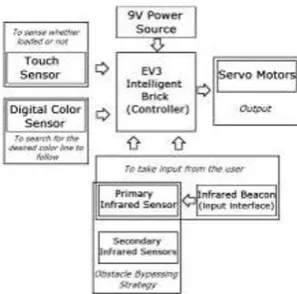
The multiple destination, multiple lines follower robot is aimed at use for carrying certain loads from point of origin to some destination. So a touch sensor is introduced in the rack of the robot where the load should be kept. When the controller detects the load, it begins perusing about desired destination from infrared beacon through infrared sensor provided by the user. On the basis of that perusing, the controller drives the motors as indicated by the characterized calculation to help the robot achieve its craved goal. A digital color sensor is introduced at the base of robot to recognize eight diverse colored lines which serves as pathways’ directions to various destinations. Since the robot should be utilized as a part of regular day to day existence around the general population in workplaces or manufacturing plants, where the odds are constantly more prominent that an obstruction may come in the way of the robot. Keeping in mind the end goal to maintain a strategic distance from crash with hindrances, three infrared sensors are utilized. One is introduced on front and other two on left and right sides of the robot separately. At the point when an obstruction comes before robot, the front infrared sensor identifies it and controller beeps a caution. It waits for a specific timeframe to get the course cleared. Once the course is cleared, it continues to move forward. On the other hand, if the course is not cleared within the specified timeframe, the robot turns leftwards. The right side sensor will begin sending readings about the position of obstruction to the controller. As the controller senses that
the deterrent is no more in the right side in the vicinity of the robot inferring that the obstruction has been avoided, the robot attempts to continue the journey. The robot “remembers” the color of the line and can resume its journey on the same colored line after the obstacle is bypassed. The block diagram of the multiple destination, multiple lines follower robot is given in Figure. 1. There are different sensors utilized in the robot for persistently sending data about the environment and condition of the robot. There is a color sensor introduced in it which helps in identifying and following a specific line. Correspondingly, the touch sensor helps the controller to identify if the robot is loaded. The infrared sensors pass on data to controller about the region of the robot and aides in maintaining a strategic distance from and in bypassing the hindrances lying in the way of the robot. On the premise of the readings from the sensors, the processor creates control data based on the sensors’ reading and thus, helps the robot in moving from beginning position to the target position.
3 Sensors
There are three different types of sensors utilized in the robot for various fundamental functions. They are:
3.1 Digital Color Sensor:
voltages, which is then changed over into digital form and processed.
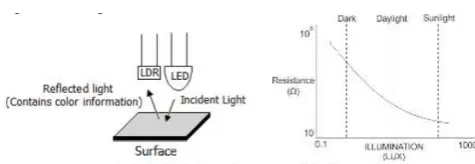
LDRs, also referred to as photo conductors, photo conductive cells or simply photocells are devices whose resistivity is a function of the incident electromagnetic radiation. They are light sensitive devices made up of semiconductor materials having high resistance. Their resistance decreases when light falls on them and vice versa. When an LDR is kept in dark, its resistance is very high. Conversely, if an LDR is allowed to absorb light, its resistance will decrease drastically. If a constant voltage is applied to it and intensity of light is increased, the current starts increasing. Figure. 3 shows resistance vs. illumination curve for an LDR. The EV3 Digital Color Sensor differentiates between 8 different colors i.e. Black, Blue, Green, Yellow, Red, White and Brown and No Color. The inside views of the color sensor are shown in Figure 4 and 5. On the top of the printed circuit board (PCB), the two LEDs are clearly visible in which the upper one having two pins is the photo detector while the bottom one is the LED having 4 pins, one for each color component (Red, Green and Blue) and a common cathode or anode. The processor used in the sensor is of Atmel.
3.2 Infrared Sensor and Touch Sensor
The infrared sensor as shown in Figure 6, is vital for obstacle bypassing and collision avoidance. In this robot, three infrared sensors are installed making one of them as the primary and the remaining two act as auxiliary. A touch sensor is utilized in the robot to tell the controller about the loading status of the robot. Thus, the robot becomes aware if a load is placed onto it to be carried to another location. In this case, a simple push button performs the task, conveying status 0 or status 1 for loading/unloading respectively.
4 Taking Input From The User
Besides the signals being provided by the sensors, the robot can also accept input from a human user. For this purpose, the infrared beacon is used as the input interface. The infrared beacon acts as a remote with buttons representing a unique digital signal (as 1, 2, 3 up to 11). A user may instruct the robot using the beacon. The input signal from the infrared beacon is received by the controller through the primary infrared sensor and then processed for driving the motors.
5 Line Following Algorithm
A proficient algorithm is developed to make the robot capable of reaching its destination from the starting position following the line for which it is given guidelines. Ideally, the robot is capable of taking the desired path with no events of missing the path even if a sharp turn exists in a path. The robot under discourse is programmed in such a manner that it follows the edge of the line. Once a specified color is perused by the color sensor, the robot will turn towards right by giving positive power to left motor and negative power to the right one. PLeft Motor >> PRight Motor: Conversely, for any other color, the robot will turn towards the left by providing positive power to the right motor and negative power to the left motor.
6 Obstacle Bypassing Algorithm
The robot presented in this work is proposed to be used in real environments in everyday life implying that obstacles may come into the path of the robot. The existing work reported in [12] achieves obstacle avoidance by stopping the robot when it is confronted by an obstacle. Similarly, collision avoidance is introduced in [16] however, it is limited for the case when a robot is confronted by another robot. This work presents an approach to improve obstacle avoidance such that: the robot detects the obstacle in the way and if the obstacle does not get away, the robot is capable to bypass it. This is achieved through the infrared sensors installed on the robot. A primary sensor is installed front of the robot to receive input. Two secondary sensors are installed, one on either side of the robot. As soon as the primary sensor senses an obstacle, the controller receives a signal from it and stops the motors in response to the signal. Followed by this, the robot waits for a particular period of time to let the obstacle get away (e.g., a human being who might get away of the path). If the obstacle does not move, the robot turns towards the left. Now, the secondary infrared sensors start sending signals to the controller regarding the proximity of the robot. The controller then moves the robot forward until it starts sensing no obstacle in the proximity (via the secondary infrared sensor) implying that the obstacle has been left behind. This step of bypassing obstacle is graphically represented in Figure 8. Similarly, the obstacle bypassing and No Obstacle scenarios are presented in Figure 9 and Figure 10, respectively. The robot is able to turn back to its point of origin and get ready to be employed again. The robot can determine if it has reached its required destination by detecting a specified color. The obstacle bypassing algorithm and the turning back mechanisms are summarized in Table. 2 and Table 3, respectively.
7 Driving And Steering Mechanism
The steering mechanism for a line follower robot needs to be highly accurate to develop an efficient line follower robot [1]. In this robot, two servo motors are employed which are responsible for the movement of the robot. A free moving wheel is set at the back of the robot which moves freely with the movement of the two basic wheels of the robot. The steering of the robot is controlled in such a way so that the robot is able to turn across sharp turns. The mechanism is summarized in Table. 4.
Move Straight: PLeft Motor = PRight Motor Turn Right: PLeft Motor >> PRight Motor Turn Left: PLeft Motor << PRight Motor Stop: PLeft Motor = PRight Motor = 0
8 Results
the controller as appeared in Figure 11 and Figure 12. The prototype is powered by 9V battery installed in the block, and the sensors are powered by the controller itself. The motors utilized in the robot are the EV3 Servo Motors able to move with a maximum speed of 160 rpm and running torque of 20 N.cm, sufficient enough to carry small loads with sensible speed. The battery of the unit could bolster the prototype in keeping it in working state for 60 minutes. Different test drives were carried out in various situations checking the impeccability of the calculations and the sensors utilized in the robot. The paths were turned with sharp turns of acute angles and after that the drives were done. Hindrances of various lengths and widths were set in the way of the robot to check the immaculateness of obstacle avoidance algorithm. All of the test drives gave precise outcomes, thus confirming the accuracy of the developed algorithms and the promising performance of the sensors utilized.
9 Conclusion and Future Work
In this paper, we have presented hardware implementation of an input based multiple destination, multiple lines follower robot with obstacle bypassing ability. The robot is able to follow the colored path and can identify the destination by using color information. Once the destination is reached and the robot is unloaded, it is able to return to its initial position to get ready for loading. During its journey, the robot is able to bypass the obstacles. Though, there has been significant work in the field of line following robots, no cost effective solution seems to have been reported for multiple lines following to reach at multiple destinations. Besides, the obstacle avoiding task has been addressed with some limitations. The robot discussed in this paper is able to bypass the obstacles effectively and efficiently. Additionally, it is also capable of returning to its initial position. The robot presented in this work accounts for obstacles only. An interesting future work is to make the robot more intelligent by using deep learning approaches such as those in [18], [19], [20], [21]. In this way, the robot can be trained for speech data so that the robot identifies voices and responds to both speech and image signaling.
References
1. Pakdaman, M. Sanaatiyan, M.M, "Design and Implementation of Line Follower Robot", Second International Conference on Computer and Electrical Engineering TCCEE '09, vol.2, pp.585-590, Dec. 2009. 2. Priyank Patil, "AVR Line Following Robot” Department of
Information Technology K. J. Somaiya College of Engineering Mumbai, India. Mar 5, 2010 [Report].
3. Atmel AVR 8-bit and 32-bit Microcontrollers: An Overview of the Product, Unsurpassed Performance,
Efficiency and Flexibility.
(www.atmel.com/products/microcontrollers/avr) (Accessed April 2017)
4. Nor Maniha, Abdul Ghani, Faradila Naim, Tan Pi own yon, "Two Wheels Balancing Robot with Line Following Capability", International Journal of Mechanical, Aerospace, Industrial, Mechatronic and Manufacturing Engineering Vol:5, No:7, 2011
5. Colak, I., Yildirim D. "Evolving a Line Following Robot to use in shopping centers for entertainment”, Industrial Electronics, 2009. IECON '09. 35th Annual Conference of IEEE, pp.3803 - 3807, 3-5 Nov. 2009.
6. Mechanic Master Chef: Robots cook dumplings, noodles and wait tables at restaurant in China. ( www.dailymail.co.uk/news/article-2261767/Robot-Restaurant-Robots-cook-food-wait-tables-Harbin) (Accessed: April 2017)
7. YANG Tian-Tian; L1U Zhi-Yuan; CHEN Hong; PEl Run, "Formation Control and Obstacle Avoidance for Multiple Mobile Robots," Acta Automatica Sinica, Vol. 34, No. 5, 2008.
8. Dean A. Pomerleau, Jay Gowdy, Charles E. Thorpe, “Combining Artificial Neural Networks and Symbolic Processing for Autonomous Robot Guidance" Engineering Applications Artificial Intelligence Vol. 4, No. 4, pp. 279-285, 1991.
9. L1U Shi-Cai, L1U Guang-Jun, "Formation Control of Mobile Robots with Active Obstacle Avoidance," Acta Automatica Sinica, Vol. 33, No. 5, 2007.
10. M. Zafri Baharuddin, Izham Z. Abidin, S. Suleiman Kaja Mohideen, Yap Keem Siah, Jeffrey Tan Too Chuan,"Analysis of Line Sensor Configuration for the Advanced Line Follower Robot”, (Report), [Accessed: April 2017]
11. Bajestani, S.E.M., Vosoughinia, A., “Technical Report of Building a Line Follower Robot” International Conference on Electronics and Information Engineering (ICEIE 2010), vol 1, pp. v1-1 v1-5, 2010.
12. K. M. Hasan, A. A. Nahid, K. J. Reza, S. Khatun, M. R. Basar, “Sensor Based Autonomous Color Line Follower Robot with Obstacle Avoidance”, IEEE Business Engineering and Business Applications Colloquium (BEIAC) 2013, pp. 598-603.
13. Charles A. Schuler, William L. McNamee, “Industrial Electronics and Robotics,” McGraw-Hill International Edition, Industrial Electronics Series 2003.
15. Sandhana, Lakshmi (2002-09-05), “A Theory of Evolution for Robots, “Wired Magazine ... Retrieved 2007-10-28. 16. Tstv'an Harmati, Krzysztof Skrzypczyk, "Robot team
coordination for target tracking using fuzzy logic controller in game theoretic framework, "Robotics and Autonomous Systems,57 ,pp. 75-86,2009.
17. 31313 Mindstorms EV3 - https://www.lego.com/en-us/mindstorms/products/mindstorms-ev3-31313 (Accessed: May 2017)
18. Hazrat Ali, Son N. Tran, E. Benetos, A. Garcez, “Speaker Recognition with Hybrid Features from a Deep Belief Network”, Springer Neural Computing and Applications, August 2016, doi: 10.1007/s00521-016-2501-7
19. Hazrat Ali, Nasir Ahmad, Xianwei Zhou, “Automatic Speech Recognition of Urdu Words using Linear Discriminant Analysis", Journal of Intelligent and Fuzzy Systems, vol. 28, no. 5, pp – 2369 – 2375, June 2015, doi: 10.3233/IFS-151554
20. H. Ali, A. S. d’Avila Garcez, S. N. Tran, X. Zhou and K. Iqbal, “Unimodal late fusion for NIST i-vector challenge on speaker detection,” Electron. Lett., vol. 50, no. 15, pp. 1098–1100, Jul. 2014. doi: 10.1049/el.2014.1207