© Universiti Tun Hussein Onn Malaysia Publisher’s Office
IJSCET
http://penerbit.uthm.edu.my/ojs/index.php/ijscet
ISSN : 2180-3242 e-ISSN : 2600-7959
International
Journal of
Sustainable
Construction
Engineering and
Technology
*Corresponding author: [email protected]
2019 UTHM Publisher. All right reserved. penerbit.uthm.edu.my/ojs/index.php/ijscet
8
Severity of Corruption Factors in Project Life Cycle from
Construction Experts’ Perspectives
Nur Amylia Izrin Mohd Saim
1*, Ismail Abdul Rahman
2, Mohd Firdaus Ismail
31,2Faculty of Civil and Environmental Engineering,
University Tun Hussein Onn Malaysia, 86400, Parit Raja, MALAYSIA
3Faculty of Technology Management and Business,
University Tun Hussein Onn Malaysia, 86400, Parit Raja, MALAYSIA
*Corresponding Author
DOI: https://doi.org/10.30880/ijscet.2019.10.02.002
Received 01 June 2019; Accepted 23 May 2019; Available online 31 December 2019
1.
Introduction
The construction industry is significant for Malaysia's economic growth, where it contributed 4.5% of the total GDP in 2018 and expecting growth estimated at 4.9% in 2019 (Ganeshwaran, 2019). Towards the transformation of the construction industry by the year 2020, the emergence of new technologies to the industry can increase the industry's growth by reducing operating cost such as 15 to 20% of the time in the design stage (Mohd Razali, 2018). Along with the appearance of the fourth industrial revolution or IR 4.0 which convert the construction industry in the direction of further digitally developed trades and contribute more in the economy and socio-economy aspects (Wesam et al., 2018).
Despite the contribution to the economic and Industrial Revolution 4.0, the construction industry is currently facing many challenges, especially corruption (Ang, 2017; Clement, 2017; Transparency International, 2019). Corruption Perception Index (CPI) rank for Malaysia is dropping significantly among 175 countries according to Transparency International as in Figure 1.0 (Trading Economy, 2019).
Abstract: A study was conducted to identify whether corruption factors extracted from the literature review are relevant to the local construction industry. This study involves 13 construction experts that have been selected based on their experiences and prominent position in their respective organizations. All of the experts have a minimum of 10 years of working experiences, and their jobs are ranging from engineer to project manager. The experts were given a questionnaire and required to score the degree of severity to each of the 31 corruption factors in 4 stages of Construction Project Life Cycle (CPLC). Data collected from this study were analyzed descriptively using Average Index Score approach. The result of the study indicated that all the factors were getting scores ranging from 2.54 to 3.77, which indicates that the factors range from moderately relevant to extremely relevant from the viewpoints of the experts. Three highest scored factors are "High of competitions amongst contractor"; "Political influence in the design and tendering stage"; "Abuse of power from the client". Findings from this study can be further explored and applied to respective construction parties in decision making.
9
Fig. 1 -Malaysia Corruption Perception Index
According to MACC (2019), majority of corruption report-ed cases from 2012 until 2018 are from the construction industry (Bernama, (i) 2019). Besides, the report on corruption trend from 2013 until 2018 shows that the public sector has been most vulnerable at an alarming rate of 63.33% (Bernama, (ii) 2019). Consequently, corruption comes at a cost such as higher prices for homes, lack of quality infrastructure, and negatively impacting the country economy (MACC, 2014; Locatelli et al., 2017). Thus, corruption becomes rampant and a major threat to Malaysia’s National security (Bernama, (ii) 2019).
2.
Corruption in Construction Industry
Corruption is defined as the abuse of entrusted power for private gain that can occur during any stage of the project life cycle (Stansbury, 2005; Transparency International, (ii) 2018). Corruption comes in many forms such as bribery, kickbacks, conflict of interest, extortion and nepotism (Fukuyama, 2005; So-hail & Cavill ,(ii) 2006; Kenny, 2006; Balboa et al., 2006; Kenny, 2007 (i); Kenny, 2007 (ii); Sohail & Cavill, (i) 2008; Ampratwum, 2008; Sohail & Cavill, 2008 (ii); Salim, 2009; Kenny, 2011; Olken & Pande, 2012; Wensik & De Vet., 2013; Shan et al., 2014; Kasimu & Kolawole, 2015; Wells, 2015; Hidayat & Mulyanto, 2016; OECD, 2016; Locatelli et al., 2017; Hadiwattege et al., 2017).
Corruption is a critical issue which has been long plaguing the construction industry. It has become a prevalent culture in the construction industry, as stated by Mohd Nordin in 2013. This situation becomes a threat to the government, economic, and social wellbeing of a community. The corruption is giving a bad image for the government, which would lead to degrading public trust (Gevansri, 2013). Furthermore, corruption discourages legitimate business investment and reduce public resources. It will also significantly impact the economic return on investment to a country while the socio impact of corruption reduces delivery of federal funds and services to the public, especially to the poor. Furthermore, corruption cause the project cost in-crease, which impacts the price of the house for buyers negatively.
Malaysia construction industry has also been facing the same issues with corruption; this is proven as many studies that have been carried out from 2011 until 2018. The studies vary from termination of contractor due to corruption practices; behavior contributes to corruption, factors towards corruption and case study on corruption in the construction industry (Has-san, 2011; Mohd Nordin, 2013;2014; Gevansri, 2013). In early 2019, the National Anti-Corruption Plan (NACP) documented a list of six risk areas of corruptions unusually public procurement in the construction industry and also been majority complaints of corruption compared to other industry (Prime Minister’s Department, 2019).
10
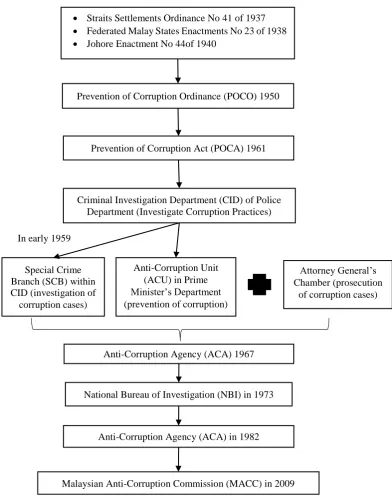
Fig. 2 - Adopted from Kapeli & Mohamed, (2015)
In June 2018, Governance, Integrity, and Anti-Corruption (GIACC) were established by Prime Minister, Tun Dr Mahathir Mohamad which will manage and monitor any activities related to governance, integrity and combating graft (Abas, 2018). The GIACC also responsible for planning, strategize and evaluate policies for government to achieve zero-tolerance towards corruption as the government manifesto.
Therefore, MACC developed strategies to combat the corruption which are ‘Inspection & Consultancy Services,’ ‘Corporate Integrity Pledge (CIP),’ ‘Corruption Risk Management’ and ‘Establishment of Integrity Units’ (MACC, 2018). Furthermore, MACC collaborates with every Ministry in the government to check the integrity to contribute for the Anti-Corruption Coalition for Construction Industry (“the Coalition”) as a way of dealing with the rampant corruption. In 2019, GIACC and the Prime Minister’s Department are in collaboration with other government agencies developed the National Anti-Corruption Plan (NACP) which is an anti-corruption initiatives tool in realizing the government’s vision towards a nation with integrity and free from corruption (MACC, 2019). The NACP contains 115 initiatives and 22 strategies in 6 priority areas which are political sector; public procurement; law enforcement; public sector administration; legislation and judiciary; as well as corporate governance (Bernama (iii), 2019). Despite those
Straits Settlements Ordinance No 41 of 1937
Federated Malay States Enactments No 23 of 1938
Johore Enactment No 44of 1940
Prevention of Corruption Ordinance (POCO) 1950
Prevention of Corruption Act (POCA) 1961
Anti-Corruption Agency (ACA) 1967 Criminal Investigation Department (CID) of Police
Department (Investigate Corruption Practices)
Special Crime Branch (SCB) within CID (investigation of corruption cases)
Anti-Corruption Unit (ACU) in Prime Minister’s Department (prevention of corruption)
Attorney General’s Chamber (prosecution
of corruption cases)
National Bureau of Investigation (NBI) in 1973 In early 1959
Anti-Corruption Agency (ACA) in 1982
11
strategies and a variety of policy initiatives, corruption still widespread in the construction industry (Siddiquee, 2010; Saieed, 2018).
3.
Corruption in Construction Industry
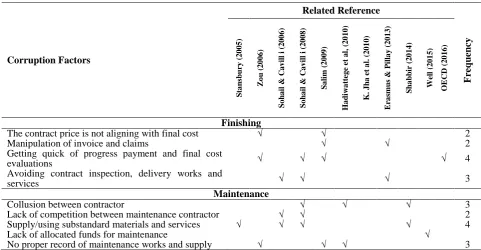
This study has managed to identify 31 corruption factors which occurred in the construction industry based on literature from previous researchers. These factors were mostly classified in every phase of the construction project life cycle (CPLC). There are several classifications CPLC ranging from 4 to 7 phases, but this study has adopted only 4 phases of CPLC which are "Design & Tendering", "Construction", "Finishing", and "Maintenance" as in Table 1.
Table 1 -Corruption Factor by CPLC.
Corruption Factors Related Reference F re qu ency S ta n sb u ry ( 2 0 0 5 ) Z o u ( 2 0 0 6 ) S o h a il & C a v il l i (2 0 0 6 ) S o h a il & C a v il l i (2 0 0 8 ) S a li m (2 0 0 9 ) Ha d iw a tt eg e et a l, ( 2 0 1 0 ) K. J h a e t a l. ( 2 0 1 0 ) E ra smus & P il la y ( 2 0 1 3 ) S h a b b ir ( 2 0 1 4 ) We ll ( 2 0 1 5 ) OECD ( 2 0 1 6 )
Design & Tendering
Erroneous detailing design √ √ √ 3
Technical specification is tailored for a specific
company √ √ √ √ √ 5
Manipulation of contract details √ √ √ √ √ √ √ √ √ 9
Absence of public notice for the bidding process √ √ √ 3
Leakage of tender details (e.g. Baseline price) √ √ √ √ √ √ 6
Abuse of power from client √ √ √ √ 4
High of competitions amongst contractor √ √ √ √ √ √ √ 7
Fake certificates and credentials of contractor’s
company √ √ √ √ 4
Collusion between tenderer and public officer √ √ √ √ √ √ √ √ √ √ √ 11
Political influence √ √ √ √ √ √ √ 7
Conflict of interest and lack of integrity √ √ √ √ 4
Greediness of contractor and public officer √ √ √ √ 4
Getting quick project approval √ √ √ √ √ 5
Lack of supplier and networking √ √ √ √ √ 5
Construction
Lack of supervision by consultant and authority √ √ √ 3
Collusion between contractors and officer √ √ √ √ √ 5
Complexity of project due to changes of variation √ 1
Manipulation of order (e.g. material & equipment) √ √ √ √ 4
Covering substandard work and materials √ √ √ √ √ 5
Theft of new assets before delivery or before being
recorded √ √ √ 3
Avoiding tax, rules and specification √ √ √ √ √ 5
Construction does not comply with the design &
12
cont. Table 1 -Corruption Factor by CPLC
Corruption Factors Related Reference F re qu ency S ta n sb u ry ( 2 0 0 5 ) Z o u ( 2 0 0 6 ) S o h a il & C a v il l i (2 0 0 6 ) S o h a il & C a v il l i (2 0 0 8 ) S a li m (2 0 0 9 ) Ha d iw a tt eg e et a l, ( 2 0 1 0 ) K. J h a e t a l. ( 2 0 1 0 ) E ra smus & P il la y ( 2 0 1 3 ) S h a b b ir ( 2 0 1 4 ) We ll ( 2 0 1 5 ) OECD ( 2 0 1 6 ) Finishing
The contract price is not aligning with final cost √ √ 2
Manipulation of invoice and claims √ √ 2
Getting quick of progress payment and final cost
evaluations √ √ √ √ 4
Avoiding contract inspection, delivery works and
services √ √ √ 3
Maintenance
Collusion between contractor √ √ √ 3
Lack of competition between maintenance contractor √ √ 2
Supply/using substandard materials and services √ √ √ √ 4
Lack of allocated funds for maintenance √
No proper record of maintenance works and supply √ √ √ 3
All these corruption factors in Table 1 were applied in this study questionnaire form.
4.
Method of Data Collection and Analysis
A questionnaire was developed to solicit the perspectives and personal experience of experts in Malaysia's construction industry regarding the severity of the listed construction corruption factors in Malaysia’s industry. The structured questionnaire is divided into two parts, first of which are demographics of respondents and secondly, the severity of construction corruption factors. The severity of construction corruption factors was assessed using a 5-point Likert scale as in Table 2.
Table 2 -Severity Based on 5-Point Likert Scale
Scale 1 2 3 4 5
Level Not
relevant
Slightly relevant
Moderately
relevant Relevant
Very Relevant
The collected data from the questionnaire survey were analyzed using Average Index (AI) Formula (Memon et al., 2011) as below:
(1)
Where;
X1 = Number of respondents for scale 1 X2 = Number of respondents for scale 2 X3 = Number of respondents for scale 3 X4 = Number of respondents for scale 4 X5 = Number of respondents for scale 5
The AI values can be classified into the five categories of relevant level as adopted from Memon et al. (2011) as below:
Not Relevant (NR): 1.00 ˂ AI ˂ 1.50
𝐴𝑣𝑒𝑟𝑎𝑔𝑒 𝐼𝑛𝑑𝑒𝑥 = (1𝑋1+ 2𝑋2+ 3𝑋3+ 4𝑋4+ 5𝑋5)
13
Slightly Relevant (SR): 1.50 ˂ AI ˂ 2.50
Moderately Relevant (MR): 2.50 ˂ AI ˂ 3.50
Very Relevant (VR): 3.50 ˂ AI ˂ 4.50
Extremely Relevant (ER): 4.50 ˂ AI ˂ 5.00
The AI is used to assess the factors and any Moderately Relevant (MR) which is 2.50 will be eliminated as a score of anything below 2.50 will be considered not relevant for this study.
5.
Method of Data Collection and Analysis
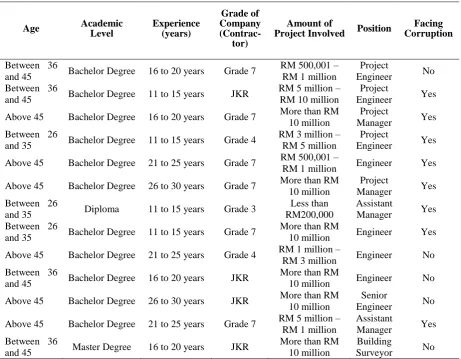
The study was conducted to identify whether the corruption factors that were extracted from the literature review are relevant to Malaysia construction industry scenarios. A total of 13 construction experts were selected based on their experiences and position in handling construction projects. An engagement using face-to-face questionnaire technique with the experts was conducted from November 2018 to December 2018 where the experts were explained the intention of the study and shown the questionnaire for them to score on the severity of the corruption factors using 5-points Likert’s scale. The demography of the experts is as shown in Table 3.
Table 3 - Demography of Experts
Age Academic Level
Experience (years)
Grade of Company
(Contrac-tor)
Amount of
Project Involved Position
Facing Corruption
Between 36
and 45 Bachelor Degree 16 to 20 years Grade 7
RM 500,001 – RM 1 million
Project
Engineer No
Between 36
and 45 Bachelor Degree 11 to 15 years JKR
RM 5 million – RM 10 million
Project
Engineer Yes
Above 45 Bachelor Degree 16 to 20 years Grade 7 More than RM 10 million
Project
Manager Yes
Between 26
and 35 Bachelor Degree 11 to 15 years Grade 4
RM 3 million – RM 5 million
Project
Engineer Yes
Above 45 Bachelor Degree 21 to 25 years Grade 7 RM 500,001 –
RM 1 million Engineer Yes
Above 45 Bachelor Degree 26 to 30 years Grade 7 More than RM 10 million
Project
Manager Yes
Between 26
and 35 Diploma 11 to 15 years Grade 3
Less than RM200,000
Assistant
Manager Yes
Between 26
and 35 Bachelor Degree 11 to 15 years Grade 7
More than RM
10 million Engineer Yes
Above 45 Bachelor Degree 21 to 25 years Grade 4 RM 1 million –
RM 3 million Engineer No Between 36
and 45 Bachelor Degree 16 to 20 years JKR
More than RM
10 million Engineer No
Above 45 Bachelor Degree 26 to 30 years JKR More than RM 10 million
Senior
Engineer No
Above 45 Bachelor Degree 21 to 25 years Grade 7 RM 5 million – RM 1 million
Assistant
Manager Yes
Between 36
and 45 Master Degree 16 to 20 years JKR
More than RM 10 million
Building
Surveyor No
14
Table 3.1 - Cronbach’s Alpha Value by CPLC phases CPLC phases Cronbach’s Alpha Values
Design and Tendering 0.904
Construction 0.886
Finishing 0.696
Maintenance 0.854
Based on Table 3.1, the Cronbach’s Alpha values are between 0.696 until 0.904. As Awang (2012) stated if the data is more than 0.67 it is considered to be valid and reliable.
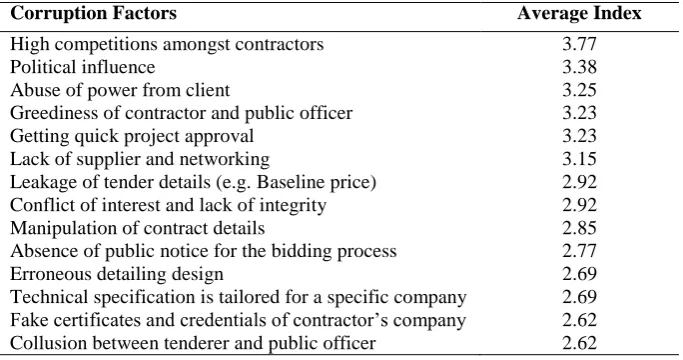
Table 3.2 shows the Average Index Value for construction corruption factors.
Table 3.2 (a) - Design and Tendering Phase
Corruption Factors Average Index
High competitions amongst contractors 3.77
Political influence 3.38
Abuse of power from client 3.25
Greediness of contractor and public officer 3.23
Getting quick project approval 3.23
Lack of supplier and networking 3.15
Leakage of tender details (e.g. Baseline price) 2.92
Conflict of interest and lack of integrity 2.92
Manipulation of contract details 2.85
Absence of public notice for the bidding process 2.77
Erroneous detailing design 2.69
Technical specification is tailored for a specific company 2.69 Fake certificates and credentials of contractor’s company 2.62 Collusion between tenderer and public officer 2.62
Table 3.2 (b) - Construction Phase
Corruption Factors Average Index
Manipulation of order (e.g. Material & Equipment) 3.23 Complexity of project due to changes of variation 3.15
Covering substandard work and materials 3.15
Collusion between contractors and officer 3.08
Theft of new assets before delivery or before being recorded 3.00 Construction does not comply with the design & specifications 2.92
Avoiding tax, rules and specification 2.85
Lack of supervision by consultant and authority 2.69
Table 3.2 (c) - Finishing Phase
Corruption Factors Average Index
The contract price is not aligning with final cost 3.00 Avoiding contract inspection, delivery works, and services 3.00
Manipulation of invoice and claims 2.92
Getting quick of the progress payment and final cost evaluations 2.54
Table 3.2 (d) - Maintenance Phase
Corruption Factors Average Index
Supply/using substandard materials and services 2.85 No proper record of maintenance works and supply 2.85
Lack of allocated funds for maintenance 2.69
Lack of competition between maintenance contractor 2.62
Collusion between contractor 2.54
15
Construction Phase, the three most relevant corruption factors are ‘Manipulation of order (e.g. Material & Equipment)’;
‘Complexity of project due to changes of variation’ and ‘Covering substandard work and materials’. Subsequently, in
Table 3.2 (c) which is in the Finishing Phase, the three most relevant corruption factors are ‘The contract price is not aligning with final cost’; ‘Avoiding contract inspection, delivery works and services’ and ‘Manipulation of invoice and claims’. Finally, for the last phase which is Maintenance Phase in Table 3.2 (d) the three most relevant corruption factors are ‘Supply/using substandard materials and services’; ‘No proper record of maintenance works and supply’ and ‘Lack of allocated funds for maintenance’. The result of data analysis found out the construction corruption factors are above
moderately relevant towards the Malaysian construction industry.
6.
Conclusion
Corruption practices are still rampant in Malaysia’s construction industry. The fight against corruption becomes Malaysia’s top-most priority as NACP 2019 is established. This study identified 31 relevant corruption factors throughout the construction project life cycle (design & tendering; construction; finishing and maintenance). The identification of these corruption factors can be further to investigate the risk level of each corruption factors in the construction industry. This result will help to alert the construction community on the potential of corruption practices which may occur and also support the Government’s initiatives to combat Corruption in Malaysia.
Acknowledgements
Authors would like to extend gratitude and thanks to BP Renal Care Sdn. Bhd. for sponsoring and making this study reality and also to those who have contributed towards this study.
References
Abas A. (2018) PM agrees to GIACC formation to handle governance, integrity and anti-graft. New Straits Times. June 1.2018. From https://www.nst.com.my/news/nation/2018/06/375513/pm-agrees-giacc-formation-handle-governance-integrity-and-anti-graft
Ampratwum E. (2008). The fight against corruption and its implications and transitions economies. Journal of Money Laundering Control. 11(1): 76-87
Ang J., (2017). Datuk Chua Tee Yong: Some still assume Industry 4.0 is not coming. Retrieved on March 10. 2019. From https://www.humanresourcesonline.net/datuk-chua-tee-yong-some-still-assume-industry-4-0-is-not-coming/
Awang, Z. (2012). Research methodology and data analysis. Penerbit Universiti Teknologi MARA Press.
Balboa J. & Erlinda M. (2006) Anti-Corruption and Governance: The Philippine Experience. 1-28
Bernama (i) (2019) Procurement Sector Records Highest Corruption Complaints. Retrieved on February 15. 2019. From https://www.thestar.com.my/news/nation/2019/01/29/procurement-sector-records-highest-corruption-complaints/
Bernama (ii) (2019) NACP: politicians interfering in government administration key issue in fighting corruption. Retrieved on February 2. 2019. From http://www.bernama.com/en/news.php?id=1689759
Bernama (iii) (2019) NACP to keep politics apart from govt administration. Retrieved on February 18. 2019. From https://themalaysianreserve.com/2019/01/30/nacp-to-keep-politics-apart-from-govt-administration/
Clement G. (2017) Crime and Corruption in the 4th Industrial Revolution. Retrieved on March 10. 2019. From
https://www.financierworldwide.com/crime-and-corruption-in-the-4th-industrial-revolution#.XIUoFygzbIU
Erasmus J. & Pillay K. (2013) Understanding Tender Corruption. Corruption Watch. Johannesburg, South Africa: 1-17.
Fukuyama, F. (2005). “Global corruption report 2005.” Transparency International, Berlin.
Ganeshwaran K. (2019) 15 February 2019. The Star. GDP in Q4 up 4.7% economy’s first acceleration growth since a year ago.
16
Hadiwattege, C., De Silva, L., & Pathirage, C. (2017, March). Corruption in Sri Lankan Construction Industry. In W107-Special Track 18th CIB World Building Congress May 2010 Salford, United Kingdom (p. 141).
Hassan, H. H. (2011) Termination of contractor due to the corruption, unlawful or illegal activities. University Technology Malaysia. Master.
Hidayat F. & Mulyanto S. (2016) Analysis characteristic of corruption in construction project in Indonesia.
K. Jha A. et al. (2010) Safer Homes, Stronger Communities: A Handbook for Reconstructing after Natural Disasters. Monitoring and Information Management Mitigating the Risk of Corruption. Washington DC: World Bank. 285-302
Kapelli N. S. & Mohamed N. (2015) Insight of Anti-Corruption Initiatives in Malaysia. International Accounting and Business Conference 2015. 525-534
Kasimu M. & Kolawole A. (2015). Appraisal of the Impact of Corruption on Sustainable Development in Nigerian Construction Industry. Journal of Multidisciplinary Engineering Science and Technology. 2(10): 2834-2842.
Kenny C. (2006). Measuring and Reducing the Impact of Corruption in Infrastructure. 1-42.
Kenny C. (2011) Publishing Construction Contract as a Tool for Efficiency and Good Governance. 1-10
Kenny C. (i) (2007). Construction, Corruption, and Developing Countries. 4271: 0-31.
Kenny, C. (ii) (2007). Infrastructure governance and corruption: where next?. The World Bank.
Locatelli G. et al. (2017). Corruption in public projects and megaprojects: There is an elephant in the room! Journal of Project Management. 35(3): 252-268.
MACC (2014) retrieved on March 2. 2019. Retrieved from https://www.sprm.gov.my/index.php/en/corporate-info/message-from-the-chief-commissioner/199-pembinaan/1042-industri-latar-belakang
MACC (2018) Strategy to combat corruption. Retrieved on March 28. 2018. From https://www.sprm.gov.my/index.php/en/prevention/prevention-strategy
MACC (2019) National Anti-Corruption Plan 2019-2023. Retrieved on February 22. 2019. From https://www.sprm.gov.my/index.php/en/arkib-berita-sprm/3227-national-anti-corruption-plan-2019-2023-nacp-2019-2023
Memon, A. H., Rahman, I. A., Abdullah, M. R., & Azis, A. A. A. (2011). Time Overrun in Construction Projects from the Perspective of Project Management Consultant (PMC). Journal of Surveying, Construction and Property, 2(1), 54-66.
Mohd Nordin R., Takim R. & Nawawi A.H. (2013). Behavioural Factors of Corruption in the Construction Industry. Procedia- Social and Behavioural Sciences. 105: 64-74
Mohd Razali N. T., (21.9.2018) Making sense of Malaysia fourth industrial revolution construction sustaining through technology. myForesight. https://www.myforesight.my/2018/09/21/making-sense-of-malaysias-fourth-industrial-revolution-construction-sustaining-growth-through-technology/
OECD (2016) Preventing Corruption in Public Procurement. 1-30
Olken B. A. & Pande R. (2012). Corruption in Developing Countries. Annual Review of Economics, Annual Reviews. 4(1): 479-509
Saieed Z. (2018) TIM: Corruption has cost the Country 4% of GDP value annually. The Star. 26 May 2018. Retrieved on March 28. 2019. from https://www.thestar.com.my/business/business-news/2018/05/26/tim-corruption-has-cost-the-country-4-of-gdp-value-annually/
17
Shabbir A. (2014) Corruption in Infrastructure Procurement - A Study Based on Procurement of Infrastructure Projects in Pakistan. University of Manchester: Doctor of Philosophy
Shan M. et al. (2014). Overview of Corruption Research in Construction. Journal of Management in Engineering. 140 (9): 1-7.
Siddiquee, N. A. (2010). Combating Corruption and Managing Integrity in Malaysia: A Critical Overview of Recent Strategies and Initiatives. 153-171.
Sohail M. & Cavill S. (i) (2006) Corruption in construction projects. Proceedings of the CIB W107 Construction in Developing Countries Symposium “Construction in developing economies: New Issues and Challenges”.
Sohail M. & Cavill S. (i) (2008). Does Corruption Affect Construction? Construction in Developing Countries International Symposium “Construction in Developing Countries: Procurement, Ethics and Technology”.
Sohail M. & Cavill S. (ii). (2008). Accountability to prevent corruption in construction projects. Journal of Construction Engineering and Management. 139 (4): 729-738
Sohail M. and Cavill S. (ii) (2006). Combating corruption in the delivery of infrastructure services. Conference on Institutions and Development, Reading.
Stansbury N. (2005) Exposing the Foundations of Corruption in Construction. Transparency International Global Corruption Report 2005. Global Corruption Report (2005) Special Focus Corruption in Construction and Post-Conflict Reconstruction. England: Transparency International. 36.
Trading Economics (2019) Malaysia Corruption Rank. Retrieved on March 10. 2019. From https://tradingeconomics.com/malaysia/corruption-rank
Transparency International, TI (2019) WEF: Does the 4th Industrial Revolution include Anti-Corruption. Retrieved on
March 10. 2019. From
https://www.transparency.org/news/feature/wef_does_the_4th_industrial_revolution_include_anti_corruption
Prime Minister’s Department (2019) National Anti-Corruption Plan (NACP) 2019-2023. National Centre for Governance, Integrity and Anti-Corruption Agency (GIACC). Putrajaya.
Wells J. (2015). Corruption in the construction of public infrastructure: Critical issues in project preparation. Norway: U4. 8.1-23
Wensik W. & De Vet J. (2013) Identifying and Reducing Corruption in Public Procurement in the EU. Europe. PWC & ECORYS. 1-371
Wesam S. A., Liew M. S., Wan Abdullah Zawawi N. A. & Mohammed B. S., Industry Revolution IR 4.0: Future Opportunities and Challenges in Construction Industry. (2018). MATEC Web of Conferences 203. 1-7