Bimal et al. World Journal of Engineering Research and Technology
SPEAKER AUTHENTICATION USING ZERO CROSSING RATE
WITH RESPECT TO BODO VOWEL PHONEME: A CLASSICAL
EXPERIMENT
1
Bimal Kumar Kalita* and 2Dr. (Professor) Pran Hari Talukdar
1
Research Scolar, Deptt. Of Usic & Instrumentation, Gauhati University, Assam.
2
Ex- Hod, Deptt. Of Usic & Instrumentation, Gauhati University, Assam.
Article Received on 08/10/2016 Article Revised on 28/10/2016 Article Accepted on 17/11/2016
ABSTRACT
The researcher fraternity in the field of Natural Language Processing
have been always enthusiastic about the possibility of machine
human interaction. In this area authentication of a certain person
based on speaker‟s specificity in his/her voice is always attracting a
section of scientists. Speaker authentication is a process of recognition and verification of the
identity of a claimant speaker through the properties of his/her utterances i.e. analyzing the
voice characteristics and then come to a conclusion whether the claim of the identity is
correct or he/she is an imposter matching the pre existing data in the database. The Bodo
language belongs to the Tibeto-Burman language family, which is a sub-group of the
Sino-Tibetan language group. It is one of the popular Indian tribal languages, primarily spoken in
Assam, the north-eastern state of India. Speakers are also found in adjoining areas of Assam
and border areas of West Bengal and Bangladesh. In our paper experiments are performed
with the method of speaker dependent modelling. System used consists of three phases.
i. Training ii. Testing and iii. Recognition/Authentication.
Five female and male speakers each are taken for speech database. Phoneme utterances are
recorded with ten repetitions for feature extraction. Zero Crossing Rate is a feature vector
which can be useful as an acoustic metric. In our study ZCR feature extraction of Bodo vowel
phonemes are performed frame by frame. ZCR analysis will be helpful in designing a BODO
World Journal of Engineering Research and Technology
WJERT
www.wjert.org
or: 3.419 SJIF Impact Fact
*Corresponding Author Bimal Kumar Kalita
Speaker Recognition, Identification and Authentication System (SPERIA-B i.e. SPEaker
Recognition, Identification and Authentication for Bodo).
KEYWORDS: Zero Crossing Rate, Speech / Speaker recognition / Authentication, feature vector, imposter.
Section A: INTRODUCTION
Speech is the tool through which human transfer their thoughts, feelings and knowledge,
which gives them the edge over the other living fraternity in the universe. This is the prime
reason why homo-sapience are well ahead in the race of knowledge accumulation and
implementation. That makes us to dominate the universe. Speech is the most predominantly
accepted, efficient and natural way for human beings to communicate. It is, therefore,
sensible to investigate, develop and deploy technologies that facilitate speech-enabled human
computer interaction, in environments where users may experience efficiency and
convenience (Gaikwad, Gawali & Yannawar, 2010:24-28). With the various developments in
the field of automatic speech recognition, dream to design a machine which can mimic the
capability of a human to speak has enthralled engineers and scientists for centuries.[1] In forensic speaker authentication, two voice samples are compared to verify whether they are
uttered by the same speaker or not. In (Rose, 2002), the author refers to scenarios in which
voice samples are more incriminating than DNA samples. Therefore, developing a speaker
recognition and authentication system can be useful in forensic applications as well.
Our focus in the present paper is on speech-enabled human computer interaction in access
control, for the ultimate purpose of developing an efficient and effective speaker
authentication system (SAS) with reference to Bodo language. Basically there are two
approaches in speech recognition and verification/authentication:
a. Text dependent and
b. Text independent.
A speaker dependent system is intended for use by a single speaker, but a speaker
independent system is intended for use by any or unanimous speaker. Developing Speaker
independent system is critical to achieve for many reasons, mainly because parameters of the
system becomes tuned to the speaker(s) that it was trained on, and these parameters tend to be
highly speaker-specific. Error rates are typically 3 to 5 times higher for speaker independent
into speaker identification and verification. Speaker identification is the process of
determining which registered speaker provides a given utterance (Rabiner et.el. 1993).In
speech authentication, isolated speech means single words; discontinuous speech means full
sentences in which words are artificially separated by silence; and continuous speech means
naturally uttered sentences. Isolated and discontinuous speech recognition is relatively easy
because word boundaries are detectable and the words tend to be cleanly pronounced.
Continuous speech is more difficult to deal with, because,
1. Word boundaries are unclear and
2. Their pronunciations are more corrupt due to the effects of co-articulation. In a typical
evaluation, the word error rates for isolated and continuous speech were 3% and 9%,
respectively (Bahl et al 1981).
Speaker Identification and authentication system consists of two essential modules, namely:
a. Feature extraction and b. Feature matching.
Speech Biometric authentication is the process of verifying a user‟s claim of identity by
performing a one-to-one (1:1) comparison on the claimed username stored in the database.
The voice biometric sample will be captured, modelled, and then compared with the
biometric data in the database assigned to the claimed username. If the captured biometric
data does not match the stored data then the user is rejected. However, if the captured data
matches the stored value within a certain predefined threshold, then the user is successfully
authenticated (Woodward, Orlans & Higgins, 2003:8). A human generated signal or attribute
for authenticating a person‟s identity is known as a biometric. Biometrics is the process of identifying and confirming an individual‟s identity through measuring and comparing certain
characteristics of their physiology or behaviour (Riley, Buckner, Johnson & Benyon,
2009:295-306).
Voice is a popular biometric for the following reasons
natural signal to produce
does not require a specialized input device
Devices are easily available: telephones and microphone equipped PC
Speaker Authentication has become an attractive field for scientific investigation and
exploration presently. The inspiration behind is the application of this biometric in several
personal identity is an essential requirement. Though robust speaker authentication remains a
challenge, steady progress has been made in this sector till date. Bodo speech synthesis
research is in early stage, recently a section of researcher have shown immense interest in this
tribal language of the North-East India, which is recognized by the sixth schedule of Indian
constitution and one of the instructional medium in the schools in Assam.
Section B: INTRODUCTION TO BODO LANGUAGE
The Bodo language belongs to the Tibeto-Burman language family, which is a sub-group of
the Sino-Tibetan language group. It is one of the popular Indian tribal languages. Bodo
language uses the Devanagari script. But, there is a huge difference in the usage of the letters in Bodo language from the Devanagari script. In bodo phonology there are six (6) pure
vowels (monophthongs) and nine vowel glides or diphthongs along with sixteen (16)
consonants. In this paper investigation will be limited to the following pure vowels.
Tables 1(A) and 1(B) gives a clear view of the vowels used in bodo language along with some very common words where the use of vowels are found in different positions.
FRONT CENTRAL BACK
HIGH / CLOSE MID इ /i/ उ /u/, औ /aw/
MID / CLOSE MID ए /e/ अ /o/
LOW / OPEN आ /a/
Table 1(A): BODO vowel phonemes and utterance positions.
Bodo pure vowels with their I.P.A representation and some example of their use: Table 1(B): Phonetic I.P.A. Manner & place
of articulation
Bodo Examples with their meaning in English.
Initial Middle Final
इ /i/ /इ/ High, front, unrounded इ इ/inai Evil
/gibi First
इ/Bɯrai Old
उ /u/ /उ/ High, back, rounded उ /undu
Sleep /gusu Cold /dukhu Sorrow ए /e/ /ए/ Mid, front,
unrounded ए ज
/enzor Rabit /be this, it /base how much
अ /o/ /अ/ Mid, back, rounded अ /oma
Pig ____ ____
ओ /ɯ/ /ओ/ High, back, unrounded ओ /ɯɳkham
Rice
ज /zɯɳni Our
/bɯlu(force) /gɯsu(mind) आ /a/ /आ/ Low, central unrounded आ /aɳ
I
ज /zathai incident
Section C: Zero Crossing Rate
Zero Crossing Rate determines the information about the number of zero crossings present in a given signal. The concept behind zero crossing is to calculate how many times the signal
waveform crosses the zero amplitude line by transition from a positive to negative or vice
versa in a specific time.[25] In mathematical terms, a „Zero Crossing‟ is a point where the sign of a function changes (e.g. from positive to negative), represented by a crossing of the axis
(zero value) in the graph of the function. Spontaneously if the numbers of zero crossings are
more in a given signal, the signal will be changed rapidly which implies that the signal
contains the high frequency information. Like the similar way, if the numbers of zero
crossings are less, the signal will be changed slowly denoting that the signal contains low
frequency information. In the context of discrete-time signals, a zero crossing is said to occur
if the successive samples have different algebraic signs. A zero crossing is said to occur when
there is a sign difference between two successive samples. The rate at which zero crossings
used to happen is a simple measure of the frequency content of a signal.
Since high frequencies imply high zero crossing rates, and low frequencies imply low
zero-crossing rates, there is a strong correlation between zero zero-crossing rate and energy distribution
with frequency.[2] The significance of ZCR are as follows:
1. Tool for end point detection. Detection process of when a speech utterance begins and
ends in very important.[1] For the utterances that are from noisy environment, end point detection is quite difficult. For the silence section of the speech wave, ZCR is zero.
2. ZCR is proposed for sex determination and approximately 97% result for gender
classification is obtained. ZCR is proposed for musical instrument identification and
result reflects more effectively the difference in musical instrument.[3]
3. In general if the zero-crossing rate is high, the speech signal is unvoiced, while if the
zero-crossing rate is low, the speech signal is voiced. An algorithm of ZCR for voiced or
unvoiced speech has been given below:
Read the given speech signal S.
Store the above signal into signal vector V.
Read the specified window size Z.
For i=(1:Z) 1 to Z
Read and Store the first value of signal vector V into temporary variable T1.
Compare the sign between T1 and T2
If any sign change is detected from T1 to T2 then increment zero crossing counter as
follows
c = c + 1.
T1 = T2.
Next i (Increment i to get the next iteration for i and continue until all data in window
size is reached or until all data in signal vector are processed).
Calculation of Zero Crossing Rate
The rate at which zero crossings used to happen is a simple measure of the frequency content
of a signal. In case of a narrow band (NB) signal, the average zero crossing rate gives a
reasonable way to estimate the frequency content of the signal. But in case of a broad band
signal such as speech, it is much less accurate. Zero-crossing rate is measure of number of
times the amplitude of the speech signals passes through a value of zero in a given time
interval/frame.
Where the values of function sgn() is defined as:
As getting a completely noise free speech is improbable, because there will be some amount
of background noise will always be there which interfere with the speech signal, meaning that
the silent regions actually have quite high ZCR rate as the signal changes just one side of the
zero amplitude to the other side and back again.[10] To nullify this possible effect or error in the ZCR value, there is a need of applying a tolerance threshold. In our experiments threshold
value has been kept as ±0.001. Therefore, any Zero Crossing that is in the range -0.001 and
+0.001will be rejected.
Section D: Experiments and Findings
For segmentation of the target speech signal sample, the free software Audacity is used and
the segmented samples are stored in the database with .wav format. Due to the slowly varying
then properties of the speech waveform can be assumed to remain relatively constant.[1] Parameters used in our work are as follows:
1. Input vowel sound wave signals are recorded at the sampling frequency fs=16 kilo Hertz.
2. Hamming window specifications are kept as:
Window size=256 samples, window overlap= 100 samples.
Frame time =[(0:frameNumber – 1) * (frameSize –overlap) +0.5*frameSize] /fs
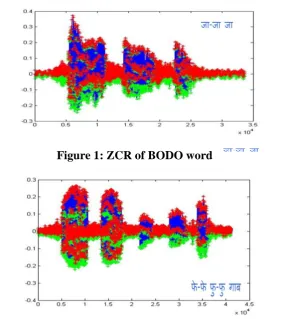
Figure 1: ZCR of BODO word
Figure 2: ZCR of BODO words
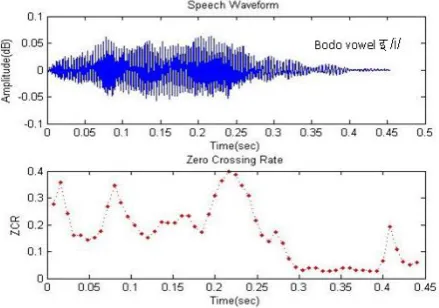
Figure 4: ZCR of BODO vowel इ /i/
Number of BODO male and female informants are taken 5 (five) each i.e. total ten speakers
are considered in our experiments. Through Matlab program ZCR values are computed using
step by step method applying the algorithm mentioned above for six (6) vowels of Bodo
language, which are recorded frame by frame. Following tables depicts the behaviour of the
recorded ZCR values:
Table 2: ZCR OF SIX BODO VOWELS UTTERED BY FEMALE INFORMANTS
Informants Frames
Bodo vowels /i/
/इ/
/u/ /उ/
/e/ /ए/
/o/ /अ/
/a/ /आ/
/ɯ/ /ओ/
Female1
0.0 46 47 47 49 50 50
0.5 47 48 48 44 51 52
1.0 43 50 49 47 53 55
1.5 46 49 51 48 49 56
2.0 47 50 50 49 48 58
Female2
0.0 48 50 50 48 50 54
0.5 46 48 45 50 53 55
1.0 50 52 50 52 48 54
1.5 47 49 51 53 54 56
2.0 48 50 49 49 56 55
Female3
0.0 52 49 48 52 50 53
0.5 48 48 52 52 52 54
1.0 47 50 50 51 51 55
1.5 49 52 52 51 49 55
2.0 52 51 49 50 49 56
Female4
0.0 47 52 50 54 53 58
0.5 52 45 50 49 52 54
1.0 54 49 51 50 51 55
1.5 50 52 48 50 51 58
Female5
0.0 45 48 50 50 50 54
0.5 53 51 51 51 51 52
1.0 50 52 50 51 50 56
1.5 46 50 54 49 45 54
2.0 45 50 49 53 53 53
Table 3: ZCR OF SIX BODO VOWELS UTTERED BY MALE INFORMANTS
Informants Frames
Bodo vowels /i/
/इ/
/u/ /उ/
/e/ /ए/
/o/ /अ/
/a/ /आ/
/ɯ/ /ओ/
Male1
0.0 52 52 50 52 48 46
0.5 53 51 51 52 51 48
1.0 52 55 50 50 46 52
1.5 49 52 49 50 50 53
2.0 49 52 50 51 50 55
Male2
0.0 51 52 49 54 50 51
0.5 50 45 51 52 50 52
1.0 53 51 49 52 48 51
1.5 53 52 50 51 47 53
2.0 52 49 50 50 52 52
Male3
0.0 53 55 49 50 48 51
0.5 52 53 49 49 48 50
1.0 53 52 50 49 49 50
1.5 49 50 49 51 46 49
2.0 53 52 51 48 50 50
Male4
0.0 52 53 50 49 48 55
0.5 53 56 50 48 49 51
1.0 53 55 49 52 49 52
1.5 50 55 50 49 49 51
2.0 51 53 49 48 52 50
Male5
0.0 52 50 49 49 49 53
0.5 56 48 50 47 46 53
1.0 53 52 49 48 51 49
1.5 51 49 51 51 52 53
2.0 54 49 51 48 50 49
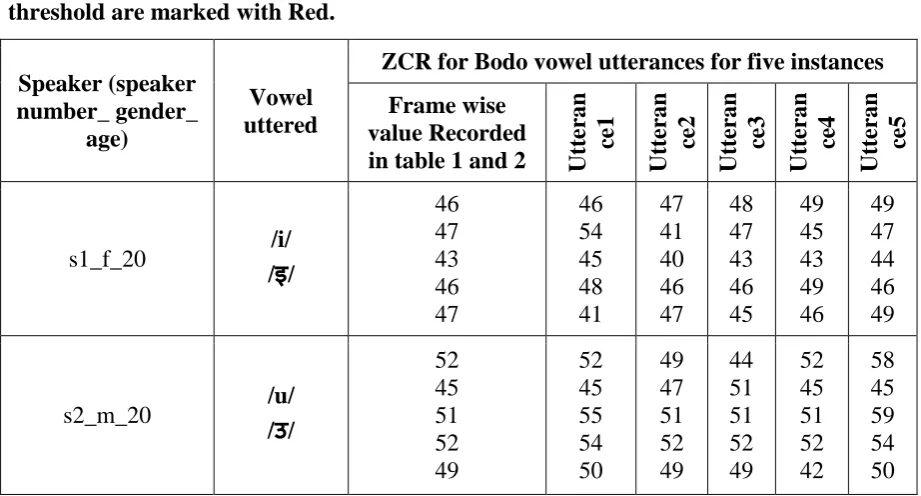
In a classical way, to test authentication of speaker based on only the ZCR feature one single
speaker is asked to utter the same vowel sound five times and the experiment is repeated for
four more speakers (total five informants). These are performed in noise free studio
environment. With repeated tests to avoid false rejection and false acceptance a threshold of
±5 is accepted which provides best result in our study. After the study of frame by frame
values for a specific utterance by a particular informant for five times the following (table 4)
Table 4: Frame wise ZCR comparison for male and female speakers. Values beyond threshold are marked with Red.
Speaker (speaker number_ gender_
age)
Vowel uttered
ZCR for Bodo vowel utterances for five instances Frame wise
value Recorded in table 1 and 2 Utt
er an ce1 Ut te ran ce2 Ut te ran ce 3 Ut te ran ce4 Ut te ran ce5
s1_f_20 /i/
/इ/ 46 47 43 46 47 46 54 45 48 41 47 41 40 46 47 48 47 43 46 45 49 45 43 49 46 49 47 44 46 49
s2_m_20 /u/
/उ/ 52 45 51 52 49 52 45 55 54 50 49 47 51 52 49 44 51 51 52 49 52 45 51 52 42 58 45 59 54 50
Utterance1 and utterance5 of speaker s1_f_20 are rejected. Similarly for speaker s2_m_20
utterance3 and utterance5 are rejected. In the same manner total five male speakers were
tested for total six vowels for five repetition of the same vowel (5x6x5=150 utterances) and
the same experiment is conducted for the female speakers. All together 150x2=300 utterances
are tested.
Table 4 records the attempted authentication trials and the outcome. In our experiment which
follows classical method of feature matching, authentication rate achieved is 79.67%. Though
the final result is not satisfactory, if other features such as Short Time Energy, Mel Frequency
cepstral coefficient, Linear Predictive coefficient are used along with ZCR are extracted and
features are mixed to define the feature vectors, the authentication is expected to reach a very
efficient and effective level.
Total number of speakers= 10 (5 male + 5 female) Total utterances by each speaker= 30 (6 vowels x 5 times) Grand total utterances= 300 (10 speakers x 30 utterances)
Successful Failed Average PERFORMANCE
Speaker1 26 4 86.67
79.67
Speaker2 27 3 90.00
Speaker3 21 9 70.00
Speaker4 22 8 73.33
Speaker5 22 8 73.33
Speaker6 24 6 80.00
Speaker8 24 6 80.00
Speaker9 25 5 83.33
Speaker10 23 7 76.67
=80% (approximately)
Section E: result analysis and discussion
In our paper based on only single feature ZCR, a classical method of speaker authentication is
represented for Bodo isolated speech words. It can be beneficial in developing a Speaker
Identification and Authentication System for Bodo language. Due to the direct and indirect
effects of various factors, speaker authentication possesses many inherent complexities
making the process immensely difficult. The basic and natural rule is that each and every
human being exhibits unique parameters in their speech waves. ZCR values can be invaluable
contributor in this regard. Thus ZCR for all six vowel phonemes are studied through this
paper and their behavior is monitored frame by frame in time domain. Experiment results
achieves 80% authentication result which is moderate for a system but also proves worthy as
it is based only on one feature. With a quality database and addition of more feature(s) will
increase the authentication rate.
REFERENCES
1. Juang B.H., Rabiner Lawrence R. Rabiner (2004), Automatic Speech Recognition – A
Brief History of the Technology Development‟.
2. A U khan, L. P Baishya, S.K. Banchhor, “Hindi Speaking person identification using
ZCR”, IJSCE, july 2012; 2(3).
3. S. K. Banchhor, A. Khan, “musical instrument recognition using Zero crossing Rate and
Short Time Energy” , IJAIS, 2012; 1: 3.
4. Baro Madhu Ram (1990),‟Structure of Bodo Language‟, N. L. Publications.
5. Baro Madhu Ram, (2008), „Structure of Bodo Language‟, N.L Publications.
6. Basumatary Phukan (2005), „An Introduction to the Bodo Language‟, Mittal Publication
7. Bodo M.R. (1991), „Assamese and Bodo, A Comparative Study‟, Priyadini Publications.
8. Borz. Porat, “A course in digital Signal Processing”, John Willy & sons. 1997.
9. CATFORD, J. C. (1994), „A Practical Introduction to Phonetics‟, Oxford University
Press.
10.Chong F. L. (2004), „Objective Speech Quality Measurement for Chinese Speech‟,
11.D. Talkin, (1987), „Speech Formant Frequency estimation using dynamic programming
with modulated transition cost‟, AT&T Bell Lab, McGraw Hill, NJ.
12.Allen J., Hunnicutt S., Klatt D. (1987). From Text to Speech: The MITalk System.
Cambridge University Press, Inc.
13.Atal, B. S. and Hanauer, S.L. (1971), „Speech analysis and Synthesis by Linear Prediction
of Speech Wave‟, J. Acoust Soc. Am., 50: pp 637-655.
14.Juang B.H., Rabiner Lawrence R. Rabiner (2004), Automatic Speech Recognition – A
Brief History of the Technology Development‟.
15.Rabiner L. R. and Schafer R. W., (2009), „Theory and Application of Digital Speech
Processing‟, pp 425-452.
16.Rabiner L.R. and Schafer R. W. (1978), „Digital Processing of Speech Signals‟,
Englewood Clifts, N.J. Prentice Hill.
17.Rabiner, L. R and B. H. Juang, (1993), „Fundamental of Speech Recognition‟,
Prentice-Hall, Englewood Cliff, New Jersy.
18.Talukdar P. H. (2010), „Speech Production, Analysis and Coding‟, Lambert Academic
Publishing.
19.Welling L. and Ney H. (1998), „Formant Estimation of Speech Recognition‟, IEEE trans,
Speech and Audio processing Sept 1985; pp-134.
20.Costas panagiotakis and G. Tzigitas, “A speech/music discriminator based on RMS and
Zero Crossing”, IEEE transaction on multimedia. feb’ 2005; 7(1).
21.D.A.Reynolds, Speaker Identification and verification using Gaussian mixture speaker
models, Speech Communication, 1995; 17(1): 91-108.
22.D. A. Reynolds, Experimental evaluation of features for robust speaker identification,
IEEE Trans. Speech Audio Processing, 1992; 2(4): 639-643.
23.Zhang Wanfeng, Yang Yingchun, Wu Zhaohui, Sang Lifeng, Experimental Evaluation of
a New Speaker Identification Frame work using PCA, IEEE International Conference on
Systems, Man and Cybernetics, Oct 2003; 5: 4147- 4152.
24.G. Saha, Sandipan Chakroborty, Suman Senapat, A New Silence Removal and Endpoint
Detection Algorithm for Speech and Speaker Recognition Applications, Proceedings of
the NCC 2005, Jan 2005.
25.M. Ito, R. Donaldson, “Zero-crossing measurements for analysis and recognition of
speech sounds, IEEE Transactions on Audio and Electro acoustics”, Sep 1971; 19, 3: 235
26.L. R. Rabiner , B. Atal, “A pattern recognition approach to voiced-unvoiced-silence
classification with applications to speech recognition, IEEE Transactions on Acoustics,
Speech and Signal Processing, Jun 1976; 24(3): 201-212.
27. L. R. Rabiner, M. R. Sambur , “ An algorithm for determining the end points of isolated
utterances, Bell System Technical Journal (BSTJ), Feb 1975; 54: 297-315,
28.Wei Han, Cheong-Fat Chan, Chiu-Sing Choy, Kong-Pang Pun, “An efficient MFCC
extraction method in speech recognition, “IEEE ISCAS, 2006.
29.D. O'Shaughnessy, “Linear Predictive Coding”, IEEE Potentials, 1988; 7(1): 29-32.
30.S. Furui, “Digital speech processing, Synthesis and Recognition”, New York, Marcel