Sabale et al. World Journal of Pharmaceutical and Medical Research
ISOLATION AND CHARACTERIZATION OF AZURIN PRODUCING PSEUDOMONAS
SPP. AND OPTIMIZATION OF PRODUCTION PROCESS
Sabale S. S.*1, Koli A.D.2, Marathe R. J.3 and Phatake Y. B.4
1,2
Department of Biotechnology, Vidya Pratishthan School of Biotechnology, Baramati-413133, Maharashtra, India. 3
Department of Microbiology, Shardabai Pawar Mahila College, Malegaon Bk., Baramati-413115, Maharashtra, India. 4
Department of Microbiology, Vidya Pratishthan School of Biotechnology, Baramati-413133, Maharashtra, India.
Article Received on 02/09/2017 Article Revised on 23/09/2017 Article Accepted on 13/10/2017
INTRODUCTION
The secondary metabolites from microorganisms play a vital role as lead compound in developing new drug and in chemotherapeutics even though chemotherapy is efficient in enhancing patient survival with primary tumors continue to have deprived prognosis (Samuilov, et al., 2003). Researchers have reported several secondary metabolite including biopigment, that shows various bioactivities like antimicrobial, anticancer, immunosuppressive, immunomodulatory, antitumor etc. (Phatake, et al., 2014).
Azurin, a low molecular weight cupredoxin produced by Pseudomonas aeruginosa and some other bacteria,which is a promising source of therapeutic peptides since it has anticancer, antiparasitic and anti-HIV properties (Fialho, et al., 2008). Azurin a redox protein that can enter human breast cancer cells and induce apoptosis mediated by the tumor suppressor P53 protein (Samuilov, et al, 2003, Yamada, et al., 2002b).
Peptides from microbes have already shown to be useful in many pathologies like diabetes, infective diseases (bacterial, fungal and viral), oncology and osteoporosis
(Vlieghe, et al., 2010). The majority of these peptides are derived from protein active sites although some are designed based on genetic, recombinant and chemical libraries (Duncan, 2008).
Azurin also reported to function in cell cycle arrest (Chaudhari, et al., 2007) and inhibits angiogenesis (Mehta, et al., 2011) through interaction with different molecules. In particular, azurin’s p28 peptide, corresponding to amino acids 50 to 77 which include the PTD (protein transduction domain) responsible for cell entry, is able to induce apoptosis and inhibit angiogenesis and recently ended phase I clinical trials (Mehta, et al., 2011; Yamada, et al., 2009).
Another azurin derived peptide, p26, corresponding to amino acid 88 to 113, was identified as being structurally similar to ephrinB2, the EphB2 ligand. p26 is able to competitively bind to EphB2 inhibiting cellular signaling pathways that ultimately contribute for cancer growth (Chaudhari, et al., 2007).
Recently, P-cadherin, which is associated with breast cancer patients with poor prognosis (Paredes, et al.,
ISSN 2455-3301
WJPMR
AND MEDICAL RESEARCH www.wjpmr.com
*Corresponding Author: Sabale S. S.
Department of Biotechnology, Vidya Pratishthan School of Biotechnology, Baramati-413133, Maharashtra, India.
ABSTRACT
The secondary metabolites from microorganisms play a vital role in developing new chemotherapeutics. Microorganisms especially bacteria produce different secondary metabolites which had proved to be one of the most important source of lead compounds. In the present study potent azurin producing bacteria were isolated and screen from from three soil samples (Maharashtra, India) and identified by morphological, biochemical and molecular method (16s r DNA) as Pseudomonas aeruginosa which produce a biologically active protein azurin, that has array of bioactivities. The produced azurin was extracted and qualitatively characterized by using conventional and modern analytical methods. The spectroscopic study shows lambda max of produced protein as 225nm. Finally the production process of azurin was optimized by classical method. The selected strain of bacteria produces maximum azurin in selective media-I containing yeast extract and potassium nitrate as carbon and nitrogen source respectively. The optimum pH for the yield of azurin was found to be 7. The time and temperature of incubation was also optimized as 24 hrs. and 37˚C respectively. Optimum speed of agitation for the azurin production was found to be 150rpm.
2007; Ribeiro, et al., 2010), was identified as a new target molecule for azurin (Fialho, 2009).
The researcher also found that cell growth and protein production by Pseudomonas is influenced by carbon and nitrogen sources as well as other physical parameters.
The aim of the present study was to isolate potent azurin producing Pseudomonas strain from the environmental sample and qualitative and quantitative characterization of the produced protein. The selected strain will be further identified up to species level by molecular method. Finally the production process will be optimized by using classical method to get maximum yield of the azurin.
MATERIALS AND METHODS
Sample collection
Three soil samples were collected from different regions of Baramati and Satara of Maharashtra, India, for isolation of azurin producing microorganisms (bacteria). The samples were collected from 8-10cm depth using a sterile spatula and transferred to pre-autoclaved sterile glass bottles with rubber stoppers. All samples were brought to the laboratory and stored in refrigerator until use (Marathe, et al., 2015).
Enrichment, isolation and characterization of bacteria
For the enrichment, one gram of each soil sample was inoculated in nutrient broth (100 ml) aseptically and incubated at 37oC for 5-6 days in rotating shaker incubator. One ml from each sample was mixed with 9 ml sterilized saline and the suspension was serially diluted up to 10-8 dilution. From the diluted suspension 0.1ml from 10-4 onward was transferred onto the sterile nutrient agar plates. These plates were then incubated at 37±2˚C for 24 hrs, as azurin is a secondary metabolite, produced by microbes in stationary phase of growth.
After incubation, the plates were observed for the isolated colonies. Selected colonies were re-streaked on same media to get pure culture. Selected bacterial isolates were screen on the basis of their azurin production ability.
One potent azurin producing bacterial strain was characterized by standered morphological and biochemical techniques.
Selected isolate was also identified upto species level by molecular method (16s r DNA).
Molecular identification of isolate
For 16s r DNA sequencing selected bacterial strain was subjected to chromosomal DNA extraction (CTAB extraction method). After extraction quality of the DNA
amplification. Forward primer 5' AGAGTTTGATCMTGGCTCAG 3' 27F and reverse primer 5' TACGGYTACCTTGTTACGACTT 3' 1492R were used for this reaction. After reaction PCR products quality was tested on agarose gel electrophoresis and it was sequenced by using big dye terminator V 3.1 cycle sequencing kit, (make-applied bio systems). The analysis was carried out as per the instrument instruction manual and the sequence of the sample was used for further analysis when it passes the all necessary criteria (Worden, et al., 2009).
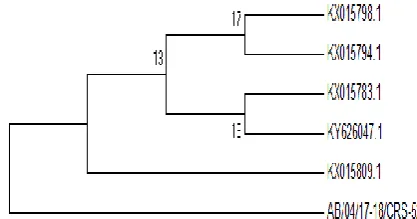
The obtained sequence was analyzed by NCBI alignment server and finally phylogenetic tree was constructed.
Qualitative and quantitative characterization of azurin
After 24 hrs incubation, cells were harvested by centrifugation at 10000 g for 15 min. Cell pellets was collected and suspended in the appropriate volume of 0.02M potassium phosphate buffer (pH 7) with protease inhibitor and kept in the ice basket for sonication. Then cells were sheared by ultra sonicator (ultrasonics) of approximately 100 ml batches of cell suspension. All batches were sonicated for 1-2 min. at 100W. After sonication the samples was stirred vigorously and centrifuged at 10000g for 20 min. which removes cell debris. The green-brown crude supernatant was stored at 4OC until further use. Precipitate was resuspended in same buffer, stirred vigorously, centrifuged and the supernatant were stored with the previous extracts.
Spectroscopic study
The extracted supernatant was used for determination of its maximum absorbance (lambda max). For this the collected supernatant were exposed to different wavelength (200-400) of UV-visible spectrophotometer and the absorbance at different wavelength was recorded. The values of absorbance were plotted against respective wavelength for calculation of lambda max.
Nanodrop method
A standard curve is required every time before initiating the assay. The sample protein was loaded onto the lower measurement pedestal and sampling arm was lowered. Finally yield was calculated in mg/ml.
Optimization of production process
as carbon source. This medium was additionally supplemented separately with nitrogen sources as ammonium sulphate, ammonium nitrate, ammonium chloride, potassium nitrate and tryptone. The pH plays vital role in growth and development of microorganism. Provision of optimum pH is necessary for proper growth and maximum yield. So for optimization of the pH, the selected Pseudomonas aeruginosa was inoculated in selective medium having different pH viz.4, 4.5, 5, 5.5, 6, 6.5, 7, 7.5 and 8. Production of azurin which is a secondary metabolite was generally starts in stationary phase of growth, so to determine optimum incubation time for production, organism was incubated for different time interval (6, 12, 18, 24, 30, 36, 42, and 48 hrs.). Provision of optimum temperature is extremely important for optimum functioning of vital enzymes in bacteria. 0.1ml suspension of the Pseudomonas aeruginosa was inoculated in medium and incubated in different temperature viz. 20, 31, 37 and 400C. The 0.1ml suspension of the isolate was inoculated in the previously optimized medium and incubated in rotary shaker incubator at different speed of agitation viz. 0, 50, 100, 150 and 200rpm for checking effect of agitation on production process. After each run of optimization, final yield of azurin was determined by nanodrop method.
RESULTS AND DISCUSSION
Isolation and screening of bacteria
After incubation growth was observed on all plates of nutrient agar. However only the greenish colored colonies, which are peculiar characteristics of Pseudomonas spp. were selected as potential isolates. Total two isolates were obtained from selected soil samples. These isolates were labeled as SS1 and SS2.
Selected two isolates were screen for their ability to produce azurin by using UV-visible spectroscopic studies and it was further quantified by using nanodrop method. The spectroscopic studies showed that both the
selected isolated bacteria produce peptide showing similarity with azurin.
Figure 1: Spectroscopic study of Azurin extract.
Whereas on the basis of yield of azurin obtained by nanodrop method, one potential isolate (SS 1) was selected for further study, because it showed yield up to 0.8564 mg/ml. while SS 2 producing azurin 0.6458 mg/ml.
Identification of the isolate
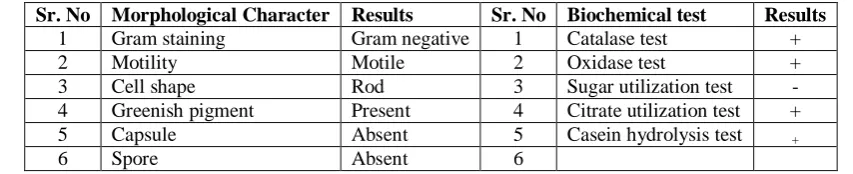
After growth on nutrient agar isolate SS1 showed greenish yellow colored colonies by producing a diffusible pigment. The biochemical characters were performed by using standard methods described in Bergey’s manual of determinative bacteriology. According to King E.O. et.al. (1954) Pseudomonas aeruginosa colonies appear green to bluish-green due to production of pyocyanin pigments.
The results obtained with morphological and biochemical characteristics (Table: 1) for SS1 were compared with the characters of reference Pseudomonas aeruginosa (Bergey’s Manual of Determinative Bacteriology) and it was found that SS1 exhibits more similarity with the Pseudomonas aeruginosa.
Table 1: Morphological and Biochemical Characterization of isolate SS1.
Sr. No Morphological Character Results Sr. No Biochemical test Results 1 Gram staining Gram negative 1 Catalase test + 2 Motility Motile 2 Oxidase test + 3 Cell shape Rod 3 Sugar utilization test - 4 Greenish pigment Present 4 Citrate utilization test + 5 Capsule Absent 5 Casein hydrolysis test + 6 Spore Absent 6
Molecular identification of isolate
Figure 2: Quality of extracted DNA on agarose gel.
After reaction PCR products quality was tested on agarose gel electrophoresis. PCR amplified DNA bands were observed on UV transilluminator. First well consist of 1kb ladder and second well consist of 1450 bp amplified PCR product.
Figure 3: Amplified PCR product on agarose gel.
PCR product was then subjected to nucleotide sequencing. Results of the cycle sequencing reaction can be seen on genetic analyzer computer using software sequencing analysis 5.2. The obtained sequence was submitted to National Center for Biotechnology Information, with accession number KY982541 (Sabale, S. S. et al., 2017).
Sample name: (SS1):
TTCAGCGGCGGACGGGTGAGTAATGCCTAGGAATCTGCCTGGTAGTGGGGGATAACGTCCGGA AACGGCGCTAATACCGCATACGTCCTGAGGGAGAAAGTGGGGGATCTTCGGACCTCACGCTATC AGATGAGCTAGGTCGGATTAGCTAGTTGGTGGGGTAAAGGCCTACCAAGGCGACGATCCGTAA CTGGTCTGAGAGGATGATCAGTCACACTGGAACTGAGACACGGTCCAGACTAATACGGGAGGC AGCAGTGGGGAATATTGGACAATGGGCGAAAGCCTGATCCAGCCATGCCGCGTGTGTGAAGAA GGTCTTCGGATTGTAAAGCACTTAAGTTGGGAGGAAGGGCAGTAAGTTAATACCTTGCTGTTTT GACGTTACCAACAGAATAAGCACCGGCTAACTTCGTGCCAGCAGCCGCGGTAATACGAAGGGT GCAAGCGTTAATCGGAATTACTGGGCGTAAAGCGCGCGTAGGTGGTTCAGCAAGTTGGATGTGA AATCCCCGGGCTCAACCTGGGAACTGCATCCAAAACTACTGAGCTAGAGTACGGTAGAGGGTG GTGGAATTTCCTGTGTAGCGGTGAAATGCGTAGATATAGGAAGGAACACCAGTGGCGAAGGCG ACCACCTGGACTGATACTGACACTGAGGTGCGAAAGCGTGGGGAGCAAACAGGATTAGATACC CTGGTAGTCCACGCCGTAAACGATGTCGACTAGCCGTTGGGATCCTTGAGATCTTAGTGGCGCA GCTAACGCGATAAGTCGACCGCCTGGGGAGTACGGCCGCAAGGTTAAAACTCAAATGAAT
Figure 4: 16 s r DNA sequence of the isolate.
Phylogenetic relationship with first five BLAST results from NCBI gen bank database, proved that isolated bacteria is Pseudomonasaeruginosa.
Optimization of production process
viz. tryptone was found to show positive induction effect on production of secondary metabolite.
Figure 6: Effect of type of media on azurin production.
Effect of carbon source on azurin production
For evaluation of effect of carbon source on azurin production total six carbon source such as glucose, lactose, maltose, sucrose, fructose and yeast extract was separately added in selective medium-I. Less yield of azurin was obtained from medium containg maltose, lactose fructose and sucrose while positive effect on yield of azurin was found in the flask supplemented with glucose, highest yield was obtained in yeast extract.
Figure 7: Effect of carbon source on azurin production.
Effect of nitrogen source on azurin production
The effect of different nitrogen source on yield of azurin was determined with selective media-I and yeast extract as a carbon source. The medium was additionally supplemented with nitrogen source such as ammonium sulphate, ammonium nitrate, ammonium chloride, potassium nitrate and tryptone. Highest azurin was obtained from flask containg potassium nitrate followed by tryptone and ammonium nitrate. Ammonium chloride and ammonium sulphate was found to be not supporting biosynthesis of azurin as their presence in the medium decrease azurin yield.
Figure 8: Effect of nitrogen source on azurin production.
Effect of pH on azurin production
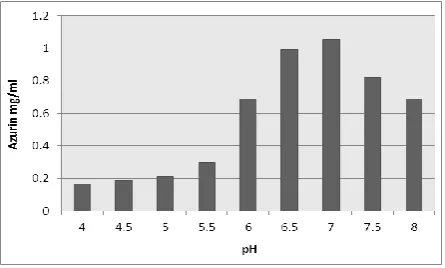
More acidic or more alkaline condition is not suitable for number of microorganism for synthesis and production of metabolite. Selective medium containing yeast extract as carbon source and KNO3 as nitrogen source with different pH i.e. 4, 4.5, 5, 5.5, 6, 6.5, 7, 7.5 and 8 were used. Highest growth and yield was obtain at pH 7 followed by 6, 6.5, 7.5 & 8. While azurin yield was significantly decreased at acidic conditions (pH 4, 4.5, 5 and 5.5).
Figure 9: Effect of pHon azurin production.
Figure 10: Effect of incubation time on azurin production.
Effect of incubation temperature on azurin production
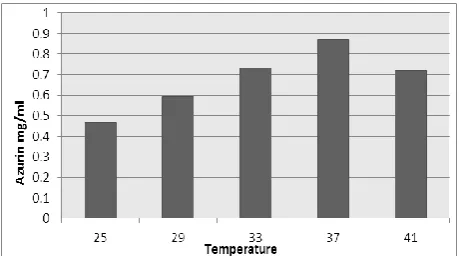
Provision of optimum temperature is extremely important for proper growth and functioning of vital enzymes. Selective medium-I supplemented with yeast extract as carbon source and KNO3 as a nitrogen source was incubated at different temperature viz. 20ºC, 31ºC, 37ºC and 400C. After incubation azurin yield was determined, highest product was obtained from the flask incubated at 37ºC, notable decrease in azurin conc. was found with change in temperature.
Figure 11: Effect of incubation temperature on azurin production.
Optimization of speed of agitation.
The effect of agitation on azurin production was studied by incubating medium at different speed i.e. 0, 50, 100, 150 and 200 rpm, after incubation final yield was determined by nanodrop method and it was found that maximum yield was obtained at 150 rpm followed by 200 and 100 rpm, but at low (0, 50 and 100) rpm significant decrease in the final yield was observed.
Figure 12: Effect of agitation on azurin production.
CONCLUSION
The soil samples used for isolation of the azurin producer were found to be thriving source of the various microorganisms. Both the selected bacterial isolates were successfully screen for their azurin producing ability and one potent isolate SS1 was identified upto species level by molecular method (16s r DNA). The produced protein was qualitatively characterized as azurin by spectroscopic studies which are reliable and accurate method for characterization of bimolecule. In shake flask culture, yield and cell density was found to significantly depend upon the media used. Selective medium-I gives highest yield of azurin as it contains CuSo4 and a mineral base with KNO3 as a sole source of nitrogen and yeast extract as the carbon source.
The pH of the medium play vital role in the the biosynthesis of metabolites. The earlier studies revealed that an optimum pH range for the growth of bacterial strains is between 6.0 and 7.0. In case of Pseudomonas spp. high biomass and protein content was observed at neutral pH.
Incubation period affected the growth rate of the cultures, to short or long incubation period reduced the total protein content of the culture. It may be due to the accumulation of other by-products in the medium. In case of Pseudomonas aeruginosa high biomass and protein content observed at 18 to 24 hrs of the incubation.
Finally the optimum temperature for azurin production was observed in the flask incubated at 370C. for 150 rpm. The large scale production using optimized parameter show two fold increase in the of azurin production, authenticating the significance and accuracy of the optimization process.
REFERNCES
1. Almas, O., Nersesyan, A., Kitada, S. and Ilin, A. Parasporins as new natural anticancer agents: a review. Journal of BUON, 2015; 20: 5-16.
3. Bernardes, N., Chakrabarty, M. and Fialho, M. Engineering of bacterial strains and their products for cancer therapy. Appl Microbiol Biotechnol, 2013; 97: 5189-99.
4. Bernardes, N., Seruca, R., Chakrabarty, M. and Fialho, M. Microbial based therapy of cancer: current progress and future prospects. Bioengineered Bug, 2010; 1: 178-90.
5. Fialho, M., Bernardes, N. and Chakrabarty, M. Recent patents on live bacteria and their products as potential anticancer agents. Recent Pat Anti-Cancer Drug Discovery, 2012L 7: 31-55.
6. Chaudhari, A., Fialho, M., Ratner, D., Gupta, P., Hong, S., Kahali, S., Yamada, T., Haldar, K., Murphy, S., Cho, W., et al. Azurin, Plasmodium falciparum malaria and HIV/AIDS: inhibition of parasitic and viral growth by Azurin. Cell Cycle, 2006; 5: 1642-1648.
7. Chaudhari, A., Mahfouz, M., Fialho, M., Yamada, T., Granja, T., Zhu, Y., Hashimoto, W., Schlarb- Ridley, B., Cho, W., Das Gupta, K., et al. Cupredoxin-cancer interrelationship: azurin binding with EphB2, interference in EphB2 tyrosine phosphorylation, and inhibition of cancer growth. Biochemistry, 2007; 46: 1799-1810.
8. Dang, H., Bettegowda, C., Huso, L., Kinzler, W., Vogelstein, B. Combination bacteriolytic therapy for the treatment of experimental tumors. Proc Natl Acad Sci USA, 2001; 98: 15155-15160.
9. Duncan Patrick, M. Discovering and improving novel peptide therapeutics. Current Opinion in Pharmacology, 2008; 8: 616-619.
10. Fialho, M., Das Gupta, K. and Chakrabarty, M. Designing Promiscuous Drugs? Look at What Nature Made. Letters in Drug Design & Discovery, 2007; 4: 40-43.
11. Fialho, M., Das Gupta, K., Chakrabarty, M. Promiscuous drugs from pathogenic bacteria in the post-antibiotics era. In Patho-Biotechnology, R. Sleator, and C. Hill, eds. (Landes Bioscience), 2008; 145-162.
12. Fialho, M., Stevens, J., Das Gupta, K., Chakrabarty, M. Beyond host-pathogen interactions: microbial defense strategy in the host environment. Current Opinion in Biotechnology, 2007; 18: 279- 286. 13. Fleming, A. (1980) Classics in infectious diseases:
on the antibacterial action of cultures of a penicillium, with special reference to their use in the isolation of B. influenzae by Alexander Fleming, Reprinted from the British Journal of Experimental Pathology, 10: 226-236.
14. Marathe, R.., Phatake, Y. and Sonavne, A. Bioprospecting of Pseudomonas aeruginosa for their potential to produce Siderophore, process optimization and evaluation of its bioactivity. International journal of bioassays, 2015; 4(2): 3667-3675.
15. Mehta, R., Yamada, T., Taylor, B., Christov, K., King, M., Majumdar, D., Lekmine, F., Tiruppathi, C., Shilkaitis, A., Bratescu, L., et al. A cell
penetrating peptide derived from azurin inhibits angiogenesis and tumor growth by inhibiting phosphorylation of VEGFR-2, FAK and Akt. Angiogenesis, 2011; 14: 355-369.
16. P. neerajaa, T., Parthasarathyb, M. and Sudhakarc. evaluation of different culture media for enhanced production of pseudomonas aeruginosa (mtcc no 2453) biomass and its proteins. Int. j. pharm. Pharm. sci, 2016; 11: 120-123.
17. Paredes, J., Correia, A., Ribeiro, A., Albergaria, A., Milanezi, F. and Schmitt, F. P-cadherin expression in breast cancer: a review. Breast Cancer Research, 2007; 9.
18. Parr, S., Barber, D. and Greenwood, C. Purification procedure for the soluble cytochrome oxidase and some other respiratory proteins from Pseudomonas aeruginosa. Biochem J, 1976;157: 423-430. 19. Phatake, Y. and Dharmadhikari, S. Evaluation of
cytotoxic and anticancer activity of prodigiosin produced by Serratia spp. American Journal of Pharmtech research, 2016; 6(3): 720-736.
20. Pozdnyakova, I., Guidry, J. and Wittung-Stafshede, P. Copper stabilizes azurin by decreasing the unfolding rate. Arch Biochem Biophys, 2001; 390: 146-148.
21. Punj, V., Bhattacharyya, S., Saint-Dic, D., Vasu, C., Cunningham, E A., et al. Bacterial cupredoxin azurin as an inducer of apoptosis and regression in human breast cancer. Oncogene, 2004; 23: 2367-2378.
22. Punj, V., Das Gupta, T. and Chakrabarty, A. Bacterial cupredoxin Azurin and its interations with the tumor suppressor protein p53. Biochem Biophys Res Commun, 2003; 312: 109-114.
23. Puri, R. Development of a recombinant interleukin 4 Pseudomonas exotoxin for therapy of glioblastoma. Toxicol Pathol, 1999; 27: 53-7.
24. Ramachandran, S., Sarkar, S., Mazumadar, A. and Mandal, M. Azurin Synthesis from Pseudomonas aeruginosa MTCC 2453, Properties, Induction of Reactive Oxygen Species, and p53 stimulated apoptosis in Breast Carcinoma Cells. J. Cancer Sci. Ther, 2011; 3: 104-111.
25. Ribeiro, A., Albergaria, A., Sousa, B., Correia, A., Bracke, M., Seruca, R., Schmitt, F. and Paredes, J. Extracellular cleavage and shedding of P-cadherin: a mechanism underlying the invasive behaviour of breast cancer cells. Oncogene, 2010; 29: 392- 402. 26. Samuilov, V. Microbial therapy of cancer: induction
of apoptosis, recombinant vaccines and inhibition of angiogenesis. Biochemistry (Mosc), 2003; 68: 958-962.
27. Schuler, M., Bossy-Wetzel, E., Goldstein, J., Fitzgerald, P. and Green, D. 53 induces apoptosis by caspase activation through mitochondrial cytochrome c release. J Biol Chem, 2000;275: 7337-7342.
sequence of Pseudomonas aeruginosa PAO1: an opportunisticpathogen. Nature, 2000; 406: 959-64. 29. Sutherland, I. The production of azurin and similar
proteins. Arch Microbiol, 1966; 54: 350-357. 30. Taylor, B., Mehta, R., Yamada, T., Lekmine, F.,
Christov, K., Chakrabarty, A., Green, A., Bratescu, L., Shilkaitis, A., Beattie, C.W., et al. Noncationic Peptides Obtained From Azurin Preferentially Enter Cancer Cells. Cancer Research, 2009; 69; 537-546. 31. Vlieghe, P., Lisowski, V., Martinez, J. and
Khrestchatisky, M. Synthetic therapeutic peptides: science and market. Drug Discovery Today, 2010; 15: 40-56.
32. Yamada, T., Goto, M., Punj, V., Zaborina, O., Kimbara, K., Das Gupta, T. and Chakrabarty, A. The Bacterial Redox Protein Azurin Induces Apoptosis in J774 Macrophages through Complex Formation and Stabilization of the Tumor Suppressor Protein p53. Infection and Immunity, 2002; 70: 7054-7062.
33. Yamada, T., Mehta, R., Lekmine, F., Christov, K., King, M., Majumdar, D., Shilkaitis, A., Green, A., Bratescu, L., Beattie, C.W., et al. A peptide fragment of azurin induces a p53-mediated cell cycle arrest in human breast cancer cells. Molecular cancer therapeutics, 2009; 8: 2947-2958.