Bhakte et al. World Journal of Engineering Research and Technology
VORTEX TUBE REFRIGERATION: A REVIEW
Dr. U. V. Kongre1, N. R. Bhakte*2 and D. R. Dixit2
1
Associate Professor, Mechanical Engineering, J.D.I.E.T. Yavatmal Maharashtra.
2
Student, Mechanical Engineering, J.D.I.E.T. Yavatmal Maharashtra.
Article Received on 09/02/2018 Article Revised on 02/03/2018 Article Accepted on 23/03/2018
ABSTRACT
The technology is making our environment poorly for existence, by
emission of hazardous elements that causes depletion of ozone layer
and affects the human comfort. A cooling is very important for both
man and machine. In general vapor compression refrigeration system
and vapor absorption refrigeration system are used for refrigeration purpose.
Non-conventional type of cooling system means Vortex tube cooling system which is not used
widely for cooling purpose. Vortex tube has many advantages over the conventional cooling
system. Separating cold and hot streams by using vortex tube can be used in industrial
application such as cooling equipment’s and refrigerants. The objective of the paper is to
review the concept of vortex tube that used for refrigeration purpose and in future can be the
best replacement over conventional refrigeration systems.
KEYWORDS: Environment, ozone layer, refrigeration system.
I. INTRODUCTION
The vortex tube is a device which generates separated flows of cold and hot gases from a
single compressed gas source. The vortex tube was invented quite by accident in 1933 by
George Ranque and later developed by Hilsch (1947). In memory of their contribution the
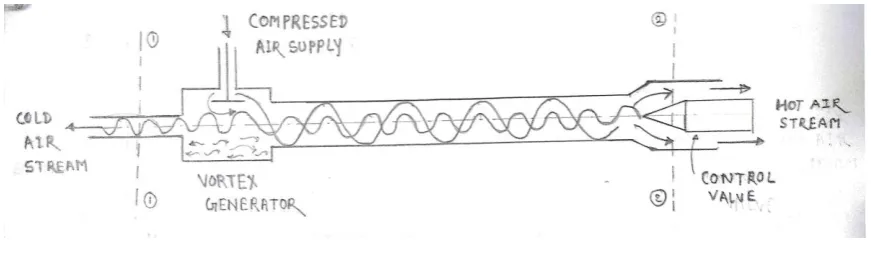
Vortex tube is also known as Ranque-Hilsch vortex tube (RHVT).It contains the parts: inlet
nozzle, vortex chamber, cold-end orifice, hot-end control valve and tube. The working
principle of the vortex tube is as shown in Fig.1. Compressible fluid is tangentially
introduced into the vortex tube through the nozzles, due to the cylindrical structure of the
tube and depending on its inlet pressure and speed, leads a circular movement inside the
World Journal of Engineering Research and Technology
WJERT
www.wjert.org
SJIF Impact Factor: 5.218*Corresponding Author N. R. Bhakte
vortex tube at high speeds. A pressure difference between the tube walls is lower than the
speed at the tube center, because of the effects of wall friction. As a result, fluid in the center
region transfers energy to the fluid at the tube wall. The cooled fluid leaves the tube by
moving against the main flow direction after a stagnation point, whereas the heated fluid
leaves the tube in the main direction. The RHVT is widely used for both cooling and heating
purpose.
Many researches had been carried out to find the reason of separation of air streams
happening inside the tube. Mischer and Bespalov explained that energy separation takes place
because of entropy generation, still the theory is unacceptable. Kassener and knoernschild in
their work proposed that the pressure difference causes the separation of air streams also they
have undergone the work that converts initially free vortex in to forced vortex, since then
vortex tube has become a topic of research. Changes in the components of vortex tube has
practiced and analyzed the results with the Ranque-Hilsch tube. A diffuser was installed
between the cone valve and the vortex tube outlet, experiments shows that the cold air
temperature TC reduced tremendously and increases the refrigeration effect. The cylindrical
tube geometry when converted to conical tube, the hot air temperature TH, and cold air
temperature TC were quite high compared to conical tube. The results obtained were
impressive by changing the aspect ratio (L/D), number of nozzles.
Fig. 1: Schematic diagram of vortex tube.
Vortex tube has many advantages it is a simple device, no moving parts, no electricity or
chemicals, small and light weight, low cost, less maintenance, instant cold air, durable
because of material used (stainless steel, aluminum), clean work media. Vortex tube has
following applications it is used in spaced suits, for spot cooling in welding, in CCTV
camera. In future because of its advantages vortex tube can be the best replacement over
conventional refrigeration system.
The research efforts taken by different researchers are discuss all the information in a table
format which contain name of literature, parameter, experiment investigation and
investigation of parameters are as fallows.
S. No.
Name Of
Researcher Parameter
Experimental
Investigation Investigation of parameter
1
prabakaran vaidyanathan kanagarajan .
L/D ratio 15
Diameter of vortex tube 12 mm
No of nozzles 1
Diameter of nozzle 2, 3, and 4 mm
Diameter of Orifice 5, 6, and 7 mm
A thermally insulated Vortex tube with L/D ratio of 15 is fabricated in the laboratory. Three different nozzles and orifices are used for the experiment to investigate the performance of vortex tube.
The significant factors affecting the performance of vortex tubes are pressure and diameter of nozzle.
The optimum diameter of nozzle is 2.969 mm .The optimum diameter of orifice is 5 mm. The optimum pressure is 4.474 bar 2 Nurhasanah Ismaila, Wirachman Wisnoeb, Muhammad Fairuz Remelic
Length of hot side 400 and 450.
Length of cold side 100 and 150.
Diameter of cold and hot side 25.4 and 19.05
He is investigated on ratio of length and diameter.
As we increase L/D ratio the pipe delivers more cooling effect and we also notice that we increase the pressure the cooling effect increase.
3
M. Selek, S. Tasdemir, K.
Dincer, S.
Baskaya
15 to 20 mm Diameter and 100mm length
experiments were conducted on the cutting tool nose point of the lathe at different diameters
The maximum performance of RHVT was found to be, for a diameter of sample ¼ 15 mm, cutting depth ¼ 3 mm and cutting speed ¼ 800 rpm.
4 Yunpeng Xue
et al.
Tube Inner Diameter 18mm, Cold Plate Orifice Diameter 9mm, Inlet Nozzle Diameter 2mm,
Length: Hot End 810, Length: Cold End 20-30mm.
Temperature separation in a Ranque–Hilsch vortex tube has been investigated. The effects of the geometrical parameters, including inlet nozzles, cold exit, hot exit and length of the tube, were investigated,
The energy separation in the vortex tube seems to involve a number of different factors, among which expansion and friction between the flow layers could be considered as the most important. Clarification of the conflicts about the secondary flow and static temperature gradient and evaluation of different factors needs further research.
5
Hemant V.
Darokar
Dr. Sachin L. Borse
Kiran D.
Devade
Diameter 12.5mm,
Length 225mm.
Experiment on change in
pressure and find
temperature difference.
With the increase in pressure more cold air is available for cooling also temperature difference increases these parameter increases the cooling
effect. The maximum
temperature difference of 27°C is obtained in cold end side while 18°C is obtained in hot end side.
Anish Raj K. 18mm, Cold Plate Orifice Diameter 9mm, Inlet Nozzle Diameter 2mm,Length 840mm
nozzle. conversion of pressure to
velocity. It doesn't have much contribution in the energy separation process. The area of nozzle is a constant for given tube size and number of nozzles depends on mass flow rate possible
7
Gupta U. S. Joshi M. K. and Pawar C.B
Length = 150 mm Diameter of the inlet = 4
mm, Diameter of cold end = 6 mm, Diameter of nozzle opening = 2 mm ,Angle at hot end = 45
The experiment was
conducted to investigate the effect of the cold mass fraction on the cold air temperature drop, rise in hot air temperature, isentropic
efficiency and the
thermodynamic analysis was carried out to evaluate the performance of the vortex tube.
The maximum temperature drop was observed for cold mass fraction of 0.4.
8
K Kiran
Kumar Rao, A
Ramesh, M.
Rajesh G.Naga Malleswara Rao
nozzle 8 mm diameter and orifice 6 mm diameter. L/D =22/8.
Experiment on increase in the pressure at the entrance of the vortex tube results in
an increase in the
performance of the vortex tube with 2, 4, 6 nozzles.
The best performance is obtained with the vortex tube which has 4 nozzles. The effect of number of nozzle is very important for improve better
cop. 4. The secondary
circulation zone is determined by controlling the vortex stopper location.
9
Jaykumar D. Golhar
B.R. Rathod A.N. Pawar, PhD.
Tube Length, L=300 mm
Number of Nozzles, N= 3. Nozzle angle =30
Pressure, P =2.0 bar Orifice diameter =3.7 mm
Experimental Investigation and Optimization of Vortex Tube with Regard to Nozzle Diameter
A unique nozzle diameter that gives the optimum performance for various geometrical parameters like nozzle angle, orifice diameter ,nozzle number, tube length and physical parameter like pressure . The optimum value of nozzle diameter (Dn) for maximum cold temperature drop max is 3.2 mm.
10
Suraj S Raut, Dnyaneshwar
N Gharge,
Chetan D
Bhimate et al
Diameter tube 24mm, Orifice diameter 12mm
Number of inlet
nozzles 2, Diameter of nozzle 3.6mm.
An experimental study has been conducted to evaluate the effect of working parameters such as inlet air pressure, Cold mass fraction and length of hot side tube.
The highest temperature drop is found between 0.4-0.6 cold air mass fraction. 5. At 10 bar Inlet pressure, 40 L/D ratio and 0.6 Cold mass fraction give the best result
11
A. M.Dalavi, Mahesh
Jadhav, Yasin Shaikh,
Avinash Patil
Diameter of nozzles
32.7mm, Length
200mm, Diameter of nozzle is 4.5mm.
Experiment on various parameters like cross section area of cold and hot end, nozzle area of inlet compressed air, cold orifice
area, hot end area of the tube, and L/D ratio
valve. Vortex tube can be used for any type of spot cooling or spot heating application
12 M. H. Saidi M. S. Valipour
Inner diameter 18 mm. diameter of the orifice at cold air exit 9 mm.
An experimental
investigation has been performed to realize thorough behavior of a vortex tube system. In this work attention has been focused on the classification of the parameters affecting vortex tube operation
Nozzle with more number of flow intakes causes cold air temperature and efficiency to decrease. So far, the cold air
temperature difference
increases by increasing the inlet pressure, the inlet pressure optimum efficiency at a specific inlet pressure. Energy separation decreases in the presence of moisture in the inlet flow.
13
Tejshree Bornare, Abhishek Badgujar and Prathamesh Natu
cold orifice diameter 10mm,
Pressure Range = (9-8 bar)
Temperature
Difference (∆) = 23℃
An experimental
investigation has been performed to realize thorough behavior of a vortex tube system. In this work attention has been focused on the classification of the parameters affecting vortex tube operation
Efficient working point of the existing design is at a cold mass fraction 0.84 for an inlet pressure of 5bar and small cold orifice (d/D=0.4).
14 S. Rejin, H. Thilakan
Angle of cone 100 to 300, orifice diameters 4 to 7.
The experiment investigate with conical valve in fully
closed position and
corresponding readings were noted, then without altering the inlet conditions the conical valve opens in millimeter steps. By controlling the opening of the valve, the quantity of the cold air and its temperature can be varied.
Finally it was observed from the study that as the cone angle decreases from 45° to 10° there will be a temperature difference of 3.5°C without altering the inlet conditions. It gives strong evidence that apart from the effect of pressure, orifice diameter, nozzle diameter, the hot end area, the hot end valve angle have much significance in temperature reduction process.
15
R. Madhu
Kumar, V.
Nageswar
Reddy, B.
Dinesh Babu.
Diameter of tube 20 mm, Length of tube 135 mm. Diameter of orifice 6 mm, Diameter of nozzle 5 mm, No of nozzle 1.
Experiment investigation on conical hot tube and that of cylindrical hot tube
It is clear that at any given pressure the temperature of the conical hot tube is better when compared to cylindrical hot Tube and the temperature difference between them is proportional to pressure i.e., the temperature difference is increasing progressively with pressure.
Pawar,
Prof. N. C. Ghuge.
400mm, diameter of cold orifice 5mm, diameter of inlet nozzle 4.5mm.
Diameter of tube 21 15 12mm.
geometrical parameters on
the operational
characteristics of vortex tube, vortex tube with different tube sizes is constructed.
of compressed air the
temperature drop at the end of tube increases. At 9 bar pressure maximum temperature drop observed. The maximum temperature difference of 12.4 ᵒC is obtained on cold side while 8.5ᵒ C is obtained on hot side of Vortex tube.
17
Y. S. Ahire, A. P. Ware, C. J. Mandge, R. H. Pardeshi.
Diameter of vortex tube 25mm, length of vortex tube is varied from 250mm, 519mm, and 769 mm, Diameter of cold orifice 8mm to 125 mm, Diameter of cone nozzle 8mm,
Experiment on energy separation in vortex tube for different tube diameter and length keeping all other parameter constant. It is observed that tube diameter and length with double inlet nozzle greatly influence on the cooling efficiency and energy separation.
In set of different tube diameter 12mm, 15mm and 21mm the tube with 15mm diameter gives best output. In set of different length 300mm, 350mm, and 400mm the tube with length
400 mm gives best
performance.
18
Sachin Godse, Devendra singh Sikarwar.
Nozzle diameter 13
mm , Diaphragm
diameter 7mm, Length
of tube 377mm,
Diameter of tube = 24mm
Investigation of Change in Working Parameters on the Performance of the Vortex Tube with CFD Analysis
High pressure we get more temperature difference. As pressure decreases temperature difference also decreases.
III. CONCLUSION
From the study of above literature it is revealed that the maximum research done by changing
the various parameter like diameter of nozzle, diameter of orifice, angle of conical valve,
diameter of vortex tube, length of vortex tube, L/D ratio and pressure difference. There is
need to give attention towards different materials by knowing the thermal conductivity, bulk
strength. With the help of these parameters we may lead maximum temperature difference in
between hot air stream and cold air stream. The optimum results are obtained with inlet
pressure of 5 bars, conical angle in between 450 to 900, diameter of nozzle of 2.969 mm,
diameter of orifice of 5 mm, and such as L/D ratio. This results in increasing the efficiency of
vortex tube refrigeration. Hence, vortex tube can be used for any type of spot cooling or spot
heating application.
1. Prabakaran j. Vaidyanathan s. , kanagarajan d. “establishing empirical relation to predict
temperature difference of vortex tube using response surface methodology”.
2. Nurhasanah Ismaila, Wirachman Wisnoeb, Muhammad Fairuz Remelic “Experimental
Investigation of Orifice Diameter, Swirl Generator and Conical Valve Shape to the
Cooling Performance of Ranque-Hilsch Vortex Tube”, Applied Mechanics and
Materials, 2014; 510: 174-178
3. M. Selek , S. Tasdemir , K. Dincer , S. Baskaya “ Experimental examination of the
cooling performance of Ranque-Hilsch vortex tube on the cutting tool nose point of the
turret lathe through infrared thermography method”, International Journal of
Refrigeration, 2011; 34: 807-81.
4. Yunpeng Xue , Maziar Arjomandi , Richard Kelso “Experimental study of the flow
structure in a counter flow Ranque–Hilsch vortex tube”, International Journal of Heat and
Mass Transfer, 2012; 55: 5853–5860.
5. Hemant V. Darokar, Dr. Sachin L. Borse, Kiran D. Devade “Experimental Investigations on Divergent Vortex Tube with Convergent Entry Nozzles”, International Journal of
Engineering Research & Technology (IJERT), August – 2012; 1(6): ISSN: 2278-0181.
6. T sankar Ram and K Anish raj “An Experimental Performance Study of Vortex Tube Refrigeration System”, International Journal of Engineering Development and Research,
17-22.
7. Gupta U. S., Joshi M. K. And Pawar C.B. “Experimental Performance Evaluation Of
Counter Flow Vortex Tube”, Journal Of Environmental Research And Development,
2012; 7(1): 496-502.
8. K Kiran Kumar Rao, A Ramesh, M. Rajesh, G.Naga Malleswara Rao “Experimental analysis of vortex tube by varying the geometry and material a review”, Journal of
Mechanical Engineering and Biomechanics.
9. Jaykumar D. Golhar, B.R. Rathod, A.N. Pawar, “Experimental Investigation and
Optimization of Vortex Tube with Regard to Nozzle Diameter”, International Conference
on Benchmarks in Engineering Science and Technology ICBEST 2012 Proceedings
published by International Journal of Computer Applications® (IJCA).
10. Suraj S Raut, Dnyaneshwar N Gharge, Chetan D Bhimate, Mahesh A. Raut, S.A. Upalkar and P.P. Patunkar “An Experimental Modeling and Investigation of Change in Working Parameters on the Performance of Vortex Tube”, International Journal of
11. A. M. Dalavi, Mahesh Jadhav, Yasin Shaikh, Avinash Patil Modeling, “Optimization & Manufacturing of Vortex Tube and Application”, IOSR Journal of Mechanical and Civil
Engineering, 45-49 Second National Conference on Recent Developments in Mechanical
Engineering.
12. M.H. Saidi, M.S. Valipour, “Experimental modeling of vortex tube refrigerator”.
13. Tejshree Bornare, Abhishek Badgujar and Prathamesh Natu, “Vortex Tube Refrigeration System based on Compressed Air”, International Journal of Mechanical Engineering and
Technology, 2015; 6(7): 97-102.
14. S.Rejin, H.Thilakan, “Experimental Analysis on Vortex Tube Refrigerator Using Different Conical Valve Angles”, International Journal of Engineering Research and
Development e-ISSN: 2278-067X, p-ISSN: 2278-800X.
15. R.Madhu Kumar, V. Nageswar Reddy, B. Dinesh Babu “Performance Improvement of
Ranque-Hilsch Vortex Tube by Using Conical Hot Tube”, International Journal of
Engineering Research, 3(1): 48-51.
16. Mr. Rahul Dilip Pawar, Prof. N. C. Ghuge International Engineering Research Journal
(IERJ) Special Issue, June 2016; Page 1158-1161, ISSN 2395-1621.
17. Y. S. Ahire, A. P. Ware, C. J. Mandge, R. H. Pardeshi. International journal of advanced
technology in engineering and science (ijates).
18. Sachin Godse, Devendra singh Sikarwar A Review on Modeling and Investigation of
Chang in Working Parameters on the Performance of the Vortex Tube with CFD