Volume-7 Issue-1
International Journal of Intellectual Advancements
and Research in Engineering Computations
Improved adaptive duty cycling model using senma base LBC-DDU
algorithm for wireless sensor networks
Vaishnavi R
1, Vidhyavarshini P
1, Venkateshprasath M
1, Vetry G,
1Mrs.M.Umamaheshwari M.E., Ph.D
21
UG Students, KSR College of Engineering, Tiruchencode
2
Assistant Professor, KSR College of Engineering, Tiruchencode.
ABSTRACT
In an energy harvesting sensor actor network, a node recharges its battery from harvestable sources, such as solar, wind and vibrations. Sustainability of the network till next recharge time is one of the most important challenges in harvesting sensor networks. In this paper, a fuzzy based adaptive duty cycling algorithm has been proposed to achieve the network sustainability in harvesting sensor actor networks. In this work, current residual energy, predicted harvesting energy (for a futuristic time slot) and predicted residual energy parameters are considered as fuzzy input variables to estimate duty cycle for a sensor node. In this work, a harvesting model has been adopted to predict the harvesting energy. In this paper implement the mobile access coordinated wireless sensor network (MC-WSN) a novel energy efficient scheme for time-sensitive applications. In conventional sensor networks with mobile access points (SENMA), the mobile access points (MAs) traverse the network to collect information directly fr om individual sensors. In SENMA, the mobile access points (MAs) traverse the network to collect the sensing information directly from the sensor nodes. SENMA model improved the energy efficiency of the individual sensor nodes over ad -hoc networks by relieving sensors from complex and energy-consuming routing functions. A major limitation with SENMA is that a transmission is made only if an MA visits the corresponding source node and thus, data transmission is largely limited by the physical speed of the MAs and the length of their trajectory, resulting in low throughput and large delay. The main limitation of these existing approaches is that data transmission depends on the physical speed of the access point, which is not desirable for time -sensitive applications. This thesis proposed a three-layer framework is proposed for mobile data transmission in wireless sensor networks, which includes the sensor layer, cluster head layer, and mobile collector layer. The framework employs distributed load balanced clustering and dual data uploading, which is referred to as DDU. The objective is to achieve good scalability, and low data transmission latency. At the sensor layer, a distributed load balanced clustering algorithm is proposed for sensors to self-organize themselves into clusters. In contrast to existing clustering methods, the scheme generates multiple cluster heads in each cluster to balance the work load and facilitate dual data uploading. The paper simulations are conducted to evaluate the effectiveness of the proposed scheme. The results show that when each cluster has at most two cluster heads, the scheme achieves over more energy saving per node and more energy saving on cluster heads comparing with data collection through multi -hop relay to the static data sink.
INTRODUCTION
Wireless Sensor Networks are heterogeneous systems containing many small devices called sensor nodes and actuators with general-purpose computing elements. These networks will consist of hundreds or thousands of low cost, low power and self-organizing nodes which are highly distributed either inside the system or very c lose to it. These nodes consist of three main components-sensing, data processing and communication. Two other components are also there called, aggregation and base station. Aggregation point’s gathers data from their neighboring nodes, integrates the collected data and then forwards it to the base station for further processing. Various applications of WSN includes habitat monitoring, manufacturing and logistics, environmental observation and forecast systems military applications, health, home and office application and a variety of intelligent and smart systems.
Advances in wireless networking, micro-fabrication and integration (for examples, sensors and actuators manufactured using micro-electromechanical system technology, or MEMS), and embedded microprocessors have enabled a new generation of massive-scale sensor networks suitable for a range of commercial and military applications. The technology promises to revolutionize the way we live, work, and interact with the physical environment. In a typical sensor network, each sensor node operates count either and has a microprocessor and a small amount of memory for signal processing and task scheduling. Each node is equipped with one or more sensing devices such as acoustic microphone arrays, video or still cameras, infrared (IR), seismic, or magnetic sensors. Each sensor node communicates wirelessly with a few other local nodes within its radio communication range. The following characteristics of wireless sensor network they are Compact size
Physical security Power
Memory space Bandwidth
Unreliable communications
The information management and networking for sensor networks will require more than just
building faster routers, switchers, and browsers. A sensor network is designed to collect information from a physical environment. In many applications, it is more appropriate to address nodes in a sensor network by physical properties, such as node locations or proximity, than by IP addresses.
Terrestrial WSNs
In these, nodes are distributed in a given area either in an ad hoc manner (sensor nodes are randomly placed into the target area by dropping it from plane) or in pre -planned manner (sensor nodes are placed according to grid placement, optimal placement, 2-d and 3-d placement models). Since battery power is limited and it cannot be recharged, terrestrial sensor nodes must be provided with an optional power source such as solar cells.
Underground WSNs
In these, sensor nodes are buried underground or in a cave or mine th at monitors the underground conditions. Sink nodes are deployed above the ground to forward the gathered information from the sensor nodes to the base station. These are more expensive than the terrestrial sensor networks because proper nodes are to be selected that can assure reliable communication through soil, rock, water and other mineral contents.
Underwater WSNs
In these, sensor nodes and vehicles are located underwater. Autonomous vehicles are used for gathering the data from the sensor nodes. Sparse deployment of nodes is done in this network. Main problems that come under this while communicating are limited bandwidth, long propagation delay and signal fading issue.
Multimedia WSNs
RELATED WORKS
Kenan Xu et al [1] describe the lifetime of a wireless sensor network (WSN) by designing energy efficient networking protocols, the impact of random device deployment on system lifetime is not stressed enough. Some research efforts have tried to optimize device deployment with respect to lifetime by assuming devices can be placed deliberately. However, the methodologies and solutions therein are not applicable to a randomly deployed large scale WSN. In this research, we propose three random deployment strategies for relay nodes in a heterogeneous WSN, namely, connectivity-oriented, lifetime-oriented and hybrid deployment. We investigate how a strategy can affect both connectivity and network lifetime of a multi-hop heterogeneous WSN, in which relay nodes transmit data to the base station via multi-hop relay. The performance of the three strategies is evaluated through simulations. The results of this research provide a viable solution to the problem of optimizing provisioning of a large scale heterogeneous WSN.
Jin Wang et al [2] describemany applications of wireless sensor networks (WSNs) where sensors are deployed in areas accessed by laid roads sinks can be assembled on mobile devices like bus or handcart. Compare to WSNs with static sink(s), Wireless Sensor Networks with Mobile Sink(s) (MSSNs) are more dominant at energy economization, delay decrease and network lifetime prolongation. In this paper, we propose a Global Best Path (GBP) data gathering algorithm based on wireless Sensor Networks with single Mobile Sink (GBP-MSSN). It aims at determining the best position for the single mobile sink and further using global sensors’ information to generate the best scheme to gather data from specified node. Generating of best scheme is conducted by GBP algorithm which can balance energy consumption among whole sensor networks and further prolong the network lifetime. Simulation results show that our GBP-MSSN algorithm outperforms conventional algorithms like LEACH, GAF, etc.
Yan Wu et al [3] describes maximize the network lifetime, which is defined as the time until the first node depletes its energy. The problem is
shown to be NP-complete. We design an algorithm which starts from an arbitrary tree and iteratively reduces the load on bottleneck nodes (nodes likely to soon deplete their energy due to high degree or low remaining energy). We then extend our work to the case when there are multiple base stations, and study the construction of a maximum lifetime data gathering forest. We show that both the tree and forest construction algorithms terminate in polynomial time and are provably near optimal. We then verify the efficacy of our algorithms via numerical comparisons.
Arati Manjeshwar et al [4] describe the wireless sensor networks are expected to find wide applicability and increasing deployment in the near future. In this paper, propose a formal classification of sensor networks, based on their mode of functioning, as proactive and reactive networks. Reactive networks, as opposed to passive data collecting proactive networks, respond immediately to changes in the relevant parameters of interest. We also introduce a new energy efficient protocol, TEEN (Threshold sensitive Energy Efficient sensor Network protocol) for reactive networks. We evaluate the performance of our protocol for a simple temperature sensing application. In terms of energy efficiency, our protocol has been observed to outperform existing conventional sensor network protocols.
In the current body of research done in the area of wireless sensor networks, we see that particular attention has not been given to the time criticality of the target applications. Most current protocols assume a sensor network collecting data periodically from its environment or responding to a particular query. We feel that there exists a need for networks geared towards responding immediately to changes in the sensed attributes. We also believe that sensor networks should provide the end user with the ability to control the trade-off between energy efficiency, accuracy and response times dynamically. So, in our research, we have focused on developing a communication protocol which can fulfill these requirements.
distributed and cooperative wireless sensor networks. Assuming a space-time block coding (STBC) based MIMO system, the energy and delay efficiencies of the proposed MIMO-based communications scheme are derived using analytic techniques. The efficiency of the proposed MIMO-based communication system is related to the system and channel propagation parameters. These investigations show that MIMO techniques can be made to provide significant energy savings and delay efficiencies at the same time with judicious choice of system parameters at the design level. Further, the dependence of energy efficiency of proposed MIMO-based wireless sensor network on fading coherence time and the required amount of training is analyzed. These results justify the application of proposed cooperative MIMO-based scheme in wireless sensor networks even after allowing for additional training overheads.
SYSTEM MODEL
A wireless sensor network (WSN) consists of spatially distributed autonomous sensors to monitor physical or environmental conditions, such as temperature, sound, pressure, etc. and to cooperatively pass their data through the network to a main location. The more modern networks are bi-directional, also enabling control of sensor activity. The development of wireless sensor networks was motivated by military applications such as battlefield surveillance; today such networks are used in many industrial and consumer applications, such as industrial process monitoring and control, machine health monitoring, and so on. The WSN is built of "nodes" – from a few to several hundreds or even thousands, where each node is connected to one (or sometimes several) sensors. Each such sensor network node has typically several parts: a radio transceiver with an internal antenna or connection to an external antenna, a microcontroller, an electronic circuit for interfacing with the sensors and an energy source, usually a battery or an embedded form of energy harvesting.
A sensor node might vary in size from that of a shoebox down to the size of a grain of dust, although functioning "motes" of genuine microscopic dimensions have yet to be created.
The cost of sensor nodes is similarly variable, ranging from a few to hundreds of dollars, depending on the complexity of the individual sensor nodes. Size and cost constraints on sensor nodes result in corresponding constraints on resources such as energy, memory, computational speed and communications bandwidth. The topology of the WSNs can vary from a simple star network to an advanced multi-hop wireless mesh network. The propagation technique between the hops of the network can be routing or flooding. cluster heads, which means that the size of CHG of each cluster is no more than M. Each sensor is covered by at least one cluster head inside a cluster. The LBC algorithm is comprised of four phases: (1) Initialization; (2) Status claim; (3) Cluster forming and (4) Cluster head synchronization. The existing system has following disadvantages.
How to find polling points and compatible pairs for each cluster is not studied.
Partition the continuous space to locate the optimal polling point for each cluster is not carried out.
To achieve optimal overall spatial diversity is not carried out.
The main contributions of this proposed work can be summarized as follows. First, we propose a distributed algorithm to organize sensors into clusters, where each cluster has multiple cluster heads. In contrast to clustering techniques proposed in previous works [10] algorithm balances the load of intra-cluster aggregation and enables dual data uploading between multiple cluster heads and the mobile collector. Second, multiple cluster heads within a cluster can collaborate with each other to perform energy efficient inter-cluster transmissions.
The Sen Car collects data from the cluster heads by visiting each cluster. It chooses the stop locations inside each cluster and determines the sequence to visit them, such that data collection can be done in minimum time. Our work mainly distinguishes from other mobile collection schemes the utilization of MU- IMO technique, which enables dual data uploading to shorten data transmission latency. We coordinate the mobility of Sen Car to fully enjoy the benefits of dual data uploading, which ultimately leads to a data collection tour with both short moving trajectory and short data uploading time.
The proposed system includes solving the problem of how to find polling points and compatible pairs for each cluster. A discretization scheme is developed to partition the continuous space to locate the optimal polling point for each cluster. Then finding the compatible pairs becomes a matching problem to achieve optimal overall spatial diversity. The second problem is how to schedule uploading from multiple clusters. An algorithm that adapts to the transmission scheduling algorithms is included.
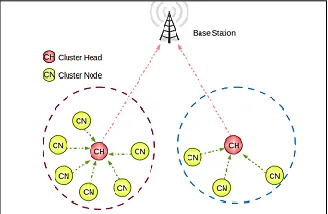
Fig 1.1 MC-WSN Architecture
The first step in the software development life cycle is the identification of the problem. As the success of the system depends largely on how accurately a problem is identified. At present distributed load balanced clustering algorithm is
presented at the sensor layer in which the essential operation of clustering is the selection of cluster heads. To prolong network lifetime, it is naturally expected the selected cluster heads are the ones with higher residual energy.
Fig 1.2 LEACH aggregation algorithm
ESENMA
Wireless sensor network (WSN) has been identified as a key technology in green communications, due to its indispensable role in
Unmanned Aerial Vehicles (UAVs) have been utilized in wireless sensor networks for data collection as well as for sensor management and network coordination. For efficient and reliable communication over large scale networks, sensor network with mobile access points (SENMA) was proposed.
In ESENMA, the mobile access points (MAs) traverse the network to collect the sensing information directly from the sensor nodes. SENMA has been considered for military applications, where small low-altitude unmanned aerial vehicles (UAVs) serve as the mobile access points that collect sensing information for surveillance, reconnaissance and collaborative spectrum sensing . When the energy consumption at the MAs is not of a concern, SENMA improves the energy efficiency of the individual sensor nodes over ad-hoc networks by relieving sensors from complex and energy-consuming routing functions. While simplifying the routing process, a major limitation with SENMA is that a transmission is made only if an MA visits the corresponding source node; thus, data transmission is largely limited by the physical speed of the MAs
and the length of their trajectory, resulting in low throughput and large delay.
In addition to ESENMA, ad hoc networks with mobile sinks have also been explored by other researchers. In a mobile sink is utilized for data collection, where it visits a limited number of pre-defined collection points in the network. Each sensor routes its information to the nearest collection point through multi hop routing, then data is delivered to the sink when it visits the corresponding location. Similar approach has been considered. As in the case of the conventional ESENMA, the main limitation of these approaches is that data transmission depends on the physical speed of the access point, which is not desirable for time-sensitive applications.
EXPERIMENTAL RESULTS
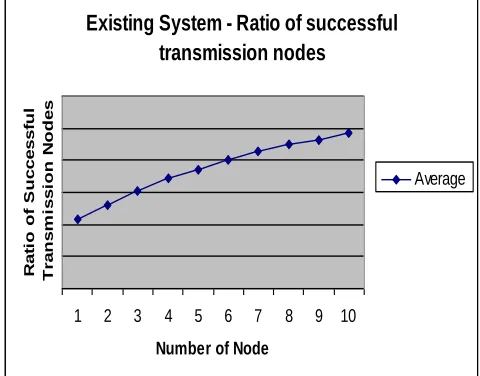
The following Table 5.1 describes experimental result for existing system successive transmission node analysis. The table contains number of time slot interval and given time interval to calculate average numbers of send transmission node details are shown
Table 5.1 Transmission Ratio-SENMA S.NO NUMBER OF
TIME SLOT (M)
RATIO OF SUCCESSIVE TRANSMISSION NODE
1 10 0.43
2 20 0.52
3 40 0.61
4 60 0.69
5 80 0.74
6 100 0.80
7 120 0.86
8 140 0.90
9 150 0.93
10 160 0.97
The following Figure 5.1 describes experimental result for existing system successive transmission node analysis. The table contains number of time slot interval and given time interval to calculate average numbers of send transmission node details are shown
Fig 5.1 Transmission Ratio-SENMA
Table 5.2 Transmission Ratio-ESENMA S.NO NUMBER OF
TIME SLOT (M)
RATIO OF SUCCESSIVE TRANSMISSION NODE
1 10 0.48
2 20 0.57
3 40 0.66
4 60 0.72
5 80 0.77
6 100 0.83
7 120 0.89
8 140 0.92
9 150 0.95
10 160 0.98
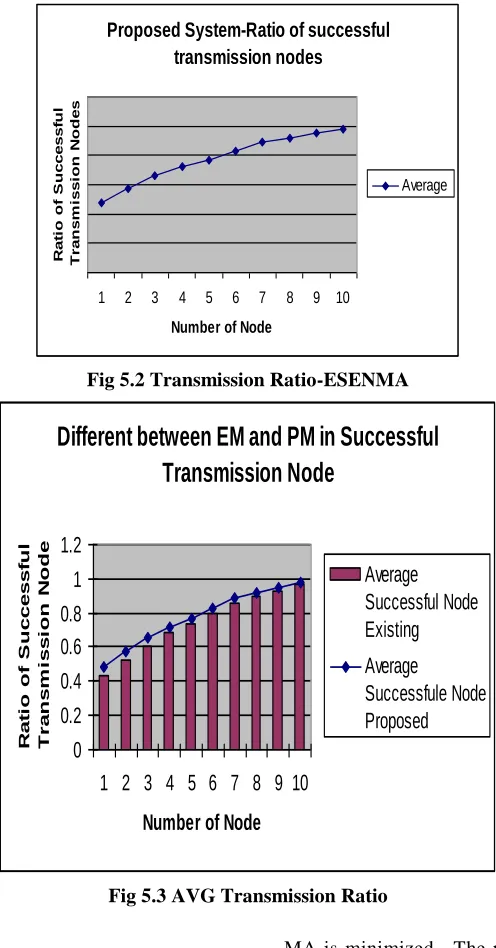
The following Figure 6.2 describes experimental result for proposed system successive transmission node analysis. The table contains
number of time slot interval and given time interval to calculate average numbers of send transmission node details are shown
Existing System - Ratio of successful
transmission nodes
1 2 3 4 5 6 7 8 9 10
Number of Node
R
a
ti
o
o
f
S
u
c
c
e
s
s
fu
l
T
r
a
n
s
m
is
s
io
n
N
o
d
e
s
Fig 5.2 Transmission Ratio-ESENMA
Fig 5.3 AVG Transmission Ratio
CONCLUSION
A mobile access coordinated wireless sensor networks (MC-WSN) architecture was proposed for reliable, efficient, and time-sensitive information exchange. MC-WSN exploits the MAs to coordinate the network through deploying, replacing, and recharging nodes, as well as detecting malicious nodes and replacing them. The hierarchical and heterogeneous structure makes the MC-WSN a highly resilient, reliable, and scalable architecture. In this proposed system provided the optimal topology design for MC-WSN such that the average number of hops from any sensor to the
MA is minimized. The proposed system analyzed the performance of MC-WSN in terms of throughput. It was shown that with active network deployment and hop number control, MC-WSN achieves much higher throughput and energy efficiency over the conventional SENMA. Our analysis also indicated that with hop number control, network analysis does become more tractable. Moreover, putting MC-WSN in the bigger picture of network design and development, we provided a unified framework for wireless network modeling and characterization
Proposed System-Ratio of successful transmission nodes
1 2 3 4 5 6 7 8 9 10
Number of Node
R a ti o o f S u c c e s s fu l T r a n s m is s io n N o d e s Average
Different between EM and PM in Successful
Transmission Node
0
0.2
0.4
0.6
0.8
1
1.2
1 2 3 4 5 6 7 8 9 10
Number of Node
REFERENCES
[1]. G. Mergen, Z. Qing, and L. Tong, “Sensor networks with mobile access: Energy and capacity considerations,” IEEE Transactions on Communications, 54(11), 2006, 2033–2044.
[2]. I. Maza, F. Caballero, J. Capitan, J. Martinez-de Dios, and A. Ollero, “A distributed architecture for a robotic platform with aerial sensor transportation and self-deployment capabilities,” Journal of Field Robotics, 28(3), 2011, 303–328. [Online]. Available: http://dx.doi.org/10.1002/rob.20383.
[3]. M. Abdel hakim, L. Lightfoot, J. Ren, and T. Li, “Architecture design of mobile access coordinated wireless sensor networks,” IEEE International Conference on Communications, ICC’13, 2013, 1720–1724.
[4]. G. Mergen and L. Tong, “Maximum asymptotic stable throughput of opportunistic slotted ALOHA and applications to CDMA networks,” IEEE Transactions on Wireless Communications, 6(4), 2007, 1159–1163, Apr.
[5]. P. Gupta and P. Kumar, “The capacity of wireless networks,” IEEE Transactions on Information Theory, vol. 46(2), 2000, 388–404.
[6]. E. J. Duarte-Melo and M. Liu, “Data-gathering wireless sensor networks: organization and capacity,” Computer Networks, 43(4), 2003, 519–537, wireless Sensor Networks.
[7]. M. Grossglauser and D. Tse, “Mobility increases the capacity of ad hoc wireless networks,” IEEE/ACM Transactions on Networking, 10(4), 2002, 477–486.
[8]. H. Wu, C. Qiao, S. De, and O. Tonguz, “Integrated cellular and ad hoc relaying systems: iCAR,” IEEE Journal on Selected Areas in Communications,, 19(10), 2001, 2105–2115.
[9]. M. Abdelhakim, J. Ren, and T. Li, “Throughput analysis and routing security discussions of mobile access coordinated wireless sensor networks,” IEEE Global Communications Conference (GLOBECOM’14), 2014, 4616–4621.
[10]. S. Cui, A. J. Goldsmith, and A. Bahai, “Energy-constrained modulation optimization,” IEEE Trans. Wireless Commun., 4(5), 2005, 2349–2360.
[11]. Z. Zhang, M. Ma, and Y. Yang, “Energy efficient multi-hop polling in clusters of two-layered heterogeneous sensor networks,” IEEE Trans. Comput., 57(2), 2008, 231–245.
[12]. B. Gedik, L. Liu, and P. S. Yu, “ASAP: An adaptive sampling approach to data collection in sensor networks,” IEEE Trans. Parallel Distrib. Syst., 18(12), 2007, 1766–1783.