Article
Evaluating Approximate Point Forecasting of
Count Processes
Annika Homburg1 , Christian H. Weiß1,* , Layth C. Alwan2 , Gabriel Frahm1 and Rainer Göb3
1 Department of Mathematics and Statistics, Helmut Schmidt University, 22043 Hamburg, Germany
2 Sheldon B. Lubar School of Business, University of Wisconsin-Milwaukee, Milwaukee, WI 53211, USA
3 Institute of Mathematics, Department of Statistics, University of Würzburg, 97070 Würzburg, Germany
* Correspondence: [email protected]; Tel.: +49-40-6541-2779
Received: 1 April 2019; Accepted: 3 July 2019; Published: 6 July 2019
Abstract:In forecasting count processes, practitioners often ignore the discreteness of counts and compute forecasts based on Gaussian approximations instead. For both central and non-central point forecasts, and for various types of count processes, the performance of such approximate point forecasts is analyzed. The considered data-generating processes include different autoregressive schemes with varying model orders, count models with overdispersion or zero inflation, counts with a bounded range, and counts exhibiting trend or seasonality. We conclude that Gaussian forecast approximations should be avoided.
Keywords: count time series; estimation error; Gaussian approximation; predictive performance; quantile forecasts; Value at Risk
1. Introduction
Let (Xt)t∈Z be a count process and x1, . . . ,xT a count time series thereof, i.e., the xt are non-negative integer values fromN0={0, 1, . . .}. After having fitted a model to the datax1, . . . ,xT
available up to timeT, in many applications, the aim is to predict the outcome ofXT+hfor some
forecast horizonh≥1 by computing a point forecast ˆxT+h. When forecasting a real-valued process,
the conditional mean is commonly used as a central point forecast, as this is known to be optimal in the sense of the mean squared error (MSE) (Box and Jenkins 1970;Gneiting 2011). Since count values are included in the set of real numbers, the same approach is commonly applied to count time series, despite the fact that the mean forecast will usually lead to a non-integer value. Actually, the discreteness of the count process(Xt)Zis often ignored in practice, in the sense that a real-valued process model such as a Gaussian ARIMA model (Autoregressive Integrated Moving-Average, also Box–Jenkins model) is fitted tox1, . . . ,xTand then used for computing the required point forecasts.
Forecasts of count processes are then approximated by taking either the rounded or ceiled value of the real-valued forecast. More recently, however,coherent forecastingtechniques have been recommended
(Bisaglia and Canale 2016;Freeland and McCabe 2004;Jung and Tremayne 2006;McCabe and Martin
2005;McCabe et al. 2011;Silva et al. 2009), which only produce forecasts inN0. This is achieved by
computing theh-step-ahead conditional distribution ofXT+h(given the pastxT, . . . ,x1) of the actual
count process model, and by deriving an integer-valued quantity as the forecast value. The most widely used coherent central point forecast is theconditional median, which also satisfies an optimality property as it minimizes the mean absolute error (MAE) (Gneiting 2011). This paper is restricted to the conditional median if aiming at a central forecast, but the conditional mode might also be relevant in some applications (see AppendixD).
In certain applications, one is more interested in obtaining a non-central point forecast. In risk analysis, for example, when considering a loss distribution, particularly large outcomes ofXtare
viewed as an undesired event (e.g., large numbers of defects, large numbers of complaints, etc.) and, as such, viewed as a risk (Göb 2011). For a fixed risk levelρ∈ (0, 1), one of the most common risk
measures is theValue at Risk(VaRρ), which is defined to be theρth quantile of the (loss) distribution,
VaRρ = min
x∈N0|P(X≤x)≥ρ . (1)
VaRρis interpreted as a threshold that is only exceeded in the worst(1−ρ)×100% cases. We use
the VaRρobtained from the conditional distribution ofXT+h, given the pastxT, . . . ,x1, as a non-central
(and coherent) point forecast. We refer to this type of VaRρas the “conditional VaRρ,” but we point
out that it should not be confused with the risk measure of the same name1. Similar to the central median forecast, the conditional VaRρis either computed based on the actual count process model
(thus leading to a coherent forecast), or in an approximate way by discretizing the conditional VaRρ
obtained from a real-valued process model.
Although there exist approaches of how to compute coherent point forecasts for count processes, these are often ignored in practice and methods for real-valued time series (plus discretization) are used instead. Thus, it is natural to ask how well these approximate forecasts perform compared to coherent forecasting techniques. There are only a few works in the literature that address this question.
Quddus(2008) analyzed central point forecasts based on certain datasets about traffic accidents in
Great Britain. It turned out that especially for the disaggregated datasets, a discrete forecasting model shows the best forecasting performance.Bisaglia and Gerolimetto(2015) performed a simulation study to compare the median forecast for a so-called Poi-INAR(1) process (see AppendixAfor details) with the rounded-mean forecast, and they concluded that the Gaussian AR(1) approximation should be avoided.Alwan and Weiß(2017) considered quantile forecasts for INAR(1) processes in the context of demand prediction and showed that, in most cases, the approximate demand forecasts lead to severely increasing costs compared to coherent model-based forecasts. The simulation results presented by
Maiti et al.(2016), who again compared Gaussian AR approximations to AR-like count processes, show
a more mixed picture: while the approximation performed equally well with respect to (non-coherent) mean forecasts, it performed poorly concerning quantiles.
Although these works indicate that such discretized approximate point forecasts might perform quite poorly, it would be too premature to outright recommend against the approximate approach. Our reason for being cautious is the limited scope of the available works, which mainly focus on central forecasts for AR(1)-like Poisson counts. Therefore, we analyze the approximation quality of both central and non-central point forecasts in a comprehensive way by considering different types of data-generating process (DGP); see Appendix A for background information, various parameterizations of the respective models as well as different experimental designs. More precisely, we compute the conditional median as a central point forecast and the VaR as a non-central point forecast either in a coherent way by using the actual count process model, or in an approximate way by ignoring discreteness and working with a Gaussian time series model instead. In the latter case, the computed real-valued forecast is discretized by ceiling2(i.e., mapping real numbersx to the least integer≥x), which corresponds to a Gaussian approximation without continuity correction
1 In a risk context (seeGöb 2011), the term “conditional VaR” is sometimes used synonymously with the tail conditional
expectation or to the expected shortfall. These measures provide additional information about the mean extend of an exceedance of VaRρand do thus not lead to integer values.
2 Alternative ways of discretizing a real-valued forecast would be rounding (to the nearest integer; this corresponds to the
Gaussian approximation with continuity correction) or flooring (i.e., mapping real numbersxto the greatest integer≤x), but these are not further considered here. Note that, in the work byHomburg(2018), the median approximation with ceiling or with rounding lead to similar results, whereas the VaRρapproximation was improved by using ceiling (or no continuity
(Homburg 2018). We investigate the quality of the approximate forecasts (either with or without estimation uncertainty) with respect to the performance metrics introduced in Section2. Note that, in contrast toBisaglia and Gerolimetto(2015);Maiti et al.(2016);Quddus(2008), we compute these forecast metrics precisely from the DGP’s model, not as data- or simulation-based empirical means (see AppendixA.4for computational details). In Section3, we start with a detailed analysis of the Poi-INAR(1) case, compare different experimental designs, and distinguish between approximation and estimation error in forecasting. We also consider the exponentially weighted moving-average (EWMA) forecasting method, which is quite popular among practitioners. In Section4, we analyze the performance of the point forecasts for count processes with overdispersion or zero inflation, for higher-order autoregressions, for different types of AR-like models, for processes of bounded counts, and for non-stationary processes exhibiting trend or seasonality (see Figure1for an overview). Our analyses are illustrated with selected figures and tables; further results can be found at
https://www.hsu-hh.de/mathstat/en/research/projects/forecastingrisk. Finally, we conclude in
Section5and outline some issues for future research.
Overdispersion: Zero inflation: Bounded counts:
NB-INAR(1) ZIP-INAR(1) BinAR(1) BinARCH(1)
(Section4.1) (Section4.4)
Poi-INAR(1) (Section3)
Mar
ginal
distribution
Poisson counts (unbounded, equidispersed) with AR(1)-like autocorrelation structure
Higher-order autoregression: Seasonality and trend:
Poi-INAR(p) Poi-INARCH(p) ll-Poi-AR(1)
(Section4.2) (Section4.3) (Section4.5)
Dependence str
uctur
e
Figure 1.Overview of considered DGPs.
2. Evaluating the Performance of Coherent Point Forecasts
In this paper, we compare quantile-based coherent forecasts with their discretized counterparts obtained from a real-valued approximation of the actual count process. The performances of the approximate forecasts are evaluated based on selected inaccuracy measures, relative to the forecasts computed from the true count model. There are many proposals in the literature of how to evaluate the point forecasting inaccuracy (seeShcherbakov et al. 2013). Concerning central point forecasts, the Mean Absolute Error (MAE),
MAE = E
|XT+h−xˆT+h|
xT, . . . ,x1
, (2)
is commonly used (see AppendixA.4for computational details), but also the Root Mean Squared Error (RMSE) is very popular (see AppendixCfor the definition). While the RMSE is minimized by the conditional mean (which is not coherent for counts), the MAE is minimized by the conditional median
(Gneiting 2011). Since we concentrate on the conditional median as the coherent central point forecast
for counts in this work, we use the MAE as the appropriate performance measure. Nevertheless, in AppendixC, we also provide some background information on the use of MSE-based performance measures. The MAE is then used to define the following relative measure
RMAE = MAEf
MAEt, (3)
true count model of the DGP. Having, for example, an RMAE value of 1.5 implies that the MAE of the evaluated forecasting scheme is increased by 50% compared to the true model’s MAE, the latter being the unavoidable error in forecasting.
Concerning non-central point forecasts, inaccuracy measures are commonly based on asymmetric loss functions. The “lin-lin” loss function, for example, is given by
ρ|XT+h−xˆT+h| ·1{XT+h>xˆT+h} + (1−ρ)|XT+h−xˆT+h| ·1{XT+h<xˆT+h},
where the indicator function1Abecomes 1 ifAis true and 0 otherwise. Defining ˆxT+has the minimizer
of the expectation thereof leads to the conditionalρ-quantile, i.e., the VaRρis the optimal forecast with
respect to this type of asymmetric loss (Christoffersen and Diebold 1997;Gneiting 2011). In a risk context, however, it seems to be more appropriate to only penalize exceedances (Lopez 1998). As such, we adjust the MAE to the situation of approximating a value in the right tail region and henceforth use the Mean Excess Loss (MEL) given by
MEL = E
(XT+h−xˆT+h)1{XT+h>xˆT+h}
xT, . . . ,x1
(4)
as well as the corresponding relative measure
RMEL = MELf
MELt. (5)
Again, we refer to AppendixA.4 for computational details, and to Appendix Cfor a brief discussion of the MSE’s tail version. The RMEL allows for a detailed insight into the inaccuracy of an approximate non-central point forecast. It takes the value 1 if the approximate forecast coincides with the true one. If the approximate forecast is larger than the true one, the RMEL takes a value<1. Then, we may interpret the forecast as being conservative, because in the practice of risk analysis, we would prepare for a larger risk than actually expected. In contrast, a RMEL value>1 indicates that the actual risk is underrated, leading to an increased mean excess loss. In view of forecast accuracy, any deviation of the RMEL from 1 is undesirable, whereas, in practice, the costs associated with exceeding or falling below the true forecast might be different.
3. Baseline Model Poi-INAR(1): Approximate Forecasting and Performance Evaluation
As described in Section1, our aim is to analyze the quality of different types of approximated point forecasts for count processes, where we evaluate their accuracy by the metrics introduced in Section2. Our analyses are done in a comprehensive way by considering a wide variety of count process models (see Figure1for an overview). As a first step, in this section, we consider counts generated by a Poi-INAR(1) model, which constitutes an integer-valued counterpart to the Gaussian AR(1) model. The approximate point forecasts are derived from the Gaussian AR(1) model as described in Section3.1. Their performance is first investigated without additional estimation uncertainty, to uncover the pure effect of approximation error; also different experimental designs are investigated in this context (see Sections3.2–3.4). Section3.5focuses on the additional effect of estimation uncertainty.
3.1. INAR(1) Model and Gaussian Approximation
Let the true DGP be anINAR(1) process(Xt)Zwith α ∈ (0, 1). It is defined by the recursion Xt=α◦Xt−1+et, where the binomial thinning operator “◦” is used as a discrete-valued substitute of
the conventional multiplication; see AppendixA.2for further details about the nature of the process along with howh-step-ahead forecasts are computed.
a corresponding Gaussian model. In the INAR(1) case considered here, an approximatingGaussian AR(1) process(Yt)Zwould be used, which follows the recursion
Yt−µY = φ(Yt−1−µY) +εt with i.i.d.εt∼N(0,σε2), (6)
where “i.i.d.” abbreviates “independent and identically distributed.” Here and throughout this article, we useµandσ2to denote the mean and variance, respectively, with the subscript indicating
the considered random variable. For a Gaussian AR(1) process to be stationary, the requirement isφ ∈ (−1, 1). However, since we use it for approximating an INAR(1) process that only allows
for positive autocorrelation3, we restrict toφ∈ (0, 1). In choosing the parameters of the Gaussian
approximation, we distinguish between two scenarios:
• If the DGP’s parameterization is assumed to be known, we implement the Gaussian approximation according to the “X-method” considered byHomburg(2018), which calls for settingµY=µXand
φ=α, and the Gaussian varianceσε2is chosen such thatσY2 =σX2 (see AppendixBfor details).
• If the DGP’s parameterization is assumed to be unknown, we directly fit the Gaussian approximate model to the given count time series. Then, we use the scenario with estimated parameters to consider the joint effect of approximation and estimation error.
After specification of the approximating Gaussian AR(1) process, the resulting approximate h-step-ahead forecast distribution is normal,
YT+h|YT=yT ∼ N φhyT + µY(1−φh), σε21−φ
2h
1−φ2 !
. (7)
We obtain the approximate discrete point forecasts by first computing the corresponding real-valued forecast from Equation (7) (settingyT = xT), and by discretizing it afterwards. In this
work, as explained in Section1, we use the ceiling operation for discretization, which corresponds to the Gaussian approximation without continuity correction.
3.2. Evaluating Poi-INAR(1) Forecast Approximations
In this section, we consider the DGPPoi-INAR(1)(see AppendixA.2for details). Using Equation (7) along with the “X-method,” the approximating forecast distribution is
YT+h|YT=yT ∼ N αhyT +
λ
1−α(1−α
h),
λ(1+α)1−α
2h
1−α2 !
(8)
withyT=xT. To first analyze the influence of the distribution parametersµXandα, we concentrate on
the forecasting scenario, where the last observationxTis assumed to equal the median of the marginal
distribution, and where the forecast horizonhequals 1. The influence of these two design parameters is examined in Sections3.3and3.4.
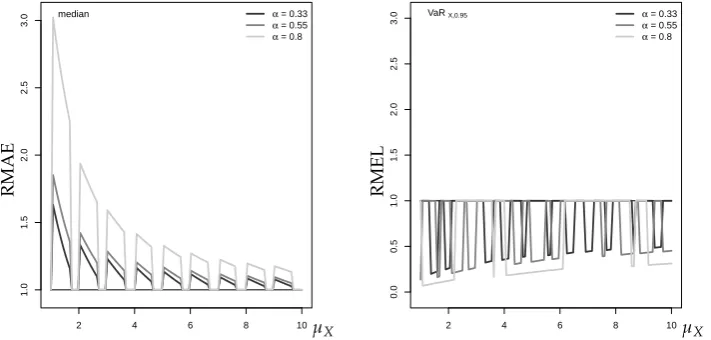
As a coherent central point forecast, we use the median of the discrete conditional distribution (see Section1) as it expresses the center of the distribution in a probabilistic sense. By contrast, the approximate median is the ceiled Gaussian median. For different autocorrelation levelsα, the left
graph in Figure2shows the computed RMAE values plotted against increasing meanµX. It can be
seen that the RMAE tends towards 1 with increasingµX, i.e., the Gaussian approximation improves
with increasing mean. This is plausible, because the Poisson distribution becomes less skewed with increasingµX and approaches normality because of the central limit theorem (Jolliffe 1995).
3 Usually, this restriction is not problematic because positive autocorrelation is most commonly encountered in practice.
Interestingly, for a given mean level, the RMAE increases with the autocorrelation parameter α.
Additionally, the gaps between RMAE values for different autocorrelation levels decrease with the mean level. For a typical low-count scenario with, say, 1≤µX ≤5 andα =0.8, we have to expect
RMAE values between 1.5 and 3.0, and these values remain notably larger than 1 even forµX ≈10.
RMAE
2 4 6 8 10
1.0
1.5
2.0
2.5
3.0 αα = 0.33 = 0.55 α = 0.8 median
µX
RMEL
2 4 6 8 10
0.0
0.5
1.0
1.5
2.0
2.5
3.0 αα = 0.33 = 0.55 α = 0.8 VaR X,0.95
µX
Figure 2. RMAE for median forecast approximation againstµX(left), and RMEL for 95%-quantile
forecast approximation (right), with horizonh=1, wherexTequals median of marginal distribution.
As already mentioned, we consider an upper quantile (VaR) as the coherent non-central point forecast. To evaluate the forecast performance of the approximate discrete upper quantile (ceiled Gaussian VaR), we use the RMEL defined in Section2. The right graph in Figure2shows the RMEL values for the VaR approximation at level 95%. First, we note that the RMEL mainly takes values≤ 1. This implies that the Gaussian approximation tends to exceed the true VaR0.95
(conservative risk forecast). Furthermore, the RMEL tends very slowly towards 1 with increasingµX,
thus the approximation quality improves much more slowly than for the central median forecast. Figure3shows the RMEL for the higher quantile levels 99% and 99.5%. Again, it can be seen that the approximation improves in accuracy with increasing µX, but now the RMEL values are
more often > 1 (underrating of the risk). Given the upper tail of the true forecast distribution (a Poisson-binomial mixture) is generally heavier than the corresponding tail of the normal distribution, this effect becomes particularly visible for very large quantile levels such as≥99%.
3.3. Effect of Last Observation xT
In the preceding analysis, the last observationxTis assumed to be the median of the true marginal
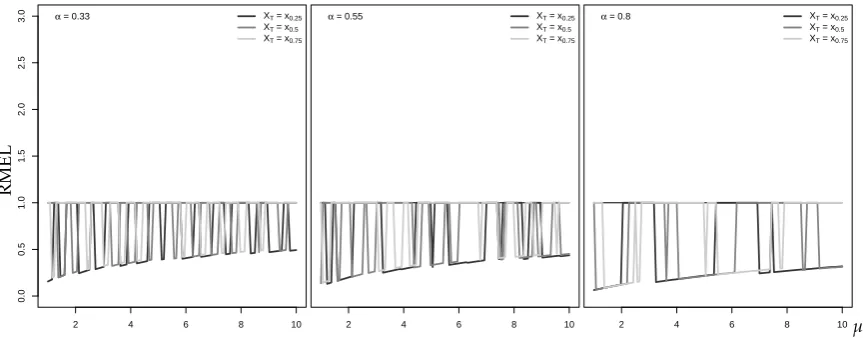
distribution. Now, we analyze the effect of the location ofxT. In Figures4and5,xTis set equal to the
RMEL
2 4 6 8 10
0.0
0.5
1.0
1.5
2.0
2.5
3.0 αα = 0.33 = 0.55 α = 0.8 VaR X,0.99
µX
RMEL
2 4 6 8 10
0.0
0.5
1.0
1.5
2.0
2.5
3.0 αα = 0.33 = 0.55 α = 0.8 VaR X,0.995
µX
Figure 3.RMEL for (left) 99%- and (right) 99.5%-quantile forecast approximation againstµX, with
horizonh=1, wherexTequals median of marginal distribution.
RMAE
2 4 6 8 10
1.0
1.5
2.0
2.5
3.0
XT = x0.25
XT = x0.5
XT = x0.75 α = 0.33
2 4 6 8 10
XT = x0.25
XT = x0.5
XT = x0.75 α = 0.55
2 4 6 8 10
XT = x0.25
XT = x0.5
XT = x0.75 α = 0.8
µX
Figure 4.RMAE for median forecast approximation againstµX, with horizonh=1 and differentα,
wherexTequals either 25%-, 50%-, or 75%-quantile of marginal distribution.
RMEL
2 4 6 8 10
0.0
0.5
1.0
1.5
2.0
2.5
3.0 XT = x0.25
XT = x0.5
XT = x0.75 α = 0.33
2 4 6 8 10
XT = x0.25
XT = x0.5
XT = x0.75 α = 0.55
2 4 6 8 10
XT = x0.25
XT = x0.5
XT = x0.75 α = 0.8
µX
Figure 5.RMEL for 95%-quantile forecast approximation againstµX, with horizonh=1 and different
α, wherexTequals either 25%-, 50%-, or 75%-quantile of marginal distribution.
Generally, the accuracy of the median approximation of the one-step-ahead forecast distribution improves overµX. However, with increasingα, the location ofxThas a stronger effect on the actual
increasing autocorrelation, it deteriorates for increasingαifxTis located central or in the left tail region.
For the VaR0.95approximation of the one-step-ahead forecast distribution, the location ofxTappears
to not have such a large influence on the accuracy of the Gaussian AR(1) approximation. Independent of the location ofxT, we generally have RMEL values<0.5 throughoutµX ≤10.
Remark 1. At this point, let us briefly comment on another scheme for VaR forecasting, as it is popular among financial practitioners: the historical simulation (HS) approach (see, e.g.,Hendricks(1996)). The HS approach is a moving-window approach that computes the sample quantile from past observations (commonly, stock or portfolio returns) to generate a VaR forecast. If computing a sample quantile from a stationary process, it constitutes an estimate of themarginaldistribution’s VaR. For forecasting, however, theconditionaldistribution’s VaR is more relevant. These alternative estimates of VaR can differ considerably for the autocorrelated count processes considered in the present work. Consider the example of a Poi-INAR(1) DGP with marginal meanµX = 5,
which has the marginal distributionPoi(5)and thus the marginalVaR0.95=9. The conditional VaRs depend
on both the autocorrelation parameterαand the last observation xT, where the latter is chosen as either the
25%-quantile x0.25=3, the 50%-quantile x0.5 =5, or the 75%-quantile x0.75=6:
• Ifα=0.33, then xT=3leads toVaR0.95=8, xT=5toVaR0.95=9, and xT=6toVaR0.95=9.
• Ifα=0.55, then xT=3leads toVaR0.95=7, xT=5toVaR0.95=8, and xT=6toVaR0.95=9.
• Ifα=0.8, then xT =3leads toVaR0.95=5, xT =5toVaR0.95=7, and xT =6toVaR0.95=8.
As can be seen, the conditional VaRs vary considerably depending on the level of autocorrelationαand
value of the last observation xT. Thus, in the context of our work on autocorrelated processes, the HS approach
does not serve as a viable alternative for VaR estimation.
3.4. Effect of Forecast Horizon h
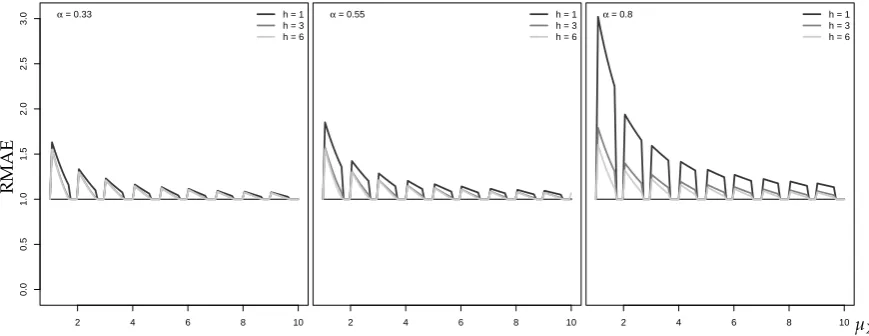
Let us now study the effect of an increasing forecast horizonh, causing the conditional forecast distribution to approach the stationary marginal distribution. For a given level of autocorrelation, Figure6shows that theh-step-ahead median approximation improves ashincreases. Furthermore, it can be seen that performance deteriorates with increasing autocorrelation. As such, by concentrating onh =1 as in the previous sections, we obtain some kind of worst-case performance of the central Gaussian AR(1) approximation. Figure7, in contrast, shows that an increased forecast horizon does not have a strong effect on the approximation of theh-step-ahead VaR0.95. Thus, the result forh=1 is
representative for the overall performance of the non-central Gaussian AR(1) approximation.
RMAE
2 4 6 8 10
0.0
0.5
1.0
1.5
2.0
2.5
3.0 h = 1h = 3
h = 6 α = 0.33
2 4 6 8 10
h = 1 h = 3 h = 6 α = 0.55
2 4 6 8 10
h = 1 h = 3 h = 6 α = 0.8
µX
Figure 6.RMAE for median forecast approximation againstµX, with differentαand varying horizons
RMEL
2 4 6 8 10
0.0
0.5
1.0
1.5
2.0
2.5
3.0 h = 1h = 3
h = 6 α = 0.33
2 4 6 8 10
h = 1 h = 3 h = 6 α = 0.55
2 4 6 8 10
h = 1 h = 3 h = 6 α = 0.8
µX
Figure 7. RMEL for 95%-quantile forecast approximation againstµX, with differentαand varying
horizonsh, wherexTequals median of marginal distribution.
3.5. Point Forecasts of Poi-INAR(1) Processes under Estimation Uncertainty
In Section3.2, the performance of the (non-)central one-step-ahead point forecasts is evaluated for the case where model parameters are known. By doing so, we can explore the pure effect of the approximation error. In practice, however, the process parameters are usually not known and have to be estimated. Consequently, the point forecasts are also affected by estimation error. For the analyses presented in this section, we simulated 1000 Poi-INAR(1) time series per scenario. For each time series, the required model parameters (either for the Poi-INAR(1) fit or the Gaussian AR(1) fit) were estimated, and the forecasts were computed based on the fitted models. For parameter estimation, we used the method of moments (Yule–Walker estimation) because of computational efficiency. In practice, maximum likelihood estimation (MLE) is preferred due to better statistical properties than method-of-moments estimation (for the INAR family, forecasting based on non-parametric MLE would also be possible (seeMcCabe et al. 2011)). We experimented with MLE and found that it rarely had any observable effect relative to method-of-moments estimation; presumably, any advantages from MLE were lost with the discretizing of the forecasts. For each simulated time series and corresponding point forecast, the RMAE and RMEL values were computed, where deviations from 1 were now caused by either estimation error only (for the coherent forecasts from the fitted count model), or by both estimation and approximation error (for the forecasts from the fitted approximating model). The plotted points in the subsequent figures represent truncated means of these 1000 simulated RMAE and RMEL values; specifically, the 10 smallest and largest RMAE and RMEL values were truncated per simulation scenario to eliminate extreme values (outliers) from this calculation.
The means of the simulated RMAE and RMEL values (wherexTis fixed as the median of the true
RMAE
2 4 6 8 10
1.0
1.5
2.0
2.5
3.0 Poi INAR(1) sim.
Gauss AR(1) sim. Gauss AR(1) theo.
T=75
α=0.55, T=75
2 4 6 8 10
Poi INAR(1) sim.
Gauss AR(1) sim. Gauss AR(1) theo.
T=250
α=0.55, T=250
2 4 6 8 10
Poi INAR(1) sim.
Gauss AR(1) sim. Gauss AR(1) theo.
T=2500
α=0.55, T=2500
µX
Figure 8.Mean of simulated RMAE values for median forecast againstµX, with horizonh=1,α=0.55,
and different sample sizesT, wherexTequals median of marginal distribution.
RMEL
2 4 6 8 10
0.0
0.5
1.0
1.5
2.0
2.5
3.0 Poi INAR(1) sim.
Gauss AR(1) sim. Gauss AR(1) theo.
T=75
α=0.55, T=75
2 4 6 8 10
Poi INAR(1) sim.
Gauss AR(1) sim. Gauss AR(1) theo.
T=250
α=0.55, T=250
2 4 6 8 10
Poi INAR(1) sim.
Gauss AR(1) sim. Gauss AR(1) theo.
T=2500
α=0.55, T=2500
µX
Figure 9.Mean of simulated RMEL values for 95%-quantile forecast againstµX, with horizonh=1,
α=0.55, and different sample sizesT, wherexTequals median of marginal distribution.
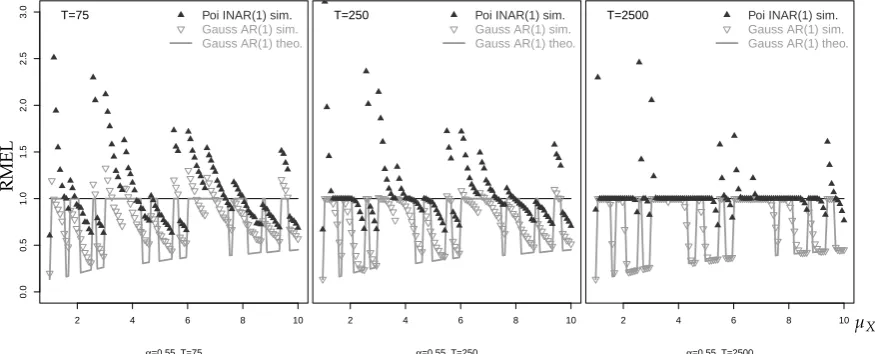
The simulated RMAEs shown in Figure8demonstrate that the median forecasts based on the fitted Poi-INAR(1) model are only slightly affected by estimation error. Estimation error has a greater effect on the Gaussian approximate forecasts than on the Poi-INAR(1) forecasts. With this said, the RMAEs show a similar behavior against µX as the RMAEs for the known-parameter case. The situation
becomes much more complicated for the VaR0.95-forecasts analyzed in Figure9. Because of estimation
error, both the Poi-INAR(1) forecasts and the Gaussian AR(1) forecasts may lead to RMEL values that deviate considerably from 1. Generally, with increasing sample size, the plotted points tend to settle down to the known-parameter counterparts. Interestingly, the Gaussian forecasts seem to settle down more generally with increasingTthan it is the case with the Poi-INAR(1) forecasts, as can be seen withT=2500. Comparing Figures8and9, it is clear that the performance of central forecasts (of either type) is rather robust while non-central forecasts (of either type) are severely affected by estimation error.
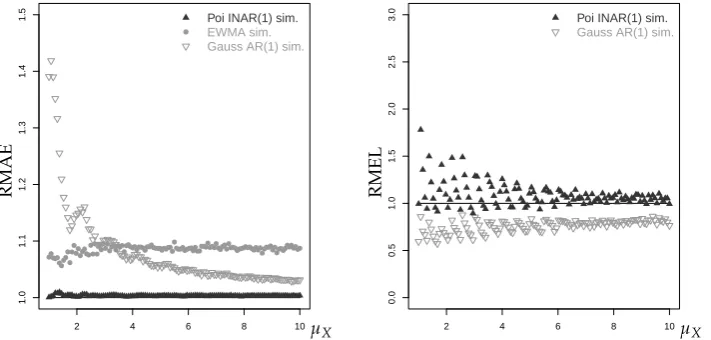
Rather than using a fixedxT, we now consider the use of the last observation xT from each
simulated time series as the starting point for forecasting. Figure10shows the resulting mean RMAE values for the median forecasts (left) and the mean RMEL values for the VaR0.95-forecasts (right) for
the example situationα=0.55,T=250. The RMAE values resulting from the fitted Poi-INAR(1) and
to the Gaussian approximation converge towards 1 with increasingµXbut show large deviations for
smallµX. In the RMAE graph, we also added another forecasting competitor: namely, the rounded
EWMA forecast (with smoothing parameter chosen to minimize the squared one-step prediction error), which is often used by practitioners. Even though the EWMA forecasting method is always worse than the fitted Poi-INAR(1) model, it outperforms the Gaussian AR(1) forecast forµX ≤3. This
effect amplifies with increasing autocorrelation. For example, forα=0.8, the EWMA approximation
provides better forecast approximations than Gaussian AR(1) for allµX ≤10.
RMAE
2 4 6 8 10
1.0
1.1
1.2
1.3
1.4
1.5
●●●●● ●●●
●●●● ● ●●●●●●●
● ● ● ● ●●●
●●●●●●●●●
●●●●●●●●●●●●●●●●●●●●●●●●●●●●●●●●●●●●●●●●●●●●●●●●●●●●●●●●●●●●●●●●●● ●●●●●●●
●●●●●●●●●●●● ●
Poi INAR(1) sim.
EWMA sim. Gauss AR(1) sim.
µX
RMEL
2 4 6 8 10
0.0
0.5
1.0
1.5
2.0
2.5
3.0 Poi INAR(1) sim.
Gauss AR(1) sim.
µX
Figure 10. Mean of simulated RMAE values for median forecast (left) and RMEL values for
95%-quantile forecast (right) againstµX, with horizonh=1,α=0.55, and sizeT=250, wherexT
equals respective last observation of simulated time series.
While the RMAE values show a quite stable behavior, the mean RMEL values for the 95%-quantile forecasts plotted on the right-hand side of Figure10show a lot of fluctuation (especially for smallµX).
The Poi-INAR(1)’s mean RMEL values are typically larger than 1 (implying that the computed forecasts fall below the true VaR0.95) and tend towards 1 with increasingµX. In contrast, the Gaussian AR(1)’s
mean RMEL values are consistently smaller than 1 (computed forecast exceeds true VaR0.95), and
remaining so even with increasingµX.
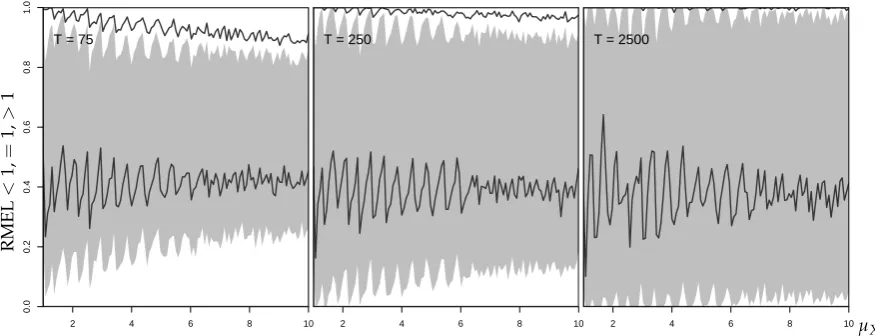
The explanation for this is given in Figure11. Here, the displayed areas express the percentages of the RMEL being<1,=1 or>1 (grey-white areas for Poi-INAR(1) forecasts, areas separated by black lines for Gaussian AR(1) ones). The percentages add up to 100% along the Y-axis: the distance between 0 and the lower bound of the grey area (lower black line) gives the percentage of simulation runs leading to RMEL<1, the height of the grey area (distance between black lines) the percentage of exact matches (RMEL=1), and the upper distances the percentages for RMEL>1. According to Figure11, the percentage of RMEL values=1 generally decreases with growingµX(for both models)
due to the increase in varianceσX2 = µX, but a growingTreduces this effect. For the Poi-INAR(1)
model, growingTalso considerably increases the percentage of RMEL values=1, with a balanced amount of RMEL>1 and<1. For the Gaussian AR(1) model, in contrast, the percentage of RMEL values<1 remains constant inT(roughly around 40%), and only the percentage of RMEL values>1 decreases. This explains why the mean RMEL in Figure10tends towards a constant value below 1. Generally, for our Poi-INAR(1) simulations, we have at least 60% matches for the central forecast (RMAE=1) if fitting a Poi-INAR(1) model, whereas the minimal hit rate is about 30% for the Gaussian approximation. For the VaR0.95forecast, we achieve at least 40% or 30% matches (RMEL=1) if fitting
RMEL
<
1,
=
1,
>
1
2 4 6 8 10
0.0
0.2
0.4
0.6
0.8
1.0
T = 75
2 4 6 8 10
T = 250
2 4 6 8 10
T = 2500
µX
Figure 11. Percentages of RMEL values for 95%-quantile forecast being= 1 (central area), < 1 (lower area), and>1 (upper area) againstµX, with horizonh=1,α =0.55, and different sample
sizesT, wherexTequals respective last observation of simulated time series. Grey area corresponds to
Poi-INAR(1) forecasts, areas separated by black line to Gaussian AR(1) forecasts.
4. Point Forecasting for Diverse Types of DGPs
The baseline analysis regarding point forecasting for the Poi-INAR(1) DGP presented in Section3 allowed us to introduce our forecasting approaches, to distinguish between approximation and estimation error, and to discuss possible variations of the experimental design. Now, we extend our analyses in a more streamlined way to several different types of DGP, as summarized in Figure1before. In Section4.1, we continue with INAR(1) DGPs, but now having overdispersion or zero inflation. Then, we allow for higher-order autoregression in Section4.2by considering an INAR(2) process. In Section4.3, we investigate the so-called INARCH family as an alternative AR type model for count processes. While all these DGPs have the full (unbounded) setN0as their range, Section4.4focuses
on processes of bounded counts. Finally, Section4.5concludes by considering non-stationary count processes, which exhibit seasonality and trend in addition to an AR component.
4.1. Point Forecasts of INAR(1) Processes with Overdispersion or Zero Inflation
The most common violations of a Poisson assumption areoverdispersion(i.e., a variance larger than the mean) andzero inflation(i.e., a larger zero probability than for a Poisson distribution having the same mean). Within the INAR(1) model, overdispersed observations Xtcan be generated by
using a negative binomial distribution for the innovation’s,et∼NB(n,π)(seeWeiß(2018)). For this
NB-INAR(1) model,πcontrols the innovations dispersion index: Ie =
σe2
µe =
1
π. Using Equation (A2)
in AppendixA.2, we can find values for(n,π)for any choice of theXt’s mean and dispersion index,
(µX, IX)with IX >1. The trueh-step-ahead forecast distribution is computed using Equations (A4)
and (A5), and the approximation in Equation (7) results as
YT+h|YT =yT ∼ N αhyT + n
(1−π)
π
1−αh
1−α,
n(1−π) π
1
π+α
1−α2h
1−α2 !
, (9)
withφ=α. Analogously, the use of the zero-inflated Poisson distribution ZIP(λ,ω)for the innovations
(which adds an amountω>0 of zero probability while reducing the underlying Poi(λ)-probabilities by
(1−ω)) causes zero-inflated INAR(1) observations (seeJazi et al.(2012)). Actually, the ZIP-innovations
of zero inflation. For the ZIP-INAR(1) model, we determine the trueh-step-ahead INAR(1) forecast distribution again using Equations (A4) and (A5), and we approximate it by the Gaussian AR(1) model
YT+h|YT=yT ∼ N αhyT + (1−ω)λ1−α
h
1−α, λ(1−ω)(1+ωλ+α)
1−α2h
1−α2 !
, (10)
withφ=α.
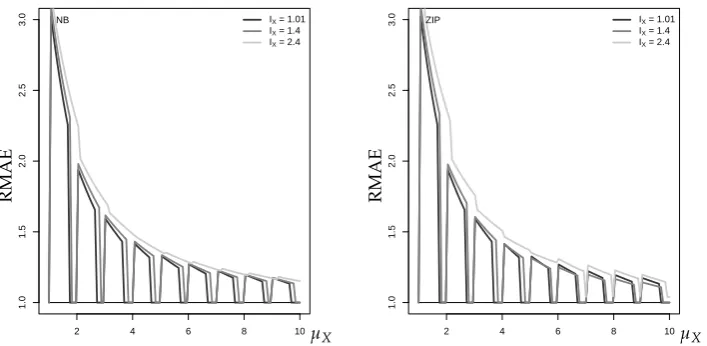
The effect of overdispersion and zero inflation on the RMAE of the approximate median forecast is generally rather small, deviations are only visible for a large autocorrelation levelα. Therefore,
in Figure12, we selected graphs withα=0.80 for illustration. There is not much difference between
the case of an NB-INAR(1) process (left) or a ZIP-INAR(1) process (right). Except for a low mean such asµ≤4, we do not see a strong effect of increased overdispersion or zero inflation on the goodness
of approximation. The deterioration of approximation quality for small meansµXcan be explained
as follows. Having fixed the marginal meanµX, the conditional means in Equations (9) and (10) and
thus the approximate median forecasts are not further affected by overdispersion or zero inflation, and only the conditional variances are increased. The true median forecasts, however, tend more and more towards zero with increasing overdispersion and especially zero inflation, thus the forecast accuracy concerning the median deteriorates.
RMAE
2 4 6 8 10
1.0
1.5
2.0
2.5
3.0 NB IX = 1.01
IX = 1.4 IX = 2.4
α=0.8
µX
RMAE
2 4 6 8 10
1.0
1.5
2.0
2.5
3.0 ZIP IX = 1.01
IX = 1.4 IX = 2.4
µX
Figure 12.RMAE for median forecast approximation of NB-INAR(1) (left) and ZIP-INAR(1) process (right) againstµX, with horizonh = 1,α = 0.80, and different IX, wherexT equals to median of
marginal distribution.
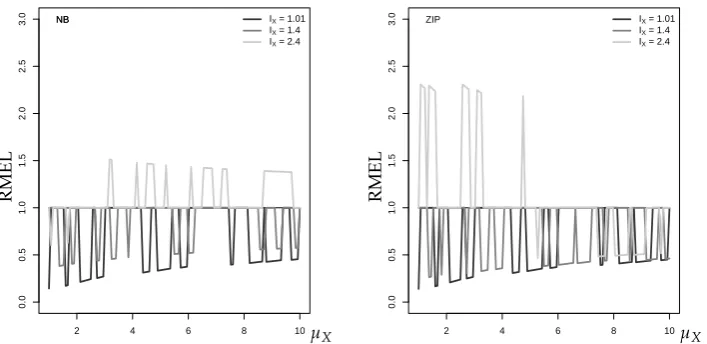
When evaluating the approximate VaR0.95of the 1-step-ahead forecast distribution with either
NB- or ZIP-distributed innovations, the RMEL values are affected for all levels ofα. Figure13shows
an illustrative example withα=0.55. In both cases, the approximation error turns from RMEL<1
(forecast exceeds true VaR0.95) to RMEL > 1 (forecast falls below true VaR0.95) with increasing IX,
but mainly for largeµXin the NB-case, and only for smallµXin the ZIP-case. The tendency towards
RMEL > 1 in the NB-case can be explained as follows: increasing overdispersion leads to more probability mass in the upper tail of the true forecast distribution and thus an increased VaR0.95,
whereas the tails of the normal distribution are always light4. In the ZIP-case with largeµX, in contrast,
the additional dispersion is caused by the large distance between the zero and the remaining probability masses, so the upper tail does not much differ from the Poi-INAR(1) case.
4 The tail behavior of the normal and the NB distribution can be distinguished, for example, based on the mean excess
RMEL
2 4 6 8 10
0.0
0.5
1.0
1.5
2.0
2.5
3.0 NB IX = 1.01
IX = 1.4
IX = 2.4
NB
µX
RMEL
2 4 6 8 10
0.0
0.5
1.0
1.5
2.0
2.5
3.0 IX = 1.01
IX = 1.4
IX = 2.4
ZIP
µX
Figure 13. RMEL for 95%-quantile forecast approximation of NB-INAR(1) (left) and ZIP-INAR(1)
process (right) againstµX, with horizonh=1,α=0.55, and different IX, wherexTequals to median
of marginal distribution.
Figure14plots the simulated mean RMEL values for IX = 2.4 under additional estimation
uncertainty (withxTchosen as the respective last observation of the simulated time series). Both for
the NB- and the ZIP-case, the mean RMEL of the INAR(1) forecasts tends towards a level near 1 with growingµX. The Gaussian approximations’ mean RMEL, in contrast, becomes increasingly larger
than 1 (forecast below true VaR0.95) in the NB-case, and smaller than 1 (forecast exceeds true VaR0.95)
in the ZIP case, confirming our discussion of Figure13.
RMEL
2 4 6 8 10
0.0
0.5
1.0
1.5
2.0
2.5
3.0 NB INAR(1) sim.
Gauss AR(1) sim.
IX = 2.4
µX
RMEL
2 4 6 8 10
0.0
0.5
1.0
1.5
2.0
2.5
3.0 ZIP INAR(1) sim.
Gauss AR(1) sim.
IX = 2.4
µX
Figure 14. Mean of simulated RMEL values for 95%-quantile forecast of NB-INAR(1) (left) and
ZIP-INAR(1) process (right) againstµX, with horizonh=1,α=0.55, sizeT =250, and IX=2.4,
wherexTequals respective last observation of simulated time series.
The reason for this change in the mean RMEL becomes obvious in Figure15. Here, we see that for both DGPs, NB and ZIP, the percentages of RMEL values below and above 1 are fairly even if fitting an INAR(1) model to the data. With growingµX, the Gaussian AR(1) approximation of the NB
model starts to produce a lot of RMEL values greater than 1, and the percentage for RMEL=1 slightly decreases. In the ZIP-case, the approximation first produces mainly RMEL values>1, but changes to producing more RMEL values<1 forµX ≥6. Thus, both cases lead to a biased RMEL performance,
RMEL
<
1,
=
1,
>
1
2 4 6 8 10
0.0
0.2
0.4
0.6
0.8
1.0
NB
µX
RMEL
<
1,
=
1,
>
1
2 4 6 8 10
0.0
0.2
0.4
0.6
0.8
1.0
ZIP
µX
Figure 15.Percentages of RMEL values<1,=1,>1 for 95%-quantile forecast of NB-INAR(1) (left)
and ZIP-INAR(1) process (right) againstµX, with horizonh=1,α=0.55, sizeT=250, and IX=2.4,
wherexTequals respective last observation of simulated time series. Grey area corresponds to INAR(1)
forecasts, areas separated by black line to Gaussian AR(1) forecasts.
4.2. Point Forecasts of Poisson INAR(2) Processes
Until now, all considered models (and their approximations) have autoregressive order 1. Now, we extend to second-order autoregression and consider the Poisson INAR(2) modelXt =
α1◦Xt−1+α2◦Xt−2+et; see Equations (A8) and (A9) in AppendixA.2for further details. For given
ρ(1) =αandα2, we computedα1 = α(1−α2)and again generated 1000 replications per scenario.
To approximate the Poi-INAR(2) process, we used its second-order counterpart, the Gaussian AR(2) process, and fit it to the simulated count time series. Based on the respective last two observationsxT,xT−1, point forecasts for both types of fitted model were computed.
The respective first- and second-order Poi-INAR models produce rather similar results. Forα=
0.55 andT=250, the RMAE values of the fitted Poi-INAR(2) model and its Gaussian approximation are very close to the values plotted in Figure10(also see the left part in Figure 18 below). Forα=0.8,
the Gaussian approximation produces slightly reduced RMAE values compared to the first-order case. In addition, the conclusions regarding the VaR0.95approximation do not change for the second-order
DGP as illustrated by Figure16for the simulation scenario α = 0.55,α2 = 0.45, T = 250. On the
left-hand side, we see the mean RMEL of the fitted Poi-INAR(2) model and its Gaussian approximation as dots. To check for possible differences to the INAR(1) case in Figure10(right), but to keep Figure16 readable at the same time, we applied a moving window of length 5 to the dots in Figure10and plotted the resulting smoothed mean RMEL values of the Poi-INAR(1) model and its approximation as solid lines. The other plots show the percentages of RMELs<1,=1,>1 of the fitted Poi-INAR model (middle) and its approximation (right). We can see slightly lower percentages of exact VaR0.95
point forecasts (RMEL= 1) than in the Poi-INAR(1) case, but the general behavior is the same for both model orders. Thus, while overdispersion or zero inflation may severely affect the approximate forecasting performance, the actual model order seems to be of minor importance in these regards.
4.3. Point Forecasts of INARCH Processes
Another type of AR-like models for counts are included in the INGARCH family; and these are often used as alternatives to the INAR model. In this section, we evaluate point forecasts of first-and second-orderPoisson INARCH models(and their Gaussian AR approximations5) under estimation uncertainty; see Equations (A10) and (A11) in AppendixA.3for background information.
5 We still use a Gaussian AR approximation, not ARCH approximation. Despite their controversial name (Weiß 2018),
RMEL
2 4 6 8 10
0.0
0.5
1.0
1.5
2.0 Poi INAR(1)
Gauss AR(1) for Poi INAR(1) Poi INAR(2) sim.
Gauss AR(2) for Poi INAR(2)
µX RMEL < 1, = 1, > 1
2 4 6 8 10
0.0 0.2 0.4 0.6 0.8 1.0
2 4 6 8 10µ
X
Figure 16. RMEL for 95%-quantile forecast of Poi-INAR(2) process, with horizonh=1,α =0.55,
α2 =0.45, and sizeT=250, wherexT,xT−1equal last observations of simulated time series. (Left)
Mean of simulated RMEL values againstµX; solid lines correspond to smoothed values of Poi-INAR(1)
case. (Right) Percentage of RMEL<1,=1,>1 for Poi-INAR(2) forecast (first graph) and for Gaussian
AR(2) forecast (second graph) as grey areas; solid lines correspond to respective Poi-INAR(1) values.
The performance of the median and VaR0.95forecast for the Poi-INARCH(1) model is generally
quite similar to the Poi-INAR(1) case. However, for large autocorrelation parameterα, the Gaussian
approximation to the Poi-INARCH(1) model provides a better performance regarding central forecasts than in the Poi-INAR(1) case, in the sense of lower mean RMAE values for the approximate median forecast, see the left part of Figure17. The middle graph shows that the mean RMEL values of the approximate VaR0.95forecast, though still constantly below 1, are closer to 1 than in the Poi-INAR(1)
case. From the right part of Figure17, however, we see that the percentage of correct VaR0.95forecasts
(RMEL= 1) is even worse. The Gaussian AR(1) approximation of the Poi-INARCH(1) model just produces more RMEL values>1, which shifts the mean RMEL closer to 1.
RMAE
2 4 6 8 10
1.0
1.2
1.4
1.6
1.8
2.0 Poi INAR(1)
Gauss AR(1) for Poi INAR(1) Poi INARCH(1) sim.
Gauss AR(1) for Poi INARCH(1)
µX
RMEL
2 4 6 8 10
0.0
0.5
1.0
1.5
2.0 Poi INAR(1)
Gauss AR(1) for Poi INAR(1) Poi INARCH(1) sim.
Gauss AR(1) for Poi INARCH(1)
µX RMEL < 1, = 1, > 1
2 4 6 8 10
0.0 0.2 0.4 0.6 0.8 1.0 µX
Figure 17.Poi-INARCH(1) DGP with horizonh=1 and sizeT=250, wherexTequals respective last
observation of simulated time series; all plots againstµX. (Left) Mean of RMAE values for median
forecast, whereα =0.80; solid lines correspond to smoothed values of Poi-INAR(1) case. (Center)
Mean of RMEL values for 95%-quantile forecast, whereα=0.55; solid lines correspond to smoothed
values of Poi-INAR(1) case. (Right) Percentages of RMEL<1,=1,>1 for Gaussian approximations
to Poi-INARCH(1) (areas) or Poi-INAR(1) DGP (lines), whereα=0.55.
The mean RMAE and RMEL values of the fitted Poi-INARCH(2) model and its approximation generally produce a very similar picture to that of the Poi-INARCH(1) model, but a growingα2slightly
part of Figure18. As the only difference, as in the first-order case in Figure17, the Poi-INARCH(2) approximation’s mean RMEL values are somewhat closer to 1 than in the Poi-INAR(1) case. The reason is the same as before: the percentage of exact matches (RMEL=1) is reduced at the cost of more cases with RMEL>1. However, besides these small differences, the specific type of AR-like DGP for counts does not have a notable effect on the forecasting performance, while other parameters such as the actual autocorrelation level are much more important.
RMAE
2 4 6 8 10
1.0
1.2
1.4
1.6
1.8
2.0 Poi INAR(1)
Gauss AR(1) for Poi INAR(1) Poi INAR(2) sim.
Gauss AR(2) for Poi INAR(2)
2 4 6 8 10
Poi INARCH(1)
Gauss AR(1) for INARCH(1) Poi INARCH(2) sim.
Gauss AR(2) for INARCH(2)
µX
RMEL
2 4 6 8 10
0.0
0.5
1.0
1.5
2.0 Poi INAR(1)
Gauss AR(1) for Poi INAR(1) Poi INAR(2) sim.
Gauss AR(2) for Poi INAR(2)
2 4 6 8 10
Poi INARCH(1)
Gauss AR(1) for INARCH(1) Poi INARCH(2) sim.
Gauss AR(2) for INARCH(2)
µX
Figure 18.RMAE for median forecast (left) and RMEL for 95%-quantile forecast (right) againstµX:
DGP Poi-INAR(2) vs. Poi-INARCH(2), with horizonh=1,α=0.55,α2 =0.45, and sizeT =250,
wherexT,xT−1equal last observations of simulated time series; solid lines correspond to smoothed
values of Poi-INAR(1) or Poi-INARCH(1) case, respectively.
4.4. Point Forecasts of Bounded Counts Processes
In the preceding sections, we examine forecasts of models with an infinite range of counts. Now, we turn to AR(1)-like count time series with a bounded range{0, . . . ,n}with somen ∈ N. This restriction is relevant if the counts are determined with respect to a population of specified (and typically low) sizen(such as a fixed group of countries, companies or customers). Here, it may happen that VaR0.95=n(i.e., it is not possible to exceed the VaR0.95), which, in turn, causes MEL values equal
to 0 (see Equation (4)). However, in our simulations, this happened extremely rarely. The few cases where we had a division by zero when calculating the RMEL did not affect the computation of the truncated mean (as described in Section3.5, the RMAE and RMEL values are averaged only after truncating their 10 smallest and largest values).
We start with thebinomial AR(1) processhaving a binomial marginal distribution; see Equation (A6) and (A7) in AppendixA.2for further details. However, we later also refer to binomial INARCH(1) processes, where the marginal distribution exhibits extra-binomial variation. The median forecast performance for BinAR(1) counts nearly coincides with the Poi-INAR(1) case from Section3.5. While this also holds for the RMEL given a smallπ (where binomial and Poisson distribution are quite
similar to each other), the Gaussian approximation in the BinAR(1) case withπ = 0.45 performs
quite differently from the one in the Poi-INAR(1) case. In the left plot of Figure19, we see that the fitted Gaussian approximation in the BinAR(1) case provides much lower mean RMEL values than in the Poi-INAR(1) case. However, as shown in the right plot, the BinAR(1) approximation does not worse in terms of exact matches (RMEL=1). It has a more biased RMEL performance, because it produces RMEL values>1 very rarely. This leads to mean RMEL values being notably lower than in the Poi-INAR(1) case, and implies more frequent exceedances of the true VaR0.95. At this point, it is
helpful to recall the discussions of Figures2and9. The Gaussian AR(1) approximation’s forecasts generally tend to exceed the true VaR0.95(RMEL<1), also in the Poisson case. There, RMEL values >1 can be assigned to the estimation error (more often in smaller samples), because it tends towards 0 for a growing sample sizeT. In the binomial case withπ=0.45, where the marginal distribution is
RMEL
0 10 20 30 40 50 60
0.0
0.5
1.0
1.5
2.0 Poi INAR(1)
Gauss AR(1) for Poi INAR(1) Binomial AR(1) sim.
Gauss AR(1) for BinAR(1)
µX
RMEL
<
1,
=
1,
>
1
10 20 30 40 50
0.0
0.2
0.4
0.6
0.8
1.0
µX
Figure 19.95%-quantile forecast againstµX, with horizonh=1,α=0.55, and sizeT=250, wherexT
equals last observation of simulated time series. (Left) Mean of simulated RMEL values for BinAR(1)
DGP (dots); solid lines correspond to smoothed values of Poi-INAR(1) case. (Right) Percentages of
RMEL<1,=1,>1 for Gaussian approximations to BinAR(1) (areas) vs. Poi-INAR(1) DGP (lines).
We also considered the binomial INARCH(1) model as a DGP for bounded counts; see Equation (A12) and (A13) in AppendixA.3for background information. The plots of the BinARCH(1) model look very similar to the BinAR(1) plots. In the case of deviation, they show the same behavior as the Poi-INARCH(1) model compared to the Poi-INAR(1) one (see Figure17). For this reason, we do not further discuss them at this point.
4.5. Point Forecasts under Seasonality and Trend
As the final scenario, we allow the count DGP to be non-stationary by including both seasonality and trend. For this purpose, we use the ll-Poi-AR(1) model with period p given by Equation (A14) in AppendixA.3, which extends an AR(1)-like data-generating mechanism with a linear trend and harmonic oscillation for the log-means. Popular models for Gaussian time series with seasonality and trend are seasonal ARIMA (SARIMA) models and regression models with ARMA innovations
(Brockwell and Davis 2016, Chapter 6), which both reduce to the ordinary ARMA models in the
absence of seasonality and trend. Thus, we defined Gaussian approximations to the ll-Poi-AR(1) DGP by considering the SARIMA(1, 1, 0)×(0, 1, 0)pwith period p on the one hand, and a regression
model with AR(1) innovations on the other hand, having linear trend and harmonic oscillation as in Equation (A14). Since now the mean varies over time, we no longer evaluate our simulation results by plots against the mean, but we present tabulated values for illustration.
Let us start with some general findings. In our simulations, we considered different periods, but there was no effect on the predictive performance; therefore, we restrict the subsequent illustrations to p = 12 (such as for monthly data). Furthermore, the Gaussian SARIMA approximation did considerably worse than the ARMA regression approximation in the majority of cases. This is plausible, because the true DGP has deterministic seasonality and trend as also assumed by the ARMA regression, whereas the SARIMA model assumes stochastic seasonality and trend. In view of this general result, we no longer consider the SARIMA approximation from this point on.
Table1shows mean RMAE and RMEL values and the corresponding percentages of RMAE or RMEL=1 (in parentheses) for the sample sizesT=75, 250, with increasing trend parameterγ1to
the right, and increasing seasonalityγ2,γ3downwards. For the fitted ll-Poi-AR(1) model, the mean
is only around 40% or worse. In addition, the exact matches of the true conditional VaR0.95(RMEL
=1) are clearly worse than in the ll-Poi-AR(1) case. In particular, these rates further decrease with both increasing trend or seasonality, and, often, they do not improve with increasingT.
Table 1. Mean RMAE and RMEL values (percentages of RMAE or RMEL=1 in parentheses) for
ll-Poi-AR(1) DGP with p=12,γ0=0.5, andα=0.55. Forecasts for fitted ll-Poi-AR(1) or Gaussian
AR(1) regression model (labeled as “Poi” or “Gau,” respectively), sample sizeT=75 vs.T=250.
T=75 RMAE RMEL
γ1 0 0.001 0.002 0 0.001 0.002
γ2 γ3 Poi Gau Poi Gau Poi Gau Poi Gau Poi Gau Poi Gau
0 0 1.011 1.186 1.012 1.185 1.012 1.178 1.604 1.078 1.401 1.044 1.093 0.889
(0.874) (0.386) (0.880) (0.350) (0.849) (0.280) (0.691) (0.679) (0.699) (0.607) (0.741) (0.589)
0.1 0.3 1.026 1.186 1.027 1.188 1.029 1.175 1.359 0.939 1.339 1.043 1.304 1.109
(0.769) (0.395) (0.763) (0.361) (0.750) (0.398) (0.611) (0.486) (0.603) (0.509) (0.579) (0.501)
0.2 0.6 1.028 1.183 1.029 1.198 1.026 1.186 1.450 0.996 1.326 1.042 1.356 1.225
(0.743) (0.387) (0.759) (0.365) (0.721) (0.376) (0.633) (0.424) (0.603) (0.367) (0.599) (0.370)
T=250
0 0 1.002 1.195 1.003 1.131 1.006 1.102 1.348 0.949 1.174 1.100 0.897 1.105
(0.944) (0.365) (0.835) (0.273) (0.900) (0.388) (0.849) (0.766) (0.851) (0.638) (0.755) (0.536)
0.1 0.3 1.007 1.154 1.007 1.149 1.009 1.108 1.203 0.845 1.219 1.033 1.169 1.266
(0.862) (0.408) (0.856) (0.345) (0.814) (0.369) (0.792) (0.576) (0.699) (0.542) (0.710) (0.503)
0.2 0.6 1.008 1.159 1.008 1.157 1.010 1.132 1.271 0.925 1.119 0.965 1.212 1.279
(0.853) (0.351) (0.820) (0.341) (0.802) (0.340) (0.761) (0.420) (0.724) (0.362) (0.675) (0.287)
We also varied the autoregressive parameterαin{0.33, 0.55, 0.8}as in the above sections, but a
clear effect could not be recognized. In contrast, such an effect is visible if varying the interceptγ0
(controlling the baseline mean exp(γ0)). This is illustrated in Table2forγ0=1, 2 (the caseγ0=0.5
is provided by the lower part of Table1). For the fitted ll-Poi-AR(1) model, the percentages of exact matches for both the central and non-central forecasts decrease with increasingγ0. This result, which
is in analogy to earlier results such as in Figure11, can be explained with the conditional Poisson’s variance, which increases with increasing mean. However, although decreasing, these rates are much larger than those corresponding to the Gaussian approximation. Note that, for these larger values ofγ0, the Gaussian approximation also shows decreasing rates of RMEL=1 for increasing trend or
seasonality. Thus, we conclude that forecasts relying on a Gaussian approximation are even more problematic in the presence of seasonality and trend than in the stationary case.
Table 2. Mean RMAE and RMEL values (percentages of RMAE or RMEL=1 in parentheses) for
ll-Poi-AR(1) DGP with p=12,T=250, andα=0.55. Forecasts for fitted ll-Poi-AR(1) or Gaussian
AR(1) regression model (labeled as “Poi” or “Gau,” respectively), interceptγ0=1.0 vs.γ0=2.0.
γ0=1.0 RMAE RMEL
γ1 0 0.001 0.002 0 0.001 0.002
γ2 γ3 Poi Gau Poi Gau Poi Gau Poi Gau Poi Gau Poi Gau
0 0 1.002 1.101 1.007 1.085 1.006 1.061 0.884 0.696 1.064 1.016 1.078 1.419
(0.950) (0.369) (0.807) (0.464) (0.768) (0.474) (0.793) (0.543) (0.776) (0.590) (0.694) (0.368)
0.1 0.3 1.006 1.114 1.010 1.088 1.012 1.070 1.097 0.866 1.149 1.118 1.148 1.353
(0.860) (0.309) (0.776) (0.354) (0.725) (0.387) (0.777) (0.509) (0.660) (0.491) (0.622) (0.454)
0.2 0.6 1.006 1.116 1.009 1.105 1.012 1.089 1.074 0.840 1.097 1.189 1.196 1.483
(0.852) (0.316) (0.785) (0.337) (0.711) (0.386) (0.768) (0.302) (0.711) (0.275) (0.614) (0.264)
γ0=2.0
0 0 1.002 1.038 1.007 1.035 1.008 1.024 1.012 0.856 1.095 1.174 1.075 1.449
(0.791) (0.443) (0.681) (0.426) (0.637) (0.372) (0.766) (0.546) (0.597) (0.461) (0.562) (0.366)
0.1 0.3 1.008 1.043 1.012 1.042 1.013 1.033 1.097 0.932 1.066 1.209 1.110 1.687
(0.713) (0.400) (0.619) (0.391) (0.540) (0.382) (0.658) (0.431) (0.538) (0.333) (0.460) (0.289)
0.2 0.6 1.007 1.063 1.012 1.066 1.013 1.084 1.113 0.978 1.098 1.318 1.117 1.650
5. Conclusions and Future Research
If coherent point forecasting is done based on a count time series model, then estimation error is nearly without effect on median forecasts. Non-central quantile forecasts, in contrast, are affected by estimation error, but the RMEL performance is more or less balanced and clearly improves with increasing sample size. If point forecasting relies on the discretization of a Gaussian ARMA approximation, the forecasting performance becomes considerably worse (both with and without estimation error). While the median forecast performance at least improves with increasing meanµX,
non-central point forecasts show a strongly biased RMEL performance for any considered mean level. The RMEL performance is also severely affected by overdispersion or zero inflation, whereas neither the actual AR order nor the type of AR-like process (INAR vs. INARCH) leads to strong differences in forecasting performance. A bounded range may cause additional difficulties in approximating non-central point forecasts because of more frequent exceedances of the true quantile’s value. Finally, point forecasts for non-stationary processes of counts were also investigated and we found that the approximation of non-central point forecasts further deteriorates with increasing trend or seasonality.
To summarize, the practice of discretizing Gaussian ARIMA forecasts for count time series is strongly discouraged. For meansµX ≤ 10, which are rather common values for real applications,
non-central point forecasting should always rely on a count time series model. The same conclusion applies to central forecasts except the case of a low autocorrelation level, where the approximation leads to a reasonable performance also for somewhat smaller mean levels. It is telling that the Gaussian AR(1) forecast approximation is often outperformed by the basic EWMA approach, although the latter still does considerably worse than the model-based prediction.
There are a few directions for future research regarding the forecasting of count processes. One important direction is the construction and evaluation of (approximate) prediction intervals for count time series. Concerning (non-central) point forecasts, it would be interesting to incorporate costs into performance evaluation; especially the effect asymmetric cost schemes should be studied, where forecasts below or above the true quantile value go along with different costs. Finally, one may think of a risk-optimal parameter estimation for count time series, in the sense that estimates are determined by minimizing some measure of forecast errors for a given risk metric and risk level. In the context of risk optimization for discrete distributions, risk metrics different than VaR are often preferred, e.g., the expected shortfall, because the VaR has a multiextremum structure in this case
(Larsen et al. 2002).
Author Contributions:Conceptualization (all authors); Funding acquisition (A.H., C.H.W.); Methodology (all authors); Software (A.H.); Supervision (C.H.W., L.C.A.); Writing—original draft preparation (A.H., C.H.W., L.C.A.); and Writing—review and editing (C.H.W., L.C.A., G.F. and R.G.).
Funding: This research was funded by the Deutsche Forschungsgemeinschaft (DFG, German Research Foundation)—Projektnummer 394832307.
Acknowledgments:The authors thank the two referees for their useful comments on an earlier draft of this article.
Conflicts of Interest:The authors declare no conflict of interest.
Appendix A. Considered Models for Count Time Series
Appendix A.1. Important Count Distributions
LetXbe a count random variable. If the range of Xis bounded from above by some upper limitn∈N, i.e., ifXcan only take values in{0, . . . ,n}, then the most common model is the binomial
distribution Bin(n,π)with someπ∈(0, 1). Its probability mass function (PMF) is given by
P(X=x) =
n x
·πx·(1−π)n−x for 0≤x≤n,
and mean and variance are equal tonπandnπ(1−π), respectively.
IfXcan take values in the full set of non-negative integers,N0, then the Poisson distribution
Poi(λ)withλ>0 constitutes an important model. Its PMF equals
P(X=x) = e−λ λ
x
x! forx∈N0.
Since mean and variance are equal to each other, both equal toλ, the Poisson distribution has the
equidispersion property. A common model for unbounded counts with overdispersion is the negative binomial distribution NB(n,π)withn∈(0,∞)andπ∈(0, 1), and with PMF
P(X=x) =
n+x−1 x
·(1−π)x·πn forx ∈N0.
Its mean equalsn1−π
π , whereas its variance is inflated by the factor 1/π, thus given byn 1−π
π2 .
If overdispersion is caused by zero inflation, one often uses the zero-inflated Poisson distribution ZIP(λ,ω)withλ>0 andω∈[0, 1)(ω=0 corresponds to the Poi(λ)-distribution). It has the PMF
P(X=x) = 1{x=0}·ω+ (1−ω)e−λλ
x
x! forx∈N0, and mean and variance are given by(1−ω)λand(1−ω)λ(1+ω λ), respectively.
Appendix A.2. Thinning-based Models
(Xt)Z is said to be an INAR process of order 1 (integer-valued autoregressive) if it follows the recursion
Xt = α◦Xt−1 + et (A1)
with independent and identically distributed (i.i.d.) innovationset. The INAR(1) model uses the
binomial thinning operator “◦” (Steutel and van Harn 1979). Forα ∈ (0, 1)and a count random
variableN, binomial thinning is defined asα◦N=∑Ni=1ξi, where(ξi)is a sequence of i.i.d. Bernoulli
random variables with P(ξi = 1) = α, being independent of N. The thinning operations at each
timetare performed independently of each other and of(et)Z, and theetare independent of(Xs)s<t
(McKenzie 1985).
The autocorrelation function (ACF) is of AR(1)-type, given byρ(k) =Corr[Xt,Xt−k] =αk. The
mean and the dispersion index of the marginal distribution of the INAR(1) process are determined by
µX:=E[Xt] = µe
1−α , σ
2
X:=Var[Xt] = σ 2
e +αµe
1−α2 and IX = σX2
µX
= Ie+α
1+α, (A2)
where I denotes the index of dispersion, and I = 1 corresponds to the case of equidispersion
(Weiß 2018). We speak of aPoissonINAR(1) process (Poi-INAR) following the recursion of Equation (A1)
if the innovations are i.i.d. Poisson,et∼Poi(λ). The marginal distribution is then also Poisson and
p(XT+h=x|XT=xT) =
min{x,xT}
∑
s=0
xT
s
(αh)s(1−αh)xT−se
−λ11−−ααh
(x−s)!· λ 1−αh
1−α !x−s
, (A3)
with conditional mean αhxT + λ
1−αh 1−α
and variance αh(1 − αh)xT + λ
1−αh 1−α
(Freeland and McCabe 2004).
If the innovations’ distribution is not Poisson or not further specified, no closed-form formula is available for theh-step-ahead pmf withh>1. The one-step-ahead pmf is given by
p(x|xT) = p(XT+1=x|XT=xT) =
min{x,xT}
∑
s=0
xT
s
αs(1−α)xT−s·P(et=x−s), (A4)
and theh-step-ahead forecast distribution is determined numerically by making use of the Markov property: for anMsufficiently large, we define the transition probability matrix
P:= p(r|s)
r,s=0,...,M and compute the matrix powerP
h, (A5)
the entries of which are the desiredh-step-ahead forecast probabilities (Weiß 2018).
The INAR(1) model in Equation (A1) cannot be used for time series of bounded counts, i.e., where theXthave the finite range{0, . . . ,n}with somen∈ N. As a solution,McKenzie(1985) suggested
replacing the innovation termetby the additional thinningβ◦(n−Xt−1). More precisely, letting
π∈(0, 1)andα∈
max{− π 1−π,−
1−π
π }, 1
, and definingβ:=π(1−α)andγ:=β+α, thebinomial
AR(1) process(Xt)N0follows the recursion
Xt = γ◦Xt−1 + β◦(n−Xt−1) withX0∼Bin(n,π), (A6)
where again all thinnings are performed independently of each other, and independently of(Xs)s<t.
The BinAR(1) model in Equation (A6) defines a stationary Markov chain with the binomial marginal distribution Bin(n,π), and the ACFρ(k) =αk(which might also become negative). The one-step-ahead
pmf equals
p(x|xT) =
min(x,xT)
∑
m=max(0,x+xT−n)x
T
m
n−x
T
x−m
γm(1−γ)xT−mβx−m(1−β)n−xT+m−x. (A7)
Theh-step-ahead conditional distribution is computed according to Equation (A5) withM=n. In addition, higher-order extensions of Equation (A1) have been proposed in the literature. Here, we concentrate on the second-order case. The most widely used type of INAR(2) model is due to
Du and Li(1991), who required conditional independence for the thinnings(α1◦t+1Xt,α2◦t+2Xt)
givenXtin the extended model recursion
Xt = α1◦tXt−1 + α2◦tXt−2 + et. (A8)
The one-step-ahead pmf equals
p(x|xT,xT−1) = ∑min
{x,xT}
j1=0 ∑
min{x−xT,xT−1} j2=0
(xT
j1)α j1
1 (1−α1)xT
−j1·(xT−1 j2 )α
j2
2 (1−α2)xT−1−j2·P(et=x−j1−j2),
(A9)
andh-step-ahead probabilities can be computed by adapting Equation (A5) to the bivariate Markov chain given by(Xt,Xt−1)N0. The ACF satisfiesρ(1) =α1/(1−α2)andρ(k) =α1ρ(k−1) +α2ρ(k−2)