Archives of Business Research – Vol.4, No.3 Publication Date: June. 25, 2016
DOI: 10.14738/abr.43.1949.
Taouab, O. (2016). The Diffusion of the ISO-9001 and firm Performance: The Case of Morocco. Archives of Business Research, 4(3), 45-52.
The diffusion of the ISO
-9001 and firm performance: The Case
of Morocco
Omar Taouab
Department of Management Ibn Tofail University Kenitra, Morocco
Abstract
The paper’s objectives is to determine the variables that have a significant impact on the diffusion of the ISO 9001 and its impact on the performance of the Moroccan companies of the textile-clothing industry. After a review of the literature on the variables which justify the diffusion of this tool, we tested our hypothesis of research. An empirical study was carried out using a sample of 45 ISO certified firms. Data were obtained from the quality managers of the companies through a questionnaire. A regression logistic model is also applied in order to determine the impact of variables that impact the diffusion of ISO quality and their impact on the performance’s firms. Our principal findings show that variables of contingency, such as: the size of the companies, turbulence, the pressure of the environment, the strategy and the implication of the employees, play a very important part in the diffusion of the ISO 9001. Keywords: ISO, performance, textile-clothing industry,
INTRODUCTION
There are several definitions of quality, for the ISO, the quality is:”the ability of an entity (product or service) to satisfy the expressed or potential needs of users”. The quality appears as the measure of the correspondence of a product or service to its specifications or standards. The specifications may relate to the duration of operation, performance, reliability or any other objective and measurable quantifiable characteristic.
In Morocco, according to the former minister of industry, trade and new technologies, Mr. Ahmed Reda Chami, there were in 2010, 1000 certified companies ISO 9001 against one in 1995, which indicates a great increase.
Despite that, the position of Morocco remains weak in relation to the market for certification at the level Africo-West Asian (1.3 %) and internationally (0.1 %) (See table 1).
Table 1: Statistics on the number of certification to ISO 9001
Morocco AFRICA-WEST ASIA World Number of ISO certification 1 000 77 408 1 064 785 Percentage in ISO certifications 100% 1.3% 0.1%
Source: global survey of ISO on ISO-9001 certification in 2009.
URL: http://dx.doi.org/10.14738/abr.43.1949. 46 very strongly diffused in particular via the best Sellers of the “gurus” of quality (Crosby, Deming, Juran…) and via international standards (ISO, EFQM…).
However, several works on the determinants of the diffusion of the quality certifications were completed in particular in the developed countries, like the United States of America (Reed et alii, 1996), France (Segrestin, 1997), the United Kingdom (Taylor and Wright, 2003), and Canada (Boiral, 2003), etc. nevertheless, this kind of studies remains still absent in several Emergent countries like Morocco.
This work places the emphasis on the determinants of the adoption of the systems of management of quality, and the impact of this managerial innovation on the performance’s firms of the textile-clothing industries.
The paper is structured as follows: in the first part, the literature on the diffusion of thee ISO 9001is presented. Then, the research hypotheses of article are formulated. In the next part, the methodology is described which is followed by the simple and data analysis. In the next part, the results are discussed and the final conclusions and the managerial implications are presented.
Finally, the limitations of the study and future research proposals are presented.
LITERATURE REVIEW AND RESEARCH HYPOTHESES
Although dozens of scientific studies have been published on the ISO 9001 standard, the impact on financial performance remains a fuzzy idea. Many studies have found a direct and positive impact of the implementation of ISO 9001 and its certification on finances, others; however, have not established a significant relationship.
Some studies have also shown that in addition to the direct relationship between QMS and financial gains, other variables may possibly be taken into account.
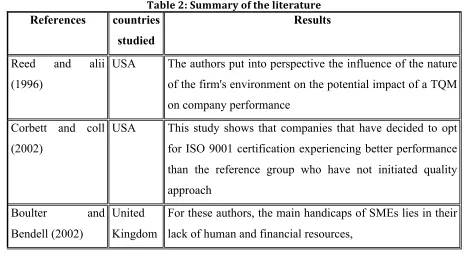
The following table reports the main studies that have investigated the development of the quality and the variables that explain the adoption of this tool.
Table 2: Summary of the literature
References countries
studied
Results
Reed and alii (1996)
USA The authors put into perspective the influence of the nature of the firm's environment on the potential impact of a TQM on company performance
Corbett and coll (2002)
USA This study shows that companies that have decided to opt for ISO 9001 certification experiencing better performance than the reference group who have not initiated quality approach
Boulter and Bendell (2002)
United Kingdom
Archives of Business Research (ABR) Vol.4, Issue 3, June-2016
Taylor and Wright (2003)
United Kingdom
For these authors, the entreprise size is significantly and negatively associated with the success of the Total Quality Management which ISO 9001 is based.
Reed and alii (1996)
USA the authors propose a relational framework between the current strategic direction of the firm, the associated components of the TQM and the resulting performance
Segrestin (1997) France the importance of the participation and involvement of staff in the implementation of the certification process
Boiral (2003) Canada Engaging a process of accreditation based on the ISO 9000 standard is usually due to a pressure outsourcer or major corporate clients.
From these studies, which used in most quantitative approaches, the variable “Diffusion of ISO 9001” can be explained by five variables that are: the environment, employee involvement, size, strategic direction and competitive pressure.
Similarly, we see that companies that have implemented these quality management systems have gained performance.
Work on the determinants of quality analyzed several variables which are at the origin of the diffusion of this tool by the companies.
Indeed, according to Boulter and Bendell (2002) and Taylor and Wright (2003), the principal handicaps of ISO 9001 to adopt quality resident in their lack of human and financial resources, therefore, the size constitutes a determinant variable of the diffusion of the ISO 9001, Similarly Ahsina (2012) showed that size influences the implementation of management tools. Conclusions of this work follow the following research hypothesis:
Hypothesis 1: More the size of a company is important, and it will tend to choose the adoption of ISO 9001.
In the same way, for Segrestin, the realization of the aims of certification ISO strongly depends on the degree of implication of staff. One proposes thus, the following assumption:
Hypothesis 2: The more the employees are motivated and the more the company will tend to make a success of the installation the ISO 9001.
Reed ET alii (1996), put in prospect the influence for the nature of the environment of the firm on the impact which an approach Total Quality Management can have on the performances of the company, from where the following assumption:
Hypothesis 3: The more turbulent the environment becomes and the more the company will tend to set up of ISO certification.
URL: http://dx.doi.org/10.14738/abr.43.1949. 48 Therefore, the strategic organization influences the installation of ISO certification.
Hypothesis 4: “Management by quality is more the business of the prospectors”
For Boiral (2004), the adoption of the approach quality is due to the pressure of the partners of the company, mainly the clients or the main customers.
Follows the following hypothesis:
Hypothesis 5: “More the environment is competing and more the company will tend to set up a system of management quality”.
Several authors affirmed that the adoption of an approach quality causes to reduce the costs and to increase satisfaction customer and thus to improve the performance.
One proposes thus, the following hypothesis:
Hypothesis 6: “The companies which set up adopted the systems of management of quality are more powerful than those which are deprived by it”
Therefore, the following variables of contingency: the size, the implication of the employees, environmental uncertainty, the strategy and the competing pressure, affect the diffusion of the systems of management of quality.
MATERIALS AND METHODS Sample
Of a total of 114 questionnaires sent, 45 were filled. The response rate is good. Recalcitrant companies systematically revived, often several times and with different interlocutors, we believe that the refusal to respond to these companies is not only due to lack of time the respondents, as has often been argued.
So, the study was based on data collected using questionnaires sent to 45 Moroccan firms of the sector textile industry-clothing.
Data analysis
A logistic regression was used to validate our model. In logistic regression, what is interesting to know is the fact that if the independents variables Xi can predict the membership of Y to one or the other of the categories.
In fact, the probability is calculated that the variable Y belongs to one or the other of the categories. When the independent variable Y is binary (Ex: 1 (adoption of quality) and 0 (not adoption), one speaks about binomial logistic regression. Among these models, the functions logit and probit have the same wanted characteristic, so that:
To study a dichotomous dependent variable (in our case: " diffusion”: “1”, or,“non diffusion” of ISO 9001: “0 "), several statistical methods are possible.
In this study, we chose logistic regression. Under this method, the model is written as:
Archives of Business Research (ABR) Vol.4, Issue 3, June-2016
RESULTS
In this section, we present firstly the main result of the binary logistic regressions and secondly we test the research hypothesis between the diffusion of ISO 9001 and the performance of firms.
The results of the logistic regression model
The results of the binary logistic regressions are presented in the tables hereafter. We will specify initially the quality of representation of the model, then we will interpret the results of the explanatory logistic regressions of the choices of the passage, finally, we will point out the limits of modeling by logistic regression.
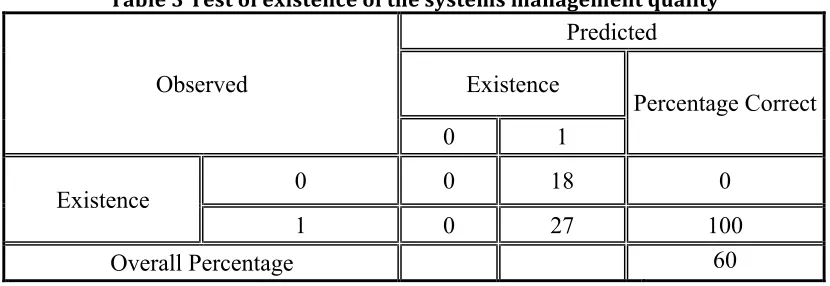
Table 3 Test of existence of the systems management quality
Observed
Predicted
Existence
Percentage Correct
0 1
Existence 0 0 18 0
1 0 27 100
Overall Percentage 60
a. Constant is included in the model. b. The cut value is ,500
The model now succeeds in classifying 60% of the sample correctly: 0 + 27 = 27 out of 45 is 60%.
Table 4 Variables in the Equation
B S.E. Wald df Sig. Exp(B)
Step 0 Constant ,405 ,304 1,776 1 ,183 1,500
The table above gives us the coefficient of regression for the variables added to the equation with this first stage; the test of Wald enables us to affirm that this coefficient of regression is significant (different from 0.0); one obtains the statistics of Wald by dividing the coefficient B by his standard error, and by putting the value obtained at the square (.0405/.304).
Table 5: The variables of the model
Variables Score df Sig.
Size(1) 34,29 1 0
Environnemnt Pres 0,567 1 0,45
Turbulence 4,966 1 0,03
Stratégy(1) 8,889 1 0
Implication 41,25 2 0
Implication(1) 40,98 1 0
Implication(2) 4,821 1 0,03
URL: http://dx.doi.org/10.14738/abr.43.1949. 50 All the variables are significant, except the variable pressure of the environment (sig=0.451)
Table 6 Model Summary
Step -2 Log likelihood Cox & Snell R Square
Nagelkerke R Square
Estimation terminated at iteration number 20 because maximum iterations have been reached. Final solution cannot be found.
The pseudonym R2 (Nagelkerke R Square) varies between 0 and 1. A value of the R2 pseudonym is close to 1 that indicates a strong contribution partial of the variables to the model of analysis. Overall the model sheds light on the determinants of the adoption of the quality management systems. It displays R2 of Nagelkerque of 100%. This result is correct, which confers on the model an explanatory power. The work quoted in the review of the literature (using the logistic regression) generally presents R2 pseudonyms in this standard.
The results of the diffusion of ISO 9001 and the performance of firms.
Table 7 Performance * ISO 9001 Cross tabulation
Performance ISO 9001 Total
0 1
1,25 15 0 15
1,5 3 0 3
4,5 0 9 9
4,75 0 6 6
5 0 12 12
Total 18 27 45
We see that companies that have a high quality of service are on average superior performance compared to those who did not.
Table 8 Chi-Square Tests
Value df Asymp. Sig.
(2-sided)
Pearson Chi-Square 39,000a 4 0
Likelihood Ratio 51,97 4 0
Linear-by-Linear Association
37,564 1 0
N of Valid Cases 45
7 cells (70%) have expected count less than 5. The minimum expected count is 1, 15.
Archives of Business Research (ABR) Vol.4, Issue 3, June-2016
DISCUSSION
Based on a sample of 45 companies in the textiles and clothing sector, thus, we have tested our theoretical model derived from the literature. We can argue that on the whole, the results seem to indicate that the implementation of the ISO 9001 is justified in a first time by the size of the company. Indeed, more than the size of firm becomes important (250 persons) the need for the quality becomes important and the tendency for companies to put in place such tools. These results are confirmed by Taylor and Wright (2003).
The analysis of the empirical data we has allows us to see the influence of these two variables on the diffusion of ISO 9001.Similarly Reed and alii (1996), posits that the turbulence and the pressure of the environment have a tendency to diffuse the development of its tools.
The strategy of the company as well as the involvement of employees also plays a very important role in the success of the implementation of this tool.
Finally, the adoption of this tool has for effect to make a performance superior to that of companies which have not yet.
In general these results are confirming those of other studies (Reed and alii, Boulter and Bendell, Boiral, etc.)
Concerning the contributions of our research to the practice of the quality, we can say that they are multiple and derive directly from our results outlined in the section four:
- First, the participation of operational in the success of the adoption of the quality through their involvement through the meetings of reporting allows to firms to make emerge strategic solutions favorable to the performance of the company.
- Secondly, the current competition between countries such as China and the Asian countries require Moroccan firms to adopt the quality to differentiate themselves from the low-end products offered by these countries.
This article is not without limits but each opens perspectives for research and improvement. Among the limitations that may arise as part of this thesis are:
- The questionnaire way through data collection method is not without limits. It will allow us only to collect subjective data.
- Similarly given the size of our sample (45 companies), the generalization of the results should be taken with caution.
- It is also important to mention that there are other tools management other than the quality (dashboards, Activity based costing cost, balanced score card, etc.) that can influence organizational performance and which are against our model apart.
- In addition, in this research, we ran a data accessibility problems mainly related to the reluctance of some corporate executives to disclose information.
The evocation of the contributions and limitations opens new perspectives for research. As an illustration, we can think about the following points:
The model developed in this research can be tested in a case in depth in order to have internal validity.
URL: http://dx.doi.org/10.14738/abr.43.1949. 52 References
Ahsina, K. (2012). Changes in Management Control Systems and Diffrential Impact on Performance: A Test Modeling. Business Management and Strategy, Vol. 3, No. 2.
Ahsina, K. (2012). Implementing IAS-IFRS in the Moroccan Context: An Explanatory Model. International Journal of Accounting and Financial Reporting. 2012, Vol. 2, No. 2.
Boulter L. ET Bendell T. (2002). How can ISO 9000:2000 help companies achieve excellence? What the companies think, Measuring Business Excellence, 6(2), 37-41
Boiral, O. (2003). ISO 9000, côté jardin ET côté cour, Gestion. 27(4), 34-42.
Corbett, C. J., Montes, M. J., Kirsch, D. A. ET Alvarez-Gil, M. J. (2002). Does ISO 9000 certification pay? ISO Management Systems, Juillet-Août 2002, 31-40
Reed R., Lemak D.J. ET Montgomery J.C; 1996; Beyond process: TQM content and firm performance; in Academy of Management Review; Vol.21; n°1; pp.173-202.
Royer I. ET Zarlowski P., Le design de la recherche, in: Méthodes de recherche en management, THIETART R. A. ET coll., 2ème édition, Dunod, Paris, 2003, p. 139-168.
W.A. Taylor, G.H. Wright., A longitudinal study of TQM implementation: factors infuencing success and failure. Omega, the International Journal of Management Science. 31 (2003) 97 – 111
Segrestin D. (1997), L’entreprise à l’épreuve des normes de marché. Les paradoxes des nouveaux standards de gestion dans l’industrie, Revue française de sociologie, vol. 38, n° 3, p. 553-585.