Proc. IAHS, 379, 313–321, 2018
https://doi.org/10.5194/piahs-379-313-2018 © Author(s) 2018. This work is distributed under the Creative Commons Attribution 4.0 License.
Open Access
v
ativ
e
w
ater
resources
management
–
understanding
and
balancing
inter
actions
betw
een
humankind
and
n
ature
Temporal and spatial variation of hydrological condition
in the Ziwu River Basin of the Han River in China
Ziyan Li1, Dengfeng Liu1,2, Qiang Huang1, Tao Bai1, Shuai Zhou1, and Mu Lin3
1State Key Laboratory of Eco-hydraulics in Northwest Arid Region of China, School of Water Resources and
Hydropower Engineering, Xi’an University of Technology, Xi’an, 710048, China 2Department of Land Resources and Environmental Sciences,
Montana State University, Bozeman, MT 59717, USA
3School of statistics and Mathematics, Central University of Finance and Economics, Beijing 100081, China
Correspondence:Dengfeng Liu ([email protected])
Received: 11 December 2017 – Revised: 5 March 2018 – Accepted: 12 March 2018 – Published: 5 June 2018
Abstract. The middle route of South-To-North Water Diversion in China transfers water from the Han River and Han-To-Wei Water Diversion project of Shaanxi Province will transfer water from the Ziwu River, which is a tributary of the Han River. In order to gain a better understanding of future changes in the hydrological conditions within the Ziwu River basin, a Mann–Kendall (M–K) trend analysis is coupled with a persistence analysis using the rescaled range analysis (R/S) method. The future change in the hydrological characteristics of the Ziwu River basin is obtained by analysing the change of meteorological factors. The results show that, the future precipitation and potential evaporation are seasonal, and the spatial variation is significant. The proportion of basin area where the spring, summer, autumn and winter precipitation is predicted to continue increase is 0.00, 100.00, 19.00 and 16.00 %, meanwhile, the proportion of basin area that will continue to decrease in the future respectively will be 100.00, 0.00, 81.00 and 74.00 %.The future potential evapotranspiration of the four seasons in the basin shows a decreasing trend. The future water supply situation in the spring and autumn of the Ziwu River basin will degrade, and the future water supply situation in the summer and winter will improve. In addition, the areas with the same water supply situation are relatively concentrated. The results will provide scientific basis for the planning and management of river basin water resources and socio-hydrological processes analysis.
1 Introduction
According to the Intergovernmental Panel Climate Change report (IPCC, 2014), climate change acts as the driving fac-tor of water cycle in hydrological processes and precipita-tion and evaporaprecipita-tion are the main climatic factors affect-ing fresh water resources. The interaction of climate change with other factors has had irreversible negative impacts on the ecological and hydrological cycle of the basin. The Ziwu River basin, which is a tributary of the upper reach of the Han River, is located in the warm humid and semi-humid cli-mate region of the north subtropics. The precipitation in the river basin changes significantly between seasons. Summer has the most precipitation, accounting for 46 % of the annual precipitation averaged across the basin, and winter the least
at about 3 % (Zhang and Zhang, 2004). The seasonal varia-tion of precipitavaria-tion will inevitably lead to differences in the temporal and spatial distribution of hydrological conditions, and therefore it is very important to study the temporal and spatial variation of hydrological condition in the basin of the climate change.
stations in the Yellow River basin and its surrounding areas from 1961 to 2000 to analyse the climatic trend of pan evap-oration. The study found that the average annual temperature of the Yellow River basin increased by 0.6◦C during the pe-riod from 1960 to 2000, but the evaporation of the evaporat-ing pan showed a decreasevaporat-ing trend, especially durevaporat-ing sprevaporat-ing and summer. Shi et al. (2006) established an exponential for-mula for estimating evaporation capacity according to the re-lationship between evaporation capacity and temperature in the Yellow River basin, to analyse the influence of tempera-ture change on the evaporation capacity. The results showed that the basin evaporation capacity increased by 5.0–7.0 % when the temperature increased by 1◦C.
Generally, the methods of M–K mutation point and trend test, rescaled range analysis (R/S) and wavelet analysis are used to analyse the change characteristics of climate el-ements in the basin (Rzeszotko, 2012; Wallis and Mata-las, 1970). For the trend analysis of meteorological ele-ments, most scholars adopt the mature Mann–Kendall and rescaled range analysis method (Whitfield and Hendrata, 2006; Polemio et al., 2008). Ling et al. (2011) tested the tem-perature, precipitation and evaporation in the Manas River basin for nearly 52 years and used the R/S analysis method to predict the future trend. The results showed that the tem-perature and precipitation increased significantly from 1956 to 2007 and the evaporation is significantly reduced. Using the R/S analysis method to test for long-range temporal de-pendence in the data, Dinh and Molnr (1999) showed that the R/S analysis method has good robustness. It can be seen that in the time series, a trend has a significant influence on the estimated Hurst value. Using global inventory modeling and mapping studies (GIMMS) data, Bisognin and Lopes (2007) selected three periods to study seasonal vegetation trends, re-sulting in a nonlinear variation in vegetation changes caused by drought. Zhang et al. (2012) used R/S analysis to pre-dict the dynamic trend of future groundwater level in the Loess Platform area of Xingping City. The results show that the annual precipitation in Xingping decreases slightly, and the quantity of irrigation water decreases significantly, which is consistent with the dynamic trend of groundwater level change in the same period. Previous studies have mostly an-alyzed the temporal and spatial evolution characteristics of the meteorological elements in the basin under the histori-cal conditions, while there are relatively fewer studies of the impact of meteorological factors on the future hydrological conditions of the basin.
In summary, this paper takes the Ziwu River basin of the upper reach of the Han River as the study area. In order to gain a better understanding of the temporal and spatial distribution of future water resources changes in the Ziwu River basin, the Mann–Kendall (M–K) trend analysis method is combined with a persistence analysis using the rescaled range analysis (R/S) method in this study. The temporal and spatial variation characteristics of precipitation and evapora-tion trends and persistence in future is obtained by setting
Figure 1.The location of the meteorological stations and the river
network of Ziwu River.
indicators set for determining the future change of regional meteorological elements and setting situations of regional fu-ture water supply. This will provide scientific basis for the planning and management of river basin water resources and socio-hydrological processes analysis.
2 Study area and data
The Ziwu River, which is a tributary of the Han River, originates in the south of the Qinling Mountain of Gangtie Town, Ningshan County, flows through Ningshan County, Shiquan County, Yangxian County and Xixiang County, and enters into Han River at Xixiang County. In Fig. 1, the Wen-shui River above Sanhekou reservoir is 106 km, the Jiaoxi River is 70 km and the Pu River is 58 km. The basin area is 3028 km2, and the altitude ranges from 360–2960 m. It is in the warm humid and semi-humid climate region of the north subtropics, where summer is warm and humid, winter is cold and dry and the spatial difference of seasonal precipi-tation in the basin is significant. The average annual tempera-ture is between 7.7–15.7◦C and annual average precipitation is 900 mm.
3 Methodology
3.1 Mann–Kendall trend analysis
The nonparametric M–K test (Mann, 1945; Kendall, 1975) has been commonly used to assess the significance of mono-tonic trends in meteorological and hydrological data time series, but it can’t predict the future trend of the sequence (Hamed, 2008). Suppose a set of hydro-meteorological time seriesX=(x1,x2,x3·,xn) (nis the number of variables in the sequence), and then establish the standard normal distri-bution statisticZ.
The M–K test statistic (S) is calculated in the following Eqs. (1) and (2):
sgn (xj−xi)=
+1; Ifxj> xi 0; Ifxj =xi −1; Ifxj< xi
, (1)
S=Xn−1
i=1
Xn
j=i+1sgn (xj−xi), (2) wherexi andxj are the data values at timesiandj,n indi-cates the length of the data set. While a positive value ofS indicates an increasing trend, a negative ofSindicates a de-creasing trend. The following expression, as an assumption, is used for the series where the data lengthn >10 and data are approximately normally distributed (variance (σ2=1) and mean (µ=0) value).
Var(S)=n(n−1) (2n+5)−
PP
k=1(tk−1)(2tk+5)
18 , (3)
in this equation,Pis the number of tied groups, and the sum-mary sign (P
) indicates the summation over all tied groups. tk is the number of data values in the “Pth” group. If there are not the tied groups, this summary process can be ignored. After the calculation of the variance of time series data with Eq. (3), the standardZvalue is calculated according to the following Eq. (4).
Z=
S−1
√
Va(S); IfS >0 0; IfS=0
S+1
√
Var(S); IfS <0
, (4)
the changing trend of judging the standard: (1) If the statistics Zis greater than 0, the past trend is increase, on the contrary, if the statisticsZis less than 0, the past trend is reduced; (2) if the statisticsZis greater than or equal to 1.96, the trend is in-crease significantly, on the contrary, if the statisticsZis less than or equal to−1.96, the trend is decrease significantly.
3.2 Hurst Exponent
The R/S analysis (Rescaled Range Analysis) is a statistical method proposed by Hurst, a British hydrologist in 1951 to
deal with hydrologic time series from the Nile (Hurst, 1951). This method is used to quantitatively characterize the persis-tence or long-range dependency of a time series. The statistic Hurst exponent can well reveal the relationship between the future and past trends of the time series so that future trend changes can be predicted based on the past trends of the time series. Up until now, it has been widely applied to the qual-itative prediction of meteorological and hydrology time se-ries such as rainfall, evaporation and runoff. And the magni-tude of theHvalue can be used to determine the strength of persistence and anti-persistence of future trend components (Feng et al., 2008). The Hurst index rating table is showed in Table 1. Although theHvalue can show the trend of change, it can’t determine the actual historical trends. The Hurst ex-ponent calculation process is as follows:
Suppose a set of hydro-meteorological time series{X(t)} (t is the number of variables in the sequence). For any pos-itive integer (τ ≥1), the mean value series (X) is calculated in the following Eq. (5).
X(τ)=1 τ
Xn
τ=1X(τ) τ=1,2,· · ·, n, (5) then the cumulative deviation can be calculated in the follow-ing Eq. (6).
X(t, τ)=Xτ t=1
X(t)−X(τ)
1≤t≤τ. (6)
The rangeR(τ) and standard deviationS(τ) are calculated in the following Eqs. (7) and (8) respectively.
R(τ)=Max
1≤t≤τX(t, τ) −Min1≤t≤τX(t, τ) (7) S(τ)=
r
1 τ
Xτ
t=1[X(t)−X(τ)]
2. (8)
Therefore, the Hurst exponent can be expressed by follow-ing Eq. (9).
R(τ) S(τ) =(ατ)
H, (9)
whereαis constant andH is the Hurst index.
Eventually, the Hurst exponent is calculated in the follow-ing Eq. (10). It can be obtained by logarithm of Eq. (9).
H=
ln
R(τ) S(τ)
(lnτ+lnα). (10)
Table 1.Hurst index rating table.
grade the range ofH value persistence strength grade the range ofH value persistence strength
1 0.50< H <0.55 very weak 1 0.45< H <0.50 very weak 2 0.55< H <0.65 weak 2 0.35< H <0.45 weak 3 0.65< H <0.75 a little strong 3 0.25< H <0.35 a little strong 4 0.75< H <0.80 strong 4 0.20< H <0.25 strong 5 0.80< H <1.00 very strong 5 0.00< H <0.20 very strong
3.3 Discriminant analysis of hydrological condition Precipitation and evaporation are important links in the pro-cess of water cycle and also important indicators of the local hydrological conditions. Because the test method of Mann– Kendall and R/S are unable to independently obtain the past and future trends of hydrological sequences, this paper uses the method of Mann–Kendall test and R/S test coupled to de-termine the indicators set for determining the future change of regional meteorological elements, which are shown in Ta-ble 2.
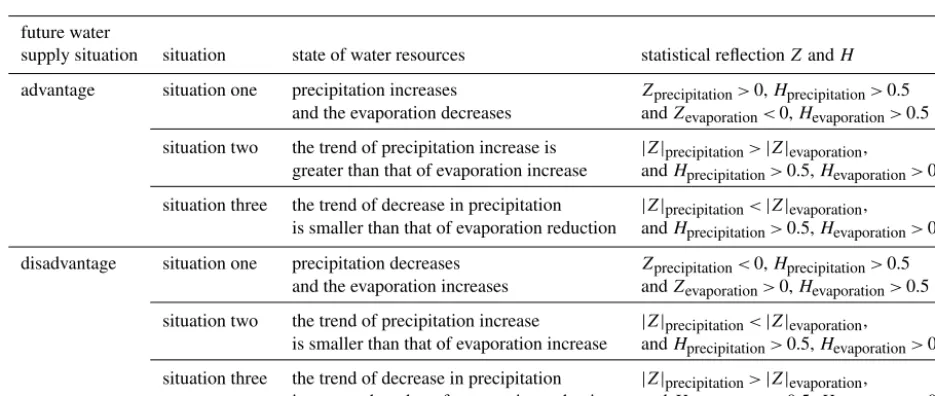
Regional hydrological conditions are greatly influenced by evaporation and precipitation under natural conditions. If one of the following three situations can happen, the regional wa-ter supply situation will improve in the future. In the situation one, the future regional precipitation increases and the evap-oration decreases. In the situation two, the trend of precip-itation increase is greater than that of evaporation increase. In the situation three, the trend of decrease in precipitation is smaller than that of evaporation reduction. If one of the fol-lowing three situations can happen, the regional water supply situation will degrade in the future. In the situation one, the future regional precipitation decreases and the evaporation increases. In the situation two, the trend of precipitation in-crease is smaller than that of evaporation inin-crease. In the sit-uation three, the trend of decrease in precipitation is greater than that of evaporation reduction. Scientifically and reason-ably evaluating the evolvement characteristics of the water supply situation in the future will have important practical significance for the sustainable development of the regional economy and society. This paper sets the situations of re-gional future water supply, which are seen in Table 3.
Whether the future water supply situation will be advan-tageous or disadvanadvan-tageous depends on the relative differ-ences in the change degree of precipitation and evaporation. This paper considers a total of six situations of advantageous (situation one, situation two and situation three) and disad-vantageous (situation one, situation two and situation three) situations.
In summary, the advantageous/disadvantageous area for future water supply in the river basin is calculated as follows: The Thiessen polygon method is used to calculate the area weightsfi of basin features represented by the meteorolog-ical stations in the river basin and calculate the area repre-sented by each station.
The Mann–Kendall analysis method and R/S analysis method is used to calculate theZ andH values of rainfall statistics at each station.
Based on the water supply evaluation indicators, the future water supply characteristics of the areas represented by each site are analysed.
Collect advantageous and disadvantageous sites for future water supply and calculate the area of advantageous or disad-vantageous area for future water supply in the basin by com-bining the area weights of advantageous or disadvantageous sites calculated in step (1) with Eq. (11):
Fadvantageous/disadvantageous= X
fi/F, (11)
whereF is the total area of the river basin andfi is the area weights of advantageous or disadvantageous area for future water supply.
4 Results and analysis
4.1 Analysis of tendency and sustainability of precipitation change
4.1.1 Precipitation historical change trend
The Mann–Kendall nonparametric test method is used to cal-culate past trends of precipitation for all 4 weather stations considered in this study. The results shows that the propor-tion of sites with decreasing trend respectively in spring, summer, autumn and winter is 100.00, 0.00, 100.00 and 84.00 %, respectively, and the proportion of sites with in-creasing trend in spring, summer, autumn and winter is 0.00, 100.00, 0.00 and 16.00 %, respectively. It can be seen from historical trends that the supply of water in spring and au-tumn is in a form of harshness and the water supply in sum-mer is in a good form.
4.1.2 Precipitation change sustainability
dis-Table 2.Indicators set for determining the future change of regional meteorological elements. Z Hurst value variation characteristics of meteorological elements
Z≤ −1.96 H >0.50 The trend of reduction in past is significant, and it will continue to decrease in the future. Z≤ −1.96 H <0.50 The trend of reduction in past is significant, but it is likely to reverse in the future.
−1.96< Z≤0 H >0.50 The trend of reduction in past is not significant, and it will continue to decrease in the future. −1.96< Z≤0 H <0.50 The trend of reduction in past is not significant, but it is likely to reverse in the future. 0< Z≤1.96 H >0.50 The trend of increase in past is not significant, and it will continue to increase in the future. 0< Z≤1.96 H <0.50 The trend of increase in past is not significant, but it is likely to reverse in the future. Z >1.96 H >0.50 The trend of increase in past is significant, and it will continue to increase in the future. Z >1.96 H <0.50 The trend of increase in past is significant, but it is likely to reverse in the future.
Table 3.Situations of regional future water supply.
future water
supply situation situation state of water resources statistical reflectionZandH
advantage situation one precipitation increases Zprecipitation>0,Hprecipitation>0.5 and the evaporation decreases andZevaporation<0,Hevaporation>0.5
situation two the trend of precipitation increase is |Z|precipitation>|Z|evaporation,
greater than that of evaporation increase andHprecipitation>0.5,Hevaporation>0.5
situation three the trend of decrease in precipitation |Z|precipitation<|Z|evaporation,
is smaller than that of evaporation reduction andHprecipitation>0.5,Hevaporation>0.5
disadvantage situation one precipitation decreases Zprecipitation<0,Hprecipitation>0.5 and the evaporation increases andZevaporation>0,Hevaporation>0.5
situation two the trend of precipitation increase |Z|precipitation<|Z|evaporation,
is smaller than that of evaporation increase andHprecipitation>0.5,Hevaporation>0.5
situation three the trend of decrease in precipitation |Z|precipitation>|Z|evaporation,
is greater than that of evaporation reduction andHprecipitation>0.5,Hevaporation>0.5
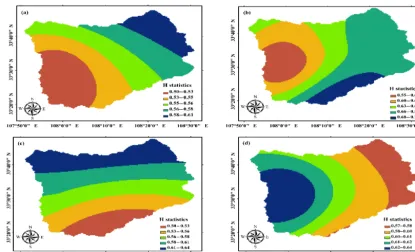
tribution. The spatial distribution trend of theHvalue in the four seasons is as follows: In spring, theHvalue of precip-itation gradually increases from southwest to northeast, that is to say, the intensity of future sustainability gradually in-creases from southwest to northeast; In summer, theHvalue of precipitation is the smallest in the northwest local region and it is very large in the southeast part; In autumn, theH value of precipitation increases from south to north, that is to say, the intensity of future sustainability gradually increases from south to north; In winter, theH value of precipitation gradually increases from west to east, that is to say, the inten-sity of future sustainability gradually increases from west to east. Each season has a strong sustainability and regularity, which is conducive to the study of future water supply and development.
4.1.3 Precipitation trends in the future
The results of the trend of future precipitation in the Ziwu River basin with time are shown in Table 4. The propor-tion of basin area where the spring, summer, autumn and winter precipitation is predicted to continue increase is 0.00,
100.00, 19.00 and 16.00 %, corresponding to the average an-nual precipitation of 0.00, 360.60, 279.69 and 21.15 mm, re-spectively; The proportion of basin area that will continue to decrease in the future respectively will be 100.00, 0.00, 81.00 and 74.00 %, corresponding to the average annual precipita-tion of 161.02, 0.00, 308.43 and 27.44 mm, respectively. The proportion of area where precipitation will be reversed in the future will be smaller in the seasonal scale.
4.2 Analysis of tendency and sustainability of potential evaporation change
Figure 2.Spatial distribution ofHvalue of precipitation in the four seasons(a)spring(b)summer(c)autumn(d)winter.
Table 4.Changes of the future precipitation trend in the Ziwu River basin.
future trend of increase future trend of decrease future trend reverse as increase future trend reverse as decrease
season (Z >0,H >0.5) (Z <0,H >0.5) (Z <0,H <0.5) (Z >0,H <0.5)
proportion of occupied area
historical av-erage annual precipitation
proportion of occupied area
historical av-erage annual precipitation
proportion of occupied area
historical av-erage annual precipitation
proportion of occupied area
historical av-erage annual precipitation
% mm % mm % mm % mm
spring 0.00 0.00 100.00 161.02 0.00 0.00 0.00 0.00
summer 100.00 360.60 0.00 0.00 0.00 0.00 0.00 0.00
autumn 0.00 0.00 81.00 308.43 19.00 279.69 0.00 0.00
winter 16.00 21.15 74.00 27.44 0.00 0.00 0.00 0.00
4.2.2 Potential evaporation change sustainability
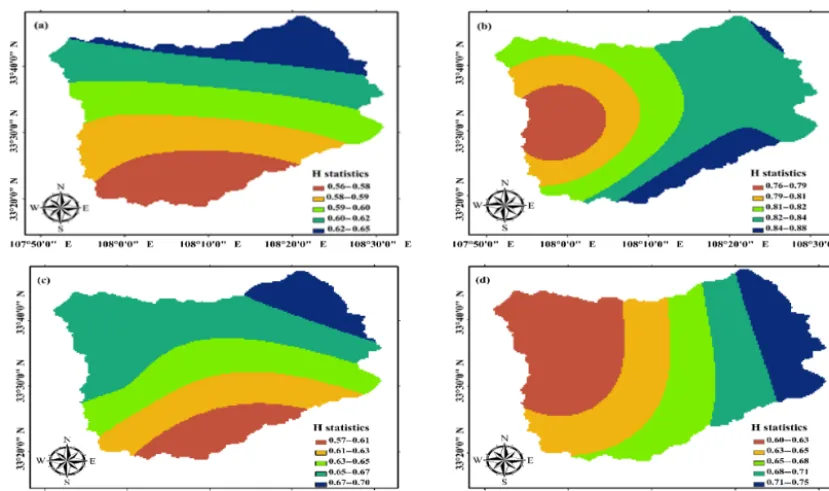
The potential evaporationH statistic value of each weather station was calculated by the R/S analysis method and spatial interpolation was carried out by kriging interpolation method based on the ArcGIS environment. The result is shown in Fig. 3. According to Fig. 3, the spatial distribution of po-tential evaporation H is significantly different. The poten-tial evaporation in summer is the largest, even in some areas reached 0.88; it in winter take second place; and it in spring is the smallest. Each season has a strong sustainability and regularity, which is conducive to the study of future water supply and development.
4.2.3 Potential evaporation trends in the future
Figure 3.Spatial distribution ofHvalue of potential evaporation in the four seasons(a)spring(b)summer(c)autumn(d)winter.
Table 5.Changes of the future potential evaporation trend in the Ziwu River basin.
future trend of increase future trend of decrease future trend reverse as increase future trend reverse as decrease
season (Z >0,H >0.5) (Z <0,H >0.5) (Z <0,H <0.5) (Z >0,H <0.5)
proportion of occupied area
historical av-erage annual precipitation
proportion of occupied area
historical av-erage annual precipitation
proportion of occupied area
historical av-erage annual precipitation
proportion of occupied area
historical av-erage annual precipitation
% mm % mm % mm % mm
spring 0.00 0.00 100.00 246.40 0.00 0.00 0.00 0.00
summer 0.00 0.00 0.00 354.68 0.00 0.00 0.00 0.00
autumn 0.00 0.00 81.00 150.45 19.00 148.83 0.00 0.00
winter 0.00 0.00 100.00 89.40 0.00 0.00 0.00 0.00
4.3 Variation characteristics of future hydrological conditions in the basin
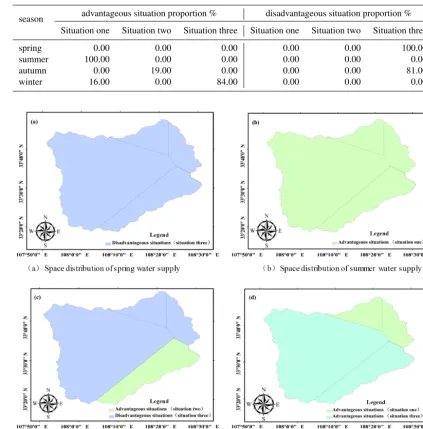
According to the trend of precipitation and evaporation in the future, the precipitation and evaporation in the basin have seasonal variation, which lays a good foundation for the study of the future hydrological conditions of the basin. Table 6 and Fig. 4 show that the future water supply situation of the basin is severe (disadvantageous) and good (advanta-geous) in regional spatial and temporal distribution.
The results show that: the area of severe water supply in spring, summer, autumn and winter respectively are 100.00, 0.00, 81.00 and 0.00 %. The future of the water supply in the spring and autumn is predicted to be more limited than in the past. The trend of decreasing precipitation in spring and autumn is greater than that in potential evaporation, and most of the water supply in the autumn basin is severe excluding
area which is 19 % in the southeast. These indicate that the future water supply is severe and are not conducive to the good development of regional hydrological conditions.
The area of water supply in spring, summer, autumn and winter good areas respectively account for 0.00, 100.00, 19.00 and 100.00 %. The summer water supply is situation one and the contradiction between supply and demand of wa-ter resources will be eased in the season; The wawa-ter supply in autumn is situation two, which mainly distribute in some ar-eas of the southar-east of the basin; The water supply in winter are situation one and three. The trend of decreasing precipi-tation is less than that of potential evaporation in most areas of the river basin, and the contradiction between the future water supply in summer and winter will be alleviated.
Table 6.Changes of future water supply characteristics of the basin.
season advantageous situation proportion % disadvantageous situation proportion % Situation one Situation two Situation three Situation one Situation two Situation three
spring 0.00 0.00 0.00 0.00 0.00 100.00
summer 100.00 0.00 0.00 0.00 0.00 0.00
autumn 0.00 19.00 0.00 0.00 0.00 81.00
winter 16.00 0.00 84.00 0.00 0.00 0.00
Figure 4.Spatial distribution of future water supply in the basin.
good in summer and winter, especially in the summer with a good space for development which precipitation will increase and evaporation will decrease.
5 Conclusions
In this paper, the Mann–Kendall non-parametric test and R/S test methods were combined to analyse the historical trend and future trend of precipitation and potential evaporation in the river basin. After combining the characteristics of fu-ture hydrological conditions, the following conclusions are obtained:
The future precipitation and potential evaporation are sea-sonal, and the spatial variation is significant. In addition, the areas with the same water supply situation are relatively con-centrated. The proportion of basin area where the spring, summer, autumn and winter precipitation is predicted to con-tinue increase is 0.00, 100.00, 19.00 and 16.00 %, mean-while, the proportion of basin area that will continue to de-crease in the future respectively will be 100.00, 0.00, 81.00 and 74.00 %.The future potential evapotranspiration of the four seasons in the basin shows a decreasing trend.
spring, summer, autumn and winter respectively are 100.00, 0.00, 81.00 and 0.00 %. The future water supply in the spring and autumn of the Ziwu River basin will be severe, and the future water supply in the summer and winter will be better, especially in the summer.
Data availability. The meteorological data in the paper are
pro-vided by China Meteorological Data Service Center, from their web site at http://data.cma.cn/en.
Competing interests. The authors declare that they have no
con-flict of interest.
Special issue statement. This article is part of the special issue
“Innovative water resources management – understanding and bal-ancing interactions between humankind and nature”. It is a result of the 8th International Water Resources Management Conference of ICWRS, Beijing, China, 13–15 June 2018.
Acknowledgements. This work was partially supported by
National Key R&D Program of China (2017YFC0405900) and National Natural Science Foundation of China (NSFC) (Grant No. 51779203, 51609270, 41330858). Funding was also provided by the Basic Research Plan of Natural Science of Shaanxi Province (2016JQ5105). The authors would like to thank Andreas Schumann and the anonymous reviewers for their comments to improve the paper.
Edited by: Andreas Schumann Reviewed by: two anonymous referees
References
Bisognin, C. and Lopes, S. R. C.: Estimating and forecasting the long-memory parameter in the presence of periodicity, J. Fore-cast., 26, 405–427, https://doi.org/10.1002/for.1030, 2007. Chebana, F., Ouarda, T. B. M. J., and Duong, T. C.: Testing for
mul-tivariate trends in hydrologic frequency analysis, J. Hydrol., 486, 519–530, https://doi.org/10.1016/j.jhydrol.2013.01.007, 2013. China Meteorological Data Service Center: available at: http://data.
cma.cn/en (last access: 21 May 2017), 2017.
Dang, T. D. and Molnr, S.: On the effects of non-stationarity in long-range dependence tests, Periodica Polytechnica Ser.el.eng, 43, 227–250, 1999.
Feng, X. L., Feng, Z. L., Luo, L. C., Qin, L. L., and Lin, P.: R/S analysis and Hurst exponential test of climate change trend of Qinghai-Tibet Plateau, J. Arid Land Geogr., 31, 175–181, https://doi.org/10.13826/j.cnki.cn65-1103/x.2008.02.002, 2008. Hamed, K. H.: Trend detection in hydrologic data: The Mann–
Kendall trend test under the scaling hypothesis, J. Hydrol., 349, 350–363, https://doi.org/10.1016/j.jhydrol.2007.11.009, 2008.
Hurst, H. E.: Long term storage capacities of reservoirs, Trans. Am. Soc. Civil Eng., 116, 776–808, 1951.
IPCC: Synthesis Report, Contribution of Working Groups I, II and III to the Fifth Assessment Report of the Intergovernmental Panel on Climate Change, edited by: Core Writing Team, Pachauri, R. K., and Meyer, L. A., Geneva, Switzerland, 151 pp., 2014. Kendall, M. G.: Rank Correlation Methods, M, 4th ed, Charles
Grif-fin, London, 1975.
Ling, H. B., Xu, H. L., Zhang, Q. Q., and Shi, W.: Climate Change in the Manas River Basin, Xinjiang during 1956–2007, J. Glaciol. Geocryol., 33, 64–71, 2011.
Ma, X. N., Zhang, M. J., Huang, X. Y., Ma, Q., and Pan, S. K.: Char-acteristics of climate change and future trend in the upper Yellow River basin from 1960 to 2008, Arid Land Resour. Environ., 26, 17–23, https://doi.org/10.13448/j.cnki.jalre.2012.06.029, 2012. Mann, H. B.: Nonparametric tests against trend, J. Econometrica,
13, 245–259, 1945.
Polemio, M., Casarano, D., Dragoni, W., and Sukhija, B. S.: Cli-mate change, drought and groundwater availability in south-ern Italy, Geol. Soc. London Special Pub., 288, 39–51, https://doi.org/10.1144/SP288.4, 2008.
Qiu, X. F., Liu, C. M., and Zeng, Y.: Changes of pan evaporation in the recent 40 years over the Yellow River Basin, J. Nat. Res., 18, 437–442, 2003.
Rzeszotko, Z.: Estimation of the Hurst exponent for market indices by use of rescaled range method and CAS Mathematica. Case study: S&P500, Electro. J. Mathe. Technol., 6, 256–267, 2012. Shi, Z. H., Wang, G. Q., Yv, H., Jiang, Y. F., Jin, X. A., and
Li, H. B.: Impact of Temperature change on Potential Evapo-ration in Yellow River Basin, Meteorol. J. of Henan, 1, 31–32, https://doi.org/10.3969/j.issn.1673-7148.2006.01.015, 2006. Wallis, J. R. and Matalas, N. C.: Small Sample Properties of H and
K Estimators of the Hurst Coefficient h, Water Resour. Res., 6, 1583–1594, 1970.
Whitfield, P. H. and Hendrata, M.: Assessing Detectability of Change in Low Flows in Future Climates from Stage Dis-charge Measurements, Canadian Water Res. J., 31, 1–12, https://doi.org/10.4296/cwrj3101001, 2006.
Xia, J., Shi, W., Luo, X., Hong, S., Ning, L., and Chiristopher, J. G.: Revisions on water resources vulnerability and adaption measures under climate change, J. Adv. Water Sci., 26, 279–286, https://doi.org/10.14042/j.cnki.32.1309.2015.02.019, 2015. Yang, H. B., Lv, H. F., Yang, D. W., and Hu, Q. F.: Seasonality of
precipitation and potential evaporation and its impact on catch-ment water-energy balance, J. Hydroelec. Eng., 31, 54–59, 2012. Zhang, K. and Zhang, S. T.: Analyses of “02.6” Ziwu River Ex-traordinary Flood in South of Shaanxi Province, J. Water Resour. Archit. Eng., 2, 54–56, 2004.
Zhang, Y. Q., Hu, W., and Liu, J. M.: Groundwater level regime variation trend on basis of rescaled range analysis, J. Central South Univ., 43, 4912–4916, 2012.