Compressive Strength of Binary and Ternary
Concrete made with OPC 53-S
R. Muni naik1, N. Ramakrishna2, Prof. A.S. Rao3 1
P.G student, Dept. of civil engineering, GVPCE (A), JNT University, Kakinada
2
Assistant prof. Dept. of civil engineering, GVPCE (A), JNT University, Kakinada
3
Professor, Dept. of civil engineering, RSR Eng. College, Nellore
Abstract: Ground Granulated Blast Furnace Slag (GGBS) and Fly Ash are chosen mainly due to the durability and
its cost effectiveness. Further environment pollution can also be decreased to some extent as the emissions of like carbon monoxide and carbon dioxide are considerably less. In this Paper the study is confined to evaluation of changes in compressive strength both GGBS and Fly Ash concrete with M40 Grade using special grade cement 53-S Four mixes by replacing cement content of0%, 20%, 30%, 40% with GGBS, Four mixes by replacing 0%, 20%, 30%, 40% cement content with Fly Ash (class C), and considered in the study three mixes using GGBS and Fly Ashwithout cement content viz(G25+F15)%, (G20+F20)%, (G15+F25)% one mix with only cement content(G0+F0)% was also done for compaction. The compressive strength tests are conducted on specimens cured for 7,28,56,91 days.
Keywords: GGBS, Fly Ash, Compressive Strength, Special cement, Concrete.
I.INTRODUCTION
Concrete is one of the most widely used construction material. Rapid production of cement creates environmental problems for which a solution has to
be found. It was estimated that Emission of CO2 in
the production process of the cement and same can be
reduced by using blended cement[1]. One ton of
carbon dioxide is estimated to be released in to the atmosphere when the same quantity ofordinary Portland cement is manufactured. GGBS is a by-product of the manufacturing of pig iron. Iron ore, coke and lime-stone are fed into the furnace and the resulting molten slag floats above the molten iron at a
temperature of about 1500ºC to 1600ºC[2]. Fly ash is
one of the by-products of thermal power plants most common mineral admixture used in concrete worldwide. Fly ash largely improves the durability of concrete.The early age strength development of fly
ash blended binary concretes shows poor
performance than the ordinary concrete. Researchers all over the world are developing Ternary Blended Concretes by adding a super fine mineral admixture like GGBS to the binary blended concretes of Fly
ash[3]. GGBS in the ternary blend improves the early
age performance of concrete and Fly ash improves the properties at the later age.
II.LITERATURE REVIEW
Alvin Harison1 et.alit was also observed that at 28
days and 56 days in20% replacement of PPC by fly Ash, the strength marginally increased from 1.9% to 3.28%. That up to 30% replacement of PPC by fly ash, the strength is almost equal to referral concrete
at 56 days.A.H.L.Swaroop2 et.alinvestigated Fly
ashconcrete on the in case of weight loss GGBS offers more resistance than fly ash. From our experimental work carried out as the strength of fly ash concrete with 20% and 40% replacement of cement and it was reported that the compressive strength is increased 20% replaced. Compared to 40% replacement and recommended the use of Fly ash between 20 to 40% replacement of cement with
Fly Ash.K.V.Pratap3 et.althecompressive strength of
concrete is improved with the addition of Fly Ash and GGBS as partial replacement to cement. Thecompressive strength of concrete is increased by a maximum of 11.13% at 28days with (4+16) %
replacement.Vinayak Awasare4 et.althe plain
III. MATERIALS
Cement:The cements used in this experimental
works are OPC 53-S (special cement).The OPC 53-S
cement is mostly usedin construction of Railway sleepers.
All properties of cement is tested by referring IS Specification for Ordinary Portland cement.
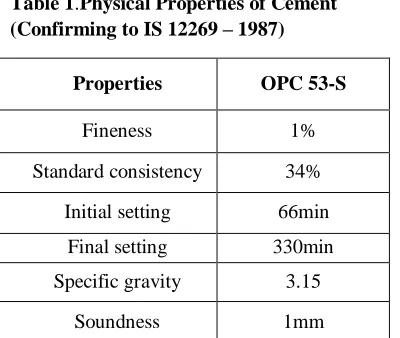
Table 1.Physical Properties of Cement
(Confirming to IS 12269 – 1987)
Properties OPC 53-S
Fineness 1%
Standard consistency 34%
Initial setting 66min
Final setting 330min
Specific gravity 3.15
Soundness 1mm
Water: Potable water available in laboratory is used
for mixing and curing of concrete.
Tests on aggregates
Natural sand from river confirming to IS 383-1970 is used. Various tests such as specific gravity, water absorption, impact strength, sieve crushing strength analysis etc. have been conducted on FA and CA to know their quality and grading. The above said test results are shown in Tables 2 & 3.Crushed black trap basalt rock of aggregate size 20mm.
Admixtures
Fly Ash:In this Project, the fly ash used belongs to
class C and was brought from NTPC limited simhadri Thermal power station.
GGBS:Ground granulated blast furnace slag is
by-product brought from vizag steel plant.
Tables 2.Physical Properties of Fine Aggregate
(sand)
Sr.no Property Results
1 Particle shape &
size
Round & 4.75mm down 2
Fineness modulus 3.23
3 Silt content 1.67%
4 Specific gravity 2.53
5 Bulking of sand 4.16%
6 Bulk density 1700kg/m3
Tables 3.Physical Properties of Coarse Aggregate (20mm)size
Sr.no Property Results
1
Particle shape & size Angular & 20mm
2 Fineness modulus of
20mm aggregate 6.87
3
Specific gravity 2.76
4
Water absorption 0.55%
5
Bulk density 1683 kg/m3
Table.4.Mix design for M40 grade concrete IS 10262-2009
Cement F.A C.A Water
420 584 1174 197
1 1.3 2.7 0.45
IV. EXPERIMENTAL INVESTIGATION
The study work is to analyses the strength properties of partially replaced GGBS and Fly Ash concrete. The tests of concretes are carried out as per IS code for this proposed investigation work. For successful investigation, tests have to be performed on normal concrete and on Fly Ash & GGBS concrete with proportion 20%, 30%, 40% cement replacement.
Collection of materials
Table 5.Chemical Composition of materials
Chemical
constituent Portland GGBS
FLY ASH
CaO 65% 35% 24%
SiO2 20% 38% 50%
AI2O3 5% 13% 16%
MgO 2% 8% 5%
Casting of Specimens
For casting the cube, standard cast iron metal moulds of size 150 mm x 150 mm x 150 mm have been used. The moulds have been cleaned of dust particles and applied with mineral oil on all sides, before concrete is poured into the mould. Thoroughly mixed concrete is filled in to mould.The mixing was carried out for 3-5 minutes duration, then compacted manually using tamping rods.
Curing the Specimens
After casting, the cubes are demoulded after 1 day of casting and then kept in respective solutions for curing at room temperature with a relative humidity of 85% the cubes are taken out from curing after 7, 28, 56, and 91days for testing.
Testing of Specimens
Studying the properties of cement with
GGBS and Fly ash by conducting tests as per BIS such as standard consistency test, initial and final setting time.
Mix design of concrete is done for
preparation of concrete as per IS
10262:2009.
Tests on fresh concrete conducted at the
time of casting of different specimens required for proposed work.
CTM is used to conduct the tests. Test
procedure used as per IS 516.
The compressive strength of specimen was
calculated by the following formula f = P/A
Where,
Pc = Failure load in compression, kN
A = Loaded area of cube, mm2
V. Results and Discussions
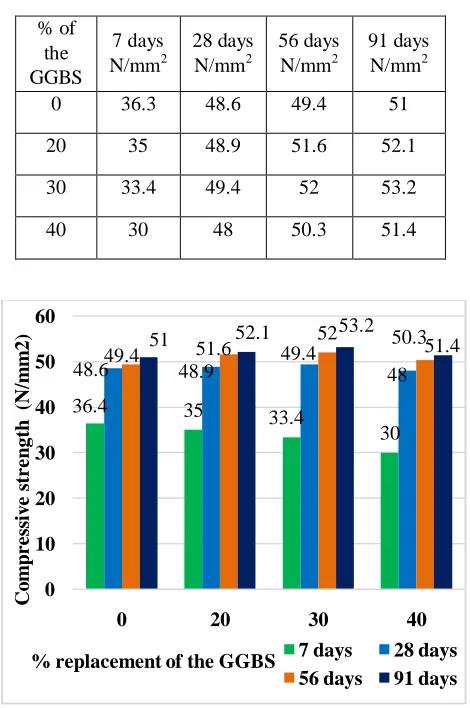
An individual comparison of compressive strength of concrete with GGBS replacement by 0, 20, 30 and 40% is made for curing periods of 7days to 91days vide Fig.1. It is observed that the compressive strength is increased from 7days to 91days at 0% replacement. At 20% and 30% replacement the compressive strength at 28 days and beyond is more than its target strength while at 40% replacement the 28days strength is decreased by 0.99%. However at 91days period of curing the compressive strength is exceeds its target strength.
Table 6.Compressive strength of GGBS concrete
Fig.1. Compressive Strength of GGBS Concrete with M40 grade
36.4 35
33.4
30
48.649.4 48.9 49.4 48
51.6 52 50.3
51 52.1 53.2 51.4
0 10 20 30 40 50 60
0 20 30 40
C
o
m
p
r
e
ss
iv
e
s
tr
e
n
gth
(N
/m
m
2)
% replacement of the GGBS 7 days 28 days
56 days 91 days
% of the GGBS
7 days
N/mm2
28 days
N/mm2
56 days
N/mm2
91 days
N/mm2
0 36.3 48.6 49.4 51
20 35 48.9 51.6 52.1
30 33.4 49.4 52 53.2
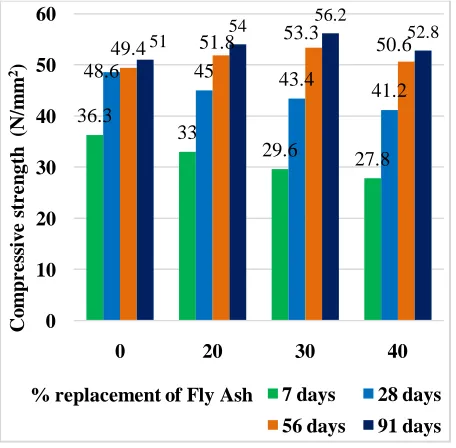
Table 7.Compressive strength ofFly Ash concrete
A comparison of compressive strength of concrete with Fly ash replacement by 0, 20, 30 and 40% is made for different curing periods vide Fig.2. It is observed that the compressive strength is increased from 7days to 91days at 0% replacement. At 20, 30 and 40% replacement the compressive strength is decreased at 28 days compared to its target strength. However at 56 days period of curing the compressive strength is increased more than its target strength.
Fig.2.Compressive Strength of fly ash concretewith M40 grade
Table 8.Comparison on compressive strength of GGBS and Fly Ash for 7days
% replacement GGBS
(N/mm2)
Fly Ash
(N/mm2)
20 35 33
30 33.4 29.6
40 30 27.8
Increase of compressive strength of GGBS concrete 20 to 40% compared with Fly ash concrete. Fig.3 the Increase of compressive strength of GGBS concrete compared to Fly ash concrete from 7days is observed
to be 2to 4.8N/mm2. The decrease in strength may be
due to slow hydration process since fly ash is a reactive pozzolans which delays the hydration process.
Fig.3. Comparison of Compressive Strength at 7days GGBS and fly ash concrete
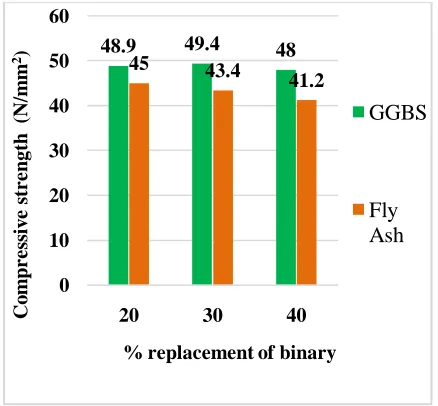
Table 9.Comparison on compressive strength of concrete GGBS & Fly Ash for 28days
% replacement GGBS
(N/mm2)
Fly Ash
(N/mm2)
20 48.9 45
30 49.4 43.4
40 48 41.2
36.3
33
29.6 27.8
48.6 45 43.4
41.2
49.451 51.8 53.3 50.6
54 56.2 52.8
0 10 20 30 40 50 60
0 20 30 40
C
o
m
p
r
e
ss
iv
e
s
tr
e
n
gth
(N
/m
m
2)
% replacement of Fly Ash 7 days 28 days
56 days 91 days
35 33.4
30 33
29.6
27.8
0 5 10 15 20 25 30 35 40
20 30 40
C
o
m
p
r
e
ss
iv
e
s
tr
e
n
gth
(N
/m
m
2)
% replacement of binary GGBS
Fly Ash
% of the fly ash
7 days
N/mm2
28 days
N/mm2
56days
N/mm2
91days
N/mm2
0 36.3 48.6 49.4 51
20 33 45 51.8 54
30 29.6 43.4 53.3 56.2
Increase of compressive strength of GGBS concrete 20 to 40% compared with Fly ash concrete. Fig.4 the Increase of compressive strength of GGBS concrete compared to Fly ash concrete from 28 days is
observed to be 3.9to 6.8 N/mm2
Fig.4. comparison of Compressive Strength at 28days GGBS and fly ash concrete
Table 10.Comparison on compressive strength of concrete GGBS & Fly Ash for 56days
%
replacement
GGBS
(N/mm2)
Fly Ash
(N/mm2)
20 51.6 51.8
30 52 53.3
40 50.3 50.6
There is an increase of compressive strength of Fly ash concrete 20 to 40% compared with GGBS concrete. Fig.5. the Increase of compressive strength of Fly ash concrete compared to GGBS concrete
from 56 days is observed to be 0.2to 1.3N/mm2.
Fig.5. comparison of Compressive Strength at 56days GGBS and fly ash concrete
Table 11.Comparison on compressive strength of concrete GGBS & Fly Ash for 91days
%
replacement
GGBS
(N/mm2)
Fly Ash
(N/mm2)
20 52.1 54
30 53.2 56.2
40 51.4 52.8
Increase of compressive strength of Fly ash concrete 20 to 40% compared with GGBS concrete Fig.6. The Increase of compressive strength of Fly ash concrete compared to GGBS concrete from 91 days is
observed to be 1.4to 3N/mm2.
Fig.6. comparison of Compressive Strength at 7days GGBS and fly ash concrete
48.9 49.4 48
45 43.4
41.2
0 10 20 30 40 50 60
20 30 40
C
o
m
p
r
e
ss
iv
e
s
tr
e
n
gth
(N
/m
m
2)
% replacement of binary
GGBS
Fly Ash
51.651.8 52 50.3
53.3 50.6
0 10 20 30 40 50 60
20 30 40
C
o
m
p
re
ss
iv
e
str
e
n
gth
(N
/m
m
2)
% replacement of binary
GGBS
Fly Ash
52.1 53.2 51.4
54 56.2 52.8
0 10 20 30 40 50 60
20 30 40
C
o
m
p
r
e
ss
iv
e
s
tr
e
n
gth
(N
/m
m
2)
% replacement of binary
GGBS
Table12. Compressive strength of Ternary (GGBS &Fly Ash)
A comparison of compressive strength of concrete with GGBS and fly ash replacement of(G0+F0)%, (G25+F15)%, (G20+F20)%, and (G15+F25)% is made for different curing periods vide Fig.7. It is observed that the compressive strength is increased from 7days to 91days at 0% replacement. At (G0+F0)% replacement of cement the compressive strength at 28 days and beyond in more than its target strength while at (G25+F15)%, (G20+F20)%,and (G15+F25)% replacement the 28days strength is decreased by 0.93%,0.89% and 0.85%. However at 91days period of curing the compressive strength is increased more than its target strength.
Fig.7.Compressive strength of Ternary (GGBS & Fly Ash) concrete
VI. CONCLUSIONS& RECOMMENDATIONS
The maximum compressive strength
achieved is 53.2Mpa at 30% of GGBS replacement for 91 days.
The maximum compressive strength
achieved is 56.2Mpa at 30% of Fly Ash replacement for 91days.
The maximum compressive strength
achieved is 53.3Mpa at (G15+F25)%of Ternary replacement for 91 days.
It is concluded at 30% replacement of
GGBS the M40 concrete is performed better and hence it is recommended 30% replacement in case of GGBS at 28days.
It is also observed that an addition of fly
ash and ternary 7days strength was decreased at all replacement level.
PPC gains strength after 56days curing
because of very slow hydration process.
PSC gains strength up to 56days curing
because of slow hydration process.
The compressive strength increases
gradually as the curing days increases.
The binary & ternary blended concrete
improves sustainability and reduces the cost compared to OPC.
VII. REFERENCES
1. Alvin Harison and vikassrivastava et.al arpan Herbert
“Effect of fly ash on compressive strength of Portland pozzolana cement concrete” Journal of academia and
industrial research(JAIR) Vol-2, Issue-8 January 2014,
ISSN:2278-5213
2. A.H.L.Swaroop and K.Venkateswararaoet.al Prof P
Kodandaramarao“durability studies on concrete with fly
ash &Ggbs”international journal of en gineering research
and applications (IJERA) ISSN:2248-9622 Vol.3, Issue 4,
Jul-Aug 2013, PP.285-289
3. D.Audinarayana and P.sarika et.al Dr.seshadrisekhar
‘‘Studies on compressive strength of ternary blended concrete at different water binder ratios‟‟ American journal
of engineering research(AJER)e-ISSN:2320-0847
p-ISSN:2320-0936 Volume-02,Issue-09,PP-37-45
4. K.V.Pratap and M.Bhasker et.al P.S.S.R.Teja“Triple
Blending of cement concrete with fly ash and groundgranulated blast furnace slag”international journal of education and applied research (IJEAR) Vol.4, Issue Spl-2, Jan-June 2014 ISSN:2348-0033
5. VinayakAwasare and Prof. M. V. Nagendra“Analysis of
Strength Characteristics of GGBS Concrete” International
Journal of Advanced Engineering Technology E-ISSN
0976-3945 36.3
31 29.2
28.4 48.6
45 43.2 41.4
49.4
48.2 48.8 51.8
51
49.5 51.7 53.3
0 10 20 30 40 50 60
G0+F0 G25+F15 G20+F20 G15&F25
C
o
m
p
r
e
ss
iv
e
s
tr
e
n
gth
(N
/m
m
2)
% replacement of ternary 7days 28days
56days 91days
% of the GGBS
7days
N/mm2
28 days
N/mm2
56 days
N/mm2
91days
N/mm2
G0&F0 36.3 48.6 49.4 51
G25&F15 31 45 48.2 49.5
G20&F20 29.2 43.2 48.8 51.7
6. Arivalagan .s ( 2014) “sustainable studies on concretes with GGBS as a replacement material in cement” Jordan journal of civil engineering , volume 8, NO .3, 2014
7. SuvarnaLatha.k and Seshagiri Rao. M et.al
SrinivasaReddy.V. (2012) “Estimation of GGBS and
HVFA Strength Efficiencies in concrete with Age.
International Journal of engineering and Advanced Technology (IJEAT) ISSN: 2249-8958, volume 2, Issue-2, December 2012.
8. Prof JayeshkumarPitroda and Dr.F.S.Umrigar,
„Experimental investigations on partial replacement of cement with fly ash in design mix concrete‟, International Journal of Advanced Engineering Technology., Vol. 3, pp.126-129. (2012)
9. VenuMalagavelli “high performances concrete with GGBS
and ROBO sand”International journal of engineering science and technology vol.2 (10), 2010, 5107-5113.
10. Mahesh Patel Prof. P. S. Rao and T. N. Patel
“Experimental investigationon strengthof high performances concrete with GGBS and Crusher sand.”
11. Muntadher Ali Challoob and VikasSrivastava, „Effect of
Fly Ash and Steel Fibre on Portland Pozzolana Cement Concrete‟, International Journal of Engineering Trends and Technology, vol.5, pp. 144-147,Nov-2013.
12. M. S. Shetty Concrete Technology and S.Chand&
Company Ltd., 2005, New Delhi.
13. Mr. Bennet Jose Mathew and Mr. M Sudhakar et.al Dr.
C Natarajan (2013) Strength, Economic and Sustainability
Characteristics of Coal Ash –GGBS Based Geopolymer Concrete, International Journal Of Computational Engineering Research (ijceronline.com) Vol. 3 Issue. 1
14. IS 383-1970 Specification for coarse and fine aggregates
from natural sources for concrete.
15. IS456-2000 plain and reinforced concrete code of practice.
16. IS 10262 -2009Guidelines for concrete mix design
proportioning [CED 2: Cement and Concrete.
17. IS(12269-1987) 53 grade ordinary Portland cement.
18. IS 12089-1987Specification for granulated slag for the
manufacture of Portland slag cement
19. IS 3812-1981 Specification for fly ash for use as pozzolana and admixture
20. IS 1727-1967Methods of test for pozzolanic materials