RESEARCH OF THE DIESEL ENGINE FAILURE DEPENDENCY ON
ENGINE OPERATING CONDITIONS
ИСЛЕДОВАНИЯ ЗАВИСИМОСТИ ОТКАЗОВ ДИЗЕЛНЫХ ДВИГАТЕЛЕЙ ОТ УСЛОВИЙ
ЭКСПЛУАТАЦИИ
dr. Dobržinskij N.
The General Jonas Žemaitis Military Academy of Lithuania; Vilnius; Lithuania; e-mail: [email protected]
Abstract
: the paper deals with the analysis of the factors and aspects covered by the Diesel Engine Reliability Theory and relevant for
the discussion of engine reliability. The paper suggests and examines indicators for the assessment of engine reliability, and quantitative function for the evaluation of engine technical condition. The integrated effect of mountainous dessert on automotive engines is also examined although it has received little research attention so far, whereas findings of quantitative criteria analysis intended for reliability assessment under difficult conditions have not been publicly reported as they have been accomplished by manufacturers of military vehicles.
Engine operating conditions refer to the manner of engine use, intensity of engine operation, different types of engine loads and their sequence, as well as culture and qualification of drivers, servicemen and maintenance personnel, provision of repair and diagnostics equipment, etc.
Research of the case under consideration has been accomplished in mountainous desert of Afghanistan showing complicated climatic conditions. For the purpose of collecting precise and accurate data, vehicles used by the Provincial Reconstruction Team situated in Ghor province (Afghanistan) were selected for the research. Their operation course, failures, and repairs can be tracked and captured more precisely than those of civilians as their data are recorded in data logs.
KEYWORDS: ENGINE FAILURES, AFGHANISTAN, ENVIRONMENTAL INTERACTION, CLIMATIC FACTOR.
1.
Introduction
Automotive internal combustion engines (hereinafter – ICEs) are usually designed for operation under normal conditions consequently, their adaptation for use in vehicles operated under difficult conditions faces some problems. These issues are caused by the engine operation in locations showing difficult climatic and geographic conditions: surroundings of mountains, deserts and torrential rivers, increased airborne dust levels, diurnal temperature variation, and solar radiation.
Most of the engine operation researches are carried out at the locations having a good road network while maintaining and repairing engines according to the requirements of their manufacturers.
Difficult engine operating conditions normally include low air temperatures, deep snow coverage, frequent snowstorms and snow banks on roads; also regions with hot desert climate with poorly developed network of automobile roads, lack of afforestation and water, increased airborne dust levels, considerable diurnal temperature variation; mountainous terrains with thin air and lower atmospheric pressure; highly variable terrain profiles; off-roads and high-scale road aggravation. Difficult engine operating conditions are also considered to include regions with high humidity levels.
Object of the research – diesel engines operating under difficult conditions.
Research material. The article analyzes performance of twenty nine diesel engines operating under difficult conditions: sixteen vehicles Toyota Land Cruiser 100 (LC) with diesel engines 1HD-FTE, and thirteen high-mobility multipurpose wheeled vehicles M998A2 (HMMWV) with diesel engines GM6.5L. All the vehicles were used under conditions of mountainous desert from the very beginning, i.e., starting with summer of 2005 till December 31, 2011.
The objective of the study – to determine the influence of the system “ICE-environment” on reliability of engines operating under difficult conditions.
Tasks:
• to identify the key factors determining operational reliability of ICEs operating under difficult conditions;
• to reveal adversity of weather and climate in the region under consideration for ICE operation;
• to suggest a dependency for the determination of number of failures of ICEs operated under difficult conditions.
As it was mentioned before, the research was carried out in mountainous dessert of Afghanistan which is located in Central Asia and has borders with Tajikistan, Uzbekistan, Turkmenistan, Iran, Pakistan, and China (Fig. 1).
Fig. 1. Map of geographical location of Afghanistan.Regions of deserts: Oxus basin Amu Darja (1A), Kara-Kum Garagum, Badghyz and Karabil (1B). Clay deserts: Seistan, Dasht-e-Margo and Dasht-i-Arbu South, South-West Afghanistan desert (1C), Registan, South-East Afghanistan Sandy Desert (1D). Regions of semi-deserts: Khorassan (2A), part of Persian Iran) desert (2B), valleys of semi-deserts of the Afghan Mountains (2C). Regions of hills, semi-deserts and lower mountains that can be passed through: regions of Safedhok and Circum Oxiani-Hill (3A), and Siahkok (3B). Mountainous regions: Chorat (4A), Paropamiz and Hazarajat Mountains (4B), alpine plain surface Hindu Kush (4C), Pamir high-mountainous region (4H). (Michael A. Mares 1999, 2003).
conditions in Ghor province of Afghanistan which is located in semi-desert valleys between the Afghan Mountains (2C) and Chorat (4A), the mountainous region of Afghanistan.
Engine failures tend to occur one after another at particular time intervals, thus ICE failure flow is indicated as the totality of variation of process’ factors. The ratio of engine motor hours to time, as well as variation of operating conditions in time are not constant, consequently engine performance indicators and engine condition will highly vary in time in response to the changing intensity and conditions of ICE operation.
2.
Investigation of number of failures of ICEs
operating under difficult conditions
Assurance of ICEs reliability should never be based on approximate awareness of the average conditions; it requires for precise and accurate data on real operating conditions. Accordingly, the following factors are distinguished: mechanical effect; climatic and other environmental external factors that are dependent on the geographic location, season and time of a day, etc.; biological factors; radiation factors; external factors of electromagnetic fields; specific factors that influence environment externally; thermal factors.
Estimation of climatic and other natural factors influencing exterior of vehicles operated in Ghor province of Afghanistan, and their diurnal variations, used meteorogical data recorded by the Air Traffic Control Centre of the Provincial Reconstruction Team of Ghor province using weather data recording equipment Vaisala TacMet Tactical Meteorological Observation System MAWS 201M, and processed using software MIDAS IV Tacmet. This equipment is used to detect and record meteorological data at one minute intervals 24 hours a day.
The most significant factors potentially leading to destabilization of performance of engines operating under conditions of mountainous desert are heat and cold that are characterized by temperature, relative humidity of air, precipitation, dust and sand, and solar radiation (insolation).
Variety of mountains in the region influences wind regimes. Wind has a negative effect like any other wind-related phenomena (such as snowstorms, sandstorms, hurricanes and tornadoes): a high wind speed puts an extra load on engine due to the increased force of vehicle resistance to movement. In the region under consideration, average wind speed ranges 5–6 m/s, whereas windflaws – as much as 30 m/s; at night a cold wind blows from mountains, whereas at the day time wind blows towards the mountains.
Atmospheric air pressure and air density varies in a course of year and tends to decrease when moving up the mountains. With these factors decreasing the effect of solar radiation and air ionization keeps increasing.
The studies of reference literature sources [7-15] show a negative effect of climatic factors on automotive ICEs to exist, therefore climatic factors and phenomena must be taken into consideration when dealing with the issue of ICE reliability. It’s worth noting that several climatic factors tend to act simultaneously leading to the combined effect thereof which can further enhance this negative effect on automotive engines.
The weather adversity of Afghanistan’s hot and cold climate for the vehicle operation shows only spotted assessment of the effect of climatic factors during three coldest or hottest months. Consequently, adversity of the climate for vehicle operation proves to be a general characteristic of climatic factors’ effect. Afghanistan weather adversity for the vehicle operation is dependent upon the same climatic factors while taking into consideration negative or positive temperature over the period of exposure.
Climatic adversity for ICE operation was determined using the climate evaluation technique suggested by B. Kozhevnikov and based on the entropic method (according to formulas 1–6), however not entire year was taken for the evaluation at once, as the author suggested, but principles adapted from Koch and ir Shevcov were
followed, i. e., weather adversity for ICE operation during each month was assessed in order to show the monthly variation of weather adversity over the year.
Entropy is an extensive variable that specifies the state of thermodynamic system and expresses irreversibility of the isolated system. It varies at almost each process.1
The amount of thermodynamic entropy is understood as a measure of irreversible spread, provided this energy is treated as an internal energy of the article contained inside its structure, whereas spontaneous energy spread influenced by the climatic factors, in course of time, makes integrity links existent inside the article to weaken, change or break. The resulting outcome – ageing and wearing of an object (Kozhevnikov 2010).
Based on the information theory, originally developed by C. Shannon (1963), the amount of disinformation occurring in result of the climatic factor effect, is marked by the minus sign, thus amount of change in entropy is calculated using formula (1) (Kozhevnikov 2010):
; )
(−QFi =AFiq ⋅t (1)
(
)
;
−
− =
N F X F X
F q q
Fi
A (2)
(
)
;
ln
)
(
t
N
k
F
q
∆
⋅
=
−
(3); 4427 , 1 2 ln
1 = =
k (4)
(
−QKM) (
= −QA) (
+ −QB)
+...+(
−QM)
, (5)where: (–QFi)– change in entropy over time t; AFiq – coefficient of linear regression angle slope; (–qF) – information speed of the climatic factor, bps; XF
N
– value of the climatic factor under normal conditions; XF – current value of the climatic factor; N – number of intervals with the value ∆X that falls in range (XXF
N
) with the current value XF; (–QKM) – the integrated effect of climatic factors on object; (–QA),(–QB), ..., (–QM)– change in entropy of climatic factors (phenomena) A, B, ..., M over time t.
Adversity of the climatic factor KN for vehicle operation is calculated as a ratio of the integrated change in climate’s entropy (– QKM) over a specific time t to the change in climate’s entropy (– QFN) under normal conditions over the same time t:
(
)
.
−
− =
N F Q
KM Q N
K (6)
Any time interval can be selected: a week, a month, a quarter, a year, etc. In the case under consideration time intervals of a month and a tear are the most appropriate, as such a selection allows for calculation of weather variation during the year while taking into consideration a specific region of vehicle operation.
The maximum value of the adversity of the climatic factor for engine operation belongs to the cold season, and is followed by relative humidity in the second place by significance, whereas the third place is shared between monthly mean air temperature, solar energy irradiation and mean air temperature variation amplitude, with minor error, then closely followed by the scattered solar energy irradiation; wind speed, air pressure, and average air temperature during three hottest months of the warm season were found to be less important. Other factors – duration of the warm
1
season, fluctuations in air temperature through 0 ºC, time period of mist coverage – do not determine adversity of the climate to ICE operation in the region, and such factors as amount of precipitation and time period of precipitation and wind direction have no influence on engine performance at whatsoever.
Fig. 2 offers the graph of climatic adversity for ICE operation obtained based on calculation results.
Fig. 2. The climatic adversity for ICE operation monthly for the
period of one year in 2005–2011
Geographical location of Afghanistan determines the climate of its regions, which is described as an extremely dry continental climate with characteristic huge amplitude of fluctuations in air temperature. The characteristics of the climate and other natural factors prevailing in Afghanistan region were identified having influence on the exterior of internal combustion engines.
Not only ICE but a technical personnel is also influenced by the mountainous terrain of Ghor province and its climatic factors. Summary table of the adversity of climatic factors for ICE operation based on calculation results reveals that the climatic factor ranges from 1.3 to 2.4 over the year while achieving its maximum values in winter and summer times, and lower values – in autumn and spring. Values of the effect of climatic factors were established, and their priority sequence was formed by applying the calculation methodology.
Seasonal variation in climate changes conditions on roads, and in Afghanistan, vehicles are mainly operated on unpaved roads. Varying humidity and temperature of such roads causes rolling resistance of a vehicle to change significantly, respectively increasing the loading on a vehicle’s transmission and engine, all of which results in increased number of failures, too. Variation of road conditions over a single year was expressed as the rolling resistance coefficient of a vehicle. Data were found experimentally in accordance with the methodology suggested in this thesis.
Actual values of the vehicle rolling resistance coefficient were found experimentally using methodology offered by R. Lahno (Fig. 3).
Fig. 3. Principal scheme for finding the vehicle rolling resistance
coefficient.
The vehicle rolling resistance coefficient (Fig. 4) is calculated as a sum of ground resistance to motion of a rolling tire and longitudinal angle of uphill (or downhill). Given the fact that longitudinal angle of uphill or downhill remains constant in the same road section, the rolling resistance coefficient is calculated as follows:
,
...
...
2 1
2 2 1 1
n n n
l
l
l
l
f
l
f
l
f
f
+
+
+
+
+
+
=
(7)where: ƒ1, ƒ2, …, ƒn – actual values of the vehicle rolling resistance coefficient in the road section 1,2,...,n; l1, l2, …, ln –
actual value of a vehicle rolling distance in the road section 1,2,...,n.
The rolling resistance coefficient is as follows:
)].
5
.
2
(
30
cos[
035
.
0
073
.
0
+
−
=
ir
t
f
(8)The rolling resistance coefficient of a vehicle was established defining potentially increased ICE loading having the dependency of seasonal features. The rolling resistance coefficient of a vehicle was found to vary all year round: it was observed to achieve its maximum values in spring fr= 0.11, and minimum values – in summertime fr= 0.043.
Fig. 4. Diagrams of the rolling resistance coefficient and its
approximation for each month of the year 2010.
Engine operating intensity is found from vehicle operation records and logs, and using the same principle as in case of finding operating conditions, ICE operating intensity is then defined as follows:
(
)
[
]
,
cos
1
0
0 P
g
k
k i Yk
ei
l
l
m
k
t
t
l
l
g
+
−
+
=
∑
=
(9)
where l0 – constant component of the operating intensity factor which is the mean value of X per cycle; k – harmonic number; gg– number of harmonics under investigation; lYk – fluctuation wave of the amplitude at the harmonic side k of the operating intensity factor, m – interval between tk and tk+1 in degrees; t0k– fluctuation phase of the initial wave in degrees; lP – incidental part of the climatic factor corresponding to time (t).
,
1
1 1 1
0
∑
= +
+
−
−
=
nai i i
i i
d
t
t
L
L
n
l
(10)where nd – number of days in a month under investigation; na– number of vehicles under investigation in the group;
L
i+1−
L
i–ICE operating intensity in the interval between the month tk+1 and ti, in km;
t
i+1−
t
i – the interval of a month under investigationbetween the month tk+1 and ti.
The intensity of operation lei of diesel engines GM 6.5L of M998A2 cars under investigation was defined through the following dependencies:
)]. 0 . 1 2 ( 30 cos[ 3 . 2 )] 0 . 8 ( 30 cos[ 3 . 9 5 .
36 + − + −
= i i
ei t t
l (11)
The intensity of operation lei of diesel engines 1HD-FTE of Toyota Land Cruiser 100 cars under investigation was defined through the following dependencies:
)]. 9 . 3 3 ( 30 cos[ 1 . 4 )] 0 . 3 2 ( 30 cos[ 9 . 1
)] 3 . 7 ( 30 cos[ 1 . 17 2 . 71
− +
− +
+ − +
=
i i
i ei
t t
t
l (12)
Engine operating intensity and rolling resistance vary all year round. However, it’s worth noting that engine operating intensity is by 1.5 times higher in summertime than in late winter.
0,02 0,07 0,12
1 2 3 4 5 6 7 8 9 10 11 12
fr
Months
Approximation of the rolling resistance coefficient
The rolling resistance coefficient 1,2
1,6 2 2,4
1 2 3 4 5 6 7 8 9 10 11 12
KN
,
sco
res
Months
Each vehicle has its specific operating intensity over the same period of time. For the purpose of calculations, mean operating intensity value was selected depending on the same group and type of cars.
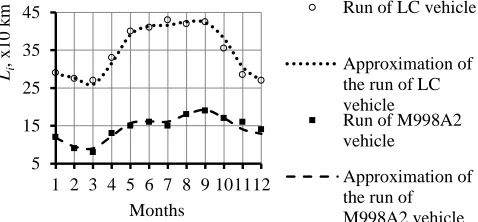
The approximation equation of the average monthly run Li for the high-mobility multipurpose wheeled vehicles M998A2 (HMMWV) with diesel engines GM6.5L is defined through the following dependency:
)]. 9 , 3 3 ( 30 cos[ 6 , 12 )] 7 , 10 2 ( 30 cos[ 7 , 5
)] 2 , 8 ( 30 cos[ 42 143
− +
− +
+ − +
=
i i
i i
t t
t
L (13)
The approximation equation of the average monthly run Li for the Toyota Land Cruiser 100 with diesel engines 1HD–FTE is defined through the following dependency:
].
) 9 , 3 3 ( 30 cos[ 6 , 12 )] 0 , 3 2 ( 30 cos[ 7 , 5
)] 3 , 7 ( 30 cos[ 9 , 54 6 , 216
− +
−
+ − +
=
i i
i i
t t
t
L (14)
Regression model is suitable as determination coefficient R2=0.98.
The error of approximation of statistical data of vehicle operating intensity and rolling resistance is below 5 %, and determination coefficients are in range of R2=0.92÷0.96, which serves as the evidence of the suitability of mathematical expression.
Fig. 5. Dependency of the run Li of M998A2 and LC vehicles for each month in the period of 2005–2011.
Experience gained through vehicles operation in Afghanistan revealed the following three main reasons behind inoperability of vehicles: combat damages; scheduled repairs after the established amount of motor hours or kilometres run by engine; car accidents and failures in a course of vehicle operation (operating failures) (Dobrzhinskij, Markshaitis 2009). Failures of engines used in vehicles are also grouped into the following three groups: catastrophic, parametric and combined failures. Taking into account high numbers of ICE failures, engine as a repairable part of a vehicle is described using a particular law of distribution (Lukinskij, 1982). ICE failure flow must be known when setting ICE reliability criteria based on values of which the adjustment of periodic maintenance intervals, need for repairs, and amounts of spare parts stored and available for repairs can be accomplished. When studying ICE operating reliability, the distribution law of ICE failures must be determined VDV.
The collected data on operating failures of diesel engines1HD– FTE and GM 6.5L used in vehicles Toyota Land Cruiser 100 and M998A2 respectively, operated in Ghor province for 6 years, allowed for constructing dependencies of engine failure flow parameter for each month in the period of 2005–2011 (Fig. 6).
Research shows the failure flow of ICEs operated in Afghanistan to be more intensive in winter and summer times. Engine failure is obviously dependent in the weather adversity for vehicle operation in the region. Engine GM6.5L used in vehicle M998A2 was found to be more dependent on weather adversity when compared to 1HD–FTE used in Toyota Land Cruiser 100. It proves that engine 1HD–FTE has better adaptation potential to such operating conditions. Linear correlations by engine failure flow and
weather adversity for operation can be calculated from the dependency equation. It was selected due to the fact that scores of engine failure flow and weather adversity for vehicle operation are random values, whereas a link between them is of correlative nature, thus it should be examined using correlation and regression methods (Koch 1981).
In case of the research under consideration, a need emerged to evaluate multiple factors simultaneously, therefore a hypothesis was made about using a multi-factor adaptive model identifying operational and road conditions as well as ICE operating intensity:
,
2
0+akKN +cf +blei =
ω
ω
(15)where ω0 – the least parameter of ICE failure intensity, corresponding to the most favourable conditions of engine operation; a – k the sensitivity of the parameter of ICE failure intensity to the adversity of engine operation; c– the sensitivity coefficient of the ICE failure intensity parameter to road conditions;
b– the sensitivity coefficient of the ICE failure intensity parameter to engine operating intensity; KN– current adversity of ICE operation; f – rolling resistance coefficient; lei – the ICE operating intensity.
In case under consideration, the failure flow parameter depends on the following three factors: climatic adversity, road conditions, and operating intensity. Given research findings and the equation (15) of proposed hypothesis, a system of linear equations can be constructed which is further expressed in the matrix form.
To find out coefficients of polynomial approximation, the system of linear equations was solved in the matrix form. When solving the system of equations, the coefficients of mathematical simulation of the approximation are calculated such as relationship between the engine failure flow, weather adversity for ICE operation, rolling resistance coefficient, and operating intensity, which results in the following regression function.
The engine failure flow ω parameterof diesel engines GM 6.5L of M998A2 cars under investigation was defined through the following dependencies:
. 005 . 0 4 . 2 28 . 0 01 .
0 2
ei r
N f l
K + +
+ =
ω
(16)The engine failure flow parameterω of diesel engines 1HD-FTE of Toyota Land Cruiser 100 cars under investigation was defined through the following dependencies:
, 002 . 0 6 . 0 06 . 0 026 .
0 + KN2 + fr+ lei
=
ω
(17)Calculations of the approximation of the failure flow parameter that was defined through the dependence (16 and 17) for each ICE model respectively.
Increase of number of kilometres of engine run with time is the process which is dependent on the amount of engine kilometres run per single time unit, or put it otherwise, on the operating intensity. For this reason, number of kilometres run by engine over time t is expressed as follows:
( )
. ΔLi =∫
tlei t dt0 (18)
Taking into account equation (5) results in the following
engine kilometres run over time period t:
(
)
[
]
.
cos
Δ
0 1
0
∫
∑
+
−
+
=
= t
p k i g
k Yk
i
l
l
m
kt
t
l
dt
L
g
(19) 5
15 25 35 45
1 2 3 4 5 6 7 8 9 101112
Li
,
x
10 k
m
Months
Run of LC vehicle
Approximation of the run of LC vehicle Run of M998A2 vehicle
The engine failure flow is defined as a mean number of failures (Fig. 6) over time t, which is calculated from the following equation:
. ΔLi
Ω =
ω
(20)Fig. 6. Distribution the failure flow of engines operating in Ghor
province of Afghanistan in the year, depicted monthly
As research shows, the failure flow parameter is variable, not constant, whereas the reliability function differs from the exponent. Assessing engine reliability requires taking into account deviation of the distribution of number of failures from Poisson distribution.
3.
CONCLUSIONS
This paper offers analysis of the climate in Afghanistan regions and other characteristics of natural factors having effect on ICE exterior, as well as road conditions and intensity of ICE use under realistic conditions of diesel engine operation. In summary:
1. Geographical location of Afghanistan determines the climate of its regions, which might be described as extremely dry continental climate with characteristic huge amplitude of fluctuations in air temperature. The characteristics of the climate and other natural factors prevailing in Afghanistan region were identified having influence on the exterior of internal combustion engines.
2. Summary table of the adversity of climatic factors for ICE operation based on calculation results reveals that the climatic factors range from 1.3 to 2.4 scores during the year while total climatic adversity for ICE operation scores 1.9. Maximum values are achieved in winter and summer times, and lower values – in autumn and spring. Values of the effect of climatic factors were established, and their priority sequence was formed by applying the calculation methodology.
3. ICE operation intensity was expressed as the vehicle operation intensity which keeps varying all year round. Engine operating intensity was found to be by 1.5 times higher in summertime than in late winter.
4. The rolling resistance coefficient of a vehicle was established defining potentially increased ICE loading having the dependency of seasonal features. The rolling resistance coefficient of a vehicle was found to vary all year round: it was observed to achieve its maximum values in spring fr= 0.11, and minimum values – in summertime fr= 0.043.
5. ICE reliability indicators of diesel engines 1HD–FTE and GM 6.5L used in vehicles Toyota Land Cruiser 100 and M998A2 respectively, operated under conditions of Afghanistan mountainous desert in Ghor province, were found to be dependent on weather adversity for ICE operation, road conditions, and operating intensity, and were constructed based on the adaptive three-component equation which allowed for calculation of ICE failure flow parameter and failure flow.
6. Major factors that determine reliability of ICEs operated difficult conditions are territorial, climatic, biological, human factors, and operating intensity.
7. The failure flow parameter for Toyota Land Cruiser 100 with diesel engine 1HD–FTE and for M998A2 with diesel engine GM6.5L, operated under difficult conditions has been examined. ICE failure flow parameter varies depending on the engine type: for 1HD–FTE – in range of 0.5 to 1.5 failure per month, and for GM6.5L – in range of 0.51 to 2.53 failure per month; generally, ICEs were found to fail less frequently in autumn and spring. In winter and summer-times ICE failure fluctuation amplitude was twice as large when compared to periods of spring and autumn. In other words, it is dependent on the season,
8.ICEs of different structure when operated under difficult conditions show different potential of adaptation: vehicles Toyota Land Cruiser 100 with diesel engines 1HD–FTE, operated under difficult conditions, are twice as durable when compared to vehicles M998A2 with diesel engines GM6.5L.
LIST OF REFERENCES
1. Dobrzinskij, N; Marksaitis, D.Investigation of Failures of Diesel Engines Under Operating Conditions of Mountainous Desert // Proceedings of 13th International Conference. Transport Means 2009 / Kauno technologijos universitetas, Technologija, Kaunas, 2009, p. 133–136.
2.Mickūnaitis, V. Transporto priemonių kokybės valdymas. Vilnius, Technika, 2006, 176 p.
3. Mares, M. Encyclopedia of Deserts, Oklahoma Museum of Natural History, Norman, Okla, 1999, 654 p.
4.Shannon, C. The Mathematical Theory of Communication. University of Illinois, 1963, 824 pp.
5. Zavadskas, E. ir kt. Technikos enciklopedija. Vilnius, Mokslo ir enciklopedijų leidybos inst., 2000–2010 m. I–IV tomai.
6.Лахно Р.П., Калинина Т.Ф. К вопросу о количественной оценке дорожных условий при планировании эксплуатационных расходов автомобильного транспорта // Труды ИКТП. Вып. 35. Москва, 1973, c. 140-162.
7.Абдуллоев М. Влияние термодинамических параметров горной среды на энергетические показатели автотракторных двигателей внутреннего сгорания. Диссертация, Душанбе, 2004, 136 c.
8. Захаров, Н. Влияние сезонных условий на процессы изменения качества автомобилей. Диссертация, Тюмень 2000.
509 c.
9.Кох, П. Климат и надежность машин. Москва, Машиностроение, 1981, 175 с.
10. Кожевников, Б. Методология расчета комплексных оценок агрессивности погодно-климатических условий для технических целей. Диссертация, Санкт-Петербург, 2010, 239 c.
11. Лукинский, В.; Зайцев, Е. Определение Прогнозирование надежности автомобильных двигателей. Обзорная информация. Москва. Mинистерство автомобильной промышленности, научноисследовательский институт информации автомобильной промышленности (НИИНАВТОПРОМ),1982, 30 c.
12.Мажитов, Б. Методы снижения токсичности отработавших газов дизеля и теплонагруженности тормозной системы автомобилей при эксплуатации в горных условиях. Диссертация, Санкт-Петербург , 2011,. 182 c.
13.Марченкo, А. Двигуни внутрішнього згоряння: Серія підручників у 6 томах. Т.6. Надійність ДВЗ. Харків, Видавн. центр НТУ “ХПІ”, 2004, 425 с.
14.Ракитин, А. Влияние Сезонных Изменений Условий Иинтенсивност Иэксплуатации На Поток Отказов Автомобилей, Диссертация, Тюмень 2004. 165 c.
15.Турсунов, А. Управление работоспособностью автомобилей в горных условиях эксплуатации. Диссертация, Душанбе, 2002, 440 с.
16.Afghanistan Map. Prieiga internete:
http://www.nato.int/isaf/docu/epub/maps/index.html 1
2
0 1 2 3
1 2 3 4 5 6 7 8 9 10 11 12
KN
, s
co
res
Ω
,
num
be
r of
f
ai
lur
es
Months
Approximation of failure flow for ICE 1DH-FTE Approximation of failure flow for ICE GM6.5L Failure flow for ICE 1DH-FTE