Open Access
Review
Retinoblastoma
Isabelle Aerts*
1, Livia Lumbroso-Le Rouic
2, Marion Gauthier-Villars
3,
Hervé Brisse
4, François Doz
1and Laurence Desjardins
2Address: 1Pediatric Oncology Department, Institut Curie, Paris, France, 2Ophthalmology Department, Institut Curie, Paris, France, 3Genetics Department, Institut Curie, Paris, France and 4Radiology Department, Institut Curie, Paris, France
Email: Isabelle Aerts* - [email protected]; Livia Lumbroso-Le Rouic - [email protected]; Marion Villars - [email protected]; Hervé Brisse - [email protected]; François Doz - [email protected];
Laurence Desjardins - [email protected] * Corresponding author
Abstract
Retinoblastoma is a rare eye tumor of childhood that arises in the retina. It is the most common intraocular malignancy of infancy and childhood; with an incidence of 1/15,000–20,000 live births. The two most frequent symptoms revealing retinoblastoma are leukocoria and strabismus. Iris rubeosis, hypopyon, hyphema, buphthalmia, orbital cellulites and exophthalmia may also be observed. Sixty per cent of retinoblastomas are unilateral and most of these forms are not hereditary (median age at diagnosis two years). Retinoblastoma is bilateral in 40% of cases (median age at diagnosis one year). All bilateral and multifocal unilateral forms are hereditary. Hereditary retinoblastoma constitutes a cancer predisposition syndrome: a subject constitutionally carrying an RB1 gene mutation has a greater than 90% risk of developing retinoblastoma but is also at increased risk of developing other types of cancers. Diagnosis is made by fundoscopy. Ultrasound, magnetic resonance imaging (MRI) and computed tomography (CT) scans may contribute to diagnosis. Management of patients with retinoblastoma must take into account the various aspects of the disease: the visual risk, the possibly hereditary nature of the disease, the life-threatening risk. Enucleation is still often necessary in unilateral disease; the decision for adjuvant treatment is taken according to the histological risk factors. Conservative treatment for at least one eye is possible in most of the bilateral cases. It includes laser alone or combined with chemotherapy, cryotherapy and brachytherapy. The indication for external beam radiotherapy should be restricted to large ocular tumors and diffuse vitreous seeding because of the risk of late effects, including secondary sarcoma. Vital prognosis, related to retinoblastoma alone, is now excellent in patients with unilateral or bilateral forms of retinoblastoma. Long term follow-up and early counseling regarding the risk of second primary tumors and transmission should be offered to retinoblastoma patients.
Disease name
Retinoblastoma.
Definition
Retinoblastoma is a rare eye tumor of childhood that arises in the retina and represents the most common intraocular malignancy of infancy and childhood [1]. It
Published: 25 August 2006
Orphanet Journal of Rare Diseases 2006, 1:31 doi:10.1186/1750-1172-1-31
Received: 10 July 2006 Accepted: 25 August 2006
This article is available from: http://www.OJRD.com/content/1/1/31 © 2006 Aerts et al; licensee BioMed Central Ltd.
may occur at any age but most often it occurs in younger children, usually before the age of two years.
Epidemiology
The incidence is 1 in 15,000–20,000 live births. In 60% of cases, the disease is unilateral and the median age at diag-nosis is two years. Of these cases, 15% are hereditary. Retinoblastoma is bilateral in about 40% of cases with a median age at diagnosis of one year. All bilateral and multifocal unilateral forms are hereditary.
Clinical description
Leukocoria (white reflection in the pupil) and strabismus are the most frequent clinical manifestations of retino-blastoma (Figure 1). Leukocoria is initially inconstant, visible only at certain angles and under certain light con-ditions. This sign may be seen on flash photography. Stra-bismus, when present, becomes rapidly constant, reflecting impairment of the vision. These signs are still all-too-often overlooked and justify an ophthalmological consultation with ocular fundus examination. Some other signs may be observed, including iris rubeosis, hypopyon, hyphema, buphthalmia, orbital cellulitis, and exophthal-mia. Some children with retinoblastoma may have no symptoms. Screening in case of familial history or dys-morphic syndrome with a 13q14 deletion [2] may lead to diagnosis of retinoblastoma. Most affected children are diagnosed before the age of five years.
Etiology
Retinoblastoma is the first disease for which a genetic eti-ology of cancer has been described and the first tumor suppressor gene identified. Knudson in 1971 developed the hypothesis that retinoblastoma is a cancer caused by
two mutational events [3]. This led to the understanding that there are two forms of retinoblastoma, germinal and non germinal. Loss or mutations of both alleles of the retinoblastoma gene RB1, localized to chromosome 13q1.4 [4], are required to develop the disease. In heredi-tary cases (representing approximately 55% of the cases) patients carry a germline inactivated RB1 allele present in all cells in the body and somatic loss of the second allele in retinal cells. Germinal RB1 mutations with a high pen-etrance rate (> 90%) concern all patients with bilateral retinoblastoma as well as 15% of patients with the unilat-eral form. In non hereditary cases (45% of all patients) both RB1 alleles are inactivated somatically in a single developing retinal progenitor cell. In these cases, retino-blastoma is always unilateral and unifocal.
The RB1 gene, composed of 27 exons, encodes for a 110 kD nuclear phospoprotein (pRB). pRB, a tumor suppres-sor gene, is a regulator at the cell cycle check point between G1 and entry into S phase. In the knock-out mouse model of retinoblastoma, Zhang et al. demon-strated that pRB is required for appropriate exit from the cell cycle of retinal progenitor cells and for rod develop-ment [5]. Numerous studies indicate that other molecular events, in addition to the loss of pRB, are necessary for tumorigenesis (chromosomal gain +1q, +6p; chromo-somal loss -16, -16q, -17, -17p) [6,7].
A novel theory about the potential mechanism of retino-blastoma tumor development was proposed in response to the observation that spontaneous unilateral retinoblas-toma may be more frequent in non industrialized coun-tries. Orjuela et al., in a study evaluating the presence of oncogenic human papilloma virus (HPV), concluded that
Leukocoria
Figure 1
pRB inactivation could be caused in part by the oncopro-tein HPV E7 [8]. Environment (low folate intake during pregnancy) was also postulated to play a role in the risk of retinoblastoma occurrence because of the increased inci-dence of unilateral retinoblastoma in developing coun-tries [9].
Diagnostic methods
An examination of the ocular fundus under general anesthesia leads to diagnosis. The lesion appears as a white tumor with angiomatous dilatation of the vessels (Figure 2).
Ocular ultrasound demonstrates a mass more echogenic than the vitreous, with fine calcifications. Retinal detach-ment may also be observed in exophytic forms (Figure 3).
Magnetic resonance imaging (MRI) is the imaging modal-ity of choice to assess the local extension. The mass has a signal equivalent to or a slightly more intense than that of the vitreous on T1-weighted sequences, with a relatively low-intensity signal on T2-weighted sequences (Figure 4). Fine calcifications are not visible. MRI can depict exten-sions to the optic nerve, anterior chamber and orbital fat. MRI may be useful for distinguishing retinoblastoma from pseudotumoral conditions such as Coats disease or eye malformations and to diagnose rare cases of trilateral retinoblastoma (third tumor in the pineal gland or para-sellar region) (Figure 5) [10].
Computed tomography (CT) typically shows an intraocu-lar mass with a higher density than the vitreous body,
cal-cified in 90% of cases and moderately enhanced after iodine contrast agent injection.
Differential diagnosis
The rare, invasive, diffuse forms of retinoblastoma, usu-ally not calcified, are very difficult to diagnose due to their atypical and radiological features, mimicking an advanced form of Coats disease and Toxocara Canis eye infection
MRI pattern of retinoblastoma with optic nerve involvement (sagittal enhanced T1-weighted sequence)
Figure 4
MRI pattern of retinoblastoma with optic nerve involvement (sagittal enhanced T1-weighted sequence).
Ocular fundus aspect of retinoblastoma
Figure 2
Ocular fundus aspect of retinoblastoma.
Ultrasound of retinoblastoma
Figure 3
[10]. Coats disease corresponds to a unilateral retinal dis-ease with telangiectasia and subretinal exudates. Persist-ence of the primitive vitreous may also be mistaken for retinoblastoma [11].
Genetic counseling
Genetic counseling should be proposed to every parent having a child with retinoblastoma and to patients having a familial history of retinoblastoma. During this consulta-tion, the progress of management of retinoblastoma and anticipated examination schedule for testing should be presented to the family. An analysis of the child's personal and familial history, and direct and indirect molecular studies should be performed by the geneticist.
Young age at diagnosis, multifocal nature of the tumor, presence of psychomotor retardation and a malformative syndrome, and presence of a familial history of retino-blastoma and retinoma suggest a genetic predisposition for the disease. The risk of transmission is a function of the familial history and the type of retinoblastoma. In case of hereditary retinoblastoma, the risk of transmission is 50%. In case of unilateral, unifocal, non familial retino-blastoma, the risk of transmission is 5%.
Genetic analysis in affected children may include the fol-lowing molecular tests:
• Direct search for a constitutional mutation of the RB1 gene performed on the constitutional DNA. The mutation detec-tion rate is very high in hereditary forms [12]. No prefer-ential mutation or "hot spot" has been identified in the
RB1 gene [13-16].
• Indirect demonstration of the allele carrying the mutation in cases of familial history. This test consists of identifying intragenic or RB1 flanking markers common to all affected members of the family.
• Tumor loss of heterozygosity evaluation. This technique requires tumor material and allows determination of which allele is remaining and carrying the mutation.
During this consultation, patients should be informed of the risks of transmission and of second primary tumor development [17,18]. At present, there is no evidence that a particular abnormality of the RB1 gene is associated with a higher risk of second cancer.
Antenatal diagnosis
Antenal diagnosis may be proposed in case of hereditary form with an identified RB1 mutation. Indirect detection of the allele carrying the mutation may be used.
Several groups have started to investigate the use of preim-plantation genetic diagnosis (PGD) for families who have children with germinal retinoblastoma. Abramson et al. recently reported the first live birth of a healthy newborn to a couple in which the father had an history of germinal retinoblastoma [19].
Management including treatment
Treatment of retinoblastoma is based on the bilateral or unilateral characteristics of the retinoblastoma, on the staging performed by the fundoscopy and the extension of the disease.
Work-up for retinoblastoma
The fundus is examined under general anesthesia by indi-rect ophthalmoscopy allowing visualization of the entire retina, from the posterior pole to the most anterior zone. It determines:
• the unilateral or bilateral nature of the lesions
• the number of tumors
• their situation in the retina (posterior pole, anterior ret-ina)
• the tumor size (diameter, thickness)
• the subretinal fluid and tumor seeds Aspect of trilateral retinoblastoma (MRI)
Figure 5
• the vitreous seeding: localized or diffuse
• the anatomical relations with the optic disc and macula
All these parameters should be taken into account for grouping the retinoblastoma and for making therapeutic decisions.
Two classifications are currently used for grouping intraocular retinoblastoma: 1) the Reese Ellsworth classi-fication, according to the chance of preserving the eye using external beam radiotherapy (Table 1 and 2) the new ABC classification, according to the chance of preserving the eye using all modern therapeutic approaches (Table 2) [20]. An international retinoblastoma classification (Table 3) covering the whole spectrum of the disease (from intraretinal to the presence of overt extra-ocular extension) has been recently proposed [21]. In addition, a proposal for a substaging (according to the histopatholog-ical features of enucleated specimens) may further help to differentiate patients with intraocular disease. The intraor-bital staging is based on CT or MRI imaging, which must be performed in almost all patients. Radiologically visible extension to the retrolaminar optic nerve must be investi-gated, especially in case of optic disc involvement, as it determines the surgical approach for enucleation. Distant staging looking for metastasis may also be performed when enucleation is necessary and histopathological risk factors have been identified (lumbar puncture, bone mar-row aspiration) [22] (Table 4).
Management of localized form of retinoblastoma
Treatment approaches have changed over the past decade. Many centers in recent years tried to increase the use of chemotherapy and focal treatment methods, such as
transpupillary thermotherapy, photocoagulation and cry-otherapy. These treatment methods were employed in an effort to avoid the use of external beam radiation therapy. Intraocular retinoblastoma continues to be managed by a large number of treatment modalities including: enuclea-tion, transpupillary thermotherapy, cryotherapy, laser photocoagulation, brachytherapy, external beam radio-therapy and chemoradio-therapy (systemic and local delivery).
Management of extensive unilateral retinoblastoma
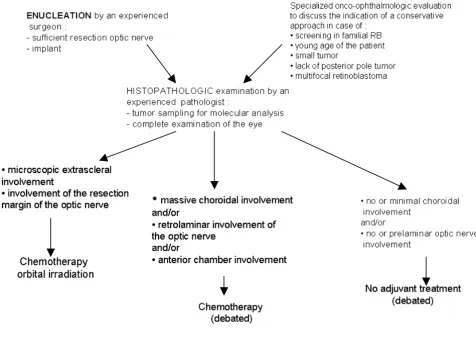
Enucleation is still often performed for extensive unilat-eral retinoblastoma because of the elevated frequency of extensive tumors (Group V, Reese Ellsworth classification for retinoblastoma). The role of adjuvant treatment (that aims to decrease the extraocular relapse) is debated; expe-rienced pathologists advise avoiding this toxic treatment in the majority of patients who would not benefit from adjuvant chemotherapy [23-27]. Combinations of differ-ent agdiffer-ents are used, such as carboplatin-etoposide and vincristine-cyclophosphamide-doxorubicin. Orbital irra-diation, external beam radiotherapy and interstitial radio-therapy [28] is performed in the case of microscopically incomplete resection. The management of extensive uni-lateral retinoblastoma is summarized in the following arborescence (Figure 6).
Management of bilateral retinoblastoma
In case of bilateral retinoblastoma, some conservative approaches for treatment of at least one eye have been developed (Figure 7). Their application depends on the number of tumors, their situation in relation to the mac-ula and the optic disc, the presence of partial or total reti-nal detachment, the presence of invasion of the vitreous and preretinal space, the age at diagnosis and the presence of a familial history.
Table 1: The Reese Ellworth classification
Group I
a) solitary tumor, < 4 disc diameters in size, at or behind the equator b) multiple tumor, none > 4 disc diameters in size, at or behind the equator
Group II
a) solitary tumor, 4–10 disc diameters in size, at or behind the equator b) multiple tumor, 4–10 disc diameters in size, behind the equator
Group III
a) any lesion anterior to the equator
b) solitary tumor >10 disc diameters behind the equator
Group IV
a) multiple tumors, some >10 disk diameters b) any lesion extending anteriorly to the ora serrata
Group V
The first conservative treatment used in the majority of patients was external beam radiotherapy. Its use has declined in many centers because numerous studies have demonstrated serious adverse effects including cosmetic, opthalmological, endocrine and neuro-cognitive seque-lae, and, in particular, the increased risk of a second non-ocular cancer in survivors of germinal retinoblastoma
[17,18]. Some of these adverse effects and the risk of development of a second cancer may be more frequent if external beam radiotherapy is delivered before one year of age [29]. However, this age-limit for increased risk of a second cancer is not constantly observed: in our own series of secondary sarcomas within the radiation field, 8/ 21 patients were irradiated after one year of age [17].
Table 3: International retinoblastoma classification
Stage 0: Patients treated conservatively (subject to presurgical ophthalmologic classifications)
Stage I: Eye enucleated, completely resected histologically
Stage II: Eye enucleated, microscopic residual tumor
Stage III: Regional extensiona a) Overt orbital disease
b) Preauricular or cervical lymph node extension
Stage IV: Metastatic disease a) Hematogenous metastasis:
1. single lesion 2. multiple lesions b) CNS extension:
1. Prechiasmatic lesion 2. CNS mass
3. Leptomeningeal disease
Table 2: The ABC classification
Group A: small tumors away from foveola and disc
• Tumors <3 mm in greatest dimension confined to the retina and • Located at least 3 mm from the foveola and 1.5 mm from the optic disc
Group B: all remaining tumors confined to the retina • All other tumors confined to the retina and not in group A
• Subretinal fluid (without subretinal seeding) < 3 mm from the base of the tumor
Group C: local subretinal fluid or vitreous seeding
• Subretinal fluid alone >3 mm and < 6 mm from the tumor • Vitreous or subretinal seeding < 3 mm from the tumor
Group D: diffuse subretinal fluid or seeding • Subretinal fluid > 6 mm from the tumor
• Vitreous or subretinal seeding > 3 mm from the tumor
Group E: presence of any one or more of these poor prognosis features • More than 2/3 of the globe filled with tumor
• Tumor in the anterior segment or anterior to the vitreous • Tumor in or on the ciliary body
• Iris neovascularisation • Neovascular glaucoma
• Opaque media from hemorrhage
External beam radiotherapy remains an excellent way of preserving eye vision in certain clinical situations (mas-sive intraocular tumor, diffuse vitreous seeding).
Some other conservative techniques have been developed: cryotherapy [30], brachytherapy [31], transpupillary ther-mochemotherapy [32,33], systemic or local chemother-apy with or without focal laser. Their indication depends
on the number, the localization (anterior retina or poste-rior pole) and the size of the tumors.
Neoadjuvant chemotherapy may be administered in order to make ocular tumors accessible to conservative manage-ment, to allow conservative management other than external beam radiation, to improve the visual prognosis by promoting retinal reapplication and by decreasing or
Management of extensive unilateral retinoblastoma
Figure 6
Management of extensive unilateral retinoblastoma. Table 4: Staging of retinoblastoma
Ocular fundus under general anesthesia + → Any patient with retinoblastoma Schema, photographs, ultrasonography Reese grouping, new grouping
Brain and orbit CT scan or MRI + → Almost any patient with retinoblastoma (except neonatal screened patients with tumor respecting the head of optic nerve)
CSF cytology Bone marrow cytohistology + → When enucleation is necessary and shows histopathologic risk factors Brain and spinal axis MRI Bone scan → Only in case of orbital, lymph node and/or distant metastatic diseases
eliminating macular invasion, and to allow creation of healthy retinal space between the tumor and the optic disc. Cytotoxic agents used as a combination of two or three drugs are carboplatin, etoposide and vincristine [32,34-39]. The choice of agents, as well as the number and frequency of cycles, may vary. In cases of paramacular tumors, chemotherapy alone may be used [35].
After neoadjuvant chemotherapy, local treatment is used in most of the cases. It includes laser treatment alone and thermochemotherapy for tumors of the posterior pole, and cryotherapy and brachytherapy for tumors of the anterior pole. In case of vitreous seeding, external beam radiotherapy, protontherapy and local administration of carboplatin by subconjunctival injection are indicated [40].
Follow-up for bilateral retinoblastoma
Fundoscopy, under general anesthesia until the age of four or five years, should be performed every month dur-ing the first year after the end of treatment. The interval between examinations may then be gradually increased to one examination every three months, even in case of uni-lateral retinoblastoma (because of the risk of late biuni-lateral involvement) [41]. The objective is to detect new tumors and ocular complications related to treatment. MRI and ultrasound are necessary in case of vitreous hemorrhage due to rupture of vitreoretinal adhesions or cataract, in order to detect tumor progression before performing sur-gery of these complications. Assessment of the orbital cav-ity after enucleation should also be performed.
MRI could be useful to detect trilateral retinoblastoma. Some argue that the infrequency of trilateral retinoblast-oma does not warrant routine neuroimaging in patients in Management of bilateral retinoblastoma
Figure 7
Management of bilateral retinoblastoma.
Specialized onco-ophthalmologic evaluation
Bilateral extensive disease Very asymetric disease No extensive disease in any eye
Attempt of a bilateral conservative approach
:
Chemotherapy (debated)Enucleation of the most involved eye (if applicable, after initial
chemotherapy)
Conservative approach of the less involved eye
Bilateral conservative approach
According to: - Tumor response and - Evolution of retinal detachment
Secondary unilateral enucleation and controlateral conservative approach
whom ocular disease is diagnosed [42]. However, Blach and Col reported that patients with bilateral retinoblast-oma have 6 to 8% risk of developing trilateral retinoblas-toma until the age of six years and that early detection (by MRI) in asymptomatic patients gives a better chance for a cure [43]. Prognosis of patients with trilateral retinoblast-oma remains poor, with most patients dying from pro-gressive disease within 2 years of diagnosis. Meta-analysis of trilateral retinoblastoma found that trilateral retino-blastoma was detected earlier in patients undergoing rou-tine serial imaging; in addition these patients survived longer than those who did not undergo such imaging [44]. Suggested screening programs for detection of trilat-eral retinoblastoma widely vary [45]. Thus, interpretation of a pineal tumor in a patient with bilateral retinoblast-oma must be carefully done, taking into consideration the recently described strong relationship between retinoblas-toma and pineal cysts [46]. Pineal cysts may represent a variant of trilateral retinoblastoma and warrant a less aggressive therapeutic approach.
Ophthalmologic follow-up should include a complete assessment of visual function (visual acuity, refraction dis-orders) [47]. Pediatric follow-up is useful for detecting sequelae of the treatment (second tumors, platin second-ary ototoxicity) and for estimating the visual handicap.
Management of retinoblastomas with extraocular involvement
Extraocular involvement of retinoblastoma may concern the soft tissues of the orbit, pretragal and cervical lymph nodes, and metastases affecting bone, bone marrow and the central nervous system (CNS). These forms, becoming rare in industrialized countries, are still frequent in devel-oping countries. Intensification of chemotherapy, based on the use of high dose carboplatin, has greatly improved the prognosis of the extraocular forms of retinoblastoma, except in cases of CNS involvement [26,48,49].
Prognosis
Vital prognosis, related to retinoblastoma alone, is now excellent in patients with unilateral or bilateral forms of retinoblastoma, with a cure rate of 95% in industrialized countries. The preservation of visual function depends on ocular preservation, the initial tumor volume, the ana-tomical relationships of the tumors with the macula and the optic disk and the adverse effects of the treatments (cataract, vitreous hemorrhage). Long term survival in the hereditary form is threatened by the risk of occurrence of second tumors [17,50]. A recently published study reported a cumulative incidence for developing a new cancer at 50 years after diagnosis of retinoblastoma of 36% for hereditary and 5.7% for non hereditary patients [18]. Patients treated for hereditary retinoblastoma are at an increased risk of developing non-ocular malignancies
due to a mutation in the second RB1 allele in different tis-sues. External beam radiation, when administered before the first year of life, and chemotherapy may also increase the risk of development of second neoplasms [29,51]. The most frequent tumors encountered are osteogenic sarco-mas of the skull and long bones, soft tissue sarcosarco-mas, cutaneous melanomas, brain tumors, and lung and breast cancer. Although external beam radiotherapy is less widely used than in the past, the risk of development of a second tumor is still significant and patients should be informed and carefully followed-up [52].
Unresolved questions
Despite the identification of the RB1 gene and the current insight into the function of pRB, the understanding of the sequence that leads to human retinoblastoma is still incomplete. Recent development of new animal models of retinoblastoma will increase the knowledge on tumor-igenesis and provide an opportunity to develop treatment strategies [5]. Although retinoblastoma has a good prog-nosis in industrialized countries, mortality due to devel-opment of a second tumor remains high. Develdevel-opment of a non-mutagenic therapy (such as photodynamic ther-apy) could be interesting, particularly in case of hereditary retinoblastoma [53-55]. Gene therapy for treatment of retinoblastoma is under evaluation [56].
In developing countries, retinoblastoma is unfortunately accompanied by a high mortality rate due to a signifi-cantly delayed diagnosis made at advanced stages of the disease.
References
1. Abramson DH, Schefler AC: Update on retinoblastoma. Retina
2004, 24:828-848.
2. Baud O, Cormier-Daire V, Lyonnet S, Desjardins L, Turleau C, Doz F: Dysmorphic phenotype and neurological impairment in 22 retinoblastoma patients with constitutional cytogenetic 13q deletion. Clin Genet 1999, 55:478-482.
3. Knudson AG Jr: Mutation and cancer: statistical study of retin-oblastoma. Proc Natl Acad Sci USA 1971, 68:820-823.
4. Friend SH, Bernards R, Rogelj S, Weinberg RA, Rapaport JM, Albert DM, Dryja TP: A human DNA segment with properties of the gene that predisposes to retinoblastoma and osteosarcoma.
Nature 1986, 323:643-646.
5. Zhang J, Schweers B, Dyer MA: The first knockout mouse model of retinoblastoma. Cell Cycle 2004, 3:952-959.
6. Zielinski B, Gratias S, Toedt G, Mendrzyk F, Stange DE, Radlwimmer B, Lohmann DR, Lichter P: Detection of chromosomal imbal-ances in retinoblastoma by matrix-based comparative genomic hybridization. Genes Chromosomes Cancer 2005,
43:294-301.
7. Mairal A, Pinglier E, Gilbert E, Peter M, Validire P, Desjardins L, Doz F, Aurias A, Couturier J: Detection of chromosome imbalances in retinoblastoma by parallel karyotype and CGH analyses.
Genes Chromosomes Cancer 2000, 28:370-379.
8. Orjuela M, Castaneda VP, Ridaura C, Lecona E, Leal C, Abramson DH, Orlow I, Gerald W, Cordon-Cardo C: Presence of human papilloma virus in tumor tissue from children with retino-blastoma: an alternative mechanism for tumor develop-ment. Clin Cancer Res 2000, 6:4010-4016.
ment of sporadic retinoblastoma. Cancer Epidemiol Biomarkers Prev 2005, 14:1433-1440.
10. Brisse HJ, Lumbroso L, Freneaux PC, Validire P, Doz FP, Quintana EJ, Berges O, Desjardins LC, Neuenschwander SG: Sonographic, CT, and MR imaging findings in diffuse infiltrative retinoblast-oma: report of two cases with histologic comparison. AJNR Am J Neuroradiol 2001, 22:499-504.
11. Kaufman LM, Mafee MF, Song CD: Retinoblastoma and simulat-ing lesions. Role of CT, MR imagsimulat-ing and use of Gd-DTPA contrast enhancement. Radiol Clin North Am 1998, 36:1101-1117. 12. Houdayer C, Gauthier-Villars M, Lauge A, Pages-Berhouet S, Dehain-ault C, Caux-Moncoutier V, Karczynski P, Tosi M, Doz F, Desjardins L, Couturier J, Stoppa-Lyonnet D: Comprehensive screening for constitutional RB1 mutations by DHPLC and QMPSF. Hum Mutat 2004, 23:193-202.
13. Harbour JW: Overview of RB gene mutations in patients with retinoblastoma. Implications for clinical genetic screening.
Ophthalmology 1998, 105:1442-1447.
14. Lohmann DR, Brandt B, Hopping W, Passarge E, Horsthemke B: The spectrum of RB1 germ-line mutations in hereditary retino-blastoma. Am J Hum Genet 1996, 58:940-949.
15. Lohmann DR: RB1 gene mutations in retinoblastoma. Hum Mutat 1999, 14:283-288.
16. Blanquet V, Turleau C, Gross-Morand MS, Senamaud-Beaufort C, Doz F, Besmond C: Spectrum of germline mutations in the RB1 gene: a study of 232 patients with hereditary and non hereditary retinoblastoma. Hum Mol Genet 1995, 4:383-388. 17. Aerts I, Pacquement H, Doz F, Mosseri V, Desjardins L, Sastre X,
Michon J, Rodriguez J, Schlienger P, Zucker JM, Quintana E: Out-come of second malignancies after retinoblastoma: a retro-spective analysis of 25 patients treated at the Institut Curie.
Eur J Cancer 2004, 40:1522-1529.
18. Kleinerman RA, Tucker MA, Tarone RE, Abramson DH, Seddon JM, Stovall M, Li FP, Fraumeni JF Jr: Risk of new cancers after radio-therapy in long-term survivors of retinoblastoma: an extended follow-up. J Clin Oncol 2005, 23:2272-2279.
19. Xu K, Rosenwaks Z, Beaverson K, Cholst I, Veeck L, Abramson DH:
Preimplantation genetic diagnosis for retinoblastoma: the first reported liveborn. Am J Ophthalmol 2004, 137:18-23. 20. Murphree AL: Intraocular Retinoblastoma: the Case for a New
Group Classification. Ophthalmol Clin North Am 2005, 18:41-53. 21. Chantada G, Doz F, Antoneli CB, Grundy R, Clare Stannard FF,
Dun-kel IJ, Grabowski E, Leal-Leal C, Rodriguez-Galindo C, Schvartzman E, Popovic MB, Kremens B, Meadows AT, Zucker JM: A proposalfor an international retinoblastoma staging system. Pediatr Blood Cancer in press. 2005 Dec 15;
22. Moscinski LC, Pendergrass TW, Weiss A, Hvizdala E, Buckley KS, Kalina RE: Recommendations for the use of routine bone mar-row aspiration and lumbar punctures in the follow-up of patients with retinoblastoma. J Pediatr Hematol Oncol 1996,
18:130-134.
23. Chantada GL, Dunkel IJ, de Davila MT, Abramson DH: Retinoblast-oma patients with high risk ocular pathological features: who needs adjuvant therapy? Br J Ophthalmol 2004, 88:1069-1073. 24. Honavar SG, Singh AD, Shields CL, Meadows AT, Demirci H, Cater J,
Shields JA: Postenucleation adjuvant therapy in high-risk retinoblastoma. Arch Ophthalmol 2002, 120:923-931.
25. Khelfaoui F, Validire P, Auperin A, Quintana E, Michon J, Pacquement H, Desjardins L, Asselain B, Schlienger P, Vielh P, et al.: Histopatho-logic risk factors in retinoblastoma: a retrospective study of 172 patients treated in a single institution. Cancer 1996,
77:1206-1213.
26. Schvartzman E, Chantada G, Fandino A, de Davila MT, Raslawski E, Manzitti J: Results of a stage-based protocol for the treatment of retinoblastoma. J Clin Oncol 1996, 14:1532-1536.
27. Uusitalo MS, Van Quill KR, Scott IU, Matthay KK, Murray TG, O'Brien JM: Evaluation of chemoprophylaxis in patients with unilat-eral retinoblastoma with high-risk features on histopatho-logic examination. Arch Ophthalmol 2001, 119:41-48.
28. Sealy R, Stannard C, Shackleton D: Improved cosmesis in retino-blastoma patients treated with iodine-125 orbital irradia-tion. Ophthalmic Paediatr Genet 1987, 8:95-99.
29. Abramson DH, Frank CM: Second nonocular tumors in survi-vors of bilateral retinoblastoma: a possible age effect on radi-ation-related risk. Ophthalmology 1998, 105:573-579.
30. Shields JA, Shields CL, De Potter P: Cryotherapy for retinoblast-oma. Int Ophthalmol Clin 1993, 33:101-105.
31. Shields CL, Shields JA, Cater J, Othmane I, Singh AD, Micaily B:
Plaque radiotherapy for retinoblastoma: long-term tumor control and treatment complications in 208 tumors. Ophthal-mology 2001, 108:2116-2121.
32. Murphree AL, Villablanca JG, Deegan WF 3rd, Sato JK, Malogolowkin M, Fisher A, Parker R, Reed E, Gomer CJ: Chemotherapy plus local treatment in the management of intraocular retino-blastoma. Arch Ophthalmol 1996, 114:1348-1356.
33. Lumbroso L, Doz F, Urbieta M, Levy C, Bours D, Asselain B, Vedrenne J, Zucker JM, Desjardins L: Chemothermotherapy in the management of retinoblastoma. Ophthalmology 2002,
109:1130-1136.
34. Levy C, Doz F, Quintana E, Pacquement H, Michon J, Schlienger P, Validire P, Asselain B, Desjardins L, Zucker JM: Role of chemother-apy alone or in combination with hyperthermia in the pri-mary treatment of intraocular retinoblastoma: preliminary results. Br J Ophthalmol 1998, 82:1154-1158.
35. Gombos DS, Kelly A, Coen PG, Kingston JE, Hungerford JL: Retino-blastoma treated with primary chemotherapy alone: the sig-nificance of tumour size, location, and age. Br J Ophthalmol
2002, 86:80-83.
36. Friedman DL, Himelstein B, Shields CL, Shields JA, Needle M, Miller D, Bunin GR, Meadows AT: Chemoreduction and local ophthal-mic therapy for intraocular retinoblastoma. J Clin Oncol 2000,
18:12-17.
37. Beck MN, Balmer A, Dessing C, Pica A, Munier F: First-line chem-otherapy with local treatment can prevent external-beam irradiation and enucleation in low-stage intraocular retino-blastoma. J Clin Oncol 2000, 18:2881-2887.
38. Kingston JE, Hungerford JL, Madreperla SA, Plowman PN: Results of combined chemotherapy and radiotherapy for advanced intraocular retinoblastoma. Arch Ophthalmol 1996,
114:1339-1343.
39. Rodriguez-Galindo C, Wilson MW, Haik BG, Merchant TE, Billups CA, Shah N, Cain A, Langston J, Lipson M, Kun LE, Pratt CB: Treat-ment of intraocular retinoblastoma with vincristine and car-boplatin. J Clin Oncol 2003, 21:2019-2025.
40. Abramson DH, Frank CM, Dunkel IJ: A phase I/II study of subcon-junctival carboplatin for intraocular retinoblastoma. Ophthal-mology 1999, 106:1947-1950.
41. Fontanesi J, Pratt C, Meyer D, Elverbig J, Parham D, Kaste S: Asyn-chronous bilateral retinoblastoma: the St. Jude Children's Research Hospital experience. Ophthalmic Genet 1995,
16:109-112.
42. Kingston JE, Plowman PN, Hungerford JL: Ectopic intracranial retinoblastoma in childhood. Br J Ophthalmol 1985, 69:742-748. 43. Blach LE, McCormick B, Abramson DH, Ellsworth RM: Trilateral
retinoblastoma – incidence and outcome: a decade of expe-rience. Int J Radiat Oncol Biol Phys 1994, 29:729-733.
44. Kivela T: Trilateral retinoblastoma: a meta-analysis of hered-itary retinoblastoma associated with primary ectopic intrac-ranial retinoblastoma. J Clin Oncol 1999, 17:1829-1837. 45. Provenzale JM, Gururangan S, Klintworth G: Trilateral
retinoblas-toma: clinical and radiologic progression. AJR Am J Roentgenol
2004, 183:505-511.
46. Beck Popovic M, Balmer A, Maeder P, Braganca T, Munier FL: Benign pineal cysts in children with bilateral retinoblastoma: a new variant of trilateral retinoblastoma? Pediatr Blood Cancer 2006,
46:755-761.
47. Desjardins L, Charif Chefchaouni M, Lumbroso L, Levy C, Asselain B, Bours D, Dendale R, Esteve M, Michon J, Doz F: Functional results of retinoblastoma treatment with local treatment used in isolation or associated with chemotherapy. J Fr Ophtalmol
2005, 28:725-731.
48. Chantada GL, Fandino A, Mato G, Casak S: Phase II window of ida-rubicin in children with extraocular retinoblastoma. J Clin Oncol 1999, 17:1847-1850.
49. Namouni F, Doz F, Tanguy ML, Quintana E, Michon J, Pacquement H, Bouffet E, Gentet JC, Plantaz D, Lutz P, Vannier JP, Validire P, Neuen-schwander S, Desjardins L, Zucker JM: High-dose chemotherapy with carboplatin, etoposide and cyclophosphamide followed by a haematopoietic stem cell rescue in patients with high-risk retinoblastoma: a SFOP and SFGM study. Eur J Cancer
Publish with BioMed Central and every scientist can read your work free of charge
"BioMed Central will be the most significant development for disseminating the results of biomedical researc h in our lifetime."
Sir Paul Nurse, Cancer Research UK
Your research papers will be:
available free of charge to the entire biomedical community
peer reviewed and published immediately upon acceptance
cited in PubMed and archived on PubMed Central
yours — you keep the copyright
Submit your manuscript here: BioMedcentral
50. Eng C, Li FP, Abramson DH, Ellsworth RM, Wong FL, Goldman MB, Seddon J, Tarbell N, Boice JD Jr: Mortality from second tumors among long-term survivors of retinoblastoma. J Natl Cancer Inst 1993, 85:1121-1128.
51. Wong FL, Boice JD Jr, Abramson DH, Tarone RE, Kleinerman RA, Stovall M, Goldman MB, Seddon JM, Tarbell N, Fraumeni JF Jr, Li FP:
Cancer incidence after retinoblastoma. Radiation dose and sarcoma risk. JAMA 1997, 278:1262-1267.
52. Schulz CJ, Riddle MP, Valdimirsdottir HB, Abramson DH, Sklar CA:
Impact on survivors of retinoblastoma when informed of study results on risk of second cancers. Med Pediatr Oncol 2003,
41:36-43.
53. Schmidt-Erfurth U, Diddens H, Birngruber R, Hasan T: Photody-namic targeting of human retinoblastoma cells using cova-lent low-density lipoprotein conjugates. Br J Cancer 1997,
75:54-61.
54. Murphree AL, Cote M, Gomer CJ: The evolution of photody-namic therapy techniques in the treatment of intraocular tumors. Photochem Photobiol 1987, 46:919-923.
55. Benedict WF, Lingua RW, Doiron DR, Dawson JA, Murphree AL:
Tumor regression of human retinoblastoma in the nude mouse following photoradiation therapy: a preliminary report. Med Pediatr Oncol 1980, 8:397-401.