e-ISSN: 2278-7461, p-ISSN: 2319-6491
Volume 6, Issue 1 (Jan 2017) PP: 23-33
Effect of Thermal Dispersion on Boundary Payer Flow of
Micropolar Fluid With Internal Heat Generation And Convective
Boundary Condition
K Uma maheswara rao
1and G koteswara Rao
21Department of Mathematics, Hyderabad Institute of Technology and management, Gowdavelly village, Rangareddy district, Hyderabad, Telangana 501401
2
Department of Mathematics, Achaya Nagarjuna University, Nagarjuna Nagar, Guntur
ABSTRACT:- The present study investigates the steady, two dimensional, natural convection flow of micropolar fluid over a vertical plate with internal heat generation and thermal dispersion in the presence of viscous dissipation and convective boundary condition. Using the similarity transformations, the governing equations have been transformed into a system of ordinary differential equations. These differential equations are highly nonlinear which cannot be solved analytically. Therefore, Runge–Kutta Gill method together with shooting technique has been used for solving it. Numerical results are obtained for the skin-friction coefficient, couple wall stress and the local Nusselt number as well as the velocity, microrotation and temperature profiles for different values of the governing parameters, namely, material parameter, thermal dispersion parameter, Prandtl number, convective parameter and Eckert number.
Keywords: micropolar fluid, viscous dissipation, thermal dispersion, convective boundary condition, internal heat generation.
I.
INTRODUCTION
The flow of a micropolar fluid with various physical effects has been extensively studied since the last few decades, after the theory is developed by Eringen ([1], [2]). This theory is capable to explain the complex fluids behavior such as liquid crystals, polymeric suspensions, animal blood, etc. by taking into account the effect arising from local structure and micro-motions of the fluid elements. An extensive review of micropolar fluids and their applications has been done by Ariman et al. [3]. Yacob et al. [4] investigated the boundary layer flow of non-Newtonian micropolar fluid past a vertical plate in the presence of wall heat flux using Keller-Box method. Rees and Basson [5] both are investigated the similarity transformation for blasius boundary layer flow of micropolar fluid over a flat plate. The transverse curvature effects on axisymmetric free convection boundary layer flow of a micropolar fluid past vertical cylinders are investigated by Gorla and Takhar [6]. Ishak et al. [7] discussed the boundary layer flow of magnetohydrodynamic micropolar fluid past a wedge with constant wall heat flux and they concluded that micropolar fluids display drag reduction and consequently reduce the heat transfer rate at the surface, compare to the Newtonian fluids. Na and Pop [8] investigated the boundary layer flow of micropolar fluid over a continuously moving surface. Lakshmi Narayana and Gangadhar [9] investigated the unsteady boundary layer flow magnetohydrodynamic micropolar fluid past a stretching surface. In the view of the above said possible applications, many authors have reported the importance of thermal and solutal dispersion effects along a vertical plate on fluid flow, heat and mass characteristics in a fluid medium. A detailed analysis regarding the effect of double dispersion on mixed convection heat and mass transfer in non-Darcy porous medium, one can refer the works of Murthy [10]. Ram Reddy [11] studied the double dispersion effects on convective flow over a cone. He concluded that the skin-friction, heat and mass transfer rates increase with the increasing the values of thermal dispersion parameter. Kumari et al. [12] investigated the laminar boundary layer flow on non-Newtonian fluids with thermal dispersion effect. Kuznetsov and Xiong [13] have been numerically investigated the effect of thermal dispersion on forced convection in a circular duct partly filled with a Brinkman – Forchheimer porous medium. The effects of double dispersion and chemical reaction on non-Darcy free convection heat and mass transfer in a semi infinite incompressible vertical wall in a fluid saturated porous medium is investigated by El-Amin et al [14].Lakshmi narayana and Sibanda [15] studied the effects of magnetic field, thermal dispersion and soret effect on double dissipative mixed convection along a vertical flat plate in a fluid saturated non-Darcy porous medium.
solution of boundary layer flow of a micropolar fluid along an isothermal vertical plate with an exponentially decaying heat generation and thermal dispersion. Gorla and Takhar [17] numerically investigated the two dimensional boundary layer convective flow of an incompressible micropolar fluid on rotating adiabatic axisymmetric surface with a concentrated heat source located at the strip. Ranga Rao et al. [18] studied the MHD boundary layer flow of heat and mass transfer over a nonlinear stretching sheet and they considered the heat source or sink effect. Gangadhar [19] investigated the similarity solution for natural convective boundary layer flow through a moving vertical plate with internal heat generation and viscous dissipation. He concluded that both velocity and thermal boundary layer thickness increases with an increasing the values of internal heat generation parameter. In another study Gangadhar [20] studied the heat generation effect on MHD boundary layer flow of Blasius and Sakiadis flows with convective surface boundary condition. Variable suction and heat generation effects on MHD boundary layer flow of a moving vertical plate are studied by Rushi Kumar and Gangadhar [21]. Pal and Mandal [22] investigated the combined convection on a boundary layer flow over a vertical flat plate embedded in a porous medium of variable viscosity with radiation and heat source or sink effect. They were concluded that momentum and thermal boundary layer thickness increases with radiation and decrease with increase in the Prandtl number. Soid and Ishak [23] investigated the flow and heat transfer analysis on boundary layer flow of a nanofluid past a moving surface with internal heat generation. Pillai et al. [24] investigated the boundary layer flow of viscoelasic fluid and heat transfer analysis in a saturated porous medium past an impermeable stretching surface with fractional heating and internal heat generation or absorption. Basiri Prasad et al. [25] investigated the laminar boundary layer flow past stretching surface with MHD and internal heat generation or absorption effects. Makinde and Sibanda [26] studied the internal heat generation and ehemical reaction effects on boundary layer flow past a vertical stretching surface. They concluded that both the velocity and temperature profiles are increase significantly with the heat generation parameter increases.
The present study investigates the steady, two dimensional, natural convection flow of a micropolar fluid over a vertical plate with thermal dispersion and internal heat generation in the presence of viscous dissipation and convective boundary condition. Using the similarity transformations, the governing equations have been transformed into a set of ordinary differential equations, which are nonlinear and cannot be solved analytically, therefore, Runge–Kutta Gill method together with shooting technique has been used for solving it. The results for velocity and temperature functions are carried out for the wide range of important parameters namely; namely, material parameter, thermal dispersion parameter, Prandtl number, convective parameter and Eckert number. The skin friction, the couple wall stress and the rate of heat transfer have also been computed.
II.
MATHEMATICAL FORMULATION
Consider a natural convection flow of an incompressible micropolar fluid over a vertical plate. By taking x to be along the plate in the vertical direction and y perpendicular to the plate.
Under the above assumptions, the partial differential equations and the corresponding boundary conditions govern the problem are given by:
Continuity equation
0
u v
x y
(2.1)
Momentum equation
y N T
T g y
u
y u v x u u
* ( )
2 2
(2.2)
Angular momentum equation
y u N j y
N
j y N v x N
u 2 2
2
(2.3)
Energy equation
2
y u
c q y T
y y T v x T u
p y
(2.4)
The boundary conditions are
T T
h y T k N
v x u
u w f f
( ), 0, 0, at y 0
N T T
where u and v are the velocity components along the x- and y-axes, respectively, hf is the convective heat transfer coefficient, N is the angular velocity, g * is the acceleration due to gravity, is the coefficient of
thermal expansion, is the vertex viscosity, is the spin gradient viscosity, jis the microinertia per unit mass,
is the density of the fluid, is the kinematic coefficient of viscosity, T is the temperature of the fluid, Tfis the surface temperature, T∞ is the ambient temperature, y is the effective thermal diffusivity and defined as
du
d d
y , 1
(2.6)
The thermal dispersion is introduced by assuming the effective thermal diffusivity y to have two components:
the molecular diffusivity and d is the diffusivity due to thermal dispersion. Where 1 is the dispersion coefficient and d is the polar diameter.
The governing Eqs. (2.2) - (2.4) subject to the boundary conditions (2.5) can be expressed in a simpler form by introducing the following transformation:
T T T T g Gr x y x N Gr x y Gr f y x f x x x ) ( ), ( 4 4 ) , ( , 4 , 4 ) ( 4 ) , ( 4 / 3 2 4 / 1 4 / 1
(2.7)
where η is the similarity variable and ψ is the stream function defined as u y
and v x
,
which identically satisfies Eq. (2.1).
The volumetric heat generation must be of the form:
Gr e
x T T
q f x
2 / 1 2 4 ) ( (2.8)
Employing the similarity variables (2.7) and (2.8), Eqs. (2.2) and (2.4) reduce to the following ordinary differential equations: 0 2 3 ) 1
( K f Kg ff f 2 (2.9)
0 3 ) 2 (
KB g f fg fg g (2.10) 0 Pr Pr 3 ) 1
( Sf Sf Ce f Ecf 2
(2.11) The boundary conditions become,
)) 0 ( 1 ( ) 0 ( , 0 ) 0 ( , 0 ) 0 ( , 0 ) 0
( f g Bi
f 0 ) ( , 0 ) ( , 0 ) (
' g
f
(2.12) Here primes denote differentiation with respect to η.
Prandtl number Pr, material parameters λ, B, K and thermal dispersion parameter S, Eckert number Ec and convective parameter Bi defined respectively as
2 4 / 1 2 2 / 1 2 / 1 2 ) ( , 4 , ) ( , 4 4 4 , , , , Pr x T T Gr C Gr k xh Bi T T c u Ec Gr x d S Gr j x B j K c k w x x s w f p w x x p (2.13)
Where (C = 1with heat generation, C = 0 without heat generation)
The exponential decaying heat generation model can be used in mixtures where a radioactive material is surrounded by inert alloys and has been used to model electromagnetic heating of materials (Sahin [27]). The average Nusselt number along a plate of length L can be determined by:
) 0 ( 4 3 4 4 / 1 L L Gr Nu (2.14)
III.
SOLUTION OF THE PROBLEM
0 ) ( , 0 ) ( , 0 ) (
)) 0 ( 1 ( )
0 ( , 0 ) 0 ( , 0 ) 0 ( , 0 ) 0 (
Pr Pr
3 1
1 '
3 )
2 ( 1 '
3 2
1 1 '
, ,
, ,
, ,
6 4
2
6 7
4 2
1
2 3 7
1 7
3 2 7
5 1 4 2 3 4 5
6 3 1 5 2 2 3
7 6
5 4 3
2 1
y y
y
y Bi y
y y
y
y Ec y y y
Sy Sy y
y y y y y y KB y
y y y Ky y K y
y y
h y h y f y f y f y
In order to carry out the step by step integration of Eqs. Refspseqn 2.7-2.9, Gills procedures as given in Ralston and Wilf [28] have been used. To start the integration it is necessary to provide all the values of
1, 2, 3, 4
y y y y at 0from which point, the forward integration has been carried out but from the boundary
conditions it is seen that the values of y3,y5are not known. So we are to provide such values of y3,y5along with the known values of the other function at 0as would satisfy the boundary conditions as
1 0
to a prescribed accuracy after step by step integrations are performed. Since the values of
3, 5
y y which are supplied are merely rough values, some corrections have to be made in these values in order
that the boundary conditions to are satisfied. These corrections in the values of y3,y5are taken care of by a self-iterative procedure which can for convenience be called ‘‘Corrective procedure’’. This procedure has been taken care of by the software which has been used to implement R–K method with shooting technique.
As regards the error, local error for the 4th order R–K method is
5O h ; the global error would be
4O h . The method is computationally more efficient than the other methods. In our work, the step size
0 . 0 1
h . Therefore, the accuracy of computation and the convergence criteria are evident. By reducing the step size better result is not expected due to more computational steps vis-a` -vis accumulation of error.
IV.
RESULTS AND DISCUSSION
The governing equations (2.9) - (2.11) subject to the boundary conditions (2.12) are integrated as described in section 3. In order to get a clear insight of the physical problem, the velocity, micro-rotation and temperature have been discussed by assigning numerical values to the parameters encountered in the problem.
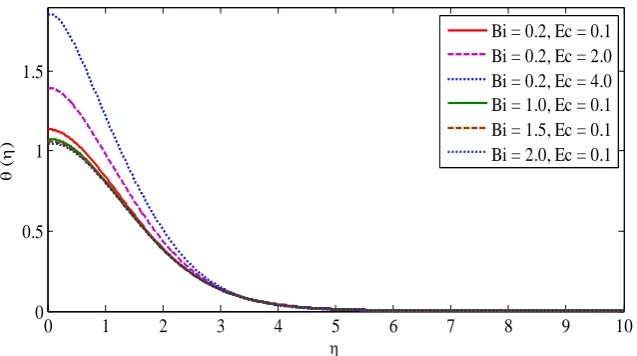
Figures 1-6, shows that the behaviour of velocity, microrotation and temperature distributions for various values of Prandtl number Pr, thermal dispersion parameter S and material parameter K for fixed Ec = 0.1, Bi = 0.2, B = 0.5 and λ = 0.5. Figures 1-3 are for fluid without the exponentially decaying heat generation them, while figures 4-6 include the heat generation. The effect of the internal heat generation and thermal dispersion are especially pronounced in the low Prandtl number case. The similarity velocity is grater when thermal dispersion and internal heat generation exists. In figure (1, 4) the location of the maximum velocity occurs at roughly the same value of 𝜼 for Pr < 1. For Pr > 1 the location of the maximum velocity occurs at a later distance from the plate, indicating the influence of the increased velocity. The temperature within the boundary layer exceeds the wall temperature in the presence of thermal dispersion and internal heat generation. We observed that the microrotation changes sign from negative to positive value within the boundary layer. The velocity and magnitude of mocrorotation and temperature profiles increases with an increase of thermal dispersion and internal heat generation.
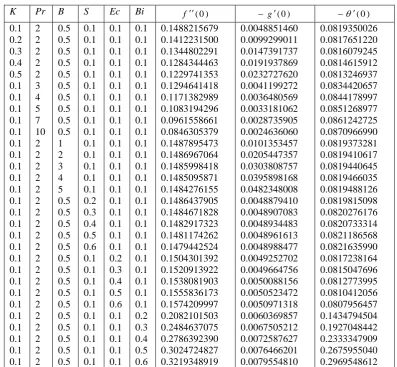
Table1 shows that the present results perfect agreement to the previously published data. From tables 2 and 3, calculated for the values of magnitude of skin-friction coefficient, wall couple stress and local Nusselt number for different values of material parameters K, Prandtl number Pr, thermal dispersion parameter S, Eckert number Ec and convective parameter Bi. From table 2 for a fluid without exponentially decaying internal heat generation and from table 3 including with internal heat generation. From the data in table 2 and 3, it is observed that the magnitude of skin friction coefficient increases with an increase in Eckert number Ec and convective parameter Bi. But the skin friction coefficient decreases for increase the values in material parameter K, Prandtl number Pr and thermal dispersion parameter S. From the values in tables 2 and 3, it is noticed that the wall couple stress increases with an increase in material parameter K, thermal dispersion parameter S, Eckert number Ec and convective parameter Bi where as the wall couple stress decreases for increase in Prandtl number Pr. From the data in tables 2 and 3, it is noticed that the local nusselt number increases with an increase in Prandtl number Pr, thermal dispersion parameter S, convective parameter Bi, whereas the local nusselt number decreases for increase in material parameter K and Eckert number Ec. From the data in tables 2 and 3, it is noticed that the magnitude of skin-friction coefficient, wall couple stress and local Nusselt number are increased in the presence of internal heat generation.
V.
CONCLUSIONS
In the present paper, steady, two dimensional, natural convection flow of a micropolar fluid over a vertical plate with thermal dispersion and internal heat generation in the presence of viscous dissipation and convective boundary condition is studied. The governing equations are approximated to a system of non-linear ordinary differential equations by similarity transformation. Numerical calculations are carried out for various values of the dimensionless parameters of the problem. It has been found that the presence of thermal dispersion and internal heat generation lead to increase the flow, and in some cases, especially for fluid with Pr < 1. We note that material parameter K increases the velocity and temperature profiles in the presence of heat generation. The microrotation profiles changes the sign from negative to positive values within the boundary layer. The magnitude of microrotation profiles increases with an increase in material parameter in the presence of internal heat generation. The velocity, magnitude of microrotation and temperature profiles are increased in Bi in the absence of internal heat generation. The magnitude of skin-friction coefficient and wall couple stress are increased for Ec and the local Nusselt number decreased in Ec.
Fig.1 Velocity for various values of Pr, K and S for C=0 when Ec = 0.1, Bi=0.2, B =0.5, λ=0.5.
Fig.2 Microrotation for various values of Pr, K and S for C=0 when Ec = 0.1, Bi=0.2, B =0.5, λ=0.5.
0 5 10 15
0 0.05 0.1 0.15
f
' (
)
Pr = 0.7, K = 0.5, S = 0.5 Pr = 0.7, K = 3.0, S = 0.5 Pr = 0.7, K = 0.5, S = 3.0 Pr = 2.0, K = 0.5, S = 0.5 Pr = 2.0, K = 3.0, S = 0.5 Pr = 2.0, K = 0.5, S = 3.0
0 5 10 15
-0.03 -0.02 -0.01 0 0.01 0.02
g
(
)
Fig.3 Temperature for various values of Pr, K and S for C=0 when Ec = 0.1, Bi=0.2, B =0.5, λ=0.5.
Fig.4 Velocity for various values of Pr, K and S for C=1 when Ec = 0.1, Bi=0.2, B =0.5, λ=0.5.
Fig.5 Microrotation for various values of Pr, K and S for C=1 when Ec = 0.1, Bi=0.2, B =0.5, λ=0.5.
0 5 10 15
0 0.1 0.2 0.3 0.4
(
)
Pr = 0.7, K = 0.5, S = 0.5 Pr = 0.7, K = 3.0, S = 0.5 Pr = 0.7, K = 0.5, S = 3.0 Pr = 2.0, K = 0.5, S = 0.5 Pr = 2.0, K = 3.0, S = 0.5 Pr = 2.0, K = 0.5, S = 3.0
0 5 10 15
0 0.05 0.1 0.15 0.2 0.25 0.3 0.35 0.4
f
' (
)
Pr = 0.7, K = 0.5, S = 0.5 Pr = 0.7, K = 3.0, S = 0.5 Pr = 0.7, K = 0.5, S = 3.0 Pr = 2.0, K = 0.5, S = 0.5 Pr = 2.0, K = 3.0, S = 0.5 Pr = 2.0, K = 0.5, S = 3.0
0 5 10 15
-0.08 -0.06 -0.04 -0.02 0 0.02 0.04
g
(
)
Pr = 0.7, K = 0.5, S = 0.5 Pr = 0.7, K = 3.0, S = 0.5 Pr = 0.7, K = 0.5, S = 3.0 Pr = 2.0, K = 0.5, S = 0.5 Pr = 2.0, K = 3.0, S = 0.5 Pr = 2.0, K = 0.5, S = 3.0
0 1 2 3 4 5 6 7 8 9 10
0 0.5 1 1.5
(
)
Fig.6 Temperature for various values of Pr, K and S for C=1 when Ec = 0.1, Bi=0.2, B =0.5, λ=0.5.
Fig.7 Velocity for different values of Bi and Ec for C=0 when Pr = 0.7, S=0.1, K =0.1, B =0.5, λ=0.5.
Fig.8 Microrotation for various values of Bi and Ec for C=0 when Pr = 0.7, S=0.1, K =0.1, B =0.5, λ=0.5.
Fig.9 Temperature for different values of Bi and Ec for C=0 when Pr = 0.7, S=0.1, K =0.1, B =0.5, λ=0.5.
0 5 10 15
0 0.05 0.1 0.15 0.2 0.25
f
' (
)
Bi = 0.2, Ec = 0.1 Bi = 0.2, Ec = 2.0 Bi = 0.2, Ec = 4.0 Bi = 1.0, Ec = 0.1 Bi = 1.5, Ec = 0.1 Bi = 2.0, Ec = 0.1
0 5 10 15
-0.015 -0.01 -0.005 0 0.005 0.01 0.015 0.02
g
(
)
Bi = 0.2, Ec = 0.1 Bi = 0.2, Ec = 2.0 Bi = 0.2, Ec = 4.0 Bi = 1.0, Ec = 0.1 Bi = 1.5, Ec = 0.1 Bi = 2.0, Ec = 0.1
0 1 2 3 4 5 6 7 8 9 10
0 0.2 0.4 0.6 0.8
(
)
Bi = 0.2, Ec = 0.1 Bi = 0.2, Ec = 2.0 Bi = 0.2, Ec = 4.0 Bi = 1.0, Ec = 0.1 Bi = 1.5, Ec = 0.1 Bi = 2.0, Ec = 0.1
0 1 2 3 4 5 6 7 8 9 10
0 0.1 0.2 0.3 0.4 0.5
f
' (
)
Fig.10 Velocity for different values of Bi and Ec for C=1 when Pr = 0.7, S=0.1, K =0.1, B =0.5, λ=0.5.
Fig.11 Microrotation for various values of Bi and Ec for C=1 when Pr = 0.7, S=0.1, K =0.1, B =0.5, λ=0.5.
Fig.12 Temperature for different values of Bi and Ec for C=1 when Pr = 0.7, S=0.1, K =0.1, B =0.5, λ=0.5. Table 1. Comparison for the values of f ''( 0 ) for the values of K, S when Pr = 0.01, B = 0.1, 𝜆 = 0.5, Bi = Ec
= 0.0.
K S f ''( 0 )
Present study Haroun et al. (2015) 0.5
0.5 0.5 1.5 1.5 1.5 5.0 5.0 5.0
0.0 0.5 1.0 0.0 0.5 1.0 0.0 0.5 1.0
1.02947 1.01117 0.99763 0.79219 0.77916 0.76925 0.48499 0.47857 0.47338
1.018034 1.000084 0.986730 0.781238 0.768414 0.758578 0.475493 0.469028 0.463766
Table 2. Computations for the values of f (0),g(0),(0) for the values of K,Pr, B,S,Ec,Bi when
0 , 5 .
0
C
.
C = 0
0 1 2 3 4 5 6 7 8 9 10
-0.02 -0.01 0 0.01 0.02 0.03
g
(
)
Bi = 0.2, Ec = 0.1 Bi = 0.2, Ec = 2.0 Bi = 0.2, Ec = 4.0 Bi = 1.0, Ec = 0.1 Bi = 1.5, Ec = 0.1 Bi = 2.0, Ec = 0.1
0 1 2 3 4 5 6 7 8 9 10
0 0.5 1 1.5
(
)
K Pr B S Ec Bi f (0) g(0) (0) 0.1 0.2 0.3 0.4 0.5 0.1 0.1 0.1 0.1 0.1 0.1 0.1 0.1 0.1 0.1 0.1 0.1 0.1 0.1 0.1 0.1 0.1 0.1 0.1 0.1 0.1 0.1 0.1 0.1 0.1 2 2 2 2 2 3 4 5 7 10 2 2 2 2 2 2 2 2 2 2 2 2 2 2 2 2 2 2 2 2 0.5 0.5 0.5 0.5 0.5 0.5 0.5 0.5 0.5 0.5 1 2 3 4 5 0.5 0.5 0.5 0.5 0.5 0.5 0.5 0.5 0.5 0.5 0.5 0.5 0.5 0.5 0.5 0.1 0.1 0.1 0.1 0.1 0.1 0.1 0.1 0.1 0.1 0.1 0.1 0.1 0.1 0.1 0.2 0.3 0.4 0.5 0.6 0.1 0.1 0.1 0.1 0.1 0.1 0.1 0.1 0.1 0.1 0.1 0.1 0.1 0.1 0.1 0.1 0.1 0.1 0.1 0.1 0.1 0.1 0.1 0.1 0.1 0.1 0.1 0.1 0.1 0.1 0.2 0.3 0.4 0.5 0.6 0.1 0.1 0.1 0.1 0.1 0.1 0.1 0.1 0.1 0.1 0.1 0.1 0.1 0.1 0.1 0.1 0.1 0.1 0.1 0.1 0.1 0.1 0.1 0.1 0.1 0.1 0.1 0.1 0.1 0.1 0.2 0.3 0.4 0.5 0.6 0.1488215679 0.1412231500 0.1344802291 0.1284344463 0.1229741353 0.1294641418 0.1171382989 0.1083194296 0.0961558661 0.0846305379 0.1487895473 0.1486967064 0.1485998418 0.1485095871 0.1484276155 0.1486437905 0.1484671828 0.1482917323 0.1481174262 0.1479442524 0.1504301392 0.1520913922 0.1538081903 0.1555836173 0.1574209997 0.2082101503 0.2484637075 0.2786392390 0.3024724827 0.3219348919 0.0048851460 0.0099299011 0.0147391737 0.0191937869 0.0232727620 0.0041199272 0.0036480569 0.0033181062 0.0028735905 0.0024636060 0.0101353457 0.0205447357 0.0303808757 0.0395898168 0.0482348008 0.0048879410 0.0048907083 0.0048934483 0.0048961613 0.0048988477 0.0049252702 0.0049664756 0.0050088156 0.0050523472 0.0050971318 0.0060369857 0.0067505212 0.0072587627 0.0076466201 0.0079554810 0.0819350026 0.0817651220 0.0816079245 0.0814615912 0.0813246937 0.0834420657 0.0844178997 0.0851268977 0.0861242725 0.0870966990 0.0819373281 0.0819410617 0.0819440645 0.0819466035 0.0819488126 0.0819815098 0.0820276176 0.0820733314 0.0821186568 0.0821635990 0.0817238164 0.0815047696 0.0812773995 0.0810412056 0.0807956457 0.1434794504 0.1927048442 0.2333347909 0.2675955040 0.2969548612
Table 3. Computations for the values of f (0),g(0),(0) for the values of K,Pr, B,S,Ec,Bi when
1 , 5 . 0 C . C=1
K Pr B S Ec Bi f (0) g(0) (0)
0.1 0.1 0.1 0.1 0.1 0.1 0.1 0.1 0.1 0.1 0.1
2 2 2 2 2 2 2 2 2 2 2
0.5 0.5 0.5 0.5 0.5 0.5 0.5 0.5 0.5 0.5 0.5
0.6 0.1 0.1 0.1 0.1 0.1 0.1 0.1 0.1 0.1 0.1
0.1 0.2 0.3 0.4 0.5 0.6 0.1 0.1 0.1 0.1 0.1
0.1 0.1 0.1 0.1 0.1 0.1 0.2 0.3 0.4 0.5 0.6
0.5578018990 0.5729912159 0.5804662184 0.5881935706 0.5961874478 0.6044631611 0.5720570450 0.5772757296 0.5816713144 0.5854259671 0.5886713948
0.0133817290 0.0134457473 0.0135498165 0.0136568441 0.0137669836 0.0138804001 0.0134172420 0.0134773436 0.0135278652 0.0135709477 0.0136081337
0.0204611214 0.0164934736 0.0148997112 0.0132439590 0.0115224468 0.0097310850 0.0327646459 0.0450447559 0.0554417238 0.0643614860 0.0721002639
REFERENCES
[1] Eringen, A.C., (1966), Theory of Micropolar Fluids, J. Math. Mech., Vol.16, pp.1-18.
[2] Eringen, A.C., (1972) Theory of Thermomicropolarfluids, Journal of Mathematical Analysis and Applications, Vol.38, pp.480-495.
[3] Ariman, T., Turk MA, and Sylvester ND, (1973), Microcontinuum Fluid Mechanics – A Review. International Journal of Engineering Science, Vol.11, pp.905-930.
[4] Yacob NA, Ishak A, Pop I, (2010), Non-Newtonian Micropolar Fluid Flow Towards a Vertical Plate with Prescribed Wall Heat Flux, Australian Journal of Basic and Applied Sciences, Vol.4(8), pp. 2267-2273. [5] Rees D.A.S., Basson A.P., (1996), The Blasius boundary-layer flow of a micropolar fluid, International
Journal of Engineering Science, Vol.34, pp.113-124.
[6] Gorla R.S.R. and Takhar H.S., (1987), Free convection boundary layer flow of a micropolar fluid past slender bodies, International Journal of Engineering Science, Vol.25(8), pp.949-962.
[7] Ishak A., Nazar R., Pop I, (2009), MHD boundary-layer flow of a micropolar fluid past a wedge with constant wall heat flux, Communications in Nonlinear Science and Numerical Simulation, Vol. 14(1), pp. 109–118.
[8] Na TY and Pop I. (1997), Boundary layer flow of a micropolar fluid due to a stretching wall, Archive of Applied Mechanics, Vol.67(4), pp.229-236.
[9] Lakshmi Narayana K. and Gangadhar K., (2015), second order Slip flow of a MHD micropolar fluid over an unsteady stretching surface, Advances in Applied Science Research, Vol.6(8), pp.224-241.
[10] Murthy PVSN, (2000), Effect of double dispersion on mixed convection heat and mass transfer in non-Darcy porous medium, ASME Journal of Heat Transfer, Vol.122, pp.476-484.
[11] RamReddy Ch., (2013), Effect of Double Dispersion on Convective Flow over a Cone, International Journal of Nonlinear Science, Vol.15(4), pp.309-321.
[12] Kumari M., Pop I and Nath G., (1992), Analysis of Thermal Dispersion Effect on Laminar Boundary Layer in Flow on Non-Newtonian Fluids, Journal of Applied Mathematics and Mechanics, Vol.72(8), pp.381-383.
[13] Kuznetsov A.V. and Xiong M., (2000), Numerical simulation of the effect of thermal dispersion on forced convection in a circular duct partly filled with a Brinkman-Forchheimer porous medium, International Journal of Numerical Methods for Heat & Fluid Flow, Vol.10, No.5/6 , pp. 488-501. [14] El-Amin MF, Aissa WA and Salama, (2008), Effect of chemical reaction and double dispersion on
non-Darcy free convection heat and mass transfer, Transport in Porous Media, Vol. 75(1), pp 93–109.
[15] Lakshmi Narayana PA and Sibanda P., (2011), Influence of the soret effect and double dispersion on MHD mixed convection along a vertical flat plate in non-Darcy porous medium, International Journal of Nonlinear Science, Vol.12(3), pp.352-364.
[16] El-Hakiem. (2004), Natural Convection in a Micropolar Fluid with Thermal Dispersion and Internal Heat Generation, International Communications in Heat and Mass Transfer, Vol.31(8), pp.1177-1186.
[17] Gorla RSR and Takhar HS, (1994), Boundary layer flow of micropolar fluid on axisymmetric surfaces with a concentrated heat source, Acta Mechanica, Vol.105(1), pp.1-10.
[18] Ranga Rao T., Gangadhar K, Hema Sundar Raju B., and Venkata Subba Rao M., (2014), Heat source/sink effects of heat and mass transfer of magnetonanofluids over a nonlinear stretching sheet, Advances in Applied Science Research, Vol.5(3), pp.114-129.
[20] Gangadhar K., (2015), Radiation, Heat Generation and Viscous Dissipation Effects on MHD Boundary Layer Flow for the Blasius and Sakiadis Flows with a Convective Surface Boundary Condition, Journal of Applied Fluid Mechanics, Vol. 8, No. 3, pp. 559-570.
[21] Rushi Kumar B. and Gangadhar K., (2012), heat generation effects on mhd boundary layer flow of a moving vertical plate with suction, Journal of naval architecture and marine engineering, Vol.9, pp.153-162.
[22] Pal D. and Mandal H., (2009), Radiation effects on combined convection over a vertical flat plate embedded in a porous medium of variable porosity, Meccanica, Vol.44(2), pp.133-144.
[23] Soid SK and Ishak A., (2015), Boundary layer flow and heat transfer of a nanofluid over a moving surface with internal heat generation, AIP conference proceeding, 1678, 060021.
[24] Pillai KM, Sai KS, Swamy NS, Nataraja HR, Tiwari SB and Rao BN, (2004), Heat transfer in a viscoelastic boundary layer flow through a porous medium, Computational Mechanics, Vol. 34(1), pp 27–37.
[25] Basiri Parsa A., Rashidi MM and Hayat T., (2013), MHD boundary-layer flow over a stretching surface with internal heat generation or absorption, Heat transfer-Asian Research, Vol.42(6), pp.500-514. [26] Makinde OD and Sibanda P., (2011), Effect of chemical reaction on boundary layer flow past a vertical
stretching surface in the presence of internal heat generation, International Journal of Numerical Methods for Heat and Fluid Flow, Vol.21(6), pp.779-792.