173406-5959- IJBAS-IJENS @ December 2017 IJENS I J E N S
Effect of Ni-doping on Structure
and
Morphology of La
0.7
Ba
0.3
Mn
1-x
Ni
x
O
3
Compounds by Sol-Gel Method
Sitti Ahmiatri Saptari
1, Arif Tjahjono
1, Suci Winarsih
1, Putranto Prasetyo
1, Budhy Kurniawan
21Faculty of Science and Technology, State Islamic University, Jakarta, Indonesia
2Departement of Physics, University of Indonesia, Depok
Abstract—This paper concerned to explain about the effect of Ni-doping on structure and morphology of La0.7Ba0.3Mn1-xNixO3 (x=0;
0.1; 0.2; 0.3) compounds. In this study, we prepared our sample through the sol-gel method with precursors La2O3, Ba(NO3)2,
Mn(NO3)2.4H2O, and Ni(NO3)2.6H2O. The crystal structure and
morphology samples were characterized by X-Ray Diffraction (XRD) and SEM-EDX. Refinement results showed that all samples were single phase and formed a rhombohedral crystal structure with space group R-3c. The effect of Ni-doping on the structure did not make phase changing, but the lattice parameter c of La0.7Ba0.3Mn1-xNixO3 compounds decreased very slightly as
Ni-doping increased. Microstructure of La0.7Ba0.3Mn1-xNixO3 observed
by Scanning Electron Microscope (SEM) indicated that the microstructures were homogeneous with nanoparticle size. The result micro analysis by EDX (Energy Dispersive X-Ray) assured phase from XRD result.
Index Term— La0.7Ba0.3Mn1-xNixO3, Ni-doping, structure,
morphology, sol-gel method
I. INTRODUCTION
Manganite material with perovskite structure has general formula RE1-xAxMnO3 (RE = trivalent rare earth and A =
divalent ion-doped) [1,2] with Mn can substitution by transition metal ion. The different substitution ion in this material lead different crystal structure, spin, transport properties compared other treatment [2] which causes this material has study extensive [1].
Manganite perovskite material RE1-xAxMnO3 is very
interesting in science and technology, because of the magnetic and electrical properties. The material can be applied for data storage, magnetic sensor, electromagnetic absorber and refrigerator [3,4]. As for in this research, we use La+3 as trivalent ion and Ba+2 as doped La+3. Because
trivalent ion has doped with divalent ion, Mn+3 ion change to
be Mn+4 ion, and the interaction between Mn+3 – O – Mn+4
decrease curie temperature. In this study Mn ion doping by Ni ion
Sol-gel method in prepared manganite perovskite is very
advantage because with sol-gel method the sample have homogenous particle distribution, uniform particle size generally nanoparticle size, increase physics characteristic and sintering process have lower temperature than solid state method.
II. EXPERIMENT
La0.7Ba0.3NixMn1-xO3 (x = 0; 0.1; 0.2; 0.3) had fabricated by
sol-gel method. The precursors are La2O3 (Merck, 99.0%),
Ba(NO3)2 (Merck, 99.0%), Mn(NO3)2.4H2O (Merck, 98.5%),
and Ni(NO3)2.6H2O (Merck, 99.0%). Each precursor has count
by stoichiometry formula, La2O3 was added nitrate acid
appropriate stoichiometry formula for convert oxide to nitrate. After that stir all precursors with aquabidest and mix the precursors in one solution. Solution was added ammonium solution until pH value of the solution reach 7 in temperature 353 K. The gel was heated at 453 K for 3 hours in dehydration process until the dried gel obtained, after that dried gel was calcination in oven at 873 K for 8 hours. Finally, all samples have sintered at 1123 K for 10 hours.
After samples have finished, samples had characterization by XRD with Cu-Ka radiation (Rigaku) for determined crystal structure and lattice parameter from each sample. The morphology samples were characterized with SEM-EDX.
III. RESULT AND DISCUSSION
The XRD pattern from La0.7Ba0.3NixMn1-xO3 (x = 0; 0.1;
0.2; 0.3) shown in Fig. 1. From the XRD pattern show that increase x value no structural phase change because all pattern XRD have same design. La0.7Ba0.3NixMn1-xO3 (x = 0; 0.1; 0.2;
International Journal of Basic & Applied Sciences IJBAS-IJENS Vol:17 No:06 13
Fig.1 XRD pattern of La0.7Ba0.3NixMn1-xO3 (a) x=0 (b) x=0.1 (c) x=0.2 (d) x=0.4
Result of rietvield refinement analysis from XRD pattern explain in Table 1. The lattice parameter a and b from each sample have not change significantly with increase x value in samples, but the lattice parameter c had decrease with increase x value. The decrease lattice parameter c might because the radius atomic ion Mn+4 is very large than radius
atomic ion Ni+3 [9], so with increasing atomic ion Ni+3
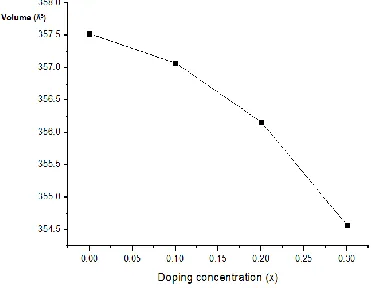
composition in the sample, the lattice parameter c had decrease, with volume each sample decrease like lattice parameters c shown in Fig. 2.
Fig. 2. Graph between Volume – doping concentration of La0.7Ba0.3NixMn1-xO3
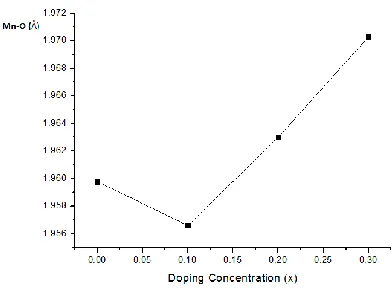
Distance between Mn-O atom from La0.7Ba0.3NixMn1-xO3
(x=0; 0.1; 0.2; 0.3) shown in Fig. 3. The Distance Mn-Ohave decrease in x value 0.1 but in x value 0.2, and 0.3 the distance between Mn-O have increase. The possibility the material with x=0.1 have low currie temperature than the material with x=0, 0.2, and 0.3. Because if the distance Mn-O have tensile strain the curie temperature have increase but if the distance Mn-O have compressive strain the curie temperature have decrease [10].
The morphology structure with Scanning Electron Microscope (SEM) shown in Fig. 4. From the picture, samples La0.7Ba0.3NixMn1-xO3 (x=0; 0.1; 0.2; 0.3) have
homogeneous and from the Fig. 5 showing that all sample commonly have nanoparticle size.
Parameter Structure x = 0 x = 0.1 x = 0.2 x = 0.3
Space group R-3c R-3c R-3c R-3c
Crystal structure Rhombohedral Rhombohedral Rhombohedral Rhombohedral
a (Å) 5.533 5.533 5.528 5.523
b (Å) 5.533 5.533 5.528 5.523
c (Å) 13.485 13.467 13.458 13.422
Volume (Å3) 357.522 357.071 356.162 354.567
<Mn-O> (Å) 1.960 1.957 1.963 1.970
<Mn-O-Mn> (o) 44.805 44.813 44.703 44.525
173406-5959- IJBAS-IJENS @ December 2017 IJENS I J E N S Fig. 3. Graph between distance Mn-O – doping concentration of
La0.7Ba0.3NixMn1-xO3
(a)
(b)
(c)
(d)
International Journal of Basic & Applied Sciences IJBAS-IJENS Vol:17 No:06 15
(a)
(b)
(c)
(d)
Fig. 5. Particle size with SEM-EDX images of La0.7Ba0.3NixMn1-xO3 (a) x=0 (b) x=0.1 (c) x=0.2 (d) x=0.3
(a)
(b)
(c)
(d)
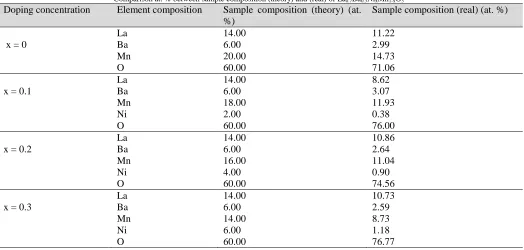
173406-5959- IJBAS-IJENS @ December 2017 IJENS I J E N S samples have purity. Table 2 shown the comparison between
sample composition (theory) and sample composition (real) with EDX (Energy Dispersive X-Rays). EDX has analyze
on semi quantitative analysis. Therefore, the outcome of EDX analysis are not implicit [1].
Table II
Comparison at. % between sample composition (theory) and (real) of La0.7Ba0.3NixMn1-xO3
Doping concentration Element composition Sample composition (theory) (at. %)
Sample composition (real) (at. %)
La 14.00 11.22
x = 0 Ba 6.00 2.99
Mn 20.00 14.73
O 60.00 71.06
La 14.00 8.62
x = 0.1 Ba 6.00 3.07
Mn 18.00 11.93
Ni 2.00 0.38
O 60.00 76.00
La 14.00 10.86
x = 0.2 Ba 6.00 2.64
Mn 16.00 11.04
Ni 4.00 0.90
O 60.00 74.56
La 14.00 10.73
x = 0.3 Ba 6.00 2.59
Mn 14.00 8.73
Ni 6.00 1.18
O 60.00 76.77
IV. CONCLUSION
The synthesis of La0.7Ba0.3NixMn1-xO3 (x=0; 0.1; 0.2; 0.3) by
sol- gel method was successfully to make single phase sample. All samples have Rhombohedral structure with R3-c as space group according rietvield analysis. From the result rietvield analysis lattice parameter in the structure not change significant for lattice parameter a and b but the lattice parameter c is decrease with increase the Ni+3 composition and the result from
mixing precursors have homogeneous sample.
REFERENCES
[1] S. Winarsih et al, “Effect of Ca-Doping on the Structure and Morphology of Polycrystalline La0.7(Ba1-xCax)0.3MnO3 (x = 0; 0.03; and 0.05),” J. Phys. Conf. Ser., vol. 7, no. December, 2016.
[2] W. Zhong, W. Chen, C. T. Au, and Y. W. Du, “Dependence of the magnetocaloric effect on oxygen stoichiometry in polycrystalline La2/3Ba1/3MnO3–δ,” J. Magn. Magn. Mater., vol. 261, pp. 238–243, 2003.
[3] A. Goktas, I. H. Mutlu, and A. Kawashi, “Growth and characterization of La1−xAxMnO3 (A=Ag and K, x=0.33) epitaxial and polycrystalline manganite thin films derived by sol–gel dip-coating technique,” Thin Solid Films, vol. 520, no. 19, pp. 6138–6144, 2012.
[4] D. Cao, Y. Zhang, W. Dong, J. Yang, W. Bai, and Y. Chen, “Structure, magnetic and transport properties of La0.7Ca0.3?xSrxMnO3 thin films by sol–gel method Danyan,” Ceram. Int., vol. 41, pp. 381–386, 2015. [5] C. Mno, K. Ghosh, S. B. Ogale, R. Ramesh, R. L. Greene, and T.
Venkatesan, “Transition-element doping effects in La0.7Ca0.3MnO3,” Phys. Rev. B Cover. Condens. matter Mater. Phys., vol. 59, no. 1, pp. 533–537, 1999.
[6] H. Wang et al, “Exchange interaction, spin cluster and transport behaviour in perovskites La0.67Sr0.33(Mn1−xNix)O3 (x <= 0.2),” J. Phys. Condens. Matter, no. 12, pp. 601–610, 2000.
[7] S. Winarsih et al., “Investigation of structural and electrical properties
of La0.7(Ba1-xCax)0.3MnO3 compounds by sol-gel method,” in The 2016 Conference on Fundamental and Applied Science for Advanced Technology (ConFAST 2016), 2016, vol. 1746, no. 20004, pp. 1–5. [8] B. G. Toksha, S. E. Shirsath, S. M. Patange, and K. M. Jadhav,
“Structural investigations and magnetic properties of cobalt ferrite nanoparticles prepared by sol–gel auto combustion method,” vol. 147, pp. 479–483, 2008.
[9] J. C. Slater, “Atomic shielding constants,” Phys. Rev., vol. 36, no. 1, pp. 57–64, 1930.