Original Research Article
Knowledge regarding hepatitis among students of a selected
government school of Trivandrum district, Kerala
Divija*, Anil Bindhu Sukumaran, Nithya Girija, Deena Divakaran Sreelatha, Jeesha C. Haran
INTRODUCTION
Hepatitis is an inflammation of the liver that is either self-limiting or progresses to chronic hepatitis, thereby leading to progressive scarring (cirrhosis) of the liver or hepatocellular carcinoma. Hepatitis is most commonly caused by various forms of viruses namely hepatitis A virus (HAV), hepatitis B virus (HBV), hepatitis C virus (HCV), hepatitis D virus (HDV) and hepatitis E virus (HEV) of which HBV and HCV are cause of over 96% mortality due to chronic hepatitis and liver cancer.1
The Global Hepatitis Report 2017 states that there were 1.34 million deaths due to viral hepatitis in 2015. Most of
the deaths were due to liver cirrhosis i.e. 7,20,000 deaths and 4,70,000 deaths were due to liver cancer. The report also mentions that 257 million people were living with chronic HBV and 71 million with chronic HCV.2
The World Health Assembly had endorsed in 2016 the elimination of hepatitis as a global public health threat by 2030 by defining the following impact indicators i.e. reduction in incidence by 90% and mortality by 65%. In order to achieve the impact, five core interventions have also been laid out which are namely; achieving three dose hepatitis B vaccine, preventing mother to child transmission of HBV, blood and injection safety, harm reduction, testing and treatment of hepatitis B.3
ABSTRACT
Background: Hepatitis is inflammation of the liver which is often self-limiting, rarely leading to progressive scarring
or hepatocellular carcinoma in case of chronic hepatitis. The objective of this study was to assess the knowledge regarding hepatitis among high school students of a selected government school of Trivandrum district.
Methods: A cross sectional study was carried out among high school students of a selected girls only government school of Trivandrum district during October to November 2017. Permission was obtained from Institute Ethics Committee (IEC) for the study. Data was entered in MS Excel and analyzed using SPSS. Knowledge score was calculated and categorized as follows. 0 to 5– poor knowledge, 6 to 11– average knowledge, 12 to 16– very good knowledge, 17 to 21– excellent knowledge.
Results: A total of 293 students participated in our study. Majority of the students had very good knowledge regarding hepatitis i.e. 64%, 10% had average knowledge, while 19% had poor knowledge. Only 7% had excellent knowledge. The mean knowledge score was 13.7 (C.I 13.44 -14.02).
Conclusions: Overall, the knowledge regarding hepatitis among students was very good.
Keywords: Awareness, Hepatitis, School students, Trivandrum
Department of Community Medicine, Sree Gokulam Medical College and Research Foundation, Venjaramoodu, Kerala, India
Received: 07 March 2019
Revised: 17 April 2019
Accepted: 18 April 2019
*Correspondence: Dr. Divija,
E-mail: [email protected]
Copyright: © the author(s), publisher and licensee Medip Academy. This is an open-access article distributed under
the terms of the Creative Commons Attribution Non-Commercial License, which permits unrestricted non-commercial use, distribution, and reproduction in any medium, provided the original work is properly cited.
The WHO reports that in the South East Asian Region (SEAR), approximately 100 million people are estimated to be living with Hepatitis B and 30 million with hepatitis C. It is also estimated that in India about 40 million people are living with chronic hepatitis B and about 6 to 12 million are living with chronic hepatitis C infection. While most common cause of epidemic hepatitis as well as acute liver failure is attributed to HEV; HAV is more common among children.4
Much of hepatitis in the community can be reduced by increasing awareness about various types of hepatitis and their transmission, effective immunization, promotion of safe blood supply and safe injection practices among health care professionals, safe sex practices and use of barrier methods (condoms), safe water and food supply and occupational safety measures.1
The B-Rodh (an initiation of HOPE) is a school based intervention that seeks to strengthen the student’s awareness on the 10 core topic of intervention; one of which is hepatitis B. This approach spreads hepatitis awareness to the community through the school students.5
It is essential to assess the present knowledge regarding hepatitis among school students in order to identify their lacunae in knowledge regarding hepatitis and help educate them so that the community may benefit through the students at large. This is one of the few studies conducted among school students to assess their knowledge regarding hepatitis.
Objective
To assess the knowledge regarding hepatitis among high school students of a selected government school of Trivandrum district.
To assess the proportion of students who have undergone vaccination against hepatitis B infection.
METHODS
A cross sectional study was carried out among high school students of a selected girls only government school of Trivandrum district during October to November 2017. The study was carried after permission for the study was obtained from concerned school authorities. Prior information was provided to the school authorities and all students of the 8th and 9th standards regarding the survey. Those students who were absent on the days of the survey were not included. A semi structured questionnaire which was pilot tested was administered in local language to the students and were requested to answer all questions to the most appropriate response. The questions were read out to the students and explained so that they could respond accurately. Each question had several options of which students had to choose the best response. There were also multiple choice questions where marks were provided for each of the correct options. Data was entered in MS Excel and
analyzed using SPSS. Mean was calculated for quantitative data and frequencies and proportions were computed for qualitative data and results were expressed in tables, bar diagram or pie charts. Knowledge score was calculated and categorized as follows: 0 to 5 – poor knowledge, 6 to 11 –average knowledge, 12 to 16 – very good knowledge, 17 to 21 – excellent knowledge. At the end of the survey, health education regarding various forms of hepatitis was provided which received great response from the students. Permission was obtained from Institute Ethics Committee (IEC) for the study.
RESULTS
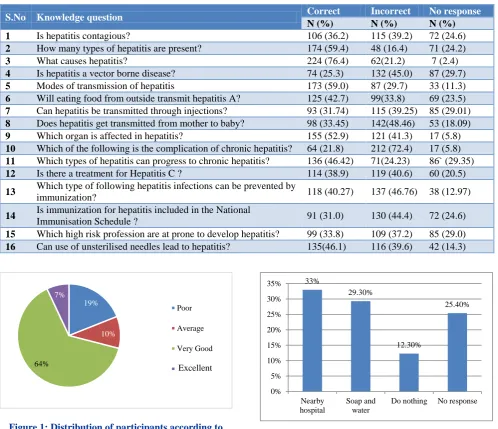
Among a total of 293 students, 121 (41.3%) students from the 8th standard and 172 (58.7%) students from the 9th standard participated in the study. While 224 (76.5%) had heard about hepatitis, 69 (23.5%) had not heard of hepatitis. Most of the people who had heard about hepatitis had got the information from school 54 (18.4%), newspaper 73 (24.9%), parents 24 (8.2%), health education classes 72 (24.6%) and others 22 (7.5%) such as friends/relatives (multiple responses included). The proportion of correct and incorrect responses provided for the various sub questions regarding hepatitis are shown in Table 1.
Among the study participants, 106 (36.2%) responded that hepatitis was contagious, 174 (59.4%) responded that there were 5 types of hepatitis infection,224 (76.4%) answered correctly that the cause of hepatitis was virus, 74 (25.3%) answered correctly that animal or insect bites did not transmit hepatitis, 173 (59%) answered at least two modes of transmission for hepatitis (blood borne, sexual, food borne, water borne, needle prick, vertical), 125 (42.7%) correctly answered that eating food from outside could lead to spread of hepatitis A infection, 93 (31.74% ) responded that hepatitis could be transmitted through the parenteral route, regarding mother to child transmission 98 (33.45%)and regarding organ affected 155 (52.9%) answered that the liver was affected. While only 64 (21.8% ) answered that hepatocellular caner was a complication of chronic hepatitis, 136 (46.62%) answered that hepatitis B and C could progress to chronic hepatitis. 114 (38.9%) correctly answered that there was no treatment for Hepatitis C infection and 118 (40.27%) answered that hepatitis A and B could be prevented by immunisation. 91 (31.0%) answered correctly that hepatitis B immunisation was included in the immunisation schedule. 99 (33.8%) correctly answered that health care providers among the options provided were at high risk of hepatitis. 135 (46.1%) answered that unsterilized needles could lead to hepatitis.
Table 1: Distribution of participants according to their knowledge regarding various questions asked in relation to hepatitis (n=293).
S.No Knowledge question Correct Incorrect No response
N (%) N (%) N (%)
1 Is hepatitis contagious? 106 (36.2) 115 (39.2) 72 (24.6)
2 How many types of hepatitis are present? 174 (59.4) 48 (16.4) 71 (24.2)
3 What causes hepatitis? 224 (76.4) 62(21.2) 7 (2.4)
4 Is hepatitis a vector borne disease? 74 (25.3) 132 (45.0) 87 (29.7) 5 Modes of transmission of hepatitis 173 (59.0) 87 (29.7) 33 (11.3) 6 Will eating food from outside transmit hepatitis A? 125 (42.7) 99(33.8) 69 (23.5) 7 Can hepatitis be transmitted through injections? 93 (31.74) 115 (39.25) 85 (29.01) 8 Does hepatitis get transmitted from mother to baby? 98 (33.45) 142(48.46) 53 (18.09) 9 Which organ is affected in hepatitis? 155 (52.9) 121 (41.3) 17 (5.8) 10 Which of the following is the complication of chronic hepatitis? 64 (21.8) 212 (72.4) 17 (5.8) 11 Which types of hepatitis can progress to chronic hepatitis? 136 (46.42) 71(24.23) 86` (29.35) 12 Is there a treatment for Hepatitis C ? 114 (38.9) 119 (40.6) 60 (20.5)
13 Which type of following hepatitis infections can be prevented by
immunization? 118 (40.27) 137 (46.76) 38 (12.97)
14 Is immunization for hepatitis included in the National
Immunisation Schedule ? 91 (31.0) 130 (44.4) 72 (24.6)
15 Which high risk profession are at prone to develop hepatitis? 99 (33.8) 109 (37.2) 85 (29.0) 16 Can use of unsterilised needles lead to hepatitis? 135(46.1) 116 (39.6) 42 (14.3)
Figure 1: Distribution of participants according to overall knowledge score (n=293).
Figure 2: Distribution of participants according to their hepatitis B vaccination status (n=293).
45.3% of the study participants were vaccinated against hepatitis B, whereas 33.33% were not vaccinated.
Figure 3: Distribution of participants according to their responses to what they would do if they got an
injury with an unsterile blade /needle?
While 33% responded that they would go to the nearby hospital, 29.3% said they would wash with soap and water, 12.3% responded that they would do nothing and 25.4% responded that they don’t know what to do.
DISCUSSION
This is one of the few studies conducted among school students to assess their awareness regarding hepatitis. We also conducted a health education session on hepatitis with the hope that the knowledge imparted to school students at the end of the survey would help in spreading awareness to the community and thereby help in taking necessary precautions for prevention of hepatitis.
19%
10%
64%
7%
Poor
Average
Very Good
45.30%
33.33% 21.4%
vaccinated
not vaccinated
unknown
33%
29.30%
12.30%
25.40%
0% 5% 10% 15% 20% 25% 30% 35%
Nearby hospital
Soap and water
In our study, the mean knowledge score regarding hepatitis was 13.7 (C.I 13.44-14.02). It is indeed noteworthy that 64% had very good knowledge and 10% had average knowledge while 19% had poor knowledge and 7% had excellent knowledge regarding hepatitis. The reason for this good level of knowledge among our study participants could be attributed to the fact that the school provided them plenty of opportunities in the form of classes, newspapers and health education as was reported by 67.9% of the students. In our study 76.5% had heard the word hepatitis. 76.4% knew that hepatitis was caused by virus and 59.4% knew that hepatitis infections were of five different types.
A study by Maroof in North India among first year dental and nursing students found that 83.32% of study subjects had heard the word hepatitis and only 42% knew that hepatitis was caused by a virus.6 In another study among school students by Salem, in Menoufia governorate, the mean score with regard to knowledge regarding hepatitis was 58.11±9.3. 78% of students had good knowledge regarding hepatitis. The source of information regarding hepatitis was either TV, radio or school for 48% of the students. It is likely that knowledge regarding hepatitis, it’s various forms and transmission could increase further with inclusion of this topic in the school curriculum or informal training in the form of health clubs or regular health news.7
In our study, 59.0% correctly responded at least two modes of transmission for hepatitis i.e. was predominantly spread either through water, food, sexual, blood borne, vertical and parenteral route. 33.4% knew that hepatitis would spread from mother to baby and 52.9% knew that liver was the organ affected. In his study, Maroof et al found that knowledge regarding mother to child transmission was present in only 12% of the study subjects and that unsafe blood transfusion was a risk factor of hepatitis B was answered correctly by 35.2% of the study population.6 In their study, Rathi reported that mode of transmission of hepatitis was answered correctly by 24% to 94% of students where 94.5% of students knew that blood and blood products and only few students 24.2% knew that breast milk could be source of infection. 95.2% of students knew regarding use of sterile instruments, 92.5% knew regarding safe sex, 98% regarding hepatitis vaccination and 81.6% knew regarding role of use of gloves while handling infectious material in prevention of hepatitis.8
In our study, 40.3% knew that there was immunization for hepatitis A and B and only 31.0% knew that hepatitis B immunization was included in the National Immunisation Schedule. Maroof et al found that 44% of students in his study were not aware of the vaccination against hepatitis B.6 In a study by Hadaye in Mumbai among nursing students, 98.1% and 72.3% were aware of immunization for hepatitis B and hepatitis A.9 In their study, Salem found that knowledge regarding availability of vaccine for HBV was 42% and knowledge that
hepatitis C can be complicated by liver cancer was present among 42% and 46% wrongly answered that vaccine for HCV was available.7 The reasons for a vast difference in knowledge between these studies could have been because study population were students from the medical and nursing profession who would have been better informed regarding blood borne pathogens at time of entry into professional courses as compared to school students.
Rathi found that only 29.2% of students knew that there was chances of hepatitis B infection (10% to 30% risk) following needle stick injury. 13 (8%) had completed 3 doses of hepatitis B vaccination while 30 (18.7%) had a history of incomplete hepatitis B vaccination.8 In our study, 46.07% correctly answered that injury by unsterile needles could lead to hepatitis. It is essential for health care providers to get immunized against hepatitis as they are at high risk of needle stick injury.9 In our study, 33% responded that they would go to the nearby hospital, while 29.3% said they would wash with soap and water. 12.3% responded that they would do nothing and 25.4% didn’t give any response on being asked as to what they would do in case of an injury by an unsterile needle or blade. 45.3% of the study participants were vaccinated against hepatitis B.
CONCLUSION
The knowledge regarding hepatitis among the students was very good. However, hepatitis needs more focus in the school curriculum and more efforts must be made to enable students to practice measures to prevent hepatitis by motivating students to practice simple measures such as hand washing with soap and water before food consumption, consuming boiled water and well cooked food, immunization against hepatitis A infection especially while travelling to endemic areas, compulsory immunisation against hepatitis B at birth, restricting to more hygienic food and food products; if possible predominantly home made food, education classes regarding safe sex; safe use of needles and prevention of needle stick injuries.
ACKNOWLEDGEMENTS
The authors would like to acknowledge the efforts of house surgeons Dr Priya N, Dr Radhika Krishnan RB, Dr Rafla Linish, Dr Reshma Jayaprakash, Dr Sebin Sebastian (2012 Batch) and Dr Athira SL (2009 Batch) and Mr. Jaims (Health Inspector, Urban Health and Training Centre, Department of Community Medicine, SGMC&RF) who helped us in carrying out data collection for this study.
Funding: No funding sources Conflict of interest: None declared
REFERENCES
1. National Health Portal India. World Hepatitis Day 2018. India: NHP Admin; 2018.
2. Available at :https://www.nhp.gov.in/world-hepatitis-day-2018_pg. Accessed on 27th February 2019
3. World Health Organization. The Global Hepatitis Report 2017. Switzerland: World Health Organization; 2017: 2.
4. Available at :https://apps.who.int/iris/bitstream/
handle/10665/255017/WHO-HIV-2017.06-eng.pdf;jsessionid=B0A7B66FC92A9FD5BF0C76 BDB97FD1C7?sequence=1. Accessed on 27th February 2019.
5. World Health Organization. Global Reporting System for Hepatitis (GRSH) An introduction. Switzerland: World Health Organization; 2018. 6. Available at:
https://www.who.int/hepatitis/GRSH-training_presentation.pdf. Accessed on 27th February 2019.
7. World Health Organization. Hepatitis. India: World Health Organization; 2019. Available at: http://www.searo.who.int/india/to.pics/hepatitis/en/ Accessed on 27th February 2019
8. HOPE. B-RODH. India: HOPE Initiative. Available at: https://hope.org.in/b-rodh/. Accessed on 27th February 2019.
9. Maroof KA, Bansal R, Parashar P, Sartaj A. Do the medical, dental and nursing students of first year know about Hepatitis B? A study from a university of North India. JPMA. 2012;62:25.
10. Salem MA, Shazaly HA, Salama A, Elseidy A. Knowledge and attitudes regarding hepatitis viruses among secondary –school students in Menoufia governorate. Menoufia Med J. 2015;28:415-9. 11. Rathi A, Kumar V, Majhi J, Jain S, Lal P, Singh S.
Assessment of knowledge, attitude, and practices toward prevention of hepatitis B infection among medical students in a high- risk setting of a newly established medical institution. J Lab Physicians. 2018;10(4):374-9.
12. Hadaye RS, Shastri S, Lavangere SR. A cross - sectional study to assess the awareness and practices related to adult immunization among nursing students in a metropolitan city. J Educ Health Promot. 2018;7:129.
Cite this article as: Divija, Sukumaran AB, Girija N,