An M/G/1 Queue with K Phases of Vacation and
with Second Optional Service and with State
Dependent Arrival Rate
Kalyanaraman, R.
Department of Mathematics, Annamalai University, Annamalainagar, India. and Shanthi, R*.
Department of Mathematics, PSPT MGR Government Arts and Science College, Sirkali, India. Corresponding Author: Shanthi, R*
Abstract
We consider an M/G/1 queue with K-phase of vacation and with second optional service. The
service policy is after completion of essential service, the customer chooses an optional service
with probability p or leaves the system with probability (1-p). Both the essential service and
optional service follows general distributions. In addition, after completion of essential service
or second optional service, if there are no customers in the system, the server takes vacation
consisting of K-phases. After completing the Kth phase of vacation, the server enters into the service station independent of the number of customers in the system. The vacation periods
follows general distribution. For this model the supplementary variable technique has been
applied to obtain the probability generating functions of number of customers in the queue at
different server states. Some particular models are obtained, and a numerical study is also carried
out.
Keywords: Vacation queue, Supplementary variable, Probability generating function,
Performance measures.
1.Introduction
Many real-life queueing situations encountered in day-to-day as well as industrial scenario, the
vacation models are the models which are the best fit. In queueing theory, the vacation period
can be considered as the period during which the server is not available as he/she has left, when
the system becomes empty. In the M/G/1 queueing system, the concept of vacation had been first
studied by Keilson and Servi (1987), they introduced the concept of modified service time which
such as production system, bank services, computer and communication networks, we have the
concept of vacation. Also, for overhauling or maintenance of a system the server (system) may
go to vacation.
The classic M/G/1 queue with various vacation policies have been well studied by
researchers (see Doshi (1986, 1990), Gross and Harris (1998), Ke (1986), Takagi (1991) collected
the research results of the M/G/1 vacation queues. Chen et al. (2009) interruption where the
vacation time follows a phase type distribution. Tian and Zhang (2001) treated the Geo/G/1
system with a variant vacation policy. In this system, they assumed that after serving all
customers in the system the server take a random maximum number of vacations before returning
to the service station. Tian and Zhang (2002, 2003) discussed the discrete time GI/Geo/1 queue
with server vacations and the GI/M/1 queue with PH vacations or setup times, respectively. Ke
and Chu (2006) analyzed the M[X]/G/1 queue with modified vacation policy by stochastic
decomposition property and Ke (2007) used supplementary variable technique to study an
M[X]/G/1 queue with balking under a variant vacation policy.
Ke (2003) made the contribution to the control policy of M/G/1 queue with server
vacations, startup and breakdowns. He obtained the system characteristics of the model and
obtained the total expected cost function per unit time to determine the optimal threshold of N
policies at a minimum cost. Ke et al. (2010) studied the operating characteristics of an M[X]/G/1
queueing system with N-policy and at most J vacations. In this model they assumed that the server
takes at most J vacations repeatedly until at least N customers are waiting in the queue while
returning from vacation.
In day to day life, we have numerous queueing situations in which all the arriving
customers are moved over the essential service and merely some of them may need additional
optional service. Such a model was first studied by Madan (1994). The other works to be noted
here are Madan (2000), Medhi (2002), Al-Jararah and Madan (2003), Wang (2004),
Kalyanaraman et al (2005) and Jau-chuan (2008). In this paper we consider an M/G/1 queue with
K-phase of vacation and with second optional service. In this queue, after completion of essential
service, the customer chooses an optional service with probability p or leaves the system with
customers in the system, the server takes vacation consisting of K- phases. After completing the
Kth phase of vacation, the server enters into the service station independent of the number of customers in the system. The service period and vacation period follows general distributions.
The mathematical description and analysis of this model is given in section 2. In section 3, we
derive some operating characteristics of the model analyzed in section 2. Section 4 deals with
some particular models and section 5 presents some numerical results related to the model
analyzed in this paper. The last section gives a conclusion.
2.The mathematical model and analysis
The arrival process is a Poisson process with positive arrival rate. The waiting room is of infinite
capacity and service discipline is first in, first out (FIFO). The server provides two types of
service called first essential service and second optional service and let B1 and B2 be the duration
of the services provided by the server toa customer respectively. The service times are assumed
to be a sequence of independent, identically distributed random variables with cumulative
distribution function 𝐵𝑗(𝑡),(𝑗 = 1, 2), Laplace-Stielties Transform (LST)
and first and second moments 𝑏𝑗1 and 𝑏𝑗2 respectively. As soon as the first
essential service is completed, with probability p, the customer may opt the second optional
service or with probability 1-p, he may opt to leave the system. After completion of a service
(first essential or second optional service), if there are no customers in the system, the server takes
vacation consisting of K-phases with each phase respectively has time duration
𝑉1, 𝑉2, 𝑉3, … , 𝑉𝐾. The 𝑉𝑖 s are independent random variables with distribution functions 𝑉𝑖(𝑥),𝑖
= 1, 2, … , 𝐾. After completing the Kth phase of vacation, theserver enters into the service station independent of the number of customers in the system. That is if there are customers in the queue,
the server starts service for the customer in the head of the queue otherwise, the server waits ideal
for a new arrival. The arriving customers waiting in a queue of infinite capacity, if the service is
not immediate due to server is busy or server is on vacation.
Now the modified vacation period is
𝑉 = 𝑉1 + 𝑉2 + 𝑉3 + ⋯ + 𝑉𝐾 (1)
Whose mean is , where , and second moment is
. Now, it is assumed that the arrival rates
are state dependent, that is, the arrival rate is defined as,
The time required by a customer to complete a service cycle is
where V is defined in equation (1). Now the LST of ,
where is given in equation (2) and
.
Assume that . The elapsed
first essential service time (second optional service time) of the customer in service at time is
denoted by and the elapsed vacation time of phase is denoted by .
Let be the state of the server at time and is defined as
Let the random variable is defined as
,
and let the random variable 𝑁(𝑡), is the number of customers in the queue. Now the following
probabilities have been defined for the analysis:
𝑄(𝑡) = Pr{𝑁(𝑡) = 0, 𝐿(𝑡) = 0}
𝑃𝑛(𝑡, 𝑥)𝑑𝑥 = Pr{𝑁(𝑡) = 𝑛, 𝑌(𝑡) = 𝐾 + 1, 𝑥 < 1(𝑡) ≤ 𝑥 + 𝑑𝑥} , 𝑛 ≥ 0
𝑄𝑛(𝑡, 𝑥)𝑑𝑥 = Pr{𝑁(𝑡) = 𝑛, 𝑌(𝑡) = 𝐾 + 1, 𝑥 < 2(𝑡) ≤ 𝑥 + 𝑑𝑥} , 𝑛 ≥ 0
𝑅𝑖,𝑛(𝑡, 𝑥)𝑑𝑥 = Pr{𝑁(𝑡) = 𝑛, 𝑌(𝑡) = 𝑖, 𝑥 < 𝑖(𝑡) ≤ 𝑥 + 𝑑𝑥} , 𝑛 ≥ 0, 𝑖 = 1, 2, … , 𝐾 where {𝑁(𝑡),
𝑌(𝑡),𝑡 ≥ 0} is a bivariate Markov process with state space
𝑆 = {(0, 0)} ∪ {(𝐾 + 1, 𝑗)} ∪ {(𝑖, 𝑗)}, 𝑖 = 1, 2, … , 𝐾, 𝑗 ≥ 0. In steady state, the corresponding
probabilities are ,
, and . The hazard rate function of 𝐵1(𝐵2) is
is the conditional probability of completion of a first
essential service (second optional service) during the time interval (𝑥, 𝑥 + 𝑑𝑥] given that the
elapsed first essential service (second optional service) is 𝑥. The similar quantity for 𝑉𝑖 is
.
The model is governed by the following differential difference equations for 𝑥 > 0,
The boundary conditions at are
For the analysis, the following probability generating functions have been introduced𝑃(𝑥, 𝑧) =
.
From equation (3), we have
𝑃0(𝑥) = 𝑃0(0)(1 − 𝐵1(𝑥))𝑒− 1𝑥 (16)
Multiplying equation (4) by 𝑧𝑛, summing from 1 to ∞ and adding equation (3), we get
𝑃(𝑥, 𝑧) = 𝑃(0,𝑧)(1 − 𝐵1(𝑥))𝑒− 1(1−𝑧)𝑥 (17)
From equation (5), we have
𝑄0(𝑥) = 𝑄0(0)(1 − 𝐵2(𝑥))𝑒− 2𝑥 (18)
Multiplying equation (6) by 𝑧𝑛, summing from 1 to ∞ and adding equation (5), we get
𝑄(𝑥, 𝑧) = 𝑄(0,𝑧)(1 − 𝐵2(𝑥))𝑒− 2(1−𝑧)𝑥 (19)
From equation (7), we have
𝑅𝑖,0(𝑥) = 𝑅𝑖,0(0)(1 − 𝑉𝑖(𝑥))𝑒− 3𝑥 , 𝑖 = 1,2, … , 𝐾 (20)
Multiplying equation (8) by 𝑧𝑛, summing from 1 to ∞ and adding equation (7), we get
𝑅𝑖(𝑥, 𝑧) = 𝑅𝑖(0,𝑧)(1 − 𝑉𝑖(𝑥))𝑒− 3(1−𝑧)𝑥 , 𝑖 = 1, 2, … , 𝐾 (21)
Multiplying equation (11) by 𝑧𝑛, summing from 1 to ∞ and adding equation (10) and multiply by
z, we get
From equation (16), we have
Similarly from equations (18) and (20) we get
From equation (17), we have
Similarly from equations (19) and (21) we get
Using equations (23), (24), (25), (26), (27) and (28) in (22), we get
𝑧𝑃(0,𝑧) = 𝑧 0𝑄 + 𝑅𝐾(0, 𝑧)𝑉𝐾∗(𝑅3) − 𝑅𝐾,0(0)𝑉𝐾∗( 3) + (1 − 𝑝)[𝑃(0,𝑧)𝐵1∗(𝑅1)
where 𝑅1 = 1(1 − 𝑧), 𝑅2 = 2(1 − 𝑧) and 𝑅3 = 3(1 − 𝑧)
Multiplying equation (12) by 𝑧𝑛, summing from 0 to ∞, we get
𝑄0(0) = 𝑝𝑃0(0)𝐵1∗( 1) (31)
Multiplying equation (14) by 𝑧𝑛, summing from 1 to ∞ and adding with equation (13), we get
𝑅𝑖(0, 𝑧) = (1 − 𝑝 + 𝑝𝐵2∗( 2))𝑃0(0)𝐵1∗( 1) (32)
Multiplying equation (15) by 𝑧𝑛, summing from 0 to ∞, we get
Put 𝑛 = 0 in equation (15), we get
From equation (29), we get
From equation (9), we get
Substituting equation (36) in (35), we get
Now
To find the unknown probability we use the normalizing condition
,
We get
where
and substituting equation (39) in (36), we get
Equations in (38), together with (30), (32), (33), (36), (37), (39) and (40) gives the probability
generating function of number of customers in the queue when server is busy the service is idle
and the server is on the phase of vacation respectively.
3.Some operating characteristics
In this section we derive the operating characteristics mean and variance number of customers
in the queue when the server is on the essential service, mean and variance number of customers
in the queue when the server is on the second optional service and mean and variance number of
customers in the queue when the server is on the phase of vacation.
Mean number of customers in the queue when the server is on the essential service is
Variance of number of customers in the queue when the server is on the essential service is
Mean number of customers in the queue when the server is on the second optional service is
Variance of number of customers in the queue when the server is on the second optional service
is
Mean number of customers in the queue when the server is on vacation is
Variance of number of customers in the queue when the server is on vacation is
𝐾 𝐾−1 𝐾 𝑑 = ∑
𝑑𝑖 + 2 ∑ 𝑐𝑖 ∑ 𝑐𝑗
𝑖=1 𝑖=1 𝑗=𝑖+1
𝐾 𝐾−1 𝐾 𝐾−1 𝐾 𝐾−2 𝐾−1 𝐾
𝑒 = ∑ 𝑒𝑖 + 3 [∑ 𝑑𝑖 ∑ 𝑐𝑗 + ∑ 𝑐𝑖 ∑ 𝑑𝑗] + 6 ∑ 𝑐𝑖 ∑ 𝑐𝑗 ∑ 𝑐𝑚
𝑖=1 𝑖=1 𝑗=𝑖+1 𝑖=1 𝑗=𝑖+1 𝑖=1 𝑗=𝑖+1 𝑚=𝑗+1
× (1 − 𝑝 2𝑏21) + 𝑝 2𝑏11(2 1𝑏11𝑏21 + 2𝑏22)] + 2(1 − 1𝑏11 − 2𝑝𝑏21)
× (1 − 1𝑏11 − 2𝑝𝑏21)2
× 𝑑𝑏21(1 − 1𝑏11 − 2𝑝𝑏21)
+ 12𝑏12 + 2𝑝 1 2𝑏11𝑏21 + 𝑝 22𝑏22) + 2(1 − 1𝑏11 − 2𝑝𝑏21)((1 − 1𝑏11)
4.Some particular cases
In this section, we present five particular cases by assuming particular form to the parameters
and/or particular probability distribution to service time and/or vacation time.
Case 1: Now we take 0 = 1 = 2 = 3 =
2D2
Lb = 2(1 − 𝑏11 − 𝑝𝑏21)𝐷1
2[2D1D3 − 3 2D22]
V =
2pD4
Ls = 2(1 − 𝑏11 − 𝑝𝑏21)𝐷1
where
𝐷2 = [𝑏12(1 − 𝑝 𝑏21) + 𝑝 𝑏11(2𝑏11𝑏21 + 𝑏22)]𝐷1 + 𝑑𝑏11(1 − 𝑏11 − 𝑝𝑏21)
𝐷3 = [3(1 − 𝑏11 − 𝑝 𝑏21 + 2𝑏12 + 2𝑝 2𝑏11𝑏21 + 𝑝 2𝑏22)(𝑏12(1 − 𝑝 𝑏21)
+𝑝 𝑏11(2𝑏11𝑏21 + 𝑏22)) + 2 (1 − 𝑏11 − 𝑝𝑏21)(𝑏13(1 − 𝑝 𝑏21) + 𝑝 𝑏11
× (3(𝑏12𝑏21 + 𝑏11𝑏22) + 𝑏23))]𝐷1 + 3 𝑑(1 − 𝑏11 − 𝑝𝑏21)[𝑝 2𝑏11(𝑏22
+2𝑏11𝑏21) + 𝑏12(1 − 𝑝 𝑏21) + 𝑏11(1 − 𝑏11 − 𝑝𝑏21)] + 2 2𝑒𝑏11
× (1 − 𝑏11 − 𝑝𝑏21)2
𝐷4 = [(1 − 𝑏11)(𝑏22 + 2𝑏11𝑏21) + 𝑏12𝑏21]𝐷1 + 𝑑𝑏21(1 − 𝑏11 − 𝑝𝑏21)
𝐷5 = [3((1 − 𝑏11)(𝑏22 + 2𝑏11𝑏21) + 𝑏12𝑏21)(1 − 𝑏11 − 𝑝 𝑏21 + 2(𝑏12
+2𝑝𝑏11𝑏21 + 𝑝𝑏22)) − 2 (1 − 𝑏11 − 𝑝𝑏21)((1 − 𝑏11)(𝑏23 + 3(𝑏12𝑏21
+𝑏11𝑏22)) + 𝑏13𝑏21)]𝐷1 + 3 (1 − 𝑏11 − 𝑝𝑏21)𝑑[ ((1 − 𝑏11)(𝑏22
+2𝑏11𝑏21) + 𝑏12𝑏21) + 𝑏21(1 − 𝑏11 − 𝑝𝑏21)] + (1 − 𝑏11 − 𝑝𝑏21)2
× 2 2𝑒𝑏21
Case 2: The service time and vacation time follows exponential distribution.
That is, ,
𝑒 , 𝑉𝑖 (𝑠) 𝑠+ 𝑖 , 𝑉𝑖 (0) 𝑖
, 𝑉𝑖 (0) 𝑖2 , 𝑉𝑖 (0) 3𝑖 , 𝑖 1, 2, … , 𝐾.
− 2𝑝µ1)𝐷62}
where
− 1𝜇2 − 2𝑝µ1)
𝐷12 = [ 2µ13(𝜇22 − 2𝑝) + 1µ1µ2(𝜇1𝜇2 + 1𝜇2 − 1 2) + 1 2𝑝µ12(3 2 − µ2)
+2 2( 12µ2 − 2𝑝µ12 + 1 2𝑝µ1) + 2 2µ1µ2(µ1 − 𝑝µ1 − 2 1) + 22𝑝2µ12]𝐷6
Case 3: The service time follows exponential distribution.
That is, ,
.
− 2𝑝µ1)} where
− 1) + ( 0 − 2)𝑝µ1)
− 2𝑝µ1)
− 2𝑝µ1)
𝐷17 = 6[ 2µ13(𝜇22 − 2𝑝) + 1µ1µ2(𝜇1𝜇2 + 1𝜇2 − 1 2) + 1 2𝑝µ12(3 2
Case 4: The vacation time follows exponential distribution.
That is,
1, 2, … , 𝐾.
− 𝑝𝑏21)}
where
× (1 − 𝑝 2𝑏21) + 𝑝 2𝑏11(2 1𝑏11𝑏21 + 2𝑏22)] + 2(1 − 1𝑏11 − 2𝑝𝑏21)
−𝑝 2𝑏21) + 𝑏11(1 − 1𝑏11 − 2𝑝𝑏21) + 𝑝 2𝑏11(2 1𝑏11𝑏21 + 2𝑏22)]
+ 12𝑏12𝑏21)(1 − 1𝑏11 − 𝑝 2𝑏21 + 12𝑏12 + 2𝑝 1 2𝑏11𝑏21 + 𝑝 22𝑏22)
× 33𝑏21𝐷7
0D24
L =
where
5.Numerical results
In this section, we present some numerical results in order to illustrate the effect of various
parameters on the performance measures of the model (case 2) in section 4. The effect of the
parameters arrival rate, service rate, vacation rate and the number of phases of vacation on the
system performance measures (i) the mean number of customers in the queue when the server is
on essential service (𝐿𝑏), (ii) the mean number of customers in the queue when the server is on
on vacation (𝐿𝑣), (iv) the variance of number of customers in the queue when the server is on
essential service (𝑉𝑏), (v) the variance of number of customers in the queue when the server is on
second optional service (𝑉𝑠) and (vi) the variance of number of customers in the queue when the
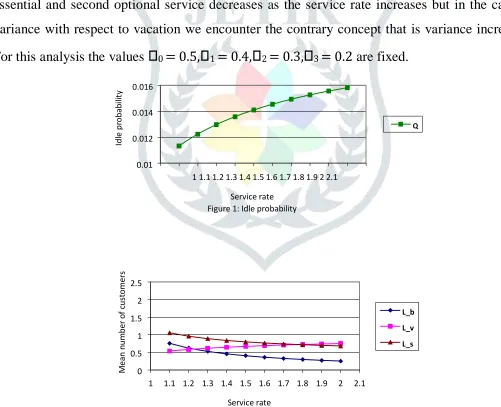
server is on vacation (𝑉𝑣) have been numerically analyzed . Figure 1 represent the idle
probability for different values of service rate. The idle probability increases for increasing value
of service rate. Figure 2 represents the graph of mean number of customers when 𝐾 = 5 by
varying the service rate. From the figure, it is seen that the mean number of customers when the
server is on essential and second optional service is decreases whereas the mean number of
customers when the server is on vacation increases for increasing values of service rate. Table 1
shows the variance of number of customers. The variance value with respect to server is on
essential and second optional service decreases as the service rate increases but in the case of
variance with respect to vacation we encounter the contrary concept that is variance increases.
For this analysis the values 0 = 0.5, 1 = 0.4, 2 = 0.3, 3 = 0.2 are fixed.
1 1.1 1.2 1.3 1.4 1.5 1.6 1.7 1.8 1.9 2 2.1
Service rate Figure 1: Idle probability
Figure 2: Mean number of customers for K=5
0.01 0.012 0.014 0.016 Q 0 0.5 1 1.5 2 2.5
1 1.1 1.2 1.3 1.4 1.5 1.6 1.7 1.8 1.9 2 2.1
Service rate
µ 𝑉𝑏 𝑉𝑠 𝑉𝑣 1.1 1.2 1.3 1.4 1.5 1.6 1.7 1.8 1.9 2.0 3.7779 2.9671 2.4389 2.0693 1.7968 1.5879 1.4228 1.2889 1.1783 1.0853 4.7543 4.0301 3.5580 3.2282 2.9859 2.8008 2.6552 2.5378 2.4411 2.3603 1.3778 1.4629 1.5296 1.5832 1.6271 1.6638 1.6948 1.7214 1.7444 1.7645 Table 1: Variance of number of customers for K=5
6.Conclusion
In the forgoing analysis an M/G/1 queue with K-phase of optional vacation and with second
optional service has been considered. For this model the queue length distribution and the mean
queue length are obtained. An extensive numerical work has been carried out to observe the
nature of the operating characteristics.
References
1. Al-Jararah, J., and Madan, K.C., An M/G/1queue with second optional service with second optional service time distribution, International Journal of Information and Management Science, Vol.14(2), 47-56, 2003.
2. Doshi, B.T., Queueing systems with vacations – a survey, Queueing System, 1, 29-66, 1986.
3. Doshi, B.T., Single server queues with vacations, In: Takagi, H.(ed.), Stochastic Analysis of the computer and communication systems, 217-264, North-Holland/Elsevier, Ansterdam, 1990.
4. Gross, D. and Harris, C.M., Fundamentals of queueing theory, 3rd edition, Wiley, New New York, 1998.
5. Hai-Yan Chen, Ji-Hong Li and Nai-Shuo Tian, The GI/M/1 queue with phase-type working vacations and vacation interruptions, J.Appl.Math.Comput., 30, 121-141, 2009.
6. Jau-Chuan, Ke., An M[x]/G/1 system with startup server and J-additional options for
7. Kalyanaraman, R., Thillaigovindan, N., Ayyappan, G., and Manoharan, P., An M/G/1 retrial queue with second optional server, Octogon, Vol.13(2), 966-973, 2005.
8. Ke, J.C., The analysis of general input queue with N policy and exponential vacations, Queueing Syst., 45, 135-160, 1986.
9. Ke, J.C., The optimal control of an M/G/1 queueing system with server vacations startup and breakdowns, Computers and Industrial Engineering, Vol.44, 567-579, 2003.
10.Ke, J.C., and Wang, K.H., Analysis of operating characteristics for the heterogeneous batch arrival queue with server startup and breakdowns, Rairo oper. Res., Vol.37, 157177, 2003.
11.Ke,J.C., and Chu, Y.K., A modified vacation model M[x]/G/1 system, Appl. Stochastic
Models. Bus. Ind., 22, 1-16, 2006.
12.Ke,J.C., Operating characteristics analysis on the M[x]/G/1 system with a variant vacation
policy and balking, Appl. Math. Model, 31(7), 1321-1337, 2007.
13.Ke, J.C., and Huang, K.B and Pearn, W.L., The randomized vacation policy for a batch arrival queue, Applied Mathematical Modeling, Vol.34, 1524-1538, 2010.
14.Keilson, J. and Servi, L.D., Dynamic of the M/G/1 vacation model, Operations Research, Vol.35 (4), 575-582, 1987.
15.Madan, K.C., An M/G/1 queue system with additional optional service and no waiting capacity, Micro Electronics and Reliability, Vol.34(3), 521-527, 1994.
16.Madan, K.C., An M/G/1 queue system with second optional service, Queueing Systems, Vol.34,37-46, 2000.
17.Medhi, J., A single server Poisson input queue with a second optional channel, Queueing Systems, Vol.42, 239-242, 2002.
18.Takagi, H., Vacation and Priority Systems Part 1. Queueing Analysis: A Foundation of performance Evaluation, Vol.1., North-Holland/Elsevier, Amsterdam, 1991.
19.Tian, N., and Zhang, Z.G., Discrete time Geo/GI/1 queue with multiple adaptive vacations, Queueing Syst., 38, 219-249, 2001.
20.Tian, N., and Zhang, Z.G., The discrete time GI/Geo/1 queue with multiple vacations, Queueing Syst., 40, 283-294, 2002.
21.Tian, N., and Zhang, Z.G., A note on GI/M/1 queues with phase-type setup times or server vacations, INFOR, 41, 341-351, 2003.
22.Tian, N., and Zhang, Z.G., Vacation queueing models: Theory and Applications, Springer, New York, 2006.
23.Wang, J., An M/G/1 queue with second optional service and server break downs, Computer and Mathematics with Applications, Vol.47(10-11), 1713-1723, 2004.