Department of Economics Finance & Accounting ________________
Working Paper N284-17
Does Tax Haven FDI Influence Firm Performance?
Gerda Dewit
National University of Ireland Maynooth Chris Jones
Aston University Dermot Leahy
National University of Ireland Maynooth Yama Temouri
1
Does Tax Haven FDI Influence Firm Performance?
Gerda Dewit
National University of Ireland Maynooth
Chris Jones
Aston University
Dermot Leahy
National University of Ireland Maynooth
Yama Temouri
Aston University
ABSTRACT
This paper provides theoretical and empirical evidence of the link between the use of tax haven
subsidiaries by multinational enterprises (MNEs) and firm performance, as measured by total
factor productivity. We find that the use of tax havens has no impact on economic dynamism for
a sample of MNEs from across the OECD. Our results have significant policy implications in
terms of the role of tax havens in the world economy.
2
1. INTRODUCTION
There is a wide-ranging international business (IB) literature that offers evidence on the impact of
foreign direct investment (FDI) on firm performance (Contractor et al., 2003; Lu and Beamish,
2004). Many of these studies are based on the theoretical premise of Dunning’s (1991) eclectic
paradigm which characterises FDI according to its motivation, namely resource-, efficiency-,
market- and knowledge-seeking FDI. This has led to an array of studies that offer detailed
assessments of FDI effects which differ in their performance implications depending on the
motivation of the multinational enterprise (MNE), home and host country characteristics and the
specific industry in which FDI takes place (see e.g. Driffield and Love, 2007).
However, only recently has the IB literature that explores the internationalisation process
and its consequences, started to consider more unconventional forms FDI and in particular the
role of tax havens in international business (see Buckley et al., 2015 and Jones & Temouri, 2016,
for exceptions) where MNEs shift profits out of high tax locations to low tax locations with high
levels of secrecy. This is an interesting omission for two main reasons. Firstly, the increasing use
of tax havens by MNEs has become a highly controversial issue, particularly in developed
countries, which more than emerging countries are beset by such concerns due to the state of the
public finances that have worsened since the global financial crisis. For example, Zucman (2015)
reports that 55 per cent of the foreign earnings of US firms are located in tax havens, whilst the
Tax Justice Network estimates that around 25 percent of those US firms’ global profits are shifted out of locations where real economic activity takes place, leading to a tax revenue losses
of around $130 billion per year (Cobham & Janský, 2015).1
1
Therefore, the use of tax havens by MNEs has sparked widespread concern among policy-makers and the media in many developed countries and is now high on the political agenda. Recent media stories concerning the tax affairs of some of the world’s most notable MNEs such as Amazon, Apple, Google and Starbucks have created much hostility from civil society and non-governmental organisations (NGOs) and the general public at large. Furthermore,
3
Secondly, the literature on corporate taxation, published mainly in public
finance/economic journals, has focused much of its attention on how corporate taxation creates
economic distortions, notably on investment, corporate form and who bears its burden
(Harberger, 1962). Surveys by Auerbach (2005), Nicodéme (2009) and Dharmapala (2016)
provide an excellent summary of this literature. In a close examination of this literature, it quickly becomes apparent, that although tax havens are bad from a policy-makers perspective – in terms
of tax base erosion – they do allow MNEs to overcome the economic distortions created by the
corporate income tax. In a sense therefore, standard internalization theory (Rugman, 1981) as
applied to this context suggests that the use of tax havens can been seen as an attempt by MNEs
to escape government induced distortions (market imperfections) in order to create their own
internal capital markets. Hence, the use of tax havens by MNEs should, according to this view
(and much of the economics literature), lower the cost of capital, increase cash flow, boost
retained earnings, enhance competitive advantage and lead to improved firm performance. Indeed
this perspective suggests that the use of tax havens will not only boost a firm’s profitability but it
will also have a positive impact on the firm’s marginal investment decision. This should feed through in to higher levels of firm-level productivity.
However, does the use of tax havens by MNEs really impact on firm-level productivity?
This is an empirical question. Is it not the case that MNEs, by virtue of their already superior
ownership advantages and access to world credit markets already have significant competitive
advantage and high levels of firm performance with or without the use of tax havens? It might be
that the use of tax havens is simply for the purposes of maximising short term profit levels and
the recent Panama papers scandal and the leaks of the Luxembourg tax rulings have added to this growing concern and have finally led to action by OECD governments. The ‘Base Erosion and Profit Shifting (BEPS) Action Plan’ (OECD, 2015), has led to 15 action points to reform the international tax system. The aim of which is to eliminate the misalignments between reported profits and real economic activity. This at a time where effective corporate tax rates across the OECD have fallen considerably (Cobham & Janský, 2015)
4
extracting rents for the owners or even managers’ benefit. Can a tax induced boost to the
marginal investment decision (that the use of tax havens might help facilitate) really impact on
firm productivity? These questions are simply not addressed in the literature, and it is our aim in
this paper to suggest some possible answers.
In order to shed light on these questions, we derive a neo-classical optimisation model
which demonstrates the relationship between the use of tax havens and a firm’s underlying
performance in terms of its productivity. Although profits are enhanced by the use of tax havens,
via the shifting of income across low tax subsidiaries, the model show’s that there is no
theoretical impact on firm-level productivity. This is a critical insight but it is tempered by
extending the model across time - in that performance effects may be brought about in the long
run. Indeed this makes the model consistent with the economics literature that finds evidence of
corporate tax cuts boosting investment. However, this long run result is conditional on whether
the MNEs are in fact capital constrained. In reality, MNEs are unlikely to face constraints to
raising capital due to their inherent size and access to world capital markets. Given the theoretical
prediction that tax havens do not impact on firm-level productivity, we then test this hypothesis
using a large firm-level database of MNEs from across the world for the period 2002-2011. We
find consistent evidence that the use of tax havens has no impact on firm-level productivity. In
many respects therefore, we in effect find an absence of evidence that tax havens improve
economic dynamism. This is an incredibly important finding because our results moderate the
findings of other studies that firstly emphasise the positive role of tax havens and secondly extol
the virtues of corporate tax competition.
Our findings are robust for MNEs that operate in both the manufacturing and services
sector. This indicates that the external returns to a firm, namely profitability are the only
5
productivity) are mainly determined by the common firm level determinants found elsewhere in
the literature on firm performance (e.g. innovation, R&D expenditure, and knowledge
accumulation). This suggests that the use of tax havens has no significant discernible impact on
economic dynamism and thus adds to the growing critique of the use of tax havens as devices for
aggressive tax avoidance and planning. From a policy perspective, our results add weight to the
growing view that multilateral action is needed to counter this type of activity not only to protect
the corporate tax base but to ensure the integrity of the corporate income tax for the foreseeable
future (OECD 2013).
The rest of the paper is organized as follows. Section 2 describes the existing literature on
the economic effects of corporate tax liberalisation and links it to the use of tax havens by MNEs.
Section 3 outlines the neo-classical optimisation model that leads to our core prediction that tax
haven FDI is unlikely to boost total factor productivity (TFP). Section 4 discusses the data used
to test our prediction. Section 5 outlines the econometric approach and methodology. Section 6
reports the results and we then discusses the implications of our results in section 7. Finally,
section 8 summarizes our findings, outlines potential weaknesses and suggests avenues for future
research.
2. LITERATURE SURVEY
A large portion of the literature on tax havens addresses tax competition and profit shifting by
MNEs. There are typically two channels through which MNEs engage in shifting profits from
high-tax to low-tax jurisdictions. One channel involves the use of transfer pricing, which
involves setting prices for internal MNE group transactions. For instance, when a foreign
subsidiary imports intermediate inputs from the parent firm, it faces a transfer price which it
6
the prices that would be charged for arm's-length transactions between unrelated parties.
However, internal prices can be manipulated in such a way so as to move profits across
subsidiaries in different countries. There are several studies documenting that this practice is
widely used (Hines, 1999; Newlon, 2000; Bartelsman & Beetsma, 2003; and more recently
Davies, Martin, Parenti & Toubal, 2014). However, there are several inputs for which
arm's-length prices do not exist (Hines and Rice, 1994). This is particularly true for intangible assets,
such as outcomes from R&D efforts and advertising, leaving even more scope for MNEs that
invest heavily in intangibles to engage in profit shifting from high-tax to low-tax jurisdictions via
transfer pricing (Barry, 2005). This is in line with findings by Desai, Foley & Hines (2006b)
who, using affiliate-level data for US firms, show that larger, more international firms, and those
with extensive intra-firm trade and high R&D-intensities, are the most likely to engage in profit
shifting to jurisdictions with very low tax rates (i.e. tax havens).
The second main profit-shifting channel consists of debt-shifting, whereby an MNE can
manipulate its financial structure across countries to minimise its tax payments by allocating debt
from tax to high-tax jurisdictions. Income from interest payments is then earned from
low-tax locations and deducted in high-low-tax locations, thus maximising the gap between low-tax savings in
high-tax countries and tax payments in low-tax ones. Several papers document the link between
the host country’s tax rate and MNEs’ internal debt (Altshuler & Grubert 2003; Desai, Foley & Hines 2004; Mintz & Weichenrieder, 2005; Ramb & Weichenrieder, 2005). A study by Büttner
and Wamser (2013) confirms that internal debt is used more intensively by MNEs with affiliates
in low-tax countries and increases with the spread between the host country tax rate and the
lowest tax rate among all affiliates.
7
While there seems to be agreement that the prevalence of profit shifting by MNEs from
high- to low-tax jurisdictions is widespread, the literature is ambiguous about the welfare effects
from the use of tax havens. Slemrod and Wilson (2009) argue that tax havens reduce welfare by
leading to suboptimal levels of taxation, resulting in an under provision of public goods. In
contrast, other studies stress the possible merits of tax competition. Low-tax jurisdictions may
help in restraining an over-expansive state (Edwards and Keen, 1996) or in mitigating policy
makers’ tendencies to waste public funds (Gordon and Wilson, 2003; Janeba and Schjelderup,
2002). Desai, Foley & Hines (2006b) present evidence suggesting that the use of tax haven
operations enhances activity in nearby non-havens. Others concur that income shifting to tax
havens may reduce revenues of high-tax jurisdictions and increase tax base elasticities, but argue
that profit shifting tends to make the location of real investment less responsive to tax rate
differentials (Hong and Smart, 2010). Dharmapala (2008) surveys the negative and positive
views of tax havens, concluding that it is important that the scholarly and policy debate on the
effects of the existence of tax havens continue.
Since MNEs engage in profit shifting to minimise their corporate tax payments,
establishing a presence in a tax haven leads to these firms facing a lower effective tax rate. This
implies that the literature that examines the relationship between corporate tax rate levels and
investment is also relevant. Within this body of work, several studies emphasise the
effectiveness of low corporate taxes in attracting FDI.2 Other work that has been suggestive of
the merits of lower corporate tax rates investigates the effect of corporate tax changes on capital
investment. Empirical studies have presented evidence that an increase in corporate taxes affects
capital accumulation negatively (Chirinko, Fazzari & Meyer, 1999; Bond & Xing, 2011;
2 Empirical work shows that multinational firms are indeed sensitive to corporate tax rates (see Gordon and Hines, 2002, for an excellant survey on this topic). De Mooij and Ederveen (2008) provide a guide to comparing responsiveness of FDI to changes in corporate tax rates across a large number of various empirical studies.
8
Dwenger, 2014). There exists a small body of work that focuses specifically on the effects of
corporate tax changes on MNEs real investment. A recent example is Simmler (2014), who
specifically examines whether MNEs invest more than domestic firms. The findings provide
evidence from a 10 per cent corporate tax cut in Germany on the causal impact of debt shifting
activities of MNEs on their capital accumulation. The results suggest that, as MNEs shift profits
abroad, their capital accumulation is less depressed by the national tax rate and thus benefits less
from a tax rate reduction.
In addition, there have been several papers that examine the effect of corporate tax
changes on particular types of investment, such as capital embodying technological progress or
investment in product or process innovation. A study by the OECD (2008) finds evidence that
corporate taxes reduce investment in innovation and hence have a negative effect on productivity.
These findings were consistent with a report by the European Commission (2014), which used a
sample of up to 20 OECD countries and 14 sectors over the time period 1994-2007 and found a
negative relationship between corporate tax rates and aggregate TFP. Investigating the effect of
changes in corporate tax rates on innovation by using patent data supports a negative relationship,
such that tax cuts affect innovation more than tax increases (see Atanassov and Liu, 2014; and
Mukherjee Singh & Zaldokas, 2016). Furthermore, several authors focus on the long-run effects
of changes in the corporate tax rate on economic growth. Lee & Gordon (2005), using data for
70 countries for 1980-1997, show that corporate tax rates are negatively correlated with
cross-sectional differences in economic growth rates. Arnold et al. (2008) investigate the effects of
different types of taxes on economic growth and find that high corporate tax rates are the most
inimical to growth.
Our paper examines whether MNEs that face an effective corporate tax cut by
9
presence. One way in which productivity could be expected to increase in this case is due to
increased investment (see the above discussion concerning the impact of corporate tax cuts on
investment, patents, R&D etc.). Neo-classical theoretical convention dictates that the optimal
investment level is reached when the marginal return of investment is equal to its marginal cost.
A change in the corporate tax rate may then affect that optimal investment level through two
channels. Consider, for instance, a cut in the corporate tax rate. Such a tax change may raise the
future marginal return on investment (by increasing after-tax profitability) and hence the optimal
investment level. Alternatively, the tax change may lower the marginal cost of an investment,
also leading to an increase in capital investment. In fact, a tax cut potentially increases the
relative attractiveness of equity financing to firms (Heider and Ljungqvist, 2015) relative to debt
financing and/or lower taxes could augment internal cash flows, which have been shown to be a
major source of financing of innovation (see Himmelberg and Petersen, 1994). Both channels
may imply that establishing a presence in a tax haven reduces the marginal cost of investment,
leading to increased investment and, in turn, increased productivity. However, our theoretical
model shows that this reasoning may only be true in the long-run for MNEs who face credit
constraints. For MNEs who do not face constraints to external financing, the optimal investment
decision is not affected by the use of a tax haven to shift profits to low tax jurisdictions. Thus, the
use of tax havens may be viewed simply as a way to enhance profitability and extract rents to the
benefit of owners and at the same time erode the corporate tax base available to governments to
provide public goods and service.
3. THEORETICAL BACKGROUND
We first present a simple basic model, comparing a MNE’s investment, productivity and profitability with and without an affiliate in a tax haven. The basic set-up will subsequently be
10
extended to incorporate how effective tax cuts may affect the marginal cost of investment, which
is a channel that is often mentioned in the literature on the effects of corporate tax changes.
However, it is important to emphasise that this channel is conditional on whether a firm is credit
constrained.
3.1 The Basic Model
Consider a multinational enterprise (MNE) with headquarters (HQ) in its country of origin,
denoted by O, producing in a foreign host location, denoted by F. The MNE faces different
corporate tax rates in each location, with the tax rate in location i (iO,F) given by i, with 1
i
. We assume that the corporate tax rate in the MNEs country of origin is lower than the corporate tax rate in its foreign host location, i.e.O F. While this assumption is not crucial, it implies that the foreign subsidiary in F was set up for non-tax purposes, such as easy market
access and/or lower production costs. This then allows us to examine the effect of setting up a
subsidiary in a tax haven for tax reasons only more clearly. The firm’s output is sold in an integrated market and receives revenues 𝑞𝑝 where q stands for the firm’s output and 𝑝 is the unit output price The MNE invests in intangibles, denoted by x. While R(q,x) stands for revenue,
) , (q x
C represents production cost. Hence both the revenue and cost functions for the firm
depend on the firm’s output level and its investment in intangibles. We assume that investment in
intangibles improves the profitability of production, either by increasing marginal revenue or by
reducing marginal cost. For instance, advertising typically increases revenues and marginal
revenue (see Fudenberg and Tirole, 1984), i.e., Rx 0 and Rqx 0, where here and henceforth subscripts denote partial derivatives. Process R&D tends to reduce marginal cost
11
(see d’Aspremont and Jacquemin. 1988), so Cqx 0. So, regardless of the channel through which investment in intangibles improves productivity, it raises marginal net revenue (i.e.,
marginal revenue minus marginal cost of production) in our model. The cost of the investment in
intangibles is borne by HQ in O and is given by (x), with '0 and ''0. Hence the cost function of investment for intangibles increases at an increasing rate. The production subsidiary
in F can make use of the intangible asset and pays, in return, a fixed fee to HQ in O, denoted by
F
.3
The MNE may wish to open up another subsidiary in a tax haven, the variables of which
will henceforth be superscripted by H, where the corporate tax rate is by definition significantly lower than in the other countries in which the MNE is active, i.e., H i (i=O,F).4 To capture the stylised facts characterising most tax havens that local demand for the MNE’s product is negligible and no actual production takes place there, we assume that the demand for
the MNE’s product level in the tax haven is zero and that the production cost in the tax haven is not lower than in any of the other subsidiaries.5 HQ will grant the tax haven affiliate a
sub-licence to collect the internal fee for the use of the firm’s intangible assets from the production
plant in F.
3.2 Outputs, investment and profits without a tax haven subsidiary
We first discuss the MNE’s decisions when it does not have a subsidiary in the tax haven, calculating the firm’s output, its investment level in intangibles and the fee it will charge to its
3 It is more efficient to charge a fixed fee than a per unit one.
4 Obviously, when opening a subsidiary in H, the MNE incurs a fixed set-up cost . One can think of this cost as the expenditures incurred from hiring lawyers and top tax accountants to set up the subsidiary in the tax haven. We assume the MNE has already sunk this fixed set-up cost.
5 Note that even if active production would take place in the subsidiary in the tax haven, the model’s conclusion would remain the same, provided that production in the tax haven takes place there because of lower-cost or easier-access reasons.
12
subsidiary in F for use of those intangibles. Without a tax haven affiliate, the after-tax profit
function for the firm, , is given by:
)] ( )[ 1 ( ] ) , ( ) , ( )[ 1 ( ) , , (q x F F R q x C q x F O F x (1)
where the term (1F)[R(q,x)C(q,x)F] stands for after-tax profits of the subsidiary in F (i.e. revenue minus cost minus the fixed fee for intangibles paid to the HQ) and
)] ( )[
1
( O F x denotes after-tax profits of the parent (i.e. revenue minus cost generated within the HQ).
A profit-maximising MNE will transfer price so as to maximise expression (1), meaning
that it will use transfer pricing to reallocate its profits to the plant in the location with the lowest
tax rate. Without there being an arm’s-length price for the use of these intangibles, we simply assume the firm will need to charge the foreign subsidiary at least a compensation for the R&D
cost incurred by the parent (i.e., F ), while not being able to charge more than the profits it makes in its foreign plant (i.e., F RC
). So, with O F, the profit-maximising internal fee for use of the parent’s R&D is equal to the operating profits of the subsidiary in F (which is
formally derived in Appendix A), or:
C R
F
, (2)
implying that all the MNE’s profits are taxed at tax rate set in the HQ locationO (hence,
] )[ 1 ( O R C ).
Substituting expression (2) into expression (1), the respective first-order conditions for q and x
are given by:
0 )] , ( ) , ( )[ 1 ( ) , , ( x q C x q R q x q q q O F (3) and
13 0 )] ( ' ) , ( ) , ( )[ 1 ( ) , , ( x x q C x q R x x q x x O F (4)
Expressions (3) and (4) then simplify to:
) , ( ) , (q x C q x Rq q (5) and ) ( ' ) , ( ) , (q x C q x x Rx x (6)
Expression (5) represents the usual optimality condition for output: the firm produces the output
level at which marginal revenue equals the marginal cost of production. Optimal investment is
given by expression (6); the firm’s investment level will be chosen such that the net revenue from the investment is equal to the marginal investment cost.6
3.3 Outputs, investment and profits with a tax haven subsidiary
Now suppose the MNE has set up a subsidiary in the tax haven, H, and has issued it with a
sublicense for the firm’s intangible assets, in return for which the tax haven affiliate will pay HQ a fixed fee of H. It will, in turn, collect a fee from the subsidiary in F for the latter’s use of the intangibles as an input in its production (see Figure 1).
6 Even if, instead of O H
, we were to assume O H, these expressions would be the same. In that case, the MNE would set the internal fee for use of the parent’s R&D equal to the cost of R&D (F ), so all the MNE’s
14
As before, we denote this fee by F, with F RC for similar reasons to those mentioned earlier. After-tax profits in the tax haven affiliate are then (1H)(F H). We denote the firm’s after-tax profits with a tax haven as H. These are given by:
] )[ 1 ( )] ( )[ 1 ( ] ) , ( ) , ( )[ 1 ( ) , , , ( F H F F O H H F H H x x q C x q R x q (7)
Where the first term on the right-hand side of eq.7 are profits generated in F, the second term are
the profits generated in O, and the third term are profits generated in the tax haven. Now, profit
maximisation implies that the MNE transfers as much pre-tax profits as possible to the tax haven
since this would minimise its tax bill. So, the production plant in F pays the tax haven affiliate
the fee for use of the firm’s intangibles amounting to its operating profits, or: C
R
F
, (8)
while the tax haven affiliate pays the parent for the investment costs incurred7:
H
. (9)
Substituting expressions (8) and (9) into expression (7) yields the respective first-order conditions
for q and x: 0 )] , ( ) , ( )[ 1 ( ) , , , ( x q C x q R q x q q q H H F H (10) and 0 )] ( ' ) , ( ) , ( )[ 1 ( ) , , , ( x x q C x q R x x q x x H H F H (11)
Expressions (10) and (11) then reduce to expressions (5) and (6). So, establishing an
affiliate in a tax haven does not have an impact on the firm’s investment in intangibles nor does it
15
affect output. In other words, the MNE’s productivity is not affected by the fact that the firm has a presence in a tax haven. Hence, maximised pre-tax operating profits are the same irrespective
of whether the MNE does or does not have an affiliate in a tax haven.8 Naturally, post-tax profits
have changed after the tax haven affiliate is set up; they now are (1H)[RC]. With the tax rate in the tax haven being much lower than the tax rate in HQ (H O
), the firm sees its
after-tax profits rise considerably. In summary, the optimal investment decision in terms of
intangibles is not impacted upon, output remains the same regardless as to whether or not the
firm utilises a tax haven or decides not to. All that differs is the fact that profits available to the
MNE to distribute have increased which implies that the corporate tax base has been eroded. In
terms of language to ease the burden on the reader, our model generates a clear falsifiable null
hypothesis that can be simply stated as:
H0: The use of tax haven subsidiaries by MNEs has no impact upon firm performance as
measured by firm-level productivity.
The null hypothesis runs counter to the predictions of much of the economics literature (as
described above) which indicates that the use of tax havens leads to lower effective tax rates that
may boost firm performance. Hence the alternative hypothesis may be written as:
H1: The use of tax havens subsidiaries by MNEs improves firm performance as measured by
firm-level productivity.
8 Note that even if active production would take place in the subsidiary in the tax haven, the model’s conclusion would remain the same, provided that production in the tax haven takes place there because of lower-cost or easier-access reasons.
16
Failure to reject the null hypothesis gives prima facie evidence that the use of tax havens have no
performance effects in terms of real economic dynamism as measured by TFP.
3.3 Extension: Tax havens and the cost of investment
In the literature on corporate tax changes and investment (see above), it is often claimed –and, as
pointed out in the literature survey, there is some evidence for this − that if a country cuts its corporate tax rate it tends to boost investment and hence increases productivity. One channel
through which the tax cut is supposed to affect investment is through a reduction in the
investment cost. High corporate taxes reduce after-tax profits, which may force firms to rely on
external financing of its investment, which may be unattainable or attainable only at a relatively
high cost. In fact, investment in innovation in particular tends to be internally financed (see, for
instance, Himmelberg and Petersen (1994)) and if internal cash flows are low as a result of high
taxes, a tax cut may significantly augment internal cash-flows, leading to more innovative
investment and hence a rise in productivity. Indeed, small firms that are typically
capital-constrained may see their cost of investment fall dramatically after a tax cut. However, MNEs
typically are large, profitable firms. It is highly debatable that they are constrained in obtaining
external financing, and therefore their level of innovative, productivity-boosting investment is
unlikely to be affected by a cut in corporate taxes.9
In this subsection, we extend our basic model by allowing for the possibility that lower
effective tax rates lower the firm’s cost of investment. Extending the basic model to a two-period framework, we assume that previous-period after-tax profits potentially lower the firm’s current
cost of investment, that is, t t(xt,t1) with t denoting period t (t=1,2) and tt1 0. So, if
9 Mukherjee et al. (2016) find that tax rate cuts do not seem to affect firms’ innovation. They give a similar explanation.
17
the firm is capital constrained, we can expect that setting up an affiliate in a tax haven in period
one will increase the firm’s investment in period two: it now faces a lower marginal investment cost as a result of the after-tax profit boost induced by the lower effective tax in the tax haven
(since 0 1 t
t ). The firm’s increased investment is then likely to lead to enhanced
productivity. However, since most MNEs are large, profitable organisations we expect the
majority of these firms not to be subject to a capital constraint when seeking finance for
innovative investment; their marginal cost would remain unchanged as a result of an effective tax
cut following the establishment of an affiliate in a tax haven ( 0 1
t
t in that case). Therefore,
one expects these firms not to change their investment levels and hence not to exhibit any
increases in their productivity.
The firm maximises the sum of profits in period one and two, with profits in period t
given by expression (1), now augmented by subscript t. As before and for the same reason, the
MNE will transfer price for the use of its intangibles in such a way as to minimise its tax bill,
implying that tF and tH are set as in expressions (8) and (9), respectively (formally derived in Appendix A). Substituting expressions (8) and (9) into the profit function, the respective
first-order conditions for qt and xt are:
) , ( ) , ( t t t t t t q x C q x R t q t q (12) and ) , ( ) , ( ) , ( 1 1 t t t t t t t t t q x C q x x R t t x t x (13)
Since H O, we have that the firm’s post-tax profits in period one have risen as a result of having set up an affiliate in a tax haven; profits are hence larger with than without a tax haven. If
we consider a firm that is capital constrained (implying 0 1 t t x
18 investment cost in the next period may indeed fall (i.e.,
1 2 1 2x x
). In order not to violate the condition for optimal investment (expression (13)), the firm will invest more in period two (
1 2 x
x ) so as to bring the marginal revenue from its investment in line with the lower marginal cost. With higher investment, the firm’s productivity is raised (either since 0
t x t q t R or because
of ) and the firm’s output level in period two increases (q2 q1). However, as argued earlier, most MNEs that have a presence in tax havens are large, profitable firms, and therefore
unlikely to be capital constrained. For those firms, a tax-cut induced boost in after-tax profits is
unlikely to lower its investment cost further (implying 0 1 t t x
t ) and hence leaves the firm’s
optimal investment level unaffected (x2 x1); profits for these firms would increase substantially as a result, but there is no reason why productivity should be affected (hence, q2 q1). Hence, even though there is empirical evidence that corporate tax cuts may boost investment and it is
possible to model this channel (as shown in this section), our model predicts that even in the long
run, for credit unconstrained MNEss, the use of tax havens should not have any impact upon
firm-level productivity.
4. DATA
This paper uses the database ORBIS which is a firm-level dataset provided by Bureau van Dijk, a
leading electronic publisher of annual accounts information of firms across the world. We use
financial data for every developed country MNE included in the database for the period
2005-2013. An MNE is defined as having an ownership of greater than 10 per cent in a subsidiary
located abroad. We use accounting data for each firm comprising of return on assets, TFP, cash
flow to total assets, intangible to total assets, long term debt to total assets and firm age and firm 0 t x t q t C
19
size (measured as number of employees). All monetary values are deflated using GDP deflators
to take account of inflation. No information about the subsidiaries is utilised as this data is often
missing, we are therefore focusing on the parent firm. The only data we have concerning a MNEs
subsidiaries is where they are located. This data allows us to construct our key independent
variable TaxHavenit1 which equals 1 if a firm has a subsidiary in a tax haven in a given year and 0 otherwise.
We distinguish between the manufacturing and service sector by using NACE 2-digit
codes1. Country specific dummies based on each MNEs country of incorporation are created
from ISO numbers. Table1 shows the distribution of tax haven presence across firms in our
sample of 31 OECD countries. In addition to this Table A in Appendix B contains the correlation
matrix for the sample of manufacturing firms and services firms.
Table 1: Distribution of Tax Haven presence by OECD country (2005-2013)
Tax Haven Status Number of
MNEs
Number of MNEs with tax haven presence
Number of MNEs that start having tax haven presence in the period 2005-2013 Austria 3,816 135 61 Australia 1,014 177 66 Belgium 3,008 660 234 Canada 1,611 361 103 Chile 47 9 2 Czech Republic 1,032 11 1 Germany 8,760 461 156 Denmark 7,599 276 74 Estonia 564 14 3 Spain 6,812 414 147 Finland 1,942 75 36 France 8,447 1,037 363 Great Britain 10,398 1,097 317 Greece 303 116 20 Hungary 572 17 2 Ireland 1,570 92 32
20 Italy 7,396 793 190 Japan 1,452 118 47 Korea 288 10 7 Luxembourg 252 45 14 Mexico 78 7 2 Netherlands 7,533 507 100 Norway 2,948 189 41 New Zealand 157 9 4 Poland 557 69 23 Portugal 2,347 237 30 Sweden 5,438 330 101 Slovenia 584 6 2 Slovakia 149 4 0 Turkey 121 19 7 United States 3,037 1,001 251 Total 89,832 8,296 2,436
Source: Authors calculations using Orbis.
Defining what we mean by tax havens is not trivial. Indeed Palan, Murphey and
Chavagneux (2010) devote a whole chapter of their book Tax Havens: How Globalisation Really
Works to defining them. They state that tax havens are “places or countries that have sufficient
autonomy to write their own tax, finance, and other laws and regulations. They all take advantage
of this autonomy to create legislation designed to assist non-resident persons or corporations to
avoid the regulatory obligations imposed on them in the places where those non-resident people
undertake the substance of their economic transaction”. Therefore the key characteristic is the fact that these countries have zero or near zero rates of taxation to non-resident companies and
high levels of secrecy. There are all sorts of tax haven lists available, see for example Hines and
Rice (1994), but they all have the same characteristics in common - a number of countries appear
on every list.
Our own list includes the following countries: Andorra, Anguilla, Antigua, Barbados,
Bahrain, Bermuda, Bahamas, Belize Cook Islands, British Virgin Islands, Costa Rica, Cyprus,
Grenada, Guernsey, Gibraltar, Ireland, Island of Man, Jersey, Saint Kitts and Nevis Cayman
21
St Vincent, Seychelles, Singapore, Turks and Caicos Islands. We include these economies
because of their small island so-called ‘dot’ status (see Desai et al. 2006b). We exclude Costa
Rica, Hong Kong, Ireland, Liberia, Panama, South Africa, Singapore and Switzerland because
they are large and encompass all types of legitimate economic activity. We acknowledge that in
many ways our choice is somewhat arbitrary but its arbitrariness is consistent with the existing
literature. Furthermore, lists provided by international organisations such as the IMF and OECD
are in addition subject to heavy political pressure. Hence our choice to choose only the so called
‘dot’ tax havens is a conservative one but captures the idea that these locations are utilised only for tax purposes. Indeed this assumption mirrors an assumption of the theoretical model, that the
choice of a tax haven location is independent of the choice as to where to locate overseas
production.
5. EMPIRICAL MODEL
One has to be mindful about the possibility that MNEs that decide to have tax haven
subsidiaries may ex ante be different from MNEs that do not. This induces the classic
“self-selection” problem that must be controlled for in the analysis. The literature advocates several solutions to this problem, including the more sophisticated technique known as propensity score
matching to overcome the self-selection problem (Kai and Prabhala, 2007). Conceptually, this
involves identifying a “treatment” group – in this case, MNEs with tax haven subsidiaries and matching those with untreated firms that are similar to the treated firms, based on a given set of
criteria. We use the following dimensions to match MNEs with tax haven subsidiaries to their
counterparts: Firm size and age, intangible assets to total assets (IATA), return on assets (ROA),
cash flow to total assets (CFTA), long-term debt to total assets (LTDTA), 2-digit industry, time
22
in the propensity score matching algorithm and shows the probability of an MNE engaging in tax
haven FDI (Belderbos and Zou, 2007; and Paul and Wooster, 2007).
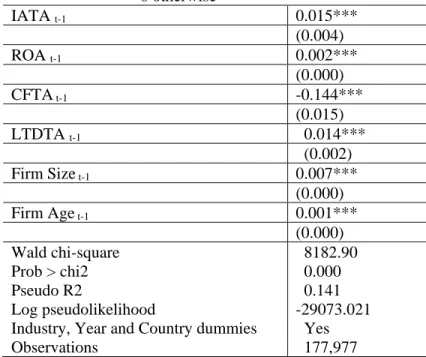
Table 2: Determinants of Tax Haven presence
Dependent variable:
Dummy variable = 1 for Island Tax Haven MNEs = 0 otherwise IATA t-1 0.015*** (0.004) ROA t-1 0.002*** (0.000) CFTA t-1 -0.144*** (0.015) LTDTA t-1 0.014*** (0.002) Firm Size t-1 0.007*** (0.000) Firm Age t-1 0.001*** (0.000) Wald chi-square 8182.90 Prob > chi2 0.000 Pseudo R2 0.141 Log pseudolikelihood -29073.021
Industry, Year and Country dummies Yes
Observations 177,977
Notes: Coefficients are shown as marginal effects from a probit regression. Robust standard errors are shown in parenthesis. All explanatory variables are lagged by one year to pre-empt potential endogeneity issues. Monetary values are deflated using GDP deflators. *** indicates significance at 1% level.
The probit model allows us to obtain the propensity scores for each firm/year observation and
hence we can create a matched sample of firms that do and do not utilise tax haven subsidiaries.
Having matched the two groups of MNEs, we proceed with the main form of analysis employed
in this paper which focusses on the production function augmented by tax haven presence. The
specific measure we use to capture productivity is TFP, which is adopted in the vast majority of
23
residual of the production function.10 This essentially involves estimating the following basic
model: it it m it l it k it
a
k
a
l
a
m
y
(14)where subscripts i and t refer to the firm and panel year; yit, kit, lit, and mit represent the log of a
firm’s output (turnover) and the production inputs: capital (measured as the book value of fixed tangible assets), labour (number of employees) and material costs respectively. In equation (1) it represents the TFP residual.
The second step involves utilising the TFP residual as our dependent variable in an
attempt to identify potential productivity effects from having subsidiaries in Tax Havens. Thus,
the underlying dynamic TFP equation is specified as:
it i t c j it it it it ijt ijt
TaxHaven
IATA
Firmsize
FirmAge
TFP
TFP
1 5 1 4 1 3 1 2 1 1 0 (15)where TFPijt is the level of TFP for firm i, industry j and at time t. The main coefficient of
interest is Tax Haven which is a dichotomous variable capturing a firm i at time t, equalling 1 if a
10
We use the Levinsohn and Petrin (2003) approach deals with the endogeneity problem associated with estimated unobserved productivity and inputs. The endogeneity problem occurs when at least a part of the TFP is unobserved by the econometrician but observed by the firm at a time early enough so as to allow the firm to change the factor input decision. If that is the case, then profit maximization implies that the realisation of the error term is expected to influence the decision on factor inputs. In other words, the regressors and the error term are correlated, which makes OLS estimation biased and inconsistent. One of the remedies to control for endogeneity is the Levinsohn and Petrin (2003) approach which uses material inputs as a proxy to control for unobservable productivity shocks.
24
MNE has a subsidiary located in a tax haven; and equals zero otherwise. We further measure firm
age using the date of incorporation and firm size by the number of employees and intangible to
total assets. We include the ratio of intangible assets to total assets (i.e. IATA) to reflect firm
specific advantages. To control for industry, country and time specific effects, we includej, c andt, respectively. Finally, i and it represent the unobserved (time constant) individual effect and the error term. All monetary values are deflated using the corresponding country level
GDP deflators.
Tax haven activity may still be endogenous due to the presence of time invariant
firm-level fixed effects renders the former correlated with the error term. These could include the
ability of management to develop the capabilities of the firm in terms of real economic activity
and the ability to use complex tax avoidance schemes. To address this issue we employ a more
sophisticated estimator known as the system generalised methods of moments (GMM) estimator
We also include fixed effects estimation as another robustness check in order to control for
heterogeneity.
6. RESULTS
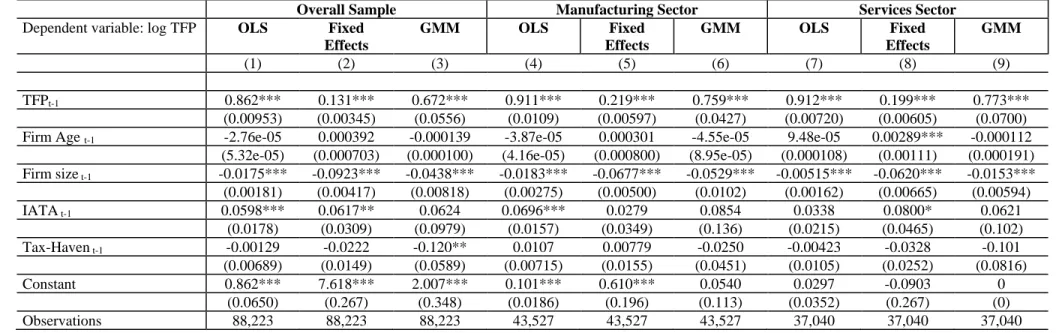
Table 3 shows the results for the overall sample, the manufacturing and the services sector
separately. As can be seen tax haven presence has no discernible impact on TFP across all
specification. This is true using OLS, fixed effects and GMM estimation to account for
self-selection. Indeed for one of the specifications (in the overall sample using GMM) the coefficient
is in fact negative, which suggests that the use of tax havens may even be detrimental to firms.
This could be interpreted as suggesting that firms focusing their energies on tax avoidance may in
25
theoretical model and indicate strongly that tax haven presence has no impact on the economic
dynamism of MNEs. This runs counter too much of the economics literature that suggests that a
reduced tax burden (as may be facilitated by a tax haven presence) on firms should boost
investment levels and result in higher productivity.
In terms of the other control variables, it is notable that the previous year’s productivity is
explaining much of a MNEs current level of TFP, which is as expected in a dynamic
specification. Moreover, firm size shows a negative and significant coefficient indicating that
smaller MNEs tend to be more productive. This is a surprising result and runs counter to the
existing literature. This is consistent in the results for the services sector and for firms in the
manufacturing sector. Furthermore, the results do indicate that intangibles assets do have an
Table 3: TFP regression estimates
Overall Sample Manufacturing Sector Services Sector
Dependent variable: log TFP OLS Fixed Effects GMM OLS Fixed Effects GMM OLS Fixed Effects GMM (1) (2) (3) (4) (5) (6) (7) (8) (9) TFPt-1 0.862*** 0.131*** 0.672*** 0.911*** 0.219*** 0.759*** 0.912*** 0.199*** 0.773*** (0.00953) (0.00345) (0.0556) (0.0109) (0.00597) (0.0427) (0.00720) (0.00605) (0.0700) Firm Age t-1 -2.76e-05 0.000392 -0.000139 -3.87e-05 0.000301 -4.55e-05 9.48e-05 0.00289*** -0.000112
(5.32e-05) (0.000703) (0.000100) (4.16e-05) (0.000800) (8.95e-05) (0.000108) (0.00111) (0.000191) Firm size t-1 -0.0175*** -0.0923*** -0.0438*** -0.0183*** -0.0677*** -0.0529*** -0.00515*** -0.0620*** -0.0153*** (0.00181) (0.00417) (0.00818) (0.00275) (0.00500) (0.0102) (0.00162) (0.00665) (0.00594) IATA t-1 0.0598*** 0.0617** 0.0624 0.0696*** 0.0279 0.0854 0.0338 0.0800* 0.0621 (0.0178) (0.0309) (0.0979) (0.0157) (0.0349) (0.136) (0.0215) (0.0465) (0.102) Tax-Haven t-1 -0.00129 -0.0222 -0.120** 0.0107 0.00779 -0.0250 -0.00423 -0.0328 -0.101 (0.00689) (0.0149) (0.0589) (0.00715) (0.0155) (0.0451) (0.0105) (0.0252) (0.0816) Constant 0.862*** 7.618*** 2.007*** 0.101*** 0.610*** 0.0540 0.0297 -0.0903 0 (0.0650) (0.267) (0.348) (0.0186) (0.196) (0.113) (0.0352) (0.267) (0) Observations 88,223 88,223 88,223 43,527 43,527 43,527 37,040 37,040 37,040
0
7. DISCUSSION
Our results, across a battery of specifications that account for endogeneity and self-selection bias,
show clear support for the main prediction of the optimisation model. It would appear that the use
of tax havens by a set of credit unconstrained MNEs has no impact upon firm-level TFP. Given
the fact TFP is one of the main drivers of economic growth across the OECD our results suggest
that the use of tax havens by MNEs has no impact upon economic dynamism. This finding has
serious implications for MNE managers and policy makers alike. Fundamentally, it negates any
intellectual justification that the use of tax havens are in any way beneficial economically and is
suggestive that their use favours special interests and may indeed contribute to the growing levels
of inequality seen across the OECD (Pikety, 2014). In this section we discuss the implications of
our results in turn for each of the two groups identified.
Implications for managers
Given the fact that our results suggest that the use of tax havens has no impact upon firm
productivity then managers need to consider carefully whether their use detracts firms from
developing their core competencies (Prahalad and Hamel, 2006). Although it is likely that the use
of tax havens will boost firm profitability in the short run, the long run performance effects of
utilising tax havens is unlikely to be impacted upon. Indeed owners should be wary about
managers starting to utilise tax havens because they could be used to boost manager’s
remuneration in the short run to the detriment of the firms underlying long run performance.
Recent evidence by Brooks et al., (2016) suggests that for UK listed firms, lower effective tax
rates do not translate into higher shareholder returns but do expose shareholders to greater risk.
Furthermore, Hasan et al. (2014) show that US banks impose higher interest rates and harsher
interest terms on firms with a greater degree of tax avoidance. Hence the use of tax havens by
In addition, the use of tax havens may also be seen as risky due to the fact that it could
create a public relations disaster and weigh heavily on a firms imagine in terms of corporate
social responsibility. Recent media attention has created much hostility to certain MNEs avoiding
tax via tax havens as well as inverting themselves for tax purposes. Starbucks received a lot of
negative press when it was reported that a negligible amount of corporate tax had been paid
during its first 14 years of UK operations. This quickly led to a backlash and in 2015 Starbucks
reacted by declaring a much higher tax bill paid to the UK exchequer. In contrast however, other
companies such as Google have not changed their corporate structures in terms of its tax
planning. It might be the case that firms with a greater physical presence may face different
degrees of political pressure. Either way, managers clearly need to weigh up the costs and
benefits of utilising tax avoidance schemes and in particular start to view the use of tax havens as
a potential cost. In our view, managers should focus on building their core capabilities in contrast
to focusing their resources on tax planning should they wish to create a sustainable long run
competitive advantage.
Implications for policy makers
Policy makers have been wrestling with the issue of tax havens for years. Politicians with a more
libertarian viewpoint may see tax havens as a useful mechanism for mitigating the size of the
state via tax competition. In contrast, politicians with a more socially liberal or even socialist
persuasion may see the use of tax havens as hindering the ability of the state to deliver much
needed public infrastructure and public services. Furthermore, they may view the use of tax
havens as a way of redistributing wealth from immobile factors of production, such as labour, to
more mobile factors of production, such as capital. Interestingly these views have perhaps aligned
somewhat with conservatives who may see the use of tax havens as benefiting special interest
the levels of criticism it has levied at MNEs and corporate executives of firms who have been
perceived to have been major beneficiaries of complex tax avoidance schemes that often utilise
tax havens to mitigate corporate tax. Hence, it would appear that an emerging consensus is
beginning to emerge across the OECD.
The OECD BEPS initiative, carried out between 2013-2015 at the behest of the G20 and
G8 group of countries, represents the single biggest collaboration concerning international tax
rules for decades; with its basic premise to eliminate the misalignment between profits and
underlying real economic activity. This agenda is consistent with the results of this paper. Indeed
in many respects our results give intellectual rigor towards the argument that tax havens create
harmful tax practices and run counter to productive economic performance both at the firm and
country level. Furthermore, the results help justify the introduction of country-by-country
reporting (CBCR) - perhaps the most significant outcome of the BEPS project. CBCR ensures
that MNEs are more transparent in terms of their financial reporting standards and it will
empower tax authorities to reign in the most harmful tax practices. However, it remains to be
seen whether the BEPS initiative will make a substantial progress in terms of eliminating harmful
tax practices. Perhaps if CBCR is made more transparent and MNEs are forced to make their
accounts across jurisdictions open to the public, then holding MNEs and the tax authorities to
account will lead to much greater scrutiny from NGOs, the media and the public at large.
8. CONCLUSION
This paper is the first of its kind that links the performance of MNEs (from around the world)
with tax havens presence, using a large firm-level dataset. Our results suggest that firms with tax
sample of firms who do not use tax havens. This is true not only in the manufacturing sector but
holds across the services sector as well.
The fact that tax haven presence has almost no impact on TFP suggests that tax havens
have no impact on economic dynamism. They can be viewed as devices, to aggressively avoid
corporate taxation and thus enhance their profitability and thus have the potential to erode the
corporate tax base. The evidence in this paper suggests that if national policy makers were to
adopt a new approach to address the concerns of base erosion and profit shifting, for example by
using a formulary apportionment system, the impact upon economic dynamism would be
insignificant.
In terms of this papers limitations, it is important to acknowledge that the determination
of which countries can be defined as tax havens is as much and art as it is a science. This paper
uses a conservative approach and focusses on the so called “dot tax havens” as listed by previous authors in the Economics literature. However, future work could extend the analysis by being
able to actually track the total assets booked in to tax haven subsidiaries to determine whether the
so-called intensive margin has any discernible impact upon performance. Unfortunately, data
constraints with ORBIS mitigate this possibility to a certain degree and would severely reduce
the sample size.
Furthermore, the results could also be extended by looking in closer detail to determine
whether there are performance effects for firms from individual countries or by look in a finer
details at specific sectors within manufacturing and service e.g. high-tech vs. low tech
manufacturing. This would shed further light on whether the use of tax havens has any impact on
Appendix A
Optimal transfer pricing without a tax haven affiliate The firm’s maximisation problem is given by:
) , , ( max , , F x q x q F (A1)
with F RC. The profit function is assumed to be concave in q and x so that there is a unique interior optimum for the output and the intangibles levels. The optimal choice of the transfer price is obtained from:
0 ) , , ( F O F F x q (A2)
Hence, the optimal internal fee for use of the firm’s intangibles involves a corner solution that transfers all the profits to country O. More specifically, the derivative of profits with respect to
F
is positive, implying that F should be set as high as possible. The maximum fee the subsidiary in F has to pay the tax haven subsidiary is its net revenue from sales (see expression (2)).
Optimal transfer pricing with a tax haven affiliate The firm’s maximisation problem is now given by:
) , , , ( max , , , H F H x q x q H F (A3)
The optimal choice of internal fees is obtained from:
0 ) , , , ( F H F H F H x q (A4) and 0 ) , , , ( H O H H F H x q (A5)
Here too, optimal internal fees for use of the firm’s intangibles involve corner solutions that transfer all the profits to the country with the lowest tax rate, now country H. More specifically, the derivative of profits with respect to F is positive, implying that F should be set as high as possible, while the opposite is true for the derivative of profits with respect to H. Hence, we obtain expressions (8) and (9), respectively.
Extension – Optimal transfer pricing
The cost of investment in intangibles is now given by t(xt,t1); t1 denotes after-tax profit in period t-1. We assume 0
t x
t , txtxt 0 and txtt1 0.
With a tax haven, the firm’s maximisation problem is given by:
t H t F t t t H t x q x q H t F t t t ) , , , ( max , , ,
(A6)with i t t t
t R C
(iO,H). The optimal choice of internal transfer fees is obtained from: 0 ] ) , , , ( [
H F F t t H t F t t t H t q x (A7) and from 0 ] ) , , , ( [
O H H t t H t F t t t H t q x (A8)Once again, the optimal internal fees for use of the firm’s intangibles involve corner solutions that transfer all the profits to the tax haven (i.e., country H). More specifically, the internal fees are given by expressions (8) and (9).
0 Appendix B
Table A: Descriptive statistics and correlation matrix
Variable Mean Std. dev. 1 2 3 4 5 6 7 8
1 TFP 1.366 2.342 1
2 ROA 4.221 15.849 0.0417 1
3 Firm Age 24.668 23.724 -0.1240 0.0179 1 4 Firm Size 4.262 1.5334 -0.1450 0.0050 0.2259 1 5 IATA 0.028 0.086 0.1008 -0.1014 -0.1165 0.0695 1 6 Tax Haven Dummy 0.052 0.221 0.0691 -0.0053 0.0518 0.0564 0.0156 1
7 CFTA 0.797 305.11 0.0297 0.7142 0.0079 0.0337 -0.0198 -0.0086 1
0
REFERENCES
Arnold, J., & Schwellnus, C. (2008). Do corporate taxes reduce productivity and investment at the firm level? Cross-country evidence from the Amadeus dataset. Documents de travail du Département des affaires économiques de l’OCDE, (641).
Altshuler, R., & Grubert, H. (2003). Repatriation taxes, repatriation strategies and multinational financial policy. Journal of Public Economics, 87(1), 73-107.
Arnold, J. (2008). Do Tax Structures Affect Aggregate Economic Growth?.
Atanassov, J., & Liu, X. (2014). Corporate Income Taxes. In Tax Avoidance and Innovation, Conference.
Auerbach, A. J. (2005). Who bears the corporate tax? A review of what we know (No. w11686). National Bureau of Economic Research.
Barry, F. (2005). FDI, transfer pricing and the measurement of R&D intensity. Research Policy, 34(5), 673-681.
Bartelsman, E. J., & Beetsma, R. M. (2003). Why pay more? Corporate tax avoidance through transfer pricing in OECD countries. Journal of Public Economics, 87(9), 2225-2252.
Bond, S. and J. Xing (2011), Corporate taxation and capital accumulation, Discussion Paper Oxford University Centre for Business Taxation No. 10/15.
Belderbos, R. and Zou, J. (2007) ‘On the growth of foreign subsidiaries: Multinational plant networks, joint ventures, and flexibility’, Journal of International Business Studies, 38(7), 1095-1112..
Brooks, C., Godfrey, C., Hillenbrand, C., & Money, K. (2016). Do investors care about corporate taxes?. Journal of Corporate Finance, 38, 218-248.
Buckley, P. J., Sutherland, D., Voss, H., & El-Gohari, A. (2015). The economic geography of offshore incorporation in tax havens and offshore financial centres: the case of Chinese MNEs. Journal of Economic Geography, 15(1), 103-128.
Buettner, T., & Wamser, G. (2013). Internal debt and multinational profit shifting: Empirical evidence from firm-level panel data. National Tax Journal,66(1), 63-95.
Chirinko, R., S. Fazzari and A. Meyer (1999), “How responsive is business capital formation to its user cost? An exploration with micro data”, Journal of Public Economics, 74, 53-80.
Cobham, A., Janský, P., & Meinzer, M. (2015). The Financial Secrecy Index: Shedding new light on the geography of secrecy. Economic geography, 91(3), 281-303.
Contractor, F. J., Kundu, S. K., & Hsu, C. C. (2003). A three-stage theory of international expansion: The link between multinationality and performance in the service sector. Journal of international business studies, 34(1), 5-18.
Davies, R., Martin, J., Parenti, M. and F. Toubal (2014), Knocking on Tax Haven’s Door: Multinational Firms and Transfer Pricing, UCD Centre for Economic Research Working Paper Series, WP14/21.
d’Aspremont, C. and A. Jacquemin (1988), “Cooperative and Non-cooperative R&D in Duopoly with Spillovers”, American Economic Review, 78, 1133–37.
De Mooij, R. and S. Ederveen (2008), “Corporate Tax Elasticities: A Reader’s Guide to Empirical Findings”, Oxford Review of Economic Policy, 24, 680-697.
Desai, M., F. Foley, and J. Hines, Jr. (2004), “A Multinational Perspective on Capital Structure Choice and Internal Capital Markets.” Journal of Finance,59, 2451–2487.
Desai, M., Foley, F., and Hines Jr, J.R. (2006b). Do tax haven operations divert economic activity? Economics Letters 90, 219–224.