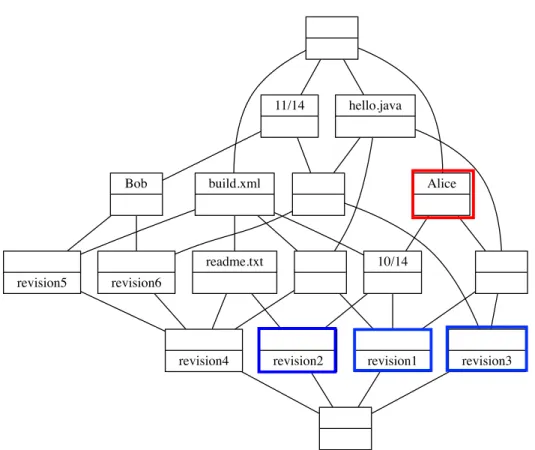
by
Gillian J. Greene
Dissertation presented for the degree of Doctor of Philosophy in the Faculty of Science at Stellenbosch University
Supervisor: Prof. Bernd Fischer March 2017
Declaration
By submitting this dissertation electronically, I declare that the entirety of the work contained therein is my own, original work, that I am the sole author thereof (save to the extent explicitly otherwise stated), that reproduction and publication thereof by Stellenbosch University will not infringe any third party rights and that I have not previously in its entirety or in part submitted it for obtaining any qualification.
March 2017
Date: . . . .
Copyright © 2017 Stellenbosch University All rights reserved.
Abstract
Concept-Based Exploration of Rich Semi-Structured Data Collections
G.J. Greene
Division of Computer Science, University of Stellenbosch,
Private Bag X1, Matieland 7602, South Africa.
Dissertation: PhD March 2017
Search has become one of the fundamental operations in computer science, al-lowing users to extract data and ultimately information from datasets. However, when users have no previous knowledge of a dataset, or have not clearly defined their search task and are therefore unable to formulate a direct query, their task
becomes one of exploratory search or browsing rather than focused search or
re-trieval. While search and retrieval tools are widely provided, support for browsing of large and especially rich semi-structured datasets, is lacking. Semi-structured data is particularly difficult to explore and query because treating it as complete free-text causes a loss of important additional information which is encoded in the structured portions of the data while considering only the structured fields results in the loss of important free-text information. We therefore develop a framework to support exploration of semi-structured data, which is otherwise difficult to gather insights from, without requiring the user to have prior knowledge of the dataset or have for-mulated a specific query. Our approach uses a novel combination of tag clouds and concept lattices to facilitate data exploration, analysis and visualization by allowing the user to continuously update (i.e., add and remove) a set of keywords that the searched documents must contain. The document set is not directly provided as the result of a specific query, but aggregated information and properties of relevant documents are provided as a result. We apply our framework to data contained in software repositories, in two different ways for different goals to highlight the flexi-bility of the approach and the different tasks that can be supported using the same
underlying dataset. We also instantiate our framework to support the exploration of a large collection of academic publication data. We evaluate the instantiations of our framework by conducting user and case studies, which indicate that our approach is usable and allows users to gather valuable information from semi-structured data archives.
Uittreksel
Konsep-gebaseerde verkenning van ryk semi-gestruktureerde data-versamelings
G.J. Greene
Afdeling Rekenaarwetenskap , Universiteit van Stellenbosch, Privaatsak X1, Matieland 7602, Suid Afrika.
Proefskrif: PhD Maart 2017
Soektogte is een van die fundamentele operasies in rekenaarwetenskap. Dit laat ge-bruikers toe om data, en uiteindelik inligting, vanuit datastelle te onttrek. Wanneer gebruikers egter geen vorige kennis van ’n datastel het nie, of hul soektog nie dui-delik gedefinieer het nie, en dus nie in staat is om ’n direkte navraag te formuleer nie, word hul taak een van verkennende soek, of blaai, eerder as gefokusde soek of herwinning. Terwyl soeken herwinnings-instrumente algemeen beskikbaar is, ont-breek ondersteuning vir die verkenning van groot en veral ryk semi-gestruktureerde datastelle. Semi-gestruktureerde data is veral moeilik om te verken en na te vra omdat die hantering daarvan as slegs vrye teks ’n verlies van belangrike aanvullende inligting veroorsaak wat ingebou is in die gestruktureerde gedeeltes van die data, terwyl die inagneming van slegs die gestruktureerde velde weer lei tot ’n verlies van belangrike vrye teks inligting. Ons ontwikkel dus ’n raamwerk om die verkenning van semi-gestruktureerde data te ondersteun, wat andersins moeilik is om insigte uit te verkry, sonder om van die gebruiker te vereis dat hulle voorafgaande kennis van die datastel het, of ’n spesifieke navraag reeds geformuleer het. Ons benade-ring maak gebruik van ’n nuwe kombinasie van etiket-wolke en konsep-roosters om data-verkenning, data-analise, en data-visualisering te fasiliteer deur die gebruiker toe te laat om voortdurend ’n stel sleutelwoorde op te dateer (m.a.w. by te voeg of te verwyder) wat bevat moet word in die dokumente waarvoor gesoek word. Die dokument-stel word nie direk verskaf as die resultaat van ’n spesifieke navraag nie,
maar saamgestelde inligting en eienskappe van relevante dokumente word eerder ver-skaf. Ons pas ons raamwerk toe op data wat in programmatuurargiewe gestoor is op twee verskillende maniere vir verskillende doelwitte om die buigsaamheid van die benadering en die verskillende take wat ondersteun kan word met behulp van die-selfde onderliggende datastel uit te lig. Ons instansieer ook ons raamwerk om die verkenning van ’n groot versameling van akademiese publikasiedata te ondersteun. Ons evalueer die instansies van ons raamwerk deur die gebruik van gebruiker en ge-vallestudies, wat daarop dui dat ons benadering bruikbaar is, en gebruikers in staat stel om waardevolle inligting vanuit semi-gestruktureerde data-argiewe in te samel.
List of Publications
[1] G. J. Greene, B. Fischer, Conceptcloud: A tagcloud browser for software archives, in: Proceedings of the 22Nd ACM SIGSOFT International Sympo-sium on Foundations of Software Engineering, FSE 2014, 2014, pp. 759–762. [2] G. J. Greene, B. Fischer, Interactive tag cloud visualization of software
ver-sion control repositories, in: 3rd Working Conference on Software Visualization (VISSOFT), IEEE, 2015, pp. 56–65.
[3] G. J. Greene, A generic framework for concept-based exploration of semi-structured software engineering data, in: Automated Software Engineering Doc-toral Symposium, IEEE, 2015, pp. 894–897.
[4] G. J. Greene, B. Fischer, Single-focus broadening navigation in concept lat-tices., in: International Workshop on Concept Discovery in Unstructured Data (CDUD), 2016, CEUR Workshop Proceedings.
[5] G. J. Greene, B. Fischer, CVExplorer: Identifying Candidate Developers by Mining and Exploring their Open Source Contributions., in: Automated Soft-ware Engineering Tool Demonstrations (ASE), 2016, ACM.
[6] M. Dunaiski, G. J. Greene, B. Fischer, Exploratory Search of Academic Publi-cation and Citation Data using Interactive Tag Cloud Visualizations., Accepted for publication in Scientometrics, Springer.
[7] G. J. Greene, M. Esterhuizen, B. Fischer, Visualizing and Exploring Software Version Control Repositories using Interactive Tag Clouds over Formal Concept Lattices., Accepted for publication in Information and Software Technology, Elsevier.
Acknowledgments
Thank you to my supervisor, Bernd Fischer, for all your support, guidance and en-thusiasm, which has made this research possible.
Thank you to the examiners for their valuable feedback which has been incorpo-rated into the thesis.
Thank you to Marion, Laura, Edward, Ignatius and Fovvy for your encourage-ment and all that you do for me. Thank you to Miesje and Pieter for your role in everything I have done.
Thank you also to Ronald and Tarnya for your support in making this possible. The financial assistance of the STIAS Doctoral Scholarship, CAIR-SU, CSIR, DST, MIH Media Lab and the National Research Foundation (Grant Number 93582) towards this research is gratefully acknowledged.
Dedications
For Pieter Hendrik Fasol
Contents
Declaration i Abstract ii Uittreksel iv List of Publications vi Acknowledgments vii Dedications viii Contents ix List of Figures xvList of Tables xvii
1 Introduction 1
1.1 Problem Description . . . 3
1.2 Research Objectives . . . 3
1.2.1 Visual Exploration of Software Development Repositories . . 4
1.2.2 Identification of Skills from Aggregated Software Repository Data . . . 5
1.2.3 Exploration of Academic Publication Data . . . 6
1.3 Outline of the Solution . . . 7
1.3.1 Research Methodology . . . 7
1.3.2 Technical Approach . . . 7
1.3.2.1 Formal Concept Lattice Construction . . . 7
1.3.2.2 Interface Construction . . . 8
1.3.2.3 Support for Navigation . . . 9
1.3.3 ConceptCloud Browser . . . 10
1.4 Contributions . . . 10
1.5 Organization of the Dissertation . . . 11
2 Background 14 2.1 Formal Concept Analysis . . . 14
2.1.1 Mathematical Foundations . . . 14
2.1.2 Visual Presentation of Data Contained in Concept Lattices . 17 2.1.3 Navigation in Formal Concept Analysis . . . 18
2.2 Exploratory Search . . . 20
2.2.1 Navigation Styles for Exploration of Datasets . . . 21
2.2.2 Visual Presentation of Data for Exploration . . . 22
2.3 Tag Clouds . . . 24
3 Single-Focus Navigation in Concept Lattices 26 3.1 Introduction . . . 26
3.2 Refinement Navigation . . . 28
3.2.1 Refinement Selection . . . 28
3.2.2 Refinement De-Selection . . . 28
3.3 Broadening Navigation . . . 29
3.4 Boolean Disjunctive Selection . . . 32
3.5 Attribute-Oriented Generalization . . . 35
3.5.1 Generating Candidate Focus Concepts . . . 36
3.5.2 Selecting a new Focus Concept . . . 37
3.5.3 Worked Example . . . 37
3.6 Object-Oriented Generalization: Finding Similar Objects . . . 40
3.7 Conclusion . . . 43
4 ConceptCloud Tool 44 4.1 Tag Cloud Visualization . . . 45
4.1.1 Tag Cloud from a Concept . . . 45
4.1.2 Relation to Information Retrieval . . . 47
4.2 Tool Architecture . . . 48
4.2.1 Pre-processing Steps . . . 50
4.2.2 Concept Lattice Construction . . . 50
4.3 Tag Cloud View . . . 51
4.3.1 Display of Multiple Viewers . . . 51
4.3.2 Viewer Customization . . . 53
4.3.3 Table Viewer . . . 54
4.5 Conclusion . . . 56
5 Concept-Based Exploration of Version Control Archives 58 5.1 Introduction . . . 58
5.2 Browsing Version Control Archives . . . 59
5.2.1 Modeling Software Repositories . . . 59
5.3 Contexts from Repositories . . . 60
5.3.1 Basic Preprocessing . . . 61
5.3.2 Revision-Based Contexts . . . 61
5.3.3 File-Based Contexts . . . 62
5.3.4 Change-Based Contexts . . . 63
5.3.5 Combined Contexts: Bug Reports and Revision Control Data 64 5.4 Advanced Customizations in ConceptCloud . . . 65
5.4.1 Personalization in Tag Clouds . . . 66
5.4.2 Filtering Tag Clouds . . . 66
5.4.3 Customized Visualizations . . . 66
5.5 Illustrative Case Studies . . . 67
5.5.1 JUnit Repository . . . 68 5.5.1.1 Overview . . . 68 5.5.1.2 Authors by Month . . . 68 5.5.1.3 Conclusions . . . 69 5.5.2 RubyGems Repository . . . 69 5.5.2.1 Conclusions . . . 70
5.5.3 Industrial Case Study: Ruby on Rails Web Application . . . 72
5.5.3.1 Project Activity . . . 72
5.5.3.2 Developer Activity . . . 73
5.5.3.3 Developer Expertise . . . 74
5.5.3.4 Conclusions . . . 75
5.5.4 Industrial Case Study: Mobile Application . . . 75
5.5.4.1 Project Contributors . . . 76 5.5.4.2 Developer Collaboration . . . 77 5.5.4.3 Commit Activity . . . 79 5.5.4.4 Commit Messages . . . 79 5.5.5 Conclusions . . . 80 5.6 Performance Evaluation . . . 80 5.7 User Study . . . 82 5.7.1 Experimental Setup . . . 83 5.7.2 Population . . . 83 5.7.3 Tasks . . . 83
5.7.4 Analysis and Results . . . 85 5.7.4.1 Summary Statistics . . . 85 5.7.4.2 Statistical Significance . . . 88 5.7.5 Question Types . . . 89 5.7.6 Discussion . . . 90 5.7.7 Threats to Validity . . . 90 5.8 Related Work . . . 91
5.8.1 Visualizing Software and Bug Repositories . . . 91
5.8.2 Tag Cloud Visualizations of Software . . . 92
5.8.3 Software Engineering and Formal Concept Analysis . . . 93
5.9 Conclusion . . . 93
6 Concept-Based Exploration of Developer Skill Sets Identified from Their Open Source Contributions 95 6.1 Introduction . . . 95
6.2 Background . . . 98
6.2.1 Candidate Identification . . . 98
6.2.2 Interpreting User Profiles . . . 98
6.2.3 Business-Oriented Social Networks . . . 99
6.2.4 Open Source Hosting Sites . . . 99
6.2.5 Profile and Skill Aggregators . . . 99
6.3 Role of Open Source Contributions in Hiring Technical Candidates . 101 6.3.1 Study Design . . . 101
6.3.1.1 GitHub Users . . . 101
6.3.1.2 Recruiters . . . 102
6.3.2 GitHub User Survey Findings . . . 103
6.3.2.1 Recruiter Contact . . . 103
6.3.2.2 Other Social Platforms . . . 103
6.3.2.3 Developer Sentiment on Contact From Recruiters . 105 6.3.2.4 Reasons for Providing Contact Information on Profile 106 6.3.2.5 Role of GitHub in Respondent’s Past and Current Employment . . . 106
6.3.3 Recruiter Survey and Interview Findings . . . 107
6.3.4 Survey Summary . . . 107
6.3.4.1 GitHub Users . . . 107
6.3.4.2 Recruiters . . . 107
6.3.4.3 Technical Aspects . . . 108
6.3.4.4 GitHub in the Hiring Process . . . 108
6.4.1 Evaluating Skills via GitHub’s Interface . . . 109
6.4.2 Mining Developer Contributions . . . 110
6.4.3 Aggregating Developer Contributions . . . 110
6.4.4 Presenting Developer Contributions in a Browsable Format . 111 6.5 Comparing Open-Source CVs to Other Developer Profile Data . . . . 113
6.5.1 Comparison to LinkedIn Profile Data . . . 113
6.5.2 Comparison to Stack Overflow Profile Data . . . 116
6.5.3 Summary . . . 117
6.6 Identifying Candidates for Open Positions . . . 117
6.6.1 Suitability of Candidates for Company A . . . 118
6.6.2 Suitability of Candidates for Company B . . . 118
6.6.3 Summary . . . 118
6.7 Related Work . . . 119
6.7.1 Mining GitHub User Data for Employment Activities . . . 119
6.7.2 Social Recruiting . . . 120
6.7.3 Assessment of Developers by Open Source Developers . . . . 120
6.8 Conclusions . . . 121
7 Concept-Based Exploration of Academic Publication and Citation Data 122 7.1 Introduction . . . 122
7.2 Constructing Contexts from Publication Data . . . 124
7.2.1 Paper-Based Contexts . . . 124
7.2.2 Key-Phrase Extraction . . . 125
7.3 ConceptCloud Publication Browser . . . 126
7.4 Handling Object References with Formal Concept Lattices . . . 128
7.5 Worked Examples . . . 130 7.5.1 Prominent Authors . . . 130 7.5.2 Author Collaboration . . . 131 7.5.3 Topic Trends . . . 131 7.5.4 Citation Analysis . . . 132 7.6 User Study . . . 132 7.6.1 Question Set . . . 134 7.6.2 Population . . . 135 7.6.3 Pilot Study . . . 137 7.6.4 Results . . . 139
7.6.4.1 Time Taken per Question . . . 139
7.6.4.2 Correctness of Answers . . . 140
7.6.4.4 Participant Feedback . . . 143
7.6.5 Analysis of Results . . . 144
7.6.5.1 Effect of participant’s background on correctness re-sults achieved . . . 144
7.6.5.2 Effect of use of a specific tool function on correctness results achieved . . . 145 7.6.6 Threats to Validity . . . 145 7.7 Related Work . . . 146 7.8 Conclusions . . . 147 8 Conclusions 149 8.1 Conclusions . . . 149
8.2 Further Work Directions . . . 151
8.2.1 Generic Framework . . . 152
8.2.2 Software Development Archive Browsing . . . 153
8.2.3 Skills Browsing . . . 153 8.2.4 Publication Browsing . . . 154 8.2.5 Additional Applications . . . 154 8.3 Final Remarks . . . 154 Appendices 155 A ConSL Grammar 156 List of References 157
List of Figures
2.1 Example context derived from wine review data. . . 15
2.2 Example concept lattice derived from wine review data . . . 16
2.3 A depiction of a large concept lattice. . . 18
2.4 The Tag Trails Interface . . . 23
2.5 The Film Finder Interface . . . 23
2.6 The Stuff I’ve Seen Interface . . . 24
2.7 Example of a tag cloud. . . 25
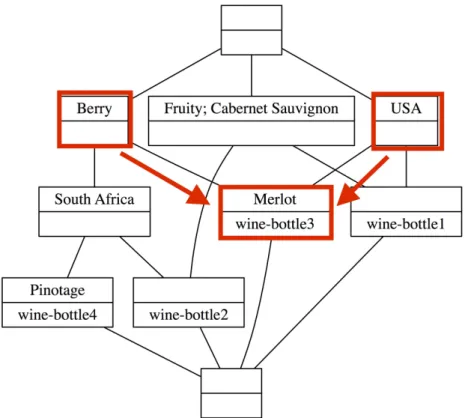
3.1 Illustration of the meet operation. . . 29
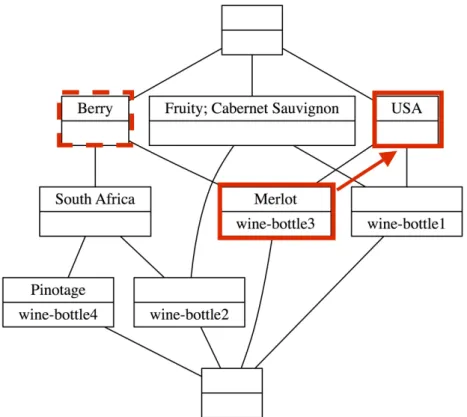
3.2 Illustration of the de-selection operation. . . 30
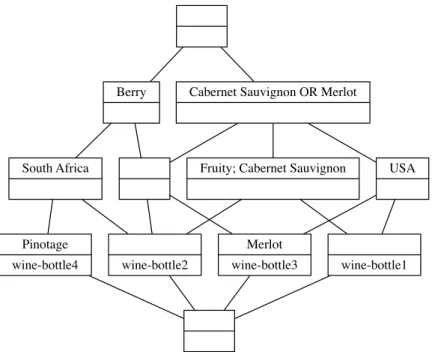
3.3 Illustration of Boolean OR navigation. . . 34
3.4 Example of a Query concept added to a lattice . . . 35
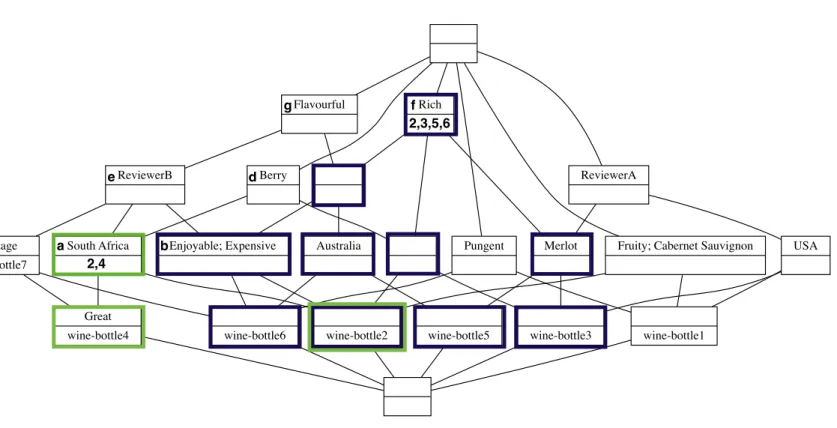
3.5 Extended wine context. . . 38
4.1 Concepts used to construct a tag cloud from a particular focus concept . 46 4.2 Navigating concept lattices with tag clouds . . . 47
4.3 Main components of the ConceptCloud browser . . . 49
4.4 Initial tag cloud for the JUnit repository . . . 52
4.5 A multi-faceted tag cloud view in ConceptCloud . . . 52
4.6 Example of a sticky tag viewer . . . 53
4.7 JavaScript classes controlling different viewers in ConceptCloud . . . 54
4.8 Available viewer customization options in ConceptCloud . . . 55
5.1 Vacation cloud for David Saff . . . 67
5.2 The Author File Graph from a section of JUnit . . . 68
5.3 JUnit author clouds and file selections . . . 69
5.4 RubyGems: Tag cloud for commit 3642 . . . 70
5.5 Overview of RubyGems combined context on Gem Install selection . . . 71
5.6 Rubygems files and committers closing issues mentioning Gem Install . . 72
5.7 Dates of all commits to industrial project . . . 73
5.8 Weekdays of developer PP . . . 73
5.9 Developers of industrial project . . . 74
5.10 Directory cloud of developer DR . . . 75
5.11 Tag cloud after selection of tag Video . . . 76
5.12 Developer contributors over project from project start to first release . . 77
5.13 Collaboration with developerLS . . . 78
5.14 Directory view of developer collaborations . . . 78
5.15 Weekdays of developer commits. . . 79
5.16 Popular keywords from commit messages. . . 80
5.17 Average percentage obtained by participants across all three tasks . . . . 86
5.18 Box and whisker plots for average percentages obtained . . . 87
5.19 Boxplots of percentages obtained by participants . . . 87
5.20 Confidence intervals obtained from Tukey Test. . . 89
6.1 Tags associated with Python file changes . . . 97
6.2 Example of a LinkedIn profile . . . 100
6.3 200 largest tags from commits in which .javafiles have been edited . . . 109
6.4 Overview of skills extraction and visualization . . . 112
6.5 Selection of skill and developer tag . . . 114
6.6 Skills across Stack Overflow, LinkedIn and GitHub . . . 115
7.1 Main, reference and citation clouds for Model Checking . . . 124
7.2 Overview of the process of creating a tag cloud from publication data . 125 7.3 Initial view of the ConceptCloud Publication Browser. . . 127
7.4 Table view of publications in the ConceptCloud Publication Browser . . 127
7.5 Overview of reference context creation for author Ben . . . 129
7.6 Top 25 prominent authors onModel Checking . . . 130
7.7 Author collaboration cloud of Robert Sedgewick . . . 131
7.8 Key-phrases of papers in International Conference on Software Engineering132 7.9 User study questions for publication browser . . . 136
7.10 Population characteristics . . . 137
7.11 An example of the search functionality provided by ConceptCloud . . . 138
7.12 Average time taken per question in user study . . . 139
7.13 Correctness Percentages Achieved . . . 141
7.14 Average correctness for questions in user study . . . 141
List of Tables
3.1 Calculated scores for candidate focus concepts . . . 40
3.2 CalculatedF2-measures for candidate focus concepts . . . 40
3.3 Extent sizes for possible generalized concepts . . . 43
5.1 Performance metrics for revision-based contexts . . . 81
5.2 Question Set for User Study, a) Ruby Gems b) Backbone c) Retrofit . . 85
5.3 Descriptive statistics for average percentages obtained . . . 86
5.4 p-values for Tukey test . . . 88
6.1 Survey questions posed to developers on GitHub. . . 102
6.2 Survey questions posed to recruiters . . . 104
7.1 Main functionalities provided by the publication browser grouped into categories . . . 133
7.2 The number of questions for each topic proposed to participants in the user study. . . 135
7.3 Mean and median of participant scores for the usefulness and usability of tool features. . . 143
Chapter 1
Introduction
Search has become one of the fundamental operations in computer science. Its pur-pose is to extract data and ultimately information from datasets. The operation itself is conceptually simple: it takes as input a query and a dataset and returns a subset of the data which matches the search query. Search engines, such as Google [14] are widely used and are continually adapted to achieve higher precision on queries; for example, Google’s personalized search takes as input a query, dataset and a user’s historical queries. Search engines also rank the results returned to the user, so while there might be a large number of results returned the most relevant results should appear first in the result list. However, other search interfaces, such as those pro-vided by a university library, are still simplistic in nature and do not necessarily provide a ranking for the results and therefore the user is left to manually examine the full list of results that appear in the result set.
While the concept of search is familiar and widely used, it is not the only infor-mation extraction approach. When users have no previous knowledge of a dataset, or have not clearly defined their search task and are therefore unable to formulate a
di-rect query, their task becomes one ofexploratory search orbrowsing [150,151] rather
thanfocused search orretrieval [128]. Browsing approaches are more concerned with
displaying all relevant information than with not showing any irrelevant information, which is the primary concern of traditional retrieval approaches [74, 103,151].
More specifically, retrieval systems require the user to provide a search term (query) and seek to optimize the relevancy and ranking of the returned results. These systems do not factor in the entire information seeking process which often in-cludes multiple queries and lengthy inspection of the query results [151]. Therefore, retrieval systems do not optimally support exploratory search tasks. In exploratory search “much of the search time in learning tasks is devoted to examining and com-paring results” [151]. In the exploratory phase the user is actively involved in the search process and the results obtained are a combination of both the human’s
main knowledge and the information provided by the machine. Retrieval approaches are only concerned with the machine presenting the most relevant answer to the human, such as automatic question answering that is being built into search engines. Additionally, in their quest to provide the user with the most relevant answer, search engines are increasingly relying on personalization of search results, so that each user is more likely to receive the search results most relevant to them first, based on their previous search history. This creates a situation where users are always viewing
an information source through their personal lens, which is referred to as a filter
bubble [113] and where a user’s personal views are always reflected back to them.
Therefore, there is a need for tools that allow users unbiased access to a dataset and support users in exploring and querying unfamiliar datasets, in particular when they have not yet formulated a direct search goal.
Both search and browsing approaches are needed in different situations. However, while search and retrieval tools are widely provided, support for browsing of large datasets, especially rich semi-structured datasets which include complex relationships between data elements and are not simple to query, is lacking.
Semi-structured data is particularly difficult to explore and query because it does not always have a separate schema (i.e., it is self-describing), but in order to formulate SQL-like queries the user is required to have knowledge of the schema [43]. Treating semi-structured data as though it is complete free-text causes a loss of important additional meta-information which is encoded in the structured portions of the data. Treating semi-structured data by only considering the structured fields places less importance on the free-text portions which results in the loss of important information. In addition, rich semi-structured data is faceted, can be multi-dimensional and documents can be related to each-other, making the data sources harder to explore without losing the relevant information contained in the additional dimensions.
In this dissertation we therefore develop a framework to support exploration of semi-structured data, which is otherwise difficult to gather insights from, without requiring the user to have prior knowledge of the dataset or have formulated a specific query. Our approach facilitates data exploration, analysis, and visualization by allowing the user to continuously update (i.e., add and remove) a set of keywords that the searched documents in the data set must contain. Our approach is novel in that the document set is not directly provided as the result of a specific query, but aggregated information and properties of relevant documents are provided. This reduces the time and mental effort spent examining and comparing each of the search results, and provides the user with further possibilities to continually refine the query. The presentation of aggregated information supports users in understanding
and learning about the dataset and enables them to formulate increasingly more accurate queries as their knowledge of the dataset increases and their search goal becomes clearer.
1.1
Problem Description
Large semi-structured datasets are not easily accessible for exploration as they cannot be effectively queried. Even existing approaches designed to support exploration of data still require the user to examine the result sets manually and aggregate the results mentally. In order to facilitate navigation in these datasets we need a uniform data structure. The data needs to be structured in a way that aids exploration and human understanding in order to provide optimal support for exploration tasks.
Semi-structured data is textual and we need a suitable visualization of this text that supports users in interacting with the data source and aids them in their query formation. In order to support a wide range of exploration tasks we also need a flexible navigation style that supports both refinement and broadening navigation steps interchangeably.
In order to provide a framework that efficiently supports exploration of a wide variety of semi-structured datasets, the process of extracting the relevant informa-tion from a large dataset and presenting it to users needs to be automated so that little or no manual pre-processing is required by the users. While there are already approaches catered to supporting a single task on a single dataset, these do not extend to a variety of semi-structured datasets in different domains. Therefore, we need a framework that is flexible enough to be applied in different domains and that supports the different tasks that arise in these domains.
1.2
Research Objectives
The main objective of this dissertation is to develop, implement and evaluate a generic framework through which large semi-structured datasets can be made avail-able to the user in the context of exploratory search tasks, so that the burden of exploration and comparison of large result sets is removed from the user. We focus on the use of formal concept lattices to provide a suitable structure through which the data can be explored. We further investigate an alternative visualization for the data contained in our concept lattices as the lattice itself does not provide a suitable and scalable user interface. We investigate the use of tag clouds as a user interface through which navigation in an underlying concept lattice can be driven. We also in-vestigate additional broadening navigation operations that further support the user in their exploration tasks. We apply our approach to three rich datasets, namely
in-dividual software repositories, collections of software repositories, which allow us to index additional information about the software projects themselves, and academic publication data, each with unique properties. We use our experiences with these datasets to drive further development of our approach.
In this dissertation we will:
• develop a framework for facilitating exploratory search in large semi-structured datasets;
• define methods for generating concept lattices from a variety of semi-structured data sources with different properties;
• develop broadening navigation in concept lattices which can be easily inter-changed with traditional refinement navigation;
• develop tool support for automatically analyzing various semi-structured data sources and making these available for exploratory search; and
• apply our framework to three different data sources each with different prop-erties.
Since a generic framework is not usable on its own, we instantiate our framework and apply it to different domains. We apply our framework to data contained in software repositories, in two different ways for different goals, to highlight the flexi-bility of the approach and the different tasks that can be supported using the same underlying dataset. We also instantiate our framework to support the exploration of a large collection of academic publication data. We evaluate each instantiation of our framework separately and perform case studies or user studies to evaluate how effectively users are able to use the tool or how the tool compares to the current available alternatives (e.g., GitK [13] and GitHub [8] for software repositories) to il-lustrate how our framework can be used to generate tools that provide functionality and flexibility that was previously unavailable in each domain. Each instantiation of our framework makes its own significant contribution to its individual domain (see Chapters 5 – 7 for further details). In addition, the application of our framework to different domains and tasks within those domains provides an evaluation for the flexibility and extensibility of the framework itself.
1.2.1 Visual Exploration of Software Development Repositories
Software version control archives such as Git and SVN contain a large amount of information. However, in trying to understand the software project the individual commits (which make up the documents in this context) are not relevant on their
own but form part of larger patterns which then provide interesting observations on the datasets. This dataset is therefore unlike other document collections as the documents here are representative of user’s actions in a larger project as opposed to being self-contained. Manually investigating thousands of commits in a list-based presentation is an infeasible task for users and so the information contained in these repositories is not fully utilized in its potential to describe the development of the software project. Software repository data is also difficult to query because it is semi-structured with the most interesting information being provided in free text in the form of a comment on the current commit. Additionally, multiple data repositories (such as issue tracking and task tracking systems) are commonly used for a single software project (both of these features are provided on a single platform by the GitHub hosting site [8]) and so these repositories allow us to apply our approach to two different data-sources which are linked and are both relevant to understanding the software project and identifying patterns within the development process.
We apply our framework to software repository data in order to: • support exploratory search on software development archives;
• evaluate how data from different sources (e.g., software development repos-itories and issue tracking systems) can be combined into the same context; and
• evaluate whether an exploratory search approach allows users to answer ques-tions about their software repositories.
1.2.2 Identification of Skills from Aggregated Software Repository Data
Collections of Git repositories and users’ commits within multiple projects provide a different dimension of information in the form of a user’s skill set [89] which is evidence-based rather than self-authored (such as in the case of a CV). Analyzing collections of repositories allows patterns to be identified that may not be visible in a single repository. In the context of skills, individual commits may not provide much insight into a user’s skill set, but when aggregated across all of a user’s commits patterns can be identified which allow identification of a skill set. In the domain of hiring or skills evaluation the human is traditionally involved in the skills evaluation process [106, 145] and therefore the knowledge of the domain expert needs to be combined with the insights generated from the tool. Additionally, there are many other factors (such as seniority, location etc.) to be considered rather than just identifying the person with the highest level of skill in a particular area. Therefore, this dataset is well suited to an exploration approach rather than a retrieval or
recommendation-based approach as the domain expert is still involved in the process and able to identify and verify the most relevant information from the dataset.
We apply our framework to collections of software projects available on GitHub in order to:
• develop a tool that allows identification of relevant software developers from a large pool of developers in a specific location;
• evaluate how skills extracted from GitHub projects can be used in the recruit-ment process; and
• identify whether the current list-based interface provided by GitHub itself al-lows for accurate identification of software developers by asking developers about their experiences with recruitment on GitHub.
1.2.3 Exploration of Academic Publication Data
Academic publications provide an interesting application in that the publications are linked in the form of references and citations and these links themselves provide a large amount of information as to the quality and content of a particular dataset. Therefore, the dataset introduces the question of how these links between documents can not only be handled in the exploration process but exploited to build a more complete picture of the dataset. We have used the dataset of academic papers to conduct research on how different documents can be linked in an exploration approach and how navigation can be supported across document links.
We apply our framework to academic publication data in order to: • support exploratory search of a large academic publication collection; • demonstrate the scalability and flexibility of our approach;
• develop mechanisms for handing relationships between objects with concept lattices;
• develop a publication browser that presents aggregated citation and reference data; and
• evaluate the usability of our approach and the presence of learning effects for new users of the tool.
1.3
Outline of the Solution
According to White and Roth [151], exploratory search tools should support a num-ber of functions including the “support of querying and rapid query refinement”, “offering facets and metadata-based result filtering”, “offer[ing] visualizations to sup-port insight/decision making” and “supsup-port [for] learning and understanding”.
In order to support initial querying and consequent query refinements we make use of formal concept lattices as a navigation structure for our semi-structured datasets. Concept lattices facilitate step-wise navigation and are constructed in or-der to facilitate human unor-derstanding of datasets [153]. However, since large concept lattices cannot be suitably visualized [50] and concept lattices themselves require un-derstanding in order to make them interpretable [69], large concept lattices do not provide a suitable interface for untrained users and are unsuitable to support users in gathering insight from large datasets. We make use of tag clouds to visualize the information at each navigation step in the underlying concept lattice as the semi-structured data is textual with the most relevant information often being contained in free text. The text visualization of the tag clouds emphasizes the most important aspect of the data and does not make the text a secondary aspect in the visualization as it would be if it were only serving the purpose of providing labels in a graph.
1.3.1 Research Methodology
In this dissertation we follow a “build and test” approach. We build a framework for exploration of semi-structured data and instantiate this for a variety of benchmark applications. We then compare the instances of this framework with customized tools previously developed for the same data analysis. We perform this comparison by conducting user studies with students, case studies in collaboration with industry partners and interviewing practitioners.
1.3.2 Technical Approach
In our approach we build a formal context from a given dataset, convert this context to a concept lattice and present the contents of the lattice in a suitable interface, which supports exploration of the underlying dataset.
1.3.2.1 Formal Concept Lattice Construction
Concepts in a concept lattice are made up of objects and attributes. In our domain the objects are a set of documents (e.g., files in a Java project, revisions in a revision-control archive, projects in GitHub) and attributes are keywords and meta-data that we have extracted from the documents (e.g., methods in Java classes, words from
commit messages in a git repository, libraries used in a GitHub project). Concept lattices are constructed directly from a formal context table. Different context tables, and therefore different concept lattices, can be created from the same data archive by changing the document/object selection, e.g., in a git repository we can either take files or commits as objects. By changing the object selection and therefore constructing different context tables, our approach presents a different view on the same underlying data.
1.3.2.2 Interface Construction
Previous work on concept-based retrieval has made use of small customized list-based user interfaces [74, 97] or focused on presenting a portion of the underlying concept lattices as an interface [81]. If we restrict the information presented in our interface such as in [81], then we also restrict the navigation paths available to the user, which is undesirable.
In order to provide an intuitive, scalable interface for exploration of semi-struc-tured data we propose a tag cloud interface. Tag clouds are a simple and popular visualization method for textual data (often keywords) where the importance of each tag (typically its frequency in the document) is reflected in its size. We generate tags directly from the underlying data, instead of relying on user-generated labels for par-ticular content, as commonly used in Web 2.0 applications (such as Flickr’s [7] early tag cloud view). Tag clouds provide a visualization which places the most emphasis on the text.
The size of the tags in our tag cloud can be calculated from the number of documents in the dataset that contain the keyword that the tag represents. In In-formation Retrieval (IR) [102] terms, our tag cloud can be seen as the aggregation of the Boolean term frequencies for each document in the query result, scaled according to the size of the document collection. The concept lattice then provides an efficient way to compute our tag cloud; a computation from only the inverted index would be impractically inefficient: we would first need to retrieve all documents indexed by the selected tags, then iterate over the entire vocabulary and compute the size of the intersection of each term’s inverted index with the query’s result. Hence, any efficient IR-based implementation must use the same information in essentially the same way as a lattice-based implementation. However, we can exploit the lattice’s support for browsing [74].
Our approach builds on concept-based retrieval and browsing. However, unlike previous work [74, 97], our tag cloud interface displays the implied ranking of the keywords in the retrieval set by using the tag size to indicate to how many docu-ments the keyword applies. Our tag cloud can be seen as a visual representation of
unexplored queries, highlighting the most prominent navigation path. We display all keywords that occur at least once in any document that matches our query (the selected tags) and calculate the size/importance of their tags according to how of-ten they occur. Tags are scaled according to the total number of documents in the dataset so that tag sizes continue to reflect the occurrence of the keyword over the full document set when the set of documents matching the query becomes smaller.
1.3.2.3 Support for Navigation
We primarily make use of a refinement navigation approach, allowing users to in-crementally select tags that make up the current query. However, since tags can be de-selected in any order, our approach also indirectly supports pivot navigation [109], for example if a user wishes to pivot from tag A to tag B they can initially select tags A and B, and then de-select tag A to have only tag B selected. In this way, users are mindful of their navigation path from one tag to another, having first seen the results for both items selected and observing what attributes or objects they have in common before pivoting.
Refinement navigation in the concept lattice is step-wise and the focus concept is updated at each navigation step [50, 97]. Our tag clouds are generated directly from the focus concept in the lattice and are updated on each navigation step. If the selected set of keywords is interpreted as the query then the extent (i.e., set of objects or, in our case, documents) of the focus concept can be seen as the query’s result. Our navigation is driven by updates (i.e., additions and deletions) to a set of keywords that the searched documents in the dataset must contain.
All tags available for refinement selection in our tag cloud will either further refine the document set or leave it unchanged. As in previous work [74, 97] the user is prevented from constructing a query that returns an empty set of documents. By de-selecting tags in a different order in which they were selected the user is able to navigate out using a different navigation path, which indirectly supports pivot navigation and facilitates exploration of the dataset.
The standard broadening operation in concept lattices uses the join in the lattice. However, for structured fields the join operation can overgeneralize and, hence move the focus to the top of the lattice, effectively resetting the navigation and removing all previous selections. For example, with a version control archive with revisions as documents the join on multiple year keywords would move the focus to the top of the lattice since no revision can have two commit dates. We develop a broadening navigation algorithm that performs as a Boolean or-operator (e.g., returning revisions
in 2002or 2004) instead of using the join in the lattice, as well as investigating other
1.3.3 ConceptCloud Browser
We have constructed the ConceptCloud browser (available at www.conceptcloud.
org), which creates interactive tag clouds. The browser can load XML and JSON
data and allows the user to choose a field of the data that will be used as the document/object (e.g., file in version control repository) and the fields that should be used as keywords for the document (e.g., authors that have changed the file). Our browser also supports various pre-processing options such as splitting large text fields, merging fields and stemming. We color tags in the interface according to the category of information that they represent (such as commit author, file etc.) and different categories can be displayed in linked tag cloud views to provide a multi-faceted view. Selected tags (forming the current query) are displayed in red in order to distinguish them. We use the incremental approach of [85] in order to construct concept lattices in our prototype. Concepts are computed on the fly eliminating the need to construct the entire lattice. This mitigates the large initial indexing times usually associated with concept lattices.
While the browser supports the exploration of any dataset that can be input in the correct format, we have also instantiated three specific instances of the browser. Our version control browser can automatically analyze Git and SVN repositories, and can combine their information with that extracted from an issue tracking system. Our skills browser can take as input a specific location e.g., "Cape Town", perform a lengthy off-line indexing phase, and return a tag cloud of skills for developers in that location, extracted from their GitHub profiles. Our publication browser can take as input a large JSON file of academic publications and present these in an interactive tag cloud that also supports exploration of reference and citation data.
1.4
Contributions
The main contribution of this PhD dissertation is the development of a framework that supports exploration tasks on a variety of semi-structured data sources and the application and evaluation of this framework in three different domains. In the construction of a generic framework this dissertation makes novel contributions which include an approach for constructing an interactive tag cloud from data contained in a formal concept lattice, a broadening navigation approach in concept lattices and the development of the framework itself.
We describe how large collections of semi-structured data can be used to construct a formal concept lattice which forms a structure for navigation. We describe a step-wise navigation algorithm that supports both refinement and broadening navigation algorithms interchangeably and indirectly supports pivot navigation as well. We
show how a tag cloud can be generated from a focus concept in the concept lattice and how navigation in the concept lattice can be driven by selections and de-selections in the tag cloud.
We instantiate our framework in three different domains and make novel contri-butions in each of these domains. We have built and described a flexible software repository browser that enables exploration of software repositories and is flexible enough to support a variety of tasks. Our ConceptCloud Version Control Archive browser can take as input a Git or SVN repository and present this to the user in an interactive tag cloud which allows them to answer questions about the development process which have been identified in [52,132].
We have instantiated our framework in the form of a GitHub skills browser which has been applied and evaluated in the software developer recruitment domain. Our skills browser allows for the identification of candidate developers from a large pool of developers and allows candidates to be identified based on their exhibited skills and not just subjective skill indications that can be be gathered from their profiles in a limited amount of time.
We have used our framework to build a flexible academic publication browser which can be used to show aggregated publication data as well as reference and citation data. Our browser allows users to answer complex questions about author activities, citation analysis and author collaborations. We have evaluated our pub-lication browser in the form of a user study. The apppub-lication of our framework to a large dataset of academic publications also demonstrates the scalability and flexibility of our approach.
1.5
Organization of the Dissertation
This introduction has provided a context for our approach and provided details as to our technical approach and contributions made in this research.
In Chapter 2 we further provide background information for the use of formal concept lattices as well as for exploratory search approaches and tag clouds. We detail the mathematical foundations on which our approach is built and show how formal concept lattices have been used to support navigation. We describe the fundamental aspects of exploratory search and the features that are needed by tools in order to support exploration of data. We also discuss tag clouds as a visualization for textual information.
We then describe our refinement and broadening navigation approaches in con-cept lattices in Chapter 3. Our refinement navigation approach allows users to continually refine their result sets. We provide a de-selection which indirectly
sup-ports pivot navigation by allowing users to de-select items in any order (not just as an undo operation). We also describe various broadening approaches which can be applied interchangeably with refinement operations.
We then describe the implementation of our approach in the ConceptCloud browser which provides a framework that can be customized for a variety of dif-ferent applications in Chapter 4. We also show how a tag cloud can be built directly from a concept in the concept lattice. ConceptCloud provides a web application framework which can be instantiated in different domains.
We describe how our approach can be applied to version control repositories and bug archives in Chapter 5. We also provide an evaluation for our repository browser in the form of case studies on open source and industrial projects, and conduct a user study.
We then show how our browser can be used to handle data from multiple reposi-tories and supports skills browsing of developers on GitHub in Chapter 6. We survey developers and recruiters to gain insight into the use of GitHub for recruitment tasks and establish the limiting features of GitHub profiles when used for recruitment. We then build a skills browser using our generic framework and evaluate the browser via feedback from recruiters and using the browser to recommend developers for open positions.
We use our approach to construct a publication browser for data contained in a digital library dataset (specifically the ACM Digital Library [34]) in Chapter 7 and evaluate the publication browser by conducting a user study. We also show how object relationships (citations and references in this domain) can be handled with concept lattices and demonstrate the scalability of our approach on a dataset containing 1.5+ million objects.
We draw conclusions and discuss directions for further research in Chapter 8.
Declaration of Joint Work
Parts of this dissertation have been done in collaboration with others. Marvin Ester-huizen has implemented the ConSL scripting language (see Section 4.4) that plugs into ConceptCloud and allows users to script different combinations of viewers. Fur-ther details of his implementation are available in [71]. Jean Breytenbach has imple-mented the initial ConceptConstructor add on (see Section 4.2.1) for ConceptCloud which facilitates the reading of generic XML and JSON files. Chapter 7 is partly joint work with Marcel Dunaiski. Marcel has performed the key-phrase extraction for the academic publication data (see [66] for further details). The user study in Chapter 7 was also done in collaboration with Marcel Dunaiski where we jointly set up the question set, observed the participants and analyzed the results.
With regards to the publication list presented on page vi, paper 6 was joint work with Marcel Dunaiski. Marcel has developed and implemented the key-phrase extraction technique, and I have adapted and applied the ConceptCloud browser to the publication data. We have also jointly conducted the user study, where we jointly set up the question set, observed the participants and analyzed the results. Paper 7 was joint work with Marvin Esterhuizen. Marvin has implemented the ConSL scripting language. Bernd Fischer has supervised all conference and journal papers.
Chapter 2
Background
In this chapter we describe the foundational work for our approach. This dissertation builds on research in the areas of formal concept analysis, particularly navigation in concept lattices, and approaches for visualizing the data contained in a concept lattice, and exploratory search, particularly navigation styles and visualizations em-ployed in data exploration approaches. We also make use of a tag cloud visualization which is described in this chapter.
2.1
Formal Concept Analysis
We describe only the basic notations for Formal Concept Analysis and provide a small illustrative example of a context table and concept lattice. We refer to the cited literature for further details.
2.1.1 Mathematical Foundations
Formal Concept Analysis (FCA) [59,77,152] uses lattice-theoretic methods to
inves-tigate abstract relations between objects and their attributes. Suchcontexts can be
imagined as cross tables where the rows are objects and the columns are attributes.
Definition 1 A formal context is a triple (O,A,I) where O and A are sets of objects and attributes, respectively, and I ⊆ O × Ais an arbitrary incidence relation.
Figure 2.1 shows an example of a small context table. The table contains data from wine reviews of four bottles of wine. The columns are used to describe the attributes (or properties) of the bottles of wine. The rows are used to describe the objects which are individual bottles of wine in this example. Whenever an attribute applies to a particular object (bottle of wine) a cross is placed in the context table to indicate the relationship.
USA South Africa Fruity Berry Cabernet Sauvignon Merlot Pinotage
wine-bottle1 X X X
wine-bottle2 X X X X
wine-bottle3 X X X
wine-bottle4 X X X
{country} {review text} {varietal}
Figure 2.1: Example context derived from wine review data. The bottles of wine are objects with review text, country and varietal as attributes. Attribute facets are indicated by the color of the column.
Definition 2 Let (O,A,I) be a context, O ⊆ O, and A ⊆ A. The common
at-tributes of O are defined by α(O) = {a ∈ A | ∀o ∈ O : (o, a) ∈ I}, the common
objects of A by ω(A) ={o∈ O | ∀a∈A: (o, a)∈ I}.
Note that foro∈O we denote ω({o}) by ω(o).
Concepts are pairs of objects and attributes which are synonymous. They are maximal rectangles (modulo permutation of rows and columns) in the context table.
Definition 3 Let (O,A,I) be a context. Then c= (O, A) is called a concept of C
iff α(O) = A and ω(A) = O. The extent and intent of c are given by πO(c) = O and πA(c) =A, respectively. The set of all concepts of C is denoted by B(C).
Concepts are partially ordered by inclusion of extents such that a concept’s extent includes the extent of all of its subconcepts; the intent-part follows by duality.
Definition 4 Let (O,A,I) be a context, c1 = (O1, A1), c2 = (O2, A2) ∈ B(C). c1 and c2 are ordered by the subconcept relation, c1 ≤c2, iff O1 ⊆O2. The structure of B(C) and≤ is denoted by B(C).
The basic theorem of FCA states that the structure induced by the concepts of a
formal context and their ordering is always a complete lattice. Such concept lattices
have strong mathematical properties and reveal hidden structural and hierarchical properties of the original relation. They can be computed automatically from any
given relation between objects and attributes. The greatest lower bound or meet
and least upper bound or join can also be expressed by the common attributes and
objects.
Theorem 5 (Wille, [152]) Let C be a context. Then B(C) is a complete lattice,
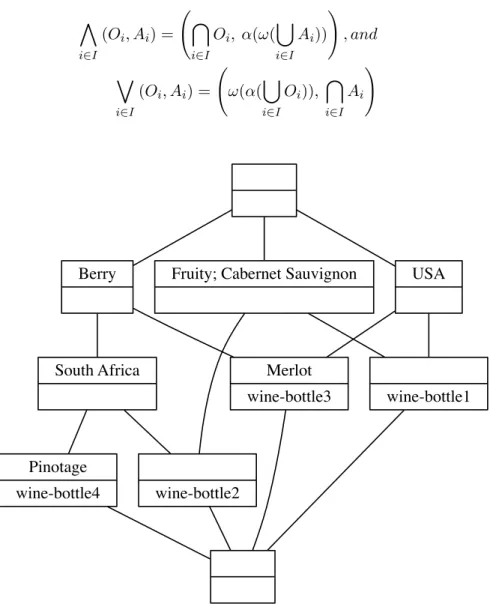
are given by ^ i∈I (Oi, Ai) = \ i∈I Oi, α(ω( [ i∈I Ai)) ! , and _ i∈I (Oi, Ai) = ω(α( [ i∈I Oi)), \ i∈I Ai ! Pinotage wine-bottle4 Merlot wine-bottle3 wine-bottle2 South Africa Berry wine-bottle1 USA Fruity; Cabernet Sauvignon
Figure 2.2: Example of a concept lattice derived from the context in Figure 2.1. Concepts are linked according to their relationships with each other: a downwards link indicates that the lower concept inherits all attributes from the linked higher concepts; an upwards link indicates that the concept inherits all objects from the linked lower concepts. Object and attribute labels are not repeated. An attribute label is provided at the highest concept to which the attribute applies and an object label is provided at the lowest concept to which the object applies.
Figure 2.2 shows an example of a small concept lattice generated from the data in the context table provided in Figure 2.1. The top concept in the lattice contains all objects (wine bottles) in the dataset and only attributes that apply to every object in the dataset (in this case no attributes). The bottom concept in the lattice contains all attributes in the context and only objects for which every single attribute applies (in this case none). Towards the bottom of the lattice the concepts have less objects
and more attributes and provide more specific descriptions of the objects. In the lattice there exists a concept which contains the full attribute set for each object, which is referred to as the object concept or introducing concept of the particular object. Note that the extent of this concept might contain more than one object if there are two objects in the context table which have exactly the same attributes. Not all object concepts are at the atom level of the lattice as there may be an object that has an attribute set which is a subset of another object’s attribute set. Higher up in the lattice there is also a concept which contains all objects for which a specific attribute applies, which is referred to as the attribute concept or introducing concept of the particular attribute. Each concept in the lattice contains a set of attributes (the concept’s intent) and a set of objects (the concept’s extent) which are synonymous with each other.
Definition 6 Let B((O,A,I)) be a concept lattice. The defining concept of an attributea∈ A(objecto∈ O) is the greatest (smallest) conceptcsuch thata∈πA(c)
(o∈πO(c)) holds. It is denoted by µ(a) (σ(o)). We use δ(x) to denote µ(x) if x is
an attribute and σ(x) otherwise.
Efficient algorithms exist for the computation of the concept lattices and the meet and join of concepts in the lattice [96].
2.1.2 Visual Presentation of Data Contained in Concept Lattices
Concept lattices themselves are traditionally visualized as Hasse diagrams [152]. However, for large datasets, the Hasse diagrams become incomprehensible and no longer provide a suitable visualization of the lattices. Figure 2.3 shows an image of a large concept lattice generated from the structure of an aerodynamics system in [99]. It is obvious that the lattice is too large to enable users to interpret the relationships between the concepts and derive any information from the lattice structure.
Alternative approaches for presenting the information contained in concept lat-tices have made use of small customized list-based user interfaces [74,97] or focused on presenting a portion (usually the neighboring concepts of the current focus) of the underlying concept lattices as an interface [81]. Carpineto and Romano have also made use of a fish-eye view for presenting portions of the lattice [48]. A representa-tion of the area beneath the focus as a tree has also been used as a visualizarepresenta-tion [54]. The LatViz tool supports interactive visualization in concept lattices directly and also supports filtering of the lattices themselves [37].
The Credo system [50] uses a list-based interface that displays the sub-concepts of the current focus but also indicates the number of times that a particular document appears in the sub-concepts. Items in the list can then be selected to generate a new
Figure 2.3: A depiction of a large concept lattice [99], which shows that concept lattices quickly become uninterpretable when they become large.
list showing their sub-concepts. This approach does not present the concept lattice directly to the user, but limits the possible navigation paths only to single-step query refinements.
The Camelis system allows the browsing of images that have been indexed in a concept lattice [73]. The interface of Camelis does not display a concept lattice but shows the current query in the lattice, the extent of the focus as well the attributes of the current focus which serve as a summary for the extent of the focus. Camelis also provides links to other concepts in order to support navigation.
2.1.3 Navigation in Formal Concept Analysis
While there has been much work on supporting information retrieval with concept lattices (for example, [53,121]) this is focused primarily on providing results for a
sin-gle query, and not step-wise navigation through the concept lattice, which follows a process of incremental refinement or query formation. However, there has been some research on exploring different step-wise navigation techniques in concept lattices. Some navigation techniques allow small step-wise increments of navigation to neigh-boring concepts in the lattice [82] while other approaches make use of larger-step navigation algorithms which are more suitable for large data collections [74,97].
Godin et al. [82] described an iterative retrieval algorithm which maintains afocus
concept whose extent is the retrieval result. Initially, the focus is the lattice’s top element; in each iteration the user moves the focus to an adjacent concept, by adding or removing an attribute in the intent (or not in the intent) of a concept directly above or below the current focus. However, this navigation style is too incremental, because the focus can move only one level at a time, and too constrained, because the user can only choose attributes from the intents of the directly adjacent concepts, and has no indication which choices are hidden behind paths not taken.
Lindig [97] introduced a semi-constrained navigation algorithm where the focus
can be refined by selecting any attribute from any concept (except ⊥) below the
focus, provided the attribute is not already in the focus’ intent. The focus is then updated by computing its meet with the attribute concept as shown in Theorem 8. A restriction on selectable attributes (which Lindig calls “significant keywords”) shown in Definition 9 prevents navigation into dead ends, and ensures that each query refinement also refines the query results. The meet operation is widely accepted as a suitable method for refinement navigation and supports conjunctive queries.
Following Lindig [97] a query (which we refer to as a navigation step) and the query result (which we refer to as the extent of the focus concept) can be defined as below.
Definition 7 [97] A set A ⊆ A is a query to a concept lattice B((O,A,I)). A component o ∈ O satisfies a query iff ω(o) ⊇ A holds. The set of all components satisfying a query is called a result and is denoted by [[A]]def= {o| o∈ O, ω(o)⊇A}.
Theorem 8 [97] Let B((O,A,I)) be a concept lattice and let A ⊆ A be a query. Then [[A]] =πO(V
a∈Aµ(a)) holds.
Definition 9 LetA⊆ A be a query toB((O,A,I)). The set of significant keywords is denoted by hhAiidef= {a∈ A | ∅ ⊂[[A∪ {a}]]⊂[[A]]}.
Fischer [74] exploited the duality of concept lattices and introduced object-based navigation; here, selection of an object not in the focus’ extent is a widening step
that is implemented via the join. This provides a broadening operation to move the focus higher in the lattice.
Note that while there has also been some further work on other broadening approaches, such as disjunctive navigation, this is discussed in Chapter 3 to make the comparison with our own navigation style clearer.
2.2
Exploratory Search
Exploratory search (or browsing) approaches support data exploration even when the user has not yet formed an explicit query or is unfamiliar with the dataset. Exploratory search tasks cover learning and investigating the data set in order to make observations as opposed to only direct lookups. Users engaging in exploratory tasks often need to learn about the dataset in order to understand how their search goal can be achieved [151].
The field of exploratory search is a sub-domain of information seeking [95] which is different from information retrieval [102] in that information retrieval assumes that the relevant information exists in a data source and can be extracted with a properly formed query, whereas in information seeking the user does not know whether an answer to their query exists or not.
Marchioni [103] defines exploratory search in the following way:
“Exploratory search can be used to describe an information seeking prob-lem context that is open-ended, persistent and multi-faceted; and to de-scribe information-seeking processes that are opportunistic, iterative and multi-tactical. In the first sense, exploratory search is commonly used in scientific discovery, learning, and decision-making contexts. In the second sense, exploratory tactics are used in all manner of information seeking and reflect seeker preferences and experience as much as the goal.”
White and Roth note that exploratory search is “as much about the journey through the information space as the destination” [151] because as users explore the dataset they learn more about the context and are able to formulate increasingly more accurate search queries.
Exploratory tasks typically involve multiple iterations and results are not imme-diately expected on the first query attempt, as they are with retrieval approaches. Exploratory search approaches heavily depend on human-interaction and therefore insights that are gathered during exploration also comprise the domain knowledge of the human interpreting the information presented. During exploration, users may notice interesting patterns in the data that they may have been unlikely to query for without having had the opportunity to observe the dataset.
Interfaces supporting exploratory search can allow the user to explore the full dataset and be cognizant of where a particular document lies in comparison to the other documents in the result set, which is not possible when users examine the results one document at a time when they are presented in a ranked list format [151]. According to White and Roth [151], exploratory search tools should support a number of functions including the “support of querying and rapid query refine-ment”, “offering facets and metadata-based result filtering”, “offer[ing] visualizations to support insight/decision making” and “support [for] learning and understanding”. Exploratory search tools therefore aid in highlighting relevant and interesting navi-gation paths for the user and allowing them to follow these paths.
2.2.1 Navigation Styles for Exploration of Datasets
Various navigation processes have been employed in data exploration approaches [64, 87,151,154]. Approaches can be largely classified into either a refinement navigation style or a pivoting navigation style, where the pivoting style of navigation does not make incremental refinements on the current result set but rather changes the entire result set when a new selection is made. With a pivoting navigation style on each new selection, the result set is completely changed or shifted [109]. The pivoting navigation style can be thought of as supporting queries which are always applied to the full dataset (always clearing the previous selection history), whereas the refinement navigation style applies each new query to the result set of the previous queries.
Examples of approaches making use of pivot navigation styles are provided in [64,87] while [134,154] provide examples of a refinement-based navigation style.
Gwizdka and Bakelaar’s work on Tag Trails [87] uses a tag cloud to facilitate nav-igation in the pivot style. They also make use of the concept of ‘breadcrumbs’ which preserves the navigation history by presenting the tags for historical selections and displaying the previous tag clouds so that the user is aware of how their navigation path has led them to the current result set.
The pivot paths approach used in [64] uses a pivoting navigation approach but seeks to make the changes between different subsets of results more gradual. The approach uses pivoting but also includes a comparison view which allows two selec-tions to be compared to each other. The previous selection can always be displayed alongside the new selection to provide some history to the pivoting process.
Yee et al. [154] use a refinement-based navigation approach in order to facilitate exploration of image collections. The query process can be started either by searching for a specific term or selecting a term from the available options. Once an initial query has been made, additional terms are then available for refinement. Once a
desirable document (image in this application) has been found it can be displayed along with its searched query terms.
The Magnet tool [134] supports exploratory search on semi-structured data archives. While there are a variety of navigation modes provided by the tool in “navigation advisors”, one of these options is refinement-based. The tool is applied to a collec-tion of recipes and the interface allows users to see lists of recipes for which selected properties (such as ingredients or cooking methods) apply to. For the refinement style navigation additional properties of recipes that apply to some but not all of the recipes shown at a specific navigation step can be selected to refine the recipe set. Selections can be made on a pane to the left of the recipe list and for each available selection the number of recipes that apply to the property is provided in brackets next to the name of the property.
2.2.2 Visual Presentation of Data for Exploration
There are multiple approaches for presenting data in formats that specifically fa-cilitate exploration. Data available for exploration can be presented along different facets (categories of information) [119], allowing the user to make refinements in a particular facet or in multiple facets.
Some approaches have made use of tags to facilitate navigation [87, 154]. For example, Figure 2.4 shows the Tag Trails interface from [87]. The interface shows tag clouds for previous navigation steps in order to provide a context for the current navigation step, since the navigation uses a pivot style which does not preserve history.
Another approach has made use of a more scatter-plot-like visualization, shown in Figure 2.5, that allows dynamic filtering based on various fields [36]. The scatter plot will update whenever any refinements are made on any of the facets provided.
Timeline visualizations have also been used to facilitate data exploration as shown in [124]. A timeline visualization from [124] is shown in Figure 2.6.
Interactive graph-based visualizations, such as the one employed in Elastic Search’s Kibana Visualization tool [18], can also support navigation by allowing users to se-lect graph segments. All graphs can then be linked so that when one item is sese-lected all other graphs update to indicate how the selection affects all facets of information. A common theme in most exploration systems is that they initially show a sum-mary of the underlying data and allow the user to pivot or make refinements by selecting a feature of the summary provided, which aids the user by providing sug-gestions for the start of their navigation path. This style of interface design (which supports dynamic querying) is highlighted by White and Roth [151] as a requirement for exploratory search tools.
Figure 4. Tag Trails interface consist of two main areas: the result list on the left and the tag clouds on the right. Tag clouds on the right represent the tag trail. The interface uses “cloud history”, “color context” and “similarity/difference” to show the history and context of user navigation or search process.
Figure 2.4: The Tag Trails interface as shown in [87] which uses a pivot navigation style and shows a history of navigation steps.
Figure 2.5: The Film Finder interface as shown in [36] which users a scatter plot interface that supports dynamic filtering.
![Figure 2.3: A depiction of a large concept lattice [99], which shows that concept lattices quickly become uninterpretable when they become large.](https://thumb-us.123doks.com/thumbv2/123dok_us/1583189.2712885/36.893.215.690.127.681/figure-depiction-concept-lattice-concept-lattices-quickly-uninterpretable.webp)
![Figure 2.4: The Tag Trails interface as shown in [87] which uses a pivot navigation style and shows a history of navigation steps.](https://thumb-us.123doks.com/thumbv2/123dok_us/1583189.2712885/41.893.184.708.576.920/figure-trails-interface-shown-pivot-navigation-history-navigation.webp)
![Figure 2.6: The Stuff I’ve Seen interface which uses a timeline visualization as de- de-scribed in [124].](https://thumb-us.123doks.com/thumbv2/123dok_us/1583189.2712885/42.893.179.712.126.504/figure-stuff-seen-interface-uses-timeline-visualization-scribed.webp)