Theses, Dissertations and Capstones
2019
Exploration of growth mindset application in
communication sciences and disorders
Kelly Jean Rutherford
Follow this and additional works at:https://mds.marshall.edu/etd
Part of theEducational Leadership Commons, and theHigher Education Commons
This Dissertation is brought to you for free and open access by Marshall Digital Scholar. It has been accepted for inclusion in Theses, Dissertations and Capstones by an authorized administrator of Marshall Digital Scholar. For more information, please [email protected],
Recommended Citation
Rutherford, Kelly Jean, "Exploration of growth mindset application in communication sciences and disorders" (2019).Theses, Dissertations and Capstones. 1185.
A dissertation submitted to the Graduate College of
Marshall University In partial fulfillment of the requirements for the degree of
Doctor of Education In
Leadership Studies by
Kelly Jean Rutherford Approved by
Dr. Ronald Childress, Committee Chairperson Dr. Bobbi Nicholson
Dr. Karen McComas
Marshall University May 2019
iii ©2019
Kelly Jean Rutherford ALL RIGHTS RESERVED
iv
ACKNOWLEDGEMENTS
I will never be able to fully express my gratitude to the doctoral faculty in the College of Education and Professional Development at Marshall University for all of their support over the past four years. I began this journey expecting to learn and achieve my goal of earning a doctoral degree, but little did I know the amount of personal growth I would gain through both my own efforts and through theirs. This has been an amazing experience of learning through
collaboration that has challenged me to be my best self as much as possible in every facet of my life.
To my committee chair Dr. Ronald Childress: I will never be able to thank you enough for the support and encouragement you have given me from the very beginning. You taught my first course in research design and have seen me through every step of the way. Through you, I now appreciate the partnership that occurs in the teaching-learning experience, where both parties are accountable for their role. Furthermore, I understand the value in collaboration as essential to the learning process as it provides opportunities to be exposed to different points of view, elicits reflection on one’s own learning and beliefs, and culminates in results that are far better than any one individual could achieve alone.
To Dr. Bobbi Nicholson: I have always been “good” at the whole school thing: when given an assignment with a set of procedures to be done, it will be done well. This is far different from the act of formulating an opinion and being able to articulate, with credible evidence, why it is so. Dr. Nicholson, I have never been so grateful to be challenged as I was in your courses. Learning from you forced me out of the cave and made me care much more deeply about what I was doing, why I was doing it, and how it will affect the world around me. Thank you from the bottom of my heart.
v
To Dr. Karen McComas: I still remember having you in class as an undergraduate some twenty years ago and wilting at the red ink feedback in my legal journal where you wrote nearly as much as I did for the assignment in the first place. Little did I realize that your investment in my education would be so instrumental in my drive to continue to find challenges and succeed throughout my career. You were the first person I mentioned potentially pursuing doctoral work to many, many years ago, and somehow, saying it out loud like that solidified my goal. Whether it was my teenage-self coming to you for questions on an assignment or me now coming to you for advice, you have always welcomed me with genuine care and a willingness to help in any way you were able. I will never be able to repay you for all of the guidance you have delivered throughout my life – thank you.
To the faculty of the Marshall University Communication Disorders department: You are my work family and I can never thank each of you enough for the words of encouragement and support you have offered over the past four years of my doctoral study. In particular, Karen McNealy – the department chair – you have been an amazing example for what it means to be a leader and you have been instrumental in pushing me to take the leap toward doctoral study in the first place.
To Carrie Childers, Sarah Clemins, and Heidi Dennison: Your friendship, advice, and support during this process has meant more than you know. I appreciate the constructive
feedback and analytical conversations, as well as having each of you cheering me on every step of the way. You have made this process of research and self-discovery more enjoyable and more meaningful because of your kindness along the way.
In addition to the amazing committee, faculty, and colleagues I have worked with over the past three and a half years, I must thank my family. To my parents, Randy and Becky Davis:
vi
you were instrumental in getting me to where I am today. In our house, education was not a choice but an expectation. Their parents passed down to them the value of hard work and dedication, and they in turn passed those same values along to my brother and me. To my children, Liam and Julia: you are the light of my life and have taught me what it means to love with my whole heart. Thank you for being patient with Mommy along this journey. To my husband, Billy: you are my other half and I would not be doing this today without your
unwavering support. The encouragement and love you have given me throughout our lives has given me the strength to take on this challenge – I love you.
vii
TABLE OF CONTENTS
Approval of Dissertation ... ii
Acknowledgements ... iv
Table of Contents ... vii
List of Tables ... xi
List of Figures ... xii
Abstract ... xiii Chapter 1: Introduction ...1 Faculty ...2 Curriculum ...4 Students ...5 Growth Mindset ...5 Purpose Statement ...8 Research Questions ...9 Significance of Study ...9 Delimitations ...10
Chapter Summary and Study Overview ...10
Chapter 2: Literature Review ...12
viii
Growth Mindset and Intelligence Theory ...13
Growth Mindset and Motivation Theory ...15
Modern Educational Practice ...18
Organizational Growth Mindset in Schools ...19
Trends in CSD Program Practice ...20
Faculty, Curriculum, and Students in CSD Programs ...20
Chapter 3: Methods ...24
Research Design ...24
Population ...26
Participant Characteristics………..27
Interview Protocol ...28
Development of Interview Protocol………...28
Data Collection and Analysis ...30
Validation ...30
Limitations ...31
Chapter Summary ...32
Chapter 4: Faculty ...33
Thematic Analysis ...33
Personal Belief Systems ...35
ix Flexibility ...47 Outcome-oriented Practice...53 Chapter Summary ...59 Chapter 5: Curriculum ...60 Thematic Analysis ...60
Lessons from the Success (and Failure) of Others...61
Influence of the Leader ...65
Student-centered Decision-making ...72
Flexibility in Curricular Development ...79
Chapter Summary ...89
Chapter 6: Students ...90
Thematic Analysis ...90
Frequent Broad-scale Assessment ...91
Faculty Openness to Accommodation ...97
Intervention Planning Models ...108
Advising and Mentorship ...119
Chapter Summary ...127
Chapter 7: Conclusions, Implications, and Recommendations ...128
Purpose and Methods ...128
x
Growth Mindset and Standard 2.0 Faculty ...129
Growth Mindset and Standard 3.0B Curriculum ...130
Growth Mindset and Standard 4.0 Students ...131
Interpretations and Conclusions…...………131
Standards and Application to Higher Education Practice ……….132
Holistic Analysis of Themes...……….134
Recommendations for the Future of the Profession ...136
Recommendations for Future Research ...137
References ...138
Appendix A: IRB Approval ...143
Appendix B: Participant Letter ...144
Appendix C: Interview Protocol ...145
Appendix D: Cross-analysis of Findings……….151
xi
LIST OF TABLES
Table 1 Growth versus Fixed Mindset ...6
Table 2 Growth Mindset Explained ...7
Table 3 Ford’s list of Motivation Theories ...15
Table 4 Modern Motivation Theory ...16
Table 5 Stratification Plan ...27
Table 6 Participant Characteristics ...28
Table 7 Growth Mindset and CSD Faculty - Themes ...34
Table 8 Growth Mindset and CSD Curriculum - Themes ...61
Table 9 Growth Mindset and CSD Students - Themes ...91
Table 10 Growth Mindset Principles Aligned to Standards………...……….…132
Table 11 Lessons from Thematic Interpretation………..…134
xii
LIST OF FIGURES
xiii
ABSTRACT
As early as 1988, Carol Dweck began a line of research connecting motivation and intelligence that later became known as mindset theory (Dweck & Leggett, 1988). This study explored the feasibility of applying Dweck’s growth mindset model to challenges in the field of
Communication Sciences and Disorder (CSD). Interviews were conducted with higher education administrators who are directly affected by requirements of program standards using a
phenomenological design. Findings suggested that growth mindset beliefs and practices are used in many ways across faculty, curriculum, and student domains; however, participants identified growth mindset concepts of willingness to embrace change, learning from the success of others, and an ability to learn from criticism as areas for continued growth. Application of growth mindset principles from an organizational perspective was discussed and future research directions were suggested.
1
CHAPTER 1 INTRODUCTION
Growth, a concept that can be perceived through frames of physical, spiritual, and intellectual development, has been studied extensively. Despite the human desire to understand these concepts, many of us have beliefs and practices that work against an innate drive to do more and be more. In 1988, Carol Dweck and Ellen Leggett began inquiry into a “social-cognitive” approach to the study of motivation which served as a catalyst for the exploration of motivation in conjunction with intelligence. This early work provided the foundation for the development of Dweck’s growth mindset framework. Subsequently, growth mindset has been applied to the fields of psychology, education, business, and athletics to help promote individual growth and success (Dweck, 2006). The available literature suggests that adopting a growth mindset can result in intellectual enhancement, greater levels of achievement, and improved cognitive flexibility (Blackwell, 2002; Dweck, 1999; 2006; Claro, Paunesku, & Dweck, 2016; Hochanadel & Finamore, 2015; Martin, 2015). With the potential application of growth mindset to an individual’s intellectual growth, researchers have begun to apply growth mindset at the organizational level (Hanson, Bangert, & Ruff, 2016a; Kezar & Eckel, 2002; Wagner, 2014). Their work suggests that applying a growth mindset framework at the organizational level can create positive change – such may be the case for the field of Communication Sciences and Disorders.
The field of Communication Sciences and Disorders (CSD) is comprised of the related disciplines of speech-language pathology, audiology, and speech and hearing science. These autonomous professions are guided by the American Speech-Language-Hearing Association (ASHA) on the national level, and it is well accepted in medical and educational communities that licensure by ASHA means professionals have met a set of established criteria preparing
2
them to effectively participate in the work force. Criteria for licensure include completion of an accredited graduate academic program, achievement of the 80% pass rate benchmark score on the professional Praxis examination, and maintenance of licensure through meeting continuing education requirements (ASHA, 2016a; 2016b). As with any governing body, ASHA provides oversight for issues that could potentially threaten both the longevity and autonomy of the field: these issues are primarily rooted in themes of education, scholarship, and promotion of the discipline (ASHA, 2002; CAPCSD, 2016). The Standards for Accreditation of Graduate Education Programs in Audiology and Speech-Language Pathology (CAA, 2017) are of particular interest as they relate to the future growth of the field. Three areas where growth mindset principles may have implications are with faculty, curriculum, and students.
Despite the desire for student growth and success articulated by the standards of accreditation, not all students succeed. Auten (2013) conducted research at the community college level and found a connection between the mindset of both teacher and student that leads to academic success. Her recommendation that explicit training in growth mindset concepts can lead to enhanced student “motivation, effort, and persistence” demonstrates the potential impact of adopting a more student-centric approach to instruction. Growth mindset may translate to higher student achievement that can be clearly demonstrated in program assessment at the organizational level that begins with faculty practice and ends with student outcomes.
Faculty
According to the Standards for Accreditation of Graduate Education Programs in Audiology and Speech-Language pathology (CAA, 2017), faculty in CSD departments support student development to meet curriculum standards; meet teaching, research, and service
3
competence and demonstrate pursuit of lifelong learning (p. 7-9). Despite the weight of these requirements, faculty development in the CSD fields has long been left to the individual faculty member to navigate unless there is an existing mentorship structure (Bennett, 1998; Seymour, Jackson, Sinclair, Weber, & Wilding, 2016). Some initiatives have outlined the need for structured mentorship relationships for newly-minted faculty members (Seymour et al., 2016; Wright-Harp & Cole, 2008); however, a true check and balance of these initiatives rarely occurs. Wright-Harp and Cole (2008) note that faculty are widely assumed to be “keen stewards of the mentoring process,” yet they recognize that these individuals receive little to no training in the way of mentorship as a component of their education. Additionally, training in pedagogy does not occur at the master’s level and does not regularly occur at the doctoral level as the focus of many doctoral programs is scholarship (Folkins, 2016).
Without explicit training in mentorship and pedagogy, faculty in CSD may struggle to find the right balance in their role among the array of responsibilities they face each day. CSD researchers (Folkins, 2016; Ginsberg, 2010) have recognized the importance of developing teaching as a practice, and there is a sense of growth in many faculty as a result. A study by McCrea and Ginsberg (2009) found that more than three-quarters (81%) of CSD faculty agree that the scholarship of teaching and learning (SoTL) is important to their success as teachers and is essential to their students’ success. Alarmingly, just over one-quarter (30%) strongly agree that they actively use SoTL literature when designing courses. These findings correlate with findings related to social bias toward issues of growth that do not match actual practice (Dweck &
Henderson, 1989; Dweck, 2006). Specific faculty development initiatives that engage an
individual in a variety of mentorship experiences and active instruction in pedagogy may benefit those working in academe.
4
Curriculum
Curriculum is another area of concern that may benefit from a growth mindset
perspective. Standard 3.0B, Curriculum in Speech-Language Pathology (SLP), states that it is the responsibility of the faculty to ensure students meet “Professional Practice Competencies,” understand “Foundations of Speech-Language Pathology Practice,” and that they can identify, prevent, evaluate, and treat speech, language, and swallowing issues (CAA, 2017, p. 20-23). In addition, a successful program effectively plans, organizes, reviews, and implements knowledge consistent with practice guidelines (p. 24). These are minimum expectations and they must occur within the constructs of both classroom/academic work and clinical education, all while
upholding acknowledgement of diversity and responsible use of research (p. 25-28).
As previously noted, not all CSD faculty members have had explicit training in the area of pedagogy and even fewer have taken courses dedicated to curricula. If we understand
curriculum as what we teach and pedagogy as how we teach it, then a mechanism must exist that facilitates growth in these areas. Smith-Olinde and Ellis (2018) discussed the importance of the SoTL in CSD, and sought to discover how CSD doctoral programs educate PhD students about teaching in higher education. They found that courses (typically seminars) or experiences (e.g., appointment as a teaching assistant) in teaching existed at all universities, yet fewer than 60% required participation in these teaching opportunities. Despite a broad-based push to spread information on student-centric practice to the masses, instructor-centric learning environments are still prevalent and curricular structures do little to promote needed change (Chan, Fong, Luk, & Ho, 2017; Fenwick & Edwards, 2014). The lack of explicit training related to curriculum and pedagogy may be a contributing factor to the slow moving shift toward student-centric teaching
5
practices. Using a growth perspective to advance curricular decision-making may result in a clearer understanding of curriculum models.
Students
Faculty and curriculum as targets of growth mindset application ultimately direct the degree to which students are affected. Standard 4.0, Students, requires students to “meet or exceed institutional policy for admission to graduate study” (CAA, 2017, p. 29). In addition, the requirements to make reasonable accommodations for individual students and policies for intervening when students do “not meet program expectations” are noted (p. 29). Students have the right to support services and regular advising throughout their enrollment with the institution (p. 31-32). Furthermore, as students progress toward meeting standards, credentialing must be documented and this documentation must be made available to the student (p. 31). The role of the institution is to successfully guide students toward professional competence in the fields of audiology, speech-language pathology, or speech and hearing science. Therefore, the expectation is student growth.
Growth Mindset
A mark of student-centric education is a focus on growth and development of the student. Carol Dweck’s work on growth mindset provides a framework for operationalizing this student-centric model of education. Dweck sought a deeper understanding of the factors associated with non-cognitive learning mechanisms and created a research line that demonstrates the power of having a growth mindset toward individual success (2006). Dweck defines growth mindset as a belief that “…your basic qualities are things you can cultivate through your efforts, your strategies, and help from others” (Dweck, 1999, p.20; Dweck, 2006, p.7). Dweck and other researchers in the field of positive psychology have established that growth mindset can be
6
explicitly trained; as a result, an instructional shift has begun where many K-12 educators are including growth mindset principles in the curricular and social-emotional instruction they provide to children.
The objective of growth mindset training is to develop characteristics of a growth
mindset in an individual and deconstruct existing fixed mindset beliefs. Fixed mindset is defined as a belief that “…your qualities [i.e. intelligence] are carved in stone” (Dweck, 1999, p.20; Dweck, 2006, p.6). Characteristics of fixed mindset create the barriers to growth mindset. Table
1 provides a side-by-side look at the specific differences between growth and fixed mindset.
Table 1
Growth versus Fixed Mindset
Growth Mindset Beliefs Fixed Mindset Beliefs
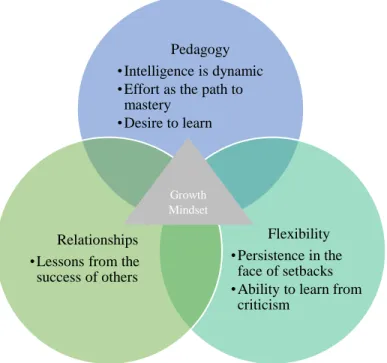
Intelligence is dynamic and can be developed; it is not fixed, or static.
Intelligence is static and cannot be changed or developed.
Belief in intelligence malleability leads to a desire to learn.
Desire to be perceived as smart by others.
Belief in intelligence malleability causes people to embrace changes.
Tendency to avoid challenges.
Belief in intelligence malleability causes people to persist in the face of setbacks.
Tendency to get defensive or give up easily.
Belief in intelligence malleability allows us to see effort as the path to mastery.
Perceives effort as fruitless.
Belief in intelligence malleability allows us to learn from criticism.
Ignores useful negative feedback.
Belief in intelligence malleability allows us to find lessons in the success of others.
Feels threatened by the success of others. (adapted from Holmes’ illustration, in Dweck, 2006, p. 263) Importantly, the end result of an individual adopting a growth mindset is a higher level of achievement; whereas, the end result of a fixed mindset is an intellectual plateau and stifled
7
potential. In order to better understand the foundation of growth mindset development, growth mindset indicators and their related applications can be seen in Table 2. Ultimately, the goals are for educators to have a personal growth mindset, apply growth mindset through their work, and model (if not explicitly teach) growth mindset for their students.
Table 2
Growth Mindset Explained
Column A Column B
What growth mindset does… How growth mindset can be applied…
Intelligence is dynamic Praise should focus on the process, rather than
the trait – i.e. strategies, effort, and choices should be praised, not talent.
Desire to Learn Use constructive criticism that promotes
strategy generation and teaches flexibility.
Embrace Changes Remember that a goal should allow
individuals to expand their skills and knowledge; it is not an innate talent.
Persistence in the face of setbacks Present new information in a growth
framework and give process feedback.
Effort as the path to mastery Remember that good teachers are intrigued by
the learning process and believe in intellectual growth.
Ability to learn from criticism Require full commitment and effort, rather
than error-free learning. Give the coaching needed for success.
Find lessons in others’ success Our mission is to develop people’s potential.
(Dweck, 2006, p. 221-222; Holmes illustration, in Dweck, 2006, p. 263) Tables 1 and 2 highlight specific beliefs that individuals hold about their intellectual ability. Dweck suggests that generations of individuals have not had explicit training in mindset concepts and strategies and consequently subscribe to what she has coined as a fixed mindset – this includes many of the students enrolled in higher education today. Furthermore, faculty in
8
higher education (for the most part) lack explicit training in intelligence malleability and are unaware of how to develop a growth mindset in themselves and their students (Yeager & Walton, 2011). Thus, growth mindset concepts may serve as a catalyst for change in faculty development, improved curricular design, and enhanced student engagement and achievement.
Purpose Statement
Communication Sciences and Disorders is a complex and dynamic field; as such, the field is facing a number of challenges including the need to promote practices that maintain the autonomy of the field and a need to engage more professionals in doctoral level study. A recent program development initiative by Hull and Coufal (2009) at Wichita State University relying heavily on mentorship and establishing connections centered on a central theme of individual growth appears promising as it uses partnership and collaboration as a way to overcome the challenge of too few doctoral level professionals. Concurrently, the field is transitioning from a more traditional assessment and learning model to a more student-centric model focused on student growth (CAA, 2017). Carol Dweck’s growth mindset provides a promising framework for operationalizing student-centric education and can be applied in a variety of ways, including personal growth and program enhancement (2006). Historically, Dweck’s work has been used in K-12 education, psychology, athletics, and business, but has rarely been applied in a higher education context (Hochanadel and Finamore, 2015). Given the challenges confronting the field of CSD, findings from Dweck and others working in related areas (Blackwell, 2002; Claro et al., 2016; Duckworth, Peterson, Matthews & Kelly, 2007; Hochanadel and Finamore, 2015) suggest a possible application for using the growth mindset model to influence faculty, curriculum, and students in CSD programs. CSD higher education programs are uniquely aware of these issues as they educate future professionals and implement the standards by which the profession is guided.
9
As no available literature exists in the field of CSD aligning growth mindset principles to program development, this study may fill the literature gap and begin discussion on the likelihood of introducing growth mindset actions toward discipline change. Therefore, the purpose of this study is to investigate the feasibility of applying Carol Dweck’s growth mindset model to select standards of Speech-Language Pathology education programs. Select
accreditation standards will serve as an anchor for this growth mindset exploration.
Research Questions
The following research questions were developed to guide this study:
1. To what extent is it feasible to use growth mindset principles in faculty development
initiatives for Speech-Language Pathology programs?
2. To what extent is it feasible to use growth mindset principles in the curriculum
decision-making process for Speech-Language Pathology programs?
3. To what extent is it feasible to use growth mindset principles in student learning
initiatives for Speech-Language Pathology programs?
Significance of Study
The intent of this study is to make recommendations concerning programming that may influence student and faculty growth by aligning growth principles to accreditation standards - specifically in the areas of faculty, curriculum, and students. This study has the potential to create a dialogue surrounding specific training for faculty and students on growth mindset development; use of growth mindset practices to advance program curricular decisions; and the importance of student-centric education practices. Currently, no literature exists in the field of CSD tying growth mindset principles to program development, thus this study seeks to fill the
10
literature gap and begin discussion on the likelihood of introducing growth mindset principles as a mechanism for change.
Delimitations
All research studies host a series of delimitations that serve as mitigating factors to create boundaries and define sets of information (Simon, 2011). Delimitations established for this study include the use of selected accreditation standards as framework anchors; selection of study design; and geographic narrowing of potential subjects. This study has been limited to include Standards 2.0 (Faculty), 3.0B (Curriculum in Speech-Language Pathology), and 4.0 (Students) as areas of interest as they have the most potential to be affected by implementation of a growth mindset framework for change. Lastly, the restriction of geographic region was implemented to identify the most likely participants and create a sense of relevance based on cultural experiences (Creswell, 2014). Participant selection was limited to states surrounding the state of the
researcher to define a regional boundary to define a research zone.
Chapter Summary and Study Overview
As stated above, the American Speech-Language-Hearing Association and the academic programs that operate under its guidelines face issues that may affect the autonomy of the
profession due to a need for advanced research, enhanced professional leadership, and a stagnant number of qualified faculty to educate tomorrow’s professionals. Approaching these
programmatic issues from Carol Dweck’s growth mindset perspective may drive the professions successfully into the future. This study is organized in the following manner: chapter one serves to introduce the study and specific research questions; chapter two serves as a review of current literature related to this study; chapter three explains the intended research methods; chapter four provides the research findings related to faculty standards; chapter five provides the research
11
findings related to SLP curriculum standards; chapter six provides the research findings related to student standards; and chapter seven provides a summary of the study including conclusions, implications, and recommendations for future research in this area.
12
CHAPTER 2 LITERATURE REVIEW
Growth mindset as a framework for education delivery is a result of the evolution of the fields of psychology and education over time. Each influences the other; whereby, a host of collaborative works has resulted in a literature-base and theoretical foundation for narrow units of study, such as intelligence, motivation, cognition, curriculum, and administration. This chapter is organized, as such, to explore the background of growth mindset inception and application, align growth mindset principles to modern educational practice, and connect this information to recent trends in CSD graduate program practices.
History of Growth Mindset
Intelligence, motivation, and the relationship between the two have been explored by many scholars in the field of psychology throughout history due to the common misalignment between them (Blackwell, 2002; Cook & Artino, 2016; Duckworth et al., 2007; Dweck, 1999, 2006; Dweck & Henderson, 1989; Dweck & Leggett, 1988; Ford, 1992; Gardner, 1993; Horn & Cattell, 1966; Yeager & Dweck, 2012). Carol Dweck is the modern researcher credited with developing the concept of growth mindset as it developed from her earlier work in the areas of intelligence and motivation. More recently, the work of Dweck (1999, 2006) and other positive psychologists (Csikszentmihalyi 2014; Duckworth, 2016; Seligman, 1990) have sought to find ways that motivation and frame of mind can enhance intelligence. It is becoming more and more accepted that intelligence is malleable, whereas, it was once thought to be static; hence, there is much excitement for the direction in which this information will take educational systems in the years to come.
13
Growth Mindset and Intelligence Theory
There are many theories of intelligence, though central to growth mindset are the concepts of incremental theory of intelligence and entity theory of intelligence. Incremental Theory of Intelligence (or implicit intelligence) is the theory that intelligence is a “…dynamic quality that can be increased” (Dweck & Leggett, 1988; Dweck, 1999) which aligns it with growth mindset. In contrast, Entity Theory of Intelligence is the theory that intelligence is a “…fixed, concrete internal entity …” (Dweck & Leggett, 1988; Dweck, 1999) thus aligning entity intelligence with fixed mindset. Both originate from earlier developed social-cognitive theories of intelligence, whereby it is understood that an individual’s belief system is a byproduct of her internal dialogue which can be either positively or negatively influenced by social and environmental systems (Dweck & Leggett, 1988). Importantly, Dweck stipulates that individuals may have shifting beliefs based on situations and interactions that result in a fluidity between the two types of intelligence that can be attributed to the adherence to growth mindset in some situations and fixed mindset in others (2006).
The earliest concepts of intelligence malleability can be traced back to Horn and Cattell’s concept of fluid and crystallized intelligence (1966). These researchers stipulated that fluid intelligence decreases over one’s lifespan, whereas crystalized intelligence increases (Knowles, Holton, and Swanson, 2015). This theory was groundbreaking in that it was the first to dispute the idea of a general level of IQ where the individual is either capable or not.
In 1983, Howard Gardner’s Multiple Intelligences Theory (MIT) was introduced. Gardner defined intelligence as a processing capacity to solve problems or create products that are of value in some context (1993). Gardner portrays intelligence as variable depending on skill sets and recognizes intelligence can be developed over time. MIT was a compelling alternate
14
view to the origins of intelligence theory and has been influential in the educational environment in molding the way teachers and administrators view students’ abilities. Prior to Gardner’s development of MIT, psychologists and educators more commonly subscribed to the standard view of intelligence as measured by IQ tests (Visser, Ashton, & Vernon, 2006). These tests generated a single score representing an individual’s skill, resulting in pure objective measurement of ability by tests and rank ordering of students based on their results.
Carol Dweck began her work on incremental and entity intelligence theories in the mid- ‘80s first with Albert Bandura and later with Ellen Leggett. It was the work with Leggett that began attaching intelligence to social constructs and internal dialogue – which can be more concisely described as motivation (Leggett & Dweck, 1986). In their 1988 article “A Social-Cognitive Approach to Motivation and Personality,” Dweck and Leggett describe their research findings about intelligence beliefs as follows:
Some children favor what we have termed an incremental theory of intelligence: They believe that intelligence is a malleable, increasable, controllable quality. Others lean more toward an entity theory of intelligence: They believe that intelligence is a fixed or
uncontrollable trait. Our research consistently indicates that children who believe intelligence is increasable pursue the learning goal of increasing their competence, whereas those who believe intelligence is a fixed entity are more likely to pursue the performance goal of securing positive judgments of that entity or preventing negative judgments of it. (Dweck & Leggett, 1988, p. 262-263)
Dweck developed the theory of implicit intelligence and the framework for growth mindset to provide explanations for behavioral reasons some individuals succeed and others do not (1999; 2006). She concluded that intelligence can be improved upon and people achieve their true potential through motivation and growth.
In light of both MIT and Incremental Intelligence Theory, both Gardner (1993) and Dweck (2006) note their theories of intelligence value effort, strategy generation, and growth as cornerstone to high levels of achievement. Additionally, both researchers perceive their theories
15
as adding to a body of research, rather than as absolute, indicating there is merit in understanding both as potential explanations for processes of intellectual development. The broad
understanding of multiple intelligences and the impact of beliefs on their function merits further exploration of the social-cognitive construct of motivation as central to the idea of growth.
Growth Mindset and Motivation Theory
As previously mentioned, the basis for the development of the growth mindset
framework originated from study of intelligence theory and motivation theory. Traditionally, it is accepted that there are 32 theories of motivation according to Martin Ford (1992). These include the following (Ford, 1992, Ch. 6):
Table 3
Ford’s List of Motivation Theories
Ford’s List of Motivation Theories
Psychoanalytic Theory Instinct Theory
Control System Theory Motivational Systems Theory
Goal Orientation Theory Idiographic Theory of Goal Content
Self-efficacy/Social Cognitive Theory Goal-setting Theory
Self-determination Theory Theory of Personal Investment
Effectance Motivation Theory Optimal Experience Theory
Learned Helplessness/Optimism Theory Self-worth Theory
Reactance Theory Personal Causation Theory
Differential Emotion Theory Causal Attribution Theory
Theory of Action Control Theory of Reasoned Action
Expectancy-value Theory of Achievement Expectancy Theory of Work
Operant Learning Theory Social Learning Theory
Optimal Level Theory Equity Theory
Actualization Theory Cognitive Dissonance Theory
Need Theory Field Theory
16
In 2016, Cook and Artino sought to clearly define modern theories of motivation, including goal orientation theories which include Dweck’s work. This study was significant in that it outlined the primary forms of motivation theory to include attribution theory, expectancy-value theory, social-cognitive theory, self-determination theory, and goal orientation theory in consideration of how motivational theory has evolved over time and the blurring of lines between indicators for each (p. 999-1000). Cook and Artino’s (2016) analysis of motivation theories identified four themes shared among these theories, which include elements of
competence, value, attributions, and social-cognitive elements. Table 4 summarizes each of these theories according to the taxonomy described in Cook and Artino’s work.
Table 4
Modern Motivation Theory Attribution Theory Expectancy-Value Theory Social-Cognitive Theory Self-Determination Theory Goal Orientation Theory Competence Perceived ability,
effort, luck, etc.
Perceived ability Self-efficacy for learning Dependent on psychosocial need Perceived ability (incremental or entity mindset) Value
Potential outcome Expectant success and task value
Performance, feedback, rewards Amotivation, extrinsic motivation, intrinsic motivation Intrinsic or extrinsic Attributions Locus, stability, controllability Affective memories, goals, self-concept Past experiences, aptitude, social support Interest, compulsion Performance or mastery goals, helplessness versus effort Social-Cognitive Elements Social influences, environment
Life events, social influences, and environment Social support, reward External demands, social conditions, reward Social influences, coaching, feedback
(summarized from Cook and Artino, 2016) Cook and Artino (2016) classify Dweck and Leggett’s (1988) implicit theories of
17
Importantly, there are two levels within goal orientation theories of motivation: mastery goals (relative to growth mindset) and performance goals (relative to fixed mindset). Ford notes that this can be a meaningful way to look at “a range of motivational problems at both the situation-specific and personality levels of analysis” (1992, p. 171). Furthermore, he states that motivation can be analyzed both “within an episode” (i.e. situation) and “across an episode” (p. 84).
Goal Orientation Theory – and specifically mastery goal motivation – establishes that learners engage in tasks with the intent to master content through deep learning and interest, and they do so with the notion that they are able to grow and are willing to try a variety of strategies to achieve the goal (Cook & Artino, 2016; Dweck, 1999, 2006). Andrew Martin further
highlights Dweck’s notions of strategy development and use as imperative to goal orientation theory (2015). Importantly, Dweck and other researchers recognize that mindset is malleable, including the potential that a fixed, or entity mindset can be “unintentionally reinforced” (Cook and Artino, 2016) through the feedback of others, resulting in a shift to performance goal motivation in certain situations (Dweck, 2006).
Ford suggests that goal-orientation theories have “proven to be a heuristically useful tactic in dealing with a range of motivational problems at both the situation-specific (behavior episode) and personality [behavior episode schemata] levels of analysis” (1992, p.171).
Importantly, he cautions that use of strict constructs such as Dweck’s categories of helplessness versus mastery achievement may fall short at capturing the scope of motivation contributors as he notes there are “…unique and joint contributions of emotions and personal agency beliefs to motivational patterns and behavioral regulation” (1992, p.122).
18
Modern Educational Practice
The study of intelligence in psychology is a major contributor to development of educational practices and historically has set the tone for instructional design (Knowles et al., 2015). Furthermore, some scholars have continued to view the fields of psychology and
education as inextricable from one another: Malcolm Knowles, Patricia Cross, Andrew Martin, and David Cook are a few of the researchers that have aided in keeping the connection alive. The classic theories of innate talent and fixed intellect were cornerstones to the educational practice of objective assessment where students are seen as performers. Ideas such as Dweck’s, however, are beginning to change the culture of the educational environment to include broad-scope ideas of malleability and growth.
An essential component of mastery goal motivation and incremental intelligence theory that has emerged from the work of Dweck and others is that growth mindset is able to be taught (Blackwell, 2002; Claro et al., 2016; Duckworth et al., 2007: Dweck, 2006; Hochanadel & Finamore, 2015). Research has primarily taken place in the K-12 arena that demonstrates how to teach growth mindset and mastery goal motivation to children and adolescents with positive outcomes. In a study by Blackwell (2002), junior high school students were analyzed in a two-part study. She demonstrated that students who held an incremental theory of intelligence achieved higher math grades than those who did not, and additionally found that incremental theory was able to be taught, resulting in increased math scores post-intervention (2002). These findings led to the conclusion that teaching growth mindset to students can result in improved effort and higher achievement.
This information led to a handful of researchers seeking to analyze implications of teaching growth mindset principles to young adults. Hochanadel and Finamore (2015) were
19
among those who sought to more clearly look at application of growth mindset at the college level. They report the similarities of growth mindset, as defined by Dweck (2006), and grit (i.e., long-term persistence), as defined by Duckworth et al. (2007), to conclude that “having a growth mindset can develop grit” (p. 49).
Organizational Growth Mindset in Schools
It has been established that interpersonal growth mindset exists and that it can be taught across human development (Dweck, 2006; Yeager & Dweck, 2012). An additional scope of growth mindset that remains to be established is the idea of an organizational growth mindset. In an effort to establish growth mindset as a response to organizational growth needs, researchers have applied growth mindset principles and applications to a few different settings. Wagner (2014) sought to apply these principles working from the hypothesis that an administrator’s interpersonal mindset would dictate her practices. Interestingly, not all participants in the study identified as having a growth mindset, yet all of them endorsed mastery goal practices and structures, demonstrating that interpersonal mindset and practice do not always align. This imbalance shows an alternate side to a caution from Dweck that an individual may have an interpersonal growth mindset but use entity-style practices (2006), and aligns with the early findings of Dweck and Henderson (1989) where individuals tend to choose mastery-oriented statements due to social biases rather than actual beliefs and actions.
In 2016 (a), Hanson, Bangert, and Ruff of the Macrothink Institute created the What’s My School Mindset (WMSM) survey (2016b) to measure the organizational mindset of educational entities. Hanson et al. began with the understanding that “… a school’s
organizational structure influences teachers’ beliefs in their collective ability to help all students grow and learn …” (p. 223) and sought to determine if the presence of implicit theories of
20
intelligence contributed to improved school performance. The authors concluded that the WMSM Survey provided reliable information for the relationship between school growth mindset and organizational variables explaining school improvement such as principals’
openness to change, faculty openness to change, and locus of control. Importantly, they note the pivotal role of the principal or administrator in creating a positive environment where individuals are open to change and development (2016a). Both the Hanson et al. and the Wagner studies provide background to support consideration of growth mindset from an organizational vantage point.
Trends in CSD Program Practice
Application of growth mindset principles to programmatic matters in CSD fields may be a natural extension of previously attempted solutions to programmatic issues. As noted in the introduction, growth of the profession has been steady and this can be accomplished only through an active leadership team that believes in the power of change. Adams (2015) explored the influence of leadership and environments on accreditation in CSD programs, but the current study seeks to infuse exploration of a potential solution. Specific utilization of growth mindset principles for the areas of faculty, curriculum, and students from the perspective of accreditation standards is an untapped avenue that warrants exploration.
Faculty, Curriculum, and Students in CSD Programs
The Council on Academic Accreditation (CAA) in Audiology and Speech-Language Pathology was created in January of 1996 and is the body of oversight for graduate programs in speech-language pathology. As with most fields, accreditation is the seal of approval needed to operate a graduate program in CSD. The CAA provides a set of standards that must be met in
21
order to maintain accreditation and each site is reviewed periodically to ensure it is meeting CAA criteria. CAA Standards include the following areas:
• Standard 1.0 Administrative Structure and Governance
• Standard 2.0 Faculty
• Standard 3.0A Curriculum in Audiology
• Standard 3.0B Curriculum in Speech-Language Pathology
• Standard 4.0 Students
• Standard 5.0 Assessment
• Standard 6.0 Program Resources
(CAA, 2017) Review of the literature led to the determination that Faculty, Curriculum, and Students were the areas most appropriately related to Dweck’s growth mindset principles; therefore, these areas have the most potential to be improved when viewed from a lens of growth.
The Standards for Accreditation of Graduate Education Programs in Audiology and Speech-Language Pathology (CAA, 2017) require the following within the categories of faculty, curriculum, and students:
1. Faculty in CSD departments must support student development to meet curriculum
standards; meet teaching, research, and service expectations of the sponsoring institution; be qualified and competent; and show continued competence and demonstrate pursuit of lifelong learning (pp. 7-9).
2. Curriculum includes the responsibility of the faculty to ensure students meet
“Professional Practice Competencies,” understand “Foundations of Speech-Language Pathology Practice,” and identify, prevent, evaluate, and treat speech, language, and
22
swallowing issues (pp. 20-23). A successful program must also effectively plan, organize, review, and implement knowledge consistent with practice guidelines (p. 24).
3. Students are required to “meet or exceed institutional policy for admission to graduate
study” (p. 29). In addition, the requirements to make reasonable accommodations for individual students and policies for intervening when students do “not meet program expectations” are noted (p. 29). Students have the right to support services and regular advising throughout their enrollment with the institution (pp. 31- and 32). Furthermore, as students progress toward meeting standards, credentialing must be documented and this documentation must be made available to the student (p. 31).
Looking at these standards through a lens of motivation allows for potential alignment with Cook and Artino’s (2016) highlights of modern motivation theory. These standards account for determination of competence, establishment of value, placement of attributions, and recognition of social-cognitive elements for meeting criteria. Aligning the Standards for Accreditation of Graduate Education Programs in Audiology and Speech-Language Pathology (CAA, 2017) with Goal-Orientation Theory may allow for analysis of practices that are either performance-based or mastery-based. As such, analysis of standards related to faculty, curriculum, and students
holistically and from a growth mindset perspective may help the American Speech and Hearing Association (ASHA), program directors, faculty, professionals, and students find new ways to work toward a solution by providing an alternative outlook for the future of CSD.
An example of goal-mastery orientation can be seen in Raymond Hull and Kathy Coufal’s description of an innovative partnership between two universities which matches graduate students and practicing professionals with an avenue of doctoral study (2009). This program is referred to as the “grow-your-own PhD initiative” and is a partnership between
23
Witchita State University and Fort Hayes State University. Their model of implementation relies heavily on mentorship and connections, which follows many preferred teaching practices in the current literature and echoes themes of growth such as openness and strategy generation
(Hinsdale, 2015; Knowles et al., 2015).
It may be possible to soften the issue of organizational/institutional compliance with explicit instruction and organizational buy-in to growth mindset practices. Finding a mechanism whereby successes of other institutions are made public to cultivate strategy generation in others; praise for positive effort toward finding a solution by accrediting bodies; and explicit growth mindset training for administrators, faculty, clinical educators, and students would be a good start toward creating motivation and igniting change.
24
CHAPTER 3 METHODS
The current study explored the feasibility of applying growth mindset principles to selected challenges in the field of communication sciences and disorders. This chapter provides information on the methods to be used throughout. This chapter is organized into sections on research design, subject selection, participant characteristics, interview protocol, and data collection and analysis.
Research Design
Qualitative design was selected to carry out this study. Schwandt (2007) defines qualitative inquiry as:
a blanket designation for all forms of social inquiry that rely primarily on qualitative data (i.e., data in the form of words) including ethnography, case study research, naturalistic inquiry, ethnomethodology, life-history methodology, and narrative inquiry. To call a research activity qualitative inquiry may broadly mean that it aims at understanding the meaning of human action (pp. 247-248).
Schwandt continues to explain that qualitative research is research of words (non-numeric) and gives a method of exploration through a paradigm that is non-experimental. From this vantage point, we can better understand human action from a social science perspective.
A phenomenological design was followed for this study as it is exploratory in nature. According to Creswell, “Phenomenological research is a design of inquiry coming from
philosophy and psychology in which the researcher describes the lived experiences of individuals about a phenomenon as described by participants” (2014, p. 14). Furthermore, Schwandt (2007) indicated that phenomenology is the study of “everyday experience from the point of view of the subject” (p. 226). The subjectivity of responses from participants is considered a strength of this method of inquiry as they are immersed in the experience of the topic (Schwandt, 2007). The
25
researcher must identify themes and discover the lessons therein. Growth mindset has not previously been applied to CSD programs in the literature; therefore, a phenomenological study serves as an appropriate first step.
Phenomenology is a form of qualitative research whereby information is gathered through descriptions received from those living the experience (Schwandt, 2007; van Manen, 1990). Van Manen (1990) refers to this type of research as description of the “lifeworld,”
explaining that phenomenology is the study of “lived or existential meanings” (p. 11). Presently, those with administrative experience in CSD higher education programs have the lived
experiences that provide valuable insights in understanding what decisions are made and why. Information received through interviews offers a richness that may otherwise have been missed by a quasi- or true experimental design. Data analysis for qualitative design, and
specifically phenomenology, finds significance in statements, synthesizes information into meaningful units, and is finally developed into an “essence description” (Creswell, 2014; Moustakas, 1994). The degree of rigor in phenomenological research provides structure for reliability and validity similar to that sought by scientific communities that value quantitative methods (Creswell, 2014).
Phenomenological methods also provide a reflective view of life. Van Manen (1990) states:
A person cannot reflect on lived experience while living through the experience. For example, if one tries to reflect on one’s anger while being angry, one finds that the anger has already changed or dissipated. Thus, phenomenological reflection is not introspective but retrospective. Reflection on lived experience that is already passed or lived through (p.10).
This study sought to collect a repertoire of administrators’ experiences to determine if growth mindset principles can be used (or have been used) to drive choices and decisions made in their
26
respective programs. The reflection that occurred through the interview process allowed
participants to think more objectively about specific program initiatives, challenges, and routine workings in the absence of emotive effects. The retrospective vantage allowed for critical analysis of prior decisions made, examples of program successes and failures, and regard for the variance in collaborative relationships among faculty.
Population
The population for this study consisted of current or former Communication Sciences and Disorders (CSD) department chairs and graduate program directors as it is their responsibility to compose reports and collect evidence of how their departments meet accreditation standards. Geographical region was limited to the following states to manage the scope of the study: Kentucky, Maryland, North Carolina, Ohio, Pennsylvania, Tennessee, Virginia, West Virginia, and the District of Columbia. A department chair and graduate program director from the same institution were not interviewed to diminish the likelihood of participants discussing the study outside of its confines and to maintain the integrity of the data. Additionally, only institutions granting master’s degrees were included; specific CSD PhD granting institutions were excluded.
A master list of 40 CSD master’s degree granting institutions in the identified states and random selection of 10 institutions determined the first round of individuals invited to
participate. Additional participants were sought through snowball sampling to achieve a sufficient amount of data, though eventually, all prospective participants were contacted via email to achieve the final study sample. The study goal was to complete 15 to 20 interviews with a stratification plan defining the number of participants from each identified state to ensure proper representation of the intended population (Creswell, 2014, p. 158-159). The planned stratification for number of schools per state and actual number achieved is provided in Table 5.
27 Table 5
Stratification Plan
State Number of master’s
degree granting institutions within criteria Intended distribution of participating institutions Actual distribution of participating institutions Kentucky 4 2 2 Maryland 2 1 2 North Carolina 3 1-2 1 Ohio 6 2-3 2 Pennsylvania 13 5 3 Tennessee 2 1 0 Virginia 4 2 3 West Virginia 2 1 1 District of Columbia 4 2 1 Total 40 17-19 15 Participant Characteristics
The population for this study included department chairs and graduate program directors for Communication Sciences and Disorders (CSD) graduate programs. The total number of
participants in this study was n=15 out of a targeted population of 40 potential interviewees
which is a response rate of 37.09%. Demographic characteristics of the final group of participants are provided in Table 6.
28 Table 6 Participant Characteristics Characteristic n % Sex Male Female 3 12 20.0 80.0 Age 26-35 36-45 46-55 56-65 66+ 0 3 1 9 2 0.0 20.0 6.7 60.0 13.3 Title/Position Chair
Graduate Program Director Both 7 3 5 46.7 20.0 33.3 Length of Service in this Administrative Role
Less than 5 years 5-9 years 10-14 years 15 years + 4 7 3 1 26.7 46.7 20.0 6.7 Additional Administrative Experience*
Yes No 8 7 53.3 46.7
*Additional administrative experience defined for the purpose of this study as previous appointment as department chair, graduate program director, undergraduate program director, or clinic director of a CSD program.
Interview Protocol Development of Interview Protocol
The power of interviews as a research method is the flexibility they provide in
consideration of the variability across programs (Creswell, 2014; van Manen, 1990). This study explored the feasibility of applying growth mindset principles to issues faced by speech-language pathology graduate programs, therefore, interviews were a natural choice. Potential relationships were identified between growth mindset principles and the selected accreditation standards; this variable analysis guided additional research regarding application of growth mindset to higher education and also provided guidance in the development of specific research questions.
29
Additional literature review offered greater insight regarding the application of growth mindset principles to higher education assessment practices. Given the exploratory nature of interviews, it is essential to create an interview protocol that follows a framework where each growth mindset indicator is directly applied to the core research questions. The framework used to guide this study was developed following thorough review of the literature and in
consideration of the primary objective to apply Dweck’s growth mindset framework to speech-language pathology graduate programs. Growth mindset principles were aligned with select accreditation standards for faculty, curriculum (speech-language pathology), and students.
A pilot study with one participant was completed prior to collecting formal interviews from the study sample. Findings from the pilot study assisted with validation of the interview protocol and allowed for discovery of ways to improve questions and probes, as well as address any issues with format (Creswell, 2014, p. 161). General format for the interview protocol did not need to be changed following the pilot study, though order of presentation for concepts did require restructuring. Initially, exploration of accreditation standards as they apply to beliefs and practices in dynamic intelligence occurred first, but it was evident this was too abstract a concept to begin the interview. Willingness to embrace change and finding lessons in the success of others was determined as a more natural starting place to ease participants into the more abstract concepts of belief application.
All interviews were conducted either online or in person and transcribed for analysis. Wording of interview questions was adjusted and follow-up questions added to gather more robust information as is typical for exploratory studies (Creswell, 2014). See Appendix C for complete Interview Protocol.
30
Data Collection and Analysis
Once participants were established, one-on-one interviews occurred with the participants either online or via telephone. Following initial data collection, interviews were transferred to a safe computer and erased from the voice recording app used. These audio recordings were then transcribed verbatim with only minor commentary added to describe events of the interview, such as pauses and/or to include notes taken during the process (Creswell, 2014).
Analysis occurred in tandem with data collection. Completion of an interview was sufficient for analysis to begin by transcription, creating research memos, and beginning organization for the final study report (Creswell, 2014). Theme identification served as the primary intention of this research whereby themes were identified in accordance with growth mindset principles and accreditation standards. To ensure validity of analysis, Creswell’s steps for data analysis in qualitative research (2014, p. 196-200) were followed. These steps include: gathering raw data; organizing and preparing data for analysis; reading through all data; coding the data; identification of themes and descriptions; interrelating themes and descriptions; and interpreting the meaning of themes and descriptions.
Validations
Both quantitative and qualitative design require validation to insure responsible information gathering. The case has been made for why phenomenology is the appropriate research method to use for this study. This study can be viewed as reliable as it seeks to “gain insightful descriptions of the way we experience the word pre-reflectively, without
taxonomizing, classifying, or abstracting it” (van Manen, 1990, p. 9). Accessing views and experiences from the CSD administrators who practice their craft daily offers the needed acumen to determine if growth mindset principles can be successfully applied to organizational practices
31
of adhering to the Standards for Accreditation in Communication Sciences and Disorders programs.
Two mechanisms were used to validate findings: 1. Participant review of the interview transcript and 2. Secondary review of data samples. Following completion of a recorded
interview, information was transcribed verbatim for the purpose of analysis and also sent to the participant via email for their own review. Each participant was given approximately two weeks to review their responses, request edits, or make additional comments if necessary. Participant 12 was the only contributor to resend the transcript with request of minor edits, which was fulfilled. The remaining 14 participants either elected not to respond to the request for transcript review or responded indicating the transcript information accurately reflected the interview. Therefore, the information was deemed as valid representations of contributors’ lived experiences as CSD administrators.
In addition, secondary review of data samples occurred to check for internal consistency of analysis. Members of the doctoral committee and one research assistant agreed to participate in this review. Of the four reviewers, only one recommended minor adjustments to the initial impressions, but ultimately, agreement was reached on the direction of analysis following face-to-face discussion of the data outcomes. The information gathered and analysis process that occurred were deemed as reliable and valid in illuminating the experiences of participants as they relate to growth mindset principles (Dweck, 2006) and the Standards for Accreditation of
Graduate Education Programs in Audiology and Speech-Language Pathology (CAA, 2017).
Limitations
Some limitations are inherent in research. Such limitations include use of indirect information, potential for biased responses, and degree of variability between participants in
32
response style (Creswell, 2014, p. 191). Creswell (2014) stated other potential limitations including lack of generalizability, possibility of receiving socially desirable responses given the absence of anonymity, and standard bias that accrues from an individual’s professional
experience. These limitations were lessened by following formal qualitative guidelines for semi-structured interviews, where field notes were taken, audio recording occurred, and verbatim transcription was completed.
Chapter Summary
In summary, this study was exploratory in nature and involved interviews of CSD department chairs to determine if there is a place for application of growth mindset principles to issues in CSD programs. The expectation was that study findings will promote longevity and autonomy of the field through enhancing endeavors in the areas of education, scholarship, and promotion of the discipline. Participants were selected from master’s degree granting programs in Kentucky, Maryland, North Carolina, Ohio, Pennsylvania, Virginia, West Virginia, and the District of Columbia. An interview framework was followed that merges growth mindset principles and identified areas of concern in a predictable manner to promote study reliability. Thematic analysis of information offered ideas for conclusions, implications, and
recommendations regarding use of growth mindset principles at the program level for CSD graduate programs.
33
CHAPTER 4 FACULTY
The next three chapters are separated according to the specific accreditation standard analyzed. This chapter will focus on Standard 2.0 Faculty of the Standards for Accreditation of Graduate Education Programs in Audiology and Speech-Language Pathology (CAA, 2017). As previously stated, interviews were completed, resulting information transcribed, and themes identified to determine the feasibility of using growth mindset principles in faculty development initiatives for Speech-Language Pathology programs. This chapter lays out the themes that emerged, as well as presents information on the administrator’s growth mindset beliefs from an organizational perspective, presents evidence of current growth mindset practices, and presents information on areas where use of a growth mindset framework may be used in the future regarding faculty development.
Thematic Analysis
Interview questions were divided into specific growth mindset categories based on Dweck’s principles; these included 1) embracing change and finding lessons in others’ success; 2) persistence in the face of setbacks and an ability to learn from criticism; and 3) belief in dynamic intelligence, desire to learn, and effort as the path to mastery (Dweck, 1999, 2006). Participant responses were analyzed and coded as per guidelines for phenomenological study (Creswell, 2014; van Manen, 1990). The following themes emerged for Standard 2.0 (CAA, 2017) as it relates to faculty: personal belief systems, influence of the leader, flexibility, and outcome-oriented practices.
Notably, during nearly all interviews it was necessary to discuss growth mindset from a philosophical viewpoint with the participants to enhance their understanding about the
34
framework and its application. Dweck discusses growth mindset as a personal construct, but undoubtedly, our actions affect those around us. Participants were encouraged to answer any questions as they saw fit in terms of their own personal mindset tendencies, the array of mindsets found in their faculty and students, or from an organizational lens where they were allowed to respond in general terms. This clarification helped with the comfort level of the respondents as they reflected and provided answers regarding faculty issues. That said, it is a natural extension to discuss the importance of personal growth mindset in faculty members and how their mindset may impact their actions.
Table 7 offers a quick-reference for thematic breakdown of faculty issues when explored through the lens of growth mindset:
Table 7
Growth Mindset and CSD Faculty - Themes
Personal Belief Systems Influence of the
Leader
Flexibility Outcome-oriented
Practice Desire to learn should
be natural to faculty.
Beliefs of the leader may influence faculty practices.
Faculty flexibility supports program growth.
Success often comes from the meshing of creativity and necessity. Faculty role fulfillment
is a developmental process.
A leader’s role in motivating faculty.
The relationships among flexibility and collaboration.
Faculty mindset may influence student engagement and outcomes. Faculty accomplishment may enhance intrinsic motivation. Feedback as a mechanism for growth. Continued faculty learning as driven by mindset.
Leader honesty and transparency create an environment of support.
The relationships among flexibility, effort and resilience.