DELL VS. SUN SERVERS: R910 PERFORMANCE
COMPARISON SPECint_rate_base2006
MARCH 2010
OUR FINDINGS
The latest, most powerful Dell PowerEdge servers
deliver better performance than Sun SPARC
Enterprise servers. In Principled Technologies’ tests
in our labs, the Dell PowerEdge R910 server with
four Intel Xeon Processor X7560s delivered higher
performance results than the publicly available
benchmark scores of the Sun SPARC Enterprise
M5000 and T5440 servers. These results
demonstrate the potential performance
improvements of the Dell server.
OUR PROCESS
We used the SPECint_rate_base2006 test of the
industry-standard SPEC CPU2006 benchmark to
focus on and measure the processor performance
of the Dell PowerEdge R910 server. We then
compared our results to publicly available
SPECint_rate_base2006 results of the two Sun
servers.
PROJECT OVERVIEW
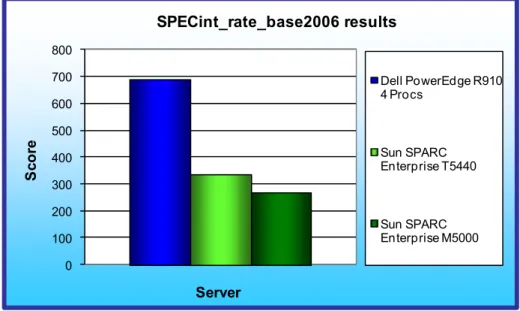
Dell PowerEdge R910 server achieved a SPECint_rate_base2006 score of 691, a 104.4 percent increase
over the Sun SPARC Enterprise T5440 server, which achieved a SPECint_rate_base2006 score of 338, and a
158.8 percent increase over the Sun SPARC Enterprise M5000 server, which achieved a
SPECint_rate_base2006 score of 267.
1(See Figure 1.)
SPEC CPU2006 is an industry-standard benchmark created by the Standard Performance Evaluation
Corp. (SPEC) to measure a server’s compute-intensive performance. The benchmark consequently stresses the
CPU and memory subsystems of the system under test. (For more information on SPEC CPU2006 and other
SPEC benchmarks, see
www.spec.org
.) The SPEC CPU2006 benchmark consists of two benchmark suites, each
of which focuses on a different aspect of compute-intensive performance. CINT2006 measures and compares
compute-intensive integer performance, while CFP2006 measures and compares compute-intensive
floating-point performance. A “rate” version of each, which runs multiple instances of the benchmark to assess server
performance, is also available. For this report, we ran only the CINT2006 SPECint_rate_base2006 benchmark
on three servers in similar common enterprise configurations.
Due to licensing issues, we did not actually test SPECint_rate_base2006 on the Sun SPARC Enterprise
T5440 and the Sun SPARC Enterprise M5000. Instead, we used the highest posted result for each Sun system
on SPEC’s site, which was 338
(
http://www.spec.org/cpu200
6/results/res2009q3/cpu2006-20090717-08200.html
) for the
T5440 and 267
(
http://www.spec.org/cpu200
6/results/res2009q4/cpu2006-20091012-08882.html
) for the
M5000.
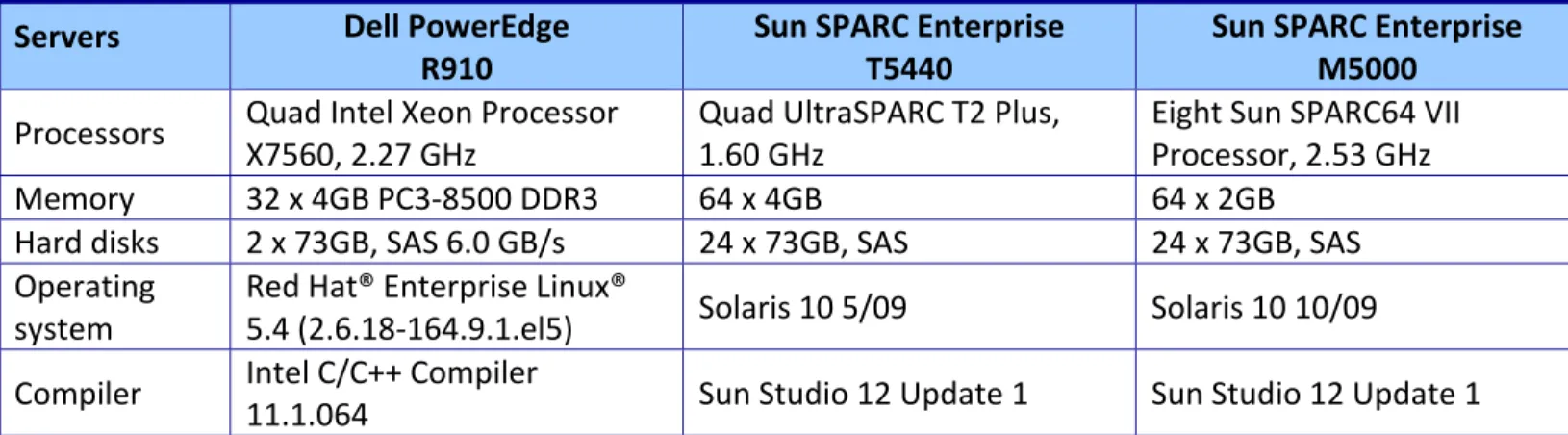
Figure 2 shows the
system configuration overview
1
Source: Principled Technologies®, Inc., “Dell vs. Sun servers: R910 performance comparison SPECint_rate_base2006,” a March 2010 report commissioned by Dell. For the latest SPECint_rate_base2006 benchmarks, visit www.spec.org.
0 100 200 300 400 500 600 700 800 Sc o re Server SPECint_rate_base2006 results Dell PowerEdge R910 4 Procs Sun SPARC Enterprise T5440 Sun SPARC Enterprise M5000
for the similarly configured Dell PowerEdge R910, Sun SPARC Enterprise T5440, and Sun SPARC Enterprise
M5000 servers.
Servers
Dell PowerEdge
R910
Sun SPARC Enterprise
T5440
Sun SPARC Enterprise
M5000
Processors
Quad Intel Xeon Processor
X7560, 2.27 GHz
Quad UltraSPARC T2 Plus,
1.60 GHz
Eight Sun SPARC64 VII
Processor, 2.53 GHz
Memory
32 x 4GB PC3-8500 DDR3
64 x 4GB
64 x 2GB
Hard disks
2 x 73GB, SAS 6.0 GB/s
24 x 73GB, SAS
24 x 73GB, SAS
Operating
system
Red Hat® Enterprise Linux®
5.4 (2.6.18-164.9.1.el5)
Solaris 10 5/09
Solaris 10 10/09
Compiler
Intel C/C++ Compiler
11.1.064
Sun Studio 12 Update 1
Sun Studio 12 Update 1
Figure 2: System configuration overview for the three test servers. See Appendix A for more details on the Dell PowerEdge servers.Generally, a system achieves the best SPECint_rate2006 score using the same number of users as
execution units for a given server. The optimum user count for our testing on our Dell system was 64, the
number of execution units (logical or physical processors) on those servers.
Figure 3 lists the 12 applications that
compose the CINT2006 benchmark. SPEC wrote
nine of the applications in C and three
(471.omnetpp, 473.astar, 483.xalancbmk) in C++.
A CINT2006 run performs each of the 12
application (tasks) three times and reports the
median for each. It also calculates the geometric
mean of those 12 results to produce an overall
score.
Name
Application area
400.perlbench Programming
language
403.gcc C
compiler
429.mcf Combinatorial
optimization
445.gobmk
Artificial intelligence: Go
456.hmmer
Search gene sequence
458.sjeng Artificial
intelligence:
chess
462.libquantum Physics/quantum
computing
464.h264ref Video
compression
471.omnetpp
Discrete event simulation
473.astar Path-finding
algorithms
483.xalancbmk XML
processing
WHAT WE FOUND
Figure 4 details the results of our tests with the optimum number of users for SPECint_rate_base2006.
We determined the number of users based on the number of execution units in a given server. We used the
same number of SPECint_rate_base2006 users as processor execution units, so there is a one-to-one ratio.
SPECint_rate_base2006 performs three runs of each benchmark in the test suite and records the
median, so the final score is a median of three runs. Higher scores are better.
Server
SPECint_rate_base2006 results
Dell PowerEdge R910
691
Sun SPARC Enterprise T5440
338
Sun SPARC Enterprise M5000
267
Figure 4: SPECint_rate_base2006 results for the three test servers. Higher scores are better.
HOW WE TESTED
Adjusting BIOS settings
We used all of the default BIOS settings on the Dell PowerEdge R910 server. Among these settings
were the following:
•
Hardware Prefetcher enabled
•
Adjacent Cache Line Prefetch enabled
•
Node Interleaving disabled
•
C States enabled
Setting up and configuring the Dell PowerEdge R910
We began by installing a fresh copy of Red Hat Enterprise Linux Server 5.4. We installed the default
packages, disabled the firewall, and disabled SELinux. We made no additional changes to the default
installation options.
After the base installation, we updated the kernel on the Dell PowerEdge R910 from 2.6.18-164.el5 to
2.6.18-164.9.1.el5. This new kernel provided proper Nehalem-EX support in Red Hat for the Dell PowerEdge
R910.
SPECCPU2006 CONFIGURATION
Intel compiled and provided the SPEC CINT2006 executables, but followed SPEC’s standard instructions
for building the executables using the following software tools for the Dell PowerEdge R910:
•
Intel C/C++ Compiler 11.1.064 for IA32 and Intel 64
•
MicroQuill SmartHeap v8.1
•
Binutils 2.18.50.0.7.20080502
The benchmark requires configuration files. Intel provided the configuration files we used for the Dell
PowerEdge R910. The configuration file we used appears in Appendix B.
We report only the base metrics for the SPECint_rate test. SPEC requires the base metrics for all
reported results and sets compilation guidelines that testers must follow in building the executables for such
tests.
Conducting the test
To begin the benchmark, we performed the following steps:
1.
Open a command prompt.
2.
Change to the cpu2006 directory.
3.
Type
. ./shrc
at the command prompt.
4.
Type
runspec -c <config file name> -r <#> -T base -v 10 int
where
o
<config file name> = name of the configuration file
o
<#> = number of users (we used 64 users on our server)
When the run completes, the benchmark puts the results in the directory /cpu2006/result. The result
file names are of the form CINT2006.<number>.<suffix>. The suffixes are html, asc, raw, and pdf. The number
is three digits and associates a result file with its log, e.g., CINT2006.002. asc and log.002.
APPENDIX A – TEST SERVER INFORMATION
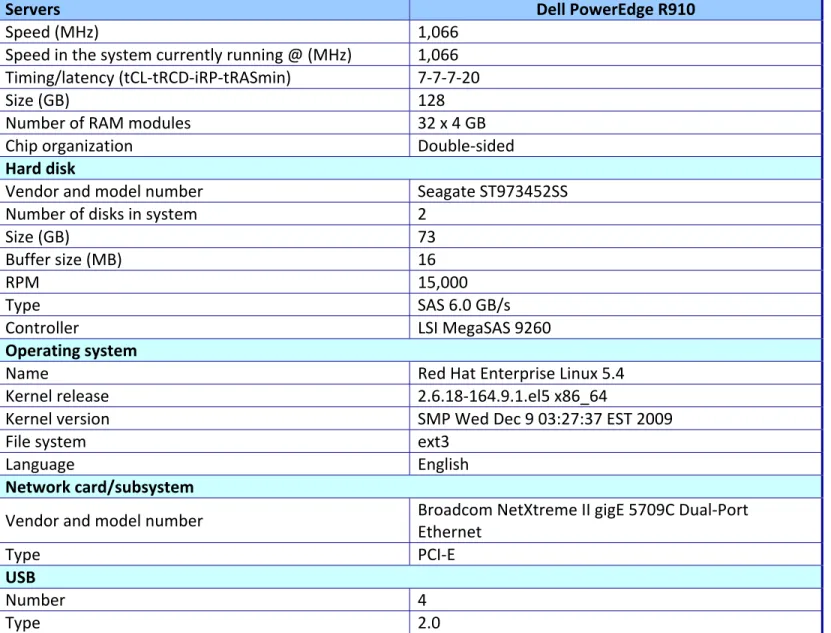
Figure 5 presents detailed information for the Dell PowerEdge test server we used in this report.
Servers
Dell PowerEdge R910
General dimension information
Height (inches)
7.00
Width (inches)
17.25
Depth (inches)
29.00
U size in server rack (U)
4
Power supplies
Total number
4
Brand and model
Dell Z1100P-00
Wattage (W)
1,023
Cooling fans
Total number
6
Dimensions (h x w)
5” x 5”
Voltage (V)
12
Amps (A)
4.80
General processor setup
Number of processor packages
4
Number of cores per processor package
8
Number of hardware threads per core
2
CPU
Vendor Intel
Name Xeon
X7560
Stepping D0
Socket type
LGA1567
Core frequency (GHz)
2.27
L1 cache
32 KB + 32 KB
L2 cache
256 KB (per core)
L3 cache (MB)
24
Platform
Vendor and model number
Dell PowerEdge R910
Motherboard model number
0P658H
Motherboard revision number
X23
BIOS name and version
Dell 1.0.1 (03/14/2010)
BIOS settings
Default
Memory modules
Total RAM in system (GB)
128
Vendor and model number
Hynix HMT151R7BFR8C-G7
Servers
Dell PowerEdge R910
Speed (MHz)
1,066
Speed in the system currently running @ (MHz)
1,066
Timing/latency (tCL-tRCD-iRP-tRASmin)
7-7-7-20
Size (GB)
128
Number of RAM modules
32 x 4 GB
Chip organization
Double-sided
Hard disk
Vendor and model number
Seagate ST973452SS
Number of disks in system
2
Size (GB)
73
Buffer size (MB)
16
RPM 15,000
Type
SAS 6.0 GB/s
Controller
LSI MegaSAS 9260
Operating system
Name
Red Hat Enterprise Linux 5.4
Kernel release
2.6.18-164.9.1.el5 x86_64
Kernel version
SMP Wed Dec 9 03:27:37 EST 2009
File system
ext3
Language English
Network card/subsystem
Vendor and model number
Broadcom NetXtreme II gigE 5709C Dual-Port
Ethernet
Type PCI-E
USB
Number 4
Type 2.0
Figure 5: Detailed configuration information for the Dell PowerEdge R910 test server.APPENDIX B – SPECINT_RATE_BASE2006 CONFIGURATION FILES
This appendix contains the benchmark configuration file we used to test the servers.
Red Hat Enterprise Linux 5.4 server: Dell PowerEdge R910
############################################################################
# This is a sample config file. It was tested with: # # Compiler name/version: Intel Compiler 11.1
# Operating system version: 64-Bit SUSE LINUX Enterprise Server 10 or later
# Hardware: Intel processors supporting SSE4.2
# ############################################################################
# SPEC CPU2006 Intel Linux64 config file # Sep 2009 IC 11.1 Linux64 ############################################################################ action = validate tune = base ext = cpu2006.1.1.ic11.1.linux64.sse42.rate.jan182010 PATHSEP = / check_md5=1 reportable=1 bench_post_setup=sync #
# These are listed as benchmark-tuning-extension-machine # int=default=default=default: CC= icc -m32 CXX= icpc -m32 OBJ = .o SMARTHEAP32_DIR = /home/cmplr/usr3/alrahate/cpu2006.1.1.ic11.1/libic11.1-32bit SMARTHEAP64_DIR = /home/cmplr/usr3/alrahate/cpu2006.1.1.ic11.1/libic11.1-64bit fp=default=default=default: CC= icc -m64 CXX= icpc -m64 FC= ifort -m64 OBJ = .o
# For UP systems, we need to know if the processors are ordered across cores first or in order
# If across cores, processors 0, 1, 2 and 3 are on distinct physical cores # Otherwise, processors 0, 2, 4 and 6 are on distinct physical cores
default:
submit = numactl --localalloc --physcpubind=$SPECCOPYNUM $command
%ifdef %{no-numa)
submit = taskset -c $SPECCOPYNUM $command %endif
#################################################################### # Compiler options
# for Nehalem use -xSSE4.2
# for processors prior to dunnington, replace -xSSE4.1 with -xSSSE3 #################################################################### default:
SSE = -xSSE4.2
FAST = $(SSE) -ipo -O3 -no-prec-div -static FASTNOSTATIC = $(SSE) -ipo -O3 -no-prec-div
################################################################ #
# portability & libraries #
#################### Portability Flags and Notes ############################
400.perlbench=default: CPORTABILITY= -DSPEC_CPU_LINUX_IA32 403.gcc=default: EXTRA_CFLAGS= -Dalloca=_alloca 462.libquantum=default: CPORTABILITY= -DSPEC_CPU_LINUX 483.xalancbmk=default: CXXPORTABILITY= -DSPEC_CPU_LINUX fp=default: PORTABILITY = -DSPEC_CPU_LP64 435.gromacs=default=default=default: LDPORTABILITY = -nofor_main 436.cactusADM=default=default=default: LDPORTABILITY = -nofor_main 454.calculix=default=default=default: LDPORTABILITY = -nofor_main 481.wrf=default=default=default:
CPORTABILITY = -DSPEC_CPU_CASE_FLAG -DSPEC_CPU_LINUX
################################################################ # Tuning Flags
################################################################ #
# Base tuning default optimization
# Feedback directed optimization not allowed in baseline for CPU2006 # However there is no limit on the number of flags as long as the same
# flags are used in the same order for all benchmarks of a given language
471.omnetpp,473.astar,483.xalancbmk=default: EXTRA_LIBS= -L$(SMARTHEAP32_DIR) -lsmartheap EXTRA_LDFLAGS= -Wl,-z,muldefs
int=base=default=default:
COPTIMIZE= $(FAST) -opt-prefetch
CXXOPTIMIZE= $(FASTNOSTATIC) -opt-prefetch
fp=base=default=default: OPTIMIZE= $(FAST)
################################################################ # Peak Tuning Flags int 2006 fast
################################################################ int=peak=default:
COPTIMIZE= -auto-ilp32 -ansi-alias CXXOPTIMIZE= -ansi-alias
PASS1_CFLAGS = -prof-gen
PASS2_CFLAGS = $(FAST) -prof-use PASS1_CXXFLAGS = -prof-gen
PASS2_CXXFLAGS = $(FASTNOSTATIC) -prof-use PASS1_LDCFLAGS = -prof-gen
PASS2_LDCFLAGS = $(FAST) -prof-use PASS1_LDCXXFLAGS = -prof-gen
PASS2_LDCXXFLAGS = $(FASTNOSTATIC) -prof-use
400.perlbench=peak=default: COPTIMIZE= -ansi-alias
401.bzip2=peak=default: CC= icc -m64
CPORTABILITY= -DSPEC_CPU_LP64
COPTIMIZE= -opt-prefetch -ansi-alias -auto-ilp32
403.gcc=peak=default: COPTIMIZE = $(FAST) feedback=0
429.mcf=peak=default:
COPTIMIZE= $(FAST) -opt-prefetch feedback=0
################################################################################# ###################################################
%ifdef %{smt-on}
%ifdef %{physicallogical}
submit = numactl --localalloc --physcpubind=`expr 2 \\* $SPECCOPYNUM` $command
%ifdef %{no-numa)
submit = taskset -c `expr 2 \\* $SPECCOPYNUM` $command %endif
%endif %endif %ifdef %{up-dale} copies=2 %endif %ifdef %{up-nhm} copies=4 %endif %ifdef %{dp-nhm} copies=8 %endif %ifdef %{up-wsm-6c} copies=6 %endif %ifdef %{dp-wsm-6c} copies=12 %endif ################################################################################# ################################################### 445.gobmk=peak=default:
COPTIMIZE= -O2 -ipo -no-prec-div -ansi-alias PASS1_CFLAGS = -prof-gen
PASS2_CFLAGS = $(SSE) -prof-use PASS1_LDCFLAGS = -prof-gen
PASS2_LDCFLAGS = $(SSE) -prof-use
456.hmmer=peak=default: CC= icc -m64
CPORTABILITY= -DSPEC_CPU_LP64
COPTIMIZE= $(FAST) -unroll2 -ansi-alias -auto-ilp32 feedback=no
################################################################################# ###################################################
%ifdef %{smt-on}
%ifdef %{physicallogical}
submit = numactl --localalloc --physcpubind=`expr 2 \\* $SPECCOPYNUM` $command
%ifdef %{no-numa)
submit = taskset -c `expr 2 \\* $SPECCOPYNUM` $command %endif %endif %endif %ifdef %{up-dale} copies=2 %endif %ifdef %{up-nhm} copies=4 %endif %ifdef %{dp-nhm}
copies=8 %endif %ifdef %{up-wsm-6c} copies=6 %endif %ifdef %{dp-wsm-6c} copies=12 %endif ################################################################################# ################################################### 458.sjeng=peak=default: CC= icc -m64 CPORTABILITY= -DSPEC_CPU_LP64 COPTIMIZE= -unroll4 -auto-ilp32
462.libquantum=peak=default: CC= icc -m64
CPORTABILITY= -DSPEC_CPU_LP64 -DSPEC_CPU_LINUX COPTIMIZE= $(FAST) -auto-ilp32 -opt-prefetch feedback=no
464.h264ref=peak=default:
COPTIMIZE= -unroll2 -ansi-alias
471.omnetpp=peak=default:
CXXOPTIMIZE= -ansi-alias -opt-ra-region-strategy=block
473.astar=peak=default: CXX= icpc -m64
CXXPORTABILITY= -DSPEC_CPU_LP64
EXTRA_LIBS= -L$(SMARTHEAP64_DIR) -lsmartheap64
CXXOPTIMIZE= -ansi-alias -opt-ra-region-strategy=routine
483.xalancbmk=peak=default: basepeak=yes
################################################################ # Peak Tuning Flags for FP
################################################################ fp=peak=default:
COPTIMIZE= -auto-ilp32 CXXOPTIMIZE= -auto-ilp32 PASS1_CFLAGS = -prof-gen
PASS2_CFLAGS = $(FAST) -prof-use PASS1_CXXFLAGS = -prof-gen
PASS2_CXXFLAGS = $(FAST) -prof-use PASS1_FFLAGS = -prof-gen
PASS2_FFLAGS = $(FAST) -prof-use PASS1_LDFLAGS = -prof-gen
410.bwaves=peak=default:
OPTIMIZE= $(FAST) -opt-prefetch feedback=0
################################################################################# ###################################################
%ifdef %{smt-on}
%ifdef %{physicallogical}
submit = numactl --localalloc --physcpubind=`expr 2 \\* $SPECCOPYNUM` $command
%ifdef %{no-numa)
submit = taskset -c `expr 2 \\* $SPECCOPYNUM` $command %endif %endif %endif %ifdef %{up-dale} copies=2 %endif %ifdef %{up-nhm} copies=4 %endif %ifdef %{dp-nhm} copies=8 %endif %ifdef %{up-wsm-6c} copies=6 %endif %ifdef %{dp-wsm-6c} copies=12 %endif %ifdef %{1p-nhm-ex} copies=8 %endif %ifdef %{2p-nhm-ex} copies=16 %endif %ifdef %{4p-nhm-ex} copies=32 %endif ################################################################################# ################################################### 416.gamess=peak=default:
OPTIMIZE= -unroll2 -Ob0 -ansi-alias -scalar-rep-
################################################################################# ###################################################
%ifdef %{smt-on}
%ifdef %{physicallogical}
submit = numactl --localalloc --physcpubind=`expr 2 \\* $SPECCOPYNUM` $command
%ifdef %{no-numa)
%endif %endif %endif %ifdef %{up-dale} copies=2 %endif %ifdef %{up-nhm} copies=4 %endif %ifdef %{dp-nhm} copies=8 %endif %ifdef %{up-wsm-6c} copies=6 %endif %ifdef %{dp-wsm-6c} copies=12 %endif ################################################################################# ################################################### 433.milc=peak=default:
OPTIMIZE= -fno-alias -opt-prefetch COPTIMIZE= 434.zeusmp=peak=default: basepeak=yes 435.gromacs=peak=default: OPTIMIZE= -opt-prefetch 436.cactusADM=peak=default: basepeak=yes 437.leslie3d=peak=default: OPTIMIZE= $(FAST) feedback=no ################################################################################# ################################################### %ifdef %{smt-on} %ifdef %{physicallogical}
submit = numactl --localalloc --physcpubind=`expr 2 \\* $SPECCOPYNUM` $command
%ifdef %{no-numa)
submit = taskset -c `expr 2 \\* $SPECCOPYNUM` $command %endif
%endif %endif
%ifdef %{up-dale} copies=2
%endif %ifdef %{up-nhm} copies=4 %endif %ifdef %{dp-nhm} copies=8 %endif %ifdef %{up-wsm-6c} copies=6 %endif %ifdef %{dp-wsm-6c} copies=12 %endif %ifdef %{1p-nhm-ex} copies=8 %endif %ifdef %{2p-nhm-ex} copies=16 %endif %ifdef %{4p-nhm-ex} copies=32 %endif ################################################################################# ################################################### 444.namd=peak=default:
CXXOPTIMIZE= -fno-alias -auto-ilp32
447.dealII=peak=default:
CXXOPTIMIZE= -unroll2 -ansi-alias -scalar-rep-
450.soplex=peak=default: PORTABILITY = CXX= icpc -m32 OPTIMIZE= -opt-malloc-options=3 CXXOPTIMIZE= ################################################################################# ################################################### %ifdef %{smt-on} %ifdef %{physicallogical}
submit = numactl --localalloc --physcpubind=`expr 2 \\* $SPECCOPYNUM` $command
%ifdef %{no-numa)
submit = taskset -c `expr 2 \\* $SPECCOPYNUM` $command %endif %endif %endif %ifdef %{up-dale} copies=2 %endif %ifdef %{up-nhm}
copies=4 %endif %ifdef %{dp-nhm} copies=8 %endif %ifdef %{up-wsm-6c} copies=6 %endif %ifdef %{dp-wsm-6c} copies=12 %endif ################################################################################# ################################################### 453.povray=peak=default:
CXXOPTIMIZE= -unroll4 -ansi-alias
454.calculix=peak=default: basepeak=yes
459.GemsFDTD=peak=default: OPTIMIZE= -unroll2 -Ob0
################################################################################# ###################################################
%ifdef %{smt-on}
%ifdef %{physicallogical}
submit = numactl --localalloc --physcpubind=`expr 2 \\* $SPECCOPYNUM` $command
%ifdef %{no-numa)
submit = taskset -c `expr 2 \\* $SPECCOPYNUM` $command %endif %endif %endif %ifdef %{up-dale} copies=2 %endif %ifdef %{up-nhm} copies=4 %endif %ifdef %{dp-nhm} copies=8 %endif %ifdef %{up-wsm-6c} copies=6 %endif %ifdef %{dp-wsm-6c} copies=12 %endif ################################################################################# ###################################################
465.tonto=peak=default:
OPTIMIZE= -unroll4 -auto -inline-calloc -opt-malloc-options=3
470.lbm=peak=default:
OPTIMIZE= -opt-malloc-options=3 -ansi-alias
################################################################################# ###################################################
%ifdef %{smt-on}
%ifdef %{physicallogical}
submit = numactl --localalloc --physcpubind=`expr 2 \\* $SPECCOPYNUM` $command
%ifdef %{no-numa)
submit = taskset -c `expr 2 \\* $SPECCOPYNUM` $command %endif %endif %endif %ifdef %{up-dale} copies=2 %endif %ifdef %{up-nhm} copies=4 %endif %ifdef %{dp-nhm} copies=8 %endif %ifdef %{up-wsm-6c} copies=6 %endif %ifdef %{dp-wsm-6c} copies=12 %endif %ifdef %{1p-nhm-ex} copies=7 %endif %ifdef %{2p-nhm-ex} copies=14 %endif %ifdef %{4p-nhm-ex} copies=28 %endif ################################################################################# ################################################### 481.wrf=peak=default: basepeak=yes 482.sphinx3=peak=default: PORTABILITY= CC= icc -m32 OPTIMIZE= $(FAST) COPTIMIZE= -unroll2
feedback=no
################################################################# # (Edit this to match your system)
#################################################################
default=default=default=default: license_num = 3184
test_sponsor = Dell, Inc hw_avail = Mar-2010 sw_avail = Feb-2010
tester = Principled Technologies, Inc. hw_cpu_name = Intel Xeon X7560
hw_cpu_char = hw_cpu_mhz = 2270
hw_disk = 73 GB SAS, 15000RPM hw_fpu = Integrated
hw_memory = 128 GB (32 x 4 GB DDR3-8500) GB hw_model = Dell PowerEdge R910
hw_ncpuorder = 1,2,3,4 chip hw_ncores = 32 hw_nchips = 4 hw_ncoresperchip = 8 hw_nthreadspercore = 2 hw_other = None
hw_pcache = 32 KB I + 32 KB D on chip per core hw_scache = 256 MB I+D on chip per core
hw_tcache = 24 MB hw_ocache = None
hw_vendor = Dell, Inc.
prepared_by = Principled Technologies, Inc. sw_file = ext3
sw_os = Red Hat Enterprise Linux (kernel 2.6.18-164.9.1.el5 x86_64) sw_state = Run level 3 (multi-user)
notes_submit_000 = numactl was used to bind copies to the cores %ifdef %{no-numa)
notes_submit_000 = taskset was used to bind copies to the cores %endif
int=default=default=default:
sw_compiler001 = Intel C++ Professional Compiler for IA32 and Intel 64, Version 11.1
sw_compiler002 = Build 20091130 Package ID: l_cproc_p_11.1.064 sw_base_ptrsize = 32-bit
sw_peak_ptrsize = 32/64-bit
sw_other001 = Microquill SmartHeap V8.1 sw_other002 = Binutils 2.18.50.0.7.20080502
fp=default=default=default:
sw_compiler001 = Intel C++ and Fortran Professional Compiler for IA32 and Intel 64, Version 11.1
sw_compiler002 = Build 20091130 Package ID: l_cproc_p_11.1.064, l_cprof_p_11.1.064
sw_base_ptrsize = 64-bit sw_peak_ptrsize = 32/64-bit
APPENDIX C – SPECINT2006 OUTPUT
This appendix provides the SPECint2006 output files from the median run for the test servers.
Red Hat Enterprise Linux 5.4 server: Dell PowerEdge R910
Solaris 10 10/08 server: Sun SPARC Enterprise T5440
Solaris 10 10/09 server: Sun SPARC Enterprise M5000
ABOUT PRINCIPLED TECHNOLOGIES
Principled Technologies, Inc. 1007 Slater Road, Suite 250 Durham, NC, 27703
www.principledtechnologies.com
We provide industry-leading technology assessment and fact-based marketing services. We bring to every assignment extensive experience with and expertise in all aspects of technology testing and analysis, from researching new
technologies, to developing new methodologies, to testing with existing and new tools.
When the assessment is complete, we know how to present the results to a broad range of target audiences. We provide our clients with the materials they need, from market-focused data to use in their own collateral to custom sales aids, such as test reports, performance assessments, and white papers. Every document reflects the results of our trusted independent analysis.
We provide customized services that focus on our clients’ individual
requirements. Whether the technology involves hardware, software, Web sites, or services, we offer the experience, expertise, and tools to help our clients assess how it will fare against its competition, its performance, its market readiness, and its quality and reliability.
Our founders, Mark L. Van Name and Bill Catchings, have worked together in technology assessment for over 20 years. As journalists, they published over a thousand articles on a wide array of technology subjects. They created and led the Ziff-Davis Benchmark Operation, which developed such industry-standard benchmarks as Ziff Davis Media’s Winstone and WebBench. They founded and led eTesting Labs, and after the acquisition of that company by Lionbridge Technologies were the head and CTO of VeriTest.
Principled Technologies is a registered trademark of Principled Technologies, Inc. All other product names are the trademarks of their respective owners.
Disclaimer of Warranties; Limitation of Liability:
PRINCIPLED TECHNOLOGIES, INC. HAS MADE REASONABLE EFFORTS TO ENSURE THE ACCURACY AND VALIDITY OF ITS TESTING, HOWEVER, PRINCIPLED TECHNOLOGIES, INC. SPECIFICALLY DISCLAIMS ANY WARRANTY, EXPRESSED OR IMPLIED, RELATING TO THE TEST RESULTS AND ANALYSIS, THEIR ACCURACY, COMPLETENESS OR QUALITY, INCLUDING ANY IMPLIED WARRANTY OF FITNESS FOR ANY PARTICULAR PURPOSE. ALL PERSONS OR ENTITIES RELYING ON THE RESULTS OF ANY TESTING DO SO AT THEIR OWN RISK, AND AGREE THAT PRINCIPLED
TECHNOLOGIES, INC., ITS EMPLOYEES AND ITS SUBCONTRACTORS SHALL HAVE NO LIABILITY WHATSOEVER FROM ANY CLAIM OF LOSS OR DAMAGE ON ACCOUNT OF ANY ALLEGED ERROR OR DEFECT IN ANY TESTING PROCEDURE OR RESULT.
IN NO EVENT SHALL PRINCIPLED TECHNOLOGIES, INC. BE LIABLE FOR INDIRECT, SPECIAL, INCIDENTAL, OR CONSEQUENTIAL DAMAGES IN CONNECTION WITH ITS TESTING, EVEN IF ADVISED OF THE POSSIBILITY OF SUCH DAMAGES. IN NO EVENT SHALL PRINCIPLED TECHNOLOGIES, INC.’S LIABILITY, INCLUDING FOR DIRECT DAMAGES, EXCEED THE AMOUNTS PAID IN CONNECTION WITH PRINCIPLED TECHNOLOGIES, INC.’S TESTING. CUSTOMER’S SOLE AND EXCLUSIVE REMEDIES ARE AS SET FORTH HEREIN.