Service User
Experience
Strategy
2013-2014
2
Version Control
Version V1.5
Ratified By Trust Board
Date of Approval 27 November 2013
Document Author Marie Allen, Patient Experience Lead Name of Responsible Committee Effectiveness Committee
Executive Director Siobhan Heafield
Date Issued 27 November 2013
Expiry Date (Maximum Two Years) 27 November 2014
Target Audience All staff across the Partnership Trust
Contents
1. Executive Summary ... 3 2. Introduction ... 4 3. Purpose ... 7 4. Vision ... 85. Aims and Objectives Measures 2013/14 ... 10
6. Implementation ... 31
7. Monitoring ... 31
1. Executive Summary
Setting the sceneThis strategy provides national and local context and provides an evidence base and background for the work ahead. The National Institute for Health and Clinical
Excellence
(NICE 2012) has condensed 65 recommendations contained in their User Experience
Clinical Guideline into 14 quality statements and these have been used to provide the framework for this strategy.
It is our intention to be better informed by what our users and carers think, feel and experience about the care, treatment and services they receive by Staffordshire and Stoke on Trent NHS Partnership Trust. To achieve this we have described our commitments and promises in this strategy. Our users and carers are placed at the centre of services providing care to the people of Staffordshire. For this reason it is important to us to demonstrate genuine commitment to providing services needed by users and carers, delivered in a manner expected for 21st century Health and Adult Social Care.
All Partnership Trust staff has a responsibility to be courteous, humane and compassionate in the care we deliver, without exception. To support our drive to achieve this ambition our Director of Nursing and Quality is the Director Lead to ensure that every users voice and their experience is brought to bear on our learning, to help inform planning and test out how we deliver care and services. Becoming a user focused organisation with key priorities in a time of continued and radical change in how Health and Adult Social Care Services are both planned and delivered. Users will have greater choice in who provides the care they need and when that care is delivered. This strategy seeks to demonstrate our willingness to provide services that are in the right place at the right time to provide the best
possible Health and Adult Social Care experience for our users. The outcome of this strategy will be that 95% of all users, carers and families cared for by the Partnership Trust tell us that they had a good and safe experience provided by a caring and compassionate workforce.
The Partnership Trust’s Current Position
The Safety and Effectiveness Operational Groups, User and Carer Forum and the Safety and Effectiveness Sub-Committee will provide the oversight, steer and monitoring of achievement against this strategy whilst providing assurance to the Quality Governance Committee and the Partnership Trust Board on the progress of embedding a positive experience for all our users and carers within the Partnership
4
have been identified for the Partnership Trust and provide an understanding as to how those aims will be monitored and their performance against them.
Core objectives
Using the 14 statements of the NICE guidance as the framework, headline plans have been identified that will be enlarged and built upon within the overarching user and carer experience scheduled work programmes.
Adult Social Care Outcomes Framework
The Department of Health ‘Adult Social Care Outcomes Framework’ (ASCOF) for 2011/2012 provides a focus on the development of outcomes of both national and local driven performance indicators. The development of this framework will assist to achieve transparency in outcomes for the community and benchmark upon performance with other Local Authorities.
CQUINs 2013 / 2014
The Partnership Trust has CQUIN targets relating to every user and carer’s experience; a regional target for the implementation of the Family and Friendly test and national target for improving responsiveness to the user’s needs. These are important stretch targets for the Partnership Trust.
Framework
Knowing how we are doing against this strategy is pivotal in knowing how well the Partnership Trust is doing in achieving the core objectives. The Partnership Trust will collate and utilise experience information to measure and monitor our
improvements along with initiatives in this strategy. To support these objectives the NICE Patient Experience Guidance will be the framework with an emphasis on learning and implementing solutions to ensure that user’s, carer’s and families accessing high standards of Health and Social Care services provided by the Partnership Trust.
2. Introduction
The user, carer or family experience is integral to Staffordshire and Stoke on Trent Partnership Trust’s core business and therefore all staff working within the
Partnership Trust has a duty to ensure that all people who may use these services receive an experience that meets or exceeds their physical and emotional needs and expectations. The Partnership Trust knows that the people’s experience who use the service is critical to the individual person who may access services along with their families.
This strategy sets out the Partnership Trust’s shared purpose for all staff to deliver high quality, compassionate care, and to achieve excellent Health and Social Care outcomes. This builds on the Partnership Trust’s values along with compliance to the NHS Constitution Rights.
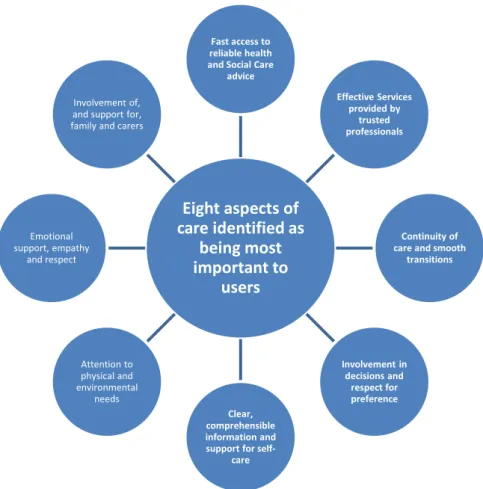
The Picker Institute (2009) reports the following eight aspects of care as being most important to users, as set out in table below.
Figure 1: Picker’s (2009) Eight Aspects of Care
What do we mean by user/carer or the Family Experience?
The Partnership Trust’s Health and Social Care staff are highly motivated and
committed to care for users and carers with compassion and dignity, identify strongly that they will care for users in a way they would want a member of their family to be treated. Users and their families are uniquely placed to judge the care that they receive and whilst we may think that we are doing a good job in terms of delivering a good user experience, the views of our users and carers may be entirely different. For the Partnership Trust it is important that we capture the views and opinions of users and carers about the services that we provide to become the provider of
Eight aspects of care identified as being most important to users Fast access to reliable health and Social Care
advice Effective Services provided by trusted professionals Continuity of care and smooth
transitions Involvement in decisions and respect for preference Clear, comprehensible information and support for
self-care Attention to physical and environmental needs Emotional support, empathy and respect Involvement of, and support for, family and carers
6
“Users experience of hospital is intrinsically difficult to grasp. It is richly textured and complex. By definition subjective, the experience is such that no one else can know how it works from one moment to the next, how the different aspects of the experience (the process of care, the manner in which it is delivered, the environment in which it occurs, the physical sense of the place) come together, or what they mean for this particular person at this particular moment in their life” (Kings Fund 2008).
Examples of user, carer and families’ experience of care are illustrated in Figure 2, below. Through the introduction of real time feedback, suggestions and comments are captured monthly empowering the people of Staffordshire to actively be involved in the change of culture through shaping the Health and Social Care model of care provided by the Partnership Trust.
National context
The NHS Constitution promotes ‘high quality care for all’. In setting out clearly what Professor Lord Darzi (Department of Health 2008) saw as the enduring principles and
values, the constitution provided clear signposting to the rights and responsibilities for users, public and staff. Key aspects of this important legislation are:
Figure 3: NHS constitution rights and responsibilities
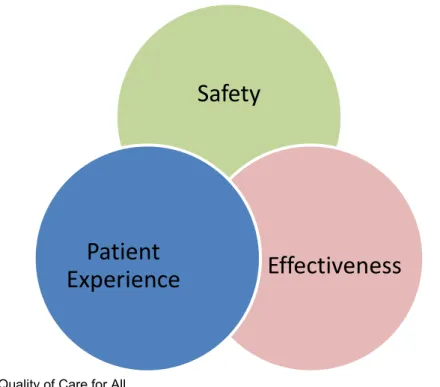
Figure 4: High Quality of Care for All
3. Purpose
While significant investment nationally has created new learning in relation to effectiveness and safety, our understanding of what matters to users in relation to their experience of Health and Social Care and how this can be improved is still
Strengthening accountability through
national standards for users Empowering and valuing staff Creating shared purpose, values and principles Empowering all users and the
public
Safety
Effectiveness
Patient
8
positive experience of Health and Social Care with an overarching indictor to clearly identify actions for improvements.
The Department of Health (2012) has published the NHS Users Experience
Framework, which outline the area’s most important to the user experience of Health and Social Care services. Improving the users experience is a key aim for all Health and Social Care providers. By asking, monitoring, and acting upon user and carer feedback, organisations are able to make improvements in the areas that users say matter most to them.
4. Vision
The vision of the Experience strategy is to promote and embed the experience as key elements in the following areas in line with the Quality Framework. This will promote and respect the user and carer’s values, preferences, and expressed needs. This will be developed through the following areas:
Cultural issues; the dignity, privacy and independence of service users; an awareness of quality-of-life issues; and shared decision making
Coordination and integration of care across the Health and Social Care systems
Information, communication, and providing an understanding on clinical status, progress, prognosis, and processes of care in order to facilitate autonomy, self-care and health promotion
Physical comfort including pain management, help with activities of daily living, within clean and comfortable surroundings
Emotional support and alleviation of fear and anxiety about such issues as prognosis, along with the impact of illness on users, their families and their finances
Welcoming the involvement of family and friends, on whom service users rely, in decision-making and demonstrating awareness and accommodation of their needs as care-givers
Transition and continuity of information that will help users care for
themselves. The Trust will coordinate, plan, and support every user and carer to receive ealth and Social Care services in the environment of their choice Access to care with attention for example, to receiving individualised care at the right
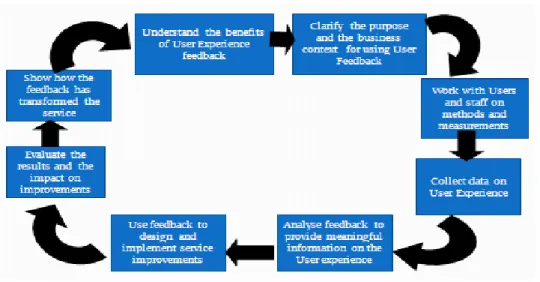
Figure 5: The User Experience Feedback – DOH (2011)
The users experience occurs at three primary levels:
Involving users and families in their own care and supporting them to make informed choices about their treatment and care
Using the user experience in a particular area to improve services
At a strategic level to ensure the public are able to actively contribute to the Partnership Trust strategic direction
Local context
High quality and safe user and carer experience remains the first priority of the Partnership Trust. The Partnership Trust is also working towards achieving Foundation Trust (FT) status. This will require intensive focus on continual
improvements within the experience of users and carers, access to services, and specific qualitative improvements across all aspects of clinical and non-clinical
services. The Partnership Trust is committed to listen and learn from users, staff and partners as we develop and deliver high quality Health and Social Care services to the people of Staffordshire.
This strategy will work alongside the Communication and Engagement Strategy and the Partnership Trust Annual Plan. This will provide key messages through a variety of effective communication tools. These will underpin principles which will guide our user and carer experience work programmes year on year:
10
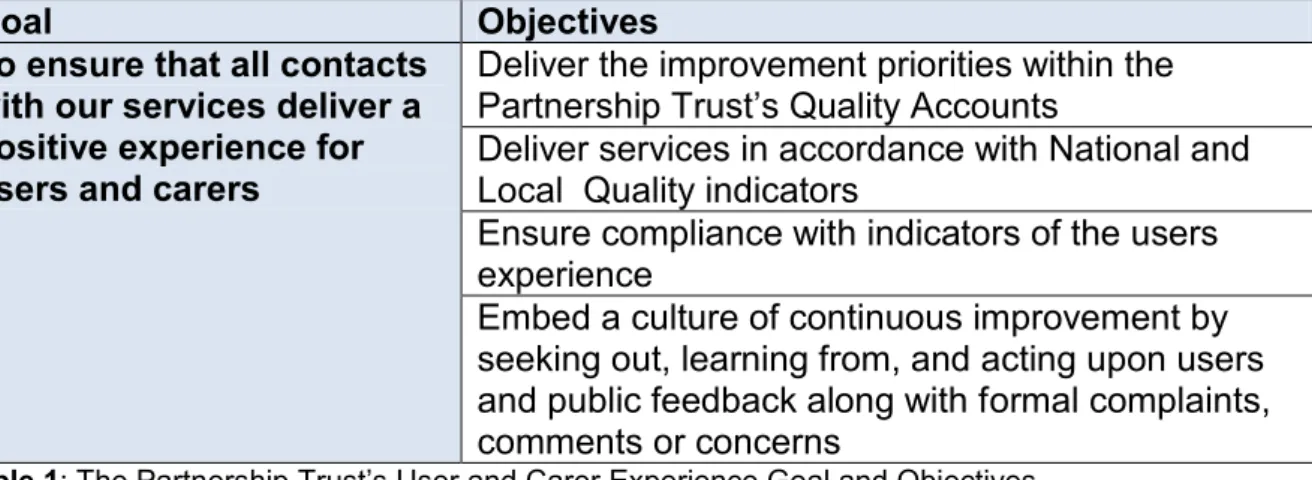
Table 1: The Partnership Trust’s User and Carer Experience Goal and Objectives. Equality and Diversity
Equality is about creating a fairer society in which everyone has the opportunity to fulfil their potential. Diversity is about recognising and valuing difference in its
broadest sense. Staffordshire and Stoke on Trent Partnership Trust are committed to promoting equality and challenging discrimination in all service provision, recognising and meeting the needs of the diverse communities we serve. Whilst every single person has their own individual needs, in some cases, for some groups of people, the Partnership Trust needs to go further to ensure access is equitable.
Working with partners
Whilst this strategy sets out how we will work to ensure that the user experience of the Partnership Trust is a positive one. We also understand that the experience of our Health and Social Care services make up only one stage of the whole user’s journey. We will therefore work closely with partners such as the Acute Hospitals, West Midlands Ambulance Services, Voluntary and Community Sector organisations to commission and develop accessible, appropriate and seamless services.
5. Aims and Objectives Measures 2013/14
The range and scope of objectives relating to the user and carer experience are understandably large. It is Staffordshire and Stoke on Trent Partnership Trust’s vision that a positive user and carer experience is integral to all we do as opposed to an added extra. This strategy is built around the 14 NICE Experience guidelines along with the Adult Social Care Outcomes Framework (ASCOF) which identifies the headline actions that will be undertaken to achieve them. Monitoring of work
programmes highlighted in the Strategy will be reviewed by the User and Carer Forum and reported to Quality Governance Committee and Partnership Trust Board. Aim and objectives
The National Institute for Health and Clinical Excellence (NICE 2012) have condensed the 65 recommendations contained in their User Experience Clinical Guideline into 14 quality statements along with the integration of the four standards of the Adult Social Care Outcomes Framework (ASCOF).
Dignity, Kindness and Compassion
Goal Objectives
To ensure that all contacts with our services deliver a positive experience for users and carers
Deliver the improvement priorities within the Partnership Trust’s Quality Accounts
Deliver services in accordance with National and Local Quality indicators
Ensure compliance with indicators of the users experience
Embed a culture of continuous improvement by seeking out, learning from, and acting upon users and public feedback along with formal complaints, comments or concerns
Partnership Trust Aim
No. NICE Service User Experience Outcomes
1 Users, carers and parents are treated with dignity, kindness, compassion, courtesy, respect understanding and honesty. Providing easier access to efficient services.
Objectives:
The Partnership Trust will capture the user and carer feedback from
Specialist Services, Community Teams, Children’s and Families services.
The Partnership Trust will achieve a monthly score of 95% through
real time user and carer reporting along with developing action plans for improvement.
Triangulation of complaints concerns and experience data will be
analysed to identify monthly trends and themes along with driving actions of improvement.
Monitoring of trends and themes will be immediately escalated as
an early warning signal for the implementation of onsite Quality visit.
Annual onsite external inspections will demonstrate the Partnership
Trusts compliance to the 57 standards of the Customer Service Excellence (CSE) Award.
A CSE central database will demonstrate evidence of best practice
and compliance to the 57 standards of every individual Health and Social Care team.
Real time reporting will capture the users and carers experience of
12
Measure
Aim Outcome Assurance
Mechanism
Date Users are treated with
dignity, kindness, compassion, courtesy, respect, understanding and honesty:
95% of all users /carers state that Partnership Trust staff are polite and courteous Monthly reporting to Safety and Effectiveness Groups, Quality Governance Committee and the Partnership Trust Board April 2013 Effective Interactions
First impressions influence the user and carer’s trust and confidence. This includes the professional appearance and attitude of every staff member. The courteous and helpfulness of staff, will ensure that every user receives a warm welcome and appropriate support and information throughout their interaction with Health and Social Care services. All staff members will maintain a positive approach where visitors do not feel intimidated to ask for help or information and staff members seek to attend to the needs of all visitors. These standards are expected for all
interactions with user’s and their families; whether they are verbal, face to face, over the telephone or written – and all staff will at all times consider the specific
communication needs of every users for example language, cognition and communication ability.
Partnership Trust Aim
No. NICE Service User Experience Outcomes
2 Users experience effective interactions with staff who have demonstrated competency in relevant communication skills.
Objectives:
The Partnership Trust to introduce the Mystery Shopper Programme across
the organisation and third party Contracts by 2013/14.
The Partnership Trust to introduce a Mystery Shopper Communication
monitoring tool by 2013/14.
70 users will be recruited to become Mystery Shoppers through the
introduction of an internal Mystery Shopper programme by 2014.
The Partnership Trust will review the written and verbal communication
through monthly rapid audit cycles and annual audits by 2014.
Communication tools will be monitored and gain consultation by its service
users. Including users for whom English is not their first language/sensory impairment/learning disabled/or low levels of literacy through the publication of easy read information.
The Partnership Trust to introduce Easy Read and Picture Surveys to be
implemented from April 2013 and reviewed annually with the Learning Disability Forums.
The Partnership Trust to provide Customer Service Excellence and a
Measure
Aim Outcome Assurance
Mechanism
Date Users experience
effective interactions with staff who have demonstrated competency in relevant communication skills. Monitor the number of PALS contacts and Complaints relating to communication
Monthly PALS and Complaints reporting
April 2013
Collate the number of Easy Read and Picture surveys across the Trust Monthly reporting to Safety and Effectiveness Groups, Quality Governance Committee and Trust Board
April 2013
Roles and Responsibilities
Users can often be confused by the myriad of people that they meet whilst in hospital and in community teams. Whilst uniforms often designate roles these can be
confusing. The elements of a role can also be difficult to appreciate and the need to have different staff involved for different reasons.
Partnership Trust Aims
Measure
Aim Outcome Assurance Date
No. NICE Service User Experience Outcomes
3 Users are introduced to all health and social care professionals involved in their care, and are made aware of roles and responsibilities of members of the health and social care teams
Objectives:
All Partnership Trust staff to wear name badges at all times
All Partnership Trust staff to introduce themselves and describe their role and responsibilities on the first initial contact with every user, carer or family member.
14
User Values and Beliefs
Different users will make different choices about their care based on their values and beliefs. They take into account their previous and current health and social care experiences and what is important to them. Users have a fundamental legal and ethical right to determine what happens to their own bodies and health and social care professionals must respect their views and decisions even if it differs from what they themselves believe.
Trust Aim
No. NICE Service User Experience Outcomes
4 Users have the opportunities to discuss their health and social care belief, concerns and preferences to inform their individualised care. Ensuring users receive high quality personal care and support
Measure
Aim Outcome Assurance
Mechanism
Date Users have opportunities to
discuss their health and social care concerns and preferences to inform their individualised care. Ensuring users receive high quality personal care and support
95% of all users /carers state that they were involved in their individualised care Monthly reporting to Safety and Effectiveness Groups, Quality Governance Committee and Partnership Trust Board April 2013
Objectives
: Every user will have an individualised plan of care specific to their individual needs
The Partnership Trust will provide quarterly data on the Patient
Empowerment CQUIN. This relates to the decision making of users within all aspects of their individualised plan of care
All Carers will be referred for a Carer Assessment dependent upon their
individualised needs
Triangulation of user and carer insight data will monitor any trends and themes which will be immediately escalated to ensure actions of
improvement are implemented
Users and carers recommendations/suggestions of improvements will be
captured and presented to Operational Teams to determine appropriate actions for improvements
Annual onsite external inspections to demonstrate compliance to the 57
standards of the Customer Service Excellence (CSE) Award
Quality announced and unannounced visits will review individualised care
Enable Users to live their Life that they want and be safe
The NHS Constitution informs users that they have the right to be given information about proposed care in advance, including any significant risks and any alternative treatments which may be available, and the risks involved in doing nothing
(Department of Health 2012), thus enabling an informed choice. Once users have the information they require, health and social care professionals play a critical role in discussing the views and wishes of the users so that choices made about their care fully reflect their wishes and beliefs.
Trust Aim
No. NICE Service User Experience Outcomes
5 Users are supported by health and social care professionals to understand relevant treatment options, including benefits risks and any potential consequences. Enabling users to live the life they want and be safe.
Objectives
:
95% of all users undergoing treatment and care are given all of the
accurate information they require in a format they can understand, to enable them to make informed choices
The Partnership Trust consent policy provides clear and precise
information upon consent which all staff adhere to demonstrate compliance by April 2013
Maintain the Partnership Trust’s Customer Service Excellence
accreditation under the Information Standard scheme and further developing its range and scope of information leaflets by March 2014
95% of User, Carer and Family members are provided with adequate
information including any risk assessments to be empowered to make informed choices about their care or treatment. Health Care Professionals will provide advice through scheduled face to face meetings, telephone advice or written information at the request of the User/Carer or Family member
The Partnership Trust will provide a duty of candour clearly identifying to user and carer any potential risks within their lifestyle choices through multi-professional meetings
All Professionals will incident report to constantly improve the safety culture across the Partnership Trust
16
Measure
Aim Outcome Assurance
Mechanism Date
Users are supported by Health and Social Care professionals to understand relevant treatment options, including benefits risks and any potential
consequences. Enabling users to live the life they want and be safe.
95% of all users undergoing
treatment and care are given all of the accurate information they require in a format they can understand, to enable them to make informed choices. Monthly reporting to Safety and Effectiveness Groups, Quality Governance Committee and Partnership Trust Board March 2014 Shared Decision
Shared decision making is a process in which clinicians and users work together in partnership taking into account the user’s wishes, beliefs and views; clinical
evidence; treatments and options available; and the desired outcomes. There is also compelling evidence that those users who are active participants in managing their Health and Social Care has better outcomes than users who are passive recipients of care (Coulter and Collins 2011).
Shared decision making may involve a degree of negotiation between professionals and users where the professional brings the Health and Social Care expertise and the users experience of living with their condition and the knowledge of the
circumstances in which they live and their lifestyle. As in Objectives 4 and 5, users need to be given the information they need to support them to make informed choices about their care and treatment and given time and support to discuss their views, and preferences.
No. NICE Service User Experience Outcomes
6 Users, carers and Parents are actively involved in shared decision making and supported by Health and Social Care professionals to make fully informed choice about investigations, treatment and care that reflect what is important to them. Enabling users to take personal responsibility.
Objectives:
95% of users state that they are fully involved in shared decision making at key
decision points in the users care pathways
To review the way that shared decision making is recorded in user’s care plans
through the rapid audit cycles
To ensure that the Users Constitution Rights are displayed and shared with all
Measures
Aim Outcome Assurance
Mechanism
Date Users, carers and Parents are
actively involved in shared decision making and supported by Health and Social Care professionals to make fully informed choice about
investigations, treatment and care that reflect what is important to them. Enabling users to take personal responsibility
95% of users state that they are fully involved in shared decision making at key decision points in the users care pathways Monthly reporting to Safety and Effectiveness Groups, Quality Governance Committee and Partnership Trust Board March 2014
Every Trust location to display leaflets on the NHS
Constitution rights for Users and Carers
Quality Visits March 2014
Consent
The NHS Constitution states users have the right to accept or refuse treatment that Is offered, and not to be given any physical examination or treatment unless they have given valid consent. If they do not have the capacity to do so, consent must be obtained from a person legally able to act on their behalf or the treatment must be in their best interests (Department of Health 2012).
No. NICE Service User Experience Outcomes
7 Users are made aware that they have the right to choose accept or decline treatment and these decisions are respected and supported. Enabling people to be as
independent as possible
Objectives:
To support users to make informed decisions about their care and
treatment
Supporting people who lack mental capacity either temporarily or for the
longer term through enabling others to make decisions on their behalf if that is in their best interests
18
Measures
Aim Outcome Assurance
Mechanism Date
Users are made aware that they have the right to choose accept or decline treatment and these decisions are respected and supported. Enabling people to be as independent as possible
95% of all Health and Social Care Health Professionals are trained in Mental Capacity and DOLS training. Monthly reporting to Safety and Effectiveness Groups, Quality Governance Committee and Partnership Trust Board March 2014
Rapid audit cycles identify consent obtained in the care plan
Annual March 2014
Second Opinions
Any user can ask a Health or Social Care professional for a second or further opinion and the request should be supported. The General Medical Council (2006) states “in providing care you must respect the user’s right to seek a second opinion.
Partnership Trust Aim
No. NICE Service User Experience Outcomes
8 Users are made aware that they can ask for a second opinion
Objectives:
• The Partnership Trust will actively support users who are requesting a second opinion
• User Constitutional Rights Information literature to be clearly displayed in all health centres and Community Hospitals by July 2013
Measure
Aim Outcome Assurance
Mechanism
Date Users are made aware that they
can ask for a second opinion
Every Trust location to display leaflets on the NHS
Constitution rights for Users and Carers
Quality Visits March 2014
Responsive to the needs of Users and local communities
The care of every users should be tailored to their needs and personal preferences, taking into account their circumstances, their ability to access services and their coexisting
conditions Whilst every single person has their own individual needs, in some cases and for some groups of people the Partnership Trust needs to go further to ensure access and care is equitable. The specific needs of individual users who access Partnership Trust services must be considered and taken into account when planning care. This will include taking into account people’s physical and learning disabilities, sensory impairment, language and communication difficulties, and religious beliefs. The Partnership Trust aims to provide quality Health and Social Care to all users, regardless of their individual needs. We
recognise those users may face barriers in accessing our services and these barriers may change for them over time. In order to provide quality Health and Social Care we will ensure that all potential discrimination is removed through carrying out equality impact assessment screening and full equality impact assessments were necessary.
Partnership Trust Aim
No. NICE Service User Experience Outcomes
9 User care is tailored to their needs and personal preference taking into account their circumstances, their ability to access services and coexisting circumstances. Creating a seamless experience for users between Health and Social Care. Providing a
modern, responsive, and consistently high standard of care which is responsive to the needs of Users and local communities and is based on identified and/or evidenced needs
20
Measure
Aim Outcome Assurance
Mechanism Date
User care is tailored to their needs and personal preference taking into account their
circumstances, their ability to access services and coexisting circumstances
Monthly performance data on home visits/ Outpatient
Appointments
PALS and Complaint monthly trends and themes Monthly User and Carer Reports April 2013
Nutrition, Hydration and Pain Relief.
Users have a wide range of varying needs during their treatment. Assumptions cannot be drawn and health and social care teams need to continuously assess the needs of their users through partnership with them. In the Essential Standards of Quality and Safety (2010) the Care Quality Commission outlines its expectations of organisations that planning and delivery of care will meet individual needs, ensure welfare and safety, reflecting appropriate research and guidance and make
reasonable adjustments to meet individual needs.
Objectives
:
The Partnership Trust will ensure the layout of Health Centres, Hospital and
Healthcare in Prison locations are accessible for all users. The Equality Act re-enforces the requirements of the Disability Discrimination Act.
Provide information in an accessible format such as Braille, large print or email. Reasonable adjustments for blind or partially user could include providing information in large print or Braille
To demonstrate compliance to the Trust equality and diversity structure
and Single Equality Scheme. This will be monitored by the CHAN group upon review of equality impact assessments upon the Partnership Trust work programmes
Demonstrate compliance to the Equality Act 2010 which covers nine
"protected characteristics". These are age, disability, gender reassignment, being married or in a civil partnership, race, religion or belief, sex and sexual orientation
Users to be offered with support to maintain their spiritual belief with in a Community, Hospital or Prison setting
All users to be placed at the heart of service provisions and be provided with individualised plans of care. This will be monitored through the annual records audits
Partnership Trust Aim
No. NICE Service User Experience Outcomes
10 Users have their physical and psychological needs assessed and addressed, including nutrition, hydration, pain relief, personal hygiene and anxiety.
Measure
Aim Outcome Assurance
Mechanism Date
Users have their physical and psychological needs assessed and addressed, including nutrition, hydration, pain relief, personal hygiene and anxiety
95% of Inpatients state that they are provided with excellent choice of food and beverages through real time reporting Monthly User and Carer Reports April 2013
Objectives
:
Every user will gain a holistic assessment of their individual needs through collating and documenting the user’s case history upon the Single
Assessment documentation
Every user will be assessed within 24 hours of admission or upon their
initial visit through evidenced based assessment tools in accordance to best practice. The appropriate assessment tools will be dependent upon the individual needs of the user and clinical reasoning of the Health or Social Care Professional
100% monthly compliance of all wards and community teams through the
quality dashboard upon assessment and quality of care
Every user will gain appropriate on-going assessments and evaluation
dependent upon their individual needs which is clearly documented within their plan of care.
The user’s preference beliefs and wishes will be clearly documented in
every user’s plan of care
Ever user will have clearly documented rehabilitation goals which will be
devised with the user and carer. The individualised care plan will ensure continuity of care upon the user’s individual needs personal preference and beliefs
LINK Food Watch Project will implement on site observations on the quality
of food and beverages users receive within the Trusts care
95% of Inpatients will score the Partnership Trust of providing excellent choice of food and beverages through real time reporting
Matron’s onsite observations will monitor the quality of food/ beverages and
serving across all Community Hospital sites
PLACE onsite user assessments upon the Community Hospital sites from
April 2013.
22
Partnership Trust Aim
Measure
Aim Outcome Assurance
Mechanism
Date Users experience continuity of
care delivered whenever
possible by the same healthcare professional or team throughout a single episode of care
95% of all users to state that they were “extremely satisfied” with the quality of care
Monthly User and Carer Reports
April 2013
Coordinated Health and Social Care
Multidisciplinary team working is crucial to ensuring an integrated approach to personalised care planning, especially for those with complex care needs that are more likely to require care from a range of different agencies/Health and Social Care staff. Whilst this is crucial at all stages of the user’s journey, it has been shown to be particularly important when care is transferred between organisations on discharge.
No. NICE Service User Experience Outcomes
12 Users experience coordinated care with clear and accurate information exchange between relevant Health and Social Care professionals. Reducing Health and Social Care inequalities
No. NICE Service User Experience Outcomes
11 Users experience continuity of care delivered whenever possible by the same healthcare professional or team throughout a single episode of care.
Objectives
:
To improve the flow of users through care pathways to ensure that users are
cared for in the right place at the right time and by the right people through multidisciplinary teams
The Partnership Trust to introduce Integrated Long Term Condition Health and
Social Care Community Teams in July 2013. With the introduction of integrated teams this will improve the continuity of care and integration of health Social Care and external partners.
The Partnership Trust to introduce the Children’s and Young Family division
across the health economy
95% of users to state that they are extremely satisfied in the quality of care
The Partnership Trust to capture and monitor compliments along with positive real
time feedback of users within continuity of care
Objectives
:
95% of users/carers to identify that they have received a positive and safe
discharge from the Partnership Trust.
The Partnership Trust to ask every user/ carer to complete randomised along
with the Family and Friendly Test upon discharge from community services.
The Partnership Trust to gain an overall monthly net promoter score from users
and carers of +72.14
The introduction in May 2013 of User and Carer Comments cards upon their
Measures
Aim Outcome Assurance
Mechanism Date
User experience coordinated care with clear and accurate information exchange between relevant Health and Social Care professionals. Reducing Health and Social Care inequalities
The Partnership Trust to achieve a 10 point improvement in Q4 of the net promoter score from the April 2013 baseline Monthly User and Carer Reports April 2013 Sharing Information
It should be clarified with the user at the first point of contact whether and how they would like their partner, family members and/or carers to be involved in key
decisions about the management of their condition and how they would like this to happen. There will be some cases where the user does not wish their information to be shared with the family or with friends and in these cases the staff need to ensure they deal with this sensitively, respecting the users confidentiality without seeming difficult or obstructive. Family and friends that will have a significant caring role to play in the users care when they return home will need to have the information they need to enable them to fulfil this role and again this needs to be discussed with the user.
Young carers (usually aged 5-18) who have a significant caring role are also likely to need to have information shared with them to enable them to carry out their caring role, but it may need to be delivered in an entirely different format or at a different level to that usually given to an adult carer.
Partnership Trust Aim
No. NICE Service User Experience Outcomes
13 Users’ preferences for sharing information with their partner’s family members and/or carers are established, respected and reviewed throughout their care. People to be active citizens and live “normal” lives taking control of their own care
Objectives
: Every user will be clearly asked upon admission or upon the first initial visit key issues relating to the sharing of information which will be clearly documented in the plan of care
Every user will be assessed within their mental capacity dependent upon their
individual needs
The Partnership Trust to receive a score of 95% upon the involvement and
24
Measures
Aim Outcome Assurance
Mechanism Date
Users’ preferences for sharing information with their partner’s family members and/or carers are established, respected and reviewed throughout their care. People to be active citizens and live “normal” lives taking control of their own care
95% of Carers provide positive feedback upon their involvement and quality of care of their family member’s experience Monthly User and Carer Reports April 2013
100% of all Carers are offered an a Carers assessment which is clearly documented in the plan of care
Performance data
March 2014
Rapid audit cycle of the users plan of care
Annual reporting
March 2014. Contact Details
Users discharged following care and treatment can often feel very vulnerable, and this can be alleviated if they are only given a name to contact on discharge or for emergency out of hours support. In some cases the appropriate signposting will be to the GP, it should be made clear to the user of any emergency contact numbers for out of hours
Partnership Trust Aim
No. NICE Service User Experience Outcomes
14 Users are made aware of who to contact, how to contact them and when to make contact about their on-going Health and Social Care needs.
Objectives:
Discharge information along with the formatting will be reviewed on Quality
Visits to ensure it is accurate and contains correct contact details for all users
Operational Teams to provide all appropriate contact details upon their first visits or admission to Hospital sites
Measure
Aim Outcome Assurance
Mechanism Date
Users are made aware of who to contact, how to contact them and when to make contact about their on-going Health and Social Care needs.
95% of users will know who to contact for Out of hours services on admission and who to contact following discharge
Quality Visits April 2013
Rapid Audit cycle of
care plans Quality reports March 2014 CQUINs 2013/14
Net Promoter Question/Family and Friends Test
NHS Midlands and East have introduced the ‘Net Promoter’ question as a method of determining the level of user satisfaction in an organisation and this is now being rolled out nationally. One benefit of applying the Net Promoter Score to the NHS lies in its abilities to measure positive ‘word of mouth’; to understand an outcome of user experience using a simple understandable metric that has been used for many years in business and commerce and to track changes in user experience over time. The Net Promoter Score is obtained by asking user’s a single question, “How likely is it that you would recommend this service to friends and family?” Based on their responses, customers are categorised into one of three groups: Promoters,
Passives, and Detractors. The percentage of Detractors is then subtracted from the percentage of Promoters to obtain a Net Promoter score (NPS). NPS can be as low as -100 (everybody is a detractor) or as high as +100 (everybody is a promoter). This takes into account that a number of users may report that they had a reasonable experience, which could be interpreted in traditional surveys as being a positive experience, but if asked to recommend a service, they would more likely be a “passive” responder. Only those that are “promoters” should be considered to have had a good experience.
In the 2013/2014 CQUIN scheme, this question is expected to be asked randomised along with upon discharge for the Community Hospital sites along with every health and social care community team. Data is filtered monthly to ensure the overall score only contains data from adults of 18 and over. The data is submitted to the
Partnership Trust Board on a monthly basis. The Partnership Trust will then be expected to demonstrate a 10 point improvement from the baseline to quarter four. The Partnership Trust is an early implementer of the Department of Health national initiative of the family and friends test across NHS community providers.
26
Objectives:
The Partnership Trust to publish the monthly Net Promoter Score on the SSOTP
website
A minimum of 1000 surveys to be captured a month by the Partnership Trust in
accordance to the Commissioners Quality Schedule of contracts for 2013/14
Every Community team to have an individual net promoter score for monthly
monitoring and comparative data
Community Team/Ward will receive a user and carer experience individual report
and develop actions of improvement from the collection of data
The Partnership Trusts net promoter score to be shared with other NHS
organisations for Foundation Trust Bench Marking. The national benchmarking average score is +72.10
Monthly gold, silver and bronze User Experience certificates are awarded to
individual teams to demonstrate their monthly achievements of the Family and Friends Test to acknowledge their success
The Partnership Trust to provide monthly CQUIN Reports upon the family and
friendly test to demonstrate achievement to the set milestones upon themed questions
Knowing how we are doing
The Partnership Trust is committed to ensuring all of its users have a good experience. The key to developing a reliable and informative picture of user’s
experiences of our services is to ensure a range of feedback is gathered in a variety of ways and at different times. Quantitative and qualitative information is vital and when considering the actions listed above alongside the detailed overarching action plan, a varied ‘toolbox’ of data collection methodologies is required. There is real value in collating this information across the Partnership Trust to benchmark services, measure performance, inform commissioners about service quality, improve public accountability and provide evidence for regulators
Objectives
:
• Monthly Quality schedules data for Contracts 2013/14 • Monthly User and Carer reports to the Commissioners
• CQUIN monthly monitoring for the User and Care Experience of service provisions
• Development and introduction of a systematic approach to listening, responding, sharing and learning from feedback from NHS Choices. • Patient Opinion website
• Monthly Regional Community Foundation Trust (CFT) benchmarking • KO14 Formal Complaints audit by the Department of Health
• Monitoring of monthly Parliamentary Health and Local Government Ombudsmen
• Annual Customer Service Excellence compliance through onsite external inspections
• Mentor and Care Quality Commission (CQC) basic standards of compliance audits
• Unannounced inspections by CQC or Mentor
• LINk Enter and View unannounced onsite inspections • Directors and Commissioners quality visits
• Introduction of the national DOH Patient Lead Assessor Care Environment (PLACE) programme
Patient- Led Assessment of the Care Environment – PLACE
Patient Led Assessor Care Environment
From the 1st April 2013, Staffordshire and Stoke on Trent Partnership NHS Trust has implemented the introduction of PLACE, which is the new system for assessing the quality of the user’s environment. This Department of Heath PLACE programme will replace the old Patient Environment Action Team (PEAT) inspections. The initial PLACE programme has implemented assessments which have been applied to hospitals, outpatients and day treatment centers which provide NHS funded care. The Partnership Trust has provide publication through local media along with inviting voluntary organisations to work in collaboration with our health care professionals to help assess the quality of our patients environment, particularly in the five community hospitals sites.
A Patient Assessor can be anyone who has visited our community hospitals as a service user or patient, relative, carer, friend, patient advocate, or even a volunteer. The Partnership Trust has also invited Non- Executive Directors to participate in the onsite PLACE assessments.
The role of the user assessor is to be objective and unbiased; have a clear
commitment to quality and most of all those who are determined to help the Trust as a provider of NHS-funded care to improve and for assessors to be prepared to make their voices heard in a constructive and supportive way.
The introduction of onsite assessment will enable members of the PLACE
assessment team to observe and provide a score on user’s privacy and dignity, food, cleanliness and general building maintenance within any of our five community hospital settings. All observations and scores were actually upon the volunteers observations at that time of the assessment.
The scoring will be based on what the volunteer assessors observe on a set day where they have been accompanied at all times by health and social care
professionals. Every onsite assessment consists of a PLACE team that contains 50% volunteers and 50% staff.
National guidance has been distributed from the Department of Health which is the initial training programme. The PLACE assessment does not cover any observations of clinical care or treatment. The programme does not include any review of the
28
Onsite Place Assessments
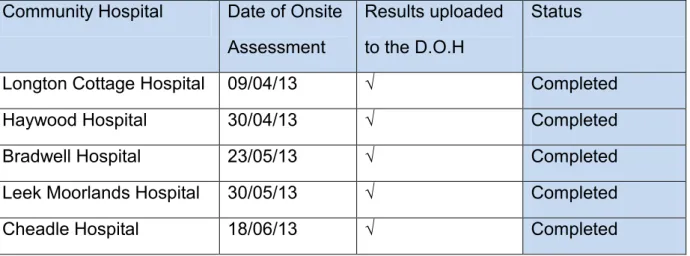
The following Community Hospital sites identified in the table below have all
completed the PLACE onsite assessments. Following the assessments the results have been uploaded onto the Department of Health (DOH) database for analysis. Table 1: Completed onsite PLACE Assessments.
Community Hospital Date of Onsite Assessment
Results uploaded to the D.O.H
Status
Longton Cottage Hospital 09/04/13 √ Completed
Haywood Hospital 30/04/13 √ Completed
Bradwell Hospital 23/05/13 √ Completed
Leek Moorlands Hospital 30/05/13 √ Completed
Cheadle Hospital 18/06/13 √ Completed
PLACE Results for the Trust.
The results for the Trust are published on the DOH analysis and publication website. To ensure that all our Users and Carers are fully aware of the Trust results they are also available to view on the Staffordshire and Stoke-on-Trent NHS Partnership Trust Website.
Hospital Site Cleanliness Food Privacy/Dignity/ Well Being Conditions/Appearanc e /Maintenance Bradwell 97.12% 93.96% 86.25% 97.03% Cheadle 93.09% 91.58% 96.15% 95.41% Haywood 99.56% 91.36% 98.71% 97.13% Longton Cottage 96.98% 93.16% 90.72% 94.40% Leek Moorlands 98.10% 92.60% 91.49% 96.71%
From the results every Community Hospital sites has devised an action plan of service improvements.
Next Steps for the Patient Experience Programme.
The Trust will be rolling out the scheme into the Health Centre across Staffordshire which is not a national development but a Trust commitment to ensure the voices of all our Users and Carers are heard. The Trust will be developing the assessment tools to ensure we can use a similar scoring outcome to ensure that the Trust is providing high quality services closer to home in the location of our patient choice. Complaints, comments, concerns and compliments
Complaints and other feedback mechanisms offer a valuable chance for the Partnership Trust to understand how our services are performing. The number of complaints should not be seen as a marker in itself to how well or how poor the service is perceived but repeated trends and issues should be addressed to stop them from reoccurring. The Partnership Trust has recently reviewed its process and policies for responding to Health and Social Care complaints following feedback from users, regulators and staff through integrated workshops.
PALS are currently at the forefront of the organisation resolving contacts with 24 hours or signposting users to the relevant services or providing information. NHS Choices and Patient Opinion can be a rich source of qualitative user
experience data and the information is in the public domain so can significantly affect the public perception of the organisation.
30
Comment cards
To expand the methodology of capturing the user, carer and family experience pre- paid anonymous comment cards have been introduced. Comment cards have been used successfully in a number of areas, particularly women and children’s services. The beauty of these cards is in their simplicity in that it asks very simple open
questions “What did we do well?” and “What could we do better? The comments left are used to identify issues that potentially would be considered minor by the user to complain or where the overall experience has been positive but where one issue has been identified. Many of the cards may contain very positive comments, these can be a great boost for staff that otherwise may not have been aware so many of their users were very happy with their experience.
Objectives
:
• Comment cards to be distributed and piloted across community teams. • Findings and outcomes will be displayed within the departments, Health
Centres and Community Hospital sites. This will ensure that users, carers or families will know that their comments are valued, using the “You said- We did” format
Objectives:
• The Partnership Trust to introduce a centralised Customer Service Department • The introduction of a management of change structure to review existing roles
and skill mix for the introduction of new Customer Service roles.
• PALS to be visible, accessible, and on site in the Community Hospitals sites through a robust rotational plan.
• The introduction of the Customer Relations and Complaints Policy along with robust Complaints, PALS and Experience Standard Operating Procedures. • The Partnership Trust to demonstrate 100% compliance to the National
Complaints and PALS targets.
• All formal complaints to have response timescales agreed with the complainant in accordance to Health and Social Care Complaint Regulations.
• All complaints and PALs concerns to be severity scored for immediate escalation of all high risk complaints for Director Leadership.
• All complaints investigation reports along with response letters to be quality assured and signed by the Chief Executive.
• The introduction of external complaint panels for the approval of all closed complaints
• The Partnership Trust to introduce independent Investigating Officers for high risk complaints in accordance to the complaints statutory criteria
• The Partnership Trust to publish complaint reports through consent of complainant upon the Trust Website along with actions of improvement. • Monitoring of the Local Government Ombudsman and Parliamentary Health
Ombudsman upon complaints upheld for the Partnership Trust along with recommendations for improvement.
• Utilisation of the Patient Opinion Website with responses to comments been answered in a timely response by the Customer Service Department by November 2013
6. Implementation
Overall approach to implementation
The Nursing and Quality Directorate will coordinate this annual strategy and the key priority areas for each year. The plan will contain actions shared across other
directorates. The implementation of this strategy will:
The basis of the patient experience strategy for 2013-2014 and will be linked to the Effectiveness and Safety strategies by the overarching Quality Framework. Form the basis of a phased approach for subsequent years, ensuring progress
against each of the theme areas while maintaining in-year flexibility for responding to quality issues
Supporting strategies and work streams for implementation
Key strategies and work streams to implementation, which will be developed by the Quality Directorate, are:
Safety Strategy
Effectiveness Strategy Experience Strategy
Quality Assurance Programme
Supporting strategies and work streams above provide detail on policies, systems and processes that will be developed or refined to achieve the six quality goals in this framework.
7. Monitoring
Monitoring the implementation of the Safety Strategy under the Quality Framework
The experience strategy will be submitted to the Quality Governance Committee and thereafter will be monitored under Safety and Effectiveness Operational
arrangements.
Monitoring the experience of care
Monitoring of the experience of care will take place primarily using the real time reporting on a monthly basis at a team level. Audits and multiple methods of testing
32
After consulting and involving staff, service users and carers we will draw the priorities for each year’s quality account from this framework
The Experience Strategy has been sent for consultation to all voluntary and
charitable organisations and members of the User and Carer Forum. Consultation around the experience strategy has been undertaken and comments noted and acted upon.
The Service User Experience Strategy will provide a valuable information stream for the annual quality account and will also feed into Quality Framework annual report. This will summarise the progress that has been made in implementing the
framework.
The user and carer experience is monitored by the Trust Board on a monthly basis, and the strategy will be driven by the Quality Governance Committee.
Detailed implementation actions are included in the Quality Framework Implementation Plan
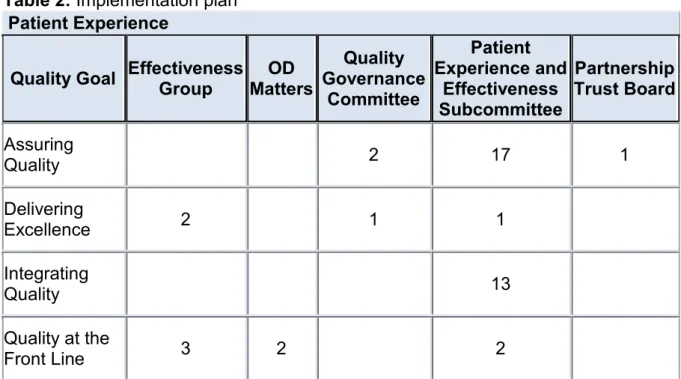
The brief summary of the implementation in table 2 below identifies the number of actions in the quality framework linked to this experience Strategy, by quality goals along with Monitoring Committee.
Table 2: Implementation plan Patient Experience
Quality Goal Effectiveness Group Matters OD
Quality Governance Committee Patient Experience and Effectiveness Subcommittee Partnership Trust Board Assuring Quality 2 17 1 Delivering Excellence 2 1 1 Integrating Quality 13 Quality at the Front Line 3 2 2
Equality Assessment
STEP 1: What is the background and starting point for this policy?
The Partnership Trust’s primary objective over the next five years is to have fully integrated its Health and Social Care services to drive up the quality of care and services provided and to deliver our five strategic goals. All of this is detailed within the Quality Framework. The Experience Strategy is one of the strategies that is required to support implementation of the Quality Framework.
STEP 2: What do we want to achieve?
The Experience Strategy sets out how we are to achieve our Experience aims within 2013-14. Each aim includes the objectives and measurement outcomes for the year. On the basis of the aims, definition of experience, and strategic goal areas it is evident that all staff, service users, and carers will be affected by the development and implementation of this strategy.
STEP 3: What do we know?
Procedural documents should not be developed in isolation and their introduction should be balanced against the priorities of the Partnership Trust. These help to clarify strategic and operational requirements and they can improve the experience work programmes and increase the successful achievement of objectives.
This strategy is being developed to support the implementation of the Quality Framework.
STEP 4: What consultation has been taken: engagement and involvement
The Experience Strategy has been sent for consultation to all voluntary and charitable organisations and members of the User and Carer Forum. Consultation around the experience strategy has been undertaken and comments noted and acted upon.
STEP 5:
The Experience Strategy is not anticipated to have any differential impact on equality groups. The introduction of the strategy will ensure that we are providing information and recording evidence against each equality group across Staffordshire
This policy is applicable to all staff with the aim to promote a single consistent approach, avoiding confusion. Advice on this policy is available with a view to
34
Resources are available to provide advice and support on this policy which will be available to all members of staff.
STEP 7: How will we know that the policy has been successful?
Monitoring the progress against the strategy measures will take place primarily via the appropriate committees. Monitoring of the overall strategy will take place at the Effectiveness Group.
STEP 8: Executive Summary
Due regard has been taken into the development of this strategy as all staff, service users, and carers will be affected by the implementation of the strategy. An equality assessment has been conducted in line with organisational requirements for