Title
Development and evaluation of a master-slave robot system for single-incision laparoscopic surgery
Authors
Yuki Horise, Atsushi Nishikawa, Mitsugu Sekimoto, Yu Kitanaka, Norikatsu Miyoshi, Shuji Takiguchi, Yuichiro Doki, Masaki Mori, and Fumio Miyazaki
Corresponding Author Atsushi Nishikawa
Shinshu University, Tokida 3-15-1, Ueda, 386-8567 Japan E-mail: [email protected]
Telephone number: +81-268-21-5617 Fax number: +81-268-21-5511
Affiliation
Y. Horise, Y. Kitanaka, F. Miyazaki
Osaka University, Graduate School of Engineering Science, Department of Mechanical Science and Bioengineering, Toyonaka, Japan
A. Nishikawa
Shinshu University, Faculty of Textile Science and Technology, Division of Mechanical Engineering and Robotics, Ueda, Japan
M. Sekimoto, N. Miyoshi, S. Takiguchi, Y. Doki, and M. Mori
Osaka University, Graduate School of Medicine, Department of Gastroenterological Surgery, Suita, Japan
Abstract Purpose
Single-incision laparoscopic surgery (SILS) brings cosmetic benefits for patients, but this procedure is more difficult than laparoscopic surgery. In order to reduce surgeons’ burden, we have developed a master-slave robot system which can provide robot-assisted SILS as if it were performing conventional laparoscopic surgery and confirmed the feasibility of our proposed system.
Methods
The proposed system is composed of an input device (master side), a surgical robot system (slave side), and a control PC. To perform SILS in the same style as regular laparoscopic surgery,
To validate the proposed system, we defined four operating conditions and conducted simulation experiments and physical experiments with surgeons under these conditions, then compared the results.
Results
In the simulation experiments, we found learning effects between trials (p=0.00013<0.05). Our proposed system had no significant difference from a condition simulating classical laparoscopic surgery (p=0.23>0.1), and the task time of our system was significantly shorter than the simulated SILS (p=0.011<0.05). In the physical experiments, our system performed SILS more easily, efficiently, and intuitively than the other operating conditions.
Conclusion
Our proposed system enabled the surgeons to perform SILS as if they were operating conventionally with laparoscopic techniques.
Keywords
master-slave, single-incision, laparoscopic surgery, flexing instrument
Introduction
Laparoscopic surgery is performed with slender surgical instruments and a laparoscope, which are inserted through multiple incisions in the abdomen. As this method is less invasive than conventional open surgery, the patient suffers fewer incisions, thus providing them a high Quality Of Life (QOL) [1-2]. Recently, a new method, called single-incision laparoscopic surgery (SILS), has been used in several operations following advances in less invasive surgery. SILS has a cosmetic advantage in that the scar is concealed within the umbilicus because the laparoscope and surgical instruments are inserted through a single incision [3]. This method has been used for many operations including splenectomies [4], colorectal resections [5], and cholecystectomies [6]. Sometimes surgeons perform SILS with a surgical robot system; for example, the da Vinci Surgical System (Intuitive Surgical Inc.) [7-10].
However, besides the difficulties found in conventional laparoscopic surgery, namely the difference between the viewing spot and the operating spot, SILS has other problems: the narrowness of the surgeon's hands' operating range, the interference between the laparoscope and surgical instruments, and the visual obstruction of the surgical site caused by the surgical instruments, thus increasing surgeons' burden. To reduce their burden, we propose and develop a master-slave robot system that can perform SILS as if a surgeon were performing conventional laparoscopic surgery. Furthermore, we evaluate the validity of the system by simulation experiments and physical experiments.
while observing the laparoscope's view. Robotic instruments attached to robotic arms on the slave side are controlled by the input instruments through the control PC, and these instruments are inserted through a single incision point so as not to interfere with each other.
Input
instruments Incision point
Control PC monitor Patient Robotic instruments Laparoscope Single incision Slave side Master side Magnetic sensor system
Fig. 1 System overview
Manipulation method
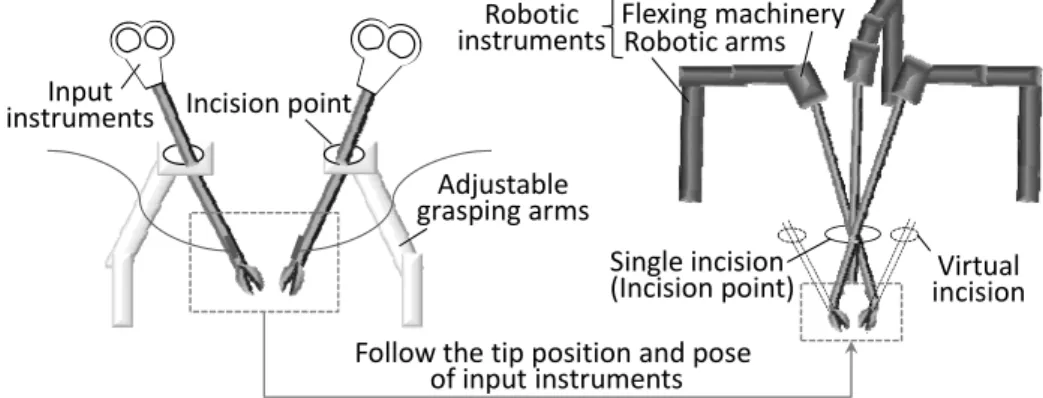
Input instruments are also inserted into multiple incisions to perform SILS in the same manner as conventional laparoscopic surgery. Each instrument can move around a fixed incision point. This system can adapt to individual variations among surgeons because the position of the incision points can be freely changed by adjusting the grasping arms.
Control method
Control commands are sent to the robotic arms and flexing machinery through the control PC as the surgeon operates the input instruments. The tip position and pose of the left-hand (right-hand) robotic instrument on the slave side follow those of the right-hand (left-hand) input instrument on the master side; in other words, the robotic instruments move exactly like the input instruments, as seen in Fig. 2. Hence, the surgeon does not need to consider which instrument he/she should utilize during the operation.
Incision point Input instruments Adjustable grasping arms Single incision
(Incision point) incisionVirtual Follow the tip position and pose
of input instruments Robotic arms Flexing machinery Robotic
instruments
System configuration
Master side
The input device on the master side consists of input instruments, adjustable grasping arms, and a magnetic sensor system (3D-Guidance by Ascension Technology Corporation) that can provide information regarding the position and pose of the input instruments. This information is used to control the slave system. The adjustable grasping arms are made of resin to eliminate the effects from metallic distortions for EM tracking.
Slave side
The surgical robot system is made up of flexing robotic instruments, robotic arms which locate and control the robotic instruments, and a monitor which shows the laparoscopic image. We use ZEUS surgical system (Computer Motion Inc), which is actually applied the conventional laparoscopic surgery, as the robotic arms [11].
For the flexing machinery, we have developed a bending surgical instrument with multiple degrees of freedom. The tip of this instrument, flexed by commands from the control PC, can achieve a flection range of 60 degrees. The bending stiffness is sufficient to perform surgeries. This instrument is composed of an existing bending instrument (Realhand by Novare Surgical Inc), three stepping motors, and a control board. The three stepping motors, whose wires are tightened or relaxed by commands from the control PC, are attached to the holding section of the flexing instrument; thus, the flexing instrument on the slave side allows the same motion as the input instrument on the master side, and its tip can be bent remotely. In addition, the flexing instrument has a safety mechanism: motors tick over when the flexing instrument is overloaded so that the instrument will not get broken, and the reduction ratio is high so that the instrument will not damage its surroundings when the power is turned off and flection is released.
Evaluation experiment Experiment conditions
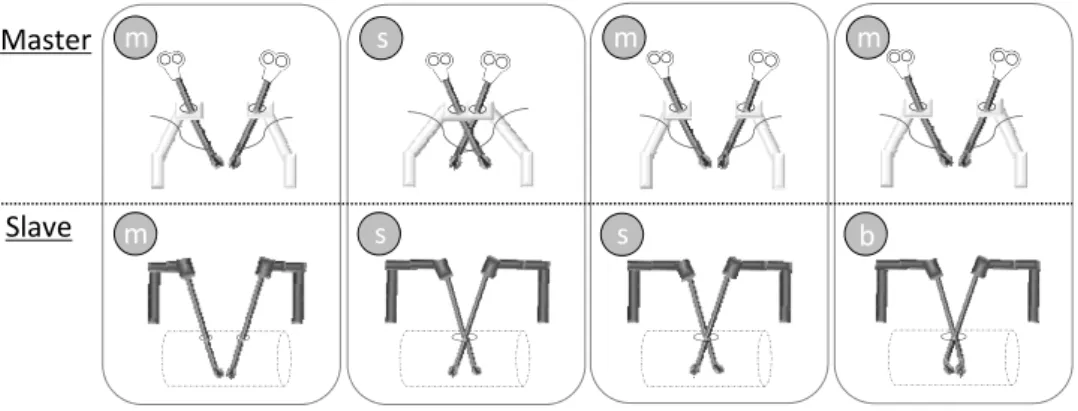
To evaluate the proposed system, we consider four operating conditions, m-m, s-s, m-s, and m-b, and compare them [see Fig. 3]. The first letter represents the experiment setup on the master side, while the second indicates that on the slave side. The letter m stands for the status in which normal surgical instruments are respectively inserted into one of multiple incisions; the letter s indicates that they are all inserted into a single incision; and the letter b means that flexing surgical instruments are inserted into a single incision. Thus, m-m represents conventional laparoscopic surgery, and s-s represents SILS; m-s and m-b indicate our proposed systems. Specifically, in the m-s condition, the robotic instruments only follow the position of the input instruments; in the m-b condition, the robotic instruments follow the position and pose of the input instruments.
m b m m s s m s Slave Master
Fig. 3 Four operating conditions: m-m, s-s, m-s, and m-b.
System degrees of freedom
On the master side, the surgeon can operate input instruments using a 4-DOF motion (2DOF spherical motion around the incision point, 1DOF depth motion along the longitudinal axis of the input instrument, and 1DOF rotation around the longitudinal axis of the input instrument). In addition, the surgeon can manage these instruments with a total of six degrees of freedom, including the position and pose of the instrument tips as acquired by the magnetic sensor system.
On the slave side, the robotic instruments are manipulated with 4-DOF motion around the incision point in the same way as on the master side; a total of six degrees of freedom, including flexion of the robotic instrument tips, is available in the m-b condition. This system does not need to calibrate the master RCM to the slave RCM since the robotic arms change the position and pose of the flexing instruments by using 3D position and pose information acquired from the magnetic sensor [12]. Thus, our system has the same stress around incisions as the regular ZEUS surgical robot system.
Task
The prominent feature of the system is that the surgeon can perform SILS with the same feel as conventional laparoscopic surgery. In order to validate this feature, we assumed a difficult operating space for SILS and simulated an object-moving task in this area for the four operating conditions (m-m, s-s, m-s, and m-b). In addition, we implemented an object-touching task in three of the operating conditions (s-s, m-s, and m-b) using the actual surgical robot system.
Simulation experiment
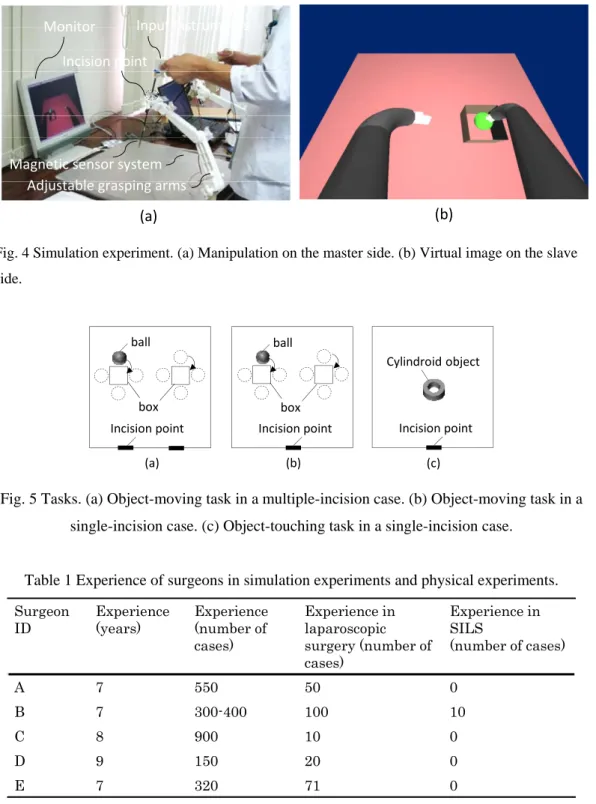
In the simulation experiments, an operator performs an object-moving task in which he/she manipulates input instruments on the master side while watching virtual robotic instruments on a monitor [see Figs. 4 (a) and (b)].
In the object-moving task, there are two boxes (18mm×18mm×18mm) in front of a single incision or multiple incisions, a sphere (radius 9mm) to be manipulated, and virtual robotic instruments. The operator maneuvers the sphere around and into each box using the robotic instruments [Figs. 5 (a) and (b)]. The location on the slave side in the m-m condition is shown in Fig. 5 (a); and that in the s-s, m-s, and m-b conditions is shown in Fig. 5 (b).
The operator moves a series of spheres around two boxes forty times in total for one trial. We defined the starting time as the time when the virtual robotic instrument touches the first sphere and the ending time as the time when the instrument moves the fortieth sphere and places it in the box. We recorded the time required from start to finish, and compared the time for each operating condition. Four surgeons (Surgeons A, B, C, and D) conducted two trials each in the four operating conditions and provided a subjective evaluation for each case afterwards. Their general experiences, including surgical experience in all cases, in laparoscopic surgery and in single-incision laparoscopic surgery, are presented in Table 1. There are four things to keep in mind: (1) none of the surgeons had ever used our system before the simulation experiments; (2) in trials 1 and 2, we determined the experimental order of the our operating conditions at random to eliminate the influence of experiment order; (3) the operator uses the left-handed (right-handed) instruments on the master side to move the sphere into the left (right) box on the slave side; (4) the laparoscopic view on the monitor was controlled so that the operator could not see the cross-point of the instruments in the m-s and m-b conditions. Three novices also performed the same simulation experiments for comparison with the surgeons. However, we recorded the operating time only for trial 2.
Fig. 4 Simulation experiment. (a) Manipulation on the master side. (b) Virtual image on the slave side. (a) Incision point ball box (b) Incision point ball box Incision point Cylindroid object (c)
Fig. 5 Tasks. (a) Object-moving task in a multiple-incision case. (b) Object-moving task in a single-incision case. (c) Object-touching task in a single-incision case.
Table 1 Experience of surgeons in simulation experiments and physical experiments. Surgeon ID Experience (years) Experience (number of cases) Experience in laparoscopic surgery (number of cases) Experience in SILS (number of cases) A 7 550 50 0 B 7 300-400 100 10 C 8 900 10 0 D 9 150 20 0 E 7 320 71 0
Physical experiment with the surgical robot system
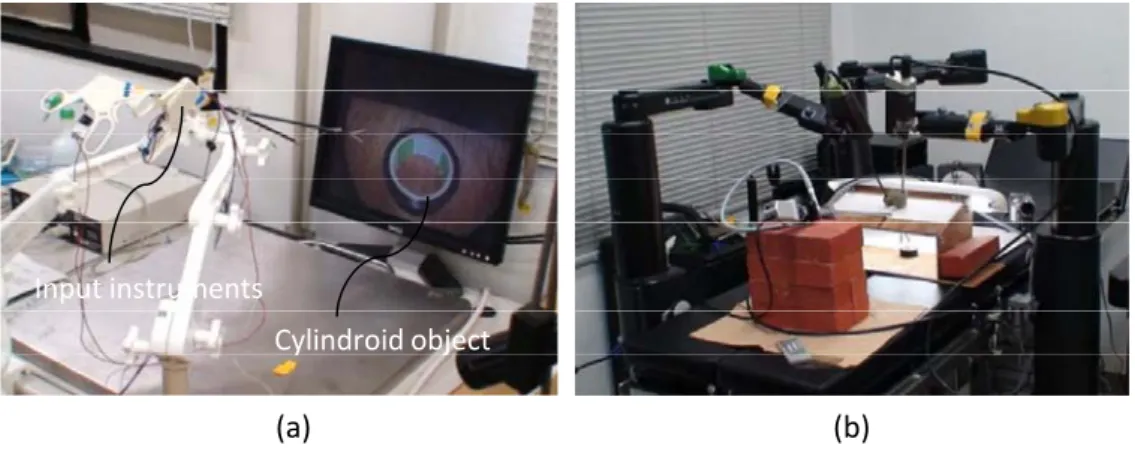
In the physical experiments, an operator conducts an object-touching task in which he/she uses the input instruments while watching a laparoscopic view on a monitor, and we use the ZEUS surgical robot system on the slave side [see Figs. 6-(a) and (b)].
(a) (b)
Monitor
Incision point
Adjustable grasping arms Magnetic sensor system
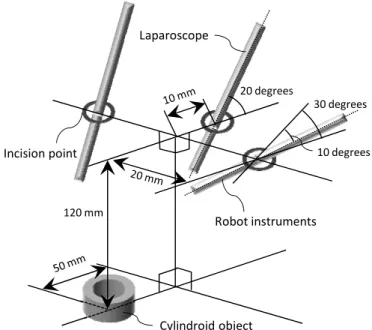
when both robotic instruments touch the cylindroid object. We recorded the time required from the starting time to ending time, and compared the time for each operating condition. One surgeon (Surgeon E) tried seven trials for each of the three conditions (s-s, m-s, and, m-b). He also contributed a subjective evaluation for each case. His general experience, including surgical experience in all cases, in laparoscopic surgery and in single-incision laparoscopic surgery, is presented in Table 1. The default position is defined as the location that the system configuration is calibrated to use to both decrease interference between the robotic instruments and show the tips of the robotic instruments on the laparoscopic view, as seen in Fig. 7. The robotic instruments and the laparoscope are inserted in multiple incisions in Fig. 7, but we assume these incisions to be a single opening since they are close to each other. Four points are worth noting. First, the operator had used our system before the physical experiments and was used to operating it. Second, the operator manipulated the two input instruments alternately, not concurrently. Third, the flexing instrument was attached to the right robotic arm and a straight surgical instrument was attached to the left robotic arm because we developed only one flexing instrument. Fourth, the laparoscope was fixed in the default position at all times.
Input instruments
Cylindroid object
(a) (b)
120 mm Laparoscope Robot instruments Cylindroid object Incision point 20 degrees 10 degrees 30 degrees
Fig. 7 Default position of the surgical robot.
Evaluation method
Required time
The time from the start to the end of the experiment was recorded, and we considered the average, the standard deviation, and the learning effect of these data.
Subjective evaluation
We asked the operators for their opinions about the usability of our system and referred to those opinions when comparing different operating conditions as well as when evaluating the system in general.
Results
The results of the simulation experiments are shown in Fig. 8, indicating the average time and standard deviation of one trial each in four operating conditions for surgeons and novices. The overall mean times for the surgeons completing the task in trial 1 were 251±61 sec (m-m), 310±52 sec (s-s), 284±35 sec (m-s), and 247±67 sec (m-b), and the mean times in trial 2 were 182±29 sec (m-m), 248±77 sec (s-s), 225±40 sec (m-s), and 178±15 sec (m-b). For the novices, the overall mean times in trial 2 were 165±28 sec (m-m), 224±32 sec (s-s), 183±30 sec (m-s), and 145±11 sec (m-b). The average times for the surgeons in trial 2 were significantly shorter than those in trial 1 (p=0.00013<0.05). The standard deviations in trial 2 were also less than those in trial 1, except for the s-s and m-s operating conditions. Results of a t-test covering all operators indicated that the m-s operating condition did not differ significantly from the m-m condition (p=0.18>0.1), but its difference from the s-s condition tended to be statistically significant (p=0.097<0.1). In the m-b operating condition, there was no significant difference from the m-m condition (p=0.23>0.1), but its difference from the s-s condition was statistically significant (p=0.011<0.05). Furthermore, the m-s and m-b conditions were significantly different (p=0.0098<0.05).
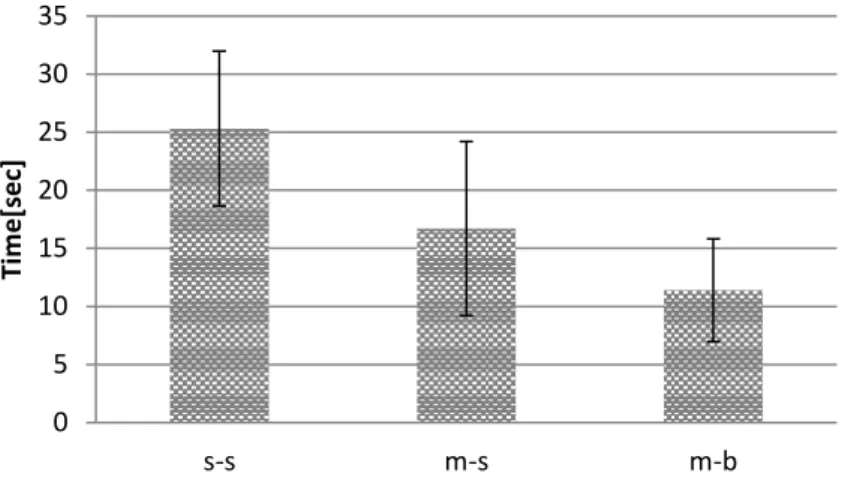
The result of the physical experiments with the surgical robot system is shown in Fig. 9, including the average time and standard deviation for a surgeon in seven trials, each with three operating conditions. The task times for the object-touching task were 25±7 sec (s-s), 17±7 sec (m-s), and 11±4 sec (m-b). The mean times in the m-s and m-b operating conditions were shorter than those in the s-s condition, and the standard deviation in the m-b condition was smaller than that in the s-s condition. The interference between the robotic instruments in the m-b condition was less than that in the m-s condition.
0 50 100 150 200 250 300 350 400 m‐m s‐s m‐s m‐b Tim e [s ec] Operating conditions
0 5 10 15 20 25 30 35 s‐s m‐s m‐b Tim e [sec] Operating conditions
Fig. 9 Average time and standard deviation in physical experiments.
Discussion
In the simulation experiments, the task time for the surgeons in trial 2 was shorter than that in trial 1, and there was a significant difference between trial 1 and trial 2. We considered that the surgeons learned with each trial in each operating condition. Since both the average time and the standard deviation in trial 2 were shorter than those in trial 1, we thought that the surgeons had exhibited stable and constant operation in the object-moving task. As for the s-s operating condition, the standard deviation in trial 2 was significantly greater than that in trial 1. We realized that this was due to the individual experiences of the surgeons, because the s-s operating condition, which simulates SILS, is difficult to operate in. A comparison of the data for the surgeons’ trial 2 and the novices’ trial 2 indicates that the task time of the novices’ trial 2 was shorter than that of the surgeons’ trial 2, even though the novices had no surgical experience. Thus, the surgeons seem to perform a stable manipulation with constant operating speed but move surgical instruments as quickly as possible during an operation. The task time for each operating condition increased in the following order: m-b, m-m, m-s, and s-s. This tendency was found in the data for all operators. Our proposed system seems to achieve the same performance as regular laparoscopic surgery and to complete an operation in shorter time than SILS, since our proposed operating conditions, including m-s and m-b, did not significantly differ from the m-m condition, representing classical laparoscopic surgery, and did significantly differ from the s-s condition, representing SILS. In comparing the m-s operating condition and the m-b operating condition, the task time in the m-b condition was shorter and the individual variability was less than in the m-s condition. We considered that all operators performed the task intuitively, like conventional laparoscopic surgery, without a sense of discomfort due to the relationship between the input instruments and the virtual robotic instruments on the monitor, since the robotic instruments follow the tip position and pose of the input instruments using the flexing instrument in the m-b operating condition, whereas the
In the physical experiments with the surgical robot system, the operability of each operating condition increased in the following order: s-s, m-s, and m-b. This shows the same tendency as the simulation experiments. The object-touching tasks in the m-s and m-b operating conditions were completed in shorter times than in the s-s condition. In the m-b operating condition, the mean time was shortest and the standard deviation was smallest among the three operating conditions. In addition, there was less of interference between the robotic instruments than in the m-s condition. Therefore, we judged that the m-b condition is the operating condition best suited for enhancing the operability of SILS. The long axis portions of the robotic instruments were not close to each other in the m-b condition due to use of the flexing instrument and there was less interference. In the m-s condition, straight surgical instruments were used and they were very close to each other. Hence, we believe that all operators conducted the object-touching task under low stress.
All operators performed SILS in the same manner as classical laparoscopic surgery by using our proposed system, meaning in the m-b condition with the flexing instrument. Furthermore, this system achieved more efficient, intuitive, and stable operation than conventional SILS, and we confirmed our system is useful for reducing surgeons’ burden. In this regard, to evaluate the system more strictly we should develop additional flexing instruments that are more compact than previous ones and perform experiments using these instruments. In addition, we should consider new tasks, for example a knot-tying task, in which operators use two input instruments at the same moment but use them interchangeably, since surgeons often manipulate two surgical instruments during an actual operation. Experiments using these new tasks would provide us with additional meaningful results.
Conclusions
We have developed a master-slave robot system that enables a surgeon to perform SILS with the same maneuvering feeling as regular laparoscopic surgery, and we conducted simulation experiments and physical experiments to evaluate the feasibility of performing SILS with laparoscopic techniques using our system. The experiments confirmed that surgeons perform SILS as if they were performing conventional laparoscopic surgery, and that our system enables surgeons to perform SILS stably, intuitively, and efficiently. Therefore, our system is useful for reducing the surgeons' burden in SILS.
In this study, we used a magnetic sensor system for acquiring the tip position and pose of the input instruments, but distortion in the EMT measurements is a very crucial problem for using our proposed system. In order to solve this problem, we plan to use an optical tracking system (e.g., Polaris by NDI Corporation) for the magnetic sensor system. Our research group ([13], [14]) has already succeeded in performing real-time, simultaneous tracking of surgical instruments and an
Acknowledgments
This research was supported by a Grant-in-Aid for Scientific Research (A) of the Japan Society for the Promotion of Science (Project Number 19206047). We are grateful to Professor Yoshiki Sawa and the entire staff of the Medical Center for Translational Research, Osaka University Hospital, who provided the opportunity to use the ZEUS surgical system. Also, we would like to express our deep gratitude to the surgeons of Osaka University Hospital who agreed to assist with our research.
References
[1] Lacy AM, Garcia-Valdecasas JC, Delgado S, Castells A, Taura P, Pique JM, Visa J (2002) Laparoscopy-assisted colectomy versus open colectomy for treatment of non-metastatic colon cancer: a randomized trial. The Lancet 359(9325): 2224-2229. doi:10.1016/S0140-6736(02)09290-5
[2] Prasad A, Mukherjee KA, Kaul S, Kaur M (2011) Postoperative pain after cholecystectomy: Conventional laparoscopy versus single-incision laparoscopic surgery. Minimally Access Surgery 7(1): 24-27. doi:10.4103/0972-9941.72370
[3] Desai MM, Rao PP, Aron M, Pascal-Haber G, Desai MR, Mishra S, Kaouk JH, Gill IS (2008) Laparoscopic and Robotic Urology. Journal Compilation Bju International 101(1): 83-88. doi:10.1111/j.1464-410X.2007.07359
[4] Targarona EM, Balague C, Martinez C, Pallares L, Estalella L, Trias M (2009) Single-Port Access: A Feasible Alternative to Conventional Laparoscopic Splenectomy. Surgical Innovation 16(4): 348-352. doi:10.1177/1553350609353765
[5] Brunner W, Schirnhofer J, Waldstein-Wartenberg N, Frass R, Weiss H (2010) Single incision laparoscopic sigmoid colon resections without visible scar: a novel technique. Colorectal Disease 12(1): 66-70. doi:10.1111/j.1463-1318.2009.01894.x
[6] Hirano Y, Watanabe T, Uchida T, Yoshida S, Tawaraya K, Kato H, Hosokawa O (2010) Single-incision laparoscopic cholecystectomy: single institution experience and literature review. World Journal of Gastroenterolgy 16(2): 270-274. doi:10.3748/wjg.v16.i2.270
[7] Ostrowitz MB, Eschete D, Zemon H, DeNoto G (2009) Robotic-assisted single-incision right colectomy: early experience. Medical Robotics and Computer Assisted Surgery 5(4): 465-470. doi:10.1002/rcs.281
[8] Ragupathi M, Ramos-Valadez DI, Pedraza R, Haas EM (2010) Robotic-assisted single-incision laparoscopic partial cecectomy. Medical Robotics and Computer Assisted Surgery 6(3): 362-367. doi:10.1002/rcs.346
[9] Kaouk JH, Goel RK, Haber GP, Crouzet S, Stein RJ (2009) Robotic single-port transumbilical surgery in humans: initial report. British Journal of Urology International 103(3): 366-369. doi: 10.1111/j.1464-410X.2008.07949.x
[11] Ghodoussi M, Butner SE, Wang Y (2002) Robotic Surgery – The Transatlantic Case. In: Proceedings of the 2002 IEEE International Conference on Robotics and Automation. pp 1882-1888. doi: 10.1109/ROBOT.2002.1014815
[12] Horise Y, Nishikawa A, Kitanaka Y, Sekimoto M, Miyoshi N, Takiguchi S, Doki Y, Mori M, Miyazaki F (2011) An Algorithm for Control of Flexing Instruments for Single-incision Laparoscopic Surgery. In: Proceedings of the 7th Asian Conference on Computer Aided Surgery (ACCAS2011). Bangkok, Thailand, pp 55-64. doi:10.1007/978-4-431-54094-6_7
[13] Nishikawa A, Nakagoe H, Taniguchi K, Yamada Y, Sekimoto M, Takiguchi S, MondenM,Miyazaki F (2008) How does the camera assistant decide the zooming ratio of laparoscopic images? Analysis and implementation. Med Image Comput Assist Interv 11: 611– 618. doi:10.1007/978-3-540-85990-1_73
[14] Blasinski H, Nishikawa A, Miyazaki F (2007) The application of adaptive filters for motion prediction in visually tracked laparoscopic surgery, In: Proceedings of the 2007 IEEE international conference on robotics and biomimetics (ROBIO2007). Sanya, China, pp 360–365. doi:10.1109/ROBIO.2007.4522188