University of Huddersfield Repository
Bougaïeff, Nicolas
An Approach to Composition Based on a Minimal Techno Case Study
Original Citation
Bougaïeff, Nicolas (2013) An Approach to Composition Based on a Minimal Techno Case Study. Doctoral thesis, University of Huddersfield.
This version is available at http://eprints.hud.ac.uk/18067/
The University Repository is a digital collection of the research output of the University, available on Open Access. Copyright and Moral Rights for the items on this site are retained by the individual author and/or other copyright owners. Users may access full items free of charge; copies of full text items generally can be reproduced, displayed or performed and given to third parties in any format or medium for personal research or study, educational or not-for-profit purposes without prior permission or charge, provided:
• The authors, title and full bibliographic details is credited in any copy; • A hyperlink and/or URL is included for the original metadata page; and • The content is not changed in any way.
For more information, including our policy and submission procedure, please contact the Repository Team at: [email protected].
An Approach to Composition Based on a Minimal Techno
Case Study
by
Nicolas Bougaïeff
Submitted for the degree of Doctor of Philosophy
Department of Music, Humanities and Media University of Huddersfield
January 2013
Abstract 4 Acknowledgments 6 Introduction 7 0. Background 10 0.1 Literature Review 10 0.2 Methodology 15
0.3 Minimal Music History 21
1. Case Study 37 1.1 Liine 37 1.1.1 Background 37 1.1.2 Systems 39 1.1.3 Kapture 48 1.1.4 Griid 53 1.2 Plastikman Live 65 1.2.1 Introduction 65
1.2.2 Tracks, Scenes, Instruments and Samples 68
1.2.3 Effects 74 1.2.4 Plasticine 77 1.3 Political Economy 87 1.3.1 Sacrifice 89 1.3.2 Representation 92 1.3.3 Repetition 96 1.3.4 Hyper-Repetition 103 1.3.5 Composition 107 2. Music 115
2.1 Phase One 117 2.2 Phase Two 121 2.3 Phase Three 125 2.4 Phase Four 127 2.5 Phase Five 130 2.6 Extras 136 2.7 DJ Set 137 2.8 Score 139 3. Conclusions 142 3.1 Summary 142 3.2 Future work 151 3.3 Synthesis 152
Appendix I: Interview with Richie Hawtin 156 Appendix II: Plastikman Live graphs and tables 157 Appendix III: Plasticine score and recording 158
Bibliography 159
Abstract
This dissertation examines key issues relating to minimal techno, a sub-genre of electronic dance music (EDM) that emerged in the early 1990s. These key issues are the aesthetics, composition, performance, and technology of minimal techno, as well as the economics of EDM production. The study aims to answer the following question. What is the musical and social significance of minimal techno production and performance?
The study is conducted in two parts. The history of minimal music is traced from Satie in the 1890s to Plastikman in the 1990s, a central contribution to minimal techno. Plastikman is a stage name for the subject of the first part, a case study of minimal techno artist Richie Hawtin. A chapter on Liine, a company I founded with partners including Richie Hawtin, describes the performance software we developed for his 2010-2011 Plastikman Live tour. A chapter on minimal techno performance methods examines the structure of the Ableton Live set created for Plastikman Live. A theory chapter, based on Jacques Attali’s Bruits (2001), studies the relationship between technology, money, power and techno music production on both an individual and collective scale. The second part provides a detailed commentary on music I composed during the project in response to the theoretical issues raised. A final chapter discusses the overall thesis, and draws conclusions.
Minimal techno, as it is practiced through Liine software, the Plastikman Live show, or through my own productions, is revealed to be a deeply improvisatory form of music. The relationship between body, mind and sound emerges as one of the major themes. Minimal techno production and performance can be seen as a reflection of the profoundly changing relationship between man and digital technology.
Acknowledgments
I would like to express my most sincere gratitude to my supervisor, Rupert Till, for his unwavering support and guidance. His insight into critical ways of thinking about EDM is very much appreciated, as is the helpful guidance he provided through the academic system. Working under Dr Till’s supervision was an intellectual and personal pleasure.
Without the collaboration of Richie Hawtin, this dissertation would simply not have been possible. I thank him for his impeccable professionalism, keen mentorship, valued partnership, and for the unparalleled access to his time and to Plastikman Live materials.
I am grateful to the following companies for providing software licenses: Ableton, AudioRealism, Cycling 74, D16, Lexicon, PSP Audioware, SoundToys. Screenshots of Live and MaxMSP used with permission from Ableton and Cycling 74.
I would like to thank my partners Gareth Williams and Etienne Noreau-Hébert and my colleague Merlin Ettore for their interest, enthusiasm and support. Exchanging ideas was always stimulating. Thanks to Jef Chippewa for the advice about scoring techniques.
My parents, André and Judith Bougaïeff, provided unstinting moral support, and they challenged my ideas and my writing. Thank you to them both.
Introduction
Electronic Dance Music (EDM) and the related Electronic Music Dance Culture (EDMC) have been developing since the late 1970s. Minimal techno, a sub-genre of EDM, has gained worldwide popularity since the 1990s. Minimal techno events are now held in stadium-sized venues, and this is the first substantial academic study of this musical and cultural form. This thesis aims to demonstrate, by way of a case study, how minimal techno music is created, performed, and why that is significant in the 21st century. What is the musical and social significance of minimal techno production and performance?
The study is structured in five chapters that, together, address a number of secondary questions. What is minimal techno? What are its principal musical characteristics? How can minimal techno be produced? How can minimal techno be performed? Why make minimal techno? What is the relationship between minimal techno and technology? What are some of the potential relationships between money and minimal techno production?
A background chapter includes a literature review, a methodology section and a brief history of minimal music. Literature dealing with music theory, composition and production receives a particular emphasis. The primary research method used for this dissertation, participant observation, is discussed, as are the reasons for its use. The history of minimal music is traced from Satie in the 1890s to Plastikman’s early works
from the 1990s, a central contribution to minimal techno. Plastikman is a stage for minimal techno artist Richie Hawtin.
A chapter on performance technology focuses on software initially created by the software company Liine for the Plastikman Live show and later released as commercial products. Liine was founded in April 2010 by myself, Richie Hawtin, John Acquaviva, Etienne Noreau-Hébert, Mark Quail and Gareth Williams. Since then we have released over a dozen apps in the iTunes App Store, including the iPad version of the JazzMutant Lemur. I went on tour several times in 2012 with Hawtin for the Plastikman Live show. Through my work at Liine I am in close contact with music technology companies such as Beatport, SoundCloud, Ableton and Native Instruments. I have worked on custom performance setups with well known EDM live acts and DJs such as Orbital, Carl Craig and Daniel Miller. I experienced the Berlin EDM and music technology scene from a unique insider perspective.
A chapter on minimal techno musical structures examines, as a case study, the Ableton Live set created for Plastikman Live. The overall structure is explained in detail and is accompanied by supporting graphs and tables. A single track, ‘Plasticine’, is analysed in detail. A theory chapter is based on Jacques Attali’s Bruits (2001), and studies the relationships between technology, money, power and techno production on both an individual and collective scale.
The penultimate chapter provides a detailed technical commentary on music that was composed as practice based research written in response to the theoretical concepts under consideration. A final chapter discusses the overall thesis, and draws conclusions.
Minimal techno, as it is practiced through Liine software, the Plastikman Live show, or through my own productions, is revealed to be a deeply improvisatory form of music. The relationship between body, mind and sound emerges as one of the major themes. Minimal techno production and performance can be seen as a reflection of the profoundly changing relationship between man and digital technology.
0. Background
0.1 Literature Review
Much has already been written about Electronic Dance Music (EDM) and Electronic Dance Music Culture (EDMC). Thornton’s Club Cultures (1995) is a significant work in this field. The author analyses the social structures of EDM events both from her own point of view of as an outsider and from the point of view of insiders she came to know through her research. One of the most significant aspects of her analysis is the application of subcultural capital theory to EDMC, which brings a better understanding to some of the motivations driving actors in EDMC. In a similar vein, Rapp (2010) gives as much attention to people working in the scene as people attending parties in Lost and Sound: Berlin, Techno and the Easyjet Set, an overview of the Berlin scene. Rapp provides a useful, somewhat journalistic, overview of the Berlin EDMC industry. The approach is similar in Rietveld’s This is Our House (1998). These three books, together, provide an overview of the principal roles in EDMC: dancers/audience, promoters/ industry and DJs/artists. A complete EDM bibliography is available online on the Dancecult.net, the electronic dance music culture research network. This site also hosts Dancecult: Journal of Electronic Dance Music Culture, the only academic journal currently dedicated to EDM research.
Much has also been written about the history of techno, the EDM sub-genre that is the focus of this study. Authors such as Sicko (1999) in Techno Rebels or Shapiro (2000) in
Modulations are quick to make the distinction between the different meanings of the term ‘techno’. At times it is used to identify a sub-genre of EDM associated with Detroit. At other times, the term is used interchangeably with EDM. The early history of techno is particularly well covered, by the aforementioned authors and many others such as May (2007) and Halstead (2010). The literature thins out in recent years, especially for the 2000s and 2010s. In his article Digital Discipline: Minimalism in House and Techno, Sherburne (2004) proposes a nomenclature for minimal techno in the early 2000s. The present dissertation focuses on the minimal techno music made by Richie Hawtin under the name Plastikman from the early 1990s, as well as its live performance in the early 2010s.
Literature dealing with other forms of minimal music, addressing different periods and composers, is plentiful, for example Mertens (1980) or Strickland (1993). However, unlike those texts, this project places the meaning of minimalism in Western music in the context of a continuous phenomenon beginning with Satie, suggesting a continuous chain of aesthetics that leads up to early minimal techno. A key text for this task is American Minimal Music by Wim Mertens (1980), in which the author presents a detailed study of each the four key figures in classical minimalism: Reich, Glass, Riley and Young. In addition, Mertens examines possible meanings of musical minimalism and debates whether or not the music is teleological. As these issues are linked to ideas from Cage, Stockhausen and Schoenberg, Mertens’ analysis provides a useful
framework for understanding minimalism before and up to classical minimalism. The book written by Steve Reich (2002), Writings on Music 1965-2000, also provides insights on the evolution and meaning of minimalism. Gann (2004) attempts to provide a definition of musical minimalism. Various texts such as Toltz (2011), Rietveld (2011) and McClary (2004) have sufficiently detailed classical minimalism and its links to krautrock, disco, house and techno, and so this will not be discussed here. It is enough to say that they share many common elements.
Most of the small, but growing, body of literature that analyses EDM musicologically uses tools borrowed from traditional music theory, including western classical notation. In a significant text on this topic, Unlocking the Groove: Rhythm, Meter, and Musical Design in Electronic Dance Music, by Mark J. Butler (2006), the author proposes analysing electronic music with a very useful framework that takes into account the different time-scales, micro and macro, at which EDM is produced, performed and experienced. Butler does, however, spend an inordinate amount of time on a particular technique, “turning around the beat”, which Butler considers to be a major component of EDM production. Although “turning around the beat” is very real and Butler’s examples are correct, the present research leads me to characterise the technique as somewhat more peripheral than it is presented, and this is certainly the case in minimal techno.
Butler also invokes fragments of European art music, such as Haydn and Mozart, to support notions of polyrhythms in Underworld or Plastikman. Although perhaps useful
for explaining EDM to classical theorists, relying on references to Haydn and Mozart in this context constitutes a far-fetched analysis. The aesthetic distance from Mozart to Jeff Mills is too great to be of use in my research. Butler uses traditional staff notation to transcribe the dance records under analysis, a useful method for addressing, again, a readership of classical theorists. A more appropriate mix of notational approaches is adopted for this project, however, one more representative of the music, including for example the arrangement view typical of Digital Audio Workstations (DAWs) used to write such music. In this format, each voice is represented as a block, whose length corresponds to the duration of the phrase. Tools from electroacoustic analysis, such as spectral analysis or those proposed by Schaeffer (1977) in Traité des Objets Musicaux, may also prove to be more appropriate in many cases, as exemplified by Zeiner-Henriksen (2010). Although his methods of analysis are more appropriate for EDM than are Butler’s, the scope of Zeiner-Henriksen’s work remains much more limited than Butler’s. While Butler aims for a comprehensive analysis of the rhythmical structure of EDM as a whole, Zeiner-Henriksen focuses on the single phenomenon of the 4/4 pattern, that is the ‘four to the floor’ bass drum. The work of both these authors serve as models for my methods of analysis, with the intended scope lying between these two extremes.
Although the roles played by the EDM musician, producer, DJ or live performer, is, in one sense, very well covered in the existing literature, the musician is often analysed strictly on the basis of how he contributes to making the party happen. This role, often qualified as ‘shamanic’ by authors such as Rietveld (2004) or St. John (2004), is social.
Rietveld (1998) also presents the DJ as a librarian or archivist. Books such as Last Night a DJ Saved My Life by Brewster & Broughton (2000), or DJ Culture by Poschardt (1998), present records as texts and the DJ as a creator of new texts through the act of mixing. The angle that I seek for my research is from the point of view of the musician, from a craftsman point of view. This focus is supported by a series of articles written by Goldmann (2011), who is also a producer, DJ and live performer. From his insider position, Goldmann discusses the relationship between the quality of EDM composition and finding commercial success. If other research focuses more on the DJ/performer as one role amongst many in a social setting, the present research focuses on the live performance as one professional role a musician can choose, and, in particular, the techno live performance as musical craftsmanship.
In the course of analysing the relationship between music, money, power and technology, the religious aspect of techno culture merits attention. Two key anthologies provide useful frameworks, St. John (2004) Rave Culture and Religion and St. John (2010) The Local Scenes and Global Culture of Psytrance. The analysis of religious structures in other scenes can be used to draw parallels with those same structures in techno and Plastikman.
An entire chapter of the present thesis is devoted to an analysis of Plastikman, Liine and global techno production as seen through the prism of Jacques Attali’s (2001) theories expounded in Bruits. In a single study he ties together the overarching relationships between musicians, music, power, money and technology. These issues
are central to projects such as Plastikman and Liine, as they are both active on the global level of the techno scene.
0.2 Methodology
Participant
EDM scenes comprise a myriad of roles. Existing literature has tended to focus on reception theory and the audience as participant. The participant in this study, however, is the musician specialising in EDM, and more specifically in a dual role of producer and DJ/performer. The producer of EDM typically assumes responsibility for the entire chain of creation of a recording, with the possible exception of the mastering stage, which is often entrusted to a dedicated mastering studio. The EDM producer thus plays the role of composer, arranger, performer and programmer, in addition to recording engineer and project supervision, a far cry from traditional studio productions with live musicians. Similarly, the EDM live performer manipulates studio equipment on stages, unlike the traditional live musician who plays an acoustic or electric instrument. Existing literature, as exemplified by Butler (2006), Rietveld (1998) and Thornton (1995), has focused on participants in local scenes, while this thesis focuses on one participant, Richie Hawtin and his Plastikman project, who for nearly two decades has played a leading role in the global techno scene.
At the time that I am writing this thesis, I am also producing EDM and developing music technology. I have been producing EDM since the late 1990s under various pseudonyms in different styles, and have completed studies in Electroacoustic Composition at the Montreal Music Conservatory. In 2010, I helped found the software company Liine. Before then, I worked as a freelance programmer for projects such as live music performance tools, contemporary dance and interactive installations, and also as a freelance composer and sound designer for video games and various art projects.
In 2006, after completing my electroacoustic studies, I began travelling regularly to Berlin. Between travels, in 2008-2009, I ran a short-lived digital label called Greynoise Recordings as an experiment in self-distribution. The music was distributed on Beatport but also available directly from my website through a custom PayPal system. During this same period, I also released over a dozen tracks on Beatport for various labels such as Josh Gabriel’s Different Pieces and John Acquaviva’s Definitive Records, as further exercises in digital music distribution.
In 2009, for my own music performance needs, I developed an Ableton Live controller on the JazzMutant Lemur hardware platform. This landed me a job with JazzMutant, thanks to Gareth Williams, whom I had the good fortune to meet in Berlin that same year. In collaboration with Williams and a small team at JazzMutant, we further developed the controller and released it under the name 'Mu'. The release of Mu, in turn, led directly led to an association with Richie Hawtin for his Plastikman Live tour.
This new professional association culminated in the foundation of Liine by myself, Richie Hawtin, John Acquaviva, Etienne Noreau-Hébert, Mark Quail and Gareth Williams. Liine develops high-level music controllers on the iPad platform, many of which were initially created for the Plastikman Live tour. Liine’s product line also includes Lemur since December 2011.
I travelled with Hawtin as part of the Plastikman Live crew for two of the early shows, in Mannheim for the Timewarp 2010 festival and Barcelona for the Sonar 2010 festival. These were work-intensive trips where we fine-tuned the custom performance systems in the days prior to the actual events. The events themselves were the first of many where I socialised backstage with other industry players such as artists, DJs, label managers and promoters. At Timewarp 2010 I shared backstage banter and after-party drinks with Sven Väth, the “embodiment of German EDM’s evolution through the eighties and nineties” (Brewster & Broughton 2005, p. 368). Over the years I became acquainted with many of the Minus artists such as Magda, Ambivalent and Marc Houle. Liine worked with Orbital, an EDM act which gained commercial and critical success in the 1990s (Sicko 1999, p. 77), to build a custom performance setup for their 2012 tour. I have had coffee with Daniel Miller, founder of Mute Records, and had Skype conversations with Carl Craig, a second-wave Detroit DJ and producer (Sicko 1999, p. 72). In Berlin I spent many weekends partying and socialising with colleagues at clubs such as Watergate and Berghain. I am friends with one of the bouncers at Berghain, a relationship that has often guaranteed me passage through the notoriously difficult door (Michael 2010).
Author’s Position
This research has been conducted from an insider’s position. Not only am I involved in EDMC as an EDM producer, but I am also actively shaping the scene, particularly as it concerns producers and performers, by creating and commercialising new music-making technology. As an insider, I have the advantage of worldwide access to people and information, and must respect the limits this advantage entails. I am cognisant of the level of trust my colleagues must place in me. I informed my colleagues that I intended to write a doctoral thesis, and all materials relating directly to a colleague or interviewee has been cleared by the person before inclusion. I am cognisant of the importance of protecting trade secrets and business strategies, a consideration vital to the portions of this thesis that deal with commercial applications. I am privy to such knowledge only by virtue of connection with my own company, confidential discussions with other companies, or camaraderie among associates of different companies.
In the course of my time in Berlin, I came to suspect that musicians in global EDM scenes were organised in a pyramid hierarchy. Goldmann’s description of the phenomenon, which he calls “categorical morphology” (2011a, para. 15), articulates what I felt intuitively. “After helping to form a first minimal subcategory of techno, Hawtin was recognised as its leader” (2011b, para. 7). The leader at the very top of a category, like Hawtin and techno, tends to be a person who significantly contributed to building the pyramid. Looking back now, entering the third year of my association with Hawtin, running Liine and producing tracks in my spare time, I have come to
understand that I had a clear choice. I could either work my way up the ladder of somebody else’s aesthetic category, or I could attempt to create my own aesthetic category. The difficulty I felt making this choice is one of the reasons I have played additional roles besides that of producer. Through these additional roles, my association with Liine and Hawtin, in addition to my role as a producer, my position is thus mainly one of participant observation.
As Chernoff (1981) observes in African Rhythm and African Sensibility, “the most important gap for the participant-observer [...] is not between what he sees and what is there, but between his experience and how he is going to communicate it” (p. 11) The bulk of this thesis attempts to objectively describe and analyse the mechanics of music production and music performance in the context of Plastikman Live and my own work. In addition, I will set out my intellectual interests and predispositions, and the fact that they shape both my subjective experience of producing EDM in a global scene, and the analytical angles I choose to pursue. I will also attempt to convey this experience through personal accounts of how I contributed to bringing Plastikman Live to stage, helped create Liine, released software and produced my own music.
Several approaches are used in this study. I have analysed portions of the score from Plastikman Live, as well as my own productions, from the angle of music theory, analysis and composition, relying on Moore’s Analysing Popular Music (2006), Butler (2006) and Zeiner-Henriksen (2010) as starting points for music analysis. I have analysed Liine technology, used as performance tools in the same show, from the
angle of music technology and performance practice. I have conducted a theoretical discussion of the issues surrounding global techno production from the perspective of economics and politics, based on Jacques Attali’s Bruits (2001). Finally, a core component of my research is based on a significant interview granted to me by Hawtin, as well as personal insights garnered after years of close work with the artist.
This study was conducted with a balance of emic and etic approaches (Harris 1976). As a producer and musician living in Berlin, developing and using performance software, I experience EDM production and performance first-hand. This position corresponds to what Chernoff describes as a “participant-observer” (1981, p. 11). The emic approach is used to describe the “behaviour stream” (Harris 1976, p. 330), that is the material and observable phenomenon of the performance technology, performance methods and commercial mechanisms associated with EDM.
0.3 Minimal Music History
Overview
This section intends to draw a brief history of minimalism, from its early pioneers up to minimal techno. A coherent lineage is drawn through Erik Satie, John Cage, LaMonte Young, Terry Riley, Steve Reich, Philip Glass, Kraftwerk, Juan Atkins, Derrick May, Kevin Saunderson, Jeff Mills, Robert Hood, Daniel Bell and finally Richie Hawtin. This is a highly selective list. For example, one could also look at the importance of 1970s German acts such as Can, Neu! and Faust, but I shall focus solely on Kraftwerk. One could also look at late 1980s rave music in the UK, acid techno in Belgium or industrial music such as Throbbing Gristle. These scenes and artists, however, are well covered in the existing literature by authors such as Ford (1999) for Throbbing Gristle, Albiez (2010) for Kraftwerk, Brewster & Broughton (2000) for DJ culture or Reynolds (1998) for rave music.
Tracing the history of musical minimalism in Western music begins with the music of Erik Satie, around 1890. From that starting point, the ideas and aesthetics of musical minimalism can be seen to evolve over a century, leading to the ubiquity of repetition in techno, as demonstrated in the music of Plastikman in the early 1990s. Classical minimalism refers specifically to the work of art music composers such as Young, Riley, Reich, Glass, Feldman or Bryars. Minimalism, generally speaking, refers to a broad range of techniques which may involve any or all of the following: audible repetition, a static and floating sense of time, a reduction in the quantity of musical materials, a
sparseness of form, and the use of multiple time signatures and metrical arrangement (Gann 2004).
The notions of repetition and minimalism, while closely linked, are not interchangeable. Structural repetition does not necessarily result in an audible musical phenomenon. For example, the repetition of the chord sequence in Bach’s Chaconne is never explicitly articulated. The chord sequence serves as a framework for continuous lyrical and textural inventiveness. Also, tone rows in serial music are often strictly repeated but that process is not apparent. Repetition in Webern is purely structural, and, as a testament to the composer’s intention, perfectly inaudible. Conversely, musical minimalism is not always repetitive. Young’s Trio for Strings, as with much of Cage and Feldman’s music, is about silence, stasis and ambiance.
Musique concrète in France, early electronic music in Germany, as well as the larger body of work known as tape music make use of mechanical reproduction. Overt repetition, however, held little interest for Schaeffer, Henry and Stockhausen. However, tape loops did become a central mechanism for popular music, as evidenced by studio productions such as The Beatles’ Revolution 9 in the 1960s, and later disco, hip-hop and techno in the 1970s and 1980s.
Western minimal music, including many musicians in the 1890-1990 period, is deeply indebted to musical traditions beyond the realm of Western music, and in particular to Javanese Gamelan, West African drumming, and North Indian classical music. These
traditions organise pitch, melody and rhythm in ways quite different than those of the European classical tradition. The implications of these non-Western structures are quite profound, as they often reflect and reinforce their own way to conceive time and perceive the world. In all cases, the goal-oriented tonal system, for example in an equally tempered I-IV-V-I progression, is displaced. In many cases, goal-oriented tonality is replaced by a sense of timelessness and suspension (Mertens 1980, p. 88). The feeling of a journey depends less on harmonic sequences, and more on development within other musical parameters, such as melody, rhythm and timbre. The manner in which each of the aforementioned non-Western musics influenced the development of minimal music will be briefly touched upon.
Satie
Erik Satie was born in 1866 and, as a young man, took up residence in Paris, where he made friends with many influential artists such as Debussy, Ravel, Milhaud and Picasso. The composers Debussy and Ravel acknowledged Satie’s influence on their own music. They championed his music by playing it, and Debussy even orchestrated some of Satie’s compositions (Prendergast 2000, pp. 6-8). The influence of Satie on minimalism can be seen in the work of many authors such as Orldedge (1998), Prendergast (2000), Mertens (1980) and Thorman (2006).
Some of Satie’s well-known works are three short series of piano compositions composed and published in the years around 1890, Gymnopédies, Sarabandes and
example, Gymnopédie no. 1, starts by alternating G and D major seventh chords, yielding no sense of resolution. Instead, these introductory chords break with the directionality of tonality, instilling a sense of time suspended. The moods pioneered by Satie continued to influence the work of later composers over a half-century later, even if Feldman and Young used very different harmonic materials. The very notation Satie chose is yet another example of minimalism. Satie wrote much of this music without bar lines, as if to convey an open sense of horizontal time unbroken by vertical signposts. Prendergast writes that Satie, like Debussy and Ravel, was influenced by Gamelan music featured at the Paris Exposition of 1889 (2000, pp. 6-14). This encounter with non-Western music might be the source of the synthetic scales in the
Gnossiennes. One such example, a scale consisting of the E minor and F# major triads, contains intervals considered exotic at the time, such as the augmented second formed between G and A#. Satie was emphasising static development and implicitly proposing a focus on timbre decades before Cage or Eno.
Satie’s posthumous work Vexations, while somewhat of a radical novelty, is extremely prescient. The score calls for 840 exact repetitions of a simple, angular melody and its subsequent, equally angular, harmonisation. Vexations could well have emerged from the Fluxus movement in the 1960s. It was first published in 1949, “thanks to [John] Cage” (Orledge 1998, para. 1), who also organised the well documented 1963 performance at the Pocket Theatre in New York (Bryars 1983, para. 10).
Cage has been discussed by authors such as Gann (2011) on the topic of silence, Prendergast (2000) on the topic of ambient music or Strickland (1993) on the topic of the origins of minimalism. John Cage was born in 1912 and played a prominent and influential role in 20th century musical thought through his prodigious output and innovations. Of particular relevance to the present study is the interest Cage demonstrated for Satie. Cage acts as a direct link between Satie, whose music he greatly admired, and the American Minimalists, many of who were strongly influenced by Cage. Cage’s legacy developed as much in his philosophy, words and personal relationships, such as his friendship with Philip Glass, as it did via his compositions and recordings.
Cage studied with Schoenberg and later corresponded with Boulez. Cage was also deeply enamoured with the music of Satie, which is diametrically opposite to the serialist approach. Cage organised a performance of Vexations and championed other Satie works in the 1960s. Cage pays tribute to Satie with the titles of some of his late compositions Letter to Erik Satie (1978) and J. Joyce, M. Duchamp, E. Satie: An Alphabet (1979).
One of the first non-Western music traditions to which Cage was drawn is Javanese Gamelan. The exotic sonorities of the prepared piano, first premiered in the dance piece Bacchanale (1940), alluded to the diverse timbres of Gamelan music. Furthermore, Bacchanale makes use of prominent and motoric ostinati. Besides the links to Gamelan patterns, Cage’s music forged a path for further evolution by Reich,
Glass and Riley. Cage’s piano piece Dream (1948) demonstrates a voluntary simplicity. Most of the piece is monophonic and uses simple diatonic patterns, anticipating techniques used in many minimal techno tracks made 50 years later.
Cage is renowned for his use of the I Ching as a method of introducing indeterminacy in composition. The use of chance operations in contemporary EDM production is now so common that it is easy to miss the significance, but its introduction to Western music marks a turning point as significant as the adoption of equal temperament or the invention of recording technologies. Cage felt compelled to push the idea to conceptual extremes, by removing all decision in Variations 8, a piece that is no more than a title, or by scoring silence to emphasise ambient sound in 4’33”. But from then on, indeterminacy took on a more subtle form in music-making. Today, indeterminacy is ubiquitous, as demonstrated by software such as Lemur or Max for Live, or through open forms such as recombinant techno tracks, or through improvised DJ sets. The focus of music on strict performance of printed scores from beginning to end is no longer a dominant format that needs to be challenged.
American Minimalists
La Monte Young, Terry Riley, Steve Reich and Philip Glass, all born between 1935 and 1937, are important composers in the history of 20th century musical minimalism. For the most part, the landmark pieces that defined their musical language were composed in the 1960s and 1970s. Generally speaking, the four composers influenced each other, attended each other’s concerts and, at times, played in each others ensembles.
Mertens studies the exact constellation of relationships and interactions in American Minimal Music (1980). Each of the four musicians made a significant contribution to the lineage of musical minimalism.
Although Young’s early output is characterised by serialism, it was soon to be characterised by ideas of silence and stasis. Mertens writes that in 1960 Young “attended Karlheinz Stockhausen’s seminars in Darmstadt and he made an intensive study of John Cage’s works” (1980, p. 19). Young was one of the first composers to consciously focus his work primarily on musical minimalism. While the work of Cage and Satie merely alludes to the roots of minimalism, Young’s work exhibits a major focus on minimalist techniques. His String Trio (1958) is a definitive piece of minimal music in spite of its atonal harmony. Each instrument of the trio plays only a single note. Each note is held for a very long time. The score features long silences. There is no notion of development, whether harmonic or of any other type. The String Trio is characteristically minimalist by virtue of its harmonic stasis and its limpid simplicity. Strickland (1993, p. 125) points to Japanese Gagaku music as an influence of “smoothness, serenity, and precise execution”. Pieces composed during Young’s Fluxus period demonstrate a reduction of sound material. Composition 1960 #7
specifies simply that a B F# open fifth should be held for a long time. Young’s interest in sustained sound took shape once he formed the ensemble The Theatre of Eternal Music. From then on, drones and the harmonic overtones series were central to Young’s musical output, and reflected the influence of his study of Indian classical music.
Like Young, Terry Riley was a student of Indian classical musician Pandit Pran Nath. However, as Mertens explains, the influence of Indian music is only partial: “since he [Riley] came to Indian music more by thinking through his own musical ideas. This is partly proved by the fact that he does not rely on a fixed form-scheme, which is an important aspect in Indian improvisatory music” (1983, p. 44). Repetition, a minor aspect of Young’s work, became a central focus for Riley. In C (1964) is a quintessential example of repetition based on short melodic cells. The ensemble that premiered the piece included Steve Reich among its performers. The score presents a series of 53 short melodic cells that should be played by a large ensemble. Each musician can repeat a cell as long as he wishes, but without straying too far in the score from the rest of the ensemble. The result is an organic phasing effect through which a harmonic drone emerges.
Steve Reich, born in 1936, was acquainted and, at times, worked with Young, Riley and Glass. Inspired by Riley’s In C, Reich’s search for new ways to use repetition led him to experiment with tape loops playing against each other. This technique was formalised in the tape pieces It’s Gonna Rain (1965), Come Out (1966) and Melodica (1966). The phasing technique was first carried over from electroacoustic music to instrumental music in Piano Phase (1967), and was last used in Drumming (1971). In addition to phasing techniques, Drumming is also notable for its adoption of West African music techniques, techniques that Reich studied during a year spent in Ghana. The short canons demonstrated in these early phase pieces evolved into the tempo-synced delay techniques commonly used in contemporary electronic music. Another technique that
defines Reich’s early work is one he calls “replacing rests with beats”. The technique consists of a pattern that is repeated while notes are slowly added to the pattern.
Reich also experimented with extreme augmentation, as formally exemplified by the piece Four Organs (1970). Four keyboard players repeatedly play a short chord in unison. Slowly, on every repetition, the chord is held slightly longer. Repeated over the course of 15 minutes, the process results in a sustained chord. All these techniques, initially explored in raw experimental pieces, were gathered in a long form for the first time in Music for 18 Musicians (1976). This composition can be considered to be the conclusion of Reich’s experimental period in repetitive techniques. Reich’s influence on EDM is explicitly acknowledged in the compilation Reich Remixed (1999), where Reich’s recordings are remixed by a variety of electronic artists. Reich’s piece Electric Counterpoint (1987), as recorded by Pat Metheny, was sampled by The Orb on their 1990 track ‘Little Fluffy Clouds’. Reich’s influence can also be heard in the minimal techno track ‘Minus’ by Robert Hood (1994). The musical structure of Hood’s ‘Minus’ will be examined further on.
Philip Glass, born in 1937, studied at the Juilliard School of Music in New York and later with Darius Milhaud, among others. Milhaud was a friend and contemporary of Satie earlier in the century. Reich attended Juilliard at the same time as Glass, although the two were not acquainted at the time. Principles of addition borrowed from Indian classical music, as well as formal studies in Western classical music, greatly influenced Glass, as demonstrated in early experimental compositions such as Music in Twelve
Parts (1974) and, later, in Einstein on the Beach (1976). Glass was first exposed to Indian Classical music through work with Ravi Shankar. Their first collaboration was on a film soundtrack in 1966. They later collaborated on the album Passages in 1990. Of the four American Minimalists, Glass was the only one who did not eventually move on to music styles sounding very different from his original motoric tendencies. Glass has generally retained his motoric arpeggios although his harmonic palette has widened. Glass’ style has been widely adopted in film music and advertising. His music is explicitly linked to EDM through various projects such as his orchestration of Aphex Twin’s ‘Icct Hedral’ (1995) and the Glass Cuts (2005) compilation, where various EDM producers remixed Glass.
Kraftwerk
The band Kraftwerk was started by two friends, Ralf Hütter and Florian Schneider, both born in the late 1940s, who met at the Düsseldorf Conservatory. In addition to the Western classical music they studied at the Conservatory, Hütter and Schneider were also very interested in Schaeffer and Henry’s tape music as well as Stockhausen’s experimental electronic music. However, in a departure from the classical and experimental music styles they studied, Kraftwerk was conceived as popular music.
Kraftwerk’s machine music features a metronomic groove and self-effacing stage performance style. Repetitive, diatonic melodies instil a floating sense of time outside of tonal cadential formulas. Simple rock and disco rhythmic patterns are played with little variation on electronic drum kits. These elements of style are prescient of the
machine groove present in techno. The first album, the self-titled Kraftwerk, was released in 1970. Within Kraftwerk’s lengthy discography, Autobahn (1974), Trans Europe Express (1977) and Computer World (1981) are clear sources of the band’s influence on techno. Kraftwerk are still active in 2012.
Techno
The history of techno has already been treated extensively elsewhere. Sicko’s Techno Rebels (1999), for example, constitutes an exhaustive study of the inception of Techno in Detroit. May (2007) summarises the history of Detroit techno in her article in African American Music. Halstead (2010) provides a similar summary in his PhD thesis, tracing the evolution of techno as it leads up to Intelligent Dance Music (IDM). However, in spite of the growing body of literature on EDM, Garcia (2010, p. 6) correctly points out “there has been very little work on the ‘minimal’ spectrum of styles (minimal house, minimal techno, dub house, glitch, microhouse, etc.) that sprang up in the late 1990s.”
The transition from techno to minimal techno in early 1990s Detroit takes off from the work of Kevin Saunderson, Derrick May and Juan Atkins in the 1980s. Sicko (1999) identifies the earliest inception of techno in the Detroit High School party scene of the late 1970s and early 1980s. The track ‘Sharevari’ (1981) incorporates a unison canon in its composition that is reminiscent of the DJ technique used to extend a track by mixing between two identical copies of the same vinyl. This single track underlines the “connection between Italo-disco, techno and Detroit’s high school sophisticates” (Sicko 2010, p. 29). It is within this party scene that Atkins and May first
gained experience as DJs. One of the first explicit forays into techno is Atkins’ project Cybotron, which was modelled directly on Kraftwerk (Ibid, p. 44). The musical structures of Cybotron tracks were not defined in terms of open-ended repetitive processes. Rather, these tracks resemble song forms, complete with vocals organised in verses.
As Detroit Techno departed from song forms, it quickly distinguished itself from electro when it evolved into loop-based structures. For example, ‘Nude Photo’ (1987), produced by May under the name “Rhythim is Rhythim” is composed of interlocking synth melodies that are very similar to Steve Reich pieces such as ‘Vermont Counterpoint’. May’s track ‘Kaos’ (1988) is composed of repetitive drum machine patterns. Development is centred on transformations of the drum machine sounds. The timbres are transformed by modulating the synthesis parameters of the drum machine, as well by modulating the effects with which the drum sounds are processed. The track stops abruptly, a style of arrangement both typical of techno and reminiscent of the early experimental works of Glass, such as Strung Out (1967). This abruptness points to an open-ended sense of time, as well as to the fact that these records are intended to be mixed in a continuous long form by DJs. The compilation album Techno! The New Dance Sound of Detroit (1988) marks a point where the style crystallised, formally gained its name and acquired a clear distinction from Chicago house.
Minimal Techno
Minimal techno first emerged in the early 1990s and the style is associated with a second generation of Detroit artists. “While the first-wave artists were enjoying their early global success, techno also inspired many up-and-coming DJs and bedroom producers in Detroit” (May 2006, p. 340). This younger generation includes Richie Hawtin, Daniel Bell, Robert Hood, Jeff Mills, Carl Craig, Kenny Larkin, Mike Banks and Alan Oldham. The work of several of these artists evolved to become focused on minimalism. While many projects in other locations, such as Regis in the UK, Basic Channel in Berlin or Mike Vainio in Finland, made significant contributions to minimal techno, this chapter is concerned with tracing those techniques of minimalism that lead to the development of Plastikman in Windsor, across the river from Detroit.
It is important to understand the distinction between minimal techno in the 1990s, and what became known simply as ‘minimal’ or ‘Berlin minimal’ in the 2000s. Mike Huckaby explains the difference accurately. "The original sound of minimal techno was made by artists like Rob Hood from Detroit, and Basic Channel from Berlin. The minimal sound of today has blended fashion, drugs, and sex into the definition" (Wasacz 2010). The early sound of minimal techno was focused on a sparseness of material and formal structures that were often borrowed, perhaps unwittingly, from classical minimalism. The difference between minimal techno and minimal, besides the cultural aspects noted by Huckaby lies in the musical parameters on which production is focused. Minimal in the early 21st century can be defined by its focus on timbre. Tracks such as Marc Houle’s ‘Techno Vocals’ and Ambivalent’s ‘R U
OK?’ are recognisable by their use of down-pitched vocals. Troy Pierce’s ‘Horse Nation’, with its dark sounds and muted sub bass line, is an example of popular minimal sounds. Sherburne’s description of this new approach to minimalism implies a focus on timbre, “massification [...] the strain of EDM that attempts to create extreme densities with a relative paucity of sonic elements” (2004, p. 325). Ricardo Villalobos, an exponent of minimal, is known for his very dense and organic productions such as his album Alcahofa (2003). Although Villalobos’ sound is very different from Houle or Pierce, the common link is a focus on timbre rather than process. The popularity of minimal hit its peak in the first decade of the 21st century. Today, the term minimal is often used as an umbrella term to describe minimalism in EDM. This research project is focused on minimal techno from the early 1990s and does not cover minimal in the early 2000s. Three tracks in particular illustrate some of the musical approaches taken in minimal techno.
First, Robert Hood’s track ‘Minus’ is an archetype of minimal techno. The track is featured twice on the 2009 compilation The Grandfather Paradox by Henrik Schwarz, Ame and Dixon. It is an extremely sparse production. There are only two instruments, a bass drum and a monophonic synthesiser. The synth plays a polyphonic melody, as in Bach’s Chaconne where a single line is arpeggiated within melody and bass notes. The minor mode melody in ‘Minus’ is reminiscent of Reich’s Piano Phase. After a thorough exposition of the theme, and nearly two minutes of repetition, a new tone, the major third, is slowly faded in. Recalling Reich’s technique, this is a process of replacing a rest for a beat. The major third scale degree is in the same register as the minor third
scale degree, thus creating a half-step friction. Once introduced in the pattern, the new, single tone is displaced by a 16th note every eight bars or so. The rhythmic groove of the melodic friction is shifted at each displacement. This is undeniably a phasing pattern, just as in Reich’s Clapping Music. In regards to the possibility that Hawtin’s label was named after Hood’s track, Hawtin set the record straight. “Although MINUS is one of my favourite tracks from Robert, it was just a happy accident with the name” (Hawtin 2013, pers. comm., 22 January).
Daniel Bell’s DBX track ‘Losing Control’ was released in 1994. The track is, like ‘Minus’, extremely sparse. Most of the percussive track is limited to a bass drum on every beat and a hihat on every upbeat. A syncopated snare briefly appears during the track’s midpoint. An atmospheric synthesiser is sometimes faded in. The central element is a short vocal loop of a man stating “I’m losing control”. Over the track’s seven minutes, the voice is filtered and transformed with different effects. Timbre modulation is thus the central mechanism for development. The effect is somewhat reminiscent of Alvin Lucier’s I’m Sitting In A Room (1969), where a voice is progressively transformed through the resonant frequencies of the titular room. A connection can also be made to Reich’s It’s Gonna Rain. In all cases, a single vocal loop, along with its transformations, becomes the central focus of the music.
Lastly, Hawtin’s ‘Spastik’, another landmark minimal techno track, was released under the Plastikman name in 1993. It is purely a rhythmical track and thus can be mixed with any other track without clashing harmonically. The track is built around a two beat
TR-808 snare pattern consisting of a mix of 16th and 32nd notes. Over the course or nearly 10 minutes, the audio effects and synthesis parameters of the snare are tweaked in all possible directions. Once again, traditional musical parameters of melody and rhythm are virtually static and development is centred on timbral modulation. At various points, subtle elements are brought in to accentuate the track’s intensity. Claps, rides and bass drums are introduced and removed. The connecting thread, however, always remains the looping two beat pattern.
There are a common group of composition techniques used in several recent stages of Western music, from Satie to ‘Spastik’, in which Non-Western musics have played an important role. While minimalism has become unfashionable with contemporary classical composers, as new forms have developed, within EDM it has developed and thrived. Minimalism in EDM is known today under the umbrella term minimal, a designation that should not be confused with minimal techno.
Minimal techno, a sub-genre of EDM that first gained popularity in the early 1990s, is related to preceding minimalist musics through a variety of techniques such as repetition, phasing, indeterminacy and replacement. Minimal techno is often purely electronic, composed of stark sounds and imbued with a mechanical groove. We now turn to the question of how minimal techno is performed, and the relationship between minimal techno and technical innovation.
1. Case Study
1.1 Liine
This chapter discusses the role of custom software development in the performance setup of Plastikman Live. The following questions will be addressed. How is minimal techno performed? What is the relationship between minimal techno and technology?
1.1.1 Background
The instrumentation of house and techno music in the early and mid 1980s consists mainly of old analogue equipment that had suddenly become affordable because of the market’s focus on new digital synthesizers such as the Yamaha DX7 (Gilbert & Pearson 1999). Certain machines, such as the Roland TR-909, TR-808 and TB-303, played key roles in this shift (Brewster & Broughton 2006). These machines are discussed in detail by Zeiner-Henriksen (2010) or Kempster (1996).
Hawtin developed a unique approach to exploiting this standard techno instrumentation in Plastikman, as Sherburne explains in an interview with Hawtin:
“Hawtin’s gear was pretty standard for the time: in addition to the 303, there were the usual drum machines (Roland’s TR-606, 808, and 909), an Akai S950 sampler, and Roland and Sequential Circuits synthesizers. But the rubbery, otherworldly sound of Plastikman had as much to do with the ways that Hawtin patched his machines together, routing audio signals through a convoluted chain of effects. (Sherburne 2011)
The Plastikman albums were created through a process of long improvised recordings that were later edited to trim them down to digestible song lengths. This improvisation-based production method was adapted for stage performance in the early 1990s Plastikman shows.
We were using pre-programmed loops and sequences. The 909 was filled with every bank so that was sixteen times four, sixty-four different drum banks, patterns. There was no song structure so I would just go between those. [...] It would just be a combination of, you know, certain patterns went together for certain songs. Certain patterns you could use to kind of bridge songs. I always kind of had an order but you would start somewhere and end somewhere. (Hawtin 2012)
This chapter explains the role and the nature of software created by Liine for Plastikman Live in 2010. The essential difference between the 2010-2011 performances and the early 1990s performances is that by 2010 digital technology had evolved to a point where most of the show could run on software. A software-based setup removes many of the logistical, technical and financial problems associated with hardware studios and performance setups.
1.1.2 Systems
Ableton Live, MaxMSP, Max for Live and LiveAPI
At the heart of the Plastikman Live performance is a computer program called simply
Live and a crucial extension called Max for Live. It is the result of confluence between two companies with very different visions: Cycling 74 and Ableton.
Ableton is a Berlin based company founded in 1999 by Gerhard Behles and Bernd Roggendorf. Behles was one half of techno act Monolake with Robert Henke. Behles is no longer active as a musician, instead dedicating himself entirely to Ableton. Henke, however, chose to stay focused on artistic creation. He is still very active as Monolake as well as in many other projects. See Rapp (2010, pp. 232-245) for a more in-depth history of Ableton, its founders and Henke’s work.
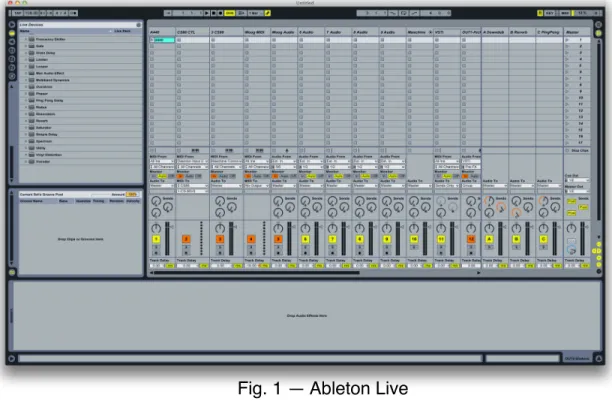
Ableton’s flagship product is music software called Live. Its purpose, as its name suggests, is to enable music technology based live performance. Ableton has released eight major versions of Live between 2001 and 2012. The software’s depth and breadth of features has continually increased to match functionality such as the horizontal audio and MIDI scoring and editing found in traditional DAWs such as Logic or Cubase. It was however the Session View, around which the first version was entirely focused, a non-linear approach that makes Ableton Live a useful tool for live electronic music performance. The Session View allows the artist to arrange audio in a two dimensional grid. Columns (called tracks) represent audio channels in which rows (called scenes)
contain an audio or MIDI clip. Audio/MIDI clips are synchronised in realtime, in fact everything in Live can be done in realtime without interrupting the audio output. Ableton Live allows you to take an arbitrary number of audio sources, each with different lengths and tempos, and perform them live in time with each other. Other DAWs allow you to do this, but it is an offline process. Ableton Live is thus structured to afford live performance, and it is particularly well suited for pulse-based music.
Cycling 74 is an American company founded in 1997 by David Zicarelli. Its mission is to create ‘software for the specialised needs of artists, educators, and researchers working with audio, visual media, and physical computing’ (Cycling 74 2011). The roots of Cycling 74’s flagship product MaxMSP (called simply Max as of 2010) go back to the very beginning of computer music, starting with MUSIC created by Max Matthews
in 1957 at Bell Labs. The first version of Max was created by Miller Puckette at IRCAM in the late 1980s and was soon followed by Max/FTS, the first version supporting digital signal processing (Cycling 74 2011). In short, Max is a product of the academic music community. Much of the music made with Max is pulseless and focused on timbre.
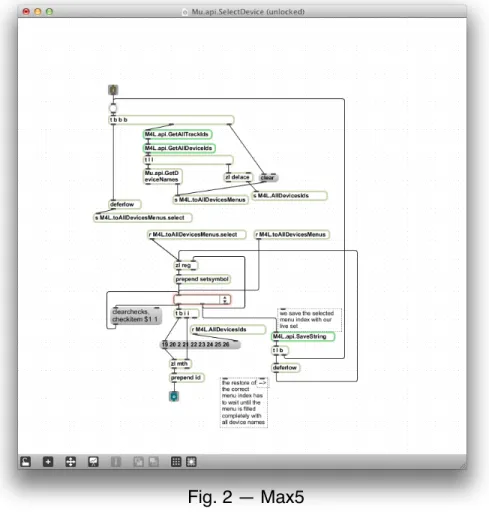
In 2009, the two companies announced news of their collaboration and released Max for Live soon thereafter. Max for Live allows the user to run Max patches from within Live, combining the incredible depth of customisation afforded by the former with the sequencing and pulse-based abilities of the latter. The significance of the collision of
these two musical worlds will be analysed further on. One particular aspect of Max for Live is especially crucial to Plastikman Live. This aspect does not involve any kind of MIDI or audio processing. What it does involve is gaining access to the inner workings of the Live program itself through a bridge called Max for Live API (Application Programming Interface). The amount of information that the Live API can provide the user about the Live set in use is extensive, such as the name, number and colour of tracks, scenes and clips, the global tempo, playback position, the state of effects and return busses.
Mu
An interesting trend in music technology began in 2006 when Brian Crabtree released a simple controller called monomer 40h. It is “a reconfigurable grid of sixty-four backlit buttons” (monome.org website 2011). The particularity of the 40h (and all subsequent monome controllers) is that there is no predefined function. It is entirely up to the user to decide if the buttons and LEDs will act as switches, radio buttons, sample triggers, effect controls or something else entirely. This style of controller, a blank slate of reconfigurable buttons, was adopted by the Arduino open source project, Yamaha (Tenori-On), Akai and Ableton (APC40, Launchpad) and Livid Instruments (Ohm64, Block, Code).
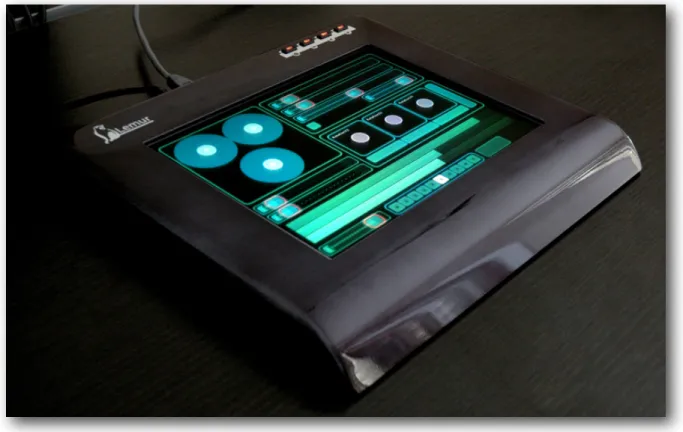
I was very interested in this type of haptic device, but for various reasons never found myself in possession of one. Instead, I acquired in mid-2006 a JazzMutant Lemur with its non-haptic multi-touch screen interface. The Lemur was originally a hardware
device created by French company JazzMutant and released in 2005, a full five years before the iPad. The Lemur was quickly adopted by a slew of world-class electronic music artists, among them Kraftwerk, Einstürzende Neubauten musician Alex Hacke, Nine Inch Nails, Björk, Daft Punk, Richie Hawtin and Justice. It is also worth noting that the Lemur was at times available through Cycling 74 as a non-exclusive distributor in the United States. Lemur can be seen as the multi-touch equivalent of MaxMSP, it lets you build any controller the way MaxMSP lets you build any MIDI or audio process. The Lemur was an incredibly powerful controller but it was also very expensive because it was a boutique item that did not benefit from mass production. It carried a price tag of 2000€. The Lemur hardware was discontinued in late 2010.
In spite of being committed to working with multi-touch screens rather than haptic interfaces, I nevertheless kept a close eye on the monome community and discussion forums. In 2007 posts started appearing about a topic that captivated me. Artists and hackers were busy reverse engineering the Live API in order to allow them to create tightly integrated custom controllers. Over the next two years this project changed hands many times, eventually culminating with a very useful library called LiveOSC maintained by Stuart Fisher. I used LiveOSC for my own experiments on building a controller for Ableton Live driven by the Lemur. The APC40, based on Henke’s Monodeck (Vdovin 2009), integrates exceedingly well with Live, after all, the APC40 was built by Ableton and Akai themselves. The controller, however, does lack a crucial capacity of the Lemur, dynamic high-resolution display.
I set out to build a controller modelled on the APC40 that would display the full range of data in the Live set. The experiment was successful and I showed my work to people at JazzMutant. They hired me to become part of the team that would build Mu, which I saw as the multi-touch answer to the APC40. Mu was to be a piece of software on the Max for Live platform that would allow one to control Ableton Live by touching the JazzMutant Lemur screen. Mu achieved the following goals: displaying the names and colours of tracks, clips and scenes; providing a custom layout of multi-touch objects for each Ableton Device (Audio or MIDI effects); full control of the mixer and a globally reconfigurable layout of these interface elements. Mu was released in March 2010. The release video received nearly 90,000 views on YouTube.
First encounter with Plastikman Live
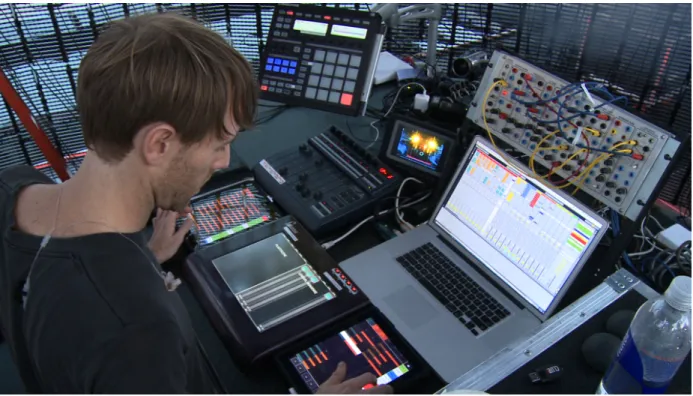
My first encounter with the Plastikman Live show took place at a general meeting of the entire team involved in creating the show, at Hawtin’s Berlin flat in early February 2010. Hawtin had shown interest in Mu for his live performances. A large diagram of the stage was displayed on a flat screen TV, depicting the laptop running Ableton Live, the outboard audio gear (a very large Midas desk, RME audio interfaces, a Serge modular, a Maschine, and more), network connections to the computers running the video synthesis programs, connections to the servers linking the stage computer to hundreds of iPhones in the audience, connections to the stage lighting and various minor systems. The team had already been working together for nearly 6 months. I asked many questions about how the whole system worked, and especially about how performance gestures from Hawtin were expected to control audio, video and lights.
A few days later, on February 15, 2010, I met with Hawtin at his Berlin studio to discuss specifics of the music performance system. I learned how every song planned for the show had been recreated (by ear, trial and error) from the original recordings by Minus artist Jeremy Jacobs, aka JPLS, using software recreations of analogue synthesisers, virtual drum synthesizers and samplers. Samplers were used only in the case of incidental sounds, such as vocals, concrete sounds and digital drum machine sounds that were originally sampled based, such as the Roland TR-707 and the Casio RZ1. Hawtin also showed me how every sound from every drum machine was routed to its own audio channel and how busses were created to mix similar sounds in stems, for
example, a snare bus and a kick bus. Furthermore, the Plastikman Live set uses 12 return tracks in which every single send knob is enabled. This results in a 12x12 modulation matrix used as an expressive dub-style feedback instrument, which is explained in the Plastikman Live chapter. The overall structure of this Live set allows a great deal of control but creates an unavoidable level of complexity due to its sheer size, spanning on average over 150 tracks and 300 scenes, depending on the version of the ALS file. It seemed obvious that using Mu, with its clear display of clip names and colours, could be the basis of an audio performance system for the show.
Hawtin has a history of developing custom hardware and software for his performances either with his father’s help, a robotics engineer, or through collaborations with other companies such as Ableton or Allen & Heath. Hawtin was also instrumental in developing and popularising Final Scratch, one of the first digital vinyl system. This time, Hawtin wanted Gareth Williams, who was soon to become my business partner at Liine, and me to create software that would help make possible the level of interaction he envisioned for Plastikman Live.
The first thing I did was to remove all the components of Mu that were not going to be useful in Plastikman Live, which amounted to essentially everything except the clip launcher. Optimising the performance system is a constant concern in Plastikman Live, both to make the human-machine interface as intuitive as possible and also to keep the computers from crashing.
The first problem we tackled was how to navigate through the colossal array of clips. Fortunately, not all 150+ tracks in Hawtin’s Live set necessarily need to be displayed. The vast majority of them, as explained above, are part of a routing and bussing system setup to facilitate a good mix and help make the soundman's job easier. Hawtin reorganised the tracks in the Live set so that all those relevant to performance, that is those which contain audio/MIDI clips he might want to trigger, are found in the first 36 tracks. I then modified Mu to display only the first 36 tracks of the set. The navigation controls, conceived initially as scroll bars, were simplified on the horizontal axis as three bank buttons. On the vertical axis the controls were changed to permit moving the view in large blocks of scenes rather than with a continuous scrollbar. In the non-realtime medium of the recording studio, the software required the detail that a scrollbar permitted, but for Hawtin’s purposes a more robust and simplified navigation was created as a bespoke solution.
We also devised a system as an extension of the simplified navigation controls to quickly jump to an area containing clips from a specific song. I built a new page in the Plastikman Lemur template that displays all the names of the songs as large buttons. Tapping one of these buttons instantly moves the view to the appropriate track and scene offset. With this system of bookmarks, one on each Lemur, left and right, Hawtin could effectively play the clips of two different songs simultaneously, mixing not two vinyls, but an intricate and improvised arrangement of the different parts of two different songs.