Manotumruksa, J., Macdonald, C. and Ounis, I. (2017) A Deep Recurrent
Collaborative Filtering Framework for Venue Recommendation. In: 26th ACM
International Conference on Information and Knowledge Management (CIKM
2017), Singapore, 6-10 Nov 2017, pp. 1429-1438. ISBN 9781450349185.
There may be differences between this version and the published version. You are
advised to consult the publisher’s version if you wish to cite from it.
© ACM 2017. This is the author's version of the work. It is posted here for your
personal use. Not for redistribution. The definitive Version of Record was
published in 26th ACM International Conference on Information and Knowledge
Management (CIKM 2017), Singapore, 6-10 Nov 2017, pp. 1429-1438. ISBN
9781450349185,
http://dx.doi.org/10.1145/3132847.3133036
.
http://eprints.gla.ac.uk/147487/
Deposited on: 7 September 2017
Enlighten – Research publications by members of the University of Glasgow
http://eprints.gla.ac.uk
A Deep Recurrent Collaborative Filtering Framework for
Venue Recommendation
Jarana Manotumruksa
University of Glasgow Glasgow, Scotland, UK [email protected]Craig Macdonald, Iadh Ounis
University of Glasgow Glasgow, Scotland, UK [email protected]ABSTRACT
Venue recommendation is an important application for Location-Based Social Networks (LBSNs), such as Yelp, and has been exten-sively studied in recent years. Matrix Factorisation (MF) is a popular Collaborative Filtering (CF) technique that can suggest relevant venues to users based on an assumption that similar users are likely to visit similar venues. In recent years, deep neural networks have been successfully applied to tasks such as speech recognition, com-puter vision and natural language processing. Building upon this momentum, various approaches for recommendation have been proposed in the literature to enhance the effectiveness of MF-based approaches by exploiting neural network models such as: word em-beddings to incorporate auxiliary information (e.g. textual content of comments); and Recurrent Neural Networks (RNN) to capture sequential properties of observed user-venue interactions. How-ever, such approaches rely on the traditional inner product of the latent factors of users and venues to capture the concept of collabo-rative filtering, which may not be sufficient to capture the complex structure of user-venue interactions. In this paper, we propose a Deep Recurrent Collaborative Filtering framework (DRCF) with a pairwise ranking function that aims to capture user-venue inter-actions in a CF manner from sequences of observed feedback by leveraging Multi-Layer Perception and Recurrent Neural Network architectures. Our proposed framework consists of two compo-nents: namely Generalised Recurrent Matrix Factorisation (GRMF) and Multi-Level Recurrent Perceptron (MLRP) models. In particular, GRMF and MLRP learn to model complex structures of user-venue interactions using element-wise and dot products as well as the concatenation of latent factors. In addition, we propose a novel sequence-based negative sampling approach that accounts for the sequential properties of observed feedback and geographical loca-tion of venues to enhance the quality of venue suggesloca-tions, as well as alleviate the cold-start users problem. Experiments on three large checkin and rating datasets show the effectiveness of our proposed framework by outperforming various state-of-the-art approaches.
1
INTRODUCTION
Location-Based Social Networks (LBSNs) such as Foursquare and Yelp have become popular platforms that allow users to find in-teresting venues to visit based on their preferences, share their
Permission to make digital or hard copies of all or part of this work for personal or classroom use is granted without fee provided that copies are not made or distributed for profit or commercial advantage and that copies bear this notice and the full citation on the first page. Copyrights for components of this work owned by others than the author(s) must be honored. Abstracting with credit is permitted. To copy otherwise, or republish, to post on servers or to redistribute to lists, requires prior specific permission and/or a fee. Request permissions from [email protected].
CIKM’17 , Singapore, Singapore
© 2017 Copyright held by the owner/author(s). Publication rights licensed to ACM. 978-1-4503-4918-5/17/11...$15.00
DOI: 10.1145/3132847.3133036
location to their friends (i.e. making a checkin) as well as leave comments on venues they have visited. Such implicit and explicit feedback can be leveraged to study user’s behaviour in urban cities as well as to make personalised recommendation of venues to visit. Among various collaborative filtering techniques, Matrix Factoris-ation (MF) [12] is widely used to predict users’ ratings on venues by leveraging explicit feedback (e.g. prior ratings of venues). Then, the venue recommendations are generated by ranking the venues based on their predicted ratings. However, users in LBSNs only focus on the top-K ranked venues for recommendation, andexplicitfeedback
can be difficult to collect. For these reasons, Bayesian Personalisa-tion Ranking (BPR) [20], which aims to generate accurate ranked lists of venues, and leveragesimplicitfeedback, is more effective
than rating prediction-based models (i.e. regression models). A challenge of implicit feedback from observing checkins is that only positive feedback can be observed, and MF-based and BPR models trained on only positive feedback are likely to be biased to positive instances. To address this challenge, various negative sampling approaches have been proposed [7, 20, 29]. For example, a negative sampling approach proposed by Rendleet al.[20] in
BPR uniformly and randomly selects items/venues that the users have not interacted with as negative instances. Moreover, users’ preferences are notstaticand change dynamically over time (e.g.
users may prefer to visit shopping malls at daytime but prefer to visit bars in evenings) [11]. However, both MF and BPR can only capture users’ long-term (static) preferences and not their
short-term (dynamic) preferences. Meanwhile, recent observed feedback
can have more influence on users’ likely checkin behaviour than historical feedback. For instance, consider a user who has recently visited several art museums and a restaurant, sequentially. Models that only capture the user’s long-term preferences will recommend other museums to visit, whereas a model that can capture the user’s short-term preferences might recommend a bar to visit instead.
Another challenge in recommendation systems is the problem of cold-start users (i.e. users who have little observed feedback), which can hinder the effectiveness of MF-based approaches. To alleviate the cold-start user problem, various MF-based approaches in literature have been proposed to leverage additional sources of information such as friendships, textual content of comments and geographical location of venues (e.g. [16–18, 29]). Previous stud-ies [4, 11, 19, 25, 28, 32] have shown that the sequential propertstud-ies of user’s interactions (e.g. sequences of checkins or clicks) play an important role in improving the quality of recommendation for var-ious tasks. To effectively capture users’dynamicpreferences as well
as take previous feedback into account, various approaches have been proposed to exploit Recurrent Neural Network models (RNN) for recommendation systems (e.g. [25, 28, 32]). Such approaches still rely on a dot product of latent factors of users and items to cap-ture the user-item interactions in a Collaborative Filtering manner,
where similar users will obtain similar recommendations. However, the dot product of latent factors may not be sufficient to capture the complex structures of user-item interactions. To address this challenge, Heet al.[7] recently proposed a Neural Matrix
Factoris-ation (NeuMF) framework that leverages a Multi-Layer Perceptron to learn the complex structures of user-item interactions. NeuMF can generalise MF-based approaches by replacing the dot prod-uct with a neural architecture that can learn an arbitrary function from implicit feedback. In this work, we propose a Deep Recurrent Collaborative Filtering framework that aims to learn the complex structure of users’staticanddynamicpreferences. In particular, our
contributions are summarised below:
• We propose a Deep Recurrent Collaborative Filtering frame
work (DRCF) with a pairwise ranking function for venue recommendation. Our proposed framework differs from the framework of Heet al.[7] (NeuMF) in three aspects:
(1) DRCF can capture both user’sdynamicandstatic
pref-erences, while NeuMF can only capture user’sstatic
prefer-ences; (2) NeuMF ignores the dot product of latent factors when making the prediction. In contrast, DRCF framework exploits the dot products of latent factors to model the user-venue interactions; and (3) DRCF aims to generate accurate ranked list of venue, unlike NeuMF which aims to accurately predict user’s rating on items. To the best of our knowledge, our proposed framework (DRCF) is the first study that extends NeuMF framework to model both users’staticanddynamicpreferences.
• Within the DCRF framework, we propose Generalised
Re-current Matrix Factorisation (GRMF) and ReRe-current Multi-Level Recurrent Perceptron (MRLP) models that exploit Recurrent Neural Networks (RNN) models to capture users’
dynamicpreferences. In contrast to existing RNN-based
ap-proaches [25, 28, 32] for recommendation systems, GRMF and MLRP models do not only rely on the dot products of latent factors but also element-wise product and con-catenation of latent factors, which are weighted using the Deep Neural Networks architecture.
• We propose a novel sequence-based (dynamic) negative
sampling approach that takes the sequential properties of checkins and geographical location of venues into account to enhance the effectiveness of the DRCF framework, as well as alleviate the cold-start user problem.
• We conduct comprehensive experiments on 3 large-scale
real-world datasets from Foursquare, Yelp and Brightkite to demonstrate the recommendation accuracy of DRCF. The experimental results demonstrate that DRCF consis-tently and significantly outperforms various state-of-the-art venue recommendation approaches across three datasets. The rest of this paper is organised as follows. We review related literature on venue recommendation in Section 2. Then, we briefly provide the problem statement, the MF-based and RNN-based ap-proaches and the Neural Matrix Factorisation framework (NeuMF) in Section 3. Our proposed DRCF framework and its components are described in Section 4. The experimental setup for our experi-ments is detailed in Section 5, while comprehensive experimental results comparing the effectiveness of DRCF with various state-of-the-art approaches are reported in Section 6. Concluding remarks follow in Section 7.
2
RELATED WORK
Matrix Factorisation, proposed by Korenet al.[12], is a widely used
collaborative filtering technique in recommendation systems. Tradi-tional MF-based approaches leverage explicit and implicit feedback (e.g. rating of venues and checkins) to model user’s preferences and characteristic of venues. In particular, MF aims to find the latent factors of users and venues to accurately predict the rating of the user to unvisited venues. Various MF-based approaches have been proposed in the literature (e.g. [3, 7, 14, 16–18]) to generate person-alised venue recommendation to the users by ranking the unvisited venues based on the predicted user-venue ratings. Such approaches can be identified aspointwiseapproaches [15]. However, as users in
LBSNs only focus on the top-K suggestions, MF-based approaches that aim to optimise pointwise loss (e.g. Root Mean Square Error) are less effective than approaches that are directly optimised for rank-ing venues (i.e. focusrank-ing on the top-K ranked list of venues that are relevant to user’s preferences) [1, 2, 15]. Rendleet al.[20] proposed
apairwiseoptimisation criteria that can be applied with MF-based
approaches, named Bayesian Personalised Ranking (BPR), in which an assumption is that for each user, the user’s previously visited venues are preferred over their non-visited ones. Although previ-ous literature [1, 2, 15] have demonstrated thatlistwiseapproaches
can be more effective thanpairwiseandpointwiseapproaches for
general information retrieval tasks such as web search, suchlistwise
approaches are not feasible in recommendation contexts, because of the need to rank a large set of non-observed item/venues for each user rather than small sets of candidate web documents.
The aforementioned MF-based approaches assume that users’ preferences arestatic, hence users who have visited similar sets of
venues in different orders would get similar venue suggestions. In-deed, users’ preferences are notstaticand change dynamically over
time [11]. To leverage sequences of implicit feedback (e.g. checkins) in order to model users’dynamicpreferences, existing approaches
in literature (e.g. [4, 19]) have been proposed based on Markov Chains. However, such Markov Chains-based approaches have a similar deficiency as they can only model local sequential behaviour between each pair of adjacent feedback items [28]. With the success of Deep Neural Network models (DNN) in several domains such as on speech recognition, computer vision and natural language processing (e.g. [6, 9, 30]), various approaches (e.g. [25, 26, 28, 32] have been proposed to exploit Recurrent Neural Networks (RNN) models to capture users’dynamicpreferences from the observed
sequences of implicit feedback. For example, Tanget al.proposed
a MF-based approach that leverages Bidirected Long-Short Term Memory, a recurrent neural network, to predict the rating of user for movie recommendation, while Yuet al.[28] extended BPR to
incorporate RNN models to recommend a ranked list of items for the user to purchase, given his previous sequence of item baskets. Apart from the recommendation systems that exploit recurrent-based models to leverage sequential properties of implicit feedback, DNN models that learns user-item interactions have been explored in the literature (e.g. [5, 7, 23]). Chenget al.[5] proposed a Wide &
Deep learning approach for mobile application recommendation system that exploits both linear models and DNNs to incorporate various features of users and items. Recently, Heet al.[7] explored
the advantages of DNNs in modelling user-item interactions in the collaborative filtering manner. In particular, they proposed a Neural Matrix Factorisation (NeuMF) framework that exploits Multi-Level Perception architecture to accurately predict the user’s item rating.
Figure 1: An illustration of the similarity between users and vectors representing the latent factors of each user in user latent spaceP. NB: Figure regenerated from [7].
3
MATRIX FACTORISATION APPROACHES
FOR RECOMMENDATION SYSTEMS
In this section, we first formalise the problem statement as well as the notations used in this paper (Section 3.1). Then, we briefly de-scribe the Matrix Factorisation approaches (Section 3.2), the Neural Collaborative Filtering framework (NeuMF) that exploits a deep neural networks architecture to generalise MF-based approaches (Section 3.3) and MF-based approach that exploits a Recurrent Neu-ral Networks model to captures thedynamicpreferences of users
(Section 3.4). Note that these MF-based approaches and frame-work were not originally proposed for venue recommendation but are flexible to do so. For simplicity, we explain these approaches and framework in the context of venue recommendation. Finally, Section 3.5 summarises the elicited limitations of these MF-based ap-proaches. Later, in Section 4, we describe our proposed framework that addresses these limitations.
3.1
Problem Statement
The task of venue recommendation is to generate a ranked list of venues∈ Vthat a user might visit given his/her historical feedback
(e.g. previously visited venues from checkin data). LetVu+denote
the list of venues the user has previously visited, sorted by time andSudenote the list of sequence of visited venues (e.g. ifVu+= (v1,v2,v3), thenSu=((v1),(v1,v2),(v1,v2,v3))).st ∈ Su denotes
the sequence of visited venues of useruat timet(e.g.s2=(v1,v2)).
We can represent all checkins by all users as a matrixC∈Rm×n
wheremandnare the number of users and venues, respectively. Letcu,i ∈Cdenote a useru∈ Uvisited venuei∈ V.Ni is a set
of neighbouring venues that are nearby venuei. Note thatcu,i =0
means useruhas neither left a rating nor made a checkin at venuei.
3.2
Matrix Factorisation
Traditional Matrix factorisation-based approaches (MF) [12] assume that users who share similar preferences (e.g. visit similar venues) can influence each other. MF techniques aim to approximate the matrixC by finding a decomposition ofC, i.e. a dot product of latent factors of usersP ∈Rm×d and venuesQ ∈Rn×dwhered
is the number of latent dimensions,C≈PuTQi. In particular, the
predicted checkin of useruon venueican be computed as follows:
ˆ cu,i =pTuqi =pu}qi = d Õ k=1 pu,kqÛi,k (1)
where}denotes the dot product andpuandqi are latent factor
of useruand venuei, respectively. Indeed, MF behaves as a linear
model of latent factors by assuming that each dimension of the la-tent factor is independent and linearly combining those dimensions with the same weight [7]. The objective of MF is to minimise the pointwise loss between the predicted checkin ˆcu,iand the observed
checkincu,i and the loss function is defined as follows:
L(Θ)=min Θ 1 2 m Õ u=1 n Õ i=1 Ii,j· (cu,i−cˆu,i)2+λ 2kΘk2F (2)
whereIi,jis an indicator variable that is 1 if userimakes a checkin
at venuej, otherwise 0. To avoid overfitting, a traditional regu-larisation technique is added into Equation (2), whereλ≥0 is a
regularisation parameter,Θ={P,Q}denotes all the parameters to
be learnt andk.kF2denotes the Frobenius norm.
Once the training process of MF is finished, the distance of the latent factors of users who have visited similar venues will be close in the latent factor space (i.e. similar users will get similar venue suggestions). Heet al.[7] argued that the dot product of latent
factors may not be sufficient to capture the complex structures of user-item interactions. Figure 1 illustrates a limitation of the dot product operation explored by Heet al.[7], which can degrade
the effectiveness of MF-based approaches. The table in the figure provides the cosine similarity between the latent factors of pairs of users, e.g.p1andp2are the latent factors of useru1 andu2, respectively, and the cosine similarity betweenu1andu2is 0.5. Let
us first consider usersu1,u2andu3. The vectors in Figure 1 present the geometric relative angles ofp1,p2andp3in the latent factor
space. From the angles of the vectors, we can see thatu1shares more common preferences withu2thanu3. Next, let us consider
u4, the highlighted row in the table. In fact,u4is most similar to
u1, followed byu3andu2. Placingp4closest top1(the two possible
geometric positions betweenp1andp4in latent factor space are
presented as red-dashed lines) resultsp4is closer top2thanp3. This scenario can lead to a large pointwise loss (i.e.u4gets similar
venue suggestions tou2, rather thanu3). Modelling such complex structures of user-venue interactions is challenging.
3.3
Neural Matrix Factorisation (NeuMF)
To address the aforementioned challenge of MF-based approaches that rely on the dot products of latent factors, Heet al.[7] proposed a
Neural Matrix Factorisation Filtering framework (NeuMF) that con-sists of two components, namely: Generalised Matrix Factorisation (GMF) and Multi-Level Perceptron (MLP) models to capture complex structures of user-venue interactions from their implicit feedback using element-wise product and concatenation of latent factors where the dimensions of the latent factors are treated dependently.
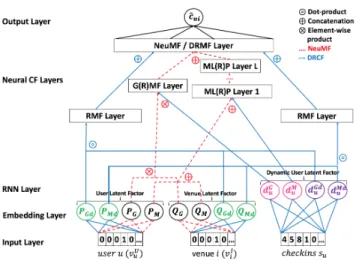
3.3.1 General framework.Figure 2 illustrates the multiple
layers of the NeuMF framework; the output of one layer serves as the input of the layer abover. The connections between layers of NeuMF framework are presented using red-dotted lines, the layers that are not connected with the red-dotted lines are not part of NeuMF (i.e. the RMF and RNN layers). Starting at the bottom of the figure, the input layer consists of a binary sparse vector with one-hot encoding that represents uservUu and venueviI, respectively.
The sparse vectors of user and venue are fed into the embedding layer. The outputs of the embedding layer can be seen as the latent factors of userpu=PTvuU and venueqi=QTviI in the context of
factorised model. Next, the latent factors are fed into the Neural Collaborative Filtering layers (i.e. hidden layers) to discover certain
Figure 2: Deep Recurrent Collaborative Filtering Frame-work. The connections of each layer linked by the red-dotted lines illustrate the NeuMF framework.
latent structures of user-venue interactions. The final output layer provides the predicted checkin ˆcu,i, which is defined as follows:
ˆ
cu,i =aout(h(ϕGM F ⊕ϕMLP)) (3)
whereaoutdenotes the activation function,⊕denotes the
concate-nation of two layers,ϕGM FandϕMLP, andh(x)=(WTx+b)is the
hidden layer –W andbare the weight matrix and bias vector, re-spectively. Overall,θh={W,b}denotes a set of parameters of the
hidden layers.h(x)ensures that each dimension of the latent factors
fromϕGM F andϕMLPare dependent. Heet al.[7] proposed to use
the sigmoid functionσ(x)=1/(1+e−x)as the activation function
aout. The combination of GMF and MLP models enables NeuMF to
model user-venue interactions as non-linear latent factor models. In particular, GMF and MLP models capture user-venue interaction using element-wise product and concatenation of latent factors, respectively (further discussed in Section 3.3.2 and Section 3.3.3 below). Similar to MF’s loss function (Equation (2)), the framework aims to minimise the Root Mean Square Error (RMSE) between the predicted checkin ˆcu,i and the observed checkincu,i. However,
as mentioned in Section 1, users in LBSNs only focus the top-K ranked list of venues for obtaining recommendations, and hence we argue that the training of NeuMF that aims to minimise a re-gression metric (RMSE) may not provide an effective top-K ranked list of venues (Limitation 1). Moreover, to alleviate the challenge
of implicit feedback mentioned in Section 1, i.e. lack of negative instances, Heet al.[7] proposed to apply traditional negative
sam-pling, as defined in BPR, to randomly select unvisited venues as negative instances. However, we argue that more effective negative sampling approaches should take both the sequential properties of observed feedback as well as the geographical location of venues into account (Limitation 2).
3.3.2 Generalised Matrix Factorisation model (GMF). As
discussed in Section 3.2, Heet al.[7] argued that the dot-product
may not be sufficient to capture the complex structures of user-venue interactions. They proposed a Generalised Matrix Factorisat-ion model (GMF) to address the limitatFactorisat-ion of MF-based approaches that relies on dot product operation, which is defined as follows:
ϕGM F =pGu ⊗qGi (4)
where⊗denotes the element-wise products of two latent factors
andpGu =PGTvuU (see red-dashed lines with⊗operation in Figure 2)
andqGi =QTGviIare the latent factors of useruand venueithat are projected from the GMF user and venue embedding layers1(PGand
QG), resp. (see the black nodes in the embedding layer of Figure 2).
3.3.3 Multi-Level Perceptron model (MLP).Next, Heet
al.[7] proposed a Multi-Layer Perceptron model (MLP) that aims
to capture complex structure of user-venue interactions using the concatenation of the latent factors, which is defined as follows:
ϕMLP =aL(hL(...a1(h1(puM ⊕qMi )))) (5)
where L is the number of layers andpuM = PTMvUu andqMi =
QTMviI are the latent factors of useru and venueithat are pro-jected from MLP user and venue embedding layer,PM andQM,
respectively (see black nodes in the embedding layers of Figure 2).
θe={PG,PM, ...,QM}denotes the set of parameters of the
embed-ding layers. Although the activation functionaLcan be a sigmoid,
a hyperbolic tangent (tanh) or a Rectified Linear Unit (ReLU), they applied ReLU as the activation function for the hidden layerhLto
alleviate the saturation problem (i.e. neurons stop learning when their output is near either 0 or 1, a problem that can be suffered by the sigmoid and tanh functions). By concatenatingpuM andqiM, MLP is more flexible than the GMF and the factorised models since both the dot-product and element-wise product operations require the dimensiondof the latent factors to be identical. However, We argue that both GMF and MLP can only capture the users’static
pref-erences, while previous works [4, 11, 19, 25, 28, 32] have shown that users’dynamicpreferences also play an important role in effective
recommendation systems (Limitation 3). In addition, although
GMF and MLP can capture different structures of user-venue in-teractions by using both element-wise product and concatenation of latent factors, we argue that the NeuMF framework should not ignore the structure of user-venue interactions that can be captured by the dot-product of latent factors (Limitation 4).
3.4
Recurrent Neural Networks-based Approaches
Recently, various approaches have been proposed to enhance the effectiveness of MF-based approaches for recommendation systems by exploiting Recurrent Neural Networks (RNN) [28, 32] to leverage sequential properties of observed implicit feedback. For example, Zhanget al.[32] proposed a RNN-based approach that models users’ dynamicpreferences from sequences of clicks as follow:
du,t=σ(Xqi,t+Rdu,t−1) (6)
whereqidenotes the latent factor of itemithe user visited at timet
andhut−1is thedynamicpreferences of the user at previous timet−1.
Ris a recurrent connection weight matrix that captures sequential signals between every two adjacent hidden statesdu,t−1anddu,t
andXis a transition matrix between the latent factors of venues and users. We note thatθr ={R,X}denotes a set of parameters of
RNN layers. For example, if a model consists of two RNN layers, we will haveθr ={R1,R2,X1,X2}.σ(x)is the sigmoid function.
Then, similar to MF-based approaches, they apply the dot product to estimate the probability that useruwill checkin at venueigiven his recently click sequences, i.e. ˆcu,i =dTu,tqi. The approach of
Yuet al.[28] is similar to that of Zhanget al., but the application
of BPR to train their proposed RNN-based model. We argue that
there are two limitations that need to be addressed. First, their proposed approach does not take the user’sstaticpreferences into
account (Limitation 5). Although we can apply more sophisticated
RNN-based models (e.g. Long-Short Term Memory model) that are capable of dealing with long sequences of observed feedback, such models are computationally expensive. Indeed, a venue that the user has visited a couple of months ago has less impact to user’s preference than a venue recently visited. Hence, an accurate model need to be capable to capture both thestaticanddynamicpreference
of users is more likely to generate better venue recommendation. Second, to model user-venue interactions in a collaborative filter-ing manner, their approach still relies on the dot products of latent factor of venuesqiand the user’sdynamicpreferencedu,t.
How-ever, as mentioned above, previous work [7] has shown that the dot product of latent factors may not be sufficient to capture the complex structure of user-venue interactions (Limitation 6).
3.5
Summary of Limitations
To conclude, in the above analysis, we have identified four limita-tions of NeuMF and two limitalimita-tions of RNN-based models:
Limitation 1: There is an inherent disadvantage in the NeuMF for
identifying the top-ranked venues to present to users.
Limitation 2: Negative sampling approaches for which this
lim-itation applies (BPR, DREAM, NeuMF) do not account for the se-quential properties of checkins and the geolocation of venues.
Limitation 3: MF-based approaches for which this limitation
ap-plies (GMF, MLP, NeuMF) assume that the users’ preferences are
staticand do not account for the sequential properties of checkins. Limitation 4: MF-based approaches for which this limitation
ap-plies (GMF, MLP, NeuMF) ignore the dot product of latent factors that capture user-venue interactions.
Limitation 5: RNN-based approaches (RNN, DREAM) that exploit
recurrent models to capture the usersdynamicpreference but do
not take the users’staticpreferences into account.
Limitation 6: RNN-based approaches that exploit recurrent
mod-els to capture user’sdynamicpreferences for which this limitation
applies (RNN, DREAM) model user-venue interaction using the dot product of latent factors to generate the venue recommendations. In summary, there is no previous work that exploits RNN to capture both thedynamicandstaticpreferences of users, and
cap-ture user-venue interactions with three operations: namely dot and element-wise products and concatenation. In the next section, we propose a framework that addresses these limitations.
4
DEEP RECURRENT COLLABORATIVE
FILTERING FRAMEWORK
In this section, we propose a novel Deep Recurrent Collaborative Filtering framework (DRCF) with apairwiseranking function and
a novel sequence-based (dynamic) geo-based negative sampling
approach for venue recommendation (Section 4.1). The proposed framework consists of three components: namely Generalised Re-current Matrix Factorisation (GRMF), ReRe-current Multi-Level Per-ceptron (MLRP) and Recurrent Matrix Factorisation (RMF) models, which will be discussed in Section 4.2, Section 4.3 and Section 4.4, respectively. In particular, our overall framework aims to address
Limitations 1, 2 & 4in Section 4.1, while the GRMF and MLRP
models aim to addressLimitations 3and the RMF model aims to
addressLimitations 5 & 6. Later, in Section 6, we demonstrate
the effectiveness of DRCF framework and its components in com-parison with state-of-the-art venue recommendation systems.
4.1
Unified Framework
Our proposed DRCF framework is illustrated in Figure 2. The DRCF framework consists of multiple layers and the connections between layers are presented using both blue-dashed and red-dotted lines. DRCF differs from NeuMF framework in various aspects. Starting at the bottom of the figure, at the input layer, we extend the NeuMF framework to leverage sequences of checkins of each useru,su.
In embedding layers, there are four additional embedding layers that are highlighted in green in Figure 2: namely GRMF and MLRP user (venue) embedding layers that are used in the RMF model,
PGd(QGd) andPMd(QMd), respectively. Later in Section 4.4, we
explain why we need these four additional layers. Recurrent Neural Networks (RNN) layers are included in our framework (pink and purple in Figure 2) to encapsulatedynamicuser preferences. In the
Neural CF layers, we include RMF layers to discover certain latent structures of user-venue interactions. The final output layer is the predicted checkin ˆcu,i, which is defined as follows:
ˆ
cu,i =aout(h(ϕGRM F ⊕ϕMLRP ⊕ϕRM F)) (7)
whereaout is the activation function,his the hidden layer and
ϕGRM F,ϕMLRP andϕRM Fdenote the GRMF, MLRP and RMF
mod-els that are described in Sections 4.2, 4.3 and 4.4, respectively. To addressLimitation 4, our proposed DRCF framework seamlessly
integrates the RMF model that captures user-venue interactions using the dot-product of latent factors, discussed in Section 4.4.
Next, instead of training the DRCF framework to minimise the
pointwiseloss between predicted checkin ˆcu,iand observed checkin
cu,i, as in Equation (2), we addressLimitation 1by proposing to
apply Bayesian Personalised Ranking (BPR) to learn the parameters
Θ={θr,θe,θh}, as follows: J(Θ)= Õ u∈U Õ st∈Su Õ k∈Ni−st Õ j∈V−st " log(σ(cˆu,i−cˆu,k)) −log(σ(cˆu,k−cˆu,j)) # (8) whereiis a venue most recently visited inst,kis an unvisited venue
that is nearby to venueiandNi is a set of venues that are nearby
to venuei. Note that venuesjandkare negative instances that we sample using our proposeddynamicgeo-based negative sampling
approach. This contrasts with the traditional negative sampling approach that is widely applied in previous literature [7, 20], which randomly selects negative instances from astaticpool of negative
venuesVu− = V − Vu+. Instead, we addressLimitation 2by
proposing a noveldynamicgeo-based negative sampling approach,
DRCFdдeo, that enhances the effectiveness of the DRCF framework
and alleviate the cold-start user problem by taking sequences of checkinsstat timetand the geographical location of venuei, i.e.
its neighbour venuesNi, into account. In particular, our proposed
dynamicnegative sampling approach (see lines 8-11 in Algorithm 1)
samples an unvisited neighouring venuekand an unvisited dis-tance venuejfrom adynamicpool of negative venuesNi−stand
V −stnot visited by the user in the current sequence of checkinsst,
respectively, rather than astaticpool of negative venues as in the
tra-ditional negative sampling approach (V − Vu+). Moreover, we also
Algorithm 1An Optimisation Algorithm of DRCF
1: Input:U,Vand sequences of visited venuesS. 2: Output:Θ={θr,θe,θh}
3: initialθr,θe,θh
4: N ←0 // iteration number 5: repeat
6: forN ←1 to|U |do
7: u←draw a random user fromU
8: forst inSudo
9: i←a venue most recently visited inst
10: k←draw a random unvisited venue fromNi−st
11: j←draw a random unvisited venue fromV −st
12: Compute gradients ofθr,θe,θh
13: Update the above parameters 14: end for
15: end for
16: untilconvergence
that samples an unvisited neighouring venuekand a distant neg-ative venuejfrom astaticpool of negative venuesNi − Vu+and V −stnot visited by the user in the current sequence of checkins
st, respectively. Later in Section 6, we compare the effectiveness of
the proposeddynamicandstaticgeo-based negative sampling
ap-proaches, DRCFdдeoand DRCFsдeo, respectively, with DRCF alone,
which does not consider anyk(neighbouring unvisited venues) during training. The gradients ofθr,θe,θhcan be estimated by the
back propagation through time algorithm proposed by Rumelhart
et al.[22], which we omit due to the space constraints. The
opti-misation algorithm of DRCF and the proposeddynamicgeo-based
negative sampling approach are described in Algorithm 1.
4.2
Generalised Recurrent Matrix Factorisation
(GRMF)
In this section, we explain how we exploit Recurrent Neural Net-work models (RNN) to capture users’dynamicpreferences in the
collaborative filtering manner as well as how to integrate the dot products of latent factors into the GMF model. In particular, we aim to addressLimitation 3by extending the GMF model to leverage
sequential properties of checkins. As mentioned in Section 2, users’
dynamicpreferences play an important role to enhance the
effec-tiveness of factorised models [4, 11, 19, 25, 28, 32]. For example, users in the evening are more likely to visit a bar directly after they have visited restaurant. However, such behaviour cannot be captured by the GMF model because it does not take the sequen-tial properties of checkins into account during the training process (Limitation 3). We propose GRMF, an extension of the GMF model
mentioned in Section 3.3.2, to exploit an RNN model as follows:
ϕGRM F =
dGu,t⊗puG⊗qGi
(9) wheredGis the user’sdynamicpreferences of useruat timetthat
are projected from the RNN layer,puGandqGi are the latent factors of useruand venueithat are projected from the GRMF embed-ding layers, respectively. Indeed, the proposed GRMF model is the element-wise product of latent factors (see the connection between red-dashed and blue lines under the GRMF layer with⊗operation
in Figure 2). Note that we do not consider the choice of recurrent
models and RNN settings in this work, which have already been explored in previous literature (e.g. [24, 25]).
4.3
Multi-Level Recurrent Perceptron (MLRP)
As mentioned in Section 3.3.3, we argue that the effectiveness of the MLP model can be enhanced by leveraging the sequential properties of checkins. In particular, similar to previous section, we propose to extend the MLP model to exploit RNN-based model to capture users’dynamicpreferences to addressLimitation 3as follows:
ϕMLRP =
aL(hL(...a1(h1(duM,t⊕puM⊕qiM))))
(10) wheredM is the user’sdynamicpreferences of useruat timetthat
is projected from the RNN layer,pM
u andQuMare the latent factor
of useruand venueithat are projected from the MLRP Embedding layer, respectively (see the connection between red-dashed and blue lines under the MLRP layer with⊕operation in Figure 2). Note
dif-ferences betweenpG
u (qGi ) (duG,t) andpuM(qiM) (duM,t) in Equations (9)
& (10), we exploit different embedding and RNN layers for each model in order to independently learn the complex structures of bothdynamicandstaticuser-venue interactions from different
mod-els (i.e. the GRMF captures the interactions using the element-wise product operation, while the MLRP capture the interactions using the concatenation). Again, the effectiveness of the framework that allows different models to learn from different set of embedding layers have been explore in previous literature [7]. Although our proposed DRCF framework allows different models to learn inde-pendently, in the output layer (Equation (7), we exploit a hidden layerhto seamlessly and dependently integrate those models to generate the ranked-list of venues to the users. In the next section, we explain RMF, the last component of the DRCF framework, which incorporates the dot products of latent factors.
4.4
Recurrent Matrix Factorisation (RMF)
In this section, we propose a Recurrent Matrix Factorisation (RMF) model that captures both the users’staticanddynamicpreferences
using the dot products of latent factors as follows:
ϕRM F= ( duGd,t |{z} dynamic +pGdu |{z} static )}qGdi ⊕ ( duMd,t |{z} dynamic +puMd |{z} static )}qiMd (11) wheredGd
u,t (duMd,t) are the latent factors of thedynamicpreferences
of useruat timetthat are projected from the GRMF (MLRP) RNN layer.pGd
u (puMd) andqGdi (qMdi ) are the latent factor of useruand
venueithat are projected from the GRMF (MLRP) embedding lay-ers, respectively. Therefore, the RMF model addressesLimitation 5by incorporating latent factors,duGd,t(dMd) andpuGd(puMd), that
represent both users’dynamicandstaticpreferences. Indeed, in
order to allow GRMF, MLRP and RMF models to learn indepen-dently, we follow Heet al.[7] to train the RMF models by using
different sets of embedding and RNN layers (see green nodes in the embedding layer and purple nodes in the RNN layer of Figure 2). Each of the GRMF, MLRP and RMF models use different operations (i.e. GRMF and MLRP use element-wise product and concatenation, while RMF uses dot product). In doing so the complex structures of user-venue interactions are independently captured by these three models using the different operations.
Moreover, to addressLimitation 6, unlike previous RNN-based
use the dot product of latent factors to generate the venue recom-mendations. Instead, we concatenate the RMF model with GRMF and MLRP models and exploit a hidden layerhto determine the in-fluence of each model (see Equation (7)). In summary, our proposed DRCF framework that consists of GRMF, MLRP and RMF models can comprehensively capture the complex structures ofdynamic
andstaticuser-venue interactions by leveraging the sequential
prop-erties of checkins using dot products, element-wise products and concatenation of latent factors. To the best of our knowledge, the proposed DRCF framework is the first that exploits those three op-erations to capture thedynamicandstaticuser-venue interactions.
5
EXPERIMENTAL SETUP
In this section, we evaluate the effectiveness of our proposed DRCF framework and its components by comparing with state-of-the-art venue recommendation approaches. In pstate-of-the-articular, to address
Limitations 1 - 6, we answer the following research questions:
RQ1 Can we enhance the effectiveness of the components of the DRCF framework for venue recommendation systems, namely the GRMF and MLRP models, by (a) leveraging the sequen-tial properties of checkins to capture the users’dynamicand
staticpreferences, (b) incorporating the dot product of la-tent factors into the models and (c) training those models to generate accurate ranked lists of venues for users?
RQ2 Are the MF-based models that capture both users’dynamic andstaticpreferences using either the element-wise product or concatenation of latent factors more effective than state-of-the-art RNN-based approaches that only model the users’
dynamicpreference using a dot product of latent factors?
Furthermore, as discussed in Section 3.3.1, no previous attempt has proposed negative sampling approaches that take the geographical location of venues into accounts to address the cold-start problem. Hence, our third research question:
RQ3 Can our proposeddynamicgeo-based negative sampling approach that leverages both sequential properties of checkins and geographical location of venues enhance the effectiveness of DRCF and alleviate the cold-start problems?
In the remainder of this section, we describe the experimental setup in terms of datasets and measures (Section 5.1), baselines (Sec-tion 5.2) and algorithm parameters (Sec(Sec-tion 5.3). The experimental results and analysis follow in Section 6.
5.1
Datasets & Measures
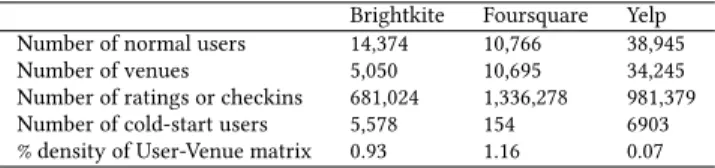
We conduct experiments using publicly available large-scale LBSN datasets. In particular, to show the generalisation of our proposed framework across multiple LBSN platforms and sources of feed-back evidence, we use two checkin datasets from Brightkite2and
Foursquare3, and a rating dataset from Yelp4. We follow the com-mon practice from previous works [8, 13, 20, 29, 31] to remove venues with less than 10 checkins/ratings. Table 1 summarises the statistics of the filtered datasets. To evaluate the effectiveness of our proposed framework, following previous works [7, 8, 20], we adopt aleave-one-outevaluation methodology: for each user, we select
her most recent checkin/rating as a ground truth and randomly select 100 venues that she has not visited before as the testing set, where the remaining checkins/ratings are used as the training set.
2https://snap.stanford.edu/data/ 3 https://archive.org/details/201309 foursquare
dataset umn 4https://www.yelp.com/dataset challenge
Table 1: Statistics of the three used datasets.
Brightkite Foursquare Yelp
Number of normal users 14,374 10,766 38,945
Number of venues 5,050 10,695 34,245
Number of ratings or checkins 681,024 1,336,278 981,379
Number of cold-start users 5,578 154 6903
% density of User-Venue matrix 0.93 1.16 0.07
The venue recommendation task is thus to rank those 101 venues for each user, aiming to rank highest the recent, ground truth checkin/rating. We conduct two separate experiments, namely:
Normal Users(those with≥10 checkins) andCold-start Users(<10
checkins) to evaluate the effectiveness of our proposed DRCF frame-work and its components in the general and cold-start settings. Recommendation effectiveness is measured in terms of Hit Ratio (HR) and Normalized Discounted Cumulative Gain (NDCG) on the ranked lists of venues – as applied in previous literature [7, 8, 28, 29]. In particular, HR considers the ranking nature of the task, by taking into account the rank(s) of the venues that each user has previously visited/rated in the produced ranking, while NDCG goes further by considering the checkin frequency/rating value of the user as the graded relevance label. Lastly, significance tests use a paired t-test.
5.2
Baselines
Our proposed Deep Recurrent Collaborative Filtering (DRCF) frame-work consists of three components, namely: Generalised Recurrent Matrix Factorisation (GRMF), Multi-Level Recurrent Perceptron (MLRP) and Recurrent Matrix Factorisation (RMF) models. We first compare our proposed DRCF framework with the NeuMF framework as well as state-of-the-art MF-based and RNN-based approaches, which can be categorised as the traditional MF-based approaches, RNN-based approaches and Deep Neural Network-based approaches. Note that such approaches may not be originally proposed for venue recommendation but are flexible to do so with-out any disadvantages. Then, we compare the components of our proposed framework with the components of state-of-the-art Neu-ral Matrix Factorisation framework (NeuMF) [7], the GMF and MLP models. Our baselines are summarised below:
5.2.1 Traditional MF-based approaches.
MF.The traditional matrix factorisation proposed by Korenet al.[12] that aims to accurately predict the users’ checkin on the
unvisited venues.
BPR.The classical pairwise ranking approach, coupled with
ma-trix factorisation for user-venue checkin frequency prediction, pro-posed by Rendleet al.[20].
GeoBPR.A state-of-the-art BPR model that incorporates
geo-graphical influence proposed by Yuanet al.[29]. Their model
as-sumes that neighbourhood venues of venues previously visited by users should be ranked higher than the distant ones. This model uses a static negative sampling approach that incorporates the geographical location of venues.
5.2.2 RNN-based approaches.
RNN.A sequential click prediction with recurrent neural
net-works approach proposed by Zhanget al.[32] (see Section 3.4). DREAM [28].A state-of-the-art RNN model that incorporates
next shopping-basket recommendation, to permit a fare comparison with our proposed DRNN, we reimplement DREAM to treat a single checkin as the shopping-basket purchase.
5.2.3 Deep Neural Network (DNN)-based approaches.
NeuMF.A state-of-the-art Neural Matrix Factorisation
frame-work5proposed by Heet al.[7], which consists of two components:
namely Generalised Matrix Factorisation (GMF) and Multi-Level Perceptron (MLP) (see Section 3.3).
GMF.A component of the NeuMF framework that models the
user-venue interaction using the element-wise product of latent factors (see Section 3.3.2).
MLP.A component of the NeuMF framework that models the
user-venue interaction using the concatenation of latent factors (see Section 3.3.3).
We implement all baselines and our proposed approach using Keras6, a deep learning framework built on top of Theano7. The
choice of recurrent models is fixed to the RNN model proposed by Zhanget al.[32], as used by Yuet al.[28]. Finally, we omit the
Markov Chain-based baselines (e.g. [21]), as experimental results in [28] showed that RNN-based models are more effective than Markov Chain-based ones. Similarly, we omit state-of-the-art MF-based approaches (e.g. eALS [8]) as Heet al.[7] showed that the
NeuMF framework significantly outperforms such approaches.
5.3
Recommendation Parameter Setup
Following [16, 17, 27, 29], we set the dimension of the latent factors
dof our proposed DRCF framework and all of the MF-based, RNN-based and DNN-RNN-based baselines to be identical:d=10 across three datasets. Following Heet al.[7], we randomly initialise all hidden,
embedding and RNN layers’ parameters,θr,θe,θh, with a
Gauss-ian distribution (with a mean of 0 and standard deviation of 0.01) and apply the mini-batch Adam optimiser [10] to optimise those parameters, which yields faster convergence than SGD and auto-matically adjusts the learning rate for each iteration. We initially set learning rate to 0.0018and set the batch size to 256. Finally, to
permit a fair comparison between MF-based approaches that exploit a Multi-Level Perceptron architecture to capture the user-venue interactions using the concatenation of latent factors (i.e. the MLP and MLRP models), we employ three hidden layers,L=3. As the impact of the hidden layer’s sizeLand dimension sizedhave been explored in previous work [7, 8], we omit varying the size of the hidden layers and the dimension of the latent factors in this work. Indeed, the larger size of hidden layers and dimension may cause overfitting and degrade the generalisation of the models [7, 8].
6
EXPERIMENTAL RESULTS
Tables 2 & 3 report the effectiveness of various approaches in term of the HR@10 and NDCG@10 on the three used datasets. In particular, Table 2 reports effectiveness for all users, while Table 3 reports re-sults for Cold-Start users. We focus first on Table 2, which contains four groups of rows: The first group, denoted vs. Baselines, reports the effectiveness of our proposed DRCF framework compared to baselines, including the NeuMF framework as well as MF-based and RNN-based approaches. The second and third groups report
5https://github.com/hexiangnan/neural collaborative filtering
6https://github.com/fchollet/keras 7 http://deeplearning.net/software/theano/
8The default learning rate setting of the Adam optimiser in Keras.
the results of the components of our proposed DRCF framework (the GRMF and MLRP models) in comparison with components of the NeuMF framework (the GMF and MLP models) as well as state-of-the-art RNN-based approaches (Component Ablation of GRMF and MLRP row, respectively). The fourth group reports the improvement of DRCF framework when incorporating either our proposeddynamicorstaticgeo-based negative sampling approach
that takes the geographical location of venues into account9.
Firstly, on inspection of the first group of rows of Table 2, we note that the relative venue recommendation quality of the baselines on the three datasets in terms of the two measures are consistent with the results reported for the various baselines in the corresponding literature [7, 28, 32]. For instance, NeuMF outperforms MF and BPR across three datasets. Similarly, DREAM outperforms RNN and BPR across the three datasets. Note that previous works [7, 28, 32] used different datasets, while our reimplementations of their proposed approaches obtain similar relative improvements.
Comparing DRCF with the various baselines in the first group of rows of Table 2, we observe that DRCF consistently and signif-icantly outperforms NeuMF, DREAM, BPR, RNN and MF, for HR and NDCG, across all datasets. For instance, DRCF improves NDCG by 23% over NeuMF for the Foursquare dataset. These results imply that our proposed framework that takes both users’dynamicand staticpreferences as well as the dot products of latent factors into
account is more effective than the NeuMF framework [7] using the same source of information.
Next, we note that unlike the Brightkite and Foursquare checkin datasets, the Yelp dataset consists of only user-venue ratings, and hence the sequential properties of visits to venues cannot be ob-served. We observe that the RNN-based approaches (RNN and DREAM) that consider the users’dynamicpreferences are more
effective than the traditional MF-based approaches (MF and BPR) across the checkin datasets, while are outperformed by BPR for Yelp dataset since those RNN-based approaches cannot leverage the sequential properties of rating data. However, our proposed DRCF, which considers both the users’dynamicandstatic
prefer-ences, is still the most effective across the different type of datasets. In addition, we observe that DRCF consistently and significantly outperforms its two components GRMFrdband MLRPrdbfor both
measures across the three datasets, except for HR on the Brightkite dataset, where GRMFrdb is statistically indistinguishable from
DRCF (difference in HR<1%).
Within the second and third groups of rows in Table 2, we fur-ther analyse the effectiveness of our proposed DRCF framework by comparing its components (GRMF and MLRP) with the components of NeuMF framework (GMF and MLP) as well as RNN-based ap-proaches (RNN and DREAM). Since our proposed GRMF and MLRP models both consists of three components: the RMF layer that in-corporates the dot product of latent factors; the RNN layer that models the users’ dynamic preferences; and BPR for pairwise rank-ing optimisation (instead of usrank-ing a pointwise loss function). To determine the importance of the GRMF’s and MLRP’s components, we follow an ablation methodology, by recording the effectiveness of the GRMF and MLRP when each of those three components is removed in turn. For simplicity, we denotedas the RMF layer,ras the RNN layer andbas the BPR optimiser. For example, GRMFrb
denotes that RMF layer is removed from the model.
9 For the first three groups of rows, recall from Section 4.1 that DCRF does not sample unvisited neighbouring venues during sampling.
Overall, we observe similar tends as for DRCF framework, where GRMF and MLRP consistently and significantly outperform the RNN, DREAM, GMF and MLP models for the two measure across the three datasets. In terms of the specific impacts of the three com-ponents of GRMF and MLRP (c.f. RQ1), we observe that all three play important roles in the effectiveness of GRMF and MLRP models as significant decreases are often observed when each component is re-moved. More specifically, for RQ1(a), w.r.t. the sequential properties of checkins as modelled by therRNN layers, significant decreases of both GRMFrdb and MLRPrdbare consistently observed
com-pared to GRMFdb and MLRPdb, respectively. These results imply
that the user’s dynamic preference can significantly improve the effectiveness of the GRMF and MLRP models. In particular, we observe the largest decreases when therRNN layers are removed from the MLRP model (see MLRPdb in the third group).
For RQ1(b), concerning the dot product (d), similar trends are ob-served as in RQ1(a) where significant decreases for both GRMFrdb
and MLRPrdbare consistently observed compared to GRMFrband
MLRPrb. More specifically, we observe the largest decrease when
RMF layer (d) is removed from the GRMF model for the checkin datasets. These results implies that RMF layers play an important role to the GRMF model and combination of element-wise product used in GRMF and dot-product used in the RMF layer can signifi-cantly improve the effectiveness of the GRMF model.
For RQ1(c), viz. the BPR optimiser (b), similar trends are ob-served as in RQ1(a) and RQ1(b) where significant decreases of both GRMFrdb and MLRPrdb are consistently observed across three
datasets when these two models are degraded intopointwise-based
approaches (c.f. GRMFdrand MLRPdr). This can be explained by
the benefits ofpairwiseapproaches in generating more effective
suggestions thanpointwiseapproaches, discussed in Section 3.3.1.
Overall, the strong results for GRMF and MLRP demonstrate the effectiveness of GRMF and MLRP models in comparison with the state-of-the-art approaches. Moreover, our DRCF framework com-bined with the GRMF and MLRP components provides a significant benefit across various datasets and measures, compared to various existing state-of-the-art approaches.
With respect to research question RQ2, we observe that the GRMF model that uses the element-wise products of latent factors to capture both users’dynamicandstaticpreferences consistently
and significantly outperforms DREAM across three datasets, while significant differences between MLRP models and DREAM are observed in Brighkite and Foursquare. However, there is no sig-nificant difference between MLRP models and DREAM in the Yelp dataset because, as discussed above, these models cannot leverage sequential properties of ratings from the Yelp dataset.
From the fourth group of rows in Table 2, we demonstrate that the effectiveness of DRCF can be further enhanced with our pro-poseddynamicgeo-based negative sampling approach10. In
partic-ular, we observe that our proposeddynamicnegative sampling
ap-proach can significantly improve the effectiveness of DRCF in term of NDCG for the Brightkite and Foursquare datasets. In addition, DRCFdдeoconsistently and significantly outperforms GeoBPR, the
state-of-the-art BPR model that considers the geographical location of venues, across all three datasets. However, for the Yelp dataset, where the sequential properties of checkins cannot be obtained, thestaticsampling approach (DRCFsдeo) significantly outperforms
10Recall that DRCF results in the first three groups of rows do not use thedynamic geo-based negative sampling approach proposed in Section 4.1.
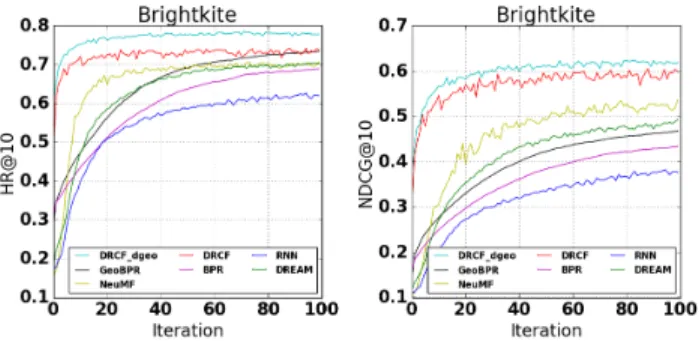
Figure 3: Test recommendation HR & NDCG of various ap-proaches with respect to the number of iterations.
thedynamicsampling approach (DRCFdдeo). Overall, the proposed
dynamicgeo-based sampling approach can significantly improve
the effectiveness of DRCF across three datasets. In addition, Fig-ure 3 reports the test performance of DRCFdдeoand the baselines
on Brightkite dataset with all users, with respect to the number of iterations. From the figure, we observe that DRCFdдeooutperform
the baselines at every iteration and converges faster than others11.
Finally, we address the third research question, by reporting the effectiveness of DRCF and state-of-the-art approaches for cold-start users. Indeed, within the first group of rows in Table 3, we observe that DRCF consistently outperforms all of the baselines for NDCG across three datasets (significantly so for all baselines except RNN, and DREAM for Foursquare). In addition, by incorporating our proposeddynamicgeo-based sampling approach into the DRCF
framework (DRCFdдeo), DRCF can be significantly improved (for
both measures, across all datasets). Therefore, in response to re-search question RQ3, we find that our proposeddynamicgeo-based
sampling approach that takes the geographical location of venues into account can enhance the effectiveness of DRCF framework as well as alleviate the cold-start problems.
7
CONCLUSIONS
In this paper, we proposed a novel Deep Recurrent Collaborative Filtering (DRCF) framework with a pairwise ranking function for venue recommendation, positioned within six elicited limitations in the state-of-the-art approaches. In particular, the proposed frame-work consists of two components (GRMF and MLRP models) that aim to capture both the users’dynamicandstaticpreferences from
their sequences of their checkins. In addition, we proposed a novel sequential-based negative sampling approach that takes the geo-graphical location of venues into account to alleviate the cold-start problem. Our comprehensive experiments on three large-scale datasets from the Brightkite, Foursquare and Yelp LBSNs demon-strate the significant improvements of our proposed DRCF frame-work and its components as well as the sequential-based sampling approaches for venue recommendation in comparison with various state-of-the-art venue recommendation approaches in both normal and cold-start settings. Indeed, on the Foursquare dataset, DRCF improves NDCG by 23% over the recent NeuMF framework [7]. For future work, we plan to extend DRCF framework to incorporate additional neural network layers such as Convolutional Neural Networks which would allow to capture the semantic properties
Table 2: Performance in terms of HR@10 and NDCG@10 between various approaches. The best performing result is highlighted in bold;−and∗denote a significant difference compared to the best performing result, according to the paired t-test forp<0.05andp<0.01, respectively.
Normal Users Experiments
Brightkite Foursquare Yelp
Model HR NDCG HR NDCG HR NDCG vs. Baselines MF 0.6206* 0.3470* 0.6656* 0.3818* 0.3539* 0.1734* RNN 0.6368* 0.3824* 0.8040* 0.5459* 0.3814* 0.1891* BPR 0.6890* 0.4333* 0.7550* 0.4834* 0.4963* 0.2676* DREAM 0.7041* 0.4839* 0.8147* 0.6081* 0.4349* 0.2235* NeuMF 0.7073* 0.5358* 0.8361* 0.5842* 0.4934* 0.2729* GRMFrdb 0.7363 0.5670* 0.8805* 0.6814* 0.5209* 0.2890* MLRPrdb 0.7291* 0.5790* 0.8873* 0.7046* 0.4771- 0.2652* DRCF 0.7419 0.6048 0.8952 0.7223 0.5162 0.2963 Component Ablation of GRMF RNN 0.6368* 0.3824* 0.8040* 0.5459* 0.3814* 0.1891* DREAM 0.7041* 0.4839* 0.8147* 0.6081* 0.4349* 0.2235* GMF 0.7072* 0.4500* 0.7753* 0.4874* 0.4809* 0.2570* GRMFdr 0.7380* 0.5199* 0.8523* 0.6126* 0.4383* 0.2232* GRMFdb 0.7460 0.5326* 0.8281* 0.5765* 0.5164- 0.2864-GRMFrb 0.6704* 0.4772* 0.8273* 0.5984* 0.5210 0.2841* GRMFrdb 0.7363* 0.5670 0.8805 0.6814 0.5209 0.2890 Component Ablation of MLRP RNN 0.6368* 0.3824* 0.8040* 0.5459* 0.3814* 0.1891* DREAM 0.7041* 0.4839* 0.8147* 0.6081* 0.4349* 0.2235* MLP 0.6780* 0.4805* 0.7638* 0.4846* 0.4656* 0.2492* MLRPdr 0.7185* 0.4536* 0.8755* 0.5627* 0.4121* 0.2131* MLRPdb 0.6851* 0.4923* 0.8012* 0.5326* 0.4740* 0.2604* MLRPrb 0.6985* 0.5390* 0.8709* 0.6737* 0.4917 0.2705 MLRPrdb 0.7291 0.5790 0.8873 0.7046 0.4771* 0.2652*
Geographic Negative Sampling
DRCF 0.7419* 0.6048* 0.8952* 0.7223 0.5162* 0.2963*
GeoBPR 0.7339* 0.4672* 0.8216* 0.5395- 0.5570* 0.3032*
DRCFsдeo 0.7847 0.6047* 0.9086 0.7217 0.5682 0.3134
DRCFdдeo 0.7852 0.6210 0.9095 0.7214 0.5618* 0.3064*
Table 3: As per Table 2, but only for Cold-Start users.
Brightkite Foursquare Yelp
Model HR NDCG HR NCDG HR NDCG vs. Baselines MF 0.6768* 0.3913* 0.6623* 0.3650* 0.3748* 0.1868* BPR 0.7519 0.4907* 0.7792- 0.4961* 0.5273- 0.2946* RNN 0.6486* 0.3694 0.5909 0.4041* 0.3856* 0.1901* DREAM 0.7452 0.4969* 0.7987 0.5379* 0.4523* 0.2239* NeuMF 0.7160* 0.5894- 0.7922 0.6227- 0.5102* 0.2734* GRMFrdb 0.7409- 0.5618* 0.8442 0.6542 0.5399 0.3083 MLRPrdb 0.7418- 0.5779* 0.8377 0.6138* 0.4928* 0.2788* DRCF 0.7526 0.5980 0.8377 0.6645 0.5330 0.3136
Geographic Negative Sampling
DRCF 0.7526* 0.5980* 0.8377- 0.6645- 0.5330* 0.3136*
GeoBPR 0.8093 0.5262* 0.7468- 0.4717* 0.5802- 0.3202*
DRCFsдeo 0.8041 0.6009* 0.8636 0.6748- 0.5948 0.3410
DRCFdдeo 0.8094 0.6199 0.8896 0.7074 0.5877
0.3318-of textual content 0.3318-of comments and thereby further enhance the quality of venue recommendations.
REFERENCES
[1] Christopher J. Burges, Robert Ragno, and Quoc V. Le. 2007. Learning to Rank with Nonsmooth Cost Functions. InProc. of NIPS. 193–200.
[2] Zhe Cao, Tao Qin, Tie-Yan Liu, Ming-Feng Tsai, and Hang Li. 2007. Learning to rank: from pairwise approach to listwise approach. InProc. of ICML. 129–136.
[3] Chen Cheng, Haiqin Yang, Irwin King, and Michael R Lyu. 2012. Fused Matrix Factorization with Geographical and Social Influence in Location-Based Social Networks. InProc. of AAAI. 17–23.
[4] Chen Cheng, Haiqin Yang, Michael R Lyu, and Irwin King. 2013. Where You Like to Go Next: Successive Point-of-Interest Recommendation.. InProc. of IJCAI.
2605–2611.
[5] Heng-Tze Cheng, Levent Koc, Jeremiah Harmsen, , and others. 2016. Wide & deep learning for recommender systems. InProc. of DLRS. 7–10.
[6] Kaiming He, Xiangyu Zhang, Shaoqing Ren, and Jian Sun. 2016. Deep residual learning for image recognition. InProc. of CVPR. 770–778.
[7] Xiangnan He, Lizi Liao, Hanwang Zhang, Liqiang Nie, Xia Hu, and Tat-Seng Chua. 2017. Neural Collaborative Filtering. InProc. of WWW. 173–182. [8] Xiangnan He, Hanwang Zhang, Min-Yen Kan, and Tat-Seng Chua. 2016. Fast
matrix factorization for online recommendation with implicit feedback. InProc. of SIGIR. 549–558.
[9] Yoon Kim. 2014. Convolutional neural networks for sentence classification.arXiv preprint arXiv:1408.5882(2014).
[10] Diederik Kingma and Jimmy Ba. 2014. Adam: A method for stochastic optimiza-tion.arXiv preprint arXiv:1412.6980(2014).
[11] Yehuda Koren. 2010. Collaborative filtering with temporal dynamics.Commun.
ACM53, 4 (2010), 89–97.
[12] Yehuda Koren, Robert Bell, and Chris Volinsky. 2009. Matrix factorization
tech-niques for recommender systems.Computer8 (2009), 30–37.
[13] Huayu Li, Yong Ge, and Hengshu Zhu. 2016. Point-of-Interest Recommendations: Learning Potential Check-ins from Friends. InProc. of KDD. 975–984.
[14] Defu Lian, Cong Zhao, Xing Xie, Guangzhong Sun, Enhong Chen, and Yong Rui. 2014. GeoMf: Joint geographical modeling and matrix factorization for point-of-interest recommendation. InProc. of SIGKDD. 831–840.
[15] Tie-Yan Liu. 2009. Learning to rank for information retrieval.Foundations and Trends in Information Retrieval3, 3 (2009), 225–331.
[16] Hao Ma, Dengyong Zhou, Chao Liu, Michael R Lyu, and Irwin King. 2011. Recommender systems with social regularization. InProc. of WSDM. 287–296.
[17] Jarana Manotumruksa, Craig Macdonald, and Iadh Ounis. 2016. Regularising factorised models for venue recommendation using friends and their comments. InProc. of CIKM. 1981–1984.
[18] Jarana Manotumruksa, Craig Macdonald, and Iadh Ounis. 2017. Matrix Factori-sation with Word Embeddings for Rating Prediction on Location-Based Social Networks. InProc. of ECIR. Springer, 647–654.
[19] Steffen Rendle. 2012. Factorization machines with libFM.ACM Transactions on Intelligent Systems and Technology (TIST)3, 3 (2012), 57.
[20] Steffen Rendle, Christoph Freudenthaler, Zeno Gantner, and Lars Schmidt-Thieme. 2009. BPR: Bayesian personalized ranking from implicit feedback. In
Proc. of UAI. 452–461.
[21] Steffen Rendle, Christoph Freudenthaler, and Lars Schmidt-Thieme. 2010. Factor-izing personalized markov chains for next-basket recommendation. InProc. of
WWW. 811–820.
[22] David E Rumelhart, Geoffrey E Hinton, and Ronald J Williams. 1988. Learning representations by back-propagating errors.Cognitive modeling5, 3 (1988), 1.
[23] Ruslan Salakhutdinov, Andriy Mnih, and Geoffrey Hinton. 2007. Restricted Boltzmann machines for collaborative filtering. InProc. of ICML. 791–798.
[24] Yong Kiam Tan, Xinxing Xu, and Yong Liu. 2016. Improved recurrent neural networks for session-based recommendations. InProc. of DLRS. 17–22.
[25] Song Tang, Zhiyong Wu, and Kang Chen. 2017. Movie Recommendation via BLSTM. InProc. of ICMM. 269–279.
[26] Bart lomiej Twardowski. 2016. Modelling Contextual Information in Session-Aware Recommender Systems with Neural Networks. InProc. of RecSys. 273–276. [27] Xin Wang, Wei Lu, Martin Ester, Can Wang, and Chun Chen. 2016. Social
Recommendation with Strong and Weak Ties. InProc. of CIKM. 5–14. [28] Feng Yu, Qiang Liu, Shu Wu, Liang Wang, and Tieniu Tan. 2016. A dynamic
recurrent model for next basket recommendation. InProc. of SIGIR. 729–732. [29] Fajie Yuan, Guibing Guo, Joemon Jose, Long Chen, and Haitao Yu. 2016. Joint
Geo-Spatial Preference and Pairwise Ranking for Point-of-Interest Recommendation. InProc. of ICTAI. 46–53.
[30] Hanwang Zhang, Yang Yang, Huanbo Luan, Shuicheng Yang, and Tat-Seng Chua. 2014. Start from scratch: Towards automatically identifying, modeling, and naming visual attributes. InProc. of MM. 187–196.
[31] Jia-Dong Zhang, Chi-Yin Chow, and Yu Zheng. 2015. ORec: An opinion-based point-of-interest recommendation framework. InProc. of CIKM. 1641–1650.
[32] Yuyu Zhang, Hanjun Dai, Chang Xu, Jun Feng, Taifeng Wang, Jiang Bian, Bin Wang, and Tie-Yan Liu. 2014. Sequential Click Prediction for Sponsored Search with Recurrent Neural Networks. InProc. of AAAI. 1369–1375.