Digital Repository @ Maurer Law
Articles by Maurer Faculty Faculty Scholarship
2014
When Churches Reorganize
Pamela Foohey
Indiana University Maurer School of Law, [email protected]
Follow this and additional works at:http://www.repository.law.indiana.edu/facpub
Part of theBankruptcy Law Commons
This Article is brought to you for free and open access by the Faculty Scholarship at Digital Repository @ Maurer Law. It has been accepted for inclusion in Articles by Maurer Faculty by an authorized administrator of Digital Repository @ Maurer Law. For more information, please contact
Recommended Citation
Foohey, Pamela, "When Churches Reorganize" (2014).Articles by Maurer Faculty.Paper 1333.
by Pamela Foohey*
INTRODUCTION
Every year approximately ninety religious organizations1 seek to
reorgan-ize under chapter 11 of the Bankruptcy Code.2 In the first part of my work
studying religious organizations’ financial distress,3 I reviewed all of the
chap-ter 11 cases filed by these debtors between 2006 and 2011—approximately 500 cases.4 The vast majority of these cases involved small Christian
congre-gations5 struggling to hold onto their buildings after falling behind on
mort-gage payments.6 In about three-quarters of the cases, the debtors claimed
they held equity cushions in their real property,7 indicating that there may be
value to be preserved through the reorganization process.8 Based on the
doc-*Associate Professor, Indiana University Maurer School of Law; Visiting Assistant Professor, Univer-sity of Illinois College of Law, 2012-2014. This Article was written in connection with the Empirical Studies in Bankruptcy panel hosted by the Section on Creditors’ and Debtors’ Rights at the AALS’ 2014 Annual Meeting. My thanks to Kenworthey Bilz, Dali´e Jim´en´ez, Robert M. Lawless, Peter Molk, Jennifer K. Robbennolt, Arden Rowell, Stephen Rushin, Michael Sousa, and Verity Winship for their comments on this paper and the underlying research, and Nicole Stringfellow for helpful research assistance. I also give a special thanks to all of the attorneys and religious organizations’ leaders who took the time to speak with me.
1I use terms such as “religious organization,” “religious institution,” and “faith-based organization”
inter-changeably and to mean any organization whose operations are motivated in a meaningful way by faith-based beliefs and principles.
2Pamela Foohey, Bankrupting the Faith, 78 MO. L. REV. 719, 732-33 n.83 (2013) (detailing the
num-ber of religious organizations that filed under chapter 11 per year between 2006 and 2011); Ken Walker,
Churches: The New Risky Bet, CHRISTIANITY TODAY, Nov. 2013, at 24 (stating that approximately 90
religious congregations filed under chapter 11 in 2012); Pamela Foohey, Are Churches Slowly Recovering?, CREDIT SLIPS (Jan. 25, 2014, 9:25 a.m.),
http://www.creditslips.org/creditslips/2014/01/are-churches-slowly-recovering.html (finding that religious organizations filed 107 chapter 11 cases in 2012 and 89 chapter 11 cases in 2013).
3Financial distress occurs when an organization has difficulty paying its financial obligations to its
creditors as they become due. See Charles J. Mooney, Jr., A Normative Theory of Bankruptcy Law: Bank-ruptcy As (Is) Civil Procedure, 61 WASH & LEE L. REV. 931, 951 n.91 (2004).
4See generally Foohey, Bankrupting the Faith, supra note 2.
5See id. at 738 tbl.3; infra notes 55-56 and accompanying text. I use the term “congregation” to mean a
group of individuals (the congregants) who meet together regularly for religious worship.
6Foohey, Bankrupting the Faith, supra note 2, at 725-26.
7Id. at 741 n.125. An equity cushion is the difference between the value of the property and the value
of all liens recorded against it. See David Gray Carlson, Postpetition Interest Under the Bankruptcy Code, 43 U. MIAMI L. REV. 577, 593 n.62 (1989).
8At a minimum, the “value” that may be preserved through reorganization is this equity cushion. See
Elizabeth Warren and Jay Lawrence Westbrook, The Success of Chapter 11: A Challenge to Critics, 107
uments submitted in connection with their cases, I ultimately concluded that chapter 11 has the potential to offer an effective solution to many religious organizations’ financial problems.9
In analyzing the filing data, I noticed that one leader typically oversaw the organization. This leader’s commitment to stabilizing the business as-pects of the organization and revitalizing the congregation usually was crucial to the debtor’s survival.10 The presence of this key leader offered an
oppor-tunity to supplement the quantitative filing data with more in-depth qualita-tive data about the organizations and their cases. Thus, I conducted extensive interviews with the leaders of religious organizations that filed under chapter 11 and the bankruptcy attorneys who represented them.
Relying on these interviews, this Article expands upon my prior consider-ation of faith-based institutions’ chapter 11 cases and, in doing so, makes three main contributions. First, I identify a subset of organizations that seemed more likely to turn to bankruptcy: small congregationalist and non-denominational churches, often with predominately African-American mem-bership. I also pinpoint salient questions about these churches’ access to credit and use of bankruptcy for future study.
Second, given that religious organizations continue to file under chapter 11 in not insignificant numbers, I highlight practical considerations for the attorneys, judges, and parties who will be involved in future cases filed by faith-based institutions. Finally, I track the post-bankruptcy outcomes of the religious organizations represented by the interviewed attorneys. A sizable majority of these debtors remained operating either in their original building or in a new location months after the closing of their bankruptcy cases. The chapter 11 process thus appeared to have offered a useful way to deal with the organizations’ financial distress. These outcomes provide evidence of the effectiveness of chapter 11 that are important to ongoing debates about busi-ness bankruptcy policy.
I. RESEARCHING CHAPTER 11 RELIGIOUS ORGANIZATION CASES
My empirical inquiry into financially distressed religious organizations be-gan with a study of the universe of chapter 11 cases filed nationwide by
faith-MICH. L. REV. 603, 625 (2009) (noting that “[a] reorganization is also thought to produce substantial
positive externalities”).
9Foohey, Bankrupting the Faith, supra note 2, at 767-71.
10Id. at 771-72. The religious organizations’ cases thereby have hallmarks of two purposes of
reorgani-zation as applied to small businesses: preserving going-concern value by keeping businesses intact or al-lowing owner-operators to remain with their current business entities. See id. at 771 (summarizing these two models of reorganization). For further analysis of what this straddling of the two purposes means for assessing religious organizations’ cases and for bankruptcy policy, see id. at 772-74.
based institutions during the six-year period from January 1, 2006, to Decem-ber 31, 2011. I chose this timeframe for two reasons. First, I wanted to analyze cases filed after the substantial overhaul of the Bankruptcy Code brought about by the Bankruptcy Abuse and Consumer Protection Act of 2005 (BAPCA), which took effect on October 17, 2005. 11 Second, I chose
the ending date of December 31, 2011, in order to assess the success rate of the cases studied based on the hypothesis that only a small minority of these cases would remain pending at the time I analyzed the dataset in December 2012.12
Using filings available via the Public Access to Court Electronic Records (PACER) service, I identified 497 chapter 11 cases filed by 454 unique relig-ious organizations.13 In creating the dataset, I searched filings from
bank-ruptcy courts located in the fifty United States and the District of Columbia.14 I removed from the study cases involving debtors that duplicate
services provided in the private market, such as senior living communities, YMCAs, and hospitals.15 I also eliminated cases filed by the Catholic
dio-ceses and related entities because these cases more closely resemble mass tort cases, where the focus is on handling widespread litigation.16
To confirm and augment the quantitative data from court filings, I later interviewed leaders of these religious organizations and their attorneys, focus-ing on a subset of debtors that also would allow me to explore how social networks may influence religious organizations’ bankruptcy filings.17
Specifi-11Pub. L. No. 109-8, 199 Stat. 23 (codified as amended in scattered sections of 11 U.S.C.).
12See Foohey, Bankrupting the Faith, supra note 2, at 745 (noting that 26 cases (5.2%) in the dataset
remained pending as of the end of November 2012).
13For a detailed description of the methodology used to assemble the dataset, see id.at 730-32. 14Id. at 730.
15Id. at 731-32.
16See Jonathan C. Lipson, When Churches Fail: The Diocesan Debtor Dilemmas, 79 S. CAL. L. REV.
363, 363-65 (2005) (analogizing the diocese cases to mass tort bankruptcy cases).
17Scholars have relied on theories of social networking and context to explain patterns of consumer
bankruptcy filing over time. Several empirical studies suggest that consumer bankruptcy filing rates in-crease in a given year if filing rates in the same geographic location rose in the prior year, which sometimes is referred to as social spillover. See, e.g., Astrid Dick, Andreas Lehnert, & Giorgio Topa, Social Spillovers in Personal Bankruptcies 1 (New York Federal Reserve, Working Paper, June 2008), available at http://ny fedeconomists.org/topa/DLT_062808.pdf (studying the extent of social spillover following changes in state law making it easier to file and finding some evidence of local spillover); David B. Gross & Nicholas S. Souleles, An Empirical Analysis of Personal Bankruptcy and Delinquency, 15 REV. OF FIN. STUDIES 319,
339-40 (2002) (finding that the “probability that someone files for bankruptcy increases with the number of people in her state who filed in the recent past”); Scott Fay, Erik Hurst, & Michelle J. White, The Household Bankruptcy Decision, 92 AM. ECON. REV. 706, 716 (2002) (predicting that if a district
exper-iences an increase in filings in one year, it will experience a greater increase in filings the next year). These studies posit that direct information sharing among neighbors and indirect observation of others in a neighborhood using bankruptcy may explain the increase in filings over time. See Dick, Lehnert, & Topa,
supra at 1. I hypothesized that the same social mechanisms may be at work in religious organizations’ filing.
cally, in analyzing the dataset, I found that the religious organization cases clustered in certain geographic areas. As shown in Table 1 below, a slight majority (51%) of the cases were filed in only ten of the ninety federal districts.18
Table 1: Ten Districts With Greatest Percentage of Religious Organization Filings During Study Timeframe
Religious
Organization All Chapter
Cases 11 Cases Congregations
District N % N % N % N.D. Georgia 53 10.7 1,791 2.9 5,830 1.7 M.D. Florida 38 7.7 2,879 4.7 9,093 2.6 W.D. Tennessee 27 5.4 323 0.5 2,861 0.8 C.D. California 24 4.8 4,791 7.8 10,750 3.1 N.D. Texas 22 4.4 1,868 3.1 8,796 2.6 S.D. Texas 21 4.2 1,684 2.8 7,438 2.2 D. Maryland 18 3.6 1,210 2.0 5,336 1.6 N.D. Illinois 18 3.6 1,504 2.5 6,215 1.8 E.D. North Carolina 17 3.4 1,689 2.8 6,065 1.8 S.D. Florida 16 3.2 697 1.1 3,977 1.2 Total 254 51.1 18,436 30.1 66,361 19.3
The concentration of religious organization filings in these districts is not simply a reflection of where the majority of all chapter 11 cases are filed.19
Nor do these areas of the country have a higher concentration of religious organizations than other regions across the United States.20 Given the lack
18Where applicable, I report “Ns,” the number of cases or debtors in the analysis. In Table 1, N for
Religious Organization Cases Filed is 497, and N for All Chapter 11 Cases is 61,260, and N for Congrega-tions is 344,894. See supra note 5 for the definition of congregations.
19Foohey, Bankrupting the Faith, supra note 2, at 734-35. In particular, 48% of all chapter 11 cases
filed during the study’s timeframe came from 10 districts. Four of these districts are among the districts from which the majority of religious organizations’ cases originated. Id. at 734 n.90. The distribution of filings also is not the same as where chapter 7 or chapter 13 cases are filed across the country. See Bankruptcy Statistics, UNITED STATES COURTS, http://www.uscourts.gov/Statistics/BankruptcyStatis
tics.aspx (last visited Feb. 5, 2014).
20Because many have few members and lack permanent locations, it is difficult to determine the precise
number and regional distribution of religious organizations. The Association of Statisticians of American Religious Bodies’ 2010 U.S. Religious Census: Religious Congregations & Membership Study provides the most comprehensive data, including reporting the number of congregations per state county. See Listings and Rankings (All Years), 2010 U.S. RELIGION CENSUS: RELIGIOUS CONGREGATIONS & MEMBERSHIP
STUDY, http://www.rcms2010.org/compare.php (last visited Feb. 5, 2014). I use this data to compare the
Over-of an easy explanation for the clumping, I theorized that religious organiza-tions’ leaders may speak with other pastors, friends, and relatives (that is, their social networks) in deciding to address their churches’ financial distress with bankruptcy. Focusing on religious organizations that filed in these ten districts offered the benefit of gathering data to answer the question of the effect of social networks in future work.21
To solicit interviews, I mailed letters to both the attorneys and the lead-ers of these religious organization debtors, detailing my study and requesting an interview.22 I asked to interview them about the chapter 11 cases
specifi-cally and the religious organizations generally. One week later, I followed up on my letters with a telephone call.23 I conducted telephonic interviews
dur-ing sprdur-ing 2013 based on scripted, open-ended questions.24 Participants were
not offered any compensation.25
A. ATTORNEYS
Out of the 254 chapter 11 cases filed in these ten districts, the debtors were represented by 168 different debtor’s attorneys. From these attorneys, I randomly selected ninety (54%)to send letters.26 However, I was not able
all, congregations tend to be spread more evenly across the United States, with no more than 3% of total nationwide congregations located in any one federal district. See id.
21The effect of leaders calling upon their social networks on the geographic concentration of religious
organizations’ chapter 11 filings is one of the subjects of my next article. For now, I posit this explanation for the concentration. See also infra Part II.A.
22The mailing addresses came from the debtors’ bankruptcy court filings. I verified and updated the
addresses via internet searches of the debtors’ operating names and the names of the debtors’ leaders and attorneys as disclosed on their chapter 11 petitions.
23The phone numbers of the debtors and attorneys generally came from the debtors’ bankruptcy court
filings. I verified and updated the phone numbers via internet searches.
24As with other studies based on semi-structured interviews, I occasionally asked questions out of
order and asked follow-up questions. See, e.g., Sara Sternberg Greene, The Broken Safety Net: A Study of Earned Income Tax Credit Recipients and a Proposal for Repair, 88 NYU L. REV. 515, 526-27 (2013)
(describing methodology for a study assessing the earned income tax credit program based on interviews of program recipients); Jean Braucher, Lawyers and Consumer Bankruptcy: One Code, Many Cultures, 67 AM. BANKR. L. J. 501, 512-13 (1993) (interviewing bankruptcy attorneys and trustees “using
non-direc-tive, open-ended questions, not always phrased the same way or asked in the same order”). One interview with a leader was conducted in March 2014. All other interviews took place between April and July of 2013. Each of the respondents consented to my audio recording of the interview. I transcribed and coded all of the interviews myself. To preserve interviewees’ anonymity, I omit identifying details. Instead, I identify each interview subject with a descriptive title such as “Central California Attorney One” or “Central California Leader One.” Interview scripts and transcriptions are on file with the author.
25In addition, prior to soliciting interviews, I obtained approval of the interview and data retention
procedures from the University of Illinois’s Institutional Review Board.
26Because of the disparity in the number of attorneys who represented debtors in each district during
the study timeframe, I did not sample equally from the districts. Rather, I randomly selected an average of 9 attorneys from each district. This random selection technique ultimately yielded a regionally diverse pool of interviewees.
to locate seven of these attorneys.27 Of those remaining, I interviewed
thirty-five attorneys, representing a response rate of 42%. By district, six of the attorneys practiced in the Central District of California, six practiced in the Middle District of Florida, two practiced in the Southern District of Texas, and three practiced in the each of the other districts. In the aggregate, these attorneys handled a total of fifty-eight religious organization cases filed during the six-year study timeframe and an additional twelve religious organi-zation cases filed outside the study’s timeframe.
The attorneys concentrated their practices in the area of bankruptcy law, and mainly represented debtors rather than creditors. Some predominately represented individuals with consumer debts, while others primarily repre-sented small businesses and individuals with business debts. The diversity of the attorneys and of their religious organization clients suggests that I inter-viewed a representative sample of attorneys both from the ten districts in which they practiced and from the overall population of attorneys who have represented religious organizations in chapter 11. Nonetheless, in considering the results of the interviews, it is important to remain cognizant of the possi-bility that I reached a non-representative sample of attorneys.
B. LEADERS
The leaders of these religious organizations proved much more difficult to reach. Of the 229 separate organizations that filed in the ten districts with the highest concentrations of cases during the study timeframe, three debtors were led by the same individual, leaving 226 individual leaders as potential interview candidates. 28 I successfully contacted ninety-three (41%) of the
leaders.29 Ten agreed to speak with me, for a response rate of 11%.30
Of the ten leaders interviewed, three were affiliated with religious
organi-27These attorneys seemingly either had left law practice or moved to government or in-house
posi-tions. Regardless, the letters I sent them were returned as undeliverable and I could not find telephone numbers for them, rendering them unreachable.
28All three of these leaders opened another church with a different incorporation and operating name
after the chapter 11 case of their previous religious organization ended. Though these three leaders are the same people (and thus could speak about both churches), the religious organizations themselves are unique debtor entities.
29I was unable to contact the other 133 leaders because their organizations’ phones were disconnected
and, to the extent that the letters were not returned as undeliverable, they did not respond to the mailed letter on their own initiative.
30Several factors may contribute to this very low response rate, including difficulties in reaching
orga-nizations that employ leaders on a part-time basis, a specific reluctance of leaders to discuss bankruptcy given that most religious writings condemn bankruptcy, and a more general reluctance of leaders to discuss their organizations’ financial situations with an outsider. See Todd J. Zwyicki, Bankruptcy Law as Social Legislation, 5 TEX. REV. LAW& POL. 393, 398-99, n.25 (2001) (noting that repaying debt is a tenant of
most religions), Robert Cornwall, Part-Time Pastor, Full-Time Church, by Robert LaRochelle, THE C HRIS-TIAN CENTURY (March 28, 2011),
zations located in the Central District of California, three were from organi-zations located in the Middle District of Florida, and another two leaders were from organizations in the Western District of Tennessee. The remain-ing two leaders were affiliated with organizations in the Northern District of Georgia and the Northern District of Illinois.
Reflecting the general breakdown of religious organization debtors’ affilia-tions overall, all ten leaders came from Christian congregaaffilia-tions, most of which were non-denominational or congregationalist.31 The membership of
nine of the ten congregations was predominately African American.32 As
detailed in the next section, the attorneys I interviewed noted that a dispro-portionate percentage of religious organizations that contacted them regard-ing bankruptcy were Black non-denominational or congregationalist Christian churches.33 Thus, the background of the ten leaders I interviewed seems
consistent with the general makeup of religious institutions that file under chapter 11. Given this, I have relied on these interviews to augment the attorneys’ observations about representing religious organizations, though in light of the response rate, I remain cognizant that the leaders interviewed may not be representative of religious organization debtors and leaders generally.
II. THE CHURCHES BEHIND THE FILINGS
The driving force behind the chapter 11 filings of the religious organiza-tions studied was to protect the organization’s real property from foreclosure, thereby saving money that congregants had invested in buildings and the congregations themselves.34 The underlying financial problems that caused
the organizations to become delinquent on their mortgages generally related to the effects of the Great Recession or management missteps.35 In addition
to confirming these two main causes of financial distress, my interviews with
United States have fewer than 100 members and cannot afford to employ full-time pastors or similar leaders).
31See Foohey, Bankrupting the Faith, supra note 2, at 737 tbl.2.
32One leader did not discuss the racial makeup of the congregation, though an internet search reveals
that the congregation is predominately African American based on recent pictures of church services. Assuming this congregation is predominately African American, all of the interviewed leaders came from Black Churches. “Black Church” refers to predominately African American congregations and includes historically African American congregations and churches with predominately African America member-ship from denominations generally associated with predominately white membermember-ship. See C. ERIC L IN-COLN& LAWRENCE H. MAMIYA, THE BLACK CHURCH IN THE AFRICAN AMERICAN EXPERIENCE 1
(1990).
33See infra Part II.A.
34More than 75% of debtors identified concerns about real property as motivating their filings.
Foohey, Bankrupting the Faith, supra note 2, at 756; see also id. at 767-70 (discussing how reorganization preserved economic value and established communities).
religious organizations’ leaders and their bankruptcy attorneys highlighted three related characteristics of these organizations that may have contributed to their susceptibility to financial distress of a magnitude that led them to file under chapter 11.
A. LACK OF AFFILIATION WITH PARTICULAR LARGER
DENOMINATIONS
A specific religious organization’s tendency to consider filing for bank-ruptcy may relate to its denomination or lack of affiliation. Nondenomina-tional churches and certain Christian denominations were overrepresented among the approximately 500 religious organizations that filed during the study timeframe. A large majority of the debtors with affiliations were asso-ciated with congregationalist denominations,36 such as Pentecostal churches
and those of several Baptist sects.37 Similar to nondenominational churches,
congregationalist churches typically are not subject to an overarching denom-inational governing structure, particularly one to which they can turn for financial assistance.38 For nondenominational and congregationalist churches
left to address their financial problems alone, bankruptcy may have repre-sented their last remaining option.
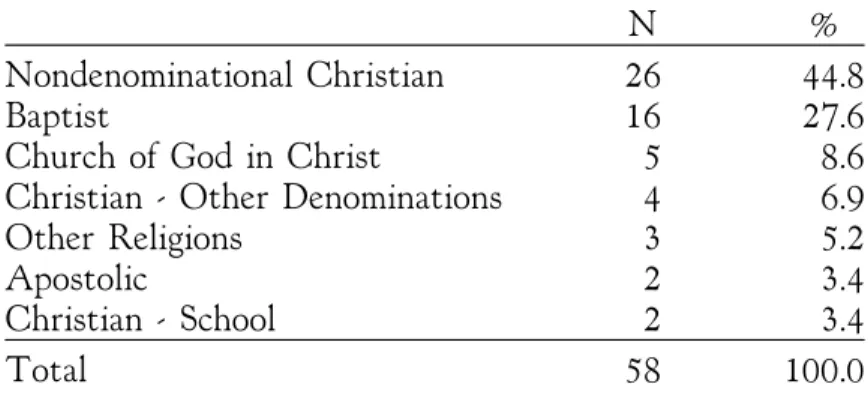
The bankruptcy attorneys I interviewed thought that their religious or-ganization clients’ effective lack of affiliation was a significant factor in lead-ing these clients to turn to chapter 11. Table 2 summarizes the affiliations of the interviewed attorneys’ clients that filed during the study timeframe.39
36Id. at 737.
37The Pentecostal movement emphasizes lay control through the authority of the founding pastor. See
Joel Robbins, The Globalization of Pentecostal and Charismatic Christianity, 33 ANN. REV. OF A NTHRO-POLOGY 117, 134 (2004). Though an individual Baptist church may belong to a convention, Baptist sects
are “loosely knit,” effectively rendering each church autonomous. LINCON& MAMIYA, supra note 32, at
43-44.
38Foohey, Bankrupting the Faith, supra note 2, at 737.
39Interviewed attorneys represented a total of 58 of the 254 debtors that filed in the ten districts with
the greatest percentages of religious organization filings during the study timeframe. See supra Part I.A. Table 2 combines certain Christian denominations to protect the identity of the interviewed attorneys because only one or two churches affiliated with various denominations filed during the study timeframe. The “other religions” category includes all non-Christian debtors, again combined to protect attorneys’ identities.
Table 2: Religious Affiliation of Attorneys’ Clients That Filed During Study Timeframe
N %
Nondenominational Christian 26 44.8
Baptist 16 27.6
Church of God in Christ 5 8.6 Christian - Other Denominations 4 6.9
Other Religions 3 5.2
Apostolic 2 3.4
Christian - School 2 3.4
Total 58 100.0
Adding together nondenominational Christian churches, churches from vari-ous Baptist branches, and Apostolic and Church of God in Christ churches, both of which are part of the Pentecostal movement,40 85% of the attorneys’
clients were not part of a larger overarching organization that typically is equipped (or expected) to provide financial support as needed. Likewise, some of the attorneys who represented other subsets of religious institution debtors, such as Jewish Chabads, described a comparable governance struc-ture in which the debtor, though part of a specific movement, could not look to other affiliated organizations for financial assistance.41
Attorneys viewed the lack of or lax affiliation as significant not only from the standpoint of financial assistance, but also because the autonomy given to nondenominational and congregational churches often resulted in ineffective internal governance. As one attorney noted, “churches that are more closely tied to a larger denominational structure are more likely to be subjected to greater oversight.”42 A Lutheran church debtor “seemed to be much more of
a corporate operation with a functioning board.”43 Similarly, one attorney
viewed the decision making in Presbyterian churches as different from the “loosely functioning” boards of more autonomous churches.44 Indeed, the
greatest risk of succumbing to financial distress appeared to exist in
nonde-40See 3 DAVID E. BERNARD, A HISTORY OF CHRISTIAN DOCTRINE: THE TWENTIETH CENTURY A.D.
1900-2000, at 358-59 (1999) (listing Apostolic and Church of God in Christ as Pentecostal churches).
41See Interview with S. Fla. Attorney Three (April 26, 2013) (stating that “Chabads work
differ-ent[ly] than normal synagogues” and noting that a chabad “basically need[s] a couple [of] big donors to support [it]”); Interview with S. Fla. Attorney One, at 2-4 (April 25, 2013) (discussing chabads). The Chabad-Lubavitch movement is worldwide, but each house is organized around one rabbi. See About Chabad-Lubavitch, http://www.chabad.org/library/article_cdo/aid/36226/jewish/About-Chabad-Luba vitch.htm (last visited Feb. 5, 2014).
42Interview with N. Ill. Attorney One, at 2 (April 24, 2013). 43Interview with C. Cal. Attorney One, at 4 (April 26, 2013). 44Interview with S. Tex. Attorney Two, at 3-4 (June 17, 2013).
nominational and congregationalist churches that also vested all authority in one leader, usually the pastor (and sometimes his or her family). These churches, attorneys observed, were “most likely to run into trouble.”45
Moreover, approximately one third of the attorneys who represented Christian churches mentioned another demographic skew to their religious organization clients. The churches they represented were mainly Black Churches.46 Some of these attorneys had only represented Black Churches,47
and some of the attorneys hypothesized that these churches approached them for representation because they were African American themselves.48
This racial demographic skew bears additional study. Though Black Churches disproportionately may be comprised of small congregationalist and nondenominational churches, they still may be filing under chapter 11 more often than they appear in these subsets of religious organizations. Further investigating why Black Churches turn to bankruptcy may expose variations in the lending market, both in terms of the secured lenders’ willingness to fund Black Churches’ building purchases and their willingness to negotiate modifications of the loans when the churches experience difficulty remaining current on their obligations.49 Thus, banks and other lenders may influence
the demographic skew of religious organization debtors. Further study also may reveal that Black Churches learn about chapter 11 from their social net-works such that they are more likely to use the bankruptcy system, likewise influencing the demographic skew of religious organization debtors.50
Finally, specific to these African American congregations, attorneys high-lighted a consistent dynamic that further impacted the churches’ ability to withstand financial distress. The organizations’ boards yielded control of the
45Interview with N. Ill. Attorney One, supra note 42, at 2; see also Interview with W. Tenn.
Attor-ney Three, at 2 (May 15, 2013) (“In each of these cases, the church was dominated by one family of the minister.”); Interview with N. Ga. Attorney One, at 3 (May 10, 2013) (“[T]his [church] was family owned and family run.”); Interview with E. N.C. Attorney One, at 2 (May 3, 2013) (“This was basically a one guy show.”).
46Of the thirty-two attorneys who represented Christian debtors, ten (32%) mentioned
demographics. See supra note 32 for the definition of “Black Church.”
47See, e.g., Interview with S. Tex. Attorney Two, supra note 44, at 2 (“Without exception, [my and
my partners’ clients] are all black churches. All of them. And they’re all congregationalist churches.”); Interview with E. N.C. Attorney Three, at 2 (May 15, 2013) (“All of these [churches] . . . have black congregations.”); Interview with C. Cal. Attorney Three, at 5 (April 22, 2013) (“I deal with black churches.”).
48See, e.g., Interview with N. Ga. Attorney Three, at 1 (June 20, 2013) (“[There are not a lot of
African American corporate bankruptcy lawyers in the nation.”); Interview with Md. Attorney One, at 1 (May 6, 2013) (“[T]here’s not a lot of African American attorneys doing chapter 11.”); Interview with S. Tex. Attorney One, at 1 (May 2, 2013) (“There are very few lawyers, African American lawyers in [my] area.”).
49See infra Part III.B for further discussion of lenders’ pre-bankruptcy actions. 50See supra notes 17-21 and accompanying text.
church to one person, who became the “driving force”51 behind the
congrega-tion and who “called the shots.”52 One attorney commented, “the minister is
a king, and his wife is the queen . . . without exception in every single black church I’ve dealt with.”53 Attorneys thought that the lack of accountability
this vesting of power sanctioned invited mismanagement that could put un-due strain on church finances.54
B. SIZE OF THE CONGREGATION
A religious organization’s size also may influence its propensity to seek bankruptcy protection. The religious institutions that filed during the study timeframe were overwhelmingly small based on their assets and debts. They owned a building worth a median of $1.2 million and personal property val-ued at a median of approximately $50,000.55 Three-quarters of the debtors
qualified as small businesses as defined by the Code.56 The amount of the
organizations’ assets and debts likely reflected a smaller membership and reve-nue base. Consequently, small churches may be more vulnerable to economic fluctuations, poor business decisions, and membership attrition.
The term “small church” encompasses two subcategories: “family run” congregations of fifty or fewer members and “pastoral” congregations of fifty to 150 members.57 Both subcategories of churches tend to be
nondenomina-tional or congreganondenomina-tionalist. A family church’s leadership is “organized around one or two matriarchs or patriarchs who are often the heads of extended biological families in the church,”58 which attorneys noted in describing some
of their clients as “family owned and family run.”59 The patriarch or
matri-51Interview with Md. Attorney One, supra note 48, at 2.
52Interview with E. N.C. Attorney Three, supra note 47, at 3; see also L
YLE E. SCHALLER, THE SMALL
CHURCH IS DIFFERENT 29 (1982) (“Regardless of how long they have been in existence, black
congrega-tions frequently are strongly pastor-centered.”).
53Interview with S. Tex. Attorney Two, supra note 44, at 2.
54Interview with E. N.C. Attorney Three, supra note 47, at 3 (“[T]here wasn’t enough supervision
over finances.”); Interview with N. Ill. Attorney Four, at 3 (May 14, 2013) (“Some of these pastors are living large . . . .”); Interview with W. Tenn. Attorney Two, at 4 (May 1, 2013) (“Their biggest problem was just gross, gross mismanagement [related to the lead minister’s actions].”).
55Foohey, Bankrupting the Faith, supra note 2, at 738 tbl.3.
56Id. at 739 n.106. The Code provides that a small business debtor is a debtor with aggregate debts as
of the petition date not exceeding $2,343,300 (as of April 2010). 11 U.S.C. § 101(51D) (2012).
57“Small churches” generally are defined by the number of congregants, but also may be defined by the
number of pastors and number of buildings owned. See John M. Koessler, The Dynamics of Small Church Ministry, 3 THE MASTER’S SEMINARY J. 175, 176 n.2 (1992) (discussing varying definitions of a “small
church”); ALICE MANN, THE IN-BETWEEN CHURCH: NAVIGATING SIZE TRANSITIONS IN C ONGREGA-TIONS 77 (1998) (categorizing churches that have less than 100 members as family-sized and
pastoral-sized).
58M
ANN, supra note 57, at 77; see also STEVEN E. BURT AND HAZEL A. ROPER, RAISING SMALL
CHURCH ESTEEM 23 (1992) (“Not only does the Family Church feel like family to its participants, in some
instances, the church literally is family.”).
arch typically controls the key operations of the church,60 though
indepen-dent congregations or congregations with loose affiliations tend to be “very pastor-centered, with the laity in a supportive role to that strong and mag-netic ministerial personality.”61 Likewise, in a pastoral church, the pastor is
the central figure.62 This type of church is the “one guy show” attorneys
sometimes represented.63
Scholars of congregational systems have noted that a small church’s size limits its finances, which in turn may hinder its sustainability and growth,64
and which makes the cost of the building the church’s largest expense.65
At-torneys likewise linked the size of the religious organization to serious finan-cial instability.66 They thought that small churches were impacted more
severely by economic downturns,67 and were more likely to have difficulty
finding and negotiating competitively priced loans.68
My interviews with leaders support the apparent denominational, demo-graphic, and size skew of the religious organization debtors. A majority of the leaders interviewed were affiliated with congregationalist or nondenomi-national churches, and nine of the ten leaders were from predominately
Afri-60See M
ANN, supra note 57, at 77 (noting that “the pastor functions in a chaplain role, leading worship
and giving pastoral care”); Roy M. Oswald, How to Minister Effectively in Family, Pastoral, Program, and Corporate-Sized Churches, 17 ACTION INFORMATION 5, 5 (1991) (“It is the patriarchs and matriarchs
who control the church’s leadership needs.”), available at http://enrichmentjournal.ag.org/200702/200702 _000_various_size.cfm.
61SCHALLER, supra note 52, at 29.
62MANN, supra note 57, at 77 (“The pastor is the central figure, holding together a small circle of
leaders.”).
63Interview with E. N.C. Attorney One, supra note 45, at 2. Small churches historically have been
nondenominational or congregationalist; see W. CURRY MAVIS, ADVANCING THE SMALLER LOCAL
CHURCH 11 (1957) (identifying one of small churches’ limitations as “a lack of denominational or
commu-nity status”).
64See L
YLE SCHALLER, THE SMALL MEMBERSHIP CHURCH 100 (1994) (“Money, rather than ministry
and mission, becomes the most influential factor in policy making.”); JACKSON W. CARROLL, SMALL
CHURCHES ARE BEAUTIFUL 125 (1977) (“Churches with membership of less than two hundred persons
are likely to have resources insufficient or barely adequate to maintain the institution and carry on a program.”).
65See A
NTHONY G. PAPPAS, ENTERING THE WORLD OF THE SMALL CHURCH 9 (2000) (describing
the cost of the church building as “a threat”); LYLE SCHALLER, 44 WAYS TO INCREASE CHURCH A TTEND-ANCE (1987) (listing real estate considerations as one of six main areas that church leaders need to
con-sider); Dean B. McIntyre, The Small Church Primer: Strengths, Weaknesses, Worship, and Music in the Small-Membership Church, GBOD, http://www.gbod.org/lead-your-church/general-resources/resource/ the-small-church-primer-strengths-weaknesses-worship-and-music-in-the-small (last visited Feb. 5, 2014) (describing how the purchase of an old building can lead a small church into serious financial problems).
66Ten attorneys described their clients as either very small, small, or as having a membership of fewer
than 200 congregants.
67See Interview with E. N.C. Attorney Three, supra note 47, at 3; Interview with N. Tex. Attorney
Two, at 4 (May 2, 2013).
68Interview with N. Tex. Attorney Three, at 3 (May 13, 2013) (“[A] small church or small fledgling
church or medium size church can’t get commercial business lending because they don’t have the proven track record, the cash flow . . . .”).
can-American congregations.69 With the exception of one, they each
pastored a “small church,” with an active membership between 100 and 200 members at the time of the bankruptcy filing.70
These leaders admitted that their congregations encountered difficulty paying the mortgage in the wake of the Great Recession and struggled with general mismanagement.71 Leaders further spoke of internal dynamics that
they thought stalled the churches’ responses to their financial declines.72
They also identified trouble in obtaining loans as smaller organizations, 73 as
well as their churches’ independence from overarching institutions as salient factors in difficulties they faced as leaders in resolving their churches’ finan-cial problems.74 In the case of one church affiliated with a more organized
denomination, which theoretically could have intervened with financial assis-tance, the leader detailed how the church was required to pay dues to its parent organization every year, regardless of the church’s financial situation that year.75 Overall, denomination and size (and possibly racial
demographics), particularly when combined, may render certain subsets of
69See supra Part I.B.
70Two of the churches previously had memberships of between 400 and 500, but membership had
declined significantly by the time the churches filed. One church had “faithful” membership of about 60, though approximately 200 people were on the membership roster. Interview with W. Tenn. Leader Two, at 3 (Mar. 17, 2014). Some leaders likewise described their churches as small. See, e.g., Interview with M. Fla. Leader Three, at 1 (May 14, 2013) (“We’re just a small congregation. . . . The oldest person in my church is the mother of my church . . . .”); Interview with C. Cal. Leader Two, at 1 (May 10, 2013) (“[I]t’s a small congregation.”); Interview with M. Fla. Leader Two, at 1 (May 3, 2013) (noting operational problems that accompanied the “small church”).
71See, e.g., Interview with C. Cal. Leader Two, supra note 70, at 1 (“[I]f the economic climate of a
country is such that people are losing their jobs, and so forth, the church can’t function.”); Interview with M. Fla. Leader Two, supra note 70, at 1 (discussing how a previous pastor had mismanaged the church); Interview with C. Cal. Leader One, at 2 (Apr. 17. 2013) (detailing how previous management had created many of the church’s problems).
72See Interview with W. Tenn. Leader Two, supra note 70, at 2 (“[W]hen you go through a crisis,
information tends to travel, that is negative information. People tend to shun or reject. But then when they pretty much find out what’s going on . . . [they] find themselves coming back.”); Interview with M. Fla. Leader One, at 2 (Apr. 18, 2013) (commenting that the trustee board was slow to act “when it came time to turn things around”); Interview with W. Tenn. Leader One, at 2 (May 1, 2013) (describing how a church split was one of the main factors leading to the church filing for bankruptcy).
73See Interview with M. Fla. Leader Three, supra note 70, at 3 (hypothesizing that banks thought of
churches as risky small businesses); Interview with N. Ill. Leader One, at 3 (May 6, 2013) (describing the church’s mortgage lender as “totally heartless”); Interview with N. Ga. Leader One, at 2 (Apr. 17, 2013) (detailing how the church had a balloon note with “an interest rate that was floating and the bank at the time was not interested in giving us a lower rate”); see also Interview with S. Tex. Attorney One, supra
note 48, at 3 (commenting that religious organizations encounter similar problems as consumers, such as the escalating interest rates of variable loans). Religious organization debtors’ chapter 11 filings likewise identified the effects of the Great Recession on their ability to find capital as one of the reasons they fell behind on mortgage payments. See Foohey, Bankrupting the Faith, supra note 2, at 758-62.
74See Interview with C. Cal. Leader Two, supra note 70, at 1 (contrasting the Catholic Church’s
“infrastructure” with less hierarchical Pentecostal assemblies).
religious organizations more susceptible to fluctuations in revenue and ex-penses that affect their ability to pay their debts, thereby causing them ulti-mately to turn to bankruptcy.76
C. MANAGEMENT MISSTEPS
Though the Great Recession took its toll on religious organizations, as it did on small businesses generally,77 the nature of religious organizations
seemed to create additional and unique avenues for management failure. Like managers of for-profit businesses, leaders sometimes mismanaged the business aspects of the church, entering into unprofitable side ventures and misjudging cash flow versus expenses.78 However, the leaders of many of the smaller
congregations lacked business acumen, even more so than owners of small businesses. Consequently, these organizations’ books and records often were in disarray, and their leaders generally were less sensitive to the business aspects of the churches, including not foreseeing and planning for the impact of the recession on the congregation’s giving.79
Even more unique to religious organizations, beloved pastors sometimes mishandled the churches’ spiritual matters and made missteps in their per-sonal lives that alienated their congregants.80 When members lost faith in
their churches’ leaders, they reduced their contributions.81 Alternately,
members simply left the congregation, likewise resulting in a reduction in cash flow.82 Considered together with the challenges of guiding a small
con-gregation through financial problems, the unique issues of managing religious organizations may have made certain organizations even more susceptible to finding themselves in financial distress that eventually required them to turn to the bankruptcy system.
76Denomination and size merely may correlate with religious organizations’ chapter 11 filings. A more
detailed study is necessary to assess whether size, denomination, and racial demographics are predictive of higher bankruptcy filing rates.
77See Robert W. Fairlie, Entrepreneurship, Economic Conditions, and the Great Recession, 22 J.
OF
ECON. & MGMT. STRATEGY 207, 207 (2013) (“Business bankruptcy filings and closures increased sharply
in the recent recession.”).
78Foohey, Bankrupting the Faith, supra note 2, at 762-67.
79See, e.g., Interview with C. Cal. Attorney Six, at 4 (May 10, 2013) (“[T]heir books are in even
worse shape than most businesses.”); Interview with N. Ill. Attorney Three, at 6 (May 9, 2013) (“[M]any of these churches . . . are not particularly sophisticated with respect to finances”); Interview with M. Fla. Attorney Three, at 5 (May 8, 2013) (noting how a client’s leaders’ “lack of business acumen” proved frustrating); Interview with C. Cal. Attorney One, supra note 43, at 3 (describing how the church’s leaders “overextended themselves in terms of their operating expenses . . .”).
80Foohey, Bankrupting the Faith, supra note 2, at 762-67. 81Id.
82Id.; see also Interview with S. Tex. Attorney One, supra note 48, at 3 (“The neighborhood was in
transition, and they lost membership. And then they had a number of members who were laid off.”); Interview with M. Fla. Attorney One, at 3 (May 2, 2013) (noting that in the cases handled, the church either suffered a loss of membership or its members were dealing with their own financial troubles).
III. CHALLENGES IN REPRESENTING RELIGIOUS ORGANIZATIONS IN CHAPTER 11
The characteristics of many of the religious organizations that sought to reorganize likewise influenced the chapter 11 process, and presented bank-ruptcy attorneys with several stumbling blocks during their representations of religious organization debtors. In discussing these difficulties, attorneys highlighted practical considerations they thought other attorneys, judges, and parties involved in future cases may benefit from bearing in mind.
A. UNCLEAR GOVERNING STRUCTURE: WHO IS THE CLIENT?
Attorneys identified religious organizations’ governing structure as the leading “special consideration” to take into account in representing a religious organization in chapter 11.83 All of the attorneys’ clients were overseen by a
board, usually called the trustee board.84 To file a chapter 11 petition, the
organizations’ articles of incorporation typically required this board to give written authorization.85 However, some churches’ bylaws gave authority to
the “body” or laity, possibly requiring consensus among all members.86 As an
initial matter, this prompted questions about who had the ability to authorize a filing.87
The main challenge, however, related to the board frequently granting significant control over the operations of the church to one pastor, who often also effectively controlled the board.88 In these instances, attorneys’ primary
contact was usually this pastor.89 The resulting mismatch between who
at-83One open-ended question I asked attorneys was: “Are there any special considerations that must be
thought through when representing religious organizations?”
84State law provides that nonprofit corporations must be governed by boards. See E
LIZABETH
SCHMIDT, NONPROFIT LAW: THE LIFE CYCLE OF A CHARITABLE ORGANIZATION 47 (2011).
85See, e.g., Interview with W. Tenn. Attorney Three, supra note 45, at 2 (“In order to satisfy the
requirements of the Bankruptcy Code, I had to make sure that the board functioned appropriately.”); Interview with Md. Attorney One, supra note 48, at 2 (“[O]nce [the church] get to the point of making a corporate resolution, you’re basically dealing primarily with that lead person who signed the resolution.”).
86See Interview with W. Tenn. Attorney One, at 2 (May 2, 2013) (noting that where a church
belonged to the “body” under its bylaws, the church had authorized the pastor to make all the decisions).
87See Interview with N. Tex. Attorney Two, supra note 67, at 3 (noting that in one case, the secured
creditor filed a motion questioning whether the church had secured proper authorization to file).
88See, e.g., Interview with N. Ga. Attorney Two, at 2 (May 21, 2013) (“[A]ll of them have had
[boards], some to a lesser extent than others.”); Interview with Md. Attorney One, supra note 48, at 2 (comparing churches to “small business, sole proprietors . . . because there’s usually one person that’s the driving force behind [the church]”); Interview with N. Ga. Attorney One, supra note 45, at 3 (describing how the lead pastor controlled the board, which was comprised of family members); see also supra Part II.A.
89In two other less common scenarios, the lead pastor or reverend was not the attorneys’ primary
contact. In the first scenario, the pastor had moved to a different congregation or the congregation essen-tially had ousted the pastor. The senior deacon or trustee board then was left in charge. See Interview with Md. Attorney Two, at 2 (May 7, 2013) (noting that two senior deacons were the attorney’s primary contacts after the lead pastor had left the congregation). Second, the religious organization employed a
torneys interacted with and reported to, and who had the ability, at least on paper, to make decisions for the organization resulted in questions about who truly “was speaking with authority.”90 Even if a church’s board members and
congregants were deferential to their pastor, attorneys still struggled to make sure that everyone who needed to be involved was in “alignment” with the decisions that were being made.91
In this way, attorneys described religious organization chapter 11 cases as requiring “consensus building” 92 and “acting almost as a referee,”93 much
more so than in small business cases. It took time to determine the pecking order of authority,94 to get a “feel for what is going on” besides the pastor’s
story,95 and more generally to be sensitive to the different cultures that exist
within religious organizations.96 The “slippery” nature97 of these
organiza-tions left attorneys feeling that they had more than one client,98 and that an
entire community was at stake.99 Because of the community aspect of the
representation, attorneys enjoyed being part of these cases, even if they had to expend time and energy navigating the governing structure and culture.100
But they nonetheless focused on how crucial it is to be “smart” about inter-acting with the leader who comes to them, with the board members who may have the final say, and with the members whose input (monetary and other-wise) may be vital to saving the congregation.101
stricter governing structure whereby the head of the trustee board or the president of the congregation was the attorney’s main contact. See Interview with N. Ill. Attorney Six, at 4 (May 28, 2013) (describing interacting with the president of the congregation of a church affiliated with a more organized denomination).
90Interview with E. N.C. Attorney One, supra note 45, at 2.
91Interview with E. N.C. Attorney Two, at 5 (May 13, 2013). See also Interview with N. Ill.
Attor-ney Three, supra note 79, at 1 (describing how it was “difficult” to get in contact with all the people who ran the church); Interview with Md. Attorney Two, supra note 89, at 2 (noting that it took extra time to make sure that the governing body was “on the same page” as to what the church should do).
92Interview with C. Cal. Attorney Two, at 2 (Apr. 18, 2013). 93Interview with W. Tenn. Attorney One, supra note 86, at 4.
94Interview with S. Tex. Attorney Two, supra note 44, at 3; see also Interview with N. Ill. Attorney
One, supra note 42, at 6 (noting that answers to questions about who owns the church entity “are simpler for small businesses, and they can be very convoluted for churches. Who is the client, who has the author-ity, that sort of thing”).
95Interview with C. Cal. Attorney Three, supra note 47, at 2. 96Interview with C. Cal. Attorney Two, supra note 92, at 2. 97Interview with S. Fla. Attorney Two, at 5 (Apr. 23, 2013).
98See Interview with W. Tenn. Attorney Two, supra note 54, at 6 (“[W]ith the church, you’re
dealing with at least two people, possibly ten people.”); Interview with C. Cal. Attorney Six, supra note 79, at 4 (“There’s more collective input.”).
99See Interview with N. Ga. Attorney Two, supra note 88, at 1 (“You have to take into consideration
the congregation, the other leaders in the church, the implication for the church and the community.”).
100See infra Part III.E.
101See, e.g., Interview with Md. Attorney Three, at 5 (May 24, 2013) (noting that “my approach is
going to be different the next time” in representing a church); Interview with C. Cal. Attorney Six, supra
B. THE CHURCH BUILDING AS AN ALBATROSS
Regardless of the underlying causes of religious organizations’ financial distress, the primary goal of the vast majority of congregations studied was to save their building from foreclosure.102 Attorneys representing religious
or-ganization debtors offered two insights into the unique issues surrounding saving the building that may have significantly influenced some of their cli-ents’ paths to bankruptcy, the reorganization processes, and case outcomes.
First, attorneys emphasized the strong emotional attachment that congre-gations have to their buildings. Congregants seemed to view their church building as “somewhere they can go and be proud and worship and invite other churches to visit and raise their families in. They are looking for a home.”103 Filing for bankruptcy was not merely about saving equity in a
building, but about “keep[ing] the congregation and keep[ing] the church together.”104 The loss of a particular building may have equaled the loss of
the congregation.105 In short, “they fall in love with that one church.”106
Because leaders and congregants often were “not driven by normal busi-ness considerations,”107 they may have behaved irrationally when faced with
a foreclosing lender. Bankruptcy provided a venue for them to realize that they needed to downsize, to “get over” 108 losing their “spiritual homes.”109
At the same time, the automatic stay110 and the chapter 11 process gave
leaders an opportunity to try to sell the buildings at higher than fire sale prices, potentially preserving some of the organizations’ equity, which they could use to rebuild their congregations.111
Attorney Two, supra note 97, at 5 (stating that “I’d be a lot smarter about” representing churches in the future).
102See, e.g., Interview with Md. Attorney One, supra note 48, at 2 (“[A]t least in this area, it’s all been
about the real estate.”); Interview with M. Fla. Attorney One, supra note 82, at 4 (noting that both cases handled were about the mortgage); Interview with C. Cal. Attorney Three, supra note 47, at 5 (“[C]hurches . . . got a little too ambitious and took on more debt than they could service.”).
103Interview with C. Cal. Attorney Three, supra note 47, at 6. 104Interview with E. N.C. Attorney One, supra note 45, at 4.
105See Interview with E. N.C. Attorney Two, supra note 91, at 6 (“[I]t would have been really
disruptive to the church had they lost their buildings.”); Interview with W. Tenn. Attorney Two, supra
note 54, at 7 (“[I]f you don’t have a building, I don’t think you stay together very long.”).
106Interview with N. Tex. Attorney Three, supra note 68, at 4. 107Interview with S. Fla. Attorney Two, supra note 97, at 4. 108Interview with C. Cal. Attorney Three, supra note 47, at 6.
109See Foohey, Bankrupting the Faith, supra note 2, at 767-68 (discussing how congregants “seem to
become intertwined with the institutions’ buildings”).
110See 11 U.S.C. § 362(a) (2012) (imposing a stay on various actions by creditors to collect on their
claims against the debtor).
111See, e.g., Interview with Md. Attorney Two, supra note 89, at 2 (describing how a client sold its
building during its case); Interview with N. Ill. Attorney Two, at 2 (May 7, 2013) (describing how a client planned to sell property); Interview with N. Ill. Attorney One, supra note 42, at 4 (“[T]he auto-matic stay give[s churches] some breathing space to . . . make transitions”).
Second, attorneys theorized that although mortgage lenders had threatened or initiated foreclosure proceedings, on balance, lenders did not want to foreclose on a church.112 Banks may have worried that a church
building would prove difficult to sell given that it is “built to be a church”113
and that the bank would not be able to “do anything with a church building except have a church in it.”114 Foreclosing on a religious organization also
could invite bad publicity. For example, one attorney questioned, “in the end, who’s going to foreclose on a church in a small town?”115
When pressed as to why banks would initiate proceedings they were not eager to conclude, one attorney hypothesized that federal legislation may re-quire them to “pursue all of their rights and remedies,” including foreclo-sure.116 Alternatively, mortgage lenders may threaten foreclosure in order to
convince religious organizations’ leaders that they need to make concessions. In some instances, leaders seemed to become so entrenched in their refusal to compromise on any item having to do with their members’ “spiritual homes” that they became “convinced that the bank was the devil.”117 Conversely,
lenders’ unwillingness to make deals with religious organizations, for whatever reason, may have impeded the productivity of negotiations, eventu-ally requiring foreclosure.118
Moreover, though banks might have initiated foreclosure proceedings, some of the church leaders interviewed indicated that they learned of the possibility of filing bankruptcy from their lenders.119 One explanation for
why lenders would start a foreclosure but suggest a bankruptcy filing to their borrowers is that a chapter 11 proceeding offered the lender a way to gain access to the debtor’s financial records, allowing it to better assess the relig-ious organization’s continued viability.120 As an added bonus, the chapter 11
process would force the churches to conform to budgeting requirements and
112But see Interview with M. Fla. Attorney One, supra note 82, at 4 (hypothesizing that banks may
wait to initiate foreclosure proceedings, but once started, would follow through).
113Interview with W. Tenn. Attorney Three, supra note 45, at 2.
114Interview with W. Tenn. Attorney Two, supra note 54, at 3; see also id. (“[S]ometimes, some of the
banks, if you just say, well, here are the keys, they’ll back off and work with you.”).
115Interview with N. Tex. Attorney Two, supra note 67, at 5; see also Interview with N. Ill. Attorney
Four, supra note 54, at 4 (“[M]any banks are reluctant to foreclose on some of these churches for various reasons . . . goodwill and their reputation in the community and so forth.”).
116Interview with N. Ga. Attorney Three, supra note 48, at 4; see also W. Tenn. Attorney Two, supra
note 54, at 9 (“These big banks, federal regulations don’t permit them to work with people.”).
117Interview with W. Tenn. Attorney Two, supra note 54, at 7.
118One explanation relates to leaders’ poor record keeping skills. See supra note 79 and accompanying
text. Lenders may have foreclosed because they had little way of knowing the financial stability of the religious organization debtors and effectively decided to cut their losses and move on.
119Interview with M. Fla. Leader Three, supra note 70, at 3; Interview with W. Tenn. Leader One,
supra note 72, at 3; Interview with M. Fla. Leader One, supra note 72, at 2.
120Debtors must file schedules detailing assets, debts, and financial affairs, and monthly reports of net
reorganization plans, as required by the Code.121
In short, prior to filing, religious organizations’ buildings become an alba-tross for some debtors and lenders. Overly emotional attachment of leaders and congregants to their “spiritual homes” may have impeded progress in re-structuring their mortgages, while lenders also may have heeded their own interests that likewise stalled negotiations. Post-filing, lenders’ apparent de-sire not to foreclose on churches may have opened the door for successful negotiations during the chapter 11 proceedings. Leaders’ ultimate goal of pre-serving their congregations similarly may have led to productive outcomes as leaders came to realize what was achievable.
C. LICENSES AND PERMITS; CASH COLLATERAL DISPUTES
Although saving the building was the primary goal of reorganization, at-torneys identified two other significant hurdles that threatened the reorgani-zation effort. First, in an attempt to generate revenue to meet expenses, some organizations undertook side businesses, such as operating daycares and delis. These side operations required the maintenance of licenses and permits and timely inspections. Unfortunately, some leaders were not versed in the intri-cacies of these requirements or were not sufficiently attentive to the business aspects of the church to keep up with the requirements. Lapsed licenses, revoked permits, and unanticipated problems with local ordinances plagued a few attorneys.122
Second, more prevalently, religious organizations faced disputes about cash collateral upon filing.123 Some attorneys were surprised when lenders
asserted that monies coming into the church from congregants’ donations were part of their collateral and that the lenders had a right to influence how the funds were spent on a monthly basis.124 Approaching the issue from a
religious perspective, one attorney thought it “offensive” and “crass” that the
121Monthly reporting may function as a budgeting tool. See Interview with W. Tenn. Leader Two,
supra note 70, at 7 (referencing the reporting requirements and noting that keeping records is “extremely important”); Interview with M. Fla. Leader Two, supra note 70, at 4 (discussing how the chapter 11 process allowed the church to make budget adjustments). To be confirmed, bankruptcy courts must find proposed plans feasible, among other requirements. 11 U.S.C. § 1129(a); see also Interview with C. Cal. Leader One, supra note 71, at 6 (describing how the confirmed plan helped the church “stay on top of the finances as it relates to chapter 11”).
122See Interview with S. Fla. Attorney Three, supra note 41, at 4 (noting that questions arose as to a
deli license); Interview with C. Cal. Attorney Four, at 2 (Apr. 18, 2013) (discussing how some religious organizations donate or sell food and noting that “they might not be aware about these special licenses that they need”).
123Cash collateral refers to “cash, negotiable instruments, documents of title, securities, deposit
ac-counts, or other cash equivalents” that are property of the estate and subject to a security interest. 11 U.S.C. § 363(a) (2012). The debtor-in-possession or trustee must obtain permission from the secured party or an order from the bankruptcy court to use cash collateral in the ordinary course of business during the chapter 11 case. 11 U.S.C. § 363(c).