IMF Conditionality
Giulio Federico
¤Nu¢eld College, Oxford
OX1 1NF, U.K.
giulio.federico@nu¢eld.oxford.ac.uk
First Draft: February 2001
This Draft: September 2001
Abstract
This paper presents a principal-agent model of IMF conditional lending, in the aftermath of a “capital-account” liquidity crisis. We show that traditional ex-post conditionality can be e¤ective in safeguarding the Fund’s resources, allowing for the provision of e¢cient emergency lending and reducing ine¢cient ex-ante credit rationing if the capital out‡ow which triggers the crisis is not excessive.
We apply the baseline model to analyse the issues of debtor moral hazard and private sector involvement (PSI), which have characterised the recent debate on reforming the Inter-national Financial Architecture. We show that debtor moral hazard is only a concern if the IMF cannot commit to make the post-crisis participation constraint of the debtor country binding, and that it can only be resolved via ex-ante conditionality (or pre-quali…cation). Attempts to reduce debtor moral hazard may however compromise the Fund’s ability to safeguard its resources ex-post.
We also show that PSI in the solution of balance of payments crisis is a central determinant of the e¤ectiveness of both crisis prevention and resolution e¤orts on the part of the IMF. PSI may be an enabling condition for e¢cient crisis resolution, and may therefore be imposed even by a “PSI-averse” IMF. Moreover, there are conditions under which it is optimal for the IMF to ex-ante precommit to a tough, and ex-post sub-optimal, PSI policy, in order to mitigate investor moral hazard.
JEL Classi…cation: F33, F34.
Keywords: IMF; conditionality; balance of payments crisis.
The purposes of the IMF are:
[...] (v) To give con…dence to members by making the general resources of the Fund temporarily available to them under adequate safeguards, thus providing them with opportunity to correct maladjustments in their balance of payments without resorting to measures destructive of national or international prosperity.
IMF Articles of Agreement, Article I
¤I thank Chris Adam and David Vines for helpful comments and conversations on an earlier draft. I am also
grateful for the remarks of James Boughton, Marcus Miller and of participants to a workshop of the Centre for the Study of African Economies (Oxford) and to the Royal Economics Society Easter School 2001.
1
Introduction
Conditionality is the practice by which the International Monetary Fund (IMF, or Fund) makes its …nancial assistance to member countries contingent on the implementation of speci…c eco-nomic policies. According to Article I(v) of its Articles of Agreement (quoted above) one of the purposes of the IMF is to intervene in support of member countries which are in a position of external disequilibrium (i.e. do not have su¢cient foreign exchange to purchase imports or to service their external debt). When it does so the IMF typically negotiates a program of ad-justment with the recipient country as a pre-condition for the initial disbursement of resources, and it makes the release of its funds contingent on the implementation of these programs. This practice is known asconditionality.1
This paper models IMF conditionality from a contractual perspective, employing a principal-agent framework. This is designed to capture both the stylised macroeconomic features of situations of balance of payment disequilibrium which warrant intervention by the IMF, and the nature and potential e¤ectiveness of these interventions. In doing so the paper seeks to bring together the various rationales for conditionality which have been put forward since the inception of this practice in the 1950s, and to analyse their mutual consistency and interaction. This analysis is of direct relevance to the current debate on reforming theInternational Financial
Architecture (IFA), which has been triggered by the large international …nancial crises of the
mid-to late 1990s (i.e. most notably the Mexican and East Asian crises), and which has generated a renewed interest by researchers and policy-makers on possible reforms of IMF crisis lending and of its conditionality practices.
The main results presented in this paper are as follows. First, two of the basic functions which can be identi…ed with IMF conditionality contracts (the protection of Fund resources and the provision of commitment technology to the recipient country) are mutually compatible, if the balance of payments disequilibrium (or capital out‡ow) which triggers IMF intervention is not too large. Second, IMF bail-outs can lead to debtor moral hazard if the IMF’s commitment power is limited. Conditionality can be used to reduce the incidence of this type moral hazard only if it is applied before the crisis (following “pre-quali…cation” procedures), and in exchange for larger post-crisis IMF loans. This may however compromise the ability of the Fund to safeguard its resources after the crisis, which may in turn lead to an institutional bias on the part of the IMF in favour of traditional post conditionality. Third, if the crisis is large,
ex-postPrivate Sector Involvement (PSI) in the form of debt-relief is a pre-condition for e¤ective
conditionality. Depending on the IMF’s attitude towards PSI and on the severity of investor moral hazard, the IMF may …nd it optimal to pre-commit before a crisis to maximise PSI if a crisis occurs. This may in turn introduce ine¢cient credit constraints ex-ante.
This paper proceeds as follows: the rest of this introduction consists of a brief review of existing literature on conditionality, and of the approach taken in this paper; Section 2 presents the baseline model of IMF conditionality, and Sections 3 to 5 employ and extend the basic framework to analyse three issues respectively: conditionality as commitment technology, debtor moral hazard, and PSI; Section 6 concludes.
1Appendix A.1 provides some information on the practice of IMF conditional lending, describing the nature and historical use of IMF …nancial facilities which are subject to conditionality.
1.1
Existing Work on IMF Conditionality
Much has been written about IMF conditionality. This has been mostly about the content
of conditionality, i.e. the type of policy changes demanded by the IMF as part of its …nancial assistance programs, and the e¤ectiveness of the IMF’s approach to stabilisation and adjustment (see e.g. Williamson (1983) and Shadler et al. (1995)). However work on the rationale and design of conditionality contracts (which is the subject of this paper) has been relatively scarce, especially at a formal level.
Papers which deal with (or comment on) the contractual aspects of conditionality can be broadly divided into three categories, which partially re‡ect three distinct stages in the evolution of the international monetary system, and which therefore place emphasis on di¤erent potential rationales for IMF intervention: the Bretton Woods era (orconditionality as a safeguard); the debt crisis of the 1980s (or conditionality as commitment technology); and the capital-account crises of the mid- to late 1990s (or conditionality as moral-hazard containment).
1.1.1 Conditionality as a Safeguard
The traditional and core view of IMF conditionality, as implicitly stated in the Articles of Agreement of the Fund and applied during the Bretton Woods era, is that by linking its …nancial support to policy changes, the IMF safeguards its resources, and guarantees their revolving nature.2 This is because conditionality can help to ensure that adjustment to a balance of payment disequilibrium will take place and that the temporary relief o¤ered by the Fund’s intervention will not lead to delays in the implementation of necessary adjustment policies. This in turn implies that the recipient country will be in a position to repay the Fund in due course (see e.g. Guitian (1981); IMF (2000b)). Conditionality therefore can be seen as acting as a substitute for the collateral which is typically employed in domestic loan contracts to discipline the behaviour of the borrower.
The ability to safeguard its lending via conditionality is often seen as a unique privilege of the Fund relative to private suppliers of liquidity,3 which enables it to intervene at times of crisis and prevent actions which are otherwise optimal for the debtor country, but which may have a negative externality on other IMF members.4 Conditionality as a safeguard may therefore go hand in hand withconditional lending as a bribe, which is used by the Fund to induce recipient countries to adopt policies which have a public good component.5
2
The IMF’s resources are made up of its members’ quotas. The Fund therefore functions like a credit coop-erative, making its resources available to members on a temporary and revolving manner. See Appendix A.1 for more detail on the IMF’s lending practices.
3
This argument has been made by a number of authors (e.g. Sachs (1989b) and Rodrik (1996)), who argue that the IMF has an advantage relative to private creditors in imposing and enforcing conditionality for several reasons: political neutrality (which makes the commitment not to extract an excessive share of the bene…ts of reform credible); informational advantage (e.g. lower costs in monitoring the implementation of conditionality); higher leverage relative to private creditors due to cross-conditionality practices (by which other donors and creditors link their …nancial support to the implementation of IMF programs).
4
This is what Article I(v) refers to as “measures destructive of national or international prosperity”, and which, depending on speci…c circumstances, may imply sharp (“competitive”) depreciation of the exchange rate, signi…cant output falls (e.g. recessions) or default on external debt.
5
1.1.2 Conditionality as Commitment Technology
A second rationale for conditionality emerged in the wake of the debt-crisis of the 1980s,6 following the realisation that high levels of sovereign debt may lead to ine¢cient outcomes due
to debt-overhang.7 This refers to the fact that a sovereign with a high level of external debt
may face sub-optimal incentives to invest and achieve higher future incomes because of the large proportion of future output gains which need to be transferred to external creditors. This can in turn reduce debt repayment, leading to a Debt La¤er curve. Two solutions to exit such debt traps have been identi…ed in the literature: fresh liquidity (or debt rescheduling) and/or debt relief (see e.g. Diwan and Rodrik (1992)). E¢cient solutions to debt-overhang may however not take place if debtors cannot precommit to policies which increase future output in exchange for favourable recontracting of their debt obligations (e.g. commit to invest rather than consume additional lending). Conditionality can represent the mechanism which allows debtors to commit to e¢cient policies by tying a favourable restructuring of the external debt to the adoption of these policies, and therefore allowing for an e¢cient exit from a debt-overhang situation.8 In the absence of conditionality and debt restructuring an ine¢cient outcome may persist (for high levels of external debt) and/or ex-ante credit-rationing may take place (Fafchamps (1996)).
1.1.3 Conditionality as Moral Hazard Mitigation
A third and more recent interpretation of conditionality is associated with the recent debate on the how to reform the International Financial Architecture (IFA)9 and on the potential need for an international Lender of Last Resort in a world with large and volatile international capital ‡ows, which may leave countries exposed to “runs” and liquidity crises even if their fundamentals are sound (in a fashion similar to the classic Diamond and Dybvig (1983) banking model).10 Some commentators have argued that, given the scale of the …nancial ‡ows involved, IMF bail-outs in these circumstances may lead to a problem of moral hazard, and excessive ex-ante risk-taking by both creditors and debtors (see for instance the IFIAC (or Meltzer)
6This was precipitated by the default of Mexico in the summer of 1982, and led to the IMF playing a key role in debt rescheduling and (eventually) relief e¤orts, with conditionality at the center of its interventions (see Guitian (1995)).
7This concept was articulated by a number of authors, in particular Sachs (1989a) and Krugman (1988). 8
Alternatively, conditionality can be seen in this context as a mechanism which guarantees to the debtor that creditors will not extract an excessive share of their future output by delegating the debt-relief (or rescheduling) management to an impartial organisation like the IMF (Claessens and Diwan (1990); Fafchamps (1996)); or as a mechanism which screens high productivity countries from low productivity ones, and allows creditors to target debt-relief on the former (Marchesi and Thomas (1999)).
More generally in these contexts conditionality can be seen as an “external agency of restraint” (Collier (1997)) which allows policy makers to adopt policies which would otherwise be time-inconsistent.
9
Eichengreen (2000) dates the start of this on-going debate to a speech made by Rubin (the then U.S. Secretary of the Treasury) in February 1998. Much of the recent discussion on IFA (e.g. Eichengreen (1999), Eichengreen (2000), Jeanne (2000) and Goldstein (2000)) centers around the issue of investor and debtor moral hazard reduc-tion, emphasising the need for reforms of IMF lending (including its conditionality) and for more Private Sector Involvement in crisis resolution.
1 0Much has been written on this issue in the wake of the Mexican crisis of 1995, and of the East Asian crisis of 1997/1998. Relevant work includes Radelet and Sachs (1998) and Chang and Velasco (1999) (who argue in a favour of a “country-run” interpretation of the crises), Dooley (2000) and Corsetti et al. (2000) (who favour a “moral-hazard” interpretation for the crises) and Fischer (1999) and Giannini (1999) (who discuss the issue of international lending of last resort).
Report (2000)). Given the risk and potential implications of moral hazard, it has been argued that conditionality should (and can) be seen as a mechanism to limit debtor moral hazard and introduceco-insurance, by imposing an additional cost onto countries which face a capital-account crisis and which are bailed-out by the Fund (Guitian (1995); Fischer (1999)).11 In this context conditionality could therefore be seen as a substitute for the “penal rates” at which the domestic Lender of Last Resort should lend according to the standard Bagheotian doctrine.
1.2
Structure and Approach of the Paper
As the survey of the literature presented above shows IMF conditionality is a multifaceted instrument, which is frequently assigned di¤erent roles by commentators (and, arguably, by the Fund itself). The purpose of this paper is to provide a stylised model which can encompass these roles, and shed light on their robustness and mutual compatibility.
The framework we develop to analyse IMF conditionality is based around a simple principal-agent model with the following building blocks: (i) external disequilibrium is due to capital in‡ows, which can trigger a “sun-spot” crisis (i.e. partially unrelated to fundamentals) by suddenly withdrawing from the debtor country;12 (ii) the model follows some of the literature on sovereign debt, starting from a recognition that debt contracts between sovereigns cannot be enforced, and that willingness to pay rather than ability to pay determines the amount of debt-repayment (see e.g. Eaton and Fernandez (1995)); (iii) the model assumes that the IMF is the only potential supplier of conditional liquidity in the immediate aftermath of a crisis (see the arguments mentioned in Section 1.1 for why this might be so); (iv) hidden action or information aspects of conditionality contracts are not modelled, for simplicity;13 and (v) there is no nominal exchange rate, so that a crisis manifests itself as a sudden reversal of foreign capital ‡ows (possibly followed by debtor default), rather than as a sharp currency depreciation. In the next section of the paper we employ these building blocks to construct an agency model of conditionality, where a principal (the IMF) o¤ers a conditional liquidity contract to an agent (the debtor) following a crisis event. As in standard principal-agent models, the principal designs the contract to trade-o¤ the maximisation of reform e¤ort with the minimisation of bail-out transfers. We show that this contract can avoid the occurrence of a ine¢cient liquidity crunch and of debt overhang if the capital out‡ow which triggers the crisis is not excessive. The use of conditionality also allows the IMF to lend under “adequate safeguards” (i.e. recover its bail-out
1 1According to this line of argument, the cost due to conditionality presumably derives from the con‡ict of priorities between the IMF and the recipient government, which implies that under conditionality the recipient adopts policies which it would have not adopted otherwise.
1 2
In other words the balance of payments crisis we consider as the trigger for IMF intervention is not a Krugman-stylecurrent-account crisis(as in Krugman (1979)), which is typically driven by over-expansionary policies and/or negative external shocks, but acapital-account crisis, of the kind seen in Mexico and East Asia in the 1990s. We focus on capital-account crises to make our analysis directly relevant to the current debate on IMF reforms, but the set-up we put forward is adaptable to more traditional current-account crises (i.e. the fundamental constraints on Fund intervention are the same).
1 3
This is the case also in the “moral hazard” extensions of the model that we present in Sections 4 and 5, where we follow the recent literature on the International Financial Architecture and use the term “moral hazard” rather loosely, to refer to a situation where an agent does not spontaneously adopt an e¢cient level of “e¤ort” from the point of view of a principal (as opposed to the standard hidden-action situation where …rst best e¤ort is not attainable because of a combination of asymmetric information, noise and agent risk-aversion).
It would be relatively straightforward to introduce hidden action and information considerations in the model we present below, but doing so would not add particularly signi…cant insights about the nature of IMF conditionality.
at the end of the crisis period), by tying the provision of the bail-out to the implementation of income-increasing reforms.
Sections 3 to 5 then proceed to draw out some of the implications of the baseline model. Section 3 shows how the presence of the IMF and of its provision of conditional liquidity can act as a source of commitment technology for the debtor both ex-post (once a crisis has occurred) and ex-ante (when foreign capital ‡ows into the country). Whilst ex-post the IMF has incentives to extract all of the value of this commitment technology with its conditionality contract (given its incentives to minimise transfers to the agent and maximise adjustment e¤orts), ex-ante the debtor may bene…t from the external restraint provided by the Fund, due to the reduction in ine¢cient credit rationing.
Section 4 and 5 address the currently topical issue of whether apparently e¢cient IMF bail-outs can induce moral hazard. We show in Section 4 that debtor moral hazard (i.e. excessive risk-taking on the part of the debtor) can arise only if the Fund’s ability to commit to make the agent’s participation constraint bind ex-post is limited. If this is the case, the IMF ex-post contract will be characterised by some slippage in the implementation of reforms,14 which will in turn induce the debtor to reduce ex-ante crisis prevention e¤orts. To solve debtor moral hazard the Fund needs to complement its ex-post bail-out with ex-ante conditionality, i.e. the commitment to higher ex-post bail-outs in exchange for more pre-crisis e¤ort on the part of the debtor. Section 4 shows that if the incidence of the Fund’s ex-post discretion is limited, ex-ante conditionality is able to restore …rst-best ex-ante e¤orts.
Section 5 examines the role for so-called Private Sector Involvement (PSI) in balance of payments crises. It shows that PSI can be an essential component of IMF-led crisis resolution packages, enabling e¢cient IMF bail-outs to take place. Even a PSI-averse IMF, i.e. one which seeks to maximise debt repayment, will therefore demand some PSI if the capital out‡ow is large. A PSI-tolerant IMF (i.e. one which trades-o¤ reform inducement with bail-out and PSI minimisation) has incentives to increase the degree of PSI, but it would still leave some rents to investors relative to a no-IMF benchmark (as long as in the absence of Fund intervention investors cannot co-ordinate on an e¢cient debt-relief o¤er). This insurance e¤ect for investors can generate an investor moral hazard problem, if the probability of crisis is su¢ciently sensitive to ex-ante capital in‡ows and if the crisis is su¢ciently disruptive (from a global perspective). If this is the case, the Fund will face incentives to pre-commit to a tougher, and ex-post sub-optimal, PSI policy, in order to deter excessive capital in‡ows.
Section 6 concludes by summarising the main results obtained in this paper, and highlighting the variety of trade-o¤s which can be identi…ed between the di¤erent possible functions and implications of IMF conditionality.
2
The Baseline Model
2.1
Set-up
Consider the following three-player and two-period model. The players are a group of foreign investors, a recipient (or debtor) country and the IMF. The two periods are an investment period (t= 1) and a potential crisis period (t= 2).
1 4
Att= 1the investors lend an amountkto the recipient country, which is assumed exogenous in this baseline model, and which we endogenise in the next section of the paper. We assume that kis consumed by the debtor country, and there is no reserve accumulation or investment.15 At t= 2a ‘crisis’ may occur, with probability°, which leads to a creditor ‘panic’, inducing investors to collectively demand k back from the debtor country at the beginning of the period. The probability of crisis is also assumed to be exogenous in this baseline model, and is endogenised in the extensions we present in Sections 4 and 5. However, both in the baseline model and in the endogenous-crisis extensions we assume that probability of the crisis occurring is notdirectly
related to the investors’ prospects for debt-repayment, and that the crisis takes place for reasons which are outside the model (e.g. investor panic; contagion; or a sudden interest-rate reversal working against the debtor country).
The recipient country faces a choice of adjustment e¤ort (et) at botht= 1and t= 2. More e¤ort leads to more outputy(et)(i.e. y0(et)>0), but at a costc(et). The standard assumption of convexity of the cost function is made (i.e. both c0(et) and c00(et) are positive). In this context e¤ort can be thought of as an e¢cient supply-side measure (e.g. price liberalisation, or a reduction in tari¤s) which increases domestic output but also implies a political economy cost for the policy makers in the recipient country.16
If a crisis occurs at the beginning oft= 2, the country can choose whether to repayk(which is demanded back by the creditor) or default. If it repays, it su¤ers a (1 +¸)k fall in welfare, where ¸ (which lies between 0 and 1) measures the deadweight loss associated with sudden
capital out‡ows. This can be interpreted as a loss due to early project liquidation (as in many banking models), or as a cost brought about by a sudden foreign exchange scarcity or a sharp fall in absorption.17 We assume that the ¸-loss applies to capital out‡ows which take place at the beginning of the t = 2 period (i.e. when investors demand their capital back), but not to those at the end of the period. If the debtor defaults on k it su¤ers a direct sanctionp(y(e2))
which is increasing in its domestic production level.18;19
If the crisis does not occur, kis not demanded back by the investor, and the debt is serviced by the debtor at t = 2 (and thereafter) at the international interest rate. For simplicity the international interest rate is …xed at 0, so that debt-servicing does not imply any transfer of resources from debtor to creditor.20
1 5This is analytically equivalent, in our set-up, to an assumption that foreign capital is invested by the recipient country at t= 1, and that its returns are fully wiped out in the event of a crisis (e.g. because of early project termination).
1 6Alternatively, y(e
t) can be thought of as the production of tradeables (rather than overall income) and et
as the relative price of tradeables to non-tradeables. Under this interpretation the functionc(et)would capture
the policy-makers’ preference with respect to tradeables and non-tradeables, for a given production possibility frontier for these two goods. Appendix A.3.1 outlines a model which de…nes e¤ortet along these lines.
1 7This e¤ect could be modelled explicitly, by introducing a concave utility function, or by allowing for price stickiness (which does not allow the debtor country to produce more tradeables when hit by a crisis to compensate for the sudden scarcity of foreign exchange). The set-up presented here can be therefore thought of as the reduced form of a more complex model, which preserves the essential features of such a model (i.e. a sudden out‡ow of foreign capital is costly) but is more tractable. Appendix A.3.1 outlines a model with price-stickiness which provides micro-foundations for the presence of a liquidity cost¸.
1 8This follows the standard assumption of “gun-boat technology” in the sovereign risk literature (see e.g. Eaton and Fernandez (1995)).
1 9
The penalty ratepis inclusive of the deadweight loss¸. The penalty received by the creditor therefore equals
p
1+¸y(e), given that it is net of the liquidity cost¸.
2 0
The IMF has resources at its disposal, and can intervene to bail-out the debtor country if a crisis occurs at t= 2.21 IMF intervention consists of a conditional loanb, which is disbursed at the start oft= 2(i.e. when the¸-loss applies) if three requirements are ful…lled by the recipient country: it implements a given (Fund-determined) second-period e¤ort level e2; it repays k to
the investors at the beginning of the periodt= 2; and it repaysb to the IMF at the end of the period. The latter two conditions imply that the IMF requires that the debtor country does not default on its external debt as a pre-condition for its lending, and that the Fundneeds to lend under “adequate safeguards”, making sure it is repaid at the end oft= 2 (we expand on both of these points below). By the end of the periodt= 2the deadweight loss ¸on capital out‡ows does not apply, so that the cost to the debtor of repaying the amountb equals¡b. This implies that an IMF bail-out leads to a net utility transfer of¸bto the debtor.
The utility functions of the recipient country and of the IMF are as follows:
² Recipient utility (UtR, fort=f1;2g): U1R = y(e1)¡c(e1) +k U2R = 8 > > > < > > > :
y(e2)¡c(e2) if there is not a crisis
y(e2)¡c(e2)¡p(y(e2)) if there is a crisis and default
y(e2)¡c(e2)¡(1 +¸)k+ ¸min(b; k)
| {z }
if the IMF intervenes
if there is a crisis and no default
² IMF utility:
UIM F =y(e2)¡b
The IMF’s utility function is underpinned by the assumption that the Fund is concerned about the production level of the recipient country (which may, for instance, contribute to global stability and/or international trade), and that it also seeks to minimise the use of its resources (to maintain their revolving nature).22 Note that we are assuming that the Fund is not directly concerned with the consumption level in the recipient country, and does not directly seek to minimise the dead-weight loss induced by a crisis. However, as we show below, the presence of a crisis allows the IMF to intervene (i.e. a crisis gives leverage to the Fund) and mitigate the incidence of the deadweight loss ¸k, even though none of the e¢ciency gains brought about by the IMF’s actions are passed on to the recipient country. In section 4 we relax the latter assumption, and allow for some rents from Fund intervention to be appropriated by the recipient.
endogenous capital which we consider in the next section of the paper, and relate to capital depreciation in the investor country.
2 1
We do not allow the IMF to intervene before the crisis. This assumption is relaxed in the debtor moral hazard extension of the model (Section 4).
We also do not model why the IMF has access to …nancial resources. We simply assume the existence of a quota-funded IMF as an instrument of international monetary co-operation, which acts a source of emergency reserves (which is an e¢cient risk-pooling activity for member states if the shocks which trigger external crises are idiosyncratic) and as a promoter of international economic linkages (see the IMF’s utility function in the main text).
2 2
Note that this assumes that the IMF does not care about …rst period output. This assumption is made for simplicity and is innocuous, given that we are ruling out IMF intervention before a crisis in the baseline model.
The following assumptions on functional forms are made in what follows, for the sake of tractability: y(et) =et;p(et) =pet, withp2(0;1); andc(et) = 12e2t.
Figure 1 summarises the timing of the game. As the …gure shows, we assume that the realisation of the crisis is known before the actual out‡ow of k or the levying of the penalty p(e2), which allows the recipient country to sete2 according to whether it wants to default on
its debt or not. The …gure also illustrates the fact that the IMF’s bail-out takes place just after e2 is set, which allows the Fund to enforce a pre-announced conditional liquidity contract (see
Section 2.3 for further discussion of this point).
As it is shown in the rest of this section this set-up can convey the basic rationale for IMF intervention: by providing valuable balance of payment support and granting debtor countries “time to adjust” (i.e. allowing them to avoid the¸-cost associated with a sudden capital out‡ow), the Fund can induce income-increasing reforms, avoid unnecessary demand-side adjustment (i.e. an excessive fall in consumption) and, depending on the level of debt, avoid ine¢cient debt-overhang. The scope for e¢cient intervention by the IMF hinges on the interaction between conditionality and the size of the capital out‡ow, as the results presented below illustrate.
- Outflow of k or of (if there is a crisis) -e2is set
time
t=1
t=2
-e1is set -Inflow of k - Outflow of b (if there is an IMF bail-out) - Crisis realisation - Inflow of b (if there is an IMF bail-out) ‘End’ of t = 2 (λ-loss does not apply)p e( ) 1!" - Outflow of k or of (if there is a crisis) -e2is set
time
t=1
t=2
-e1is set -Inflow of k - Outflow of b (if there is an IMF bail-out) - Crisis realisation - Inflow of b (if there is an IMF bail-out) ‘End’ of t = 2 (λ-loss does not apply)- Outflow of k or of (if there is a crisis) -e2is set
time
t=1
t=2
-e1is set -Inflow of k - Outflow of b (if there is an IMF bail-out) - Crisis realisation - Inflow of b (if there is an IMF bail-out) ‘End’ of t = 2 (λ-loss does not apply)p e( ) 1!"
Figure 1: The timing of the game.
2.2
The Equilibrium without the IMF
At t = 1 the recipient maximises its utility relative to e, and therefore sets e¤1 = 1 (from the following FOC: @U1R
@e1 = 1¡e1 = 0), which is independent of the level of capital in‡ow k given
the assumption of quasi-linearity in the utility function.23
At t = 2 if the crisis does not occur the same level is chosen for e2. If a crisis occurs the
debtor faces a choice between defaulting and paying the debt. This yields the following optimal
2 3
Throughout the paper we write variables with a superscript¤to denote optimal levels in the absence of IMF conditionality, and with superscriptcto indicate optimal levels chosen by the IMF.
level fore2:
e¤2 =
(
1 fork·kD (repayment equilibrium)
1¡p fork > kD (default (or debt-overhang) equilibrium) (1) where kD ´ p(1¡
p
2)
1+¸ , with @kD
@p > 0 (i.e. the likelihood of default falls with the size of the default penalty).
Equation (1) implies that if the level of external debt is high enough the recipient …nds it optimal to default on its external debt and reduce national output (or withdraw from external trade), and su¤er the penaltyp(e). This corresponds to a situation ofdebt overhang(as in Sachs (1989a)), where high levels of external debt induce a country to reduce adjustment e¤ort and therefore production. For low levels of k, the recipient …nds it optimal to repay the debt, and run a current account surplus equal to(1 +¸)k at the start oft= 2, by reducing consumption.
The equilibrium utility level obtained by the recipient at t= 2is as follows:
U2R;¤ = ( 1 2 ¡(1 +¸)k fork < kD (1¡p)2 2 fork¸k D
2.3
The Equilibrium with the IMF
As set out above, the IMF can intervene if a crisis occurs att= 2:The IMF’s incentive to supply emergency funds derives from its ability to o¤set the deadweight loss ¸k with its bail-out and, therefore, obtain some leverage on the recipient country to induce it to adopt an optimal level of adjustment.24
IMF intervention consists ofconditionality, i.e. the o¤er of a bail-outbin exchange for a given second period e¤ort level e2. We assume here that the IMF can enforce the optimal contract
fbc; ec
2g in a time-consistent fashion, i.e. it can guarantee that the agent will exercise e¤ort ec2
in exchange for the (net) transfer ¸bc (as long as the agent’s individual rationality constraint is satis…ed). In our set-up this is analytically equivalent to assuming that the choice of e2 by
the agent can be observed by the Fund and is not reversible, and that the Fund has access to full commitment technology (and hence has all the bargaining power). If this is the case, the principal can enforce optimal conditionality by relying, for instance, on a linear contract which speci…es bas a function of e2, and which therefore ‘delegates’ the choice of e2 to the agent. By
meeting the relevant incentive compatibility constraint, such a contract would ensure thatec
2 is
set by the agent, andbc is transferred by the principal.
In practice however reform implementation is a gradual and reversible process, and only a share of the IMF’s bail-outs is paid out at the outset of a reform program, and additional tranches of b are released depending on the level of progress in reforming policies. That is, the IMF solves the incentive-provision problem which would be caused by front-loading the bail-out in the absence of the agent’s commitment to a given level of e2 by staggering its lending
(see Appendix A.1). This gives rise to a trade-o¤ between the early disbursement of bail-out funds (which is more e¤ective in preventing excessive demand-side adjustment and, therefore, in
2 4
Note that the adjustment that we are allowing for here is both an explicit supply-side adjustment (i.e. a change in e, or “expenditure-switching”) and an implicit demand-side one (i.e. a reduction in absorption, or “expenditure-changing”) which is given by the change in consumption (= income - debt repayment) relative to a no-crisis outcome.
meeting the agent’s participation constraint) and the provision of incentives to change policies. We abstract from this trade-o¤ in our modelling, by e¤ectively ‘compressing’ the timing of the liquidity-reform contract and assuming that reforms demanded by the IMF can be fully implemented before liquidity is provided.25
Our modelling of conditionality does however allow for the imperfect enforcement of the optimal IMF contract due to limited commitment power on the part of the Fund. This is arguably a more relevant reason, from a policy perspective, for why optimal IMF conditionality contracts may not be fully enforceable. We introduce this feature in Section 4 of the paper, in the context of our discussion of debtor moral hazard.
The IMF is subject to three constraints in its intervention. One is a standard individual rationality constraint (IRC) for the recipient country, which in this case implies that the cost to the recipient country of implementing the level of e¤ort demanded by the IMF rather than e¤2 and the cost of having to repayk fully for all values ofk (i.e. even for k¸kD) needs to be outweighed by the bene…t of receiving the IMF bail-out at the outset of the crisis. We express this constraint asU2R(e2; b;¡k)¸U2R;¤whereU2R(e2; b;¡k)indicates the recipient’s utility when
it exercises second-period e¤orte2, receivesbat the beginning oft= 2(and repays it at the end
of the period), and pays backkat the beginning of t= 2.
The second constraint re‡ects the legal framework under which the IMF operates (as re‡ected in its Articles of Agreement), and in particular the need for the Fund to lend “under adequate safeguards”. This means that the IMF needs to guarantee that the recipient country faces appropriate incentives to repay at the end of period 2 the funds lent as part of the bail-out. This constraint is satis…ed if we impose the following restriction on IMF contractsfe2; bg: 1+p¸e2¸b.
This assumes that the Fund has access to the same penalty technology as private creditors, and accounts for the fact that the penalty faced by the recipient for not paying the Fund needs to be scaled down by1 +¸, given that it is levied at the end of period 2. We de…ne this restriction as the “Adequate Safeguards Constraint” (ASC).
The third constraint is a “no net transfers constraint”, which implies that the size of the bail-out cannot exceed the initial capital out‡ow su¤ered by the debtor country (i.e. b · k). This is a technical constraint which is employed to re‡ect the fact that any b in excess of k does not bene…t the recipient (given that it does not provide any liquidity relief), and therefore cannot be optimal for the IMF (since it cannot be used to induce additional e¤ort).
Optimal IMF intervention therefore consists of a conditional bail-out package {e2; bg which
solves the following program: max
e2;b
UIM F = e2¡b
s:t: : U2R(e2; b;¡k)¸U2R;¤ (IR constraint) (IRC)
: b· p
1 +¸e2 (adequate safeguards constraint) (ASC)
: b·k(no net transfers constraint)
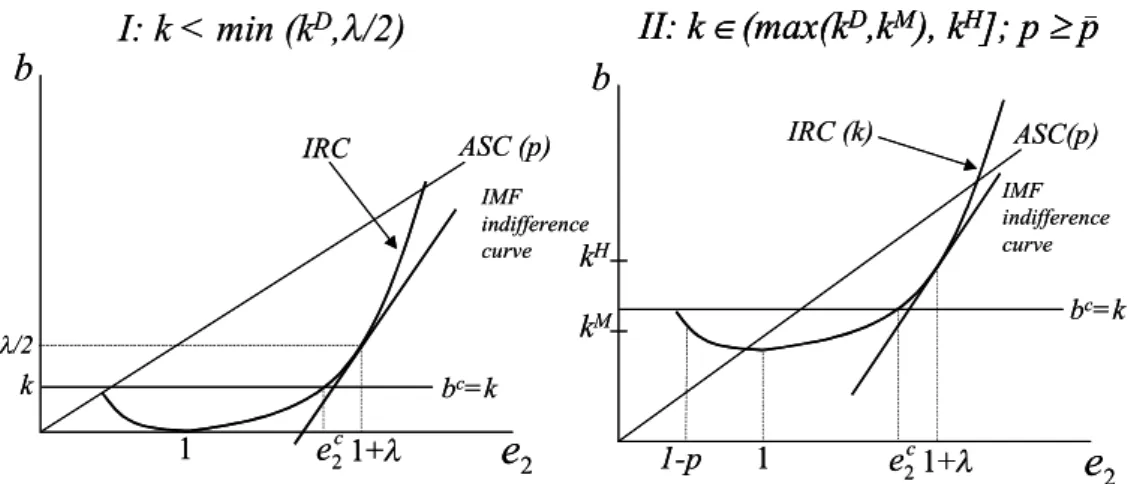
Figure 2 describes the IMF ’s conditionality program, plotting the Fund’s indi¤erence curve in (b; e2) space and the three constraints under which it optimises (i.e. the IRC, the ASC and
2 5Our modelling approach is also analytically equivalent to assuming thatbc is released in tranches (e.g.
ac-cording to an optimal linear contract) ase2is increased up toec2, over a time horizon during which the additional ‘liquidity’ value of the bail-out (i.e. ¸b) applies in full.
the b=k schedule). The …gure illustrates the fact that making IRC binding is always optimal for the Fund (i.e. …rst-best conditional e¤ort is at the tangency of the IMF’s indi¤erence curve and the IRC) and that a binding b·k constraint and/or a binding ASC lower the intensity of conditionality relative to the …rst-best and can ultimately provoke the collapse of the contract. This is shown formally in Proposition 1, which describes the properties of the solution to the IMF’s conditionality program, and is also illustrated in Figure 3 below.
Proposition 1 The intensity of IMF conditionality is a function of the level of capital out‡ows
which precipitate the balance of payments crisis.
For high values of k(i.e. k > kH ´(1 +¸)kD) no conditionality can be imposed by the IMF
(i.e. the IR and “no net transfers” constraints cannot be jointly satis…ed).
For lower values of k(i.e. k·kH);three cases for the optimal conditionality contract can be
identi…ed, depending on whether the “no net transfers” constraint and the “adequate safeguards” constraint bind:
(i) neither the “no net transfer” nor the “adequate safeguards” constraints bind if kD ¸ ¸2
and fork2£¸2; kM¤, where kM ´kH¡¸22:If this is the case the IMF is able to induce …rst-best conditionality, characterised by:
ec2 = 1 +¸´eF B2 bc = ( ¸ 2 for k2[ ¸ 2; kD) ¸ 2 + 1+¸ ¸ (k¡kD) for k2[kD; kM]
For other values of k or if kD < ¸2 (which implies kD > kM), the IMF can only impose
second-best conditionality (i.e. ec2 <1 +¸). If this is the case we have:
(ii) For p high enough (i.e. p ¸ p¹ ´ 1+2¸¸) the “adequate safeguards” constraint is always
slack, bc=k and the IMF imposes the following level of conditional e¤ort:
ec2 =
(
1 +p2¸k for k <min(kD;¸2) 1 +p2 (kH¡k) for k2[max(kD; kM); kH]
(iii) For p < p¹ the “adequate safeguards” constraint binds if k ¸ max(kD; kM) for high
enough k. This implies that there exists a ^kH(p)2(max(kD; kM); kH) such that for k >k^H(p)
conditionality collapses. For k2(max(kD; kM);^kH(p)] we have one of two cases, depending on
the value of p: if p 2[^p;p¹) (where p^´ 1+22¸(1+¸(1+¸)¸) <p¹);we have that ec2 and bc are given by the values in case (ii) above, in the relevant range for k; ifp <p^, bothec
2 and bc are lower than the
corresponding levels in case (ii) atk= ^kH(p), and converge to those levels for lower values of k:
Proof. In Appendix A.2.1.
Proposition 1 shows the IMF is able to “bribe” the country experiencing a balance of pay-ments crisis to exert more adjustment e¤ort and, where relevant, not default on its foreign debt, as long as the level of external debt is not too high. The “bribe” consists of the provision of foreign exchange to the debtor country at a time of crisis. The ability to provide such a bribe partially derives to the IMF from the fact that it can impose conditionality to safeguard its bail-out, and prevent default on its own lending. We elaborate on this point in the next section of the paper, where we discuss the role of the contract as ex-post commitment technology for the debtor country and as an enabling condition for e¢cient debt rescheduling.
IMF indifference curve ASC (p)
b
b=k1
IRCk
#
k
Dcase (repayment equilibrium)
b
ce
2e
ce
FB 2$
2 IMF indifference curve ASC (p)b
b=k1
IRCk
#
k
Dcase (repayment equilibrium)
b
ce
2e
ce
FB2
$
2IMF utility increases as one moves South-East (i.e. towards a higher effort level and a lower bail-out), and its indifference curve has a slope of 1.
The IRC is a convex function of e2, given that the cost of e2 is quadratic, and always binds at the optimum, since the
IMF has incentives to minimise b. The unconstrained optimum (first-best effort) is therefore at the tangency of the IMF’s indifference curve and the IRC.
Higher levels of b are necessary to satisfy the IRC if k > kD
, given that if this is the case the recipient finds it optimal to default on the external debt in the absence of IMF intervention, and needs to be compensated for not doing so. This is why, in this case, the IRC lies above the x-axis and its position is a function of k.
The additional two constraints faced by the IMF are also shown on this graph: the ASC, which is flatter (and therefore harder to satisfy) the lower is the penalty for default p; and the b # k constraint. Both of these constraints are shown as slack in the figure (i.e. the optimal contract lies below both of them), implying that effort is at its first-best level.
b
cb
b=k
1
IRC (k)
k > k
Dcase (default equilibrium)
1-p
IMF indifference curve ASC(p)%
&
1!" ' " k k De
2e
ce
FB 2$
2b
cb
b=k1
IRC (k)k > k
Dcase (default equilibrium)
1-p
IMF indifference curve ASC(p)%
&
1!" ' " k k De
2e
ce
FB 2$
2ASC(p)
b
bc=k 1 IRC (k) 1-p 1+" kM kHIV: k
(
(max(k
D,k
M), k
H]; p
(
[p,p)
^ _III: k
(
(max(k
D,k
M), k
H]; p<p
^b
bc=k 1 IRC (kH) 1+" kM kH ASC(p) ASC(p)_ kH IRC (kH)Panels III and IV depict case (iii) of the Proposition, which describes the optimal IMF contract for high values of k(k > max(kD,kM)) and relatively low values of p(p < p).
Panel III shows the weakening of conditionality relative to case (ii) if the penalty rate pis particularly low (namely p<p). If this is the case the IMF needs to weaken conditionality further relative to the case (ii), and
conditionality collapses ‘earlier’ (i.e. for lower threshold values of k).
Panel IV shows the corresponding case for p (( p,p). If this is the case, as long as conditionality can be imposed, the effort level is equal to case (ii). However conditionality collapses ‘earlier’ than under case (ii), namely for k >kH= k3C(see the Proof of the Proposition). The panel shows the equilibrium where k = k3C.
^ ^ _ _ ec 2
e
2 e2ce
2 ^ ^ ^ ASC(p)b
bc=k 1 IRC (k) 1-p 1+" kM kHIV: k
(
(max(k
D,k
M), k
H]; p
(
[p,p)
^ _III: k
(
(max(k
D,k
M), k
H]; p<p
^b
bc=k 1 IRC (kH) 1+" kM kH ASC(p) ASC(p)_ kH IRC (kH)Panels III and IV depict case (iii) of the Proposition, which describes the optimal IMF contract for high values of k(k > max(kD,kM)) and relatively low values of p(p < p).
Panel III shows the weakening of conditionality relative to case (ii) if the penalty rate pis particularly low (namely p<p). If this is the case the IMF needs to weaken conditionality further relative to the case (ii), and
conditionality collapses ‘earlier’ (i.e. for lower threshold values of k).
Panel IV shows the corresponding case for p (( p,p). If this is the case, as long as conditionality can be imposed, the effort level is equal to case (ii). However conditionality collapses ‘earlier’ than under case (ii), namely for k >kH= k3C(see the Proof of the Proposition). The panel shows the equilibrium where k = k3C.
^ ^ _ _ ec 2
e
2 e2ce
2 ^ ^ ^ IMF indifference curveb
bc=k 1 IRC (k)b
ASC (p) bc=k 1 1+" IRCI: k < min (k
D,
"
/2)
"/2 1-p IMF indifference curve ASC(p) k 1+" kM kHPanels I and II illustrate case (ii) of the Proposition, where the b = kconstraint is always binding.
Panel I shows the case of excessively low k, which decreases the leverage of the Fund, and forces it to accept an effort level which is below the first-best one.
Panel II illustrates the case of high k(but not high enough to lead to a collapse of conditionality) and high p, where the Fund needs to settle for second-best effort given its inability to compensate the recipient for both not-defaulting on debt and choosing first-best effort.
ec 2 e2c
e
2e
2II: k
(
(max(k
D,k
M), k
H]; p
)
p
_ IMF indifference curveb
bc=k 1 IRC (k)b
ASC (p) bc=k 1 1+" IRCI: k < min (k
D,
"
/2)
"/2 1-p IMF indifference curve ASC(p) k 1+" kM kHPanels I and II illustrate case (ii) of the Proposition, where the b = kconstraint is always binding.
Panel I shows the case of excessively low k, which decreases the leverage of the Fund, and forces it to accept an effort level which is below the first-best one.
Panel II illustrates the case of high k(but not high enough to lead to a collapse of conditionality) and high p, where the Fund needs to settle for second-best effort given its inability to compensate the recipient for both not-defaulting on debt and choosing first-best effort.
ec 2 e2c
e
2e
2II: k
(
(max(k
D,k
M), k
H]; p
)
p
_II: k
(
(max(k
D,k
M), k
H]; p
)
p
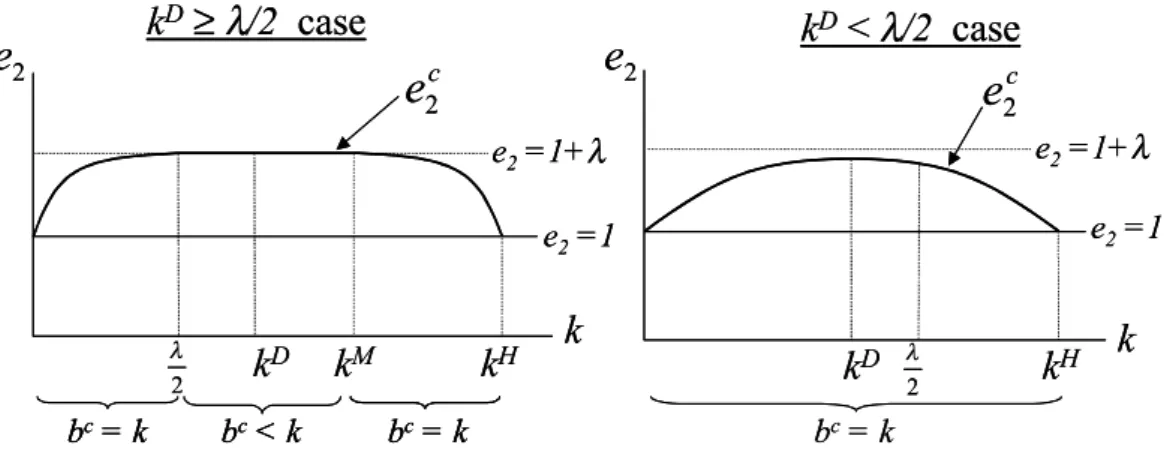
_Conditionality is at its …rst best (i.e. ec= 1 +¸;bc< k) if the crisis is of an intermediate size and if the penaltypis su¢ciently high relative to¸so thatkD¸ ¸2 is satis…ed (see Figure 4 and Figure 5). The …rst-best e¤ort level re‡ects the one-to-one trade-o¤ faced by the IMF between extra e¤ort by the recipient and additional bail-out funds, which induces it to optimally increase e2 relative to the recipient’s optimum (e¤2= 1) in accordance with the marginal e¤ectiveness of
its bail-out in increasing the recipient’s utility (which is given by¸). The …rst-best conditionality contract can be decentralised with a linear “tranching” contract of the formb=¹0+¹1e2, where
the IMF optimally sets¹c1 = 1and it uses the level of ¹c0 to satisfy the IRC.
If the crisis is either too small or too large, or if the kD < ¸2 is not satis…ed, second-best conditionality needs to be accepted by the Fund. The second-best cases (i.e. cases (ii) and (iii) of Proposition 1) are illustrated in Figure 3 and in Figure 4. Under second-best conditionality the intensity of the “tranching” contract is lower than under the …rst-best (¹c
1<1).
Conditionality is weakened relative to the …rst-best if capital out‡ow is too small (e.g. k < ¸2) because if this is the case the bene…ts deriving to the recipient from the IMF bail-out are relatively low, thereby reducing the leverage of the Fund in imposing extra reform e¤ort. In this case,bc=k, so that the Fund is e¤ectively “…nancing the run” with its resources.
Conditionality is also not at its …rst best if the crisis is “too large”(e.g. k > kM)since if this is the case the IMF needs to reduce the intensity of the contract to compensate the recipient for not defaulting on a higher level of debt. For particularly high levels of capital out‡ows (i.e. k > kH) the IMF cannot impose any conditionality, and therefore does not intervene. Allowing for some debt relief mitigates this conclusion, and always enables conditionality to take place, as it is shown in Section 5.
In the high-ksecond-best cases, the levels of the parameters¸andpinteract to determine the intensity of conditionality and the extent to which the IMF is “…nancing the run”. In particular, if the default penalty is relatively low, the ASC will bind for high k and conditionality will collapse for values ofk belowkH (see Figure 5):
As Figure 5 shows, the Fund prefers high values ofprelative to¸(as in Area I of the graph), to be able to exercise …rst-best conditionality and not be constrained by the ASC. This is because high levels of ¸ increase the debt-repayment costs due to the IMF conditionality package for the debtor, which makes it harder for the Fund to meet the agent’s participation constraint in the cases where the optimal bail-out is not fully covering the initial capital out‡ow (i.e. where bc < k). High levels of p on the other hand make it easier for the IMF to meet the agent’s participation constraint, and to protect its lending at the end of t= 2.
Throughout the rest of the paper, and in particular in Sections 3 and 5, we restrict the values of the parameters p and ¸to be in Area I of Figure 5 (i.e. so that both p¸p¹and kD¸ ¸2 are satis…ed). This allows us to focus on one speci…c form of ex-post IMF conditionality, enhancing the tractability of the extensions of the baseline model we consider in the following sections of the paper. This restriction does not alter the substance of the results obtained in what follows. The following three sections of the paper employ the baseline model to assess the role of the IMF in both crisis resolution and prevention, and evaluate the various functions performed by IMF conditionality. In the next section of the paper we spell out the role of the baseline conditional liquidity contract as a source of valuable commitment technology for the debtor country. In Sections 4 and 5 we extend the baseline model to be able to examine the issue of moral hazard, and to allow for the possibility of PSI (in the form of debt relief) in the crisis resolution package designed by the IMF.
k
Hk
Dk
Mk
e2=1+λ e2=1k
D≥
λ
/2
case
k
k
Hk
Dk
D<
λ
/2
case
e
c 2e
2 " 2 " 2 e2=1+λ e2=1e
c 2e
2 bc= k bc< k bc= k bc= kk
Hk
Dk
Mk
e2=1+λ e2=1k
D≥
λ
/2
case
k
k
Hk
Dk
D<
λ
/2
case
e
c 2e
2 " 2 " 2 e2=1+λ e2=1e
c 2e
2 bc= k bc< k bc= k bc= k bc< k bc= k bc= kFigure 4: The intensity of IMF conditionality as a function of capital out‡ows k(forp¸p¹).
-0.2 0.4 0.6 0.8 1.0 0 0.2 0.4 0.6 0.8 1
p
λ
p = p_ IFirst-best contract attainable ASC never binds
IV
First-best contract unattainable ASC can bind
II
First-best contract unattainable ASC never binds
III
First-best contract attainable ASC can bind
kD $ " 2 -0.2 0.4 0.6 0.8 1.0 0 0.2 0.4 0.6 0.8 1
p
λ
p = p_ IFirst-best contract attainable ASC never binds
IV
First-best contract unattainable ASC can bind
II
First-best contract unattainable ASC never binds
III
First-best contract attainable ASC can bind
kD $ "
2
3
IMF Conditionality as Commitment Technology
In this section of the paper we focus on the role of the IMF as an external agency of restraint which is capable of constraining the policies of the debtor country and remove sub-optimal discretionary equilibria. We highlight two roles of IMF conditionality as commitment technology: an ex-post one, which a¤ects the e¢ciency of crisis resolution; and an ex-ante role, which has an impact on capital in‡ows before a crisis takes place. Both of these roles are direct by-products of the baseline IMF conditionality presented in the previous section, and their presence does not rely on the Fund explicitly seeking to act as an agency of restraint.
We …rstly introduce the idea of IMF conditionality as a source of ex-post commitment tech-nology. This role of IMF conditionality is implicit in the modelling we have presented so far, and the main purpose of the next sub-section is to isolate and clarify some of the features of the baseline IMF contract, and to illustrate their relationship with the issue of debtor ex-post commitment.
The second commitment role of conditionality highlighted in this section requires us to extend the modelling presented so far, by endogenising capital in‡ows att= 1. This enables us to examine issues of credit-rationing, and to introduce a framework which we also use in Section 5 of the paper, to analyse the issue of PSI (in the form of debt-relief) and investor moral hazard. Both of the roles of IMF conditionality we discuss in this section have been noted, and to some extent formalised, in the literature on sovereign debt and conditionality.26 The main objective of this section of the paper is therefore to incorporate these results in the context of the stylised agency framework introduced here, and to show that our baseline model is capable of capturing them. In the following two applications of the baseline model (in Sections 4 and 5) we extend the model in original directions, addressing issues which are currently being discussed in the context of the debate on reforming the IFA.
3.1
Ex-post Commitment, Ownership and Safeguards
The model of conditionality presented in the previous section interprets IMF conditional bail-outs as contracts for liquidity, in the context of a balance of payments crisis. In our baseline model the IMF is assumed to have a comparative advantage relative to private investors with respect to both the imposition of conditionality (i.e. the ability to monitor and contract upon e2) and in the provision of emergency liquidity (i.e. in the form of the bail-out b). In this
sub-section we show that the …rst property of the contract (i.e. conditionality) can be interpreted as a source of post-crisis commitment technology which can bene…t the debtor relative to a no-IMF state of the world, as long as the Fund refrains from extracting all the rents from its intervention. It is possible to isolate the role of conditionality by initially considering an IMF bail-out without conditionality, i.e. the provision of unconditional liquidity following a crisis. A default-averse IMF which is subject to an “adequate safeguards” constraint is able to avoid default and debt-overhang by providing an unconditional bail-out b which is less or equal tok, as long as k2(kD;^kD], where ^kD´ p
1+¸
³
1¡2(1+p¸)´2(kD; kH). ^kD is the value of external debt which 2 6
Sachs (1989b) notes the importance of IMF conditionality as a source of commitment in debt restructuring negotiations, and Claessens and Diwan (1990), Diwan and Rodrik (1992) and Fafchamps (1996) formalise this insight. Fafchamps (1996) also comments on the potential role of IMF conditionality in mitigating ine¢cient credit rationing ex-ante.
makes the debtor indi¤erent between repayment and default at the end of t = 2 (i.e. when the liquidity cost of sudden capital out‡ows¸ does not apply). It therefore corresponds to the maximum amount that the IMF can lend unconditionally at the start of t = 2, and still be certain to be repaid at the end of t= 2.
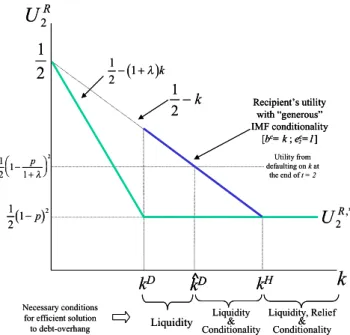
As long as b·k·^kD, the IMF is able to intervene under adequate safeguards, without the need to impose conditionality. The fact thatk^D> kDimplies that, by acting as a pure liquidity provider, the IMF can increase the range of values of debt k for which ine¢cient default does not occur in equilibrium.27 This increases debt repayment and makes the debtor country better o¤, relative to the no-IMF outcome (see Figure 6, which plots debtor utility in the no-IMF case and in the full debt-rescheduling, i.e. b=k, case).
The liquidity-only intervention also increases IMF utility (i.e. UIM F = e
2 ¡b) relative to
a no bail-out alternative, given that debtor reform e¤ort equals 1, rather than 1¡p, and the funds provided by the IMF are always below p (given that ^kD < p). The IMF faces therefore incentives to provide an unconditional bail-out, as long as debt default is the equilibrium outcome otherwise. % & 1 21 2 'p 1 21 1 2 ' ! * +, -./ p " 1 2 1 2'k % & 1 2' !1 "k kD kH
k
U
R 2U
R 2 ,* k^D Necessary conditionsfor efficient solution
to debt-overhang Liquidity Liquidity & Conditionality Liquidity, Relief & Conditionality Recipient’s utility with “generous” IMF conditionality [bc= k ; ec=1] 2 Utility from defaulting on kat the end of t = 2 % & 1 21 2 'p 1 21 1 2 ' ! * +, -./ p " 1 2 1 2'k % & 1 2' !1 "k kD kH
k
U
R 2U
R 2 ,* k^D k^D Necessary conditionsfor efficient solution
to debt-overhang Liquidity Liquidity & Conditionality Liquidity, Relief & Conditionality Recipient’s utility with “generous” IMF conditionality [bc= k ; ec=1] 2 Recipient’s utility with “generous” IMF conditionality [bc= k ; ec=1] 2 Utility from defaulting on kat the end of t = 2
Figure 6: Debtor’s utility as a function of external debt kand of the IMF’s bail-out policy. Liquidity without conditionality therefore can improve the e¢ciency of the interaction be-tween private investors, the debtor and the IMF (i.e. all three parties are better o¤).28 The
2 7This e¤ect is due to the fact that the marginal bene…t to the debtor of a reduction in the liquidity ‘tax’¸ is larger if the country is repaying its debt as opposed to defaulting, given that in the latter case the country reduces its exposure to the tax by distorting its production. Therefore, if the e¤ective ¸¡penalty faced by the debtor is reduced (which is the case for b >0) a higher value of the debtkis required to equalise debtor utility in the debt-repayment and default equilibrium respectively.
2 8
If investors are su¢ciently patientwithinthet= 2period, they may be willing to provide the unconditional liquidity themselves, rendering IMF intervention unnecessary fork <^kD. Our assumption of “investor panic” once
a crisis hits is e¤ectively equivalent to a high-impatience assumpion, which rules out this form of PSI, and forces the IMF to act as a sole provider of both emergency lending and conditionality. Allowing for private contributions
absence of conditionality does not however allow the Fund to maximise the e¢ciency of crisis resolution and it does not provide it with enough ‡exibility to maximise its own utility.
The …rst e¤ect is clear from the fact that ^kD < kH: there is a range of debt (namely k 2 (^kD; kH] for which liquidity plus conditionality can avoid default and sub-optimal e¤ort, whilst unconditional liquidity cannot. In this range of k the debtor would like to be able to pre-commit, after a crisis has occurred, to repaying the entirety of the debt and set e2 = 1, in
exchange for a bail-out equal tok(which is equivalent to a debt stand-still until the end oft= 2). However, if conditionality is not imposed (e.g. becausee2 cannot be observed by the Fund), the
debtor has incentives to renege on the promise of full debt repayment at the end of t= 2, and minimise the cost of default by setting e2 = 1¡1+p¸ (and obtain utility U2R = 12
³
1¡1+p¸´2 -as shown in Figure 6). Anticipating this, the Fund would not rele-ase the unconditional b =k bail-out, if k2(^kD; kH].
By making the bail-out conditional on reform e¤ort, the IMF can solve this ex-post debtor commitment problem, and allow for e¢cient debt-rescheduling to take place. By doing so the Fund is also able to lend under adequate safeguards, and prevent debtor default on the bail-out. This implies that in this range of k (k 2 (^kD; kH]), the conditional bail-out contract displays a circular logic: the provision of emergency liquidity allows the Fund to impose conditionality (i.e. additional reform e¤ort), which in turn protects IMF resources and enables the bail-out to take place.
From the debtor’s perspective, the most attractive conditional liquidity package which solves its commitment problem is one which sets bc=kand ec2 = 1, i.e. it reschedules all of the debt repayment, and it allows for optimal domestic production (from the debtor’s point of view). As long ask < kH, the debtor would be better o¤ than under the no-IMF outcome (see Figure 6), and it would therefore bene…t from the commitment technology provided by IMF conditionality (i.e. there is “ownership” of the program).29 The IMF would also be better o¤ relative to the no-conditionality outcome: it would earn1¡b, which is greater than its utility in the no bail-out case (i.e. UIM F = 1¡p), given that the maximum value for the bail-out,kH, is lower thanp.
There is however a second role of conditionality, in the form of debtor rent-extraction, which is present in the baseline contract described by Proposition 1. If the IMF is not concerned about leaving any rents to the debtor country in a crisis-situation, then it will use the ability to contract upon e2 both to maximise the range of k for which default can be avoided under
adequate safeguards (i.e. provide commitment technology to the debtor), and to extract rents from its intervention (i.e. by increasing e2 and -when possible- decreasing b, relative to the
“ownership” package described above).30 If this is the case, the debtor is e¤ectively indi¤erent between IMF intervention or default, and “ownership” of the program is therefore limited.31
to the provision of bail-out funds (which, for example, might be necessary if the IMF is resource-constrained) may give rise to issues of IMF moral hazard. That is, the IMF might not face su¢ciently strong incentives to monitor and enforce its conditionality adequately if it is not the sole (or main) provider of the bail-out (see Rodrik (1996) for an argument along these lines).
2 9
We explore the debtor moral hazard implications of a “generous” IMF, which leaves rents to the debtor country, in the next section of the paper.
3 0As Proposition 1 shows, the IMF …nds it optimal to depart from a policy of full debt rescheduling (bc=k)
for k2(kD; kM), as long as thekD > ¸
2 condition holds. Note that^k
D
> kM so that in the range ofk where conditioning one2 is required to enable the Fund to lend under adequate safeguards, the IMF captures the rents from its intervention by increasinge2 above 1 (rather than by reducingbbelowk).
3 1