IMPROVING SCHOOL CLIMATE AND STUDENT PERFORMANCE THROUGH TIER 1 POSITIVE BEHAVIOR INTERVENTION AND SUPPORT
IMPLEMENTATION
A Record of Study
by
LAURIE KATHERYN WELLS
Submitted to the Office of Graduate and Professional Studies of Texas A&M University
in partial fulfillment of the requirements for the degree of DOCTOR OF EDUCATION
Chair of Committee, Patrick Slattery Co-Chair of Committee, James Laub Committee Members, Krystal Simmons
Noboru Matsuda Head of Department, Michael de Miranda
May 2018
Major Subject: Curriculum and Instruction
ii ABSTRACT
This mixed methods study addressed the need for common area expectations that serve to create a positive school culture and climate. An embedded research design was used during which information from teacher interviews were conducted before designing a professional development for teacher and student training of common area
expectations. The training process included teacher and student training on the foundations and processes of PBIS, as well as teacher education on principles of working with students in poverty. Teacher interviews were used during the training process to determine the understanding and commitment level of the teachers regarding the systems changes. After the common area expectations were established, new discipline data was compared to discipline data from the previous year in order to measure the effectiveness of the new procedures. The administrative and PBIS team analyzed this data identifying common areas of need, teachers who needed additional training, and students who required individual intervention. After an academic year of implementation, STAAR data was analyzed to show improvement in student academic performance. As a result of the intervention, a correlation was evident between
implementation of Tier 1 of the PBIS framework, and an improved culture and student achievement.
iii DEDICATION
I dedicate this record of study to the teachers and administrators in the public school systems across the country. There is no work more noble, or more challenging, than the work that occurs in classrooms each and every day. Teachers and
administrators continually search for ways to reach children and create a learning environment that is positive, safe, and nurturing. Through these positive learning structures, teachers build the future of our country, shape the minds of our children, and foster the spirits of courage that will take on academic and societal challenges with confidence and resolve. My hope is that my work through this paper will add to the conversation of how to better care for our children.
iv
ACKNOWLEDGEMENTS
The process of earning this degree was a massive undertaking. I am aware that my decision to pursue this dream created a sacrifice on the part of many people that are extremely important to me. Without their encouragement to finish, their understanding and patience when I turned down an invitation, and their unwavering belief in my ability, it would have been impossible to complete. Thank you to my friends, Erin Siegrist, Lindsay Durr, Sarah Platten, and Natasha Balfour, for continually checking on my progress and encouraging me to continue.
Sandra Jones, Deborah Bird, and Lila Slayton, the hours that we shared over a meal getting caught up on life and laughing together have been medicine to my heart. Your loyalty and honesty over the years is a true treasure to me.
My brothers and sisters-in-law, Michael and Chanyce Wells, Larry and Deana Wells, and Mathis and Karla Wells, and all my nieces and nephews, bless you for your encouragement and love. To my dad, Leon Wells, thank you for encouraging me to start and believing that I would finish. I love each of you dearly.
Amy Davis, you are one of the best people I have ever known. Thank you for pushing me to be the best version of myself. Thank you for your encouragement, not just through words but through your loyalty and courage. Thank you for calling, and for being my person.
My late mother, Sallye Ann Mitchell Wells, throughout this process, I have wanted to call you a million times. I miss you down to my bones, but I know you are watching and cheering. You always did. I complete this degree in your honor. You
v
were my greatest teacher. Most of all, thank you for teaching me about the grace of Jesus. His grace remains sufficient in both the best and the darkest of times, just as you taught me that it would.
When I received the acceptance letter to this program, I knew immediately that God had a very specific plan and purpose for my life. My prayer from the first day has been that I would be prepared and willing for the road that God called me to walk. I will continue to be your faithful follower, knowing that You and your children are the reason for all of the work.
vi
NOMENCLATURE
PBIS Positive Behavior Intervention and Support
STAAR State of Texas Assessments of Academic Readiness TEAMS Total Education Administrative Management Solution
vii
CONTRIBUTORS AND FUNDING SOURCES
Contributors
This work was supported by a record of study committee consisting of Professor Patrick Slattery, Clinical Assistant Professor James Laub, and Associate Professor Noboru Matsuda of the Department of Teaching, Learning, and Culture, and Clinical Associate Professor Krystal Simmons of the Department of Information and Operations Management.
All other work for this record of study was completed by the student independently.
Funding Sources
viii TABLE OF CONTENTS Page ABSTRACT………... ii DEDICATION……….. iii ACKNOWLEDGEMENTS……….. iv NOMENCLATURE……….. vi
CONTRIBUTORS AND FUNDING SOURCES……… vii
TABLE OF CONTENTS……… viii
LIST OF TABLES……….. x
CHAPTER I INTRODUCTION AND LEADERSHIP CONTEXT……….. 1
Relevant History and Significance of the Problem………. 2
Personal Context………. 4
CHAPTER II REVIEW OF SUPPORTING SCHOLARSHIP……… 7
CHAPTER III SOLUTION AND METHODOLOGY……… 16
Guiding Questions, Data Collection Methods, and Rationale for Methods……. 24
Instruments and Analysis……….. 27
Issues of Reliability, Validity, Confidentiality, and Other Ethical Concerns…... 33
Statement Regarding Human Subjects and the Institutional Review Board…… 33
CHAPTER IV ANALYSIS AND RESULTS……….. 35
Research Question One………. 36
Research Question Two……… 37
Research Question Three……….. 41
CHAPTER V CONCLUSIONS AND DISCUSSION………. 45
REFERENCES………. 55
ix
x
LIST OF TABLES
TABLE Page
1 Goals, Outcomes, and Activities Associated with the Problem Solution……… 24
2 Goals, Outcomes, Activities, Guiding Questions, and Assessments Associated with the Problem Solution………. 26
3 Guiding Questions, Data Collection Methods, and Rationale for Methods Leading to Conclusions………... 29
4 Timeline of Activities and Products……… 31
5 Difference in 2015-2016 and 2016-17 Discipline Referrals………37
6 Issues of Poverty Acknowledge by Teachers Prior to Intervention……… 39
7 Issues of Poverty Acknowledged by Teachers Following Intervention and the Difference……… 40
8 Teachers Who Understood and Valued PBIS Tier 1 Implementation Plan……. 41
9 Comparison of STAAR Scores from 2015-16 and 2016-17………... 42
10 Discipline Referrals by Grade Levels for 2015-16 and 2016-17………. 43
1 CHAPTER I
INTRODUCTION AND LEADERSHIP CONTEXT
Current research shows that school climate and culture is a major factor in student success, both socially and academically. According to Burgess and Hart (2013), “It is the culture and climate of our schools that lay the foundation for the development and growth of all students” (p. 45). The authors emphasized the importance of climate and culture to administrators, discussing that teacher and student performance is directly impacted by a positive school environment. The authors purposed that a positive school culture is the foundation to all other systems within a school. Mitchell and Bradshaw (2013) echoed this belief when they examined student perceptions of classroom culture and determined that students believed the elements of kindness, fairness, order, and student-teacher relationships were vitally important to student success. Tobin, Ritchie, Oakley, Mergard, and Hudson (2012), examined the impact that classroom culture on conversational fluency among students. The researchers determined when a classroom culture is nurturing, the conversations on the part of the students and the teacher are more positive and encouraging. However, when the culture and climate was less positive, the conversations between students and with the teacher become more frustrated and less patient, negatively impacting student achievement. Habib,
Densmore-Jones, and Macfarlane (2013) examined school culture within diverse student populations, determining that when administrators intentionally addressed the need for a positive school climate, all stakeholders benefitted.
2
Relevant History and Significance of the Problem
City Elementary School in State Independent School District began the 2016-2017 academic year in Phase 3 of the Texas Education Agency’s reconstitution plan. Because of several consecutive years of academic performance that is below state expectation, the school was in danger of being closed and the students being redistributed to other schools within the district. At that time, immediately upon entering the building, a major issue of student behavior was apparent. Discipline data supported that students and teachers were unsuccessful in functioning in a safe and orderly manner. The culture and climate in the building and within classrooms reflected negativity, punishment, and low academic expectations. According to Hattie (2013), high teacher expectations have a major influence on student performance. This level of expectation is directly linked to the school climate and culture within any classroom or school building. School-wide positive behavioral interventions and supports (PBIS) serve as a prevention-oriented framework that assists stakeholders in creating learning environments that are safe, socially competent, and maintains a positive school climate (Cressey et al., 2014). PBIS is a three-tiered system with each tier focusing on a specific group of students and a targeted set of behaviors. Tier 1 addresses 85% of the student population and focuses on the behavior expectations in the common areas of the building. The common areas include any area that experiences high traffic and large groups of students throughout the day. These common areas are the hallways, cafeteria, restrooms, and playground. Tier 2 targets 10% of the student population that require frequent feedback on behavior and academic performance, mentoring, or extracurricular
3
involvement to experience success. Tier 3 addresses the specific 5% of the student population who require an individualized behavior plan with targeted behaviors for improvement. Because this study is limited to one year, Tier 1 interventions in the common areas of the building will be the focus of this study. With the common areas of the building functioning in a more positive and orderly manner, many of the reoccurring discipline issues will decrease.
However, at the beginning of the 16-17 school year, City Elementary had no definitive plan in place to address student discipline issues or create a positive school culture. The students and staff at City Elementary lacked common area expectations that serve to create a positive school culture and a climate conducive to academic and social growth. The common areas include spaces in the building in which all students and staff frequent many times during the day, often in large groups. The hallway, cafeteria, restrooms, and playground are the focus areas when considering the spaces in the building that are commonly used by everyone. Student and teacher behavior in the hallway was not orderly or conducive to quick transitions that protected instructional time. During the prior academic year, sixty-two percent of all discipline referrals occurred in the hallways. Additionally, procedures in the cafeteria were non-existent. The cafeteria was not safe and did not function in a manner that encouraged social growth. Primary level students had particular issues functioning within the cafeteria in a manner that promoted social development. All grade levels except one primary grade discontinued any time on the playground due to unsafe behavior, which included student fights that resulted in countless discipline referrals and out of school suspensions. The
4
common areas of the school should be an area of calm, cooperative behavior between students and adults that creates an academic climate of consistent support and
encouragement. However, the lack of common area expectations and structure created an environment that was chaotic, unstructured, and unsafe.
City Elementary struggled for many years with discipline, academic performance, and a poor school climate and culture. The administrative team was replaced twice in the previous five years, with each administrator bringing his or her own belief and value system to the discipline approach. Three years ago, the entire faculty resigned with the exception of three teachers. The departing staff was replaced with inexperienced,
alternatively certified teachers who were grossly ill prepared for the challenges presented in discipline or academics. At the beginning of this study, the administration of 2016-2017 was in their second year at City Elementary and continued to struggle with teacher retention, student discipline, school climate, and academic performance.
Personal Context
I have chosen to spend my entire educational career working with highly at-risk students and the teachers who work with them. Students who live in extreme poverty, in foster care or homeless shelters, have parents in prison, or are being raised by second or third generation parents, are far more likely to repeat the cycle of oppression. Often, the most consistent and influential person in children’s lives is the classroom teacher. For over half of my career, I served at South Elementary in State ISD. The majority of the students at this elementary school are in critical situations that will easily lead to
5
this time that when Positive Behavior Intervention and Supports were put in place, the climate and culture of the school began to change. Students began to enjoy school again and felt valued. They were clear that their success or failure academically and socially mattered to the adults in their classrooms. Over the course of several years, I became convinced that teachers who are typically from different backgrounds than the students they serve needed specific guidance and training on how to best address behavior issues and intentionally create a positive climate in the school and classroom. During this time, I earned two advanced degrees that led to administrative positions and a wider influence throughout the district. My career aspirations continue to pull me to at-risk students and the teachers who educate them. I am particularly interested in the role of trust among educators, which is also indirectly addressed through the implementation of the PBIS framework. My hope is that this Record of Study will be the beginning of the second half of my career during which I will train teachers and administrators in methods that will improve climate, culture, and academic achievement for both teachers and students.
From this study, several stakeholders benefitted. Students experienced an improvement of classroom and school climate. Learning environments became more engaging and purposeful, which improved student achievement. Teachers benefitted from an improved classroom climate and culture, experienced student growth and learning in a more personal manner that allowed the development of student and teacher relationships. Administrators observed the growth and change that occurred in the school that ultimately impacted student achievement and school success. The process that the stakeholders experienced served to guide future policy makers when considering
6
the implementation and necessity of PBIS and resource support for the efforts to support and sustain change.
7 CHAPTER II
REVIEW OF SUPPORTING SCHOLARSHIP
The body of literature on Positive Behavior Intervention and Supports addresses the issue of climate and culture improvement in the educational setting. In Handling PBIS with Care: Scaling up to School-Wide Implementation, Cressey (2014) described Positive Behavior Intervention and Supports (PBIS) as a prevention-oriented framework that focuses stakeholders on creating environments that reflect safety, social
competence, and positive school climates. Rather than a boxed curriculum, the
framework of PBIS provides a structure for the school environment that decreases stress, improves attendance, and improves student achievement. Relying on a continuum of increasingly intensive interventions, the organizational systems put in place through the framework of PBIS assist with the common areas of the building, such as hallways and cafeteria, allowing the collective organizational health of the school to improve
(Cressey, 2014). The framework of PBIS also provides a systematic method of analyzing discipline data in order to respond to problem areas in an organized, collaborative manner. Because PBIS is considered a multi-tiered system of support, Cressey (2014) explained that all stakeholders are trained in the expectations and framework of PBIS from the initial stage of implementation. The author emphasized that the school counselor, administration, and staff must work collaboratively in order for the expectations and framework of PBIS to be consistently implemented through the building.
8
Implementing PBIS with fidelity and consistency will also have a critical impact on creating positive relationships with students. Rather than focusing on responses to negative behaviors, teacher-child relationships are potentially the critical factor to creating successful interactions in the classroom. O’Conner (2010) documented that students who have a high level of closeness with their teachers are more likely to have a low level of conflict in the classroom. The author reported more specifically that
teachers who have more students living below the poverty line tend to have less frequent positive interactions with students. However, when the teacher intentionally creates positive interactions with the students through frequent instructional dialogue, small group instruction, and frequent behavioral and academic feedback, the relationship between the teacher and student will improve (O’Conner, 2010).
Mitchell and Bradshaw (2013) proposed that the type of behavior management system that is in place reflects the type of perception of the school among students. Teacher use of punishment-oriented systems are often associated with confrontational student-teacher interactions that promote a negative view of the school for students. By creating a positive environment and intentionally addressing the improvement of school climate through a framework such as PBIS, teachers begin to decrease the use of
exclusionary behavior management strategies and improve both the relationship with students and their perception of the school in general (Mitchell & Bradshaw, 2013). The framework of PBIS is also critical for students by creating an organized system of supports, both academically and socially. Meisels (2015) wrote that students who have a structured system of supports in place are more likely to seek help when they
9
are in need. Academic supports, such as tutoring and after school programs, or social supports, such as counseling, mentoring, and health programs are systems that are part of the PBIS framework of support for students. Research suggests that when students have these types of supports available to them, they are more likely to attempt to seek
academic assistance or counseling than when these types of interventions were only available outside the school setting. In Meisels’ (2015) study, students document that teachers, nurses, counselors, as well as peers attending the same types of intervention supports are considered by the students to be their primary support system. The students report that both the learning and social supports are critical to their overall well-being. The multi-tiered system of PBIS creates opportunities for these types of supports for students which contributes to their overall academic and social growth.
According to research, school administrators have also become increasingly concerned about the improvement of school climate. Smith, Connolly, and Pryseski (2014) reported that any administrator can improve school climate by putting in place intentional measures to create a more positive environment. School climate, or what is considered the quality and character of the school’s life, includes stakeholders’
experiences at the school, the goals and values of the stakeholders, the teaching and learning practices, and the interpersonal relationships that are developed and maintained within the educational setting (Smith et al., 2014). When students and families have a positive view of the school and the teachers, there are fewer discipline and behavior problems, academic performance improves, and students report higher self-esteem.
10
Research suggests that the successful implementation of PBIS contributes to the improvement of school climate from the perspective of all stakeholders. Blomeke and Klein (2013) reported that the structure and organization of the PBIS supports are significant to new and inexperienced teachers. The PBIS elements of the climate of respect, recognition, and appreciation significantly improved job satisfaction among new teachers. Reaching beyond the inexperienced teacher, Muhammad (2009) suggested that staff division can be overcome and the climate of the school completely revitalized through intentional efforts to address school climate. The author noted that a toxic school culture is typically grounded in frustration from constant poor behavior and repeated low academic performance. In a toxic school culture, the blame for these issues is continually deflected, causing an environment and mentality of defeatism and
helplessness. However, when stakeholders choose to implement positive supports in an intentional manner, such as PBIS, teachers as well as students begin to feel more in control of their future and more hopeful for the outcome of their efforts (Muhammad, 2009).
Gruenert and Whitaker (2015) supported the idea that the cultural health of an organization is directly linked to the success or failure of its people. The authors noted that improving school culture requires the stakeholders to have a shared vision and shared values. “The fact is, the whole purpose of a school culture is to get members to adopt predictable behaviors and a common mental model.” (Gruenert & Whitaker, 2015, p. 10). Most importantly, the manner in which administration and teachers approach relationship building with the students impacts the much deeper issue of
problem-11
solving and social growth. When the adults in the educational setting agree to follow a framework of support and positivity, their own job satisfaction improves, attendance improves, and their efforts are centered on a foundation of belief in the ability for everyone to be successful.
Improved academic achievement is another major benefit of PBIS. Tobin et al. (2013) reported that classroom performance is positively impacted when teachers are able to have more frequent productive interactions with students. The emotional climate of a classroom, directly linked to the opportunities of the class to have academic
conversations with the teacher, small group discussions, and general positive verbal interaction, is greatly improved when the teacher has an intentional and positive practice in place for maintaining appropriate voice level, positive tone, and encouraging
responses. The authors also suggested that another critical factor in maintaining a positive emotional climate within the classroom is a preplanned response and plan for times when the students do not adhere to the behavior expectations that have been put in place. The teacher must have a calm and positive method for bringing the students back within the boundaries of the framework to prevent reverting to negative and punishment oriented interactions (Tobin et al., 2013).
Matsumura, Slater, and Crosson (2008) supported these findings. In their study of instructional practices and school climate, the authors found that rigorous
instructional practices coupled with intentional efforts to create a respectful,
collaborative classroom environment resulted in improved positive student behavior toward one another, as well as improved classroom participation. A study focused
12
primarily on students in low-socioeconomic settings, the findings support that when teachers implement a positive behavior structure and intentionally address the need to teach appropriate social skills, academic achievement greatly improves. Fullen (2002) supported this finding but focused more on the administrator as the agent of climate improvement.
School leaders with moral purpose seek to make a difference in the lives of students. They are concerned about closing the gap between high-performing and lower-performing schools and raising the achievement of all students. They act with the intention of making a positive difference in their schools. (p. 7) Fullen focused on the moral responsibility of educators to intentionally address social growth so that classroom experiences will be more productive and successful.
Hood (2013) studied the relationship that exists between trust among teachers and students and student achievement. While the majority of the collection of research on trust and student achievement focuses on low-income areas, Hood focused on suburban schools to determine if a difference existed. The study supported that when teachers and administrators intentionally address the need to build trust between teachers and students, improving their classroom climate, the students’ academic performance and achievement levels improve. Directly related to positive behavior and academic achievement, student trust of teachers remains a major cornerstone of any plan to improve school climate and culture. Romero (2015) studied the trust relationship that exists between students and teachers and noted that schools should be viewed as social systems. Because the school is a social system, the authors suggested that high levels of
13
learning are unlikely to occur without a high level of trust. Focused specifically on high school students, the authors suggested that the while the major focus of educational systems remains on more measurable factors such as test scores, the non-cognitive factors such as trust, positive relationships, and nurturing environments have been overlooked. Additionally, the authors remind that trust is multifaceted. Benevolence, competence, fairness, and integrity are qualities that students must perceive in their teachers’ daily interactions in order to function both socially and academically to reach their potential. The framework of PBIS addresses the need for opportunities to build trust through positive interactions.
Bower, Bowen, and Powers (2010) wrote that improvement of trust between the families and faculty of schools requires intentional attention to the communication between the two stakeholders. The tone and manner in which teachers communicate with families and the frequency of the interactions create a perception of how a teacher cares for her students and the potential that she sees within them. The framework of PBIS addresses this type of positive communication and builds within a system of opportunities for families and teachers to have interactions that focus on the goals, both social and academic, of the students. The authors suggested that when teachers build trust with families through frequent positive and goal focused interactions, the families are more likely to become involved in the students’ activities at school and at home.
Adams and Forsyth (2013) also examined the effect of trust in urban elementary schools. Through the study, the authors determined that trust of the faculty is a critical element for students in urban settings. The findings suggest that instead of policy
14
makers focusing on academic outcomes, support should be provided for systems such as PBIS that build capacity and adapt structures and processes that meet both the social and academic needs of the students. Fink (2014) supported the findings and furthered the idea that students in low-income areas are in particular need of a high level of trust in order to achieve academic success. Students living in poverty are in desperate need of consistency and predictability. Fink wrote that trust is impossible to develop without predictability and positivity.
Low trust schools and systems exist when policy-makers sacrifice the trust of policy implementers in an organization, in the name of quick, easily measured, politically motivated results that are often accompanied by a plethora of invasive and punitive verification measures. (p. 31)
The author continued by stating that trust is the gateway to achievement, particularly among students living in poverty.
Demir (2015) continued this type of research and found that while students must experience trust with teachers, teachers must experience trust with administrators. The author found that the level of trust of teachers toward their administrators directly impacts the quality of instruction within the classroom. When teachers perceived the environment as supportive and collaborative, attendance improved, job satisfaction improved, and the school climate overall improved allowing student performance to improve. The structure and systems of PBIS create the opportunity for the relationships between teachers and administrators to improve.
15
Johnson (2011), reported that national education policy experts agreed that trust among stakeholders is a major issue that will push schools either further into failure or further above expectations. Among the suggestions for creating a trusting environment for teachers, families, and students, the leaders noted that positive behavior systems and organizational methods such as PBIS would facilitate clear expectations and procedures within which the stakeholders can function in a healthy manner. Additionally, positive communication was noted as a critical element to create trust and facilitate productive conversation that encourages collaboration toward a shared vision (Johnson, 2011).
Bradshaw et al., (2008) addressed the implementation of PBIS in the elementary school setting. Elementary schools particularly benefit from the implementation of PBIS due to its multi-tiered structure. The Tier 1 supports of PBIS, which address the needs of over 80% of the staff and students population, center on improving the overall climate and culture of the educational setting. Both within the classroom and in the more
common areas of the building, the structures of PBIS provide opportunities to improve relationships through intentional measures, which creates a setting more conducive to improved teaching and learning, allowing academic achievement to improve as well.
16 CHAPTER III
SOLUTION AND METHODOLOGY
At the start of the 2016-2017 school year, City Elementary School was in stage three of the Texas Education Agency’s reconstitution plan for underperforming schools. Academically, the schools STAAR scores in Writing and Math remained well below the state minimum for three consecutive years. At the close of the previous year, the
teaching staff was almost completely new. Because the principal was also new to the school and did not come to the school until July, the hiring pool was extremely limited. Only three of the teaching staff returned from the previous year, and all of the newly hired teachers were alternatively certified with no teaching experience. In 2016-2017, the same three experienced teachers returned. However, the rest of the teaching staff was again replaced. The majority of the new teachers were regularly certified, and many had some limited prior teaching experience. However, the discipline plan at City
Elementary had been non-existent for several years. The previous principal ruled the building with an authoritarian presence and governed the staff mostly from fear. Prior to 2016-2017, discipline referrals were rampant causing countless lost instructional
minutes. The climate of the building, although improving, remained one of chaos and lack of structure. Teachers were quickly reaching burn-out, and staff attendance began to suffer. Most importantly, many of the new teachers were frustrated and deferred to yelling and negative feedback in an attempt to change student behavior.
17
The discipline situation at City Elementary was an obvious problem wrapped in a complex dilemma. A problem that can be solved is often considered familiar, common issues, and occurs frequently. The problem associated with discipline at City
Elementary was one of common area procedures. Hallways were often loud and chaotic. Students were not in orderly lines, and teachers were often yelling over students in an attempt to quiet rowdy groups of children. Training on common area procedures that are part of the PBIS framework quickly addressed this tame problem. It required consistent feedback from administration in order to train both teachers and students to function in a more orderly and positive manner. A school-wide procedural change addressed this portion of the problem.
However, the school climate was a more complex dilemma and was not an issue that could be changed quickly. School climate involves the belief systems and values of both teachers and students. Teachers hold a strong belief system of how they believe students should respond to adults and how they should behave at school. Many times, teachers and administrators have different belief systems that are in conflict with each other. Students have beliefs from home that often create distrust in the school system. Teachers also have beliefs regarding the role of administration when dealing with problem behaviors. All of these complex pieces made the deeper issue of discipline management and school climate at City Elementary a problem wrapped in a very complex dilemma. Several elements contributed to the problem situation at City Elementary. The high turnover rate of teachers was one of the most obvious issues contributing to the lack of positive discipline on campus. Even with professional
18
development on positive discipline strategies, the staff in place must remain consistent in order to maintain continuity. Over 90% of students at City Elementary were classified as economically disadvantaged. This fact presented a unique challenge for the staff. Instructional strategies, discipline approaches, and relationship building had to be considered through the lens of poverty in order to achieve success in this situation.
This study is directed to administrative teams in Texas, as well as the Texas Education Agency. State ISD is a public school district in Texas that serves more than eighteen thousand students. The principals in the district are given complete autonomy to choose the behavioral system and plan that best suits the unique needs of their campus community and culture. The framework of Positive Behavior Intervention and Support (PBIS) is one method that can build structure and improve climate among educators in a district that serves highly at-risk students. Once the study concluded, the administrative team in the district would be responsible for continuing the implementation of the PBIS framework or the behavior management structure of their choice that they believed would most benefit the students and staff.
The ideal situation at City Elementary, or any other school in a similar situation, was that Tier 1 of the PBIS framework would be implemented with fidelity and
consistency. The structure experienced by the staff and students would cause the morale to improve having a positive impact on school climate. Staff and student attendance would improve, and student discipline referrals would decrease. Once discipline and classroom management improved, instructional minutes would increase and be utilized more efficiently. This increase in instructional minutes would lead to an improvement in
19
academic performance. However, because of different value systems and belief systems, not every teacher would implement PBIS with fidelity and consistency.
At the beginning of the 2016-2017 school year at City Elementary, many of the teachers and staff were alternatively certified. With a degree in a field other than
education, individuals learn to teach through real time experience and almost no training in management theory or strategies. This lack of guidance created an opportunity for teachers to practice the management techniques that they experienced themselves, or that they believe to be most effective with typical children. However, children in at-risk schools often require intentional structures specifically designed for students dealing with extreme poverty. Without a framework of climate improvement and behavior management, the situation at City Elementary and schools with similar issues will certainly continue to falter.
Should the current situation at City Elementary continue, the school would undoubtedly be closed by the Texas Education Agency for failing to meet academic standards for several consecutive years. Not only would the academic achievement continue to decline, the negative and chaotic behavior of the students would continue as well. Students would fail to learn behavior strategies to reduce stress, collaborative practices among peers, and goal setting practices. The lack of these life skills would impact their future both educationally and socially. The teachers and staff at City Elementary would continue to struggle with negativity, a lack of cooperation, and the loss of purpose in the midst of an already stressful career.
20
My role in the process of implementing the Positive Behavior Implementation and Support framework was to train the teachers, administration, and the students in strategies that would create a more positive, efficient, and effective instructional
experience. Although PBIS is a three-tiered system, Tier 1 interventions are the focus of this study. This level of intervention addresses 85% of the students in the building by creating a calm, positive, and orderly educational environment. I planned and delivered training that addressed the framework and expectations of Tier 1 of PBIS, as well as principles of successfully working with students in poverty. In addition to the
procedures and expectations of Tier 1, the training included relationship building and positive discipline management strategies that assisted teachers with positively
communicating the expectation in each of the common areas. With Tier 1 of the PBIS framework in place, the teachers and administration would experience opportunities to develop relationships with students and discipline in a manner that was both positive and motivational. Each month, I made observations and analyzed the discipline data that provided information regarding the problems areas in the building. When the discipline data showed that one of the common areas continued to experience discipline issues, the administrative team addressed the procedures and expectations again with participating teachers.
The solution to the discipline issues at City Elementary was the successful implementation of Tier 1 of the PBIS framework. Tier 1 interventions include common areas of the school in which large groups of students gather at one time. The common areas addressed at City Elementary were the hallways, the cafeteria, the restrooms, and
21
the playground. For each common area, procedures and expectations were
communicated, thoroughly discussed and modeled, and implemented throughout the building. In the hallways, the expectation was that students walk silently in a single-file line on the right side of the hallway, stopping at designated intersections. These
procedures were communicated on charts throughout the building emphasizing the expectations. This orderly method of moving throughout the building intended to
prevent chaos and confusion, allowing classes to transition quickly and without incident. In the cafeteria, students followed a designated walking path to pass through the lunch line, join classmates at clearly marked tables, and exit the cafeteria in a line on the opposite side. This procedure intended to create a smooth flow of traffic, improve the transition time, and create a more enjoyable social experience during the meal time.
Restroom and playground procedures included a planned schedule for classes to utilize the facilities and equipment. With a carefully developed schedule, classes moved through the processes of these two areas in a safe manner that limited the areas to two classes in one area simultaneously. Because there had been no schedule, the restrooms and playground were frequently congested with an unsafe number of students in these areas at one time. As the number of students became regulated, students transitioned through the restrooms quickly, and the playground became more enjoyable with adequate space for games and group activity. When implemented with fidelity, the outcome of these procedures and expectations was intended to be an improved school climate at City Elementary. The training of teachers and students in the common area expectations intended to create a common language and common goals that all
22
stakeholders would continue to employ. With an improved school climate, student behavior should improve and become more positive causing discipline referrals to decrease. Discipline data was collected and compared to the previous years’ discipline referral data. A decrease in discipline referrals in the common areas of the building was the indicator of a favorable outcome and indicated the beginning to an improvement in school climate.
The successful implementation of Tier 1 of the PBIS framework also addressed the need for improved academic performance. Over time, the framework should
contribute to a more positive school climate, reduced discipline referrals, and an increase in instructional time. The hallways and cafeteria procedures would significantly reduce transition times. The restroom and playground procedures would provide a safer and more enjoyable experience in those areas. Opportunities for social growth was
maximized in the cafeteria and playground as students experienced time with classmates in a positive and safe atmosphere. The increase in instructional time would create opportunity for an increase in student academic performance. STAAR data was collected and compared to the previous years’ STAAR data to determine if the performance has improved.
The administrative team at City Elementary expressed excitement that the teachers would receive training on the framework of PBIS and positive strategies to address student behavior issues. They were hopeful that the study would improve both the school climate and the academic performance of students. My field advisor
23
School. However, she expressed that attributing improved student performance will be difficult to prove. The correlation between the implementation of the PBIS framework and student achievement may be more indirect than simply the decrease in discipline referrals.
Upon examination of the discipline data and the academic achievement data from the previous years, the implementation of the PBIS framework would greatly assist City Elementary School in the improvement of school climate, increased instructional time, decreased student discipline referrals, and improved student achievement. The school climate would become more organized, less chaotic, and more positive. With decreased student discipline referrals and decreased transition time, teachers would experience an increase in instructional time. Each of these elements combined provided an opportunity for the students to have an improved instructional experience and improved academic performance on the state exams. Table 1 outlines the goals, outcomes, and activities planned for the study.
24 Table 1
Goals, Outcomes, and Activities Associated with the Problem Solution
Goal Outcome Activity
The implementation of Tier
1 of the PBIS framework. A. The culture and climate of the school will improve as the teachers develop a more positive view of discipline management and assign fewer discipline referrals. B. The academic
performance of the students will increase through decreased transition time and increased instructional time.
1. All participating
teachers will participate in training on the framework of PBIS and strategies for working with students living in poverty. 2. Administer teacher interviews both before the training and at the end of the academic year.
3. Analyze discipline data from the previous year and at the end of the academic year.
4. Analyze STAAR data from the previous year and at the end of the academic year.
Guiding Questions, Data Collection Methods and Rationale for Methods
Guiding questions prior to the intervention focused on assessing the current situation discipline situation at City Elementary. What was the school-wide behavior management plan and how effective is the implementation of the current school-wide behavior management plan? I determined the effectiveness of the current discipline plan
25
percentage of issues occur in common areas of the school (cafeteria, hallways,
playground, and restrooms). What were the teachers’ beliefs regarding student behavior
and discipline? What were the teachers’ beliefs regarding student discipline in the school? What were the teachers’ beliefs regarding working with students in poverty? I determined the answers to these questions through teacher interviews. What was the current level of student performance on STAAR? I determined the level of student performance on STAAR by analyzing the STAAR data from the previous year.
After the intervention, guiding questions shifted to measure the change that occurred as a result. Did the culture and climate in the school improve? I determined
improvement in the culture and climate of the school through teacher interviews. What
was the change in discipline referrals in the common areas of the building? I determined the change in discipline referrals in common areas of the building by analyzing relevant discipline referral data and comparing it to discipline referral data from the previous year. Did the implementation of school-wide behavior expectations impact student
performance? I determined the impact of the school-wide behavior plan on student performance by comparing STAAR data from the previous year to STAAR data from the current year. Table 2 details the goals, outcomes, activities, and assessments associated with the study.
26 Table 2
Goals, Outcomes, Activities, Guiding Questions, and Assessments Associated with the Problem Solution
Goal Outcomes Activity
The implementation of Tier 1 of the PBIS framework.
A. The culture and climate of the school improved as the teachers developed a more positive view of discipline management and assigned fewer discipline referrals.
Guiding Question:
What was the school-wide behavior management plan and how effective was the implementation of the current school-wide behavior management plan?
Guiding Questions: What were the teachers’ initial beliefs regarding student behavior and discipline?
What were the teachers’ beliefs regarding student discipline in the school? What were the teachers’ beliefs regarding working with students in poverty? Did the culture and climate in the school improve after the intervention?
1. All participating teachers participated in training on Tier 1 of the framework of PBIS and strategies for working with students in poverty. 2. Administered teacher interviews both before the training and at the end of the academic year.
I determined the answers to these questions through teacher interviews
conducted both before the initial training and at the end of the academic year.
I determined that the culture and climate of the school improved through the teacher interviews.
27 Table 2 Continued
Goal Outcomes Activity
What was the change in discipline referrals in the common areas of the building?
B. The academic
performance of the students increased through
decreased transition time and increased instructional time.
Guiding Question:
What was the current level of student performance on STAAR?
After the intervention, did the implementation of school-wide behavior expectations impact student performance?
I determined the change in discipline referrals in common areas of the building by analyzing relevant discipline referral data and comparing it to discipline referral data from the previous year. 3. Analyzed discipline data both before the training, monthly throughout the remaining school year, and at the end of the academic year.
4. Analyzed STAAR data from the previous year and at the end of the academic year.
I determined the impact of the school-wide behavior plan on student
performance by comparing STAAR data from the previous year to STAAR data from the 16-17 school year.
Instruments and Analysis
I developed interview questions that were administered to participating teachers both before the intervention and at the end of the school year. The interview questions
28
are attached as Appendix II. The discipline data was analyzed through discipline referral reports that are available through the district. STAAR data was analyzed and was
available through the district as well as the Texas Education Agency.
Before the intervention, discipline data was used as the source for information regarding the current behavior situation at City Elementary School. The discipline reports in State Independent School District were created and sorted by location of the offense, referring teacher, referred student, type of offense, and the date of each referral. For this study, the reports were most useful sorted by type of offense and location of offense. PBIS Tier 1 interventions addressed school-wide behavioral expectations in common areas of the building. Typically, the common areas consist of areas in which large groups of students frequent many times per day, thus creating a possibility of behavior issues unless carefully planned procedures are in place. Common areas for City Elementary School are the cafeteria, the hallways, the playground, and restrooms. The discipline data showed the percentage of discipline referrals that occurred in these areas. The intervention specifically targeted the common areas and served to improve the procedural practice in these areas.
Teacher interviews were conducted before the intervention as well. This qualitative data source was analyzed for information on the teachers’ belief systems regarding students living in poverty, student discipline in general, and the buy-in level regarding the new behavior management system. STAAR data was utilized as an additional quantitative data source. The test scores were analyzed as an overall passing
29
rate, sorted by grade level and teacher to provide a correlation between discipline referrals and student academic achievement.
During the intervention, the teachers attended training on the principles of
working with students in poverty, the framework of Tier 1 of PBIS, and the specific plan of the common area behavior expectations. These expectations governed the behaviors of both students and teachers intended to ensure that problem issues were avoided. The effectiveness of this training was evaluated through the qualitative data gathered from teacher interviews. The teacher interviews were administered after the training and provided information on the teachers’ belief system on working with children in poverty, as well as the expectation of the new behavior plan. Likewise, the interview results showed that when teachers continued to have a lack of understanding regarding the issues of children in poverty, further intervention was necessary for the behavior plan to be successful. Table 3 outlines the guiding questions, data collection methods, and the rationale for the methods used that lead to the conclusions of the study.
Table 3
Guiding Questions, Data Collection Methods and Rationale for Methods Leading to Conclusions
Guiding Questions Data Collection Methods Rationale for Methods What was the school-wide
behavior management plan and how effective was the implementation of the current school-wide
I determined the effectiveness of the discipline plan by
analyzing discipline data from the previous year, specifically to determine
Analysis of the discipline data from the previous school year provided a baseline to compare any change that occurred after
30 Table 3 Continued
Guiding Questions Data Collection Methods Rationale for Methods behavior management
plan? what percentage of issues occur in common areas of the school (cafeteria, hallways, playground, restrooms).
Tier 1 of the framework of PBIS was implemented.
What were the teachers’ current beliefs regarding student behavior and discipline?
What were the teachers’ beliefs regarding student discipline in the school? What were the teachers’ beliefs regarding working with students in poverty?
I determined the answers to these questions through teacher interviews that occurred prior to the training, and at the end of the school year.
Information about the teachers’ beliefs and values toward student behavior and discipline before the implementation of the PBIS framework provided a baseline to compare how their beliefs changed after the training and
implementation. What was the current level
of student performance on STAAR?
I determined the current level of student
performance on STAAR by analyzing the STAAR data from the previous year.
Analysis of the STAAR data from the previous school year provided a baseline to compare any change that occurred after the framework of PBIS was implemented. Did the culture and climate
in the school improve after the implementation of the PBIS framework?
I determined if the culture and climate of the school improved through teacher interviews.
Information gathered through the interviews determine if the beliefs and values of the teachers changed after the training and the implementation of the PBIS framework. What was the change in
discipline referrals in the common areas of the building?
I determined the change in discipline referrals in common areas of the building by analyzing current discipline referral data and comparing it to discipline referral data from the previous year.
Data analysis determined if the discipline referral rate decreased after the
implementation of the PBIS framework compared to the previous year.
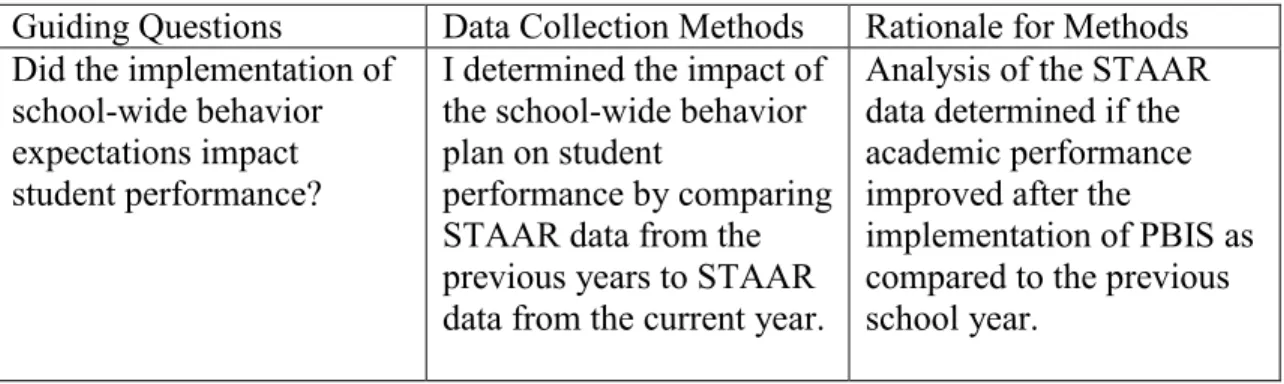
31 Table 3 Continued
Guiding Questions Data Collection Methods Rationale for Methods Did the implementation of
school-wide behavior expectations impact student performance?
I determined the impact of the school-wide behavior plan on student
performance by comparing STAAR data from the previous years to STAAR data from the current year.
Analysis of the STAAR data determined if the academic performance improved after the
implementation of PBIS as compared to the previous school year.
Table 4 outlines the specific timeline of activities to complete the entirety of this study.
Table 4
Timeline of Activities and Products
Mo Wk Contact/Activity Collected Analyzed/
Action Product/Audience Jan 1 Principal/ Superintendent – Requested permission, presented overview Consent Sheets
for study completed Gather consent sheets Proposal to Principal Before Inter-vention
Jan 1 Principal and Asst.
Principal Discipline data reports Analyzed for location of referrals
Report with percentages of discipline referrals per
location 2 Principal and Asst.
Principal Discipline data reports Analyze for type of referral
Report with percentages of discipline referrals per
32 Table 4 Continued
Mo Wk Contact/Activity Collected Analyzed/
Action Product/Audience 3 Principal and Asst.
Principal from previous STAAR Data year Analyze for overall passing score by subject and grade level
Report sorted by grade with overall passing percentage by subject
4 Teachers Teacher
Interviews interviews for Analyzed knowledge level of working with students in poverty Analysis of teacher knowledge level of principles of working with students in poverty Inter-vention
Feb 1 Principal, Asst
Principal, Teachers Principles of Training– Working with Students in Poverty, PBIS Framework and Common Area Expectations Teacher Interviews and Feedback Sheets Analyzed for understanding of principles of working with student in poverty, understanding of framework, common area expectations. 2 Teachers, students Monitor
implementation of common area expectations 3,4 Teachers, students Continue to
monitor implementation of common area expectations After Inter-vention
Mar All Principal, Asst
Principal Discipline Data Analyzed discipline data for problem areas
Report with data by location, teacher April All Principal, Asst
Principal Final Discipline Data Analyzed discipline data by location and
teacher
Report with discipline data sorted by location, type, and teacher, and compared to the previous year discipline data to determine change. May 2 Principal, Asst
33 Table 4 Continued
Mo Wk Contact/Activity Collected Analyzed/
Action Product/Audience area, compared to previous data to determine change May 4 Principal, Asst
Principal, Teachers reports and Shared findings with
stakeholders
Summary of Findings; Copy of completed study
Issues of Reliability, Validity, Confidentiality, and Other Ethical Concerns
Establishing validity is an important step in the process of research. This study focused on the implementation of the Positive Behavior Support and Intervention
framework in an effort to create an educational climate that was both safe and engaging. With the implementation of the PBIS framework, the discipline referrals decreased, leading to an increase in instructional minutes in the classroom. The increase in instructional minutes, coupled with the improved school climate and culture le to an increase in student achievement. A potential threat to the validity of this study was possible inconsistency among teachers in implementation of the PBIS framework. However, continual analysis of discipline data determined classrooms and teachers that needed additional intervention. The frequent and consistent data analysis served to identify any trouble areas in the building which needed more specific procedures to prevent behavior issues.
34
This study has undergone the process through the Institutional Review Board to secure compliance with federal guidelines for collecting data from human subjects. The approval is attached as Appendix I.
35 CHAPTER IV
ANALYSIS AND RESULTS
The purpose of this study was to examine the impact that the implementation of the Tier 1 PBIS framework would have on school climate and student achievement. In order to determine the findings, three guiding questions have been addressed:
1. Will the implementation of the Tier 1 PBIS framework impact student behavior?
2. Will school climate improve as a result of the implementation of the Tier 1 PBIS framework?
3. Will the implementation of the Tier 1 PBIS framework impact student achievement?
Discipline data is the primary source of quantitative results for this study. The district employs Total Education Administrative Management Solution (TEAMS) software to maintain discipline records. Through this system, discipline data was analyzed from the 15-16 school year, before the PBIS Tier 1 structure was implemented at City School, and for the 16-17 school year, after the intervention. The two reports were sorted by grade level, date, and teacher. The type of offense, location of the offense, and the student identification number were also included. Through these two reports, the change in discipline referrals are evaluated.
Teacher interviews are the qualitative source of information for this study. Teachers’ beliefs regarding student behavior in an educational setting were analyzed before the training on the structure of PBIS. The teachers’ beliefs are also analyzed after
36
the training to determine if a shift has taken place in the belief system of student behavior.
Research Question One
Research question one examines the impact that the implementation of the Tier 1 PBIS framework had on student behavior. During the 2015-2016 school year, the school did not follow a specific school-wide behavior plan. The principal was in her first year at City Elementary and the staff primarily consisted of inexperienced, alternatively certified teachers.
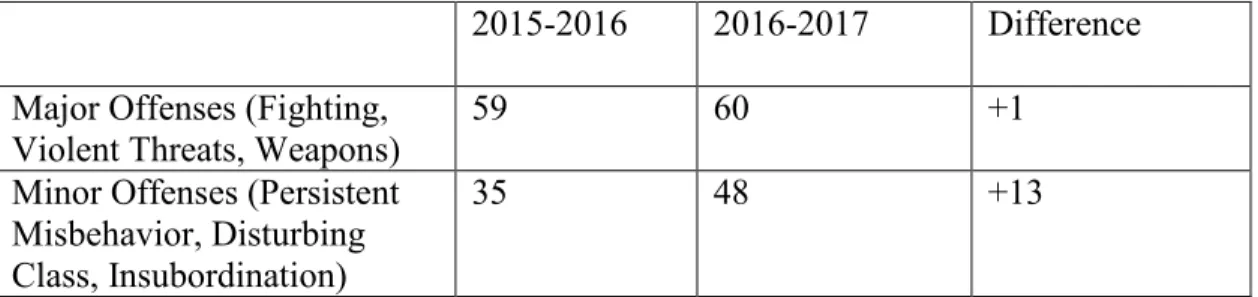
Table 5 shows that a total of 100 discipline referrals were submitted during the 2015-2016 school year. Thirty-one, or 31%, of these referrals occurred in common areas of the building, including the hallway, cafeteria, restroom, and playground. Sixty-nine percent of the total referrals for 2015-2016 school year occur in areas of the building that are not considered common areas, such as classrooms. This data suggests that a high percentage of discipline issues occurred in the areas of the building that are shared with the entire student population at multiple times throughout the school day. During the 2016-2017 school year, after the Tier 1 PBIS framework was put in place, the total number of discipline referrals actually increased. However, the number of referrals in the common areas of the building decreased by 24%. During that school year, a total of 127 office referrals were submitted. Nine, or 7%, of the total number of discipline referrals occurred in the common areas of the school. With the implementation of the Tier 1 PBIS systems in place, the school incurred a 24% reduction in office referrals in
37
the common areas of the building. Table 1 shows that 118 of the discipline referrals occurred in classrooms, areas that are not addressed by Tier 1 of the PBIS framework. Table 5
Difference in 2015-2016 and 2016-2017 Discipline Referrals
2015-2016 Percentage 2016-2017 Percentage Difference Total Referrals 100 127 +27 Classroom 69 69% 118 93% +24% Common Areas 31 31% 9 7% -24%
Research Question Two
Research question two examines the improvement in climate after the
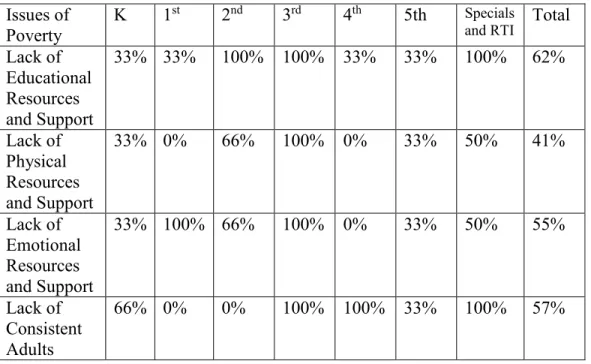
implementation of the Tier 1 PBIS framework. Interviews were conducted to determine the teachers’ understanding of the issues facing students living in poverty and their understanding of the PBIS Tier 1 framework. Table 6 shows that a total of 62% of participating teachers mentioned that a lack of educational resources and support significantly impacted the behavior and performance of the students. Educational resources are considered access to books, educational programs, and support with homework. Physical resources include access to medical and dental care, appropriate
38
nutrition and food, clean clothes, and clean living conditions. Before the intervention, only 41% of participating teachers mentioned the impact of physical resources during the interviews. Emotional resources include a consistent and positive adult in a child’s life that teaches basic life skills such as kindness, sharing, respect, and integrity.
Emotional resources could be provided by a parent or mentor that would be found in the home or church. Prior to the intervention, 55% of participating teachers mentioned this type of resource and support being an issue for students at City Elementary. Consistent and positive adult influence in the students’ lives were mentioned as an issue impacting education by 57% of participating teachers. A lack of consistent adult influence is typically an issue with students who have parents or grandparents in prison, or are moving several times per year due to financial need.
39 Table 6
Issues of Poverty Acknowledged by Teachers Prior to Intervention
Issues of
Poverty K 1
st 2nd 3rd 4th 5th Specials
and RTI Total Lack of Educational Resources and Support 33% 33% 100% 100% 33% 33% 100% 62% Lack of Physical Resources and Support 33% 0% 66% 100% 0% 33% 50% 41% Lack of Emotional Resources and Support 33% 100% 66% 100% 0% 33% 50% 55% Lack of Consistent Adults 66% 0% 0% 100% 100% 33% 100% 57%
Table 7 shows the difference in the understanding of issues of poverty after the intervention and training provided to the teachers. Twenty-eight percent had a better understanding of the educational resources that must be considered when educating students living in poverty. When considering physical resources and support, 9% more teachers indicated an understanding of these issues on their students’ well-being. Proper nutrition and health care were the major considerations of physical resources.
Understanding of the need for emotional resources and support improved by 9% as well. Nineteen percent more teachers acknowledged that students in poverty were impacted by a lack of consistent adults in their lives. Overall, teachers had a clearer understanding of
40
the issues of poverty after the intervention and how these specific issues impact student growth and achievement. With a better understanding of the issues of poverty, the teachers will better adjust to the needs of the students they serve.
Table 7
Issues of Poverty Acknowledged by Teachers Following Intervention and the Difference
Issues of
Poverty K 1
st 2nd 3rd 4th 5th Specials
and RTI Total Differ-ence Lack of Educa-tional Resources and Support 100% 100% 100% 100% 100% 33% 100% 90% +28% Lack of Physical Resources and Support 66% 33% 66% 100% 0% 33% 50% 50% +9% Lack of Emotional Resources and Support 66% 100% 66% 100% 0% 33% 85% 64% +9% Lack of Consistent Adults 66% 66% 66% 100% 100% 33% 100% 76% +19%
Table 8 shows that 76% of all teachers indicated a clear understanding of the process of the Tier 1 implementation plan. These teachers were clear on the
expectations of each common area and committed to implement the processes with their students. Seventy six percent of the teachers interviewed also discussed the value of the
41
Tier 1 framework and expressed their belief that the structure would benefit the climate of the school in general.
Table 8
Teachers Who Understood and Valued PBIS Tier 1 Implementation Plan
PBIS Tier 1
Implementation Kinder 1
st 2nd 3rd 4th 5th Specials
and RTI Total Understand
Value 100% 66% 100% 100% 33% 33% 100% 76%
Understand
Expectations 100% 66% 100% 100% 33% 33% 100% 76%
Research Question Three
Research question three examines the impact that the Tier 1 PBIS framework had on student achievement. This result was determined by comparing the results on the required STAAR tests during the 2016-2016 school year and the 2016-2017 school year. The level of student achievement on the state required exams, or STAAR, were at a low level at the close of the 2015-2016 school year. Table 9 shows that 38% of third grade students passed Math, and 50% passed Reading in 2015-16. Fourth grade scored 45% passing in Math, 47% passing in Reading, and 47% in Writing. Fifth grade was higher with 67% in Math, 58% in Reading, and 66% in Science. Because these scores were lower than the state requirement, the school remained in Improvement Required (IR) status after the 2015-2016 school year.
42
During the 2016-2017 year, the school performance on STAAR improved in some areas. Table 9 shows that third grade Reading improved by 17% and Math by 9%. However, fourth grade Writing decreased by 14% and Reading by 5%. Fourth grade Math had minimal improvement by 4%. Fifth grade also showed some improvement in Math increasing by 7%. However, Science decreased by 13% and Reading decreased by 4% at the end of the 2016-2017 school year. The total change in overall percentage passing for the 2016-17 school year was only +1.
Table 9
Comparison of STAAR Scores from 2015-16 and 2016-17
2015-16 2016-17 Difference 3rd Reading 50% 67% +17% 3rd Math 38% 47% +9% 4th Reading 47% 42% -5% 4th Math 45% 49% +4% 4th Writing 47% 33% -14% 5th Reading 58% 54% -4% 5th Math 67% 75% +7% 5th Science 66% 53% -13% Total Average Percentage 52% 53% +1