POUR L'OBTENTION DU GRADE DE DOCTEUR ÈS SCIENCES
acceptée sur proposition du jury: Dr R. Boulic, président du jury Prof. R. Guerraoui, directeur de thèse
Prof. P. Felber, rapporteur Prof. V. Quéma, rapporteur Prof. A. Ailamaki, rapporteuse
Scalable Synchronization in Shared-Memory Systems:
Extrapolating, Adapting, Tuning
THÈSE N
O8843 (2018)
ÉCOLE POLYTECHNIQUE FÉDÉRALE DE LAUSANNE
PRÉSENTÉE LE 12 OCTOBRE 2018À LA FACULTÉ INFORMATIQUE ET COMMUNICATIONS LABORATOIRE DE CALCUL DISTRIBUÉ
PROGRAMME DOCTORAL EN INFORMATIQUE ET COMMUNICATIONS
Suisse
PAR
“A journey of a thousand miles begins with one step” — Laozi
To my parents, Dimitris and Lemonia, my sister Fenia, and my brother Evangelos
Acknowledgements
First, I would like to thank my advisor, Prof. Rachid Guerraoui. Rachid taught me a lot, both at an academic and a personal level, including what good research is and how it should be done, as well as how to think about problems. Without his support and advice, this journey would not have been possible.
I would like to also thank Aleksandar Dragojevi´c, whom I have worked with for the biggest part of this PhD, for his help, both at a technical and a personal level, his support and patience, as well as all the nice times we had, both during my internship at Microsoft Research and every time we would meet.
I want to thank Prof. Anastasia Ailamaki, Prof. Vivien Quéma and Prof. Pascal Felber for their feedback on this dissertation, and Dr. Ronan Boulic for presiding over my thesis committee. Many thanks to all the members of the Distributed Computing Laboratory: Oana Balmau, Peva Blanchard, Victor Bushkov, Mahdi El Mhamdi, Mihai Letia, Alexandre Maurer, Rhicheek Patra, Julien Stainer, Mahsa Taziki, Kristine Verhamme, Jingjing Wang and Igor Zablotchi. A big thanks to Lê Nguyên Hoang for helping with the translation of my abstract to French. During my PhD, I was also lucky enough to meet some special people at DCL, whom I consider close friends. Adrian, David, George, Karolos, Matej, Tudor, and Vasilis made the days and nights of the PhD much more enjoyable and created an environment in which I really felt at home, and for that I am deeply grateful. I would like to thank Vasilis for also being a great collaborator, and for contributing to the research in this thesis. A big thanks to France Faille for making my life significantly easier by helping with everything related to (among other things) administrative tasks, as well as for all the interesting discussions in French. Finally, thanks to the lab’s system administrator, Fabien Salvi, for making everything technically possible. Many people outside the lab were also very important these five years. I would like to thank George Psaropoulos, whom I also shared apartments with when I first arrived in Switzerland, as well as Danica, Eleni, Iraklis, Javier, Manos and Matt for their company and help, both personally and professionally. I would also like to thank all of my friends in Greece and abroad. There are too many of them to thank and too much to write for each one, but they all know who they are and how much they have done for me, being there for me for many years now, and enduring my unpredictable schedule and last-minute notices (and cancellations). A big “thank you” goes to William Markoutis, who has been there from the beginning, and has honoured me with his friendship and kind character for more than 20 years.
Acknowledgements
These past five years I had the luck of meeting some great people in the ShARE student association that I have been part of, including members at EPFL, as well as members from all over the world. I would like to thank everyone that I had the chance to meet and work with. A very special “thank you” goes to Mirjana Pavlovi´c, for her love and support, for putting up with my never-ending supply of “ideas” and busy schedule, and for always encouraging me to do more, both in the office and outside. She made my life much more colourful and sunny. Last, but in no way least, I would like to thank my family, my parents Dimitris and Lemonia, my sister Fenia, and my brother Evangelos, for shaping the person I am today and for supporting me unconditionally in my every step. They have always been the most important “constants” in my life and for that I can never thank them enough.
The research presented in this dissertation has been supported by the European Research Council (ERC) Grant 339539 (AOC) and the “Revisiting Transactional Computing on Modern Hardware” project of the Microsoft-EPFL Joint Research Center.
Preface
The research presented in this dissertation was conducted in the Distributed Computing Laboratory at EPFL, under the supervision of Professor Rachid Guerraoui, between 2013 and 2018. The main results of this dissertation appear originally in the following publications:
1. G. Chatzopoulos, A. Dragojevi´c and R. Guerraoui. “ESTIMA: Extrapolating ScalabiliTy of In-Memory Applications”. In the Proceedings of the 21st ACM SIGPLAN Symposium on Principles and Practice of Parallel Programming (PPoPP ’16), 2016 [29].
2. J. Anti´c, G. Chatzopoulos, R. Guerraoui, and V. Trigonakis. “Locking Made Easy”. In the Proceedings of the 17th International Middleware Conference (Middleware ’16), 2016 (Best paper award) [14].
3. G. Chatzopoulos, A. Dragojevi´c and R. Guerraoui. “ESTIMA: Extrapolating ScalabiliTy of In-Memory Applications”. In ACM Transactions on Parallel Computing (TOPC) - Special Issue: Invited papers from PPoPP 2016, Part 2, 2017 [30].
4. G. Chatzopoulos, A. Dragojevi´c and R. Guerraoui. “SPADE: Tuning scale-out OLTP
on modern RDMA clusters”. To appear in the Proceedings of the 19th International Middleware Conference (Middleware ’18), 2018.
Besides the above-mentioned publications, I was also involved in other research projects that resulted in the following publication:
1. G. Chatzopoulos, R. Guerraoui, T. Harris, and V. Trigonakis. “Abstracting Multi-Core
Topologies with MCTOP”. In the Proceedings of the 12th European Conference on Com-puter Systems (EuroSys ’17), 2017 [31].
Abstract
As hardware evolves, so do the needs of applications. To increase the performance of an application, there exist two well-known approaches. These are scaling up an application, using a larger multi-core platform, or scaling out, by distributing work to multiple machines.
Both approaches are typically implemented using theshared-memoryandmessage-passing
programming models. In both programming models, and for a wide range of workloads, there
is contention for access to data, and applications needsynchronization. On modern
multi-core platforms with tens of multi-cores and network interconnects with sub-millisecond latencies, synchronization bottlenecks can significantly limit the scalability of an application.
This dissertation studies the scalability of synchronization in shared-memory settings and focuses on the changes brought upon by modern hardware advances in processors and network interconnects. As we show, current approaches to understanding the scalability of applications, as well as prevalent synchronization primitives, are not designed for modern workloads and hardware platforms. We then propose methods and techniques that take advantage of hardware and workload knowledge to better serve application needs.
We first look into better understanding the scalability of applications, using low-level
perfor-mance metrics in both hardware and software. We introduceESTIMA, an easy-to-use tool for
extrapolating the scalability of in-memory applications. The key idea underlyingESTIMAis
the use of stalled cycles in both hardware (e.g., cycles spent waiting for cache line fetches or busy locks), as well as software (e.g., cycles spent on synchronization, or on failed Software
Transactional Memory transactions). ESTIMAmeasures stalled cycles on a few cores and
extrapolates them to more cores, estimating the amount ofwaitingin the system.
We then focus on locking, a common way of synchronizing data accesses in a shared-memory setting. Typically, contention for data limits the scalability of an application. A poor choice
of locking algorithm can further impact scalability. We introduceGLS, a middleware that
makes lock-based programming simple and effective. In contrast to classic lock libraries,GLS
does not require any effort from the programmer for allocating and initializing locks, nor for selecting the appropriate locking strategy. GLSrelies onGLK, a generic lock algorithm that dynamically adapts to the contention level on the lock object, delivering the best performance among simple spinlocks, scalable queue-based locks, and blocking locks.
Finally, we study the performance of distributed systems that offertransactions, by
Abstract
advancements in networking hardware for datacenters. We show how such systems require significant manual tuning to achieve good performance in a popular category of workloads (OLTP), and argue that doing so is error-prone, as well as time-consuming, and it needs to be repeated when the workload or the hardware change. We then introduce SPADE, a physical design tuner for OLTP workloads on modern RDMA clusters. SPADE automatically decides on data partitioning, index and storage parameters, and the right mix of direct remote data ac-cesses and function shipping to maximize performance. To achieve this, SPADE uses low-level hardware and network performance characteristics gathered through micro-benchmarks.
Keywords: Multi-cores, scalability, synchronization, extrapolation, performance counters, locking, adaptive locks, RDMA, tuning, OLTP
Résumé
Les besoins des applications évoluent avec les progrès en hardware. Il existe deux façons bien connues pour améliorer les performances d’une application : utiliser une plateforme multi-cœur, ou distribuer le calcul sur de multiples machines. Ces deux approches sont typiquement
implémentées à l’aide de modèles demémoire partagéeet depassages de messages. Pour une
grande gamme de charges de calculs, il y a d’étranglement au niveau de l’accès aux données, et les applications ont besoin desynchronisation. Sur les plateformes modernes avec des dizaines de cœurs et des interconnections de réseaux performantes, les exigences de synchronisation peuvent significativement limiter la mise à l’échelle d’une application.
Cette dissertation étudie la mise à l’échelle de la synchronisation sur la mémoire partagée. Elle s’intéresse aux changements exigés par les avancées modernes en hardware des processeurs et des réseaux. Comme on le montre, les approches traditionnelles pour comprendre la mise à l’échelle de la synchronisation, ainsi que les primitives de synchronisation prédominantes, ne sont pas adaptées aux charges et aux plateformes hardware modernes. On propose des méthodes et des techniques qui exploitent au mieux la connaissance de la charge et du hardware pour répondre aux besoins des applications.
On commence par chercher à mieux comprendre la mise à l’échelle des applications, à l’aide de métriques de performance de bas niveau, à la fois en termes hardware et software. On introduit ESTIMA, un outil pour extrapoler la scalabilité d’applications. L’idée clé derrière ESTIMAest l’utilisation de cycles retardés, en hardware (e.g., les cycles des requêtes de caches perdus) aussi bien qu’en software (e.g., les cycles passés en synchronisation, ou les transactions enSoftware Transactional Memoryqui ont échoué).ESTIMAmesure les cycles retardés dans quelques cœurs et les extrapole, en estimant le temps que le système passe à attendre. On se concentre ensuite sur le verrouillage, une approche commune de synchronisation. La contention pour l’accès aux données typiquement limite la mise à l’échelle d’une application. Un mauvais choix d’algorithme de verrouillage peut davantage impacter sa scalabilité. On
introduitGLS, un middleware qui rend la programmation avec des verrous simple et efficace.
Contrairement aux bibliothèques classiques,GLSne requiert aucun effort de la part du
pro-grammeur pour allouer et initialiser les verrous, ni pour choisir l’ algorithme.GLSutiliseGLK, un algorithme de verrouillage générique qui adapte dynamiquement au niveau de contention pour chaque verrou, atteignant la meilleure performance parmi des verrous tournants simples, des verrous scalables à base de queue, et les verrous de blocage.
Résumé
Enfin, on étudie les systèmes distribués qui permettent lestransactions. On montre que de tels systèmes nécessitent d’importants réglages à la main pour atteindre de bonnes performances pour des charges OLTP. On se soutien que cette approche est chronophage et sujette aux erreurs. On introduit SPADE, un système de réglage physique pour les charges OLTP sur les clusters RDMA. SPADE décide automatiquement du partitionnement des données, des para-mètres de stockage et d’indexage, et du bon mix entre accès directs et le lancement de fonction à distance pour maximiser les performances. Pour y arriver, SPADE utilise les caractéristiques de performance de hardware et de réseau, collectées via des micro-benchmarks.
Keywords :Multi-cœurs, scalabilité, synchronisation, extrapolation, compteurs de perfor-mance, verrouillage, verrou adaptatif, RDMA, réglage, OLTP
Contents
Acknowledgments i
Preface iii
Abstract (English/Français) v
Table of Contents ix
List of Figures xiii
List of Tables xv
1 Introduction 1
1.1 Shared-Memory Scalability and Synchronization . . . 2
1.2 Understanding the Scalability of Shared-Memory Applications . . . 3
1.3 Improving the Scalability of Shared-Memory Applications . . . 4
1.4 Thesis Statement and Contributions. . . 5
1.5 Roadmap . . . 5
I Preliminaries 7 2 Background 9 2.1 Modern Multi-Core Platforms. . . 9
2.2 Stalled Cycles and Performance Counters. . . 10
2.2.1 Stalled cycles . . . 10
2.2.2 Hardware stalled cycles . . . 10
2.2.3 Software stalled cycles . . . 11
2.2.4 Extrapolating time . . . 11
2.3 Lock-based Programming . . . 12
2.3.1 Programming with locks . . . 13
2.3.2 System correctness with locks . . . 13
2.3.3 System performance with locks. . . 14
2.4 Distributed Transactions and Modern Hardware . . . 14
2.4.1 Modern hardware trends . . . 14
Contents
2.4.3 The cost of performance on modern RDMA networks . . . 15
3 Related Work 17 3.1 Scalability Prediction and Performance Analysis. . . 17
3.2 Locking for Multi-Core Processors . . . 19
3.3 Distributed Transactions in the Datacenter . . . 20
3.3.1 Distributed transactions and modern hardware . . . 20
3.3.2 Index tuning . . . 21
3.3.3 Partitioning and remote accesses . . . 22
II Understanding the Scalability of Shared-Memory Applications 23 4 Extrapolating the Scalability of In-Memory Applications 25 4.1 Introduction . . . 25
4.2 ESTIMA: Insights . . . 27
4.2.1 Stalled cycles for scalability predictions . . . 27
4.2.2 Other performance counters . . . 29
4.3 ESTIMA. . . 29 4.3.1 Prediction process . . . 29 4.3.2 Prediction example . . . 33 4.4 Evaluation . . . 34 4.4.1 Implementation. . . 34 4.4.2 Evaluation setup . . . 35
4.4.3 Extrapolating to different machines . . . 35
4.4.4 Scaling-up applications . . . 37
4.4.5 Weak scaling. . . 40
4.4.6 Identifying future bottlenecks . . . 41
4.5 Discussion . . . 43
4.5.1 Stalled cycles and scalability . . . 43
4.5.2 Backend vs. frontend stalled cycles . . . 45
4.5.3 Software stalled cycles . . . 46
4.5.4 Limitations . . . 48
4.5.5 NUMA effects . . . 49
4.6 Conclusion. . . 51
III Improving the Scalability of Shared-Memory Applications 53 5 Locking Made Easy 55 5.1 Introduction . . . 55
5.2 GLK: A Generic Lock Algorithm . . . 58
5.2.1 GLK sensitivity analysis . . . 62
Contents
5.3 GLS: A Generic Locking Service . . . 66
5.3.1 Programming with GLS . . . 67
5.3.2 Debugging with GLS . . . 69
5.3.3 Profiling with GLS. . . 71
5.4 GLS / GLK in Lock-based Systems . . . 72
5.4.1 Re-engineering memcached with GLS. . . 72
5.4.2 Optimizing systems with GLK. . . 74
5.5 Conclusions . . . 77
6 Tuning Distributed Transactions in the Datacenter 79 6.1 Introduction . . . 79
6.2 SPADE . . . 81
6.2.1 Architecture overview . . . 81
6.3 Tuning . . . 83
6.3.1 Index tuning . . . 83
6.3.2 Partitioning and remote access optimization. . . 86
6.4 Evaluation . . . 88 6.4.1 Implementation. . . 89 6.4.2 Experimental setup. . . 89 6.4.3 TATP . . . 89 6.4.4 TPC-C . . . 94 6.5 Conclusions . . . 95 IV Concluding Remarks 97 7 Conclusions and Future Directions 99 7.1 Understanding the Scalability of Shared-Memory Applications . . . 99
7.2 Improving the Scalability of Shared-Memory Applications . . . 100
Bibliography 103
List of Figures
2.1 Time extrapolation forkmeans. . . 12
4.1 Stalled cycles and execution time correlation. . . 28
4.2 Constructing extrapolations withESTIMA. . . 29
4.3 The regression analysis ofESTIMA. . . 30
4.4 intruderprediction example. . . 32
4.5 Predictions formemcachedandSQLite. . . 36
4.6 Comparison of errors betweenESTIMAand time extrapolation. . . 38
4.7 Predictions usingESTIMA. . . 39
4.8 Predictions with changing workload sizes. . . 40
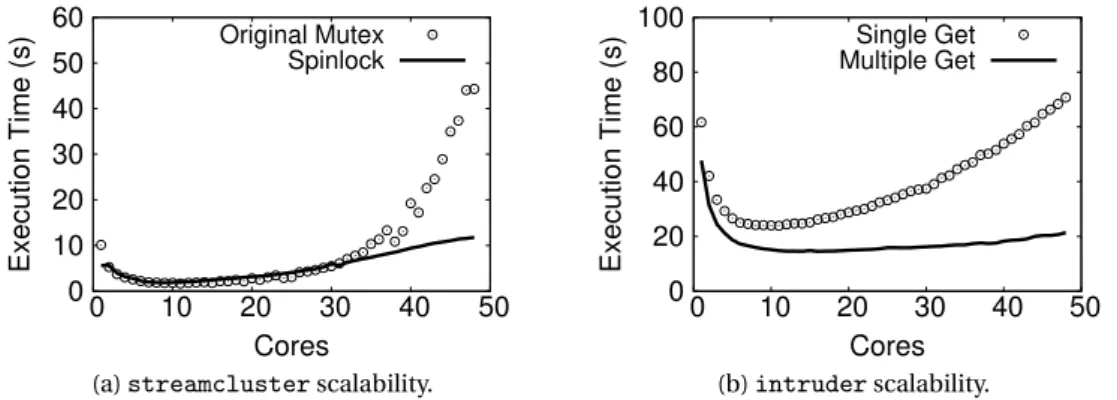
4.9 Predictions forstreamclusterandintruderusingESTIMA. . . 42
4.10 Improving the scalability ofstreamclusterandintruderusingESTIMA’s pre-dictions. . . 42
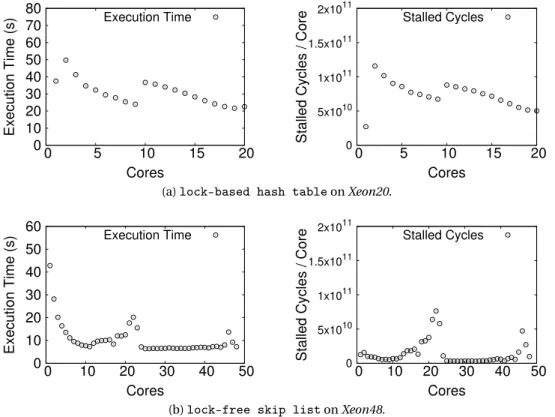
4.11 Execution time and stalled cycles for two data structure microbenchmarks. . . 44
4.12 Comparison of prediction errors with and without software stalled cycles. . . . 47
4.13 Effect of software stalled cycles forstreamcluster. . . 48
4.14 Predictions forstreamcluster. . . 48
4.15 Predictions with NUMA effects captured. . . 49
5.1 Different lock strategies under varying contention. . . 56
5.2 The three modes ofGLK. . . 58
5.3 Performance crosspoint: The number of threads that should be concurrently accessing a lock object so thatMCSoutperformsTICKET. . . 62
5.4 Relative throughput of GLKinticket andmcsmodes compared to GLKwith adaptation disabled, depending on the adaptation period (left) and the queue sampling period (right). . . 62
5.5 Relative throughput ofGLKcompared to the best per-configuration lock on various configurations. . . 64
5.6 A single lock on varying contention. . . 64
5.7 Eight locks on varying contention. . . 65
5.8 One lock under varying contention levels over time. The numbers on top of the graph represent the number of threads on each phase (blue, top), the critical section duration in cycles (red, middle), and the phase id (black, bottom). . . . 66
List of Figures
5.9 Latency overhead ofGLSover directly using locks on a single thread.. . . 68
5.10 Relative throughput ofGLSover directly using locks on 10 threads. . . 69
5.11 Normalized (toMUTEX) throughput of ourmemcachedimplementations onIvy. 73 5.12 Normalized (toMUTEX) throughput of various systems with different locks on our Ivy machine. . . 74
5.13 Normalized (toMUTEX) throughput of various systems with different locks on our Haswell machine. . . 75
6.1 Effect of physical design tuning on TATP. . . 80
6.2 The architecture of SPADE. . . 82
6.3 Performance of random RDMA reads. . . 84
6.4 Performance of inlined lookups. . . 85
6.5 Performance of 256-byte row lookup mix.. . . 85
6.6 Performance of RDMA and RPC for a single-row update operation. . . 87
6.7 Performance of all TATP versions. . . 90
6.8 TATP’sGET_ACCESS_DATAtransaction latency after partitioning. . . 91
6.9 TATP’sGET_ACCESS_DATAtransaction latency with tuned remote accesses. . . 92
6.10 Overview of the impact of different physical design choices to TATP operation latency. . . 93
List of Tables
4.1 Extrapolation function types. . . 31
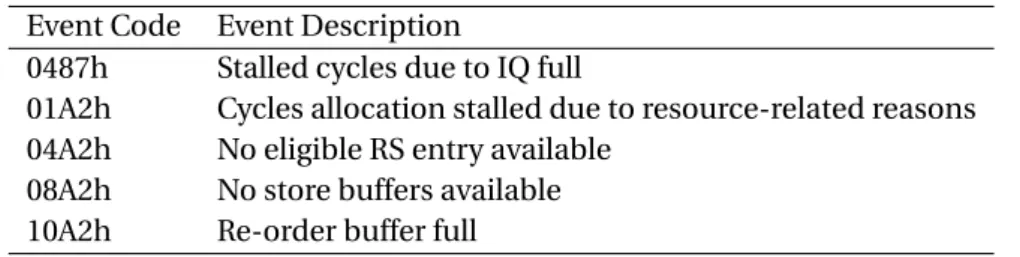
4.2 Hardware performance counters used for theOpteronmachine. . . 33
4.3 Hardware performance counters used for the latestIntelprocessors. . . 36
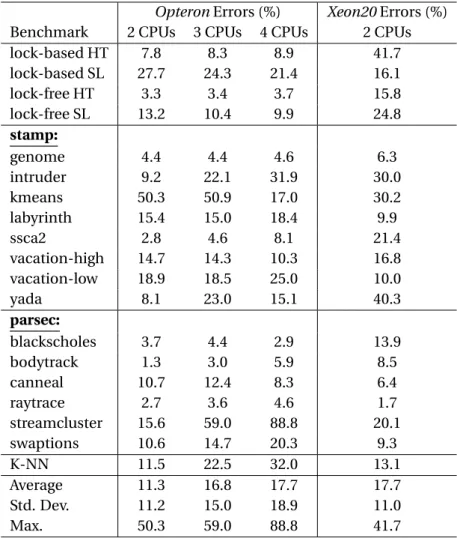
4.4 Maximum prediction errors with measurements on 1 processor of each machine (12 cores forOpteronand 10 cores forXeon20). . . 37
4.5 Correlation of stalled cycles per core with execution time for the full machines. 43 4.6 Frontend+backend stalled cycles improvement over backend-only stalls (%). . 46
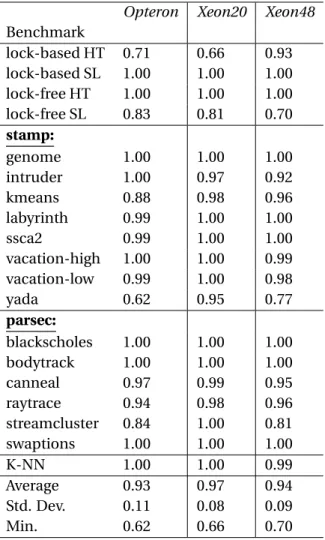
4.7 Maximum prediction errors for predictions targeting our Xeon48 machine (Xeon20prediction errors from Table 4.4 for comparison). . . 50
5.1 Hardware platforms used in this chapter. . . 57
5.2 GLSinterface. . . 67
1
Introduction
In 1965, Gordon Moore described a doubling of the density of components in integrated
circuits every two years. This observation is nowadays known as Moore’s Law[118]. For
decades, Moore’s Law went hand in hand with the Dennard Scaling Rule, which described that as circuit density increases, power density remains constant, resulting in an increase of the performance of circuits [42]. The result was increased performance for applications without significant effort from the part of the developers, as each generation of processors would bring performance improvements.
In the early 2000s, the Dennard Scaling Rule’s validity came to an abrupt end, when current leakage prevented further lowering of the threshold voltages, limiting transistor performance
gains [23]. Processor designers moved towards utilizing the increasing transistor density
to add more processing cores on the same die. Commodity processors becamemulti-core
processors. Applications stopped seeing performance improvements and developers began transforming their applications into multi-threaded ones. As modern processors keep adding more cores and features such as deep cache hierarchies, multi-threaded applications take advantage of hardware, scaling their performance with the resources available in a machine. We say that such applicationsscale up. Additionally, even before processors hit the end of Dennard scaling, applications that needed more resources than a single machine could offer, opted for distribution of work. That refers to systems consisting of multiple machines, often interconnected by fast networks (as allowed by each generation of networking hardware), and applications that spread work among these machines. We say that such applicationsscale out. Developing applications for both scaling methods involves distributing work between the processes that make up the application. These processes might run on the same machine, or different machines. For some workloads, calledembarrassingly parallel, distributing the work is straightforward, and minimal communication is necessary between the processes. Such applications typically scale with very little effort, as the resources available (processing cores and/or machines) increase. However, for a wide range of applications, distributing work is not as trivial, and processes haveshared state. In those cases, to ensure correctness, there is a need forsynchronization, that is coordination of access to this shared state.
Chapter 1. Introduction
Applications nowadays follow one of two main programming models: shared-memory, or
message-passing. In the first model, all the threads of an application have access to a common memory, and communicate by accessing common variables, or data structures. Examples of such communication are shared counters, shared flags, and more. In the second model, threads compute independently, and communicate with other threads when there is a need for exchange of state. For example, threads can compute partial results, exchange their computed parts, and continue computing towards a final result.
While the two programming models have typically lent themselves to the two scaling meth-ods, with shared memory being primarily used for scaling up and message-passing used to scale out, the boundaries have become blurred, as modern hardware has evolved. Modern multi-core systems resemble small-scale distributed processing cores, and research projects
have proposed message-passing inside a single machine [19]. Similarly, shared-memory
ab-stractions can be built on top of a cluster of machines, where the global address space can be distributed over the physical memory of the machines. Such implementations have typically been prohibitively expensive computationally. However, modern network interconnects have offered fast ways to access remote memory, through Remote Direct Memory Access capabili-ties. This advancement has made it feasible to offer shared-memory abstractions over clusters of interconnected machines, using commodity hardware [8,32,52,88,106,174].
In this dissertation, we focus on shared-memory model systems and applications. In such systems, memory is exposed to all the threads of an application, in a shared global address space. Threads are free to read and write any part of the memory. Memory can either be a physical memory module attached to a processor running all the threads of an application, a physical memory module attached to a remote processor on the same machine (i.e., a different Non-Uniform Memory Access Domain), or physical memory attached to a remote machine exposed over a local network. In such distributed settings, we only focus on machines interconnected in a local environment with fast network interconnects, such as a datacenter.
1.1 Shared-Memory Scalability and Synchronization
Synchronization on shared-memory systems is traditionally achieved throughlocking.
Devel-opers choose the granularity of data that need to be protected from concurrent accesses (e.g., a node in a linked list) and choose a locking algorithm to implement their locking strategy. During execution, the algorithm acquires and releases locks, based on the operation to be performed. Synchronization through locking can be a significant bottleneck, but can also affect the correctness of an application, since lock implementations can suffer from problems such as deadlocks and livelocks [33,76]. Another method of synchronizing access to data is throughlock-freealgorithms [63,77], which typically use hardware-provided primitives (such asCompare-and-Swap) to avoid using locks.
Alternatively, applications can usetransactions. Transactions are indivisible sets of operations in an application, that typically satisfy a series of properties. In shared-memory systems,
1.2. Understanding the Scalability of Shared-Memory Applications
applications that use transactions rely on either hardware-provided abstractions (e.g., Intel’s TSX [81]), or runtimes that offer transactional abstractions (e.g., SwissTM [49]).
Nowadays, modern multi-core machines become bigger and more diverse. Processors on server machines typically contain tens of cores, and hundreds of gigabytes of main memory. This allows them to achieve performance by holding big parts (or the entirety) of their dataset in main memory. At the same time, it also means that new bottlenecks are becoming more important. Synchronization is one of them. The performance degradation of synchronization algorithms and implementations that are not designed to scale to this large number of cores is significant. If the synchronization primitives in a synchronization-heavy application do not scale, the scalability of the application suffers.
In this dissertation, we focus on understanding and improving the scalability of synchroniza-tion in the shared-memory setting. We propose techniques and methodologies for predicting the scalability potential of applications and understanding the bottlenecks that may limit scalability. We then set out to improve two common synchronization primitives used in shared-memory applications: locking in multi-core systems and transactions in distributed shared-memory systems. We do so, by adapting to the contention and workload, showing that static approaches can significantly limit scalability.
1.2 Understanding the Scalability of Shared-Memory Applications
Modern multi-core machines nowadays have large main memories, allowing for a wide range of applications to keep their data in-memory, avoiding slow secondary storage and networks. However, many application still exhibit poor performance in large production machines. Un-derstanding the reasons behind this can be difficult: developers typically use smaller machines to develop and test applications than the ones used in production settings. Additionally, pro-cessors and memory systems evolve, meaning that applications tested today even on high-end multi-cores, in a few years will be run on significantly larger machines.To better understand the scalability of applications, various approaches and methodolo-gies have been proposed, including performance evaluation and detailed models of applica-tions [70,109]. In the first part of this dissertation, we argue that such approaches are not only time-consuming and error-prone, and look for an alternative that not only makes the process easier, but also provides high accuracy.
In Chapter4we presentESTIMA, an easy-to-use tool for extrapolating the scalability of
in-memory applications.ESTIMAis designed to perform a simple, yet important task: given the
performance of an application on a small machine with a handful of cores,ESTIMAextrapolates its scalability to a larger machine with more cores, while requiring minimum input from the
user. The key idea underlying ESTIMAis the use of stalled cycles in hardware (e.g., cycles
that the processor spends waiting for missed cache line fetches or busy locks) and software (focusing on cycles spent on synchronization).ESTIMAmeasures stalled cycles on a few cores
Chapter 1. Introduction
and extrapolates them to more cores, estimating the amount ofwaitingin the system.ESTIMA
can be effectively used to predict the scalability of in-memory applications for bigger execution
machines. We extensively evaluate our solution and show the effectiveness ofESTIMAon a
large number of in-memory benchmarks.
1.3 Improving the Scalability of Shared-Memory Applications
In the second part of this thesis, we focus on two synchronization primitives commonly used in shared-memory applications: locking and transactions. We first identify the shortcomings of existing designs and implementation, and present two systems that improve the performance of these primitives, tailoring them to modern hardware platforms.A priori, locking seems easy: To protect shared data from concurrent accesses, it is sufficient to lock before accessing the data and unlock after. Nevertheless, making locking efficient requires fine-tuning (a) the granularity of locks and (b) the locking strategy for each lock and possibly each workload. As a result, locking can become very complicated to design and debug.
In Chapter5we presentGLS, a middleware that makes lock-based programming simple and
effective. GLSoffers the classic lock-unlock interface. However, in contrast to classic lock
libraries, it does not require any effort from the programmer for allocating and initializing locks, nor for selecting the appropriate locking strategy.GLSis based onGLK, a generic lock algorithm that dynamically adapts to the contention level on the lock object.GLKdelivers the
best performance among simple spinlocks, scalable queue-based locks, and blocking locks.
Furthermore,GLSoffers several debugging options for easily detecting various lock-related
issues, such as deadlocks. We evaluateGLSandGLKon two modern multi-core platforms,
using several software systems and show howGLKimproves their performance by 23% on
average, compared to their default locking strategies. We also illustrate the simplicity of using
GLSand its debugging facilities by rewriting the synchronization code for Memcached and
detecting two potential correctness issues.
Distributed transactions on modern RDMA clusters promise high throughput and low latency. However, achieving good performance requires tuning the physical layout of the data store to the application and the characteristics of the underlying hardware. Manually tuning the physical design is error-prone, as well as time-consuming, and it needs to be repeated when the workload or the hardware change.
In Chapter6we quantify the effect of this tuning on the performance of OLTP workloads and
present SPADE, a physical design tuner for OLTP workloads on modern RDMA clusters. SPADE automatically decides on the partitioning of data, tunes the index and storage parameters, and selects the right mix of direct remote data accesses and function shipping to maximize performance. To achieve this, SPADE combines information derived from the workload and the schema with low-level hardware and network performance characteristics gathered
1.4. Thesis Statement and Contributions
show how tuning can achieve up to 2.2x higher performance over manual designs for two widely used OLTP benchmarks.
1.4 Thesis Statement and Contributions
This dissertation studies the effect of synchronization on applications that employ the shared-memory programming model. As we show, existing ways of understanding and extrapolating the scalability of applications developed for the shared-memory setting, as well as existing synchronization primitives, are workload agnostic and not tailored to the modern hardware landscape. In this dissertation, we propose using new sources of information to extrapolate the scalability of applications and show how synchronization primitives that consider workload and hardware characteristics can help shared-memory applications scale better.
In detail, this dissertation makes the following intellectual contributions:
• It introduces the use of stalled cycles in hardware and software for extrapolating the scalability of in-memory applications.
• It introduces a new locking paradigm, in which lock management and lock algorithm selection is abstracted from the programmer and handled by a locking runtime. • It identifies and quantifies the effect of tuning On-Line Transaction Processing (OLTP)
applications on modern RDMA clusters and shows how this tuning can be automated.
1.5 Roadmap
The rest of this dissertation is organized as follows:
• PartIprovides some background on synchronization and modern hardware trends
(Chapter2) and discusses related work (Chapter3).
• PartIIpresents a new technique for understanding and extrapolating the performance
of in-memory applications (Chapter4). It also shows how developers can identify the
root cause of poor scalability in their applications.
• PartIIIshows how we can improve the scalability of applications that use two popular
synchronization abstractions, locking and transactions. Chapter5proposes a locking
runtime that improves the scalability of applications and minimizes the development effort for lock-based programming. Chapter6presents our analysis of the effect of tun-ing on OLTP applications runntun-ing on modern RDMA-enabled clusters and introduces SPADE, a physical design tuner for OLTP workloads built in FaRM [52,53].
Part I
2
Background
In this chapter, we present some background related to this thesis. We begin by describing modern multi-cores and the trends that have affected them. We then continue by presenting some background on performance counters and stalled cycles, which form the basis of our
work in Chapter4. We continue by presenting lock-based programming, which we set out
to improve in Chapter5. Finally, we highlight recent hardware trends and how they affect
distributed transactions, which is the topic of Chapter6.
2.1 Modern Multi-Core Platforms
The shift of processor manufacturers from high-frequency, single-core processors in the early 2000s drastically changed the design of software. While before applications typically would benefit from the increase in the performance of processors, suddenly developers had to start developing multi-threaded applications, explicitly handling aspects of their applications such as data splitting and workload distribution. Even more, as more and more cores were added to processors, the single-thread performance of an application stopped being the most important performance metric, andscalability, or the ability of an application to use additional cores, became the most important performance characteristics of an application.
To better take advantage of the increasing transistor density on processors, manufacturers have added additional levels of cache memory, and additional processing units in each core. The additional levels of cache have been added to mitigate the growing gap between CPU
and memory performance [73]. Nowadays, server processors typically have 3 levels of cache
memory, with tens of MB of shared L3 cache memory per processor. However, multi-core processors need to solve a significant problem when caching is introduced: they need to ensurecache coherence, that is maintaining a consistent view of data, as it is modified by the private caches of different cores. To achieve that, they utilize coherence protocols, the most prominent of which is the MESI protocol [128].
Chapter 2. Background
Including more processing units in the same core is done to improve thread-level parallelism. While an executing thread stalls (e.g., because of data dependencies, or waiting on a memory transfer), more threads can run on the same core, using the additional processing units in it.
In modern processors, such processing units are presented assimultaneous multi-threading
(SMT) threads [162]. While SMT threads can execute in parallel, the fact that they share
significant resources, such as caches and pipelines, means that they can also interfere with each other and degrade performance.
The last hardware trend in modern processors is regarding the interconnection of multiple processors in the same machine, to createmulti-processormachines. Typically, each processor is housed in a different die, with a locally attached memory module. We refer to these configu-rations asmulti-socketconfigurations. Manufacturers typically have specialized interconnects between sockets, such as Intel’s QuickPath [80] and AMD’s Hyper Transport [36]. The result of such configurations is that data accesses and shared data among cores residing on different sockets can incur higher latencies, thus limiting scalability. As such, taking NUMA effects into account becomes important, especially for machines with multiple sockets.
2.2 Stalled Cycles and Performance Counters
2.2.1 Stalled cyclesDuring the execution of an application, CPU cycles are spent to produce useful work, while part of the cycles is spent stalling (calledstalled cycles), either at the hardware level (i.e., waiting on a cache line miss), or at the software level (i.e., spinning on a busy lock). In an ideal scenario, stalled cycles would not constitute a significant part of the execution time and cycles that produce useful work would be evenly distributed across processors, resulting in linear speedup for the application (assuming that the instructions executed do not change significantly when running on more cores).
However, this is rarely the case. Stalled cycles can comprise a significant part of execution time, increasing with the number of cores. Stalled cycles exist both in hardware and software. At the hardware level, stalls are the result of unavailability of processing units or data, which degrades the performance of an application as the number of cores increases. Parallel applications additionally need synchronization, which causes further increases in stalled cycles at the software level. These stalls minimize the benefits from scaling up an application and could be the reason behind even slowdown for higher core counts.
2.2.2 Hardware stalled cycles
Hardware stalls can be divided into two big categories, depending on the stalled execution stage.Frontend stallsare stalled cycles in the fetch and decoding phase of an instruction exe-cution, whilebackend stallsare stalled cycles during the rest of the execution of an instruction.
2.2. Stalled Cycles and Performance Counters
Frontend stalls can typically be attributed to waiting on an instruction fetch that missed in the instruction cache, or a target fetch after a branch misprediction. Backend stalls are typically the result of resources or data not being available during execution. Both categories of stalled cycles have a negative effect on the performance of an application. However, frontend stalled cycles do not change significantly for increasing core counts. In contrast, backend stalled cycles have a direct impact on the scalability of an application, as they significantly increase when adding more cores.
2.2.3 Software stalled cycles
Previous research has shown that Instructions-Per-Cycle (IPC) related metrics are not always useful in predicting the performance of an application [11]. Stalled cycles are closely related to IPC calculations and can thus face the same problem. A processor can spend time executing instructions that do not contribute to useful work. If only hardware stalls are considered, this choice can be the source of prediction inaccuracies. Stalls at the software level can typically be found in synchronization of threads. This includes both lock-based synchronization (e.g., spinning on a busy lock), as well as optimistic concurrency control mechanisms, such as
software transactional memory (STM)[74,144]. In applications that use STM libraries, aborted transactions discard all work done inside the transaction.
Our work onESTIMA( Chapter4) solves this problem by enabling the use ofsoftware stalled
cycles. These represent cycles during which the application is executing instructions that do not produce useful work. Software stalls are optional: users can use a runtime that reports software-level stalled cycles, or modify their applications to provide such information, in order to improve the accuracy of predictions.
2.2.4 Extrapolating time
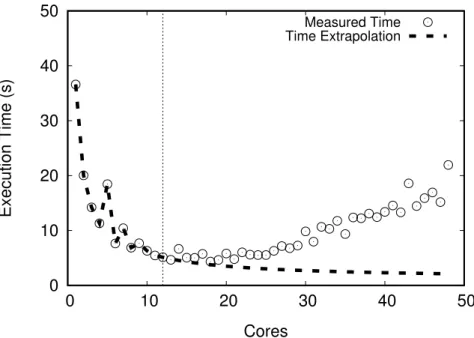
A straightforward approach for scalability predictions is to extrapolate the execution time of an application, measured for low core counts. Indeed, such approaches already exist [17] and provide high accuracy for the workloads they target. They typically function as follows: initially, they take measurements of the execution time of the application for different core counts. The next step is to use analytic functions to approximate the measurements, and extrapolate the measurements to higher core counts. An important drawback of this approach is that extrapolation requires scalability trends to be present in the existing measurements. When that is not the case, such as in the case ofkmeans, shown in Figure2.1, directly extrapolating time can lead to erroneous conclusions. In this case, the time extrapolation method predicts that the application will continue scaling for up to 48 cores, which is not the case. Similar cases can appear when small changes in the execution time steer the extrapolation towards
wrong predictions. In Chapter4) we show howESTIMAcompares against time extrapolation,
as well as cases whereESTIMAis able to capture the scalability of applications for which trends are not visible in measurements.
Chapter 2. Background 0 10 20 30 40 50 0 10 20 30 40 50 Execution Time (s) Cores Measured Time Time Extrapolation
Figure 2.1 – Time extrapolation forkmeans.
2.3 Lock-based Programming
Locksare objects with two states:busyorfree. A lock can be either free, or have a singleowner,
namely the thread that holds the lock. Locks ensuremutual exclusion: Only the owner can
proceed with its execution, while any concurrent threads are waiting behind the lock. Locks offer two operations:lockandunlock. The former is used toacquirethe lock (i.e., make the current thread the owner of that lock). Unlockreleasesthe lock so that it can be subsequently acquired by another thread.
There are numerous lock algorithms. These algorithms mostly differ in the way they handle contention, namely the situation where threads are waiting for a busy lock to become free. Typical designs employ eitherbusy waiting, orblockingfor waiting. With busy waiting, waiting threads remain active, polling the lock until they manage to acquire it. With blocking, waiting threads release their hardware context to the OS. The OS is responsible for unblocking these “sleeping” threads when the owner releases that lock.
There exist various busy-waiting locking algorithms. Simple spinlocks, such astest-and-set
(TAS),test-and-test-and-set(TTAS), andticket lock[111] (TICKET), use a single memory location on which threads are busy waiting. Spinlocks are fast under low contention due to their simplicity. However, simple spinlocks might generate a lot of coherence traffic on the single memory location (i.e., cache line) of the lock [13]. Queue-based locks (e.g.,MCS[111],CLH[37]) generate a queue of waiting nodes so that each thread is spinning on a unique location when busy waiting. Queue-based locks thus remove the single-memory-location bottleneck of simple spinlocks.
2.3. Lock-based Programming
The most well-known blocking lock is themutex-lock (MUTEX), part of thepthreadlibrary.
Because the overheads of the OS for blocking and unblocking a thread are high, blocking locks typically employ a busy-waiting period before putting threads to sleep.
At a first glance, programming with locks looks simple. Locking is appealing precisely because of this simplicity. Nevertheless, using locks efficiently (i.e., achieving correct and fast designs) can become cumbersome, mainly because of various correctness and performance problems that are often associated with locks.
2.3.1 Programming with locks
In short, programming with locks involves the following steps:
1. Recognizing the various critical sections and the data they protect (i.e., thegranularity
of each lock).
2. Selecting and using concrete lock implementations.
3. Declaring the lock objects. Non-statically allocated locks must not only be declared, but allocated as well.
4. Initializing the locks.
5. Using the locks through their interface (i.e.,lock,trylock,unlock) in order to protect the critical sections.
6. Destroying and possibly deallocating the locks.
If the developer implements any of these steps improperly, correctness and performance issues can emerge.
2.3.2 System correctness with locks
The most well-known bugs associated with locks aredeadlocks. In a deadlock, a thread has
acquired a lockl0and is waiting for an already acquired lockl1, the owner of which is waiting for a different acquired lockl2and so forth. Finally, there is a thread that has acquiredlnand
is waiting forl0, in which case none of the threads can make progress. Deadlocks are often a result of acquiring locks in the wrong order and are notoriously hard to debug.
Another hard-to-detect issue with locks is using uninitialized locks (i.e., trying to (un)lock a non-initialized lock object). This issue results in executions where the system may or may not work properly, depending on the initial value of the lock object’s memory. Other common mistakes with locks are trying to lock the same object twice, unlocking a lock that is already free, or releasing a lock that has been acquired by another thread.1As with uninitialized locks, the latter issues can break the system.
Chapter 2. Background
These issues are common in practice [33]. In §5.3.2, we present an easy-to-use debugging
extension ofGLSfor detecting all of these issues. In fact, we useGLSto detect and solve two of these issues in Memcached (§5.4.1).
2.3.3 System performance with locks
In addition to correctness problems, locks might become a performance bottleneck, mainly due to two different reasons.
First, highly-contended locks can easily become a bottleneck (e.g., the global lock in Mem-cached v1.4.13 [59] or in the Linux kernel [21,104]). Removing these bottlenecks might require significant effort. The designer must redesign the critical sections and change the granularity of the locks. This process is of course prone to the correctness issues discussed earlier. The second and more important reason is that different lock algorithms are suitable for different workloads [40,66]. As we show in Figure5.1, simple spinlocks shine under very-low contention, queue-based locks are by far the best under medium to high contention, and blocking locks are necessary under multiprogrammed workloads. Choosing the “wrong”
algorithm under multiprogramming can lead to livelocks, situations where although the
threads execute, the system throughput is close to zero (see MySQL in §5.4.2).
Naturally, while designing and implementing a general-purpose system, the designer cannot predict every single deployment or potential runtime fluctuation of the behavior of the work-load. Therefore, she must choose the common-denominator lock algorithm (i.e., the one that works even on multiprogramming), namely mutex. Unfortunately, studies have shown that
mutex is slow compared to other algorithms in the absence of multiprogramming [40].
2.4 Distributed Transactions and Modern Hardware
2.4.1 Modern hardware trendsModern hardware clusters follow two main trends: large main memories and fast network interconnects. Indeed, commodity machines nowadays typically contain a few hundreds of gigabytes of main memory at very low prices. This enables handling tens of terabytes of data with only a small cluster of machines, benefiting from the low latency and high throughput of
main memory and avoiding complex buffering mechanisms [149].
Ensuring data durability in main memory requires persistent logging. In order to avoid the overheads of logging to disks or SSDs, machines of a cluster can be equipped with a "distributed uninterruptible power supply" (distributed UPS) [53,114] that writes the contents of the memory to an SSD when a power failure occurs, effectively making all DRAM non-volatile. New Non-Volatile RAM (NVRAM) technologies that have been proposed [99,113,137,
2.4. Distributed Transactions and Modern Hardware
At the same time, datacenter networking has also evolved. Commodity Network Interface Controllers (NICs) nowadays support Remote Direct Memory Access (RDMA). Current imple-mentations include InfiniBand, RoCE (RDMA over Converged Ethernet) and iWARP (internet Wide Area RDMA Protocol). Connection-based implementations support one-sided RDMA requests. Applications register memory regions with the NIC, after which the NIC can serve one-sided RDMA requests (e.g., remote read or write requests) without involving the CPU. Remote reads and writes are currently only supported in reliable connection-based implemen-tations. RDMA has been exploited to increase performance in a number of different systems and scenarios [18,79,89,100,116,146,151,161].
2.4.2 Distributed transactions
Distributed database transactions are old, but still an active area of research [90,155,170]. Recently, various systems have utilized fast networks and modern hardware to achieve millions of OLTP transactions at the sub-millisecond scale [8,32,52,88,106,174]. Most of these systems either build (or rely on) message-passing abstractions (typically Remote Procedure Calls – RPCs), utilize one-sided RDMA operations to directly access the memory of remote machines, or use a combination of the two (e.g., one-sided RDMA reads and writes with RPCs).
There are two main execution models for distributed transactions. In the first [32,52,88],
often referred to assymmetric, all the machines participate in storing data and executing
transactions. Each server is responsible for storing parts of the data (and possibly replicas of the data stored by other machines of the cluster), as well as running distributed transactions.
The second model [106,174] distinguishes between computation and storage nodes. The
former run transactions, utilizing RDMA to access the data stored in the memory of the latter.
We use FaRM[52,53] as our target platform. In FaRM, objects are stored in the memory of the cluster with a global address. FaRM uses one-sided RDMA accesses for lock-free reads, as well as message-passing for read-write transactions. It offers an API that allows applications to create and execute transactions. It also includes implementations of a distributed hashtable and a distributed B-Tree.
2.4.3 The cost of performance on modern RDMA networks
Distributed transaction systems typically offer APIs for low-level operations within transac-tions. Some of them also include implementations of data structures that can be used for OLTP workloads. More specifically, [8,32,52,88,106,174] have a hashtable implementation, while [32,52,106,174] have a B-Tree [35] implementation. Even with the available APIs and data structures, implementing OLTP workloads using such an API is not straightforward. For
example, given only two of the queries of TATP benchmark [120],GET_SUBSCRIBER_DATA
andUPDATE_LOCATION(shown in Listing2.1and Listing2.2), there are a few crucial choices to get performance out of the underlying hardware. For theSubscribertable, these are:
Chapter 2. Background
1. Table storage. This includes data partitioning and deciding on how the data is stored, for example inlining data in an index, or flat storage of data.
2. Indexes. By examining the queries, in addition to a primary hash index ons_id, a
secondary hash index onsub_nbris necessary. Based on the choices in the previous
step, each index needs additional tuning to get the best performance of the underlying network, based on characteristics such as the record size, the operation mix and the neighbourhood size of the hash index.
3. Remote data access. Possible options here include: a) remotely accessing the data using RDMA, b) doing an RPC to the server holding the data, or c) a combination of the two. Choosing when to remotely access data and when to send a message can be fine-tuned based on the length of the operations and the size of transfers necessary.
S E L E C T s_id , sub_nbr ,
bit_1 , bit_2 , bit_3 , bit_4 , bit_5 , bit_6 , bit_7 , bit_8 , bit_9 , bit_10 , hex_1 , hex_2 , hex_3 , hex_4 , hex_5 , hex_6 , hex_7 , hex_8 , hex_9 , hex_10 , byte2_1 , byte2_2 , byte2_3 , byte2_4 , byte2_5 , byte2_6 , byte2_7 , byte2_8 , byte2_9 , b y t e 2 _ 1 0 ,
m s c _ l o c a t i o n , v l r _ l o c a t i o n F R O M S u b s c r i b e r
W H E R E s _ i d = < rnd >;
Listing 2.1 – TATP’sGET_SUBSCRIBER_DATAquery.
U P D A T E S u b s c r i b e r
SET v l r _ l o c a t i o n = < rnd > W H E R E s u b _ n b r = < rnd >;
Listing 2.2 – TATP’sUPDATE_LOCATIONquery.
Making the correct choices is not only cumbersome, but also error prone. In fact, workloads typically contain a mix of operations for each table and queries can touch data on more than one tables (and possibly machines). Deciding on a set of parameters for each table, based on the workload and the hardware it will execute on quickly becomes overwhelming, and making
the wrong choices can have a significant impact on performance, as we showed in Figure6.1.
Additionally, changing the workload requires repeating the entire process, which is time-consuming if done manually. Previous work has implemented and studied the performance of OLTP transactions on modern RDMA clusters, but has not looked at the trade-offs of tuning, or quantified the effect that these choices have on the performance of an OLTP workload on modern RDMA networks.
3
Related Work
In this chapter we present related work to the topics addressed by this dissertation. We begin with work related to our scalability prediction tool (presented in Chapter4) in Section3.1. We then present work on locking for multi-cores and adaptive locking in Section3.2, which relates to our work in Chapter5. Finally, in Section3.3, we describe work in the area of distributed
transactions on modern hardware, which relates to our work presented in Chapter6.
3.1 Scalability Prediction and Performance Analysis
The work that is most closely related toESTIMA(Chapter4) is that of Crovella et al. [38], in which the authors identify two categories of stalls at the software level: productive cycles and stalled cycles. They collect measurements of the two categories of cycles and use them
to predict the performance of an application. As we show in Chapter4using low-overhead
performance counters offered by modern hardware can reduce overheads. At the same time, adding software-level stalls to measure synchronization overheads can further improve accuracy, making a solution applicable to a wider variety of workloads.
Various research projects have studied the scalability of parallel and distributed applications. Barnes et al. [17] use linear logarithmic functions to predict the scalability of message-passing scientific applications on large-scale parallel systems. The number and the configuration of CPUs are the inputs and the process uses linear logarithmic functions. In [98], statistical techniques and regression analysis are used to build piecewise black-box polynomial and neural network models of scientific programs. Neural networks are also used in [83] to build
models of SMG2000 applications executing on two different large-scale machines. In [124],
the author extrapolates address stream profiles, using low-level metrics collected on memory access patterns, in order to study the memory performance of an application under strong scaling. Finally, in [34], the authors use call path profiles and expectations on the cost dif-ferences between executions to estimate the scalability costs incurred by different parts of
Chapter 3. Related Work
machines with significantly higher number of CPUs available, and uses both hardware and software stalls to extrapolate the scalability of the application as a whole.
Several systems combine predictions of the sequential performance of single-node tasks
performed by distributed cores with models of communication between them [27,109,175].
Similar cross-platform performance predictions for large-scale machines using a combination of known relative performance of the two systems and partial execution of the workload
are described in [172]. Various formal modeling techniques for distributed and concurrent
systems have also been proposed [84], including petri nets and queuing theory [131]. They were used to develop detailed analytic models for several applications [78,93]. These models are very accurate. They require however in-depth understanding of the applications and the system. In contrast,ESTIMA(Chapter4) can be used with little effort onanyparallel in-memory
application.
Models based on discrete-time Markov chains were developed for several STM algorithms [69,
70,71] to compare different STM designs. Usui et al. [163] use a simple cost-benefit analysis
to choose between locking and transactions. The performance model from [134] focuses
on modeling transactional conflict behavior. UnlikeESTIMA, this approach requires heavy
instrumentation of the application memory accesses.
Performance counter research has mainly focused on profiling of applications. In [147]
and [164], the authors use performance counters to increase power efficiency, through thread
scheduling and placement. In [166], the authors use performance counters to capture
per-formance impacts as a function of resource usage. Srikanthan et al. [148] use performance
counters for online workload scheduling in multiprogrammed environments. Jiménez et
al. [85] devise a model based on performance counters to predict total power consumption.
While performance counters have been used for many different goals, the low-level informa-tion they provide has not yet been exploited for scalability predicinforma-tions, as inESTIMA.
Finally, numerous projects have focused on identifying bottlenecks in parallel applications. Liu et al. [105] develop ScaAnalyzer, a tool that uses event-based sampling to identify memory-related bottlenecks in parallel applications and suggest optimizations that improve scaling. In [173], the author proposes a set of new performance counters, which, together with a new analysis method can identify performance bottlenecks in out-of-order processors. Torrellas et al. [156] use hardware performance counters to identify scalability bottlenecks in parallel applications running on distributed shared-memory multiprocessors. The main goal of our work in Chapter4is to predict the scalability of an application for larger machines. By
pinpointing the sources of stalled cycles predicted byESTIMA, developers can also identify
bottlenecks that will appear in their applications. This, however, does not replace tools specifically built for performance tuning and bottleneck identification.
3.2. Locking for Multi-Core Processors
3.2 Locking for Multi-Core Processors
Lock algorithms. Apart from the traditional spinlock algorithms (e.g., test-and-set, ticket locks [111]), there are several efforts towards designing more scalable locks. Mellor-Crummey et al. [111] and Anderson [13] introduce several alternatives, such as queue-based locks. Luchangco et al. [108] design a hierarchical CLH lock [37] for NUMA architectures. Dice et al. [46] generalize the design of NUMA-aware hierarchical locks by introducing a technique for converting any lock algorithm to be hierarchical. Chabbi et al. [28] and Zhang et al. [176] design locks for NUMA systems, delivering performance in various contention scenarios. David et al. [40] analyze various lock algorithms on different platforms and point out that “every lock has its fifteen minutes of fame.” OurGLSmiddleware andGLKalgorithm ( Chapter5)
directly build on top of the observations and the results of such prior work. Concurrently with our work, Guiroux et al. [66] study the performance of lock algorithms in applications and confirm the previous findings. Their LiTL library uses a similar approach toGLS, but with the aim of easily switching between lock algorithms.
Adaptiveness in locks. Karlin et al. [92] analyze the cost of busy waiting and blocking and show that adaptive techniques (i.e., adapting the amount of spinning before threads block) deliver the best performance. Similarly, Falsafi et al. [57] design a mutex algorithm that dynamically adapts the amount of spinning when locking/unlocking, to achieve higher energy efficiency. Many modern lock designs, such as the classic mutex lock, both on Linux [1] and on Solaris [153], include this type of adaptiveness. Similarly, the Hotspot 7 JVM modifies its
semaphore algorithm at runtime to save memory, based on the idea of thin locks [16]. If
there are no threads waiting behind the lock, the JVM represents the lock with just a few bits, otherwise it converts the lock to keep track of the queue of waiting threads. Lock elision [60,
138,139] aims at reducing the overhead of locking when critical sections do not actually
conflict. A thread can optimistically execute its critical section without acquiring a lock. If a data conflict appears, then the thread rolls back and executes the critical section normally.
Diniz and Rinard [47] introduce dynamic feedback, where the compiler generates various
synchronization policies that can then be selected at runtime based on sampling.
Lim and Agarwal [101] propose reactive locks, an adaptive synchronization scheme that
switches between different protocols and waiting strategies. In this sense,GLKcan be viewed
as an instance of reactive locks. However,GLKis a fully practical adaptive lock algorithm,
tailored to modern multi-cores.GLKincludes three concrete lock algorithms which cover the
needs of modern software systems, tuned approaches for collecting contention statistics for the locks, as well as a low-overhead method for detecting multiprogramming and switching to a blocking lock when necessary.
Johnson et al. [87] present a locking technique (LC) that decouples waiting from thread
scheduling. A global monitor controls how many threads must block, while the remaining threads use time-published MCS locks [68]. The background thread we use inGLSis similar to
Chapter 3. Related Work
this global monitor. However, in our work, every lock object is a “normal” lock with just a hint
on whether it should employ themutexmode.
Debugging locks. Debugging locks is notoriously hard. The main techniques available today can be categorized intostaticanddynamic. Static techniques identify deadlocks by analyzing the lock and flow graphs of an application and by employing heuristics for identifying the prerequisites for a deadlock [55,119,167]. Dynamic deadlock-detection techniques employ ways of monitoring the acquired locks for each thread and discovering cycles in the locks that are being locked [94,135,142,160]. More specifically, Koskinen et al. [94] implement a deadlock detection algorithm that allows lock operations to expire. Pyla et al. [135] implement a runtime for deadlock detection for applications that usepthreads. Samak et al. [142] use
dynamic analysis and execution traces to identify possible deadlocks. GLSincludes a
low-overhead, dynamic debugging mode, which can identify issues in lock-based applications.
Alternatives to traditional locks. Transactional memory, in software (STM) [51,117,145] or in hardware (HTM) [45,75], replaces locks with transactions as a concurrency-control mecha-nism. On the one hand, STMs are typically slower than locks, due to their instrumentation overhead. On the other hand, HTMs are not mature enough and cannot yet fully replace locking [169]. Flat combining [72] is a technique for optimizing coarse-grained locks (e.g., the global lock of a queue). With flat combining, a critical section translates to a message to a dedicated server thread that executes the request on behalf of the invoking thread. Similarly to flat combining, RCL [107] overloads the lock function for highly-contended locks with remote
procedure calls on a dedicated server thread. Unlike flat combining and RCL,GLKoptimizes
both lightly- and highly-contended locks.
Locks in systems. There are various efforts in operating systems to minimize sharing [24], to remove lock-related bottlenecks [25,26], or to completely avoid locks [15,19] in order to resolve scalability bottlenecks. Similarly, in data stores and DBMSs, recent projects [48,59,
65,86,107,110] show significant performance improvements in systems such as Memcached
and RocksDB, mainly by removing contended locks.GLSis designed to make development of
such systems easier, while achieving high performance.
3.3 Distributed Transactions in the Datacenter
3.3.1 Distributed transactions and modern hardwareDistributed transactions on traditional hardware and networks has a long history of research. However, in the past, networks imposed a significant bottleneck that dominated performance. As such, a large body of research has focused on partitioning schemes [39,126,129,136,143] to avoid crossing partitions, or relaxation of the consistency of transactions [95].
3.3. Distributed Transactions in the Datacenter
Recently, a number of research projects and commercial systems have taken advantage of modern network characteristics, such as high throughput and low latencies, as well as RDMA capabilities, to implement fast distributed transactions. FaRM [52,53] uses one-sided RDMA verbs and optimistic concurrency control to implement serializable distributed transactions. FaRM uses primary-backup replication to ensure fault-tolerance, a fast failure detection mech-anism, and a recovery protocol that ensures that transactions are not blocked when failures occur. FaSST [88] implements serializable distributed transactions on top of unreliable, un-ordered, non-congestion-friendly RPC implementation. FaSST also uses primary-backup replication and a similar optimistic commit protocol. Tell [106] decouples processing nodes from storage nodes, using one-sided RDMA accesses to ship data to processing nodes. Tell implements a distributed snapshot isolation protocol that uses a centralized commit
man-ager. NAM-DB [174] also separates computation from storage, however it uses a distributed
snapshot isolation algorithm that relies on a scalable timestamp oracle. DrTM+R [32] provides serializable transactions by using both RDMA accesses and Hardware Transactional Memory (HTM), relying on primary-backup and an optimistic replication scheme.
All the above systems [32,52,53,88,106,174] take advantage of modern hardware to imple-ment distributed transactions. Moreover, they all impleimple-ment some type of distributed index
structures. In Chapter6we present SPADE, which optimizes for the physical design of data,
such as tuning indexes and remote accesses, which is applicable to distributed systems that leverage modern RDMA networks in general.
3.3.2 Index tuning
Databases require a significant amount of tuning to achieve performance. Research on automatically tuning indexes has been meticulous [7,64,91,130,165]. Additionally, DBMS vendors provide tools that aid administrators in tuning a database. Microsoft’s SQL Server has the Database Tuning Advisor [5], which can both tune existing indexes for performance, as well
as recommend new ones. Oracle Server has both self-tuning [20,44,177] and performance
analysis capabilities [171]. DB2 has offered the Performance Wizard tool [96]. Recent research projects have also looked into machine learning [10], adaptive sampling [54] and regression
models [157] to choose the best parameters for DBMSs.
In Chapter6we focus on a distributed setting. We argue that, in addition to previous efforts for tuning of indexes, modern transactional systems require an additional level of tuning. SPADE takes into account the network and hardware characteristics to tune index parameters. This way, applications take full advantage of the performance of modern networks, which, as we show, can have a significant impact on performance.