Casting conference calls
LSE Research Online URL for this paper: http://eprints.lse.ac.uk/101136/ Version: Accepted Version
Article:
Cohen, Lauren and Lou, Dong (2020) Casting conference calls. Management Science. ISSN 0025-1909
https://doi.org/10.1287/mnsc.2019.3423
[email protected] https://eprints.lse.ac.uk/ Reuse
Items deposited in LSE Research Online are protected by copyright, with all rights
reserved unless indicated otherwise. They may be downloaded and/or printed for private study, or other acts as permitted by national copyright laws. The publisher or other rights holders may allow further reproduction and re-use of the full text version. This is
Casting Conference Calls*
Lauren Cohen
Harvard Business School and NBER
Dong Lou
London School of Economics and CEPR
Christopher Malloy
Harvard Business School and NBER
* We would like to thank Javed Ahmed, Malcolm Baker, Lucian Bebchuk, Bo Becker, Dan Bradley, Zhi Da, Kent Daniel, Alex Edmans, Ben Esty, Andrea Frazzini, Oliver Hart, Campbell Harvey, David Hirshleifer, Louis Kaplow, Scott Kominers, S.P. Kothari, Christian Leuz, Ulrike Malmendier, Bill Mayew, Scott Mayfield, Atif Mian, Roni Michaely, Maureen O’Hara, Daniel Paravisini, Thomas Philippon, Jose Scheinkman, Kelly Shue, Doug Skinner, Ken Singleton, David Solomon, Siew-Hong Teoh, David Thesmar, Han Xia, Luigi Zingales, Eric Zitzewitz, and seminar participants at University of California Berkeley, University of California Irvine, Case Western Reserve University, University of Chicago, China Europe International Business School, Cornell University, George Washington University, University of Georgia, Georgia State University, Harvard Business School, Harvard Law School, HEC Paris, University of Hong Kong, Hong Kong University of Science and Technology, University of Illinois, Indiana University, INSEAD, London Business School, London School of Economics, University of Miami, MIT Sloan, University of Notre Dame, University of North Carolina, NYU Stern, Pontifica Universidad Catholica De Chile, Princeton University, University of Washington, University of Pennsylvania Wharton, University of York, 2014 AFA Philadelphia Meeting, 2013 NBER Behavioral Economics Meeting, 2013 University of Miami Behavioral Finance Conference, 2013 Helsinki Finance Summit, 2013 Yale Doctoral Summer Program in Behavioral Finance, 2013 European Finance Association Annual Meeting, 2013 Borsa Istanbul Finance & Economics Conference, Acadian Asset Management, AQR Capital, PanAgora Asset Management, and SAC Capital for helpful comments and discussions. We thank Alok Kumar and Kelvin Law for generously providing data on analyst brokerage house affiliation. In addition, we are grateful to James Boggie, Huaizhi Chen, Manuel Daj, David DiCenso, Barbara Esty, Laura Glass, Beth Hall, David Kim, Christine Rivera, Elizabeth Sampson, Pablo Torroella, Shannette Washington, and James Zeitler for providing excellent research assistance. We are grateful for funding from the National Science Foundation and the Paul Woolley Center at the London School of Economics.
Casting Conference Calls
ABSTRACT
We explore a subtle but important mechanism through which firms can control information flow to the markets. We find that firms that “cast” their conference calls by disproportionately calling on bullish analysts tend to underperform in the future. Firms that call on more favorable analysts experience more negative future earnings surprises and more future earnings restatements. A long-short portfolio that exploits this differential firm behavior earns abnormal returns of up to 149 basis points per month, or almost 18 percent per year. We find similar evidence in an international sample of earnings call transcripts from the UK, Canada, France, and Japan. Firms with higher discretionary accruals, firms that barely meet/exceed earnings expectations, and firms (and their executives) that are about to issue equity, sell shares, and exercise options, are all significantly more likely to cast their earnings calls.
JEL Classification: G12, G14, G02
Playing Favorites – Page 1
Regardless of the extent of disclosure regulation, there exists private information which managers can release at their discretion. Given the current regulatory environment in the US of level playing-field information laws, firms are mandated to communicate material information in public information exchanges. However, even in these highly regulated venues, there are choices that firms can make that reveal differential amounts of information to the market.
In this paper we explore a subtle but important mechanism through which firms can control information flow to the markets. The setting we exploit is the universe of regularly scheduled quarterly earnings calls. Our empirical strategy is to examine firms’ decisions to “cast” their earnings conference calls in a particular way; specifically, how and who they call on to participate in these calls. In particular, we show that firms tend to “cast” their conference calls by disproportionately calling on bullish analysts to speak during the Q&A session of these calls, a fact we document using a 13-year sample of US data, as well as in 4 international markets.1
Using this fact as our starting point, we then provide novel evidence on the implications of this managerial tendency for both asset prices and future firm behavior. We focus on the firms that call specifically on analysts that have given them the highest recommendations (as proxied by the average recommendation over the past year), and test the idea that firms that cast their conference calls in this way may be preventing the revelation of negative information to the market. Rather than focus on the impact on the sell-side analyst community of this type of managerial behavior—the focus of prior work in this area—our key contribution in this paper is to analyze the implications for future asset prices, along with future behavior and firm outcomes. We find that the casting of conference calls has a large and predictable effect on future stock returns, both in the US and across broad international markets.
To better understand our approach, consider the case of Sealed Air Corp. Sealed Air produces a variety of packaging materials, the most well-known of which is Bubble
1 This confirms prior evidence in the literature, namely Mayew (2008) and Mayew, Sharp, and Venkatachalam
(2013), who establish this same pattern in a US sample of firms and calls from 2002-2005, and who explore the implications of differential analyst participation during conference calls for analyst accuracy.
Playing Favorites – Page 2
Wrap. Sealed Air held their Q1 earnings conference call in April 2007. While Sealed Air was covered by 11 analysts, on this particular call, it only allowed a select few to participate in the conference call: those analysts that had particularly high recommendations on the firm in advance of the call. These analysts largely complimented the firm on the quarter, but did not push them on the upcoming quarter. Figure 1 shows excerpts from the conference call: Panels A-C show several cases in which the analysts can be seen joking and laughing with the CEO, with one analyst specifically complimenting the CEO on cash strategy. Throughout all of the exchanges there is a notable lack of difficult (or even substantive) questions posed by the analysts.
Three months later, at the Q2 earnings call following the April call where analysts with particularly positive recommendations were called upon, Sealed Air missed expectations, had their first negative free cash flow quarter (following 20 consecutive positive ones), and dropped 7% on the announcement. In this paper we show that this pattern--of firms appearing to choreograph information exchanges directly prior to the revelation of negative news--is systematic across the universe of publicly traded firms.
More generally, our primary contribution is that there is a powerful asset pricing implication from this behavior. Namely, firms that manipulate their conference calls in this way appear to be hiding bad news, which ultimately leaks out in the future in terms of predictable future return dynamics and firm operating performance. Specifically, we find that casting firms experience consistently predictable negative future returns. A long-short portfolio that goes long the non-casting firms and short the casting firms around their subsequent call earns abnormal returns ranging from 129 basis points (t=2.59) to 149 basis points (t=2.64) per month; which translates to annualized abnormal returns of roughly 15 to 18 percent per year. These returns are robust over time, alternative factor-model controls, and formation horizons.
Going further, using a hand-collected dataset of international earnings transcripts, we then show that the core evidence in this paper extends beyond the U.S., to an international sample including the United Kingdom, Canada, France, and Japan. Specifically, we again find that an analyst’s prior recommendation level is a strong predictor of the likelihood of asking a question on an earnings call in each of these 4 additional
Playing Favorites – Page 3
countries. We then show that casting on an international earnings call predicts negative future announcement returns on the subsequent earnings event, consistent with our U.S. evidence. Collectively, our evidence spans 5 countries, 13 years, 4101 firms, and 7125 analysts, covering 91,878 conference calls in total, making our dataset the largest and most extensive of any project analyzing corporate earnings calls.
In terms of the magnitude and incidence of casting across the population of firms, we find that more “extreme” examples of casting—where the average gap in recommendation levels between the analysts who are called upon in a call and those who do not speak is largest (which we term (RECD(IN)-RECD(OUT))—are associated with the most negative future returns, suggesting that the tails of this gap distribution do capture true casting behavior by firms. A one-standard deviation move above the zero recommendation-gap benchmark implies that between 17-22% of firms in a given quarter engage in this type of opportunistic behavior. In the time-series we find that RECD(IN)-RECD(OUT) is (on average) significantly higher in 2008 than in other years, consistent with the idea that casting behavior was more prevalent during the financial crisis.
We show that the predictability also relates to future firm operating performance – with firms that cast having significantly and predictability more negative future earnings surprises and negative returns surroundings those surprises. Importantly, the return predictability that we document is not driven by well-known predictors of future returns such as analyst forecast dispersion, analyst recommendation dispersion, discretionary accruals, affiliation status, or issuance behavior. Further, we observe no sign of any return reversal in the future, suggesting that the negative information that is hidden is information important for fundamental firm value.
We explore the mechanism behind the behavior by turning to the mechanics of the conference call itself. In particular, analysts face two choices: i.) whether or not to dial (or log) into a given call, and ii.) conditional on (i), whether or not to indicate that they’d like to ask a question. The firm has a number of choices in the action space once announcing the time and call-in details:2
i.) How long to hold the conference call; ii.) how to split the
2 Though we’ll show that they can actually be selective on the latter of these in extreme cases, through the
Playing Favorites – Page 4
time between initial management discussion and presentation and Q&A; iii.) of the analysts who have indicated they’d like to ask a question, decide how many of the analysts to call upon; iv.) decide exactly whom to call upon; and v.) in what order. Our evidence, cast in the light of these firm decisions, is that the more positive analysts are called upon - and called upon significantly earlier in the conference Q&A – systematically (and directly) preceding periods of future negative price and firm operating performance realizations. This is consistent with firms actively using their ability during the calls to call upon more “friendly” analysts when they have more negative information to conceal. However, it could be that the firm calling patterns we observe are coming through analysts’ portion of action space; namely, that optimistic analysts are the only analysts who choose to speak on an earnings call, and that firms are merely passive actors in this process.
In order to further explore this alternative story and shed more light on the precise mechanism, we conduct a collect new data, construct a number of new measures, and perform a number of analyses. First, we parse our entire dataset and manually examine each conference call transcript in order to identify all the calls where phrases such as “There are no more questions in the queue” are spoken by management or by a moderator at the very end of the call. For these calls, management is ostensibly not casting the call, since for these calls management actively opens up the call to the entire audience until there are no other call participants desiring to ask a question. We show that these calls are not accompanied by significantly negative returns in the future; meanwhile the negative future returns described earlier are concentrated only on the calls where this phrase does not occur, suggesting that only the casted calls drive our key results.
Second, we examine a number of instances in which firms might be expected to be particularly interested in concealing negative information ex-ante. For instance, firms that engage in more earnings management (discretionary accruals), may be especially wary of calling on analysts that will probe into these accruals. Additionally, firms that barely meet or exceed earnings expectations (meeting at 0, or beating by 1 penny), have been shown in prior literature to be far more likely to have manipulated earnings in order to do so, and so may be less likely to want to be aggressively questioned. Lastly, firms planning to do SEOs (or managers planning to sell their shares, or exercise their options) in the near future may be interested in keeping share price high to maximize proceeds, and so may prefer to
Playing Favorites – Page 5
call on friendly analysts. We find evidence on all three of these paths: firms with higher discretionary accruals, firms that barely meet/exceed earnings expectations, and firms (and their executives) about to issue equity, sell shares, and exercise stock options are all significantly more likely to call on analysts with more optimistic views of the firm.
Summing all of these results, our evidence is less consistent with a view that the patterns we document are driven solely from the analyst side, i.e., that optimistic analysts are the only analysts who choose to speak on an earnings call, and that firms are merely passive actors in this process. First, the evidence on the timing of the behaviors above is hard to reconcile with this alternate view, since the analysts would have to choose to show up and speak only on the calls that exactly coincide with the firm- and manager-level opportunistic behaviors listed above, which seems implausible. Added to the “no more questions” sample, and the results only being driven by the actively firm-“casted” conference calls, and the evidence seems to point more toward the firm being an important and active participant in the call patterns we document.
Lastly, we attempt to explore the dynamics of the sentiment of the analysts’ questions. While this is a difficult task, we use a simple measure of how positive the tone of the question is (the number of positive vs. negative words). In doing so, we find evidence that favorable analysts—i.e., those with higher outstanding recommendations—tend to ask more positive questions. Moreover, the more positive of questions an analyst asks in a call, the more likely they are to be called upon again in future calls – with negative questions being contrastingly associated with a significantly lower likelihood of that analyst being called upon again in future calls.
The remainder of the paper is organized as follows. Section I provides a brief background and literature review. Section II describes the data we use, while Section III explores firm behavior in casting earnings conference calls. Section IV examines the impact of casting on firms; Section V presents international evidence; and Section VI explores the mechanism in more detail. Section VII concludes.
I. Background and Literature Review
Playing Favorites – Page 6
information environments, the manner in which firms disclose information to the markets, and the impact of different forms of disclosure on various stakeholder groups (e.g., investors, customers, regulators, media, etc.). A series of recent papers, for example, studies the impact of Regulation Fair Disclosure (“RegFD”), which was designed to combat selective disclosure by firms. Effective October 23, 2000, companies must reveal any material information to all investors and analysts simultaneously in the case of intentional disclosures, or within 24 hours in the case of unintentional disclosures. According to SEC Proposed Rule S7-31-99, regulators believed that allowing selective disclosure was "not in the best interests of investors or the securities markets generally." Several recent papers examining the impact of Regulation FD on the behavior of equity analysts conclude that the law has in fact been effective in curtailing selective disclosure to analysts (see, for example, Mohanram and Sunder (2006), Groysberg, Healy, Chapman, Shanthikumar and Gui (2007), Cohen, Frazzini, and Malloy (2010), Agrawal, Chadha, and Chen (2006), and Gintschel and Markov (2004)). Our paper is unique in that we take as given the “level playing field” imposed by Regulation Fair Disclosure (RegFD), and explore the subtle choices firms can make even within this seemingly strict information disclosure environment, choices that can (as we document) have large implications for market prices and firm outcomes.
Since the laboratory we exploit is that of quarterly earnings conference calls, our paper is also relevant to a large literature studying the relationship between firms and analysts, as well as studies of the information content of earnings announcements and earnings conference calls specifically.3 For example, a recent strand of the literature
examines management communication during conference calls and its association with information content (Hollander, Pronk and Roelofsen (2010), Matsumoto, Pronk and Roelofsen (2011)), information asymmetry (Chen, Hollander, and Law (2014)), future performance (Mayew and Venkatachalam (2012)) and financial fraud and misreporting (Larcker and Zakolyukina (2011), and Hobson, Mayew and Venkatachalam (2012)). In
3 For instance, Hirshleifer et al. (2009), DellaVigna and Pollet (2009), and Neissner (2013) all give evidence
that managers attempt to time disclosures around times of low perceived investor attention. There is also an accompanying literature examining the release of negative news (see, for example Kothari et al. (2009), Bergman and Roychowdhury (2008), and Westphal and Deephouse (2011)).
Playing Favorites – Page 7
addition, Zhou (2014) uses textual analysis to analyze when corporate executives blame poor performance on external factors such as the industry or the broader economy. Chen and Matsumoto (2006) also find that in the pre-Reg FD period that analysts with access to management deliver more accurate earnings forecasts. Closest to this paper are the findings in Mayew (2008) and Mayew, Sharp, and Venkatachalam (2013), who also document and explore differential analyst participation on conference calls; however, their focus is primarily on the implications for analyst accuracy. Our focus, by contrast, is on the asset pricing implications of casting, along with future firm behavior and outcomes.
II. Data and Summary Statistics
We draw from a variety of data sources to construct the sample we use in this paper. A critical input to our study is the earnings conference call transcript data. We obtain these transcripts from Thomson Reuters, specifically from the StreetEvents data feed. We collect the complete transcripts of all US conference calls for the period of 2003 to the first quarter of 2015. We also obtain, from the same source, all available conference calls in Canada, UK, France, and Japan for the period of 2003 to 2014. We isolate the name of the firm conducting the call, along with the name and affiliation of all analysts covering the firm conducting the call. In practice, firms know the identities of all listeners to the call, as each person must dial in through a conference call-in service that requires them to sign in at the outset of each call; the company then filters who can ask questions, the order of the queue, and when to end the call.
With regard to the call mechanics, we have contacted, and had a number of discussions with, the largest of these conference call providers: InterCall (a subsidiary of West Corporation), which administers over 85% of all quarterly conference calls for the Fortune 100. Many employ the industry-standard product called Leader-View, which allows a firm’s “call-team” – which from InterCall has a modal constituency of the CEO/CFO, head of Investor Relations, Legal Counsel, and two to three other company executives - to see a computer screen with everyone that has entered the call. This “call-team” then has a private line to the operator at InterCall who is orchestrating the call. What the firm sees on Leader-View is a list of participants in the call, along with affiliation
Playing Favorites – Page 8
of each participant, and a flag for whether the participant has indicated interest in asking a question during the Q&A. Through their private communication line, the firm’s call-team indicates to the operator who it would like to call on, and at what point during the call it would like to call on that participant. The operator then introduces the questioner chosen by the firm - this is why conference call transcripts are filled with lines such as: “Operator: Next up we’ll hear from Colin Gillis from BGC Partners.” When the firm decides, it indicates to InterCall, and the Q&A portion of the call comes to a close.
As mentioned above, we obtain the conference call transcript data for all publicly traded firms from 2003 through the first quarter of 2015 from the Thomson StreetEvents Database. In the StreetEvents data, we extract the full text of all earnings calls, the names of all company affiliates present, the names of analysts who were called upon to ask a question during the call, coding every exchange between questioner and replier during the call. We attempted to obtain the full participant list (those who did and did not ask questions) from both InterCall and the underlying firms, but neither would provide this full set of participants (specifically the set of participants that “indicated” they wanted to ask a question, but were not able to).4
To construct our dataset, we first hand-match the StreetEvents analyst names for each call back to the brokerage house and analyst last name and first initial available on IBES, using a conservative matching procedure. This allows us to match the data to IBES, so that we can obtain data on past forecast accuracy and past recommendation levels. For some of our additional tests, we also examine the text of each question in order to assess the difficulty of the question.
In addition to analysts’ past forecasts and recommendations, we also obtain analyst data on length of career, Institutional Investor All Star status, and other selected analyst biographical items (such as past employment) from ZoomInfo. We also collect additional
4 We do tests specifically on calls in which all analysts who indicate interest in asking a question are called
upon (tests in Section IV). In addition, in Appendix Table A7 we show that analysts who are able to ask questions during the call have significant increases in their future forecast accuracy following the call. Anecdotally, we also contacted a number of analysts directly, and in those conversations the analysts commented that it was a “job-requirement” to call-in (and if possible to ask questions) during the conference calls. One recounted an instance where a lead-analyst at his firm had not called in, and it being mentioned at the lead analyst’s performance review.
Playing Favorites – Page 9
firm-level data, such as firm restatements over our sample period from the Audit Analytics database, as well as monthly stock returns, shares outstanding, volume, and market capitalization from CRSP, and a variety of firm-specific accounting variables from Compustat. For our international sample, we obtain their daily stock returns from Datastream. In sum, our evidence spans 5 countries, 13 years, 4101 firms, and 7125 analysts, covering 91,878 conference calls.
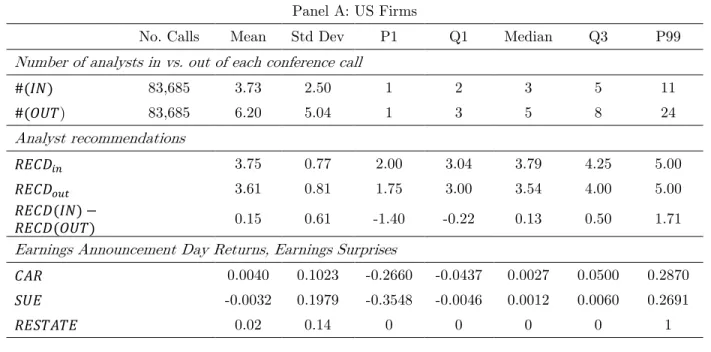
Table I presents summary statistics from our final dataset. Panel A reports statistics for our U.S. dataset, and Panel B reports numbers for our pooled international dataset, consisting of observations from the UK, Canada, France, and Japan. Each analyst covering a given stock is designated as “in” for a particular conference call if she was called on during that call, and “out” if she was not called on during that call. An analyst is said to be “covering” a stock if she has produced a stock recommendation for a given stock in the IBES database in the past year. Table I shows that an average of 3.73 unique analysts (out of an average of 9.93 analysts covering a stock) are called on during a typical quarterly earnings call. In a preview of some of our results, Table I also shows that analysts who are called tend to issue more optimistic recommendations in the year prior to the call (an average of 3.75 on a 1-5 scale, where 1=Strong Sell, 2=Sell, 3=Hold, 4=Buy, 5=Strong Buy) relative to other analysts covering the stock (=3.61). The average level difference in analyst recommendations between the two groups (equal to 0.15) is statistically significant and of the same magnitude as the optimism effect associated with “affiliation” (i.e., when a firm has an underwriting relationship with the analyst’s brokerage house), which is the subject of a vast analyst literature (see, for example, Lin and McNichols (1998), Lin et al. (2005), Michaely and Womack (1999), Hong and Kubik (2003)). Panel B shows a similar, although somewhat smaller, unconditional difference between the average recommendation levels of the two analyst groups (RECD(IN)-RECD(OUT)=0.08) in the international data. Note that Appendix Table A1 reports some additional firm-level summary statistics; relative to the average firm on CRSP, our sample is tilted towards stocks that are larger, have lower book-to-market ratios (i.e., are more “growth-like” in nature), and have higher institutional ownership.
Playing Favorites – Page 10
III. Firm Behavior on Earnings Conference Calls A. Analyst Recommendations and Conference Call Participation
We begin by examining the likelihood of an analyst being called upon in a quarterly earnings conference call. Specifically, we run panel regressions where the dependent variable (IN) is an indicator variable equal to 1 if the analyst was called on during a call, and 0 if the analyst was not; the main independent variable of interest is the analyst’s recommendation level prior to the conference call. We focus on the average recommendation in the year prior to the call rather than the most recent recommendation of each analyst; this is because firm managers may not be immediately aware of the most recent recommendation updates by individual analysts, and thus have to rely on the historical average to identify “friendly” vs. “unfriendly” analysts. Using lagged recommendations also helps alleviate the concern that our results are driven by the information content of recent recommendation changes.
We also control for a variety of other determinants of call participation, including several analyst-level variables (such as the number of years the analyst has worked in the industry, the number of years the analyst has covered the firm in question, the number of stocks currently covered by the analyst, the number of stocks currently covered by the analyst’s brokerage firm, a dummy if the analyst was named an Institutional Investor All-Star analyst within the past year, and a dummy indicating whether the analyst is affiliated with a brokerage house that underwrites for the firm in question5
), and numerous firm-level measures (such as size, book-to-market ratio, past year returns, share turnover, and idiosyncratic volatility). We then test the hypothesis that firms choose to call on or “cast” their earnings calls with analysts who were more favorable in their past recommendations on these firms.
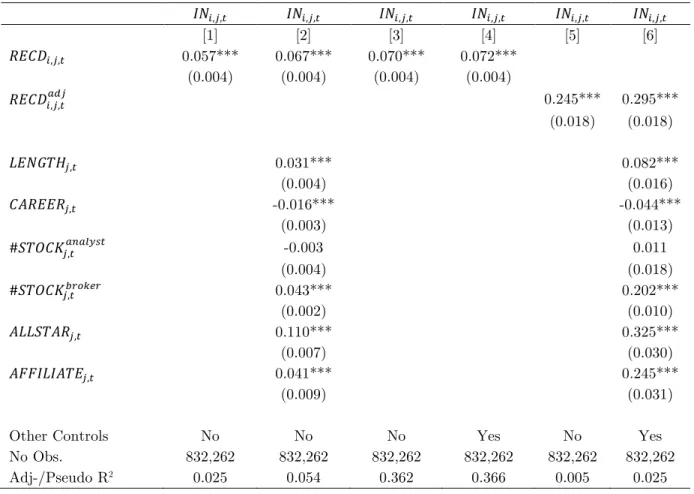
Table II, using data on all US publicly traded firms from 2003-2015, confirms the finding in Mayew (2008) that firms do indeed call on analysts who issue more favorable recommendations in the year leading up to a conference call. Further, Table II shows that this effect persists even after controlling for a host of analyst- and firm-level variables
5 We thank Alok Kumar and Kelvin Law for providing data on affiliation of all analysts and brokerage houses
Playing Favorites – Page 11
known to correlate with analyst recommendations, and after including firm-quarter fixed effects (in Columns 1-2, thus comparing in and out analysts covering the same firm in the same quarter), and after including analyst-time fixed effects (in Columns 3-4, thus comparing in and out stocks covered by the same analyst in the same quarter).6
The estimates in Columns 1-4 imply that for a one-notch increase in analyst recommendation level (roughly a one-standard deviation move), the likelihood of being called on increases by about 6%, relative to an unconditional probability of 38% (so a 16% increase in the likelihood). In Columns 5 and 6, we run the same regressions but now using a logit specification, again using being “called on” as the 0/1 dependent variable, and the average prior recommendation level (minus the average recommendation level for that firm prior to the call) as the independent variable of interest; these tests again reveal a positive and significant effect of prior recommendation level on the likelihood of being called on during an earnings conference call. In terms of economic magnitude, the marginal effect of a one-standard-deviation increase in recommendation is associated with a 5.7%-6.9% increase in the likelihood of being called.
B. Types of Firms that Call on Bullish Analysts, and Incidence of Casting
Next we examine the behavior and characteristics of firms that tend to call specifically on analysts with higher past recommendations. Our first test explores the determinants of firms’ casting decisions. Our key measure of casting, RECD(IN)-RECD(OUT), equals the difference in average recommendation level by “in” analysts (i.e., those analysts called upon during the conference call) versus “out” analysts (i.e., those analysts not called upon, but who cover the firm in the given quarter), measured in the one year prior to the conference call. We then run panel regressions with this firm-level (RECD(IN)-RECD(OUT)) variable on the left-hand side of the regression, and present the results in Table III.7
6 Appendix Table A2 shows that controlling directly for the number of times the analyst has been called on
in the past (PASTCALL), has no effect on these results from Table II. Also note that including firm-analyst fixed effects in these Table II regressions has no effect on the results either.
7 We find nearly identical results using an alternate measure of casting, termed RECD(IN)>RECD(OUT),
Playing Favorites – Page 12
For our explanatory variables, we start by analyzing two measures that plausibly capture a firm’s incentive to call on more favorable analysts. First, we examine discretionary accruals, as firms with higher accruals may have an incentive to call on bullish analysts to avoid a potentially unfavorable discussion of the specific composition of their earnings. We also create a dummy variable equal to one if a firm’s earnings surprise in the quarter in question is exactly 0 or 1 cent, since firms that just meet (or barely exceed) consensus forecasts may want to avoid any difficult questions about the precise manner in which they hit their forecasts so narrowly.
We also control for the same firm-level variables defined in Table II, and run the tests as panel regressions with firm and time (quarter) fixed effects and standard errors double-clustered at both the firm and quarter level. In addition, we include controls for: analyst forecast dispersion (measured as the standard deviation of analysts’ outstanding quarterly EPS forecasts); and analyst recommendation dispersion (measured as the standard deviation of analysts’ outstanding recommendations); analyst coverage (the number of unique analyst estimates made in the 12 months leading up to the call); institutional ownership (the proportion of the firm that is held by institutional investors); and the idiosyncratic volatility of the firm (measured as the standard deviation of the four-factor adjusted monthly return over the past 12 months).
Columns 1-3 of Table III show that discretionary accruals (ACCRUAL) and the dummy for meeting or barely exceeding consensus earnings forecasts (SUE(0)) are both positive and significant predictors of RECD(IN)-RECD(OUT), consistent with the idea that firms with the largest incentive to call on favorable analysts are exactly the firms that do so. In terms of magnitude, a one-standard deviation move in accruals leads to a 6.5% increase in RECD(IN)-RECD(OUT). In addition, firms that meet or barely exceed forecasts have a 20% higher value of RECD(IN)-RECD(OUT).8
In Columns 4-7 of Table III we explore the future behavior of firms after they engage in casting behavior. Specifically, we run logit regressions in order to examine the predictive
than the average recommendation of those who do not speak on the call.
8 Controlling for the magnitude of the SUE (standardized unexpected earnings) itself in all of the regressions
Playing Favorites – Page 13
power of casting on a given call for several firm (and executive) behaviors during the following quarter. Our first dependent variable is a dummy variable equal to one if the firm in question issues a secondary equity offering (SEO) in quarter t+1, as firms issuing equity in the near future may want to avoid the release of any potential bad news that could decrease their issuance proceeds. Second, we create a dummy variable equal to one if the insiders of the firm conducting the call on aggregate engage in net-selling of their insider owned shares – the idea being that firms may want to prop up their stock price (delay the release of bad news) if they plan to engage in sales of their shares, as they would like to sell the shares at the highest price possible. Third, we create a dummy variable equal to one if a firm’s top executives exercise their stock options in the following quarter, and zero otherwise; again the idea is that executives ideally would like to exercise their options at the highest share-price possible. And finally, we create a dummy variable equal to one if a firm’s top executives receive an option grant in the following quarter, and zero otherwise; here the idea is the opposite of the exercise variable, since in this case an executive hopes to receive a grant at the lowest price possible.
Columns 4-7 show that casting behavior (RECD(IN)-RECD(OUT)) is indeed a positive and significant predictor of future equity issuance (SEO), future insider selling (INSIDER), and future option exercise by management (OPTIONEXCS), and a negative and significant predictor of option grants (GRANT). In terms of marginal impact, a one-standard deviation move in RECD(IN)-RECD(OUT) leads to a 6% increase in the likelihood of SEO issuance, a 3% increase in the likelihood of insider selling, a 2% increase in the likelihood of option exercise by management, and a 5% decrease in the likelihood of option grants given to management (all as a fraction of their corresponding unconditional probabilities).
One important question is the extent to which we are capturing the information staging activities of a few firms that engage in this frequently throughout our sample, or whether this is a more systematic activity engaged in by a large universe of firms at precisely those times when it is most valuable for any given firm to withhold negative information. However, note that Columns 1-3 of Table III include both firm and quarter
Playing Favorites – Page 14
fixed effects.9
If it were simply a subset of firms always casting their calls, the firm fixed effect would capture this, and these independent variables would be insignificant upon the inclusion of the fixed effects. In contrast, Table III shows that even controlling for firm fixed effects, all of the results on motivators for potentially wanting to cast a call (e.g., earnings management) are highly significant.
One persistent firm-level variable worth mentioning is the corporate governance G-index measure of Gompers, Ishii, and Metrick (2003). This measure is highly persistent at the firm level, so one would expect that firm fixed effects would largely capture this measure, and we confirm this in our data. Without firm fixed effects, the coefficient on the G-Index is 0.0037 (t=2.37), suggesting that casting behavior is positively related to poor governance, but this result is no longer significant once firm fixed effects are included.
In Figure 2 we graph the histogram of frequency of quarters that each firm casting episode in our sample lasts. In theory, once a firm begins to “cast” their conference call (RECD(IN)>RECD(OUT)), they could continue this behavior indefinitely. As we have 36 quarters in our sample, if the firm is present throughout the entire sample, the maximum casting length could be 36 quarters, with the minimum 1 (as we are conditioning on it being a casting episode). What we see from Figure 2 is that the most common length for a casting episode is one quarter. Also note that in Appendix Figure A1, we compute two “placebo” figures, one of which represents a histogram of casting spells under the assumption that firms calls on firms randomly, and another which is a histogram of spells of non-casting episodes (where RECD(IN)<RECD(OUT)); the casting distribution depicted in Figure 2 is noticeably more fat-tailed relative to these two placebos, and also statistically different from both in a Chi-Squared test.
These histograms, along with the firm fixed effects not impacting the results in Table III, suggests that casting is something a wide range of firms engage in selectively at precisely those times they have strong incentives to do so, and we are not identifying a behavior solely driven by a few firms that continuously cast their calls.
To further explore the magnitude and incidence of casting across time and across
9 Note that if we re-run Columns 4-7 using OLS with firm and quarter fixed effects, instead of logit regressions,
Playing Favorites – Page 15
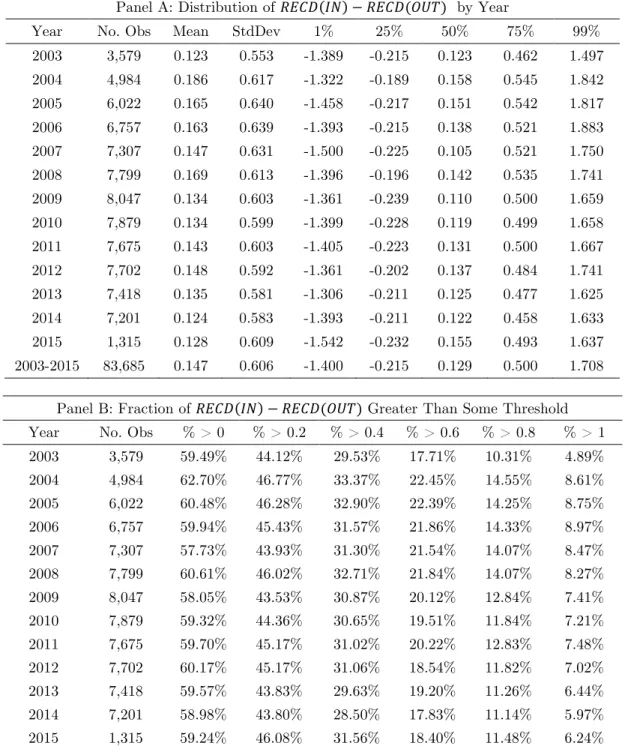
the population of firms in our sample, Table IV plots the distribution of casting (RECD(IN)-RECD(OUT)) by year, both according to percentiles of the distribution (in Panel A), and using fixed thresholds (in Panel B). As we show later in Table VI, exploring the tails of the casting distribution (i.e., firms where RECD(IN)-RECD(OUT) is particularly high, e.g., greater than the 90% percentile) results in even stronger results than our baseline findings, suggesting that these higher thresholds capture “extreme” casting more cleanly. Panel A of Table IV shows that RECD(IN)-RECD(OUT) is (on average) significantly higher in 2008 than in other years, consistent with the idea that casting behavior was more prevalent during the financial crisis. Panel B indicates that the percentage of firms with RECD(IN)-RECD(OUT)>0 is roughly 60% across the sample. At the threshold of 0.6 (a one-standard deviation move above the RECD(IN)-RECD(OUT)=0 benchmark), we find between 17-22% of firms in a given quarter fall into this category; this number represents a possible estimate of the general incidence of casting in the population of firms.
Collectively, the results in this section indicate that during our full 2003-2015 sample of the universe of quarterly earnings calls, firms are more likely to call on analysts who have issued more favorable recommendations on these firms leading up to the call. Moreover, this type of behavior is most pronounced among firms with the strongest incentives to manage the flow of information to the market, such as firms with higher discretionary accruals, firms that barely meet/exceed earnings expectations, and firms (or executives) about to issue equity, sell shares, or exercise their stock options in the near future.
IV. The Impact of Casting on Firms
In this section we explore what happens to the firms that call on more favorable analysts during earnings conference calls. We exploit cross-sectional and time series variation in the extent to which firms engage in this type of behavior, and importantly when they choose to cast their calls. We explore the impact of casting on a host of future firm-specific outcomes, such as future stock returns, future earnings surprises, and future
Playing Favorites – Page 16
earnings restatements.
A. Future Earnings Announcement Returns and Future Earnings Surprises
If firms calling on favorable analysts are doing so in order to portray the most positive view to the market and potentially hide any negative information from coming to light, our hypothesis is that firms engaging in this type of behavior are more likely to experience negative future outcomes, such as negative future earnings surprises, as this news will ultimately be revealed to the market (it likely cannot be hidden forever). We test this idea by running forecasting regressions of future earnings announcement returns and future earnings surprises on the lagged spread between average recommendation levels (in the prior year) of analysts called on vs. those not called on (RECD(IN)-RECD(OUT)) during the last earnings call, plus a host of additional control variables. We measure announcement returns using cumulative abnormal returns (CARs) around the earnings date, and earnings surprises using SUEs, and control for the same firm-level variables used in Table III. Again, since these CARs and earnings surprises are measured around the subsequent earnings announcement relative to the one-quarter lagged casting measure, these regressions are strictly predictive in nature. We conduct quarterly Fama-MacBeth regressions for both CARs and SUEs, controlling for the following lagged firm-level variables: market capitalization; book-to-market ratio; prior year returns; share turnover over the past 12 months; analysts’ recommendation dispersion; idiosyncratic volatility, institutional holdings, and analyst coverage.
Columns 1-3 of Table V show that firms that call more on favorable analysts (i.e., those with higher values of RECD(IN)-RECD(OUT)) experience more negative future announcement returns (CARs). For example, the coefficient of -0.259 in Column 3 implies that for a one-standard deviation move in (RECD(IN)-RECD(OUT)) this period, CARs are 39% lower at the next announcement (computed relative to the sample mean CAR of 40 basis points). Controlling for additional known predictors of future earnings returns, such as net insider selling behavior, discretionary accruals (Sloan (1996), Hirshleifer, Hou, and Teoh (2012), etc.), analyst forecast dispersion (Diether et al. (2002)), etc., have no
Playing Favorites – Page 17
effect on this return predictability.10
Columns 4-6 of Table V show a similar effect for future earnings surprises. In terms of the magnitude of this effect, a one-standard deviation move in (RECD(IN)-RECD(OUT)) this period implies a lower earnings surprise by over 20% of the interquartile range for the next announcement, so an economically large impact.
B. Isolating Cases Where Management Left No Questions Unanswered
Our evidence so far is less consistent with a view that the patterns we document are driven solely from the analyst side, i.e., that optimistic analysts are the only analysts who choose to speak on an earnings call, and that firms are merely passive actors in this process. In particular, the timing of the firm-level behaviors documented in Section III.B is hard to reconcile with this alternate view, since the analysts would have to choose to show up and speak only on the calls that exactly coincide with these behaviors, which seems implausible.
That said, we cannot “prove” that management denied access to particular analysts on a given call, since we do not have data on the “operator lists” that flag all those wishing to ask questions.11
In order to further explore this alternative story, however, we also went through and parsed our entire dataset and manually examined each conference call transcript in order to identify all the calls where phrases such as “There are no more questions in the queue” are spoken by management or by a moderator at the very end of the call. For these calls, it appears that management was not casting the call, since for these calls management actively entertained and took all questions from the call participants, ostensibly ending the conference call only when there were no further questions. Therefore, for these calls we can plausibly assume that management was at least not “refusing” to allow any additional questions from certain analysts in the audience. There may have been (negative) analysts who did not want to ask questions, but we can at least rule out the possibility that management was actively disallowing additional
10 Also if we run these regressions on the set of firms who do not issue SEOs, to ensure that our results are
not driven by post-SEO underperformance, we find that the coefficient on RECD(IN)-RECD(OUT) in predicting future CARs is -0.229 (t=2.38), which is very similar to the figure reported in Column 3 of Table V.
11 As mentioned above, we attempted numerous times (and methods) of obtaining the full participant list
from both InterCall and the underlying firms, but neither would provide the full set of participants (nor the set of participants that “indicated” they wanted to ask a question, but were not able to).
Playing Favorites – Page 18
questions that the audience wished to ask.
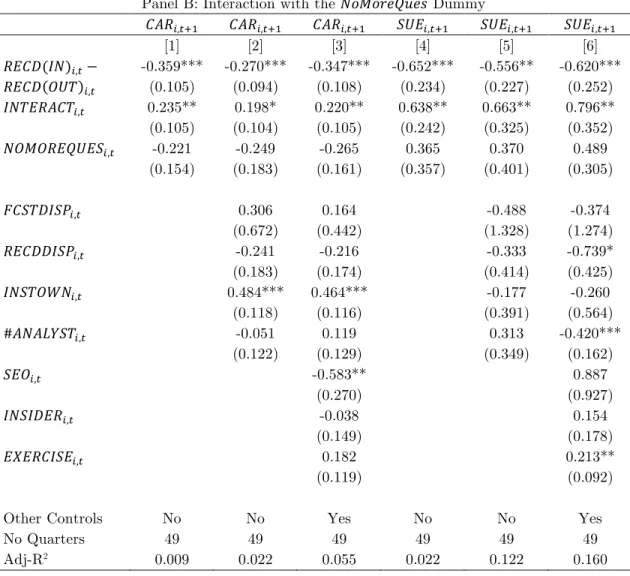
We take this set of calls and create a dummy variable called “NoMoreQuestion” which is set equal to one for all the calls where phrases such as (“There are no more questions in the queue”) are used to close the call. We find that these types of phrases are used in 25-30% of the calls. In Panel B of Table V, we then interact this dummy variable with our indicator for a casted call (RECD(IN)-RECD(OUT)), and re-run the basic future earnings CAR test from Table V. The idea is that for these calls in which (presumably) all questions have been allowed to be asked, the firm is not then casting the call. Thus, any variation in (RECD(IN)-RECD(OUT)) we observe in these calls should essentially be random noise, such that (RECD(IN)-RECD(OUT)) will mean something different for these non-casted calls. In particular, (RECD(IN)-RECD(OUT)) now being random, it should have no predictive power for future firm earnings events, returns, etc., in contrast to what we see for choreographed earnings calls.
The results are shown in the new Table V, Panel B. The interaction term of (RECD(IN)-RECD(OUT)) and NoMoreQuestion is significantly positive. Further, combining this with the main effect on (RECD(IN)-RECD(OUT)) gives an estimated impact of (RECD(IN)-RECD(OUT)) in calls where all questions are allowed to be asked that is statistically equal to zero for both future earnings surprises and returns around those future earnings events. Meanwhile, the negative returns are concentrated on the calls where this phrase does *not* occur, which in our view are much more likely to be the strategically cast calls that drive our key results.
Collectively, our results appear consistent with a view that firms are - at the very least - active partner participants in this process, in terms of being opportunistic with information release, and as such are taking an active role in casting these calls.
C. “Extreme” Cases of Casting
In Table VI we explore the ability of the extreme tails of the distribution of casting (RECD(IN)-RECD(OUT)) to predict future CARs. We do this in order to examine if the return predictability we document in Table V increases monotonically as the extent of casting increases, as our thesis would suggest if casting is driving the future return
Playing Favorites – Page 19
relationship we have documented. Specifically, Table VI replicates the approach in Table V but employs a dummy variable construction for the variable of interest (RECD(IN)-RECD(OUT)), and explores the impact of casting above certain thresholds. For instance, Column 6 of Table VI shows that the coefficient on casting “greater than 90%” (meaning that the value of RECD(IN)-RECD(OUT) for that firm is above the 90th
percentile across all firms in a given quarter) is -0.430 (t=2.77), which is larger than the coefficient on casting above the 75% threshold (=-0.327, t=2.17).12
D. Portfolio Returns
Next we employ a portfolio approach to examine if the CAR returns documented above show up in calendar-time portfolios. In terms of portfolio construction, the casting of the call is known directly upon the conclusion of the call. Thus, in theory it could be traded upon the next calendar day. However, in the data we find that the market updates – and the return revelation from the casting occurs - on average when the “hidden” information is actually revealed in the poor future earnings announcement. Certainly, ex-ante theory does not suggest that it had to be the next earnings announcement, as the markets could have begun to figure this out (and so incorporated it into price) the following trading day, for instance. However, in the data we find something very different – unlike traditional underreaction-type regularities (e.g., Momentum or PEAD), we do not see an initial somewhat large response in the “right” direction only be followed by trickling up (or down) in the same direction over the coming weeks or months. Instead, we see returns move modestly in the opposite direction (as the market seems fooled by the overly optimistic tone of the positive-analyst dominated call, which we discuss in more detail in Section VI), and the market subsequently only “realizing” the negative information at the next earnings, when (on average) firms underperform along with miss expectations. Thus, the strategy that we implement takes into account this behavior, by investing solely in the week surrounding the next earnings (t-2, t+2).
12 We have also broken out earnings announcements associated with firms’ fiscal year-ends, to examine if the
results are stronger at these times, but the coefficient on RECD(IN)-RECD(OUT) in predicting future CARs is not significantly different from the coefficient reported in Table V for the full sample.
Playing Favorites – Page 20
The strategy is thus a calendar-time portfolio that holds each of its constituents for one week, with daily rebalancing (so containing a mix of (t-2) firms, (t-1) firms,..., (t+2) firms, at any given time). The portfolio’s size and dynamics over the calendar year are shown Appendix Figure A4. The average number of stocks in the portfolio at any time is 89. Not surprisingly, there is a seasonality in the number of constituents that varies with the earnings calendar.
The portfolios are rebalanced daily, and aggregated up to monthly figures that are reported in Table VII. Panel A presents excess returns (in excess of the 3-month Treasury bill), 1-factor (CAPM), 3-factor Fama-French, 4-factor Carhart, and 5-factor (including the Pastor-Stambaugh liquidity factor) alphas, and Panel B presents factor loadings.13
Panel A of Table VII indicates that the Long/Short (Q1 minus Q5) portfolio earns monthly abnormal returns ranging from 129 basis points (t=2.59) to 149 basis points (t=2.64) per month, or roughly 18 percent abnormal returns per year.14
Out of the 129 basis points, around 38% is due to the spread on the long side (Q1 minus Q3), and the remaining 62% due to the spread on the short side (Q5 minus Q3).15
Importantly, as shown earlier in Table V in a regression context, Appendix Table A3 also demonstrates in a portfolio setting that the return predictability we demonstrate in this paper is not simply a repackaging of the well-known predictability associated with either discretionary accruals or analyst forecast dispersion. Controlling for both accruals and forecast dispersion as factor mimicking portfolios, we show that the return predictability associated with casting conference calls remains large and significant. Moreover, in Appendix Table A11 we show that the returns are also robust to the alternative factor models of Fama and French (2015) - a five factor model incorporating profitability (RMW) and investment policy (CMA) factors), and the production-motivated
13 Note that here in these initial tests we are using the daily, realized timing of earnings announcements,
which may not be perfectly knowable in advance. In Appendix Table A4, we instead use predicted earnings announcement months, which are forecasted a year in advance, and present the returns to simple monthly, calendar-time portfolios using these, in addition.
14 This portfolio return result is not driven by Friday announcements. Excluding all Friday announcements,
the spread portfolio still earns 123 basis points per month (t=2.53).
15 As can be seen from Panel A of Table VII, the average abnormal return across all quintiles in our sample
is positive. This is consistent with a large literature (see Frazzini and Lamont (2006) for a summary) documenting an “earnings announcement premium” for all stocks announcing earnings in a particular month.
Playing Favorites – Page 21
q-model of Hou, Zue, and Zhang (2015) – including investment and ROE factors.
As mentioned above, the negative information that firms appear to be hiding by casting their calls could be released into the market at any point following the earnings call. Transcriptions of the calls are publicly available during our sample period usually within hours (or minutes) of the call itself.16
In Appendix Figure A2, we thus examine event time returns following the earnings call that was cast by the firm. This figure plots the event time abnormal stock returns for the 12 months following portfolio formation of the long-short portfolio in Table VII (short firms that cast, long firms that do not cast). The figure begins charting abnormal returns (DGTW characteristically-adjusted) directly after the earnings announcement in which the firm cast (or did not cast). We see that the returns to this L-S portfolio concentrate primarily around the subsequent earnings announcement (Month 3). Critically, while there is a return shock at the subsequent earnings call, this shock in abnormal returns never reverses following Month 3. Given that prices react sharply around subsequent information revelation and never revert, far from being overreaction, this suggests that the negative information that was hidden by the firms, and is subsequently revealed, is information fundamentally important for firm value.
E. Future Earnings Restatements
Given the findings on future negative earnings surprises, and the future negative stock returns associated with these casting firms, and in particular the results in Table III suggesting that casting firms tend to be those with higher discretionary accruals, a natural question is to what extent this type of behavior predicts future earnings restatements and accounting irregularities. Ultimately, in the future the market seems to realize the negative information that these firms were withholding during their prior earnings calls, and in the same manner we might expect abnormal accruals ultimately may be undone in the form of future earnings restatements. To test this conjecture, we run a predictive regression of future restatements (drawn from the Audit Analytics database) in quarter t+1 on lagged
16 For instance, Morningstar, Inc. and Thomson Reuters offer subscription products, while Seeking Alpha and
Playing Favorites – Page 22
RECD(IN)-RECD(OUT), plus the same firm-level control variables used in Tables V and VI. Table VIII confirms that RECD(IN)-RECD(OUT) is a positive and significant predictor of future earnings restatements. In particular, as shown in Columns 1-3, a one standard-deviation move in (RECD(IN)-RECD(OUT)) this period predicts a 32% increase in the likelihood of future restatements by the firm, as a fraction of the unconditional probability of having a restatement. Again, as can be seen in Columns 4-6, this result is concentrated in conference calls where the management is likely to be casting, and completely disappears if we focus solely on the set of conference calls ending with no more questions in the queue.
V. International Evidence
In this section, we explore international evidence on earnings conference calls. We do this for two reasons. First, any paper that shows evidence of stock return predictability is strengthened by the use of out-of-sample evidence, since this helps to assuage concerns about data mining. Second, the U.S. sample period we explore in Section IV all takes place in the period after the enactment of Regulation Fair Disclosure (RegFD) (in August of 2000) as well as the subsequent Global Analyst Research Settlement (in April of 2003). RegFD mandated that all publicly traded companies must disclose material information to all investors at the same time, and potentially changed the extent to which analysts can benefit from especially close relationships with firms (e.g., through additional underwriting links between their brokerage house and the firms in question). The Global Settlement was an enforcement agreement reached between the SEC, NASD, NYSE, and ten of the largest brokerage houses that sought to address conflicts of interest within brokerage houses specifically with regard to analyst recommendations.
Although these changes mean that our sample takes place entirely within the current regulatory regime--and hence the most relevant one on a forward-looking basis—in this section we explore out-of-sample evidence to investigate whether or not our findings extend to other settings and other regulatory regimes. We cannot go back to the “pre-RegFD” sample, because we do not have transcript data available in that period,17
but we can
Playing Favorites – Page 23
explore international evidence. As described in Cohen, Frazzini, and Malloy (2010), the regulatory environment in many other countries (e.g., the United Kingdom) did not change over this period, meaning that the structural shift in the disclosure environment experienced in the U.S. since the early 2000s has not been replicated outside the U.S. Therefore, exploring non-U.S. evidence can help determine the extent to which our findings are confined to the current U.S. regulatory environment.
To investigate this question, we compile international transcript data from four countries: the United Kingdom, France, Canada, and Japan. This required an intensive hand-matching process in order to match these transcripts to the firms and analysts listed in the I/B/E/S database. Collectively, the international sample contains an additional 7770 unique conference calls, covering 637 firms, 2723 analysts, and 12 years.
In Table IX we replicate our tests from Table II that explore the likelihood of being called on during a conference call, for these four foreign countries. As in Table II, the dependent variable in Table IX is an indicator that takes the value of one if the analyst asks a question on the call, and zero otherwise. Columns 1, 3, 5, and 7 of Table IX conduct a panel OLS regression, where the main independent variable is the average recommendation level of the analyst in the year prior to the conference call (𝑹𝑹𝑹𝑹𝑹𝑹𝑹𝑹); Columns 2, 4, 6, and 8 conduct a pooled logit regression, where the main independent variable is the average prior-year recommendation level of the analyst relative to the firm’s consensus recommendation (𝑹𝑹𝑹𝑹𝑹𝑹𝑹𝑹𝒂𝒂𝒂𝒂𝒂𝒂). Columns 1, 3, 5, and 7 also include firm*quarter fixed effects.
Table IX shows that for all specifications, across all four countries, the level of an analyst’s prior recommendation is a positive and significant predictor of the likelihood of being called on during an earnings call. In terms of the marginal effect (from the logit regressions), a one-standard deviation move in recommendation level is associated with a 2.2%, 1.8%, 1.2%, and 2.2% increase in the likelihood of having the opportunity to ask a question in a conference call in Canada, UK, France, and Japan, respectively. Collectively, these findings confirm that casting behavior by corporations on earnings conference calls is an international phenomenon, and not one that is confined to the U.S., or to the current
Playing Favorites – Page 24
regulatory regime in the U.S.
Next we examine the future earnings announcement returns associated with the casting behavior that we observe outside the U.S. We present these results in Table X. As in Table V, this table reports forecasting regressions of earnings announcement day returns on lagged differences in average recommendations between analysts that ask questions in the conference call and those that do not in the international setting. Our sample includes conference calls in four foreign countries: Canada (column 1), UK (column 2), France (column 3), and Japan (column 4). In column 5, we pool all observations from the four countries together. The dependent variable in each column is the cumulative abnormal return in the five day window around the future subsequent earnings announcement (CAR, in %). The main independent variable is a dummy variable equal to one if the average lagged recommendation level of in-analysts is larger than that of out-analysts (RECD(IN)-RECD(OUT)), and zero otherwise.
Consistent with the U.S. evidence, Table X shows that casting behavior on an international earnings call predicts significantly negative future announcement returns on the subsequent earnings event. This finding holds true for all four foreign countries. In terms of magnitude, as shown in Column 5, when pooling observations across all four countries, we find that a one-standard-deviation move in RECD(IN)-RECD(OUT) predicts a 32bp (t=3.21) lower earnings announcement return in the next quarter.
In sum, the out-of-sample evidence we present in this section suggests that our U.S. evidence is unlikely to be a result of data mining, nor is it confined to a particular regulatory regime in the U.S. Rather, the casting phenomenon we document, and the impact of this behavior on future stock returns, is a global phenomenon engaged in - and experienced by - worldwide financial markets.
VI. Additional Tests of Mechanism and Discussion
In this final section we explore the mechanism at work behind our results in greater depth. To do so, we investigate the nature of the questions asked during earnings calls in more detail, both by examining the ordering of analysts called upon during the conference call, and by conducting exploratory textual analysis. We conclude by discussing some
Playing Favorites – Page 25
potential costs and benefits of the casting phenomenon we document, for both firms and analysts.
A. Order of Analysts Called Upon During Call
First, we examine the order that analysts are called on during these earnings calls. The results in Table II (regarding more favorable analysts being called upon during the call), imply a natural extension of our tests to examine not just who participates, but when they participate on a call. If company behavior is pre-meditated (and the length of the call is somewhat unknown), one would suspect that the true favorites (i.e., bullish analysts) might be called upon earlier in the call. This favoritism in ordering might also extend to other analysts with observably “high status” (e.g., All-Star analysts, and/or analysts from an affiliated or prestigious brokerage house), followed by analysts from the largest brokerage firms, followed by the small firm analysts, and so on down the line.
Table XI examines the order in which analysts are called upon conditional on being in the conference call. Thus, this analysis is independent of that in Table II, in that it examines solely within-call ordering conditional on call participation (as opposed to participation or not). The dependent variable in all columns represents the order of the analysts asking questions (e.g., the first questioner would have a value of one). The main independent variables include: the recommendation level of the analyst prior to the conference call (𝑹𝑹𝑹𝑹𝑹𝑹𝑹𝑹), whether the analyst is an all-star analyst (𝑨𝑨𝑨𝑨𝑨𝑨𝑨𝑨𝑨𝑨𝑨𝑨𝑹𝑹), whether the analyst is affiliated with a broker that underwrites for the firm in question (𝑨𝑨𝑨𝑨𝑨𝑨𝑨𝑨𝑨𝑨𝑨𝑨𝑨𝑨𝑨𝑨𝑹𝑹), and the number of All-Star analysts employed by the broker (𝑷𝑷𝑹𝑹𝑹𝑹𝑨𝑨𝑨𝑨𝑨𝑨𝑷𝑷𝑹𝑹), which is a common measure of broker prestige. We also interact the analyst’s recommendation with these “high status” variables.
Table XI indicates that bullish analysts are significantly more likely to be called on earlier in a call; a one-standard deviation increase in 𝑹𝑹𝑹𝑹𝑹𝑹𝑹𝑹 brings a questioner forward by about two tenths of a position in the queue. In addition, Table XI shows that All-Star analysts, affiliated analysts, and analysts from more prestigious brokerage firms are called on earlier in a call. Further, the interaction terms between the recommendation level and the status variables are all negative and significant, suggesting that bullish analysts with
Playing Favorites – Page 26
status are particularly likely to be called on earlier in a call. In sum, these results provide additional evidence on the extent to which firms manipulate the structure and content of their earnings calls.
B. Types of Questions Asked
To further assess the degree to which firms manage the information environment of the call, we explore the aggressiveness of the questions asked by the analysts called upon. If firms are trying to conceal negative information by calling on analysts less likely to uncover problematic information through their questioning, one might expect to see that the questions posed by favorable analysts are more favorable or less probing in some way. Gauging the difficulty of a question is obviously a nontrivial exercise without understanding the context in which a question is asked. We use a straightforward, but imperfect, measure, and hence view these results as merely suggestive. Specifically, we measure how “positive” each question is by the number of positive relative to negative words in an analyst’s question using the Loughran and McDonald (2011) dictionary, which is constructed for financial contexts.
Appendix Table A5 shows the results examining aggressiveness of question. Columns 1 and 2 have as dependent variable the ratio of positive words relative to total coded words (#positive + #negative). Columns 3 and 4 use a slightly different specification, with the dependent variable being the log difference between the number of positive and negative words in the question. Columns 1-4 of Appendix Table A5 give a consistent message: those analysts who are called on during the call that are more favorable ask significantly more positive questions. In terms of magnitude, the coefficient of 0.031 (t=2.82) implies that analysts with one notch higher recommendation (e.g., Buy vs. Hold), have 3.1% more positive words in their questions.
C. Discussion of Costs and Benefits of Casting for Firms and Analysts
Playing Favorites – Page 27
issue of the relative costs and benefits of casting for both the firms and the analysts.
i. Potential Firm Benefits: Contemporaneous Investor Response
We explore one potential benefit that firms receive by engaging in this type of behavior. Specifically, we investigate the investor response around the earnings call in which the firm is calling on more favorable analysts. If the firm is successful in preventing the flow of negative information by avoiding negative or cynical analysts, then the stock market response around the earnings call may be relatively positive. In Appendix Table A6 we test this idea by running Fama-Macbeth quarterly regressions of contemporaneous earnings announcement returns on the spread between recommendation levels of analysts in and out of the current call (RECD(IN)-RECD(OUT)), plus a host of additional control variables (identical to Table V) including the magnitude of the earnings surprise itself.
Appendix Table A6 indicates that firms have significantly more positive abnormal returns around the call when they engage in casting behavior (i.e., call on more favorable analysts). In terms of magnitude, a one standard-deviation increase in (RECD(IN)-RECD(OUT)) implies a 24% increase in the contemporaneous earnings announcement effect (CARt). For robustness, we also compute an indicator variable equal to one if
RECD(IN) is greater than RECD(OUT) in quarter t (RECD(IN)>RECD(OUT)), which again captures the contemporaneous effect of casting on earnings announcement returns in that same quarter t. Columns 4-6 reveals that this indicator variable yields similar results as the continuous measure used in Columns 1-3. In fact, from Column 6, CARs are 41% higher in quarters where firms stage their conference calls (RECD(IN)>RECD(OUT)), controlling for other determinants of earnings returns including the level of surprise itself.
ii. Future Analyst Accuracy
On the analyst side, we also explore if analysts who participate on the call are more accurate in their earnings forecasts in the future in our sample (see also Mayew (2008) and Mayew, Sharp, and Venkatachalam (2011) for similar evidence). To do so, we run panel regressions of future earnings forecast accuracy on a participation dummy, and a host of