CONTROL OF CASH PAYMENT SYSTEM BASED ON THE
SOFTWARE AS A SERVICE
Mirko Cobović, B.Sc.1, Andreja Katolik, B.Sc.2, Ninoslav Novak, Ph.D.3 1Polytechnic of Slavonski Brod, Republic of Croatia, [email protected] 2Polytechnic of Slavonski Brod, Republic of Croatia, [email protected]
3Faculty of Economics in Osijek, Republic of Croatia, [email protected]
Abstract
Small and medium enterprises have a growing role and infl uence on the increase of production, and therefore on greater economic growth. By the Law of fi scal-ization enterprises which receive cash money for their products and services shall embed systems for fi scalization.
According to Law of fi scalization in circulation of cash, fi scalization represents a set of measures implemented by the tax payers,in order to enable eff ective monitor-ing of realized turnover in cash.
Although, the Law provides system components for the implementation of fi s-calization such as unique account identifi er, elements of accounts, protective code of the issuer, etc., it leaves enough space to upgrade the system to provide services and assistance to small and medium sized enterprises.
Systems that are off ered on the market, represent an additional workload on enterprises as an economic as well as technological. Th e authors explore the pos-sibility of a new model of a system based on Cloud Computing, SaaS model. Th e model in this manner, hardware and software infrastructure is provided as a service. Accordingly, companies will not have the need for a large initial investment in ICT infrastructure, and later maintenance requirements. Service would be paid by the model pay as you go.
Also, the paper will present a comparative analysis of the system for implemen-tation of fi scalization based on technological and cost components.
JEL Classifi cation: D24, E42
1. INTRODUCTION
By entering into force the Law of fi scalization, the taxpayers of fi scalization are introduced with additional requirements related to information systems. Taxpay-ers are forced to adapt existing or in worse case, get a new ICT infrastructure. Acquisition and adaptation of infrastructure carries additional start-up costs in the business.
Guided by the above-mentioned problems, the paper presents a model of con-ducting fi scalization which helps in taxpayers adaptation, particularly relating to micro, small and medium enterprises.
Th e goal of the paper is to present the system model which supports fi scalization based on SaaS and points to the savings by using such services.
In this paper, the hypotheses are:
H1 Fiscalization reduces the gray economy
H2 In comparison with countries that have introduced fi scalization Croatian law of fi scalization simplifi es the introduction of end-users
H3 System model for fi scalization based on SaaS is more favorable compared to systems that are based on our own infrastructure.
In this paper are used methods of analysis and synthesis, abstraction and gener-alization and comparative methods.
2. INFORMATION SYSTEMS
Th e owledge and information are the two basic resources for a successful busi-ness. To make informed decisions it is necessary to own various information about the business enterprise and its surroundings. Some of the most signifi cant trends within the change mode in a business organization are working in a group, the pos-sibility to work outside the offi ce, not a hierarchical organization and entrusting, partially, work to the external organizations. Th e information system represents the set of all resources in providing necessary information needed to make business decisions in order to improve the functioning of the organizational system.
Information technology with fast communication and the possibility of using a distributed database and centralized data warehouse, thus locally distributed tools for decision making supports, also, non-hierarchical work organization, in which, due to rapid changes in the business surroundings, individuals and work groups in
the realization of a task, are to a large extent independent and can quickly adapt to change and respond to new challenges.
“E-business leads to management optimization, reduces the need for paper, re-duces transport costs, makes faster and better decision-making opportunities, inte-grates the supply chain, and thereby, increases the businesses competitiveness in the market.” (Ćerić & Varga, 2004, 33)
3. FISCALIZATION
Th e country’s successful economic development is in a great extent based on a well-designed tax model. It is important to emphasize that those are particularly successful tax models that stimulate the economy, while at the same time suppress the grey or black economy. Th e introduction of the tax laws with this goal for each country is a step forward in its development.
According to the fi nal draft of the Fiscalization Law-October/November 2012., 01.01.2013. begins the implementation of fi scalization.
Th e Fiscalization is a set of measures which are going to be applied by fi scaliza-tion taxpayers in order to achieve eff ective supervision over records in cash turn-over. Th e introduction of fi scalization means to bring order, by establishing a sys-tem of recording the output of each account, and the recording inputs of goods and services that create new values, recording each cost in the entrepreneur business.
Th e reason for introducing fi scalization is a high level of tax evasion, and low turnover record (only 15% cash turnover). Fiscalization objectives are prevention of tax evasion in the cash operations, improvement in the tax inspection proce-dures, raising customer awareness of the importance of taking receipts and the unfair competition suppression. Th e path that Croatia has chosen decentralizes control and it switches to the end user, with certain stimulation if they fi nd unde-clared transaction.
3.1. TAX SYSTEM
Until the day 01 January 2013 the only way of checking the taxpayer was fi eld work of tax inspectors by order of superiors and invoices books review. As it is above mentioned, tax inspectors have not been able to fi nd out whether the taxpayer has fully performed his obligations to the state or not. By reviewing accounts and busi-ness records irregularities could be observed, but not to the extent that it is allowed
by the fi scalization model. “Th e Fiscalization model contains four Acts, namely the Law on Value Added Tax Act, the Income Tax Act, Income Tax and Accounting Act. Th e fi scalization model connects above mentioned laws, recognizes taxpayers, accelerates and helps tax inspectors in the struggle with the grey economy.” (Tax Administration, 2013)
3.2. THE PROCESS OF IMPLEMENTING FISCALIZATION
Th e process of implementing fi scalization is carried out by many European countries, starting with Italy, Poland, the Czech Republic, Slovakia, Hungary, Ser-bia, etc. All of them had successfully implemented fi scalization. Countries that have not implemented fi scalization are in the process implementation, for example, Germany. Croatia carries out the process of the Law on fi scalization implementa-tion on transparent rules. Th e existence of the monopoly is disabled from fi scal solutions providers, because each trader is free to choose whatever fi scal solution that best fi ts their surroundings and needs. In most cases, it is required the usage of fi scal cash or printers that contain fi scal memory which stores items and appli-cable taxes. Apart from the laws, that precisely specify the fi scal device to be used, fi scal law often determines the level of customer service that the seller is obligated to buy, and is related to the fi scal cash or a printer maintenance. “Th e legislator, as the next regulation in certain countries prescribes which driver should be used to control and communicate with the fi scal device, and often fi scal law touches on POS application and stipulates which application is allowed and which is not. All provisions of the Fiscal Law are represent technical requirements and include fi nancial expenses during the implementation, apropos constant costs when using the product. “(Tax Administration, 2013)
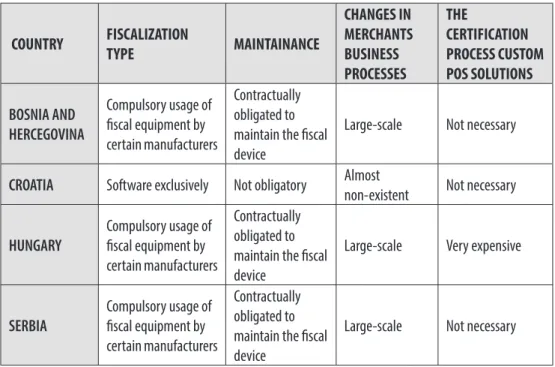
Th e changes in business is what aff ects traders, almost all countries prohibit the negative items on the fi scal account, prohibit products with zero cost, limit possible discounts, abatements and others. When we are talking about the Croatian fi scal law, it is discussed about the law that prescribes only one thing, and that is the ap-plication of the fi scal slot at the state server. In fi scal policy direct comparison it may be said that with the business side and the technical side, the Croatian law is the simplest, and yet the most eff ective and it is shown in Table 1.
Table 1 Fiscalization implementation comparison in the countries bordering with the Republic of Croatian
COUNTRY FISCALIZATION TYPE MAINTAINANCE CHANGES IN MERCHANTS BUSINESS PROCESSES THE CERTIFICATION PROCESS CUSTOM POS SOLUTIONS BOSNIA AND HERCEGOVINA Compulsory usage of fi scal equipment by certain manufacturers Contractually obligated to maintain the fi scal device
Large-scale Not necessary
CROATIA Software exclusively Not obligatory Almost
non-existent Not necessary
HUNGARY Compulsory usage of fi scal equipment by certain manufacturers Contractually obligated to maintain the fi scal device
Large-scale Very expensive
SERBIA Compulsory usage of fi scal equipment by certain manufacturers Contractually obligated to maintain the fi scal device
Large-scale Not necessary
Source: Žališevskij, R; 2012, 18
4. UPGRADING POSSIBILITIES OF THE FISCALISATION MODEL
By entering into force the Law of fi scalization, the taxpayers are forced to adapt existing or in worse case, get a new ICT infrastructure. Th e implementation of the Cloud Computing business changes habits of ICT using. Computing power, stor-age space for data and applications required for usstor-age are used as a service. With this strategy, ICT is accessible to businesses and customers. Also, Cloud Comput-ing is used in other commercial and scientifi c sectors such as marketComput-ing, organiza-tion of conferences, sharing of biomedical materials and others.
4.1. CLOUD COMPUTING
“Cloud Computing is a set of online services designed to provide a variety of computer services. Th e providing of these services is characterized by features: on-demand self-service, network access, resource virtualization, rapid elasticity and scalability, pay as you go.” (Brumec, 2011., 25)
Cloud computing consists of three service models: SaaS (Software as a Service), PaaS (Platform as a Service) and IaaS (Infrastructure as a Service). Services are accessible through standard interfaces such as Internet browsers, SOA (Service-Oriented Architecture) or REST (Representational State Transfer Services).
For the fi scalization implementation, acceptable model is SaaS. Software as a Service, which is sometimes referred to as the Application as a Service (AaaS), and in that version off ers multiple user interface and ready-made software. Applications can be off ered to one or more users simultaneously.
According to the approach the Cloud Computing is categorized on: Public Clouds, Private Clouds, Hybrid Clouds and Academic Clouds.
For the fi scalization purposes Public Cloud is suitable, where it is possible to install the necessary applications for the proper execution of their obligations.
5. FISCALIZATION MODEL BASED ON SAAS
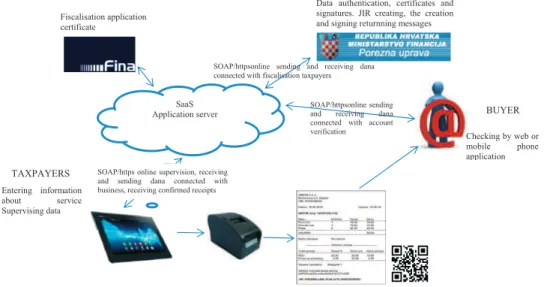
Fiscalization model relying on SaaS is designed as an application that is appli-cable to any device that has a permanent connection to the Internet. Fiscalization taxpayer is obliged to provide a computer, tablet or thin client to input and view data, a device for printing it on paper and a permanent connection to the Internet. Th e number of sets depends on the company size, number of branches and number of workers.
Th e software to manage business data and the process of signing and generation data are maintained in the system of Cloud Computing. Fiscalization taxpayer se-lects those modules as needed and by enterprise functions and pays them by usage. Fiscalization taxpayer by the above mentioned does not have a large initial in-vestment for the purchase of a server, upgrade of the client’s computers, the com-plex network infrastructure and adequate software. Th ere is also no maintenance costs and investments in infrastructure renewal.
Fiscalization taxpayer, in this case, is properly required to fi ll out the applica-tion, sign it and send it to be approved on signing and verifi cation by the tax ad-ministration, and after approval to print out the receipt.
Given that the data is already entered on the remote servers, the Tax Authority, with the certain approvals of fi scal payers and certain fi scal adjustment of legislation
would have access to the transaction. Using agents to search for Tax Administration could sort, fi lter, and compare data fi scalization of taxpayers, assigning the appro-priate JIR and return it signed to taxpayer to allow issuance. Th e access to survey data, is also possible to use any input-output device that has a permanent connec-tion to the Internet, while to check it by the Tax Authority, a major computer server performance is needed.
Th e buyer can validate account by using a web or application on a mobile device using JIR. Th e JIR would be shown in the form of a numeric display and by the QR code to reduce verifi cation time, and the error possibility.
Th e system is shown in Figure 1
Figure 1 Fiscalisation model relying on SaaS
SaaS Application server Fiscalisation application certificate TAXPAYERS Entering information about service Supervising data Checking by web or mobile phone application
SOAP/https online supervision, receiving and sending dana connected with business, receiving confirmed receipts
SOAP/httpsonline sending and receiving dana connected with fiscalisation taxpayers
Data authentication, certificates and signatures. JIR creating, the creation and signing returnning messages
BUYER
SOAP/httpsonline sending and receiving dana connected with account verification
Source: Made by authors (based on our own research)
Level of rights, security and data confi dentiality in the Cloud Computing is de-fi ned by SLA (service-level agreements) contracts. Th e access to applications is pos-sible only through a registered device (MAC address or IMEI) and correspondingly fi scalization taxpayers username and password or the tax administration employees. Protocols that are used to exchange data are SSL, SOAP/HTTPS.
5.1. COST COMPARISON MODEL
Most computers in general, private or business, have a total utilization of be-tween 5% and 20%, but the applications running on these systems sometimes require the maximum that the computer can achieve. In the procurement of hard-ware, one has to take into account precisely these maximums that applications require. Th en, administrators are faced with a situation in which that purchased hardware, in most of the time is not fully used, but it is necessary to obtain it due to working conditions.
Th e optimal procurement according to the above can be defi ned as the engage-ment of computing resources necessary to be paid for its use, without a major capital investment in its own, not enough used resources. Furthermore, in this paper, it will be shown the calculation costs for three diff erent models. For research purposes, authors collected the data from the small and medium enterprises. Ac-cording to the dana, authors selected a system from one computer server, computer network and personal computer. Th e prices from computer network and computer users will not be considered because of the assumption that all systems need the same number of computers with the same characteristics. All prices are without VAT and are prone to change.
Th e average price per server is 8.000,00. Th e computer servers characteristics are one four core CPU, disk space of 500 GB and 4 GB of RAM, with an ad-ditional UPS power safety. Th e average electricity price is 0,65 kn/kWh, and the actual consumption (the server and cooling) is 0,6 kWh. Th e costs of buying and preparing servers are calculated based on 20 hours of administrator work, admin-istrator hourly cost by average is 250,00 kn. Th e system operating costs amounts to 6.500,00 kn.
Th e applications required for business information systems and systems fi scal-ization that would include commodity-material accounting, warehouse manage-ment, wholesale and retail trade, and a one year warranty and maintenance by the three off erings is by average 10.500,00 kn. Th e maintenance after one year is paid by fl at, on average, 200,00 kn/monthly. Th e bidders off er application, also, through monthly rent in the amount of 500,00 kn/monthly. With the application, it is needed to obtain additional licensed databases that by average value amounted to 4.000,00 kn for a pack of 4 licenses.
Th e Cloud Computing infrastructure costs are elastic, which is a great advantage to the business. Th e service is not required to be paid at the time when it not in use.
Th e applications required for business information systems and systems fi scal-ization would consist of commodity-material accounting, warehousing, wholesale and retail. According to the analysis of parts in the existing system that relies on SaaS, it is amounted to 300,00 kn/monthly for the workplace. Given that in the fi rst case and in the second one 4 licenses were selected, in this case will be selected 4 jobs to be worked on in two shifts.
In order to get the total cost it is required to examine 10 categories of infra-structure costs. Categories of costs are: Cost Of Hardware For Intended Useful Life Of 4 Years; Cost Of Electricity For Operation And Cooling; Cost Of Purchasing And Preparing Servers; Th e Costs Of Administering Th e Server; Cost Of Th e OS. Excluded Costs; Cost Of Application; Cost Of Renting Applications; Applications Maintenance; System Renting.
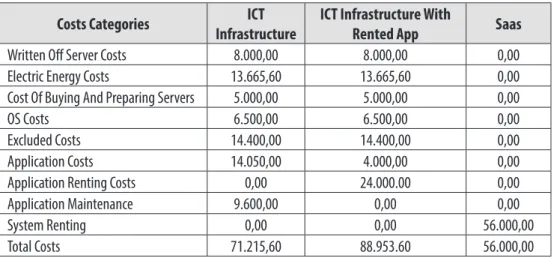
Based on the data, Table 2 is created, where costs are summarized by category in the period of 4 years.
Table 2 Costs of ICT infrastructure in the period of 4 years were analyzed in 10 categories in kuna
Costs Categories ICT Infrastructure
ICT Infrastructure With
Rented App Saas Written Off Server Costs 8.000,00 8.000,00 0,00
Electric Energy Costs 13.665,60 13.665,60 0,00
Cost Of Buying And Preparing Servers 5.000,00 5.000,00 0,00
OS Costs 6.500,00 6.500,00 0,00
Excluded Costs 14.400,00 14.400,00 0,00
Application Costs 14.050,00 4.000,00 0,00
Application Renting Costs 0,00 24.000.00 0,00
Application Maintenance 9.600,00 0,00 0,00
System Renting 0,00 0,00 56.000,00
Total Costs 71.215,60 88.953.60 56.000,00
Source: Made by authors (based on our own research)
In Table 3 and Figure 1 are shown comparative costs through four years of using the system.
Table 3 Th e comparison of total costs over 4 years in kuna
Total Cost 1. year 2. year 3. year 4. year Total Cost ICT infrastructure 26.691,40 21.691,40 11.416,40 11.416,40 71.215,60 ICT infrastructure with rented app. 25.266,40 20.266,40 15.016,40 15.016,40 75.565,60 SaaS 14.000,00 14.000,00 14.000,00 14.000,00 56.000,00 Source: Made by authors (based on our own research)
Graph 1 Th e comparison of total costs over 4 years
Source: Made by authors (based on our own research)
According to the data provided in Tables 2 and 3 and Figure 1 it can be con-cluded that the use of SaaS in the fi rst four years would reduce operating costs for at least 15,000.00 kn and achieve savings of 21,3%. Also, one can see that the biggest savings is made through the fi rst two years, while in the other two years the savings is made by using their own ICT infrastructure. Th erefore it could be concluded that the further use of SaaS will not generate more savings. However, one must take into account that the ICT infrastructure after four years is technologically outdated and needs to be renewed, which would require new investment of the users themselves.
6. CONCLUSION
In this paper is presented a system model to support fi scalization completaly adapted with the needs of taxpayers. Th e characteristics of the existing system are given and deployment capabilities of existing systems. Th e hypothesis H1 which is stating that the implementation of fi scalization process generally reduces the gray economy, is proven. Also, in comparison with other countries that have introduced fi scalization, Croatia is introduced with a simplifi ed system that reduces the prob-lems around implementation of fi scalization and thus proves the hypothesis H2.
Furthermore, the paper presents a model for the implementation of fi scalization based on SaaS with basic characteristics. On the basis of characteristics a compara-tive analysis is made with other existing models. Th e analysis shows that the model based on SaaS reduces the cost to end users and thus proves the hypothesis H3.
It can be concluded that the use of SaaS reduces the cost of micro, small and medium-sized enterprises in fi scalization implementation, but also in other pro-cesses that require the data processing by using ICT.
REFERENCES:
Čerić, V. & Varga, M. (2004) Informacijska tehnologija u poslovanju, Element, Zagreb, Lamza - Maronić, M. & Glavaš, J., & Lepešić, D.(2009.): Poslovni informacijski sus-tavi, Studio HS Internet, Ekonomski fakultet u Osijeku, Osijek
Novak, N. & Cobović, M.(2012) Business improvement using Cloud Computing in companies in the Republic of Croatia, Interdiscplinary Management Research IV, Barković, D. & Runzheimer, B. Osijek
Žališevskij, R (2012) Zakon dobar, vrijeme kratko, Ja trgovac, studeni/prosinac 2012., KunaPak
Available at: http://brumec.com.hr (accessed 15-12-2012)
Available at: http://ccenterclient.porezna-uprava.hr/index.asp (accessed 18-12-2012) Available at: www.infolink.hr/astra-q (accessed 21-02-2013)
Available at: http://www.pupilla.hr/ (accessed (21-02-2013)
Available at: www.hrvatskitelekom.hr/poslovni/ict/poslovna-rjesenja/fi skalizacija (ac-cessed 21-02-2013)
Available at: http://www.hep.hr/ods/kupci/tarifni.aspx (accessed 23-02-2013) Available at: http://www.pentagram.hr/PentaCloud.htm (accessed 23-02-2013)